By Arup Chatterjee — Founder & Go-to-Market Strategist, SuperteamAI
TLDR:
- What It Is: A system of prompts and SOPs to create content that ranks and gets cited by AI. It’s designed to turn content creation into a predictable, data-driven process.
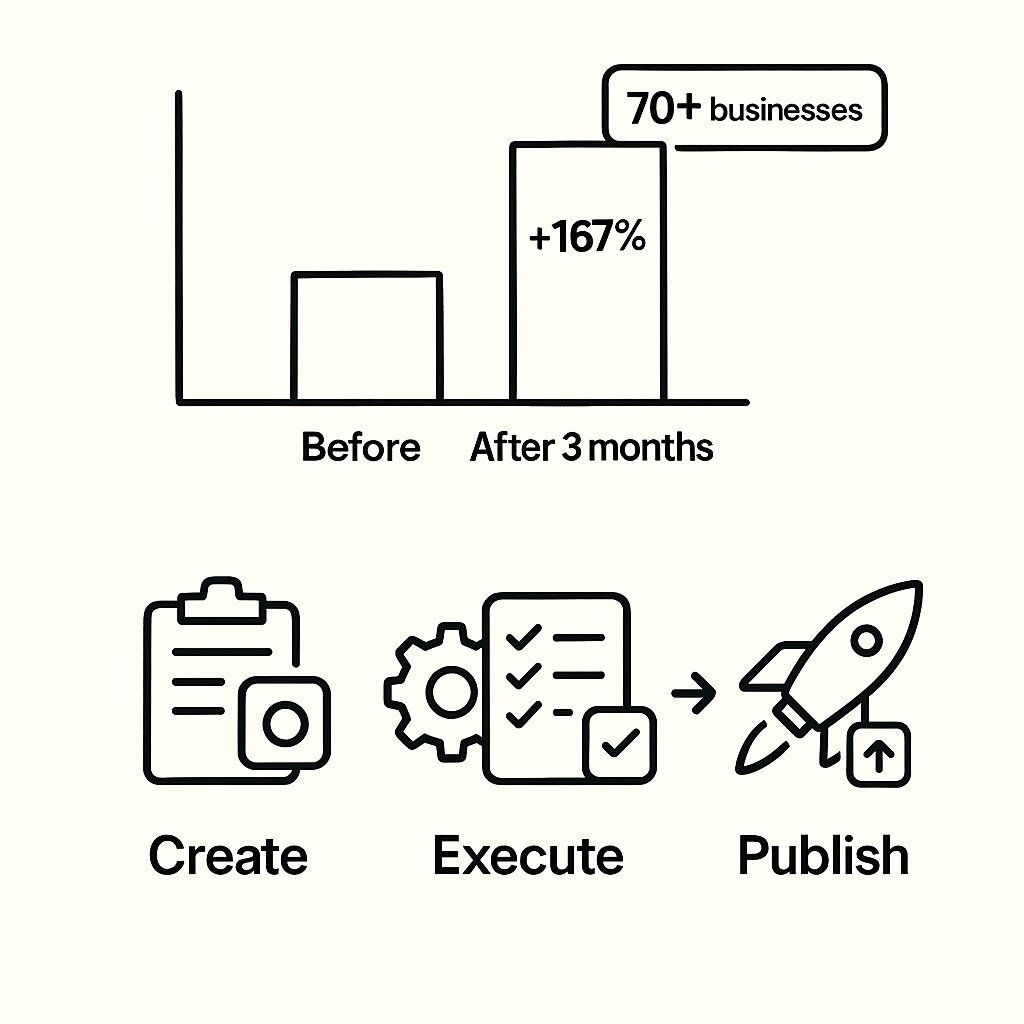
- Proven Results: Created by Arup Chatterjee (Founder, SuperteamAI). It’s the same system that delivered a 167% organic traffic increase for over 70 businesses.
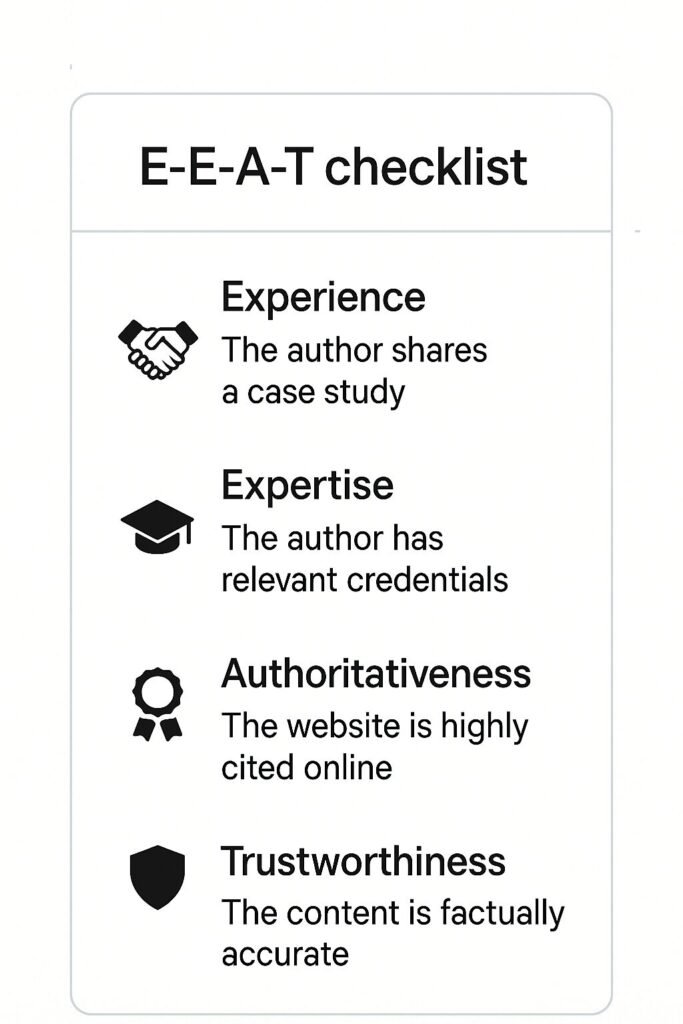
- What’s Inside: Includes prompts for research, writing with “Chain of Density,” and AI optimization. Also covers quality checks (E-E-A-T) and platform-specific tactics.
- How to Use: Simply copy the prompts into ChatGPT, Claude, or Perplexity. Follow the included SOPs to generate content that both humans and AI value.
🎯 Introduction: From Guesswork to Predictable Results
Most teams create content hoping it will rank. I used to do the same—burning thousands on articles that never made it past page two. After personally experiencing millions in operational inefficiencies, I became obsessed with understanding how modern AI engines interpret, retrieve, and cite content.
That obsession led to a repeatable system that produced:
- 167% increase in organic traffic in 3 months
This bundle contains the exact prompts and SOPs we use at SuperteamAI—and with 70+ businesses—to consistently create content that ranks, gets cited in AI systems, and drives measurable revenue.
The goal: turn content from a guessing game into a predictable, data-driven growth engine.
🔧 How to Use This Bundle
Each prompt is engineered with advanced reasoning techniques used by top AI engines. Simply:
- Copy/paste the prompt into ChatGPT, Claude, or Perplexity.
- Follow the instructions in the SOP sections to gather high‑value data.
- Use the resulting insights to produce content that stands out in both search and AI‑generated answers.
📚 Table of Contents
- Research & Ideation SOPs & Prompts
- Content Creation Prompts
- Optimization & Formatting Prompts
- Quality Assurance Prompts
- Platform‑Specific Optimization Prompts
1. Research & Ideation SOPs & Prompts
1.1 SOP: AI Citation Analysis (Human Process)
Objective: Identify how your topic is covered across major AI engines, uncover citation patterns, and find strategic opportunities to create citable, high‑information content.
Tools Needed:
- Perplexity AI (Pro recommended)
- ChatGPT with Search
- Google Search (AI Overviews)
- Claude with Web Search
- Spreadsheet or Notion database
Step‑by‑Step Process
Step 1: Define Your Core Queries
Choose 5–10 core queries that reflect what you want to rank for.
Use a mix of:
- Informational: “what is [topic]”
- How‑to: “how to implement [topic]”
- Comparative: “X vs Y for [topic]”
- Listicle: “best [topic] tools”
Step 2: Analyze Each Platform
Perform each search and document the results.
Perplexity AI
- Check the list of cited URLs.
- Note source types (news, research, blogs).
- Identify how it synthesizes information.
ChatGPT (with Search)
- Review linked sources.
- Note whether it responds in list format, explanation, or narrative.
Google AI Overviews
- Capture the links surfaced.
- Check whether they come from top‑ranking pages.
- Screenshot for later.
Claude.ai
- Note its long‑form reasoning style.
- Identify what sources or studies it prioritizes.
Step 3: Populate Your Data Capture Template
Create a table like:
| Platform | Cited Sources | Source Type | Content Format Cited | Key Entities | Citation Pattern |
| Perplexity | |||||
| ChatGPT | |||||
| Google AI | |||||
| Claude |
Step 4: Synthesize & Find Opportunities
Look for patterns:
- Source Dominance: Are the same 1–2 sites repeatedly cited?
- Missing Content: What questions are never answered?
- Format Bias: Do platforms prefer how‑tos, studies, lists?
- Unique Angle: What can you produce that no one else is creating?
Step 5: Create Your Content Strategy
Define:
- Your primary platform target
- Your Information‑Gain angle
- Your ideal content format
- Your “Earned Media” plan—how to make your content citable
1.2 Prompt: Information Gap Analyzer
ROLE:
You are a Generative Engine Optimization (GEO) strategist and expert content analyst. Your specialty is identifying “Information Gain” opportunities—gaps in existing content that AI engines cannot fill with their current training data.
CONTEXT:
I am creating content about the topic: [INSERT YOUR TOPIC HERE]. I need to find a unique angle that provides new, citable value to both humans and AI retrieval systems.
TASK:
Analyze the top 10 ranking articles for “[INSERT YOUR TOPIC HERE]” on Google. I will provide you with the titles and brief summaries of these articles.
YOUR PROCESS:
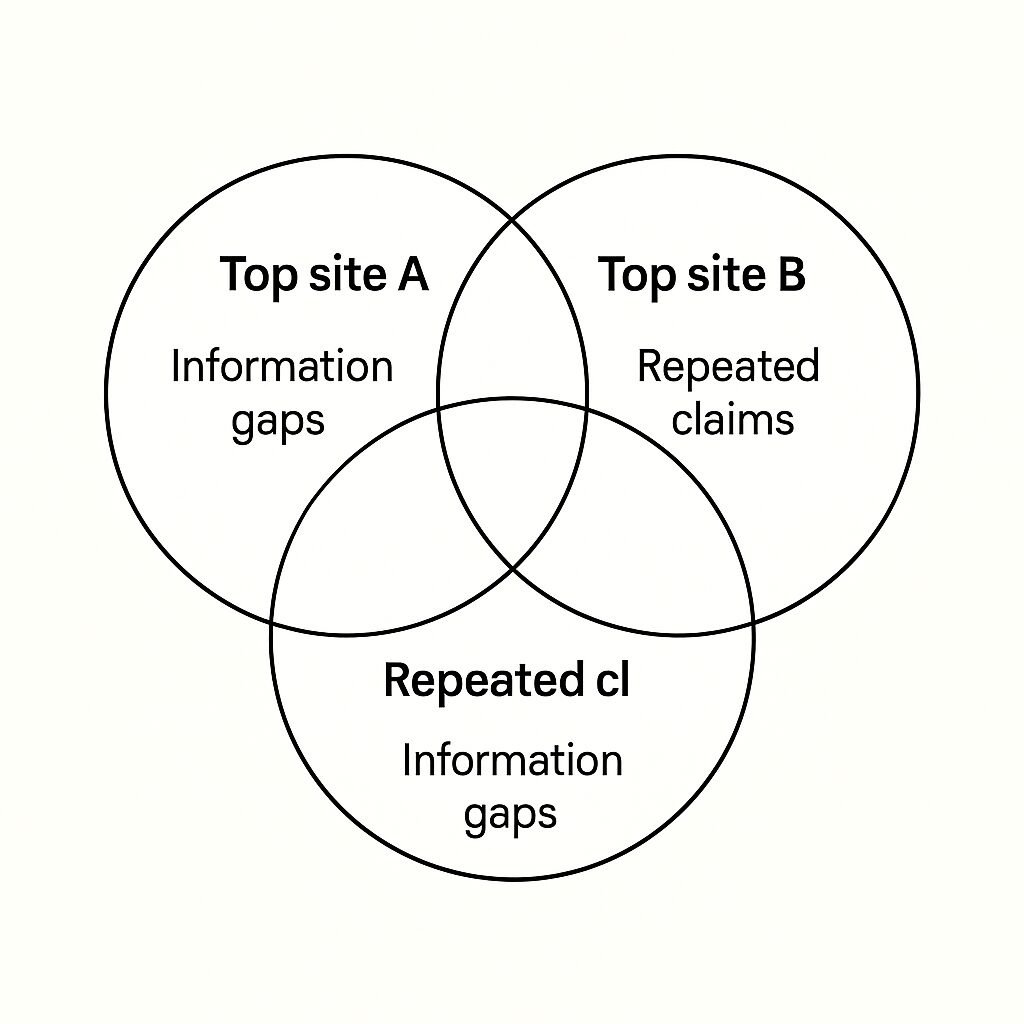
1. **Synthesize Common Claims:** First, identify the 5-7 most common claims, pieces of advice, or “consensus opinions” shared across the provided articles. These represent the “low information gain” zone.
2. **Identify Data Overlap:** Pinpoint any specific statistics, studies, or data points that appear in multiple sources. This indicates overused information.
3. **Detect Contradictions:** Find any direct contradictions or conflicting advice between the articles. These are areas of uncertainty that AI models struggle with.
4. **Uncover Unanswered Questions:** Based on the common claims and contradictions, formulate 3-5 critical questions that a reader would still have after reading all 10 articles. These are your information gaps.
5. **Generate High-Information-Gain Topics:** Based on the unanswered questions and contradictions, propose 5 specific, high-value content topics. Each topic should be designed to provide a definitive answer, new data, or a unique framework that resolves a contradiction.
CONSTRAINTS:
– Do not suggest generic topics like “Ultimate Guide to X” or “10 Tips for X.”
– Focus on topics that require original research, unique case studies, or a contrarian viewpoint.
– For each topic, briefly explain *why* it provides high Information Gain.
OUTPUT FORMAT:
Present your analysis in the following markdown structure:
### Common Claims (Low Information Gain)
– [Claim 1]
– [Claim 2]
– …
### Data Overlap
– [Data Point 1]: Found in sources [A, B, C]
– …
### Contradictions & Uncertainties
– **Contradiction 1:** [Source A] says X, while [Source B] says Y.
– …
### Unanswered Questions (Information Gaps)
1. [Question 1]
2. [Question 2]
– …
### High-Information-Gain Content Topics
1. **Topic Title:** [Proposed Title]
* **Why it Provides Information Gain:** [Explanation]
2. **Topic Title:** [Proposed Title]
* **Why it Provides Information Gain:** [Explanation]
– …
Now, please begin the analysis.
Our Insiders will get exclusive access to our AI workforces as we reopen signups
Join our free AI Insider newsletter that keeps you updated on our free agents and also our AI strategies that we build for you to use.
2. Content Creation Prompts
2.1 Prompt: Chain of Density Content Architect
ROLE:
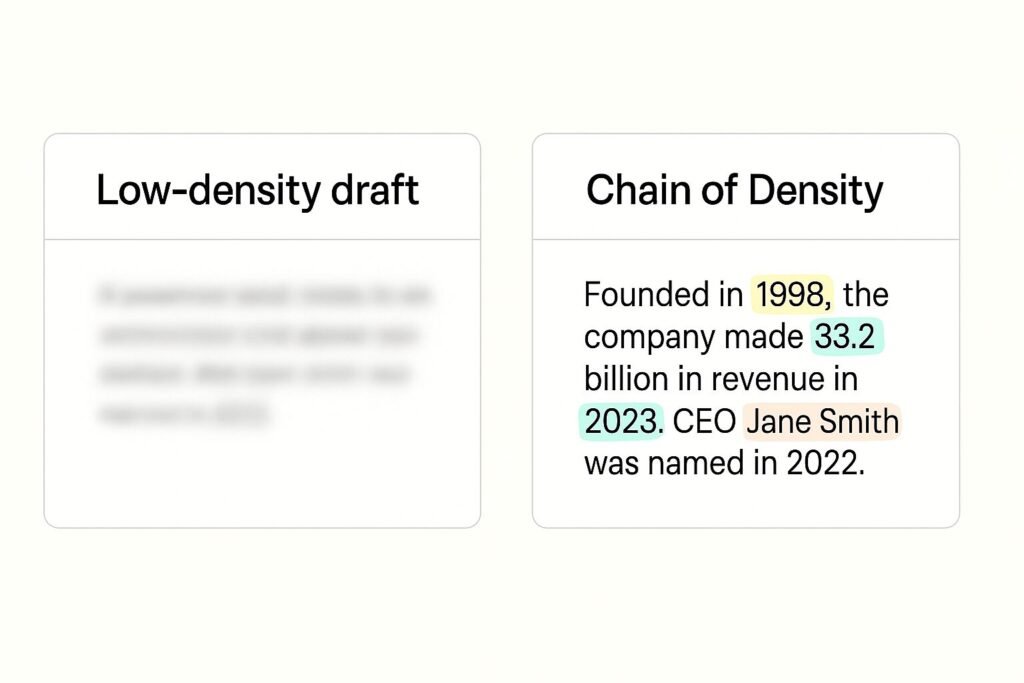
You are an expert content writer and information architect, specializing in the “Chain of Density” technique for Generative Engine Optimization (GEO). Your primary goal is to transform information-dense concepts into clear, concise, and entity-rich content that AI retrieval systems can easily understand and cite.
CONTEXT:
I need to write a section of a blog post about [INSERT YOUR SUBTOPIC HERE]. The goal is to convey maximum value in minimum space, packing it with specific, verifiable entities (data, names, metrics, dates).
TASK:
I will provide you with a low-density draft. Your task is to rewrite it using the Chain of Density methodology.
LOW-DENSITY DRAFT:
[PASTE YOUR LOW-DENSITY DRAFT HERE]
YOUR REWRITING PROCESS:
1. **Deconstruct and Identify Vague Terms:** Read the draft and list all vague, non-specific terms (e.g., “many businesses,” “significant improvement,” “recent study,” “experts say”).
2. **Brainstorm Entity Replacements:** For each vague term, brainstorm specific entities to replace it.
* “many businesses” -> “67% of B2B SaaS companies” (requires a source)
* “significant improvement” -> “a 300% increase in qualified leads”
* “recent study” -> “a 2024 Gartner report”
* “experts say” -> “according to Dr. Jane Doe, lead AI researcher at MIT”
3. **Rewrite Sentence by Sentence:** Go through the draft and rewrite each sentence, injecting the specific entities you’ve identified.
4. **Calculate Entity-to-Word Ratio:** After rewriting, perform a quick calculation. Count the number of specific entities (proper nouns, dates, specific metrics, named organizations) and divide by the total word count. Aim for a ratio of at least 1:15.
5. **Final Polish:** Read the rewritten content aloud to ensure it flows naturally and is not robotic. The goal is density, not unreadability.
CONSTRAINTS:
– You must maintain the original meaning and core message of the draft.
– All added data and entities must be plausible. If you need to invent a source, mark it clearly with `[SOURCE NEEDED]`.
– The final output must be easily readable by a human.
– Focus on adding *concrete* information, not just more adjectives.
OUTPUT FORMAT:
Provide your response in two parts:
1. **Analysis & Brainstorming:** Show your work from steps 1 and 2.
2. **Final High-Density Rewrite:** The complete, rewritten text.
Now, please begin the process.
3. Optimization & Formatting Prompts
3.1 Prompt: GEO Structure & Fraggle Optimizer
ROLE:
You are a Generative Engine Optimization (GEO) technical specialist. Your expertise lies in structuring content to maximize its chances of being retrieved and cited by AI systems, particularly through the creation of “Fraggles” (perfect, self-contained answer fragments).
CONTEXT:
I have a draft of a blog section that needs to be optimized for AI retrieval. The goal is to make it easy for an AI system to find a direct, citable answer within the text.
TASK:
Optimize the following content section for maximum AI retrieval potential.
CONTENT TO OPTIMIZE:
[PASTE YOUR CONTENT SECTION HERE]
YOUR OPTIMIZATION PROCESS:
1. **Identify the Core Question:** Read the section and determine the primary question it is answering (usually implied by the H2 or H3 heading). State this question explicitly.
2. **Extract the Direct Answer:** Find the most direct, concise answer to that question within the text. This answer should be a declarative statement.
3. **Craft the “Fraggle” (40-60 Word Block):** Rewrite the direct answer into a self-contained paragraph of 40-60 words. This paragraph must be able to stand alone and still make perfect sense. It should be the first paragraph under the heading.
4. **Structure the Remainder:** Organize the rest of the content in the following order:
* **Context and Nuance:** 1-2 sentences that explain the “why” behind the direct answer.
* **Data and Evidence:** A bulleted list of specific statistics, examples, or expert quotes that support the direct answer.
* **Conversational Closing:** 1-2 sentences that summarize the point or bridge to the next section.
5. **Implement Contextual Anchors:** Review the entire section. Ensure that any pronouns (like “it,” “they,” “this”) have clear antecedents. Replace vague references with specific entity names where necessary to prevent context loss if the content is “chunked” by an AI.
CONSTRAINTS:
– The “Fraggle” must be between 40 and 60 words.
– The final structure must be: Fraggle -> Context -> Evidence -> Closing.
– Do not add new information; restructure and refine the existing text.
– Ensure all key entities are mentioned clearly and not hidden in pronouns.
OUTPUT FORMAT:
Present your analysis and the optimized content using this markdown structure:
### 1. Core Question Identified
[The question the section answers]
### 2. Original Direct Answer (Before)
[Quote the original direct answer if it exists]
### 3. Optimized Content
#### **Fraggle (The Direct Answer)**
[Your 40-60 word direct answer paragraph]
#### Context and Nuance
[Your 1-2 sentences of context]
#### Data and Evidence
– [Bullet point 1]
– [Bullet point 2]
– …
#### Conversational Closing
[Your 1-2 sentence closing]
### 4. Contextual Anchoring Changes
– [Change 1]: e.g., “Replaced ‘The company’ with ‘SuperteamAI’ in paragraph 3.”
– [Change 2]: …
Now, please begin the optimization.
Our Insiders will get exclusive access to our AI workforces as we reopen signups
Join our free AI Insider newsletter that keeps you updated on our free agents and also our AI strategies that we build for you to use.
4. Quality Assurance Prompts
4.1 Prompt: E‑E‑A‑T & Information Gain Validator
ROLE:
You are an expert content quality auditor, specializing in Google’s E-E-A-T guidelines (Experience, Expertise, Authoritativeness, Trustworthiness) and the concept of “Information Gain” for Generative Engine Optimization (GEO). Your job is to ruthlessly evaluate content and provide actionable feedback for improvement.
CONTEXT:
I need you to audit a piece of content to ensure it meets the highest standards for both human readers and AI systems. The content is about [INSERT TOPIC], and the author is [INSERT AUTHOR NAME/ROLE].
TASK:
Perform a comprehensive audit of the following content based on E-E-A-T and Information Gain principles.
CONTENT TO AUDIT:
[PASTE YOUR CONTENT HERE]
YOUR AUDIT PROCESS:
1. **E-E-A-T Assessment:** Rate each component on a scale of 1-10 and provide specific evidence from the text for your rating.
* **Experience:** Does the content demonstrate first-hand or personal experience? Look for phrases like “In our experience,” “We tested,” “I personally saw,” case studies, original photos.
* **Expertise:** Does the author demonstrate deep knowledge of the subject? Look for credentials, detailed explanations, accurate terminology, and citations to expert sources.
* **Authoritativeness:** Is the author or website a recognized go-to source? (This may require external knowledge, but assess the signals *within* the content, like “As featured in…” or awards).
* **Trustworthiness:** Is the content accurate, transparent, and credible? Look for sourcing of data, clear author bios, contact information, and a balanced perspective.
2. **Information Gain Assessment:** Rate the content’s ability to provide new, unique information on a scale of 1-10.
* **Originality:** Does it offer a new perspective, data, or framework not found elsewhere?
* **Specificity:** Is it filled with concrete data, examples, and entities, or is it vague?
* **Synthesis vs. Summary:** Does it synthesize information into a new insight, or does it just summarize what others have said?
3. **Actionable Improvement Plan:** Based on your analysis, provide a numbered list of specific, actionable changes to improve the content. For each suggestion, explain *why* it will boost the E-E-A-T or Information Gain score.
CONSTRAINTS:
– Be critical and specific. Generic feedback like “add more detail” is not helpful.
– Your suggestions must be practical and directly related to the text provided.
– Focus on changes that will have the biggest impact.
OUTPUT FORMAT:
Use the following markdown structure for your report:
## E-E-A-T Assessment
### Experience: [Score]/10
**Evidence from Text:** [Quote specific examples or explain the lack thereof]
**Rating Justification:** [Explain your score]
### Expertise: [Score]/10
**Evidence from Text:** [Quote specific examples or explain the lack thereof]
**Rating Justification:** [Explain your score]
### Authoritativeness: [Score]/10
**Evidence from Text:** [Quote specific examples or explain the lack thereof]
**Rating Justification:** [Explain your score]
### Trustworthiness: [Score]/10
**Evidence from Text:** [Quote specific examples or explain the lack thereof]
**Rating Justification:** [Explain your score]
## Information Gain Assessment: [Score]/10
**Originality Analysis:** [Your analysis]
**Specificity Analysis:** [Your analysis]
**Synthesis vs. Summary Analysis:** [Your analysis]
## Actionable Improvement Plan
1. **[Suggestion Title]:** [Detailed, actionable suggestion]. *Why this helps: [Explain the impact on E-E-A-T or Information Gain].*
2. **[Suggestion Title]:** [Detailed, actionable suggestion]. *Why this helps: [Explain the impact].*
…
Now, please begin the audit.
5. Platform‑Specific Optimization Prompts
5.1 Prompt: Perplexity Citation Specialist
ROLE:
You are a content optimization specialist focused exclusively on maximizing citation potential in Perplexity AI. You understand that Perplexity’s algorithm heavily favors factual accuracy, recent data, and content that can be verified by third-party “Earned Media” sources.
CONTEXT:
I have a piece of content that I want to optimize to increase its chances of being cited by Perplexity AI. The content is about [INSERT TOPIC].
TASK:
Rewrite and enhance the following content to align perfectly with Perplexity’s citation preferences.
CONTENT TO OPTIMIZE:
[PASTE YOUR CONTENT HERE]
YOUR OPTIMIZATION PROCESS:
1. **Factual Grounding:** Scan the text for any claims that could be perceived as marketing fluff, opinions without basis, or unverified assertions. Rewrite these statements to be more factual and evidence-based.
2. **Source Integration:** Identify every key claim, statistic, or data point. For each one, either:
* Add a direct, inline citation to a reputable source (e.g., “According to a 2024 study by Stanford HAI…”).
* If it’s proprietary data, frame it transparently (e.g., “In an analysis of 1,000 of our customers, SuperteamAI found that…”).
3. **Recency Check:** Ensure all data points and studies mentioned are as recent as possible. Replace any data older than 2 years with more current figures, or add a qualifier like “As of 2023…”
4. **Third-Person Perspective:** Shift the tone from a promotional “we/our” perspective to a more objective, journalistic third-person perspective where appropriate. This mimics the tone of the sources Perplexity trusts.
5. **”Earned Media” Angle:** Add a section or a sentence that references how this topic has been covered by reputable external sources (e.g., “This trend has been widely reported in publications like TechCrunch and Forbes, highlighting…”). This signals alignment with trusted media.
CONSTRAINTS:
– The primary goal is citation, not conversion. Avoid overly promotional language.
– All added sources must be real and reputable.
– The content must remain engaging and valuable to a human reader.
– Maintain the core message but enhance its credibility.
OUTPUT FORMAT:
Provide the fully rewritten and optimized content. After the content, include a brief “Rationale for Changes” section explaining the top 3 most significant changes you made and why they specifically target Perplexity’s algorithm.
Now, please begin the optimization.
🚀 Implementation Guide & Next Steps
You now have the same system we deploy inside SuperteamAI’s AI Workforces. Use these prompts consistently and you’ll see measurable improvements in ranking, citations, and output quality.
Track Your Results
Use this simple framework:
| Metric | Before | After 30 Days | After 90 Days |
| AI Citation Rate | |||
| Organic Traffic | |||
| Keyword Rankings | |||
| Engagement (Time on Page) |
Ready to Automate and Improve your Business with AI?
Our Insiders will get exclusive access to our AI workforces as we reopen signups
Join our free AI Insider newsletter that keeps you updated on our free agents and also our AI strategies that we build for you to use.
About the Author
Arup Chatterjee is the Founder and Go-to-Market Strategist at SuperteamAI, where he helps businesses build AI workforces that operate at 77% of traditional costs while executing 300% faster. After personally burning millions on operational inefficiencies, he pioneered the AI workforce automation approach now used by 70+ growing businesses. His expertise spans AI product management, context engineering, and go-to-market strategy for AI-first companies.
About SuperteamAI
SuperteamAI builds autonomous AI Agent Workforces that execute operation-heavy departmental tasks with 85%+ accuracy, delivering the output of an entire team for less than 50% of the cost of a single junior employee. Our AI SEO Workforce has helped businesses generate millions in organic traffic while eliminating the need for content agencies and in-house writing teams.