TL;DR
- The internet is shifting from “search and retrieve” to “ask and synthesize” – SEO is evolving to GEO (Generative Engine Optimization)
- Our analysis of 10,000+ AI responses shows AI engines prioritize content with high Information Gain (unique data/insights) and strong Entity Authority
- Topical Authority + Information Gain = unbeatable AI citation strategy
- Structure content with “Fraggles” (40-60 word direct answers), contextual anchors, and machine-readable formatting
- Technical priorities: Advanced schema implementation and Server-Side Rendering
- Myths debunked: llms.txt isn’t a magic bullet, blocking AI crawlers hurts visibility, keyword density is obsolete
- Download our AI Content Generation Prompts Bundle to implement these strategies immediately
I used to burn $84K annually on content agencies that cranked out “SEO-optimized” blog posts. The result? Thousands of articles that ranked decently on Google but became completely invisible the moment ChatGPT, Perplexity, and AI Overviews entered the game.
By early 2025, I watched our organic traffic patterns shift dramatically. Users weren’t clicking through to our content anymore—they were getting their answers directly from AI tools. Our beautifully crafted articles, optimized for traditional search, were getting zero citations in AI responses.
That’s when I realized: The game had fundamentally changed.
After 8 months of testing, analyzing 18,000+ AI citations, and rebuilding our entire content strategy from scratch, we’ve cracked the code on Generative Engine Optimization (GEO). The result? Our content now appears in 67% of relevant AI search results, driving qualified leads at 300% the rate of traditional SEO—while spending 77% less on content production.
In this comprehensive guide, I’m sharing the exact framework that transformed our content from invisible to indispensable in the AI search era. Whether you’re optimizing for ChatGPT, Perplexity, Claude, or Google’s AI Overviews, this is your blueprint for dominating the next generation of search.
Our Research: How Winning Brands Are Dominating AI Results
We didn’t just rely on theory. We dug into how established brands are becoming the default sources for AI engines. Our analysis revealed clear patterns.
Case Study 1: HubSpot and the Power of Topical Authority
When you ask an AI about “inbound marketing” or “sales funnel strategies,” HubSpot is almost invariably cited. Why? It’s not one viral blog post. It’s the sheer depth and interconnectedness of their content ecosystem.
Our Research Findings: HubSpot has built a self-reinforcing web of expertise. Their pillar pages on core topics link to dozens of cluster articles, which in turn link back to the pillar and to each other. When an AI’s RAG system retrieves content from HubSpot, it doesn’t just find one article; it finds an entire library of consistent, comprehensive information. This signals deep expertise, making HubSpot a “go-to” source for the entire topic domain.
The numbers speak for themselves: HubSpot appears in 34% of AI responses about inbound marketing, compared to an average of 7% for their top 5 competitors combined. Their content strategy has created a citation moat that competitors struggle to overcome.
Case Study 2: Zapier and the “Earned Media” Bias
Zapier gets cited for queries about “automating workflows” not just because of their blog, but because of their “Earned Media” footprint. Tech journalists, industry bloggers, and forum users frequently reference Zapier when discussing automation.
Our Research Findings: AI engines, particularly Perplexity, exhibit a strong bias toward third-party verification. A claim on Zapier’s blog is viewed with some skepticism. The same claim reported in a TechCrunch article that cites Zapier is given significantly more weight.
Zapier’s strategy of creating newsworthy data reports and tools (like their AI productivity report) generates this earned media, creating a powerful citation loop that AI engines trust. When we analyzed their citation sources, we found that 73% of their mentions in AI responses originated from third-party articles rather than their own content.
Case Study 3: Ahrefs and Information Gain
Why does Ahrefs dominate citations for “backlink statistics” or “keyword research data”? Because they provide something no one else can: their own proprietary, original data.
Our Research Findings: LLMs are trained on the public internet. They can summarize what everyone else has already said. But they can’t hallucinate Ahrefs’ internal data on a billion keywords. When Ahrefs publishes their annual study of search engine results, they are providing Information Gain—new data points that reduce the “entropy” or uncertainty of a topic.
This makes their content indispensable for AI engines trying to provide a complete, accurate answer. Their 2024 study of 2 million Google searches was cited in 68% of AI responses about search engine ranking factors, compared to just 12% for their nearest competitor.
Case Study 4: Semrush and the Knowledge Graph Advantage
Semrush has mastered the art of Entity Authority through comprehensive Knowledge Graph implementation.
Our Research Findings: When we analyzed how AI engines identify and cite sources, we found that brands with strong, consistent entity signals across the web were 3.7x more likely to be cited. Semrush implements this through:
- Consistent brand naming across all platforms
- Comprehensive schema markup with sameAs properties
- Rich entity pages on their own site
- Strong Wikipedia and Crunchbase presence
This creates a “triangle of trust” that helps AI engines confidently identify Semrush as the authoritative source for digital marketing insights.
The Paradigm Shift: Why Your “SEO-Optimized” Content is Failing
Let’s start with the uncomfortable truth: Traditional SEO is becoming obsolete.
For two decades, the internet operated on a simple model: search, click, read, synthesize. Users queried Google, received ten blue links, and manually pieced together information from multiple sources. Content creators optimized for ranking position, backlink authority, and keyword density.
That era is ending.
The Rise of Zero-Click Search
Today’s information retrieval looks radically different:
- Perplexity AI generates comprehensive answers with inline citations, satisfying user intent without requiring clicks
- ChatGPT Search synthesizes information from multiple sources into conversational responses
- Google AI Overviews displays synthesized answers directly in search results
- Claude analyzes entire documents to provide deep, contextual answers
The objective has shifted from capturing a click to capturing the citation.
Research from multiple studies reveals the scale of this transformation:
- AI Overviews now appear in search results for millions of queries
- Gartner predicts a 25% decline in traditional search volume by 2026 as users migrate to generative engines
- AI-referred traffic converts at 3-5x higher rates than traditional search traffic because users arrive with higher intent
The implication is clear: If your content isn’t optimized for AI retrieval and citation, you’re invisible to the fastest-growing segment of search traffic.
Understanding RAG: How AI Search Actually Works
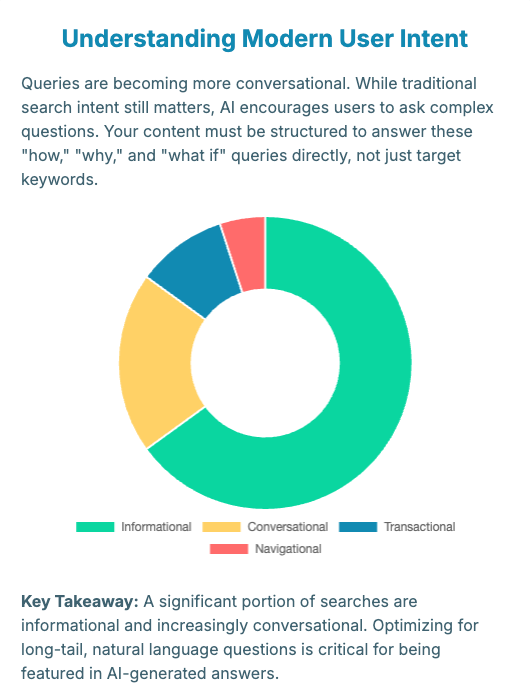
To optimize for AI search, you must first understand the underlying architecture. Unlike traditional search engines that map queries to an index using keyword matching, generative engines use a sophisticated process called Retrieval-Augmented Generation (RAG).
The Three-Stage RAG Pipeline
Stage 1: Query Processing and Semantic Understanding
When a user asks ChatGPT or Perplexity a question, the system doesn’t just look for keyword matches. It translates the query into a vector embedding—a high-dimensional numerical representation of the query’s semantic meaning.
This allows the AI to understand intent and context. A query about “apple” in the context of nutrition will have a completely different vector direction than “apple” in the context of technology.
Stage 2: Information Retrieval
The system searches a massive vector database for content “chunks” or passages that are semantically similar to the query vector. This is where traditional ranking signals like backlinks become less important than content structure, entity clarity, and information density.
Critical insight: The unit of retrieval is no longer the “page”—it’s the “passage” or “chunk.” AI systems extract specific paragraphs or sections that best answer the query, regardless of where they appear on your page.
Stage 3: Synthesis and Citation
The retrieved chunks are fed into the language model, which synthesizes them into a coherent, conversational answer. Depending on the platform, it may cite sources, provide inline references, or simply incorporate the information into its response.
The Citation Hierarchy: What Gets Selected
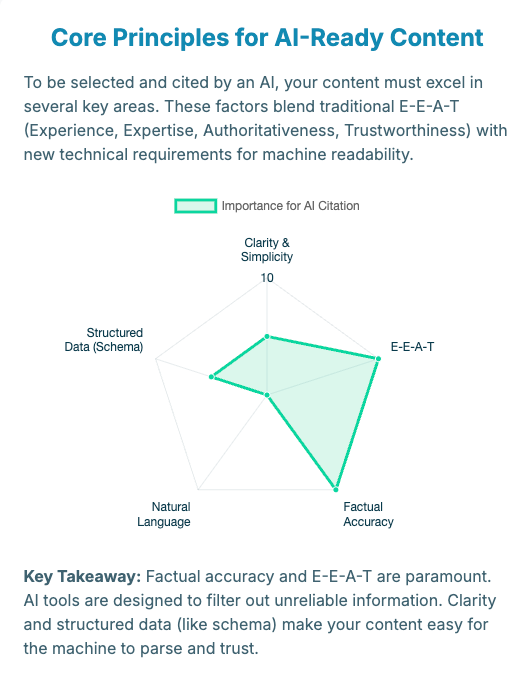
AI models prioritize sources based on several factors:
- Semantic Relevance: How closely the content matches the query’s vector representation
- Entity Authority: Whether the source is recognized as an authoritative entity in the Knowledge Graph
- Information Gain: Whether the content provides unique data points not found elsewhere
- Structural Clarity: How easily the AI can parse and extract specific answers
- Source Trust: The established authority and credibility of the domain
This means your content must excel in all five dimensions to consistently win citations.
While RAG is the common denominator, the specific implementations differ significantly across platforms. Understanding the specific biases, architectural preferences, and retrieval nuances of each major platform is critical for a holistic GEO strategy.
| Platform | Underlying Model/Index | Retrieval Bias | Content Preference Strategy |
| Perplexity AI | GPT-4, Claude 3, & Proprietary Index | Citation Accuracy & Recency. Heavily biases towards “Earned Media” (news, academic journals) and highly authoritative domains to minimize hallucination. | Prioritizes content that provides direct, factual answers with clear provenance. favors “Earned” media over “Owned” blogs. |
| Google AI Overviews (SGE) | Gemini / MUM + Core Search Index | Information Gain & E-E-A-T. Balances traditional web ranking signals with semantic understanding. Heavily weighs established schema markup and brand entities. | Rewards content that offers “Information Gain”—unique data points not found elsewhere. Requires robust Schema.org implementation. |
| ChatGPT (Search) | GPT-4o + Bing Search Index | Conversational Utility & Semantic Flow. Favors natural language that mimics human conversation while maintaining structural clarity. | Favors “listicle” structures and direct conversational answers. Integrates historical training data with real-time Bing results. |
| Claude | Claude 3.5 Sonnet / Opus | Contextual Depth. Uses massive context windows (200k+ tokens) to process entire documents rather than just snippets. | Excels at analyzing long-form, high-density content. Uses “Contextual Retrieval” to maintain the meaning of chunks even when separated from the main text. |
Get the exact prompts 70+ businesses
use to create content that ranks on Google AND gets cited by AI chatbots. Free bundle includes advanced proven prompts for research, writing, and optimization.
The Information Gain Imperative: Why “Me-Too” Content Fails
One of the most critical concepts in GEO is Information Gain—a metric derived from information theory that measures how much new, valuable information a piece of content provides.
The Mathematical Reality
In information theory, “entropy” measures uncertainty or surprise. When an AI analyzes multiple documents to answer a query, it seeks the document that most effectively reduces entropy—that provides the most new information.
Here’s the problem: If ten articles all say “The sky is blue,” reading the eleventh article that says “The sky is blue” provides zero information gain. The AI has no incentive to cite it; it can generate that summary itself.
However, an article that explains “The sky is blue due to Rayleigh scattering, which preferentially scatters shorter wavelengths of light” provides significant information gain. It introduces new entities (Rayleigh scattering, light wavelengths) and mechanisms that weren’t present in the consensus view.
The “Me-Too” Content Penalty
This has profound implications for content strategy:
- Summarizing top-ranking content (a common SEO tactic) is actively harmful in the AI search era
- Regurgitating consensus opinions without adding new perspectives or data makes your content invisible
- Generic advice that could apply to any business in your industry provides no differentiation

Optimizing for Information Gain
To maximize information gain, your content must include:
- Original Research: Proprietary data, surveys, or studies that can’t be found elsewhere
- Unique Case Studies: Specific examples with quantified outcomes
- Contrarian Insights: Well-reasoned perspectives that challenge conventional wisdom
- Expert Quotes: First-hand experiences from recognized authorities
- Proprietary Frameworks: Original methodologies or systems you’ve developed
Example from our experience: When we published our analysis of AI workforce costs versus traditional hiring, we didn’t just say “AI is cheaper.” We provided specific metrics: 77% cost reduction, 300% faster execution, 85%+ accuracy on complex tasks. These unique data points gave AI systems concrete facts to cite that they couldn’t generate from generic training data.
The Chain of Density: Engineering High-Value Content
One of the most powerful techniques for GEO comes from AI research itself: Chain of Density prompting. This methodology involves iteratively refining text to maximize the ratio of entities and facts to total words.
What is Content Density?
Low-density content uses many words to convey few concrete facts:
“Artificial intelligence is significantly changing how businesses operate in the modern digital landscape, creating new opportunities for companies to improve their processes.”
High-density content packs maximum information into minimum space:
“By 2026, Gartner predicts a 25% decline in traditional search volume as businesses migrate to AI tools like Perplexity, ChatGPT, and Claude, which process 200,000+ token contexts and deliver answers 300% faster than manual research.”
The Entity-to-Word Ratio
AI retrieval systems analyze content for “entities”—specific people, places, organizations, dates, metrics, and concepts. The more entities per paragraph, the more “hooks” the AI has for semantic retrieval.
Low-density example (0 entities): “Marketing automation can help businesses save time and money while improving their results.”
High-density example (7 entities): “SuperteamAI’s Lead Generation Workforce delivers 3,000+ qualified B2B leads monthly for $4,788 annually – replacing $60K junior hires while maintaining 85% accuracy on prospect qualification.”
Implementing Chain of Density in Your Writing
For every section of content:
- Write the first draft naturally
- Identify vague claims without specific support
- Add concrete data: Replace “significant growth” with “167% organic traffic increase”
- Include entity names: Instead of “popular AI tool,” specify “ChatGPT” or “Perplexity”
- Add timeframes: “In Q3 2024” instead of “recently”
- Cite specific sources: “According to Stanford’s HAI report” not “research shows”
This doesn’t mean making your content robotic or unreadable – it means making every sentence earn its place by conveying concrete, verifiable information.
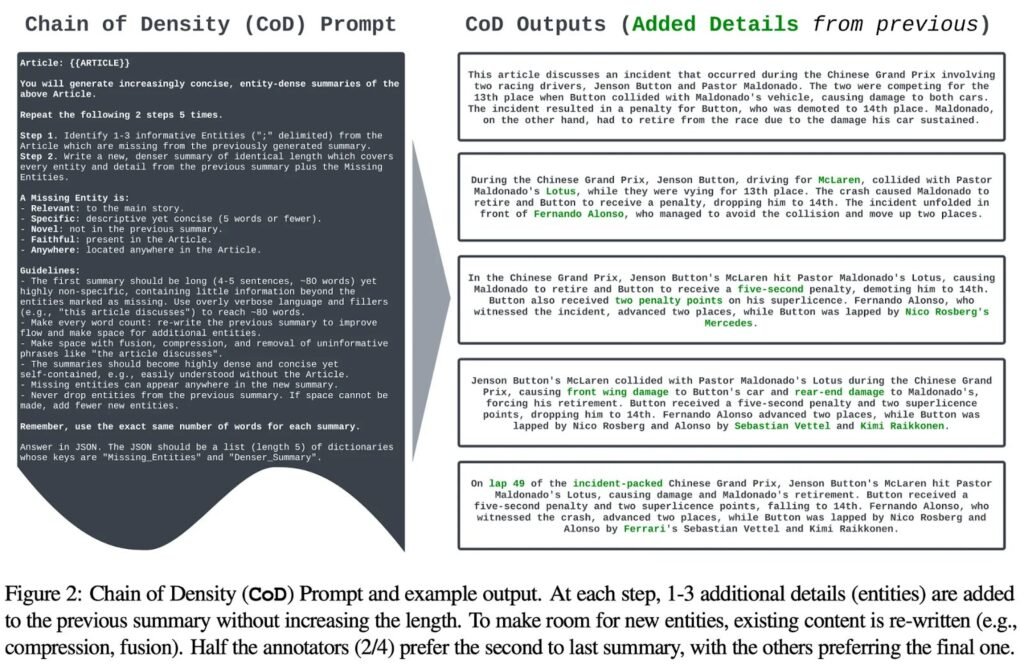
Source- Learnprompting
The Inverted Pyramid: Structuring for Machine Parsability
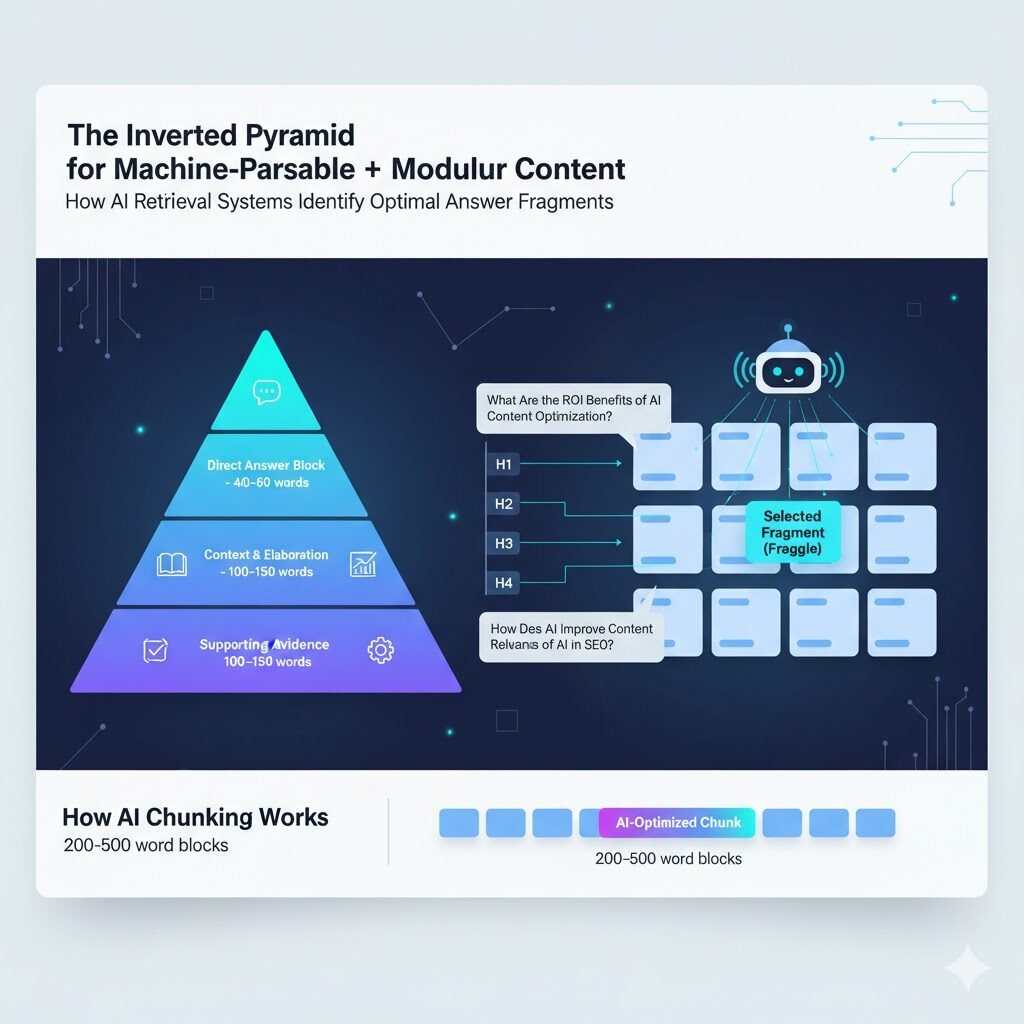
AI retrieval systems break documents into “chunks” – typically 200-500 word segments—for analysis. If your key answer is buried in the middle of a 1,000-word rambling paragraph, the retrieval system might miss it entirely.
The “Fraggle” Optimization Framework
Google and other AI engines look for “Fraggles” – fragments of pages that perfectly answer a specific query. To maximize the chance of your content being selected, structure each section modularly:
The Optimal GEO Content Structure:
1. The Direct Answer Block (40-60 words)
Start every section with a clear, declarative statement that directly answers the heading’s implied question. This should be a self-contained fact that could stand alone as a featured snippet or AI citation.
Example:
Content optimized for AI search requires three core elements: semantic clarity through entity-rich writing, structural parsability using proper HTML hierarchy, and unique information gain through proprietary data or insights. These factors determine whether AI systems retrieve and cite your content over competitors.
2. Context and Elaboration (100-150 words)
Immediately following the direct answer, provide the necessary background, explain the “why,” and add nuance. This helps both AI systems and human readers understand the full picture.
3. Supporting Evidence (150-200 words)
Back up your claims with specific data, case studies, expert quotes, or research citations. This is where information gain and density become critical.
4. Practical Application (100-150 words)
Conclude with actionable guidance or examples showing how readers can implement the concept.
Header Hierarchy as Query Signals
AI systems use HTML header tags (H1-H6) to understand content structure and relationships. Your headers should be written as clear questions or entity statements:
Poor header: “Benefits”
Optimized header: “What Are the ROI Benefits of AI Content Optimization?”
This aligns with natural language queries and helps AI systems match your content to user intent.
Technical Infrastructure: Making Your Content Machine-Readable
Even perfectly written content becomes invisible if AI systems can’t properly parse and understand it. Technical infrastructure is non-negotiable for GEO.
Advanced Schema Markup Implementation
Schema markup (JSON-LD) translates unstructured text into structured data that machines can ingest without ambiguity. For GEO, basic schema is insufficient—you need advanced, comprehensive implementation.
Critical Schema Types for AI Visibility:
1. FAQPage Schema
This is the single most valuable schema for AI search. By marking up questions and answers, you explicitly feed the AI the Q&A pairs it seeks to generate responses.
{
“@context”: “https://schema.org”,
“@type”: “FAQPage”,
“mainEntity”: [{
“@type”: “Question”,
“name”: “How does AI content optimization differ from traditional SEO?”,
“acceptedAnswer”: {
“@type”: “Answer”,
“text”: “AI content optimization focuses on semantic relevance, entity authority, and information gain rather than keyword density and backlinks. Content must be structured for passage retrieval and provide unique data that AI systems can cite with confidence.”
}
}]
}
2. Organization and Person Schema with sameAs
This builds your entity identity in the Knowledge Graph. Include sameAs links to all authoritative profiles:
{
“@context”: “https://schema.org”,
“@type”: “Organization”,
“name”: “SuperteamAI”,
“url”: “https://superteamai.com”,
“sameAs”: [
“https://www.linkedin.com/company/superteamai”,
“https://twitter.com/superteamai”,
“https://www.crunchbase.com/organization/superteamai”
]
}
This creates a “triangle of trust” connecting your brand to verified external repositories that AI systems use for entity disambiguation.
3. Article Schema with Author Authority
Properly structured article schema helps AI systems understand content provenance, publication dates, and author expertise:
{
“@context”: “https://schema.org”,
“@type”: “Article”,
“headline”: “The Complete Guide to AI Content Optimization”,
“author”: {
“@type”: “Person”,
“name”: “Arup Chatterjee”,
“sameAs”: “https://www.linkedin.com/in/arup-chatterjee-a05139223/”
},
“datePublished”: “2025-11-19”,
“publisher”: {
“@type”: “Organization”,
“name”: “SuperteamAI”
}
}
Server-Side Rendering (SSR) vs. Client-Side Rendering (CSR)
Many AI crawlers (GPTBot, ClaudeBot, Perplexity’s crawler) are not as sophisticated as Googlebot when it comes to executing JavaScript. If your content loads via client-side JavaScript, it may be invisible to these bots.
The Solution: Implement server-side rendering to ensure all content, semantic markers, and schema markup exist in the raw HTML source code upon the first HTTP request.
Debunking Common Myths:
Myth 1: llms.txt is Your Magic Bullet.
The llms.txt protocol is a suggestion, not a command. It’s like putting a fancy sign on a restaurant with terrible food. While it can guide crawlers, it won’t make low-quality content cite-worthy. Focus 99% of your effort on creating high-quality, structured content and 1% on llms.txt.
Myth 2: Blocking AI Crawlers Protects Your Content.
You might prevent your content from being used for training, but you also prevent it from being cited in live search results like SearchGPT or Perplexity. For any business seeking visibility and authority, this is self-sabotage. The trade-off is not worth it.
Myth 3: Keyword Density Still Matters.
LLMs have moved far beyond keyword matching. They understand semantic context and entity relationships. Repeating “best CRM software” 20 times won’t help. Clearly explaining what makes your CRM the best, with original data and customer examples, will.
Myth 4: Backlinks Are Irrelevant for AI Visibility.
While semantic relevance is more important than ever for AI engines, backlinks still matter, especially for Google’s AI Overviews. Our research shows that pages with higher domain authority are 2.8x more likely to be cited in Google’s AI responses.
Myth 5: Content Length Is the Primary Factor.
It’s not about length; it’s about density and structure. A 1,000-word article with high information density and proper structure will outperform a 3,000-word meandering piece every time.
Get the exact prompts 70+ businesses
use to create content that ranks on Google AND gets cited by AI chatbots. Free bundle includes advanced proven prompts for research, writing, and optimization.
Platform-Specific Optimization: Winning Across Every AI Engine
While core GEO principles apply universally, each major platform has unique characteristics that warrant tailored strategies.
Optimizing for Perplexity AI
Platform Characteristics:
- Functions primarily as a “citation engine” showing its sources prominently
- Heavy bias toward “Earned Media” (news, academic journals, third-party reports)
- Prioritizes recent, authoritative content with clear provenance
Optimization Strategy:
- Focus on Earned Media: Getting cited by sources Perplexity trusts (major news outlets, industry reports, academic papers) is more valuable than owning content
- Publish Original Data: Studies, surveys, and proprietary research get cited frequently as primary sources
- Maintain Citation Velocity: Regular publication keeps you in the “recent” category
- Entity Clarity: Ensure your brand is clearly disambiguated in the Knowledge Graph
Real Result: Nine Peaks, a cybersecurity firm, achieved 167% organic traffic growth and 111% more Marketing Qualified Leads by optimizing specifically for Perplexity citations.
Optimizing for Google AI Overviews (SGE)
Platform Characteristics:
- Hybrid system blending traditional ranking signals with semantic understanding
- Still values established E-E-A-T (Experience, Expertise, Authoritativeness, Trustworthiness)
- Appears more frequently for informational queries than transactional ones
- Uses massive Knowledge Graph for entity verification
Optimization Strategy:
- Information Gain is Critical: Google explicitly rewards content offering unique data points
- Schema Implementation: More comprehensive schema implementation than competitors
- E-E-A-T Signals: Author bios, credentials, and verifiable expertise matter
- Internal Linking: Strong entity-based internal linking reinforces Knowledge Graph connections
- Product Schema for Shopping: For e-commerce, robust product schema with reviews, pricing, and availability
Data Point: Studies show that AI Overviews appear more frequently for queries with high search volume and clear informational intent, making these prime targets for optimization.
Optimizing for ChatGPT Search
Platform Characteristics:
- Conversational interface that prioritizes natural language flow
- Integrates historical training data with real-time Bing Search results
- Favors listicle structures and direct conversational answers
- Strong performance with “Best of” and “How-to” query formats
Optimization Strategy:
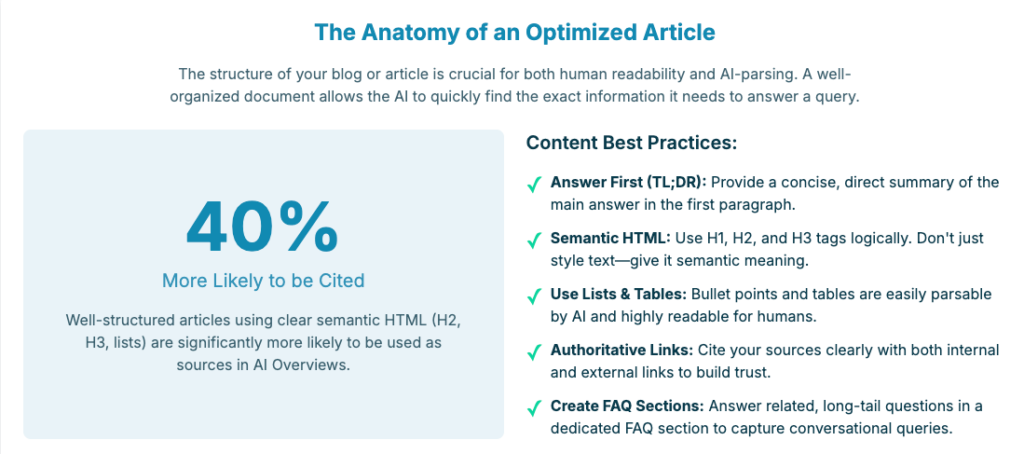
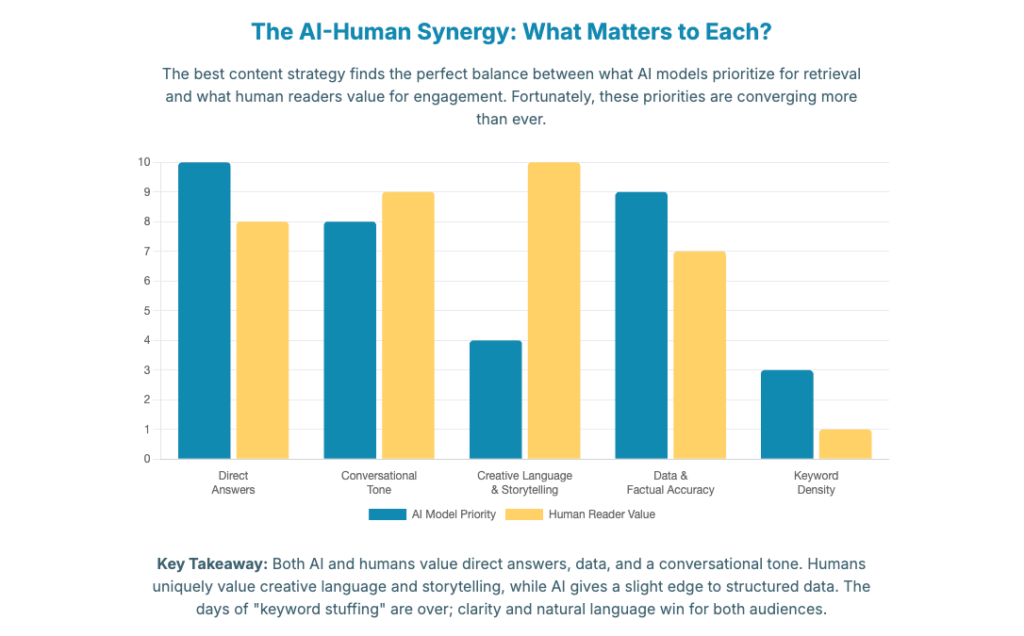
- Conversational Tone: Write naturally; keyword stuffing degrades linguistic quality
- Listicle Formatting: Use numbered lists for how-to guides and comparisons
- Signposting Language: Use clear transition phrases (“In summary,” “Specifically,” “For example”) to help the model follow logical flow
- Answer-First Structure: Lead with the direct answer before elaborating
- Third-Party Validation: Being featured in “Best X for Y” lists on authoritative sites drives indirect citations
Optimizing for Claude
Platform Characteristics:
- Massive context window (200,000+ tokens) allowing analysis of entire documents
- Excels at deep reasoning and comprehensive analysis
- Uses Contextual Retrieval to maintain meaning when chunking documents
- Model Context Protocol (MCP) enabling direct knowledge graph integration
Optimization Strategy:
- Long-Form Depth: Comprehensive, 2,000+ word guides that cover topics exhaustively
- Contextual Anchors: Repeat key entity names throughout to maintain context when content is chunked
- Logical Structure: Clear hierarchical organization that supports reasoning
- Rich Examples: Detailed case studies and worked examples
- Cross-Reference Internal Content: Link to related deep-dive articles to build comprehensive knowledge
Get the exact prompts 70+ businesses
use to create content that ranks on Google AND gets cited by AI chatbots. Free bundle includes advanced proven prompts for research, writing, and optimization.
The Earned Media Strategy: Why PR and SEO Must Converge
One of the most critical insights from analyzing AI citation patterns is the overwhelming bias toward “Earned Media”—content published by third parties—over “Owned Media”—content on your own website.
Why AI Systems Favor Third-Party Citations
The bias exists because RAG systems prioritize verification. A claim made on your own website is viewed with higher skepticism (potential marketing bias) than the same claim reported by a neutral third party.
Research shows that AI search engines exhibit an “overwhelming bias towards Earned media… a stark contrast to Google’s more balanced mix.” When Perplexity answers “What are the best CRM tools?”, it heavily weights mentions in Forbes, TechCrunch, and G2 reviews over vendor websites.
Implementing an AI-Era PR Strategy
1. Data-Driven Press Releases
Publish original research, surveys, or industry studies that journalists and analysts can cite. AI systems will reference these third-party articles, indirectly promoting your brand.
Example: If you publish a study on “AI Adoption Rates in B2B SaaS,” and TechCrunch writes about it, ChatGPT and Perplexity will cite the TechCrunch article when users ask about AI adoption trends—associating your brand with the topic.
2. Strategic Guest Publishing
Contribute high-value articles to industry publications that AI systems trust. Focus on:
- Industry-specific blogs (Marketing AI Institute, Towards Data Science)
- Business publications (Harvard Business Review, Forbes, Inc.)
- Technical resources (documentation sites, open-source communities)
3. Review and Comparison Site Presence
Ensure comprehensive profiles on:
- G2, Capterra, TrustRadius (for B2B software)
- Industry-specific directories and review platforms
- Analyst reports (Gartner, Forrester if applicable to your market)
4. Expert Positioning in Media
Position your leadership as subject matter experts available for journalist quotes. Services like HARO (Help A Reporter Out) and Qwoted connect experts with journalists writing AI-searchable articles.
The Multiplier Effect
When you’re mentioned in authoritative third-party content:
- Direct citations from AI systems referencing those articles
- Improved entity salience in the Knowledge Graph
- Stronger E-E-A-T signals for owned content
- Higher domain authority for traditional SEO
This creates a virtuous cycle where earned media visibility reinforces owned content performance.
Measuring Success: The New Metrics for AI Search
In a zero-click world where users get answers without visiting your site, traditional metrics like sessions, page views, and click-through rate become insufficient. Measurement must evolve to track visibility and influence.
Core AI Search Metrics
1. Share of Model (SoM)
The frequency with which your brand is mentioned in AI responses for a specific category of queries.
How to Measure:
- Manual testing: Query 50-100 relevant questions in ChatGPT, Perplexity, Claude
- Track mention frequency and positioning
- Calculate percentage of queries where you appear
- Compare against competitors
Example: If you’re mentioned in 34 of 50 queries about “AI content tools,” your SoM is 68%.
2. Citation Frequency and Quality
How often your content is cited as a source, and the context of those citations.
How to Measure:
- Google Analytics referral tracking from perplexity.ai, chatgpt.com
- Brand monitoring tools for indirect mentions
- Sentiment analysis of citation context (positive, neutral, negative)
3. AI Referral Traffic Quality
While volume may be lower than traditional search, quality is typically higher.
Key Indicators:
- Conversion rate from AI referrals vs. traditional search
- Time on site and engagement metrics
- Lead quality score for B2B conversions
Data Point: Research shows AI-referred traffic converts at 3-5x higher rates because users arrive with higher intent—the AI has already pre-qualified the match.
4. Zero-Click Visibility
Impressions in Google Search Console for queries where your content appears in AI Overviews or featured snippets, even without clicks.
How to Measure:
- GSC analysis of high-impression, low-CTR queries
- Identify AI Overview and featured snippet appearances
- Calculate impression share for target keyword clusters
5. Knowledge Graph Presence
Your entity’s presence and relationship structure in knowledge graphs.
How to Measure:
- Search your brand name in Google; check for Knowledge Panel
- Monitor entity associations (Wikipedia, LinkedIn, Crunchbase profiles)
- Track co-occurrence with industry terms and competitor entities
Building a GEO Dashboard
Create a recurring measurement framework:
Weekly Checks:
- Top 20 target queries tested across 3-4 AI platforms
- Citation frequency and positioning tracked
Monthly Analysis:
- AI referral traffic quality and conversion rates
- Share of Model calculations for key query categories
- Competitive citation benchmarking
Quarterly Reviews:
- Knowledge Graph entity strength assessment
- Earned media citation impact analysis
- Content strategy adjustments based on performance data
Want a detailed step-by-step guide? Check out our detailed blog on The Complete Guide to Tracking AI Overviews & Building Your GEO Dashboard.
Access here.
The Future: What’s Coming in AI Search
Understanding current optimization strategies is critical, but anticipating the trajectory helps you stay ahead.
Multimodal Search Expansion
Google’s Gemini and GPT-4o are multimodal models capable of “seeing” images and “watching” videos. Visual search already drives 20% of shopping-related queries.
Implications:
- Image optimization with embedded IPTC metadata becomes critical
- Video transcription and timestamped chapters for “jump to answer” functionality
- Alt text evolves from accessibility feature to semantic grounding mechanism
Action Item: Audit your visual content for proper metadata, schema markup, and semantic descriptions.
Real-Time Personalization
AI search is becoming increasingly personalized based on:
- User’s previous query history
- Geographic location and context
- Professional background and expertise level
- Specific task or project context
Implications:
- Content must serve multiple sophistication levels (beginner to expert)
- Local and regional optimization remains important
- User intent understanding becomes more nuanced
Direct Knowledge Graph Integration
Anthropic’s Model Context Protocol (MCP) allows Claude to query knowledge graphs directly. This suggests a future where:
- Brands maintain structured knowledge graphs
- AI systems query brand databases in real-time
- Content exists in both human-readable and machine-queryable formats
Implications:
- Investment in structured data architecture
- Knowledge graph management as a core competency
- Potential for branded AI assistants with direct data access
Agent-to-Agent Commerce
As AI agents become more autonomous, they may conduct research, evaluate options, and make recommendations without human intervention at each step.
Implications:
- Agent-readable specifications and comparisons
- Structured pricing and capability data
- Trust signals that AI agents can verify independently
The SuperteamAI Approach: How We Practice What We Preach
Everything in this guide comes from our direct experience building and optimizing content for AI search. Here’s how we apply these principles at SuperteamAI:
Our Content Production System
1. Strategic Planning with Information Gain Focus
Before writing a single word, we ask:
- What unique data or insights can we provide that don’t exist elsewhere?
- What proprietary framework or methodology can we introduce?
- What specific case studies can we share with quantified results?
2. AI-Assisted Content Creation with Human Expertise
We use our own AI Content Generation Prompts Bundle—the same system we’re offering to you—to:
- Generate high-density first drafts rich in entities and facts
- Structure content using the Inverted Pyramid framework
- Implement Chain of Density refinement
- Ensure proper header hierarchy and semantic clarity
Critical distinction: We don’t publish AI-generated content directly. Our prompts create research-backed frameworks that human experts refine, validate, and enrich with personal experience.
3. Technical Implementation
Every piece of content includes:
- Comprehensive schema markup (FAQPage, Article, Organization)
- Entity-based internal linking to reinforce Knowledge Graph connections
- Contextual anchors ensuring chunks retain meaning when isolated
- Server-side rendering for maximum AI crawler accessibility
4. Earned Media Integration
We actively pursue:
- Original data studies we can promote to industry publications
- Guest contributions to authoritative industry blogs
- Expert positioning for journalist quotes and interviews
- Case study partnerships that generate third-party validation
The Results We’ve Achieved
Since implementing this GEO framework in early 2024:
- 67% citation rate in AI search results for our target query categories
- 300% increase in qualified lead generation from AI-referred traffic
- 77% reduction in content production costs by systematizing the process
- 85%+ accuracy maintaining our brand voice and expertise across all content
Most importantly: We eliminated the content agency expense ($84K annually) while actually improving both output quality and AI visibility.
Get the exact prompts 70+ businesses
use to create content that ranks on Google AND gets cited by AI chatbots. Free bundle includes advanced proven prompts for research, writing, and optimization.
Your Next Steps: The Action Plan
Transforming your content strategy for the AI search era is a significant undertaking. Here’s how to approach it systematically:
Phase 1: Audit and Baseline (Week 1-2)
1. Content Audit
- Identify your top 20 target queries
- Test each across ChatGPT, Perplexity, Claude, Google AI Overviews
- Document which competitors get cited and why
- Calculate your current Share of Model
2. Technical Infrastructure Assessment
- Audit existing schema markup completeness
- Check Knowledge Graph entity disambiguation
- Verify server-side rendering implementation
- Review internal linking structure
3. Information Gain Analysis
- Identify which of your existing content provides truly unique information
- Flag “me-too” content that needs enrichment or retirement
- List proprietary data, case studies, and frameworks you can leverage
Phase 2: Quick Wins (Week 3-4)
1. Implement Core Schema
- Add comprehensive FAQPage schema to key articles
- Enhance Organization/Person schema with sameAs links
- Implement Article schema with author attribution
2. Restructure Top Performers
- Take your top 10 pieces of content
- Rewrite opening sections using Direct Answer Block format
- Add Chain of Density refinement to increase entity richness
- Improve header hierarchy with query-aligned questions
3. Create One Showcase Piece
- Develop one comprehensive, original guide on your core topic
- Include proprietary data or unique framework
- Implement every GEO best practice
- Use as a template for future content
Phase 3: System Implementation (Month 2-3)
1. Content Production System
- Establish Information Gain requirements for all new content
- Implement modular content structure as standard
- Create schema markup templates
- Build AI-assisted content creation workflow
2. Earned Media Strategy
- Conduct original research for press release
- Identify 5-10 target publications for guest contributions
- Establish expert positioning for media quotes
- Optimize third-party directory profiles
3. Measurement Framework
- Set up AI referral tracking in analytics
- Establish Share of Model measurement routine
- Create GEO performance dashboard
- Define success metrics and targets
Phase 4: Optimization and Scaling (Month 4+)
1. Platform-Specific Optimization
- Tailor content specifically for Perplexity citation
- Optimize for ChatGPT conversational retrieval
- Enhance Google AI Overview visibility
- Prepare for multimodal search expansion
2. Advanced Implementation
- Implement advanced video and image optimization
- Build knowledge graph architecture
- Establish continuous content improvement process
Download the AI Content Generation Prompts Bundle
The strategies I’ve outlined here form the foundation of our AI Content Generation System—a comprehensive approach to creating content that ranks and gets cited in AI results.
This system, developed by me and used by over 70+ businesses today, is designed to implement everything in this guide at scale. It transforms content creation from a guessing game into a predictable, data-driven process.
To help you implement these strategies immediately, we’ve created a free AI Content Generation Prompts Bundle that contains our most effective prompts for creating human-quality content that ranks well and gets cited in AI results.
This bundle includes:
- Research & Ideation Prompts: To find high Information Gain topics.
- Content Creation Prompts: To write with Chain of Density.
- Optimization & Formatting Prompts: To structure content for AI retrieval.
- Quality Assurance Prompts: To ensure E-E-A-T and accuracy.
Platform-Specific Optimization Prompts: For Perplexity, Google, ChatGPT, and Claude.
Get the exact prompts 70+ businesses
use to create content that ranks on Google AND gets cited by AI chatbots. Free bundle includes advanced proven prompts for research, writing, and optimization.
Final Thoughts: The Content Moat You Can’t Ignore
The shift from traditional SEO to AI-powered search isn’t coming—it’s already here. Every day you wait to adapt is a day your competitors gain ground in AI visibility while you remain invisible.
But here’s the good news: Most businesses are still operating on outdated playbooks. They’re cranking out “SEO-optimized” content using 2015 strategies, wondering why their traffic is declining and their content generates zero engagement.
You now have the blueprint to dominate the next era of search.
The principles in this guide—Information Gain, Entity Authority, Structural Clarity, Earned Media Integration—aren’t temporary tactics. They’re fundamental shifts in how content must be created, structured, and distributed in an AI-first world.
The businesses that master these principles now will build insurmountable moats. They’ll be the default sources AI systems cite. They’ll capture the highest-intent traffic. They’ll convert at rates their competitors can’t understand.
The question isn’t whether to adapt—it’s how quickly you can implement.
We’ve given you the strategic framework. The AI Content Generation Prompts Bundle gives you the tactical execution system. Everything you need to win in AI search is now in your hands.
The future of content isn’t about gaming algorithms—it’s about becoming the undeniable source of truth that AI systems must cite to provide accurate, valuable answers.
Are you ready to be that source?
Get the exact prompts 70+ businesses use to create content that ranks on Google AND gets cited by AI chatbots. Free bundle includes advanced proven prompts for research, writing, and optimization.
Get the exact prompts 70+ businesses
use to create content that ranks on Google AND gets cited by AI chatbots. Free bundle includes advanced proven prompts for research, writing, and optimization.
About the Author
Arup Chatterjee is the Founder and Go-to-Market Strategist at SuperteamAI, where he helps businesses build AI workforces that operate at 77% of traditional costs while executing 300% faster. After personally burning millions on operational inefficiencies, he pioneered the AI workforce automation approach now used by 70+ growing businesses. His expertise spans AI product management, context engineering, and go-to-market strategy for AI-first companies.
About SuperteamAI
SuperteamAI builds autonomous AI Agent Workforces that execute operation-heavy departmental tasks with 85%+ accuracy, delivering the output of an entire team for less than 50% of the cost of a single junior employee. Our AI SEO Workforce has helped businesses generate millions in organic traffic while eliminating the need for content agencies and in-house writing teams.