| Client | ReachInbox |
| Industry | B2B SaaS / Email Outreach Automation |
| Client Type | Bootstrapped B2B SaaS Startup |
| SuperteamAI Product Used | AI SEO Workforce (Scale Plan) |
| Engagement Duration | 12 months (results continuing to compound) |
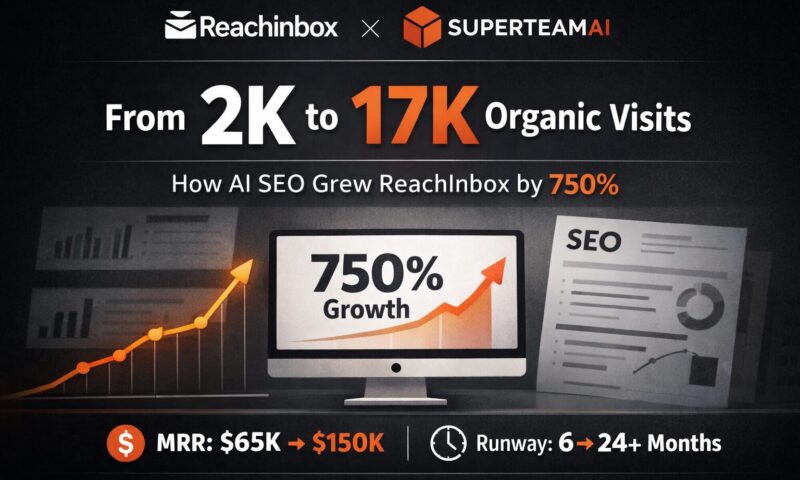
| Organic Traffic | 2,000 to 17,000 monthly visits (+750% at month 12) |
| Monthly Signups | 34 to 714 per month |
| Monthly Demos | 8 to 204 per month |
| MRR | $65,000 to $150,000 (+130%) |
| Runway | 6 months extended to 24+ months |
SECTION 1: THE STARTING POINT
Founded in 2022, ReachInbox built an email outreach automation platform aimed at mid-market SaaS companies and digital agencies that needed enterprise-level capability without enterprise pricing. The product offered AI-powered personalization, multi-channel sequencing, and a feature set that held up directly against tools like Lemlist and Instantly at a fraction of the cost.
By mid-2024, the company had 8 employees and $65,000 in monthly recurring revenue. That MRR number hadn’t moved in three consecutive months. More urgently, $380,000 in remaining runway at current burn gave the team roughly 6 months before they’d need to wind down or find a different path.
Organic search was generating 2,000 monthly visitors, nearly all from branded terms. For commercial queries like “email outreach software” or “cold email tool,” ReachInbox ranked beyond page 12. Only 3 keywords held any top-10 position. Paid acquisition wasn’t a viable escape route: their cost per qualified lead was $180, and scaling that channel with limited cash would have accelerated the problem rather than solved it.
Content production sat at 4 articles per month, handled primarily by the founder alongside every other operational responsibility. Established competitors were publishing 40-plus pieces monthly with years of domain authority already built underneath that volume. Trying to outpublish them on a founder’s spare hours wasn’t a strategy. It was a slow loss.
The conversion problem underneath the traffic problem made things harder still. At a 1.7% signup rate and 0.4% demo rate against industry benchmarks of roughly 3.5% and 1.0% respectively, simply driving more visitors to the site wouldn’t fix the business if those visitors weren’t arriving with the right intent. Both problems needed addressing together.
Anup Sharma, CEO, described the situation plainly: “We had a better product at half the price of Lemlist, but nobody knew we existed. Our traffic was embarrassingly low: 2,000 visitors translating to just 34 signups and 8 demos per month. We couldn’t afford paid acquisition, and our SEO efforts were producing negligible results. We were 180 days away from having to shut down.”
SECTION 2: THE APPROACH
ReachInbox brought on SuperteamAI’s AI SEO Workforce on the Scale Plan with one clear objective: build an organic acquisition engine that would compound over time and reduce the company’s dependence on paid ads and founder-led outbound. This was not a campaign. It was infrastructure.
The AI SEO Workforce’s 18 coordinated agents handled the full content lifecycle: SERP research, 14-point competitive gap analysis, keyword clustering, brief generation, drafting, editorial QA, SEO optimisation, and meta details. Anup reviewed and approved every brief and final article before publication. As revenue grew through the engagement and a marketing manager was brought on board in month six, that review responsibility transferred to her. The AI SEO Workforce handled production volume and research depth. The human always owned editorial direction.
Keyword strategy was built around a deliberate constraint: ReachInbox would not try to compete head-on with Lemlist and Instantly on high-volume terms where those companies had years of domain authority stacked up. Instead, the gap analysis focused on commercial-intent long-tail queries and comparison searches where a specific, well-targeted article could outperform a generic competitor piece within a realistic window. Queries like “affordable Lemlist alternative,” “cold email tool for small SaaS teams,” and “multi-channel sequencing for mid-market companies” had lower raw search volume but significantly higher purchase intent from visitors already evaluating their options.
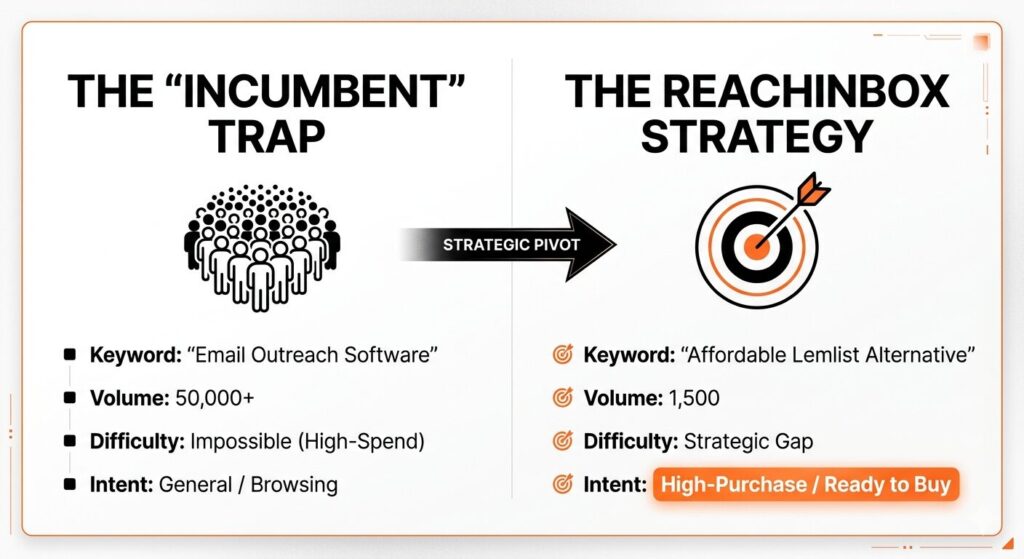
Four topical clusters structured the content architecture. The first addressed affordable alternatives to enterprise email platforms. The second covered AI-powered personalization for outreach sequences. The third targeted multi-channel outreach workflows for lean teams. The fourth produced use-case content for ReachInbox’s three core ICP segments: mid-market SaaS companies, digital marketing agencies, and B2B service providers. Gap analysis by the AI SEO Workforce identified 187 long-tail keyword opportunities where existing top-ranking content was outdated, too generic, or too shallow to satisfy the searcher’s actual buying question.
SECTION 3: THE EXECUTION TIMELINE
Months 1 to 3: Foundation
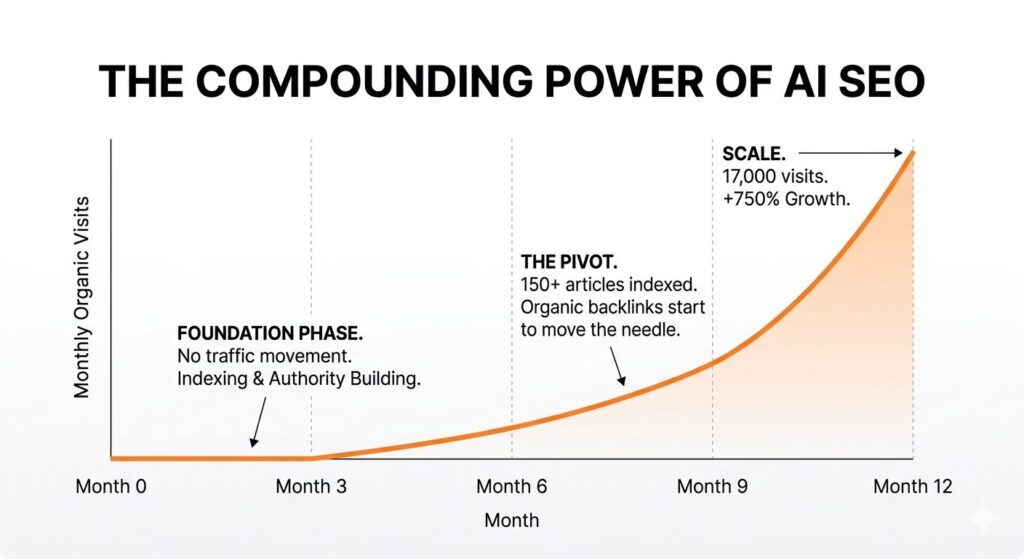
The first three months were setup and early production. The AI SEO Workforce was onboarded with ReachInbox’s brand guidelines, ICP documentation, competitive positioning, and product feature details. The keyword architecture and topical cluster structure were reviewed and approved before publishing began in week three. Publishing ran at 25 to 28 articles per month from the start.
No meaningful traffic movement happened during this phase. That is not a failure. It is how SEO works. Content published in months one through three was accumulating indexation, initial crawl signals, and early authority. The payback would come in months six through twelve. Anup was clear-eyed about this going in: the decision to build an organic channel was a decision to invest for compounding returns, not immediate ones.
Months 3 to 6: Early Signals
By month three, articles published in the first two months had started producing initial ranking signals on lower-competition long-tail terms. Monthly organic visits climbed from 2,000 to roughly 4,000 by month four. An early top-five ranking appeared for “affordable Lemlist alternative,” a comparison query where visitors arrived already in buying mode. Those visitors converted at a meaningfully higher rate than the site’s previous branded traffic.
By month six, monthly organic traffic reached approximately 7,000. Keywords in the top 10 grew from 3 to around 18. First organic-sourced demos were appearing in the pipeline, and the team could see for the first time that SEO was generating not just volume but qualified volume. Signup rate had improved from 1.7% to around 2.5% as traffic composition shifted toward intent-matched visitors.
Revenue had grown enough by month six that Anup hired a marketing manager, freeing him from the content approval workload and adding capacity to accelerate the editorial process.
Months 6 to 9: First Meaningful Traction
The compounding effect of 150-plus published and indexed articles started to show clearly in months six through nine. Content from months one through four was maturing in the index, earning secondary rankings on related terms beyond the primary target keywords, and generating organic backlinks as it circulated through communities and newsletters in the email outreach space.
Monthly organic traffic grew from 7,000 to approximately 11,000 by month nine. Keywords in the top 10 reached 32. Signup rate continued improving as the proportion of solution-aware visitors grew, reaching 3.4% by month nine. The business had meaningful pipeline for the first time, MRR was moving again after months of stagnation, and runway pressure had eased significantly.
The comparison and alternative content that had been ranking since month four was driving a measurable shift in competitive deals. By month eight, the sales team was winning a larger proportion of head-to-head evaluations against Lemlist and Instantly because prospects were arriving having already read content that addressed the pricing and feature comparison directly. They came into demos with a clearer picture of where ReachInbox sat in the market, which shortened the evaluation process and reduced the number of objections the team had to handle from scratch.
Months 9 to 12: Accelerating and Compounding
Month nine is where the earlier investment stops feeling like faith and starts feeling like a strategy. Articles published in months one through six were now fully established in the index, rankings were consolidating, and new content published in months seven through nine was ranking faster because the domain had built genuine topical authority.
By month 12, monthly organic visits had reached 17,000, a 750% increase from the 2,000 baseline. Keywords in the top 10 grew from 3 at the start to 47. The engagement had produced approximately 300 published articles over the 12 months, compared to the 48 ReachInbox would have produced on their own at their previous pace of 4 per month.
Signup rate reached 4.2% at month 12 and demo rate hit 1.2%, both above the industry benchmarks ReachInbox had been underperforming against at the start. At 17,000 monthly visitors with a 4.2% signup rate, the team was generating 714 signups per month versus 34 at baseline. At a 1.2% visitor-to-demo conversion rate, they were running 204 demos per month versus 8.
ReachInbox appeared in 14 major email tool comparison articles across G2, Capterra, and SaaS-focused review publications by month 12. G2 listed them in the High Performers grid for the email outreach software category. Three SaaS newsletter roundups with a combined readership of 182,000 featured the platform in recommendation content. That earned media coverage generated approximately 1,400 additional monthly referral visits by month 12, tracked separately from the 17,000 organic search figure, and contributed directly to the competitive deal volume the sales team was handling.
SECTION 4: THE RESULTS
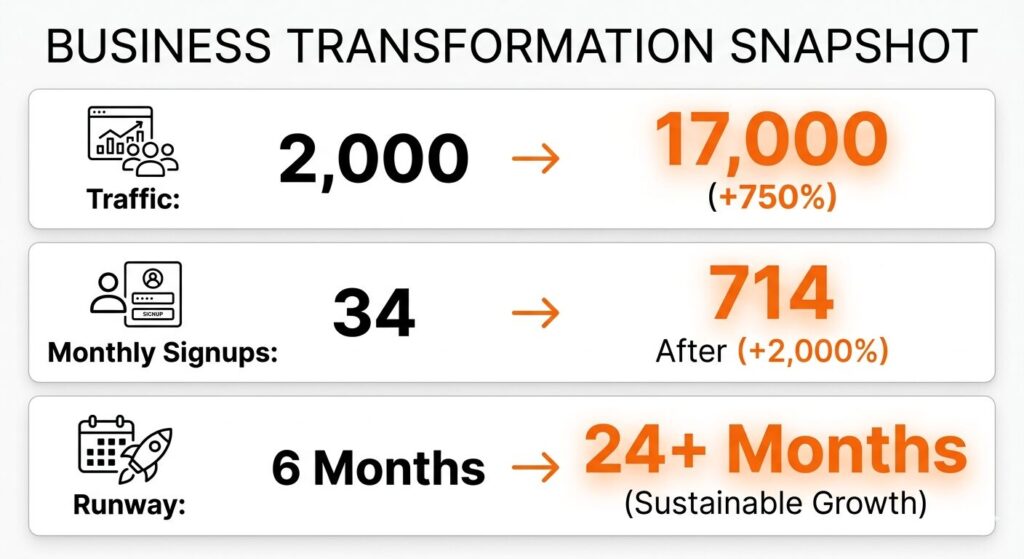
Organic traffic grew from 2,000 to 17,000 monthly visits, a 750% increase. The growth was not a spike. It followed a compounding curve: roughly 4,000 at month four, 7,000 at month six, 11,000 at month nine, and 17,000 at month twelve. Each phase of content publication built on the authority established in the prior phase.
Keywords in the top 10 grew from 3 to 47, concentrated on commercial-intent and comparison terms that captured visitors at the bottom of the buying journey.
Signup rate improved from 1.7% to 4.2%, delivering 714 monthly signups at month 12 versus 34 at baseline. Demo rate improved from 0.4% to 1.2%, delivering 204 monthly demos versus 8. The conversion improvement alongside traffic growth confirms the traffic quality, not just quantity, improved. Visitors arriving through specific, intent-matched content converted at a higher rate than visitors from paid or branded sources had been.
Win rate in competitive deals improved from 38% to 61% by month 12, tracked across 84 deals in the CRM where Lemlist, Instantly, or Apollo was named as a competing option. Prospects arriving through comparison and alternative content came into demos with a clearer picture of where ReachInbox sat on price and features, which reduced from-scratch objection handling and shortened the average evaluation cycle.
Cost per qualified lead dropped from $180 to $75, a 58% reduction, as organic acquisition became the dominant channel. The marginal cost of additional organic-sourced visitors is near zero once the content infrastructure is in place and the domain has built authority.
MRR grew from $65,000 to $150,000 over the 12-month engagement. The organic channel was the primary new growth lever introduced and the one that drove the step-change in qualified pipeline. Normal sales execution, product improvements, and the earned media coverage from comparison sites and newsletters all contributed to the full picture.
Runway extended from 6 months to 24-plus months. The team grew from 8 to 12 employees, funded from revenue growth rather than additional fundraising.
SECTION 5: IN THEIR WORDS
Anup Sharma, CEO, ReachInbox:
“SuperteamAI’s AI SEO Workforce didn’t just produce content. It became our organic growth engine. The system learned our business, our market, and our customers well enough to produce content that actually converted. Over 12 months, we went from 2,000 visitors to 17,000, and our conversion rates more than doubled because we were attracting the right audience. We went from 6 months of runway to 24. That is the difference between shutting down and building something real.”
Sarah Johnson, Marketing Manager, ReachInbox (joined month 6):
“The AI SEO Workforce understood that we weren’t just another email tool. We were the affordable option for mid-market companies that couldn’t justify Lemlist pricing. That specificity showed up in every piece of content. Our traffic didn’t just increase: it became qualified traffic. Visitors were arriving having already read an article that spoke to their exact situation. That is why the conversion rates moved the way they did.”
Michael Chen, VP of Growth, Vantage CRM:
“I found ReachInbox through an article comparing email outreach tools for mid-market SaaS companies. The content spoke directly to our situation around budget and the need for enterprise features at a price that made sense. That level of relevance made me confident they understood the problem, not just the product category. It is what made me request a demo.”
SECTION 6: KEY TAKEAWAYS
- For a bootstrapped SaaS company competing against well-funded incumbents, organic search is the one acquisition channel that doesn’t require outspending the competition. ReachInbox couldn’t match Lemlist’s paid budget. They could, with the AI SEO Workforce, match and then exceed them on content depth in the specific long-tail terms their buyers were actually searching. That is a structural advantage that compounds over time rather than resetting to zero every month.
- The conversion rate improvement is as important as the traffic number. Signup rate going from 1.7% to 4.2% alongside an 8.5x traffic increase tells you the strategy was attracting the right visitors, not just more visitors. That only happens when keyword targeting is built around buyer intent, not search volume. The win rate improvement from 38% to 61% in competitive deals makes the same point from the sales side: content that educates buyers before they arrive in a demo changes the quality of the conversation, not just the volume.
- Twelve months is where the compounding starts to feel obvious. Months one through six are investment. Months six through nine are early validation. Months nine through twelve are where the earlier work pays back at scale. Businesses that expect SEO to deliver peak results in months two or three misunderstand the asset they are building. ReachInbox committed to the full timeline, which is why the month-12 numbers look the way they do.
The Fastest Way To Upgrade Your Entire Growth Operation.
For the cost of one software subscription, you get the execution power of an elite team without burnout, overhead, or delays. This is how modern companies scale smarter.


