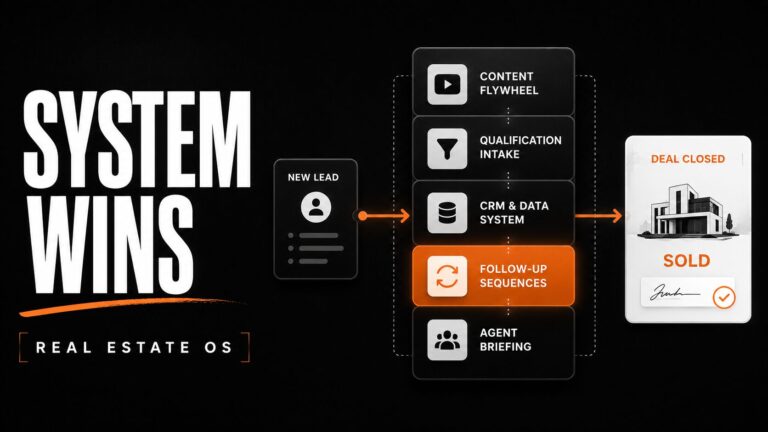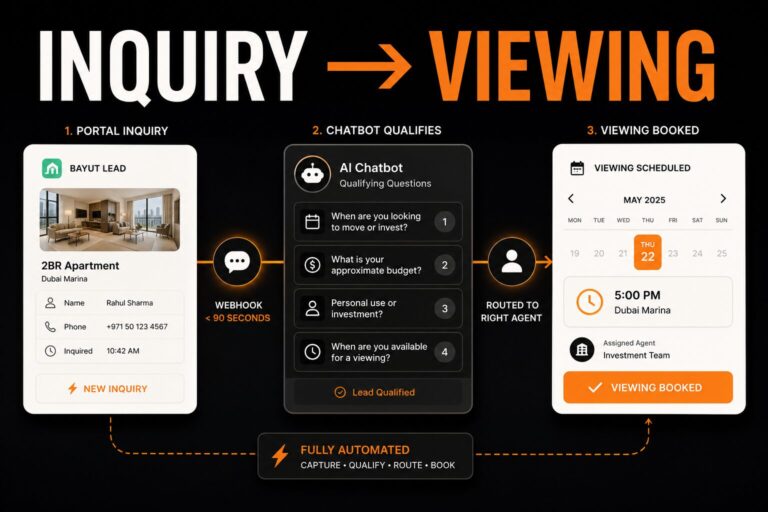
How He Turned a Real Estate Team Into a Machine That Qualifies, Follows Up, and Closes Without Him in the Room
A journalist interviewing Ryan Serhant in 2022 asked the question everyone asks when they encounter someone doing $1B+ in annual sales volume while simultaneously running a brokerage, filming a Netflix show, hosting a podcast, writing books, and posting on social media every single day.
How?
His answer was three words.
“I built systems.”
The journalist nodded and moved on. The audience assumed he meant some version of good habits and relentless discipline. What Serhant actually meant was more precise: a layered operating system with defined inputs, defined outputs, and specific people responsible for each layer – designed so that deals close whether Ryan is in the building or not.
That’s the part worth studying.
Not the TV exposure. Not the 3.8 million Instagram followers. Not the charisma that makes him compelling to watch. Those are outputs of the system. The system is what feeds them. The system is what makes them compound year after year without requiring him to personally manufacture every result.
This is a breakdown of that system – what Serhant has documented publicly across his books, interviews, and the structure of SERHANT. as a firm. And at the end: an honest accounting of the gap between what his firm runs on and what most brokerages in India and Dubai are running on right now.
What Most People Think Is the Secret
When real estate firms study Ryan Serhant, they almost always study the wrong thing.
They watch his Instagram and conclude: we need better content.
They read Sell It Like Serhant and conclude: we need to follow up more.
They see the Netflix show and conclude: we need a stronger personal brand.
All three conclusions are directionally correct. None of them is the system.
The system is the thing that decides which content gets produced, executes the follow-up without relying on individual memory, and builds the personal brand through consistent output – without Serhant having to be present for every decision.
The distinction matters enormously.
A brokerage that tells its agents to “follow up more” gets inconsistent results that depend entirely on individual agent discipline. A brokerage with a follow-up system gets consistent results regardless of who’s working that week.
One is a cultural aspiration. The other is infrastructure.
Serhant built infrastructure. Almost every brokerage in India and Dubai builds cultural aspiration and calls it a system.
Here is what the infrastructure actually looks like.
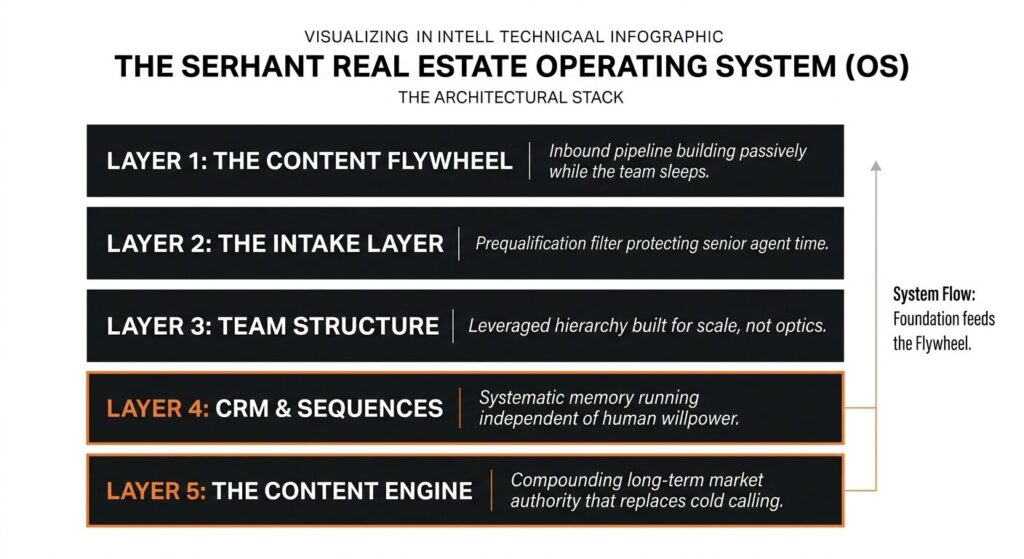
Layer 1: How Leads Enter – The Content Flywheel
Before Serhant’s team speaks to most buyers, those buyers already know who he is.
That is not an accident. It is the first and most misunderstood layer of the system.
SERHANT. operates as a media company that also sells real estate – deliberately, not incidentally. The firm has SERHANT. Studios, an in-house media production arm. Every significant listing receives a produced content package: professional video, a dedicated social campaign, YouTube presence, Instagram presence. The listing becomes a content event, not just an entry on a portal.
This does two things simultaneously.
First, it reaches buyers who are not yet in the market. Someone watching a SERHANT. YouTube video on Manhattan’s luxury market today is not necessarily buying next month. But twelve months later, when they are in the market, they remember the firm whose content helped them understand it. That is inbound pipeline built passively. No outreach required. No cold call made. The content is working while the team is sleeping.
Second, it pre-qualifies before the first conversation. A buyer who reaches out after watching a produced video of a $12M townhouse in the West Village has already seen the price point. They are not shocked by the number. They are not a curiosity click from someone who wanted to see how the other half lives. The content filters before the dialogue begins – and that makes every subsequent conversation more efficient.
The result: Serhant’s team spends the majority of their conversion effort on people who arrived already warm. The cold-to-warm ratio that kills most brokerages’ efficiency – where agents burn time and energy on leads who were never ready to buy – is structurally different at SERHANT. because the content machine handled the warming before the lead was ever recorded.
What most brokerages run on instead: Two agent-managed Instagram accounts, posting property photos with prices in the caption. Portal listings with phone-quality video, if any. Zero owned content that reaches buyers before they’re in the market. The entire pipeline depends on buyers actively searching. There is no inbound. There is only outbound, and it never stops being required.
Layer 2: How Leads Are Qualified – The Intake Layer
This is where the gap between SERHANT. and the average brokerage becomes structural rather than just stylistic.
In most brokerages, a lead arrives and an available agent calls. That agent has a name and a number. They know the portal the lead came from, if they’re lucky. They know nothing else. The call is effectively a cold call on a warm lead – and the agent is simultaneously trying to build rapport, gather requirements, assess seriousness, and pitch the firm, all in the same conversation.
This is inefficient. It also explains why most buyers call three brokerages and go with whichever agent happened to be the most informed and the most prepared in the first conversation. The competition isn’t being won on property knowledge. It’s being won on information architecture.
Serhant talks about this principle explicitly: know more about the person than they expect you to know before you speak to them.
That requires a system that captures, organises, and surfaces information – not an agent relying on memory from a WhatsApp enquiry they read at 7am.
At SERHANT., there is a qualification layer between lead arrival and senior agent call. Before a senior agent is assigned to a lead, something has happened: the lead has been captured with source attribution, any engagement with firm content has been noted, and the buyer’s requirements have been gathered – whether through an intake form, an initial touch from a junior team member, or an automated qualification sequence.
By the time the senior agent is briefed, they’re not going in blind. They’re going in with context.
The qualification layer also does something equally important: it protects senior agent time. In a firm doing significant volume, not every enquiry warrants a senior agent’s first call. The qualification layer determines who is serious, what they’re looking for, and where they are in their decision – and that determination dictates who handles the lead and how.
A buyer who is six months away from readiness gets a nurture sequence. A buyer who is thirty days from committing gets the senior agent immediately. The same lead treated the same way regardless of urgency is one of the most expensive mistakes a brokerage makes.
What most brokerages do instead: Every enquiry goes to an available agent in the order it arrived. No intake. No context. No determination of seriousness before time is invested. The managing director and the newest junior agent call the same undifferentiated list. The quality of the conversation depends entirely on individual agent skill rather than on what the system gave them before they picked up the phone.
Layer 3: How Agents Are Briefed – The Team Structure
The SERHANT. team hierarchy is one of the most documented elements of how the firm operates – and one of the most misread.
Most people look at it and see a pyramid with Ryan at the top. What they miss is the reason the pyramid exists: not ego, not optics. Leverage.
At the top sits Serhant – the brand, the senior relationships, the rainmaker. He is not personally closing most deals. He is the reason deals arrive at the firm, and the person who shows up at the specific moments where his presence changes the outcome: the listing appointment that needs the name, the negotiation where the other side needs to feel the weight of the firm, the client relationship that determines whether a buyer comes back for a second transaction and brings three referrals.
Everything else is handled by layers beneath him – each with defined responsibilities.
Senior agents manage active transactions: showings, offer management, client communication, negotiation, process oversight. They receive briefings, not names and numbers. When a serious buyer has been qualified and is ready for agent contact, the senior agent receives a formatted summary: who this buyer is, where they came from, what they’re looking for, what they’ve said, what their timeline is. They walk into the first real conversation already knowing the person.
That context changes the call entirely. A conversation where an agent demonstrates knowledge of the buyer’s situation – rather than gathering that knowledge in real time – converts at a different rate. The buyer feels understood. Trust arrives faster. The sale cycle compresses.
Junior agents and support staff handle the volume: initial enquiry responses, scheduling, document management, database maintenance, the interactions that would otherwise consume 60% of a senior agent’s time. Their job is to protect senior agent time and to prepare the information that makes senior conversations effective.
What the briefing contains before a senior call:
- Lead source and content engagement history
- Budget range (confirmed, not assumed)
- Property type, location preference, and specific requirements
- Timeline and urgency level
- Prior interactions with the firm, including what was discussed
- Any properties they’ve expressed interest in or ruled out
- Suggested opening approach based on their profile
What most brokerages do instead: The agent who is available calls. They introduce themselves. They ask the buyer what they’re looking for. They take notes in their phone or a personal notebook. They go back to their inventory search with incomplete requirements. There is no briefing. There is no context. The first conversation is the qualification conversation – information gathering disguised as sales – rather than a conversion conversation built on information already gathered.
Layer 4: How Follow-Up Never Falls – The CRM and Sequence System
This is the layer Serhant has documented most publicly. And the one most brokerages believe they understand while executing almost none of.
His framework is three words: Follow Up, Follow Through, Follow Back.
Follow Up is the initial contact after a lead enters the system. Most brokerages do this once. Some do it twice. The actual data on when real estate deals close is less convenient: the majority of transactions close after the fifth to eighth meaningful contact. The average agent stops at two – not because they don’t care, but because there is no system reminding them that the lead still exists.
Follow Through is delivering exactly what you committed to in the prior contact. If you said you would send three properties by Thursday, they arrive by Thursday. If you said you would call after the buyer had time to think, you call at exactly that time. Every broken follow-through is a trust withdrawal. Reliability sounds like table stakes. It is not. Most agents over-promise in the moment and under-deliver on the timeline. The agents who do exactly what they said they would, every time, stand out precisely because the bar is low.
Follow Back is the re-engagement of leads that have gone quiet. The buyer who stopped responding has not necessarily bought elsewhere or lost interest. They’re busy, or uncertain, or waiting for a personal situation to resolve – a job change, a marriage, a liquidity event. The brokerage that maintains contact on a value-first schedule – not pressure, not desperation – is the one that gets called when the situation changes. And it always changes.
The mechanism that makes all three happen at scale is not willpower or discipline or good intentions.
It is the CRM.
Serhant has spoken about his contact database as one of the most important business assets he has built across his career. Every interaction goes in. Every commitment goes in. Every note about what a buyer said, what they revealed about their situation, what matters to them, what they ruled out – all of it goes in. The CRM is not an administrative tool. It is the memory of the business.
When the business’s memory is in one person’s head, the business is fragile. When it’s in a system that anyone on the team can access and that generates its own reminders, the business compounds.
The follow-up sequences that run from the CRM are not manually triggered. They are scheduled. When a buyer enters the system, the next seven contact points are already mapped – the timing, the channel, the type of content or message. The agent doesn’t have to remember. The system creates the task, surfaces the context, and flags when a lead has been silent for too long.
The sequence most firms should run but don’t:
- Day 1: First contact with property match and value resource
- Day 3: Follow-up with additional context based on their requirements
- Day 7: Market intelligence relevant to their search area
- Day 14: Check-in – has their timeline or thinking changed?
- Day 21: New matching property or market development
- Day 30: Re-qualification – light touch to confirm they’re still in market
- Day 45–90: Monthly nurture – value, not pressure
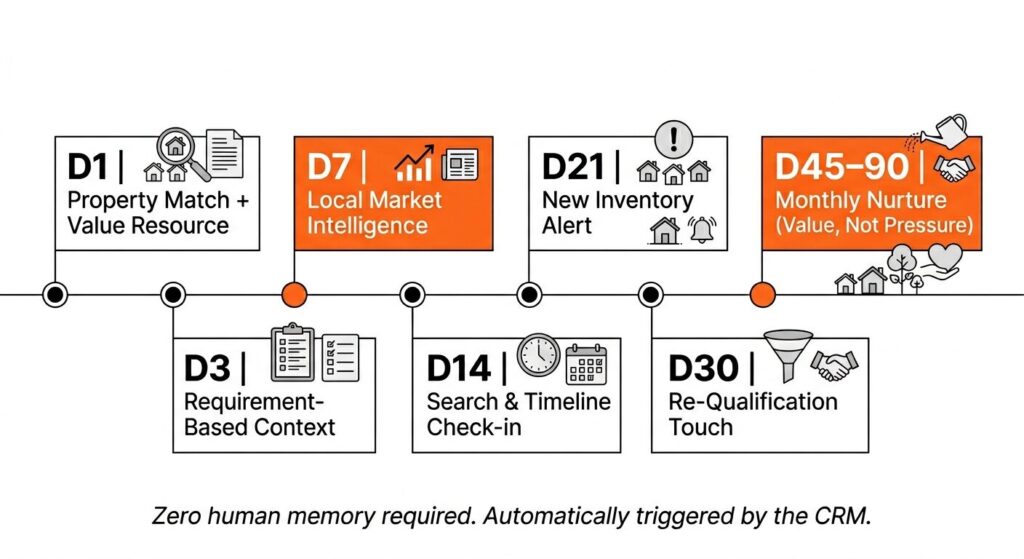
This is not a complex system. It is a consistent one. Consistency is what separates it from what most brokerages do, which is follow up when they remember and move on when they don’t hear back.
What most brokerages are sitting on right now: A database of 400–1,200 old leads. Some of them went cold six months ago. Some of them went cold two years ago. Almost none of them have been contacted in the last ninety days. Some of them have already bought. Some of them haven’t. There’s no way to know – because there’s no system that would surface them, no sequence that kept them warm, and no re-engagement trigger that would have caught them when they became ready.
The leads aren’t dead. The system is.
Layer 5: The Content Machine – Why Cold Calling Becomes Optional
Serhant does not cold call.
Not because he finds it beneath him. Because he built something that makes it unnecessary.
The content flywheel works through compounding. Content published today reaches a fraction of the audience that is currently in the market – and a much larger fraction that will be in the market in 6, 12, or 24 months. Those future buyers have been consuming the content in the interim. By the time they’re ready to transact, the firm isn’t unknown. It’s familiar. The first conversation isn’t an introduction. It’s a continuation.
The investment required to build this flywheel is significant and slow to return. A YouTube channel with consistent market intelligence content takes 12–18 months to generate material inbound. A newsletter with genuine insight takes 6–12 months to build a subscriber base that produces enquiries. A podcast takes 18–24 months to build the audience and guest relationships that convert to deals.
Most brokerages don’t have the patience. They need pipeline this quarter, not next year. So they keep doing outbound – cold calls, portal leads, WhatsApp broadcasts – all of which require constant reinvestment of energy and produce no compounding effect. The pipeline that exists today disappears if the outbound stops tomorrow.
The content machine is the opposite. Content published 18 months ago is still generating enquiries. The archive grows, the distribution grows, the inbound grows – without proportionate growth in the effort required to produce it. That’s what compounding looks like.
For a firm starting from nothing, the minimum viable version: One market intelligence video or article per week. Not a property tour – a genuine analysis. Neighbourhood breakdown, buyer’s guide, investment case for a specific area, an honest market update. Published consistently for 18 months. Not for the audience you have now, but for the audience you’ll have in 18 months – and for the search engine that will index it and surface it for years.
This is not a fast strategy. It is a permanent one. And it is the only strategy that eventually makes outbound optional.
The Serhant Gap – What Indian and Dubai Brokerages Are Actually Running On
Here is the honest part.
Serhant built this system over fifteen-plus years in one of the world’s most competitive real estate markets, with access to media infrastructure, a buyer pool capable of funding significant content investment through single transactions, and a brand that arrived with a television platform behind it.
Most brokerages in India and Dubai are starting from a different position.
They’re starting from this one:
Leads from three or four portals landing in a shared WhatsApp group or a shared inbox, being called by whoever is available. A follow-up system that lives in one agent’s good memory. A CRM that is actually a spreadsheet titled “Leads Q3.” A content strategy that is six Instagram posts per month, all property photos with prices in the caption. A database of 800 old leads that nobody has touched in fourteen months because there is no system telling anyone they still exist.
This is not a criticism. It is the accurate starting condition for the majority of real estate firms in both markets right now.
The gap between this and the SERHANT. operating system is real. But it is not primarily a gap in budget or ambition.
It is a gap in sequencing.
The mistake most brokerages make when they try to close this gap is attempting to add the visible layers first – the content, the AI tools, the social media – before the foundation underneath those layers exists. The result is a content calendar with no system to capture the inbound it generates. An AI chatbot running on a lead database that isn’t clean. A follow-up sequence built in a tool that agents don’t use because it’s not connected to where leads actually arrive.
Serhant didn’t build the Netflix show before he had a team that could handle the volume it generated.
He didn’t launch the content machine before he had a CRM that could capture and route the leads it produced.
He didn’t deploy follow-up sequences before he had the data infrastructure to know which leads needed which sequences.
Infrastructure first.
The database clean. The CRM live. The lead sources connected. The qualification layer running. Then the AI. Then the content. In that order.
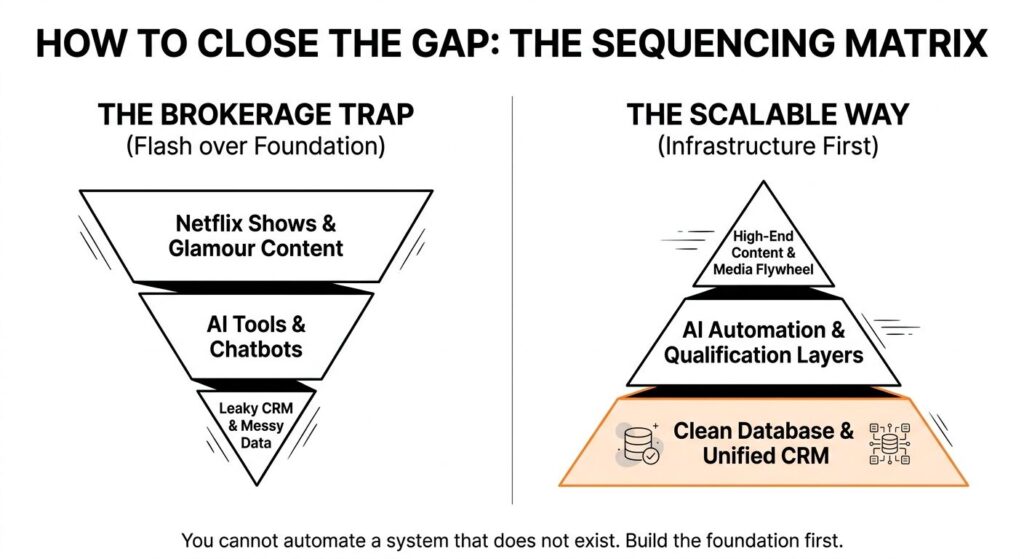
This is not the exciting version of the story. But it is the version that explains why his system produces what it produces – and why most firms that attempt to replicate it without the foundation get noise instead of results.
The Three Changes That Close Most of the Gap
Not everything in the SERHANT. system is required to produce a meaningful improvement. Based on where the worst leakage actually occurs in most brokerages, three changes – in order – close the majority of the gap:
1. A CRM that is actually used
Not a spreadsheet. Not a shared inbox. A CRM where every lead, every interaction, and every follow-up commitment is logged – and where the next action is generated by the system rather than by individual memory. This is the foundation. Without it, everything else built on top degrades.
2. A qualification layer before senior agents touch a lead
This can be a structured intake call handled by a junior team member. It can be an AI agent running on WhatsApp that captures requirements before the human agent is assigned. The technology matters less than the principle: a senior agent should never open a call without knowing who they’re speaking to, why they came to the firm, what they’re looking for, and where they are in the decision.
3. A follow-up sequence that runs independent of agent memory
Mapped in the CRM. Scheduled. Running for every lead without exception. It does not have to be complex. Day 1, Day 3, Day 7, Day 14, Day 30. What matters is that it runs every time, for every lead, regardless of which agent owns the record or how busy they are this week.
These three changes – in this order – represent the core of what Serhant’s system does at the operational level. The content machine and the team structure are the layers that come after, when the foundation is clean enough to support them.
Serhant did not start with the Netflix show.
He started with a database, a follow-up discipline that was relentless, and the CRM that made that discipline systematic rather than personal.
That part of the story is less often told.
The Serhant System Audit – Your 12 Checkpoints
Below is a framework for mapping your firm against every layer of the system described above.
Score each checkpoint honestly – not where you want to be. Where you are.
The checkpoints scoring 1 or 2 are where your pipeline is leaking. Start there.
LAYER 1 – Lead Capture
Checkpoint 1: Lead Source Consolidation Do all lead sources – portals, ads, referrals, website, social media, walk-ins – flow into a single system with source attribution? Or do leads arrive in scattered inboxes, phones, and spreadsheets?
| Score | What it looks like |
| 1 | Completely scattered. No single source of truth. |
| 2 | Most sources in one place. Material gaps exist. |
| 3 | All sources captured with some manual steps. |
| 4 | All sources captured automatically with attribution. |
| 5 | All sources captured, attributed, and triggering automated next steps. |
Checkpoint 2: Response Time What is your actual average response time to a new inbound enquiry – including evenings and weekends?
| Score | What it looks like |
| 1 | Hours or days. Depends on when an agent notices. |
| 2 | Within 2 hours during business hours. |
| 3 | Within 1 hour. |
| 4 | Within 15 minutes consistently. |
| 5 | Within 5 minutes, 24/7. Including 11pm on Sunday. |
LAYER 2 – Lead Qualification
Checkpoint 3: Senior Agent Context Before a senior agent calls a new lead, what do they know about that buyer?
| Score | What it looks like |
| 1 | Name and phone number only. |
| 2 | Name, number, portal source. |
| 3 | Basic requirements gathered informally. |
| 4 | Budget, property type, and timeline confirmed before the call. |
| 5 | Full qualification – budget, type, timeline, urgency, prior engagement – formatted as a briefing the agent receives before contact. |
Checkpoint 4: Lead Filtering Is there a process that identifies unserious or clearly out-of-budget enquiries before they consume senior agent time?
| Score | What it looks like |
| 1 | No. Every enquiry goes to the available agent. |
| 2 | Informal – some agents screen naturally, others don’t. |
| 3 | A junior team member handles initial contact for some leads. |
| 4 | A structured intake process with defined qualification criteria. |
| 5 | An automated or structured qualification layer that screens all leads before any senior agent involvement. |
LAYER 3 – Agent Briefing
Checkpoint 5: Briefing Quality When an agent is assigned a lead, how are they briefed?
| Score | What it looks like |
| 1 | They’re not. They look up the lead themselves. |
| 2 | A WhatsApp message with basic details. |
| 3 | A CRM record with some notes. |
| 4 | A CRM record with full qualification data and prior interactions. |
| 5 | An auto-generated briefing card – qualification summary, urgency level, matched properties, conversation context – delivered before the call. |
Checkpoint 6: Property Match Speed Can your firm produce a relevant, accurate property shortlist for a qualified buyer in under 30 minutes?
| Score | What it looks like |
| 1 | No. Manual search across multiple sources takes 2+ hours. |
| 2 | 1–2 hours with significant effort. |
| 3 | 30–60 minutes. |
| 4 | Under 30 minutes with a structured process. |
| 5 | Under 10 minutes with a matching system connected to a current inventory database. |
LAYER 4 – Follow-Up
Checkpoint 7: Follow-Up Sequence What happens to a lead who doesn’t convert on the first call or first showing?
| Score | What it looks like |
| 1 | Nothing systematic. We call if we remember. |
| 2 | One or two follow-up attempts, then the lead is effectively abandoned. |
| 3 | An informal sequence some agents follow and others don’t. |
| 4 | A documented sequence with defined touchpoints and timing. |
| 5 | An automated CRM sequence – scheduled, tracked, running for every lead, every time, regardless of agent. |
Checkpoint 8: Dormant Lead Visibility How many leads in your database were last contacted more than 90 days ago – and do you know which ones?
| Score | What it looks like |
| 1 | Most of the database. No re-engagement system. No visibility. |
| 2 | Significant portion. Occasional manual re-engagement. |
| 3 | Some. A partial nurture sequence is running. |
| 4 | Few. Most leads are in active sequences. |
| 5 | Near zero. Every lead is in a sequence or formally marked closed with a reason. |
LAYER 5 – Content and Inbound
Checkpoint 9: Inbound Ratio What percentage of your new leads arrive without active outreach – inbound through content, reputation, or referral?
| Score | What it looks like |
| 1 | Under 10%. Nearly all leads require active outreach to generate. |
| 2 | 10–25%. Mostly portal and paid. |
| 3 | 25–50%. A referral network and some organic. |
| 4 | 50–75%. Referral and content generate more than half. |
| 5 | Over 75%. The content machine and referral network fill most of the pipeline without outbound. |
Checkpoint 10: Listing Content Standard What does your standard property listing include in terms of content?
| Score | What it looks like |
| 1 | Portal listing with phone photos. No video. |
| 2 | Professional photography. Basic or no video. |
| 3 | Professional photography and phone-quality video. |
| 4 | Professional photography and produced video for premium listings. |
| 5 | Produced video content for all significant listings with a social distribution plan per property. |
LAYER 6 – Visibility and Delegation
Checkpoint 11: Business Independence If the managing director or top producer was unavailable for two weeks, would the pipeline continue to move without degradation?
| Score | What it looks like |
| 1 | No. The business depends on one person’s daily involvement. |
| 2 | Partially. Some things continue. The pipeline slows noticeably. |
| 3 | Most things continue with clear delegation. |
| 4 | Yes. Protocols exist. The business runs. |
| 5 | Yes – and the pipeline would be in better shape on return because the systems ran without interruption. |
Checkpoint 12: Leadership Visibility Does leadership have real-time visibility into what every agent is doing, how leads are converting, and where the pipeline stands?
| Score | What it looks like |
| 1 | No visibility. Deals surface when they close. |
| 2 | Anecdotal. Weekly meetings provide updates. |
| 3 | Basic CRM visibility – stages and counts. |
| 4 | A dashboard with pipeline by stage, agent activity, and conversion rates. |
| 5 | Real-time visibility plus automated weekly performance briefs – agent ranking, lead quality by source, pipeline health, at-risk leads – without anyone compiling it manually. |
Scoring Your Firm
| Total Score | What it means |
| 49–60 | You’ve built something real. The gaps are refinements, not foundations. |
| 37–48 | The infrastructure exists in parts. An AI and automation layer would compound what’s already there. |
| 25–36 | Key layers are missing. The leakage is significant and identifiable. Prioritise CRM and qualification layer first. |
| 13–24 | The foundation needs to be built before anything else can hold. Start with lead capture and a working CRM. |
| 12 and under | There is no system yet. Which means the opportunity in front of you is as large as the gap. |