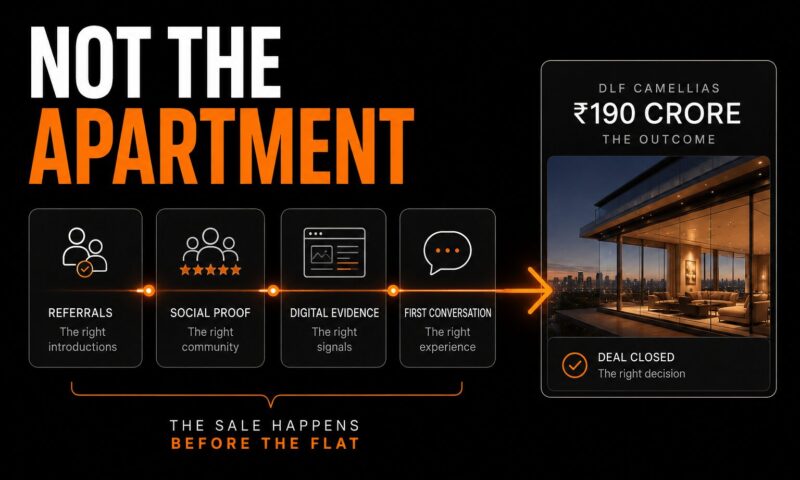
On December 2, 2024, a 16,290 square foot penthouse at DLF Camellias on Golf Course Road, Gurugram changed hands for Rs.190 crore.
The stamp duty alone was Rs.13 crore.
At Rs.1.8 lakh per square foot on carpet area, it set a new record. The most expensive high-rise condominium deal ever registered in the National Capital Region. The buyer was Rishi Parti, founder and MD of Info-x Software Technology, an angel investor who co-founded his company at 24 and has been building since.
That number is remarkable. But it is not the interesting part of the story.
The interesting part is what happened before December 2.
No portal generated that enquiry. No Facebook Lead Ad captured that buyer. No broker cold-called Rishi Parti and pitched him a penthouse. The transaction was the end of a process that looked nothing like what most people call real estate sales.
And inside that process is every principle that determines whether a Rs.5Cr buyer calls your brokerage, or the one down the road.
What People Think Sells a Rs.190Cr Apartment
Ask most brokers what sells a Camellias unit and they describe the product.
16,290 square feet. Floor-to-ceiling glass. A private elevator lobby. Views across the Aravalli ridge. A clubhouse that operates more like a private members club than a residential amenity. A roster of services that most five-star hotels would consider generous.
All of that is true. None of it is what sells the apartment.
The product earns the price. The relationship earns the decision.
This is the distinction that separates how ultra-premium real estate actually changes hands from how most people imagine it does. The apartment, with all its specification, is what the buyer points to when they justify the number to themselves or to their family. It is the rational justification for an identity decision that was made much earlier, on completely different grounds.
Understanding this distinction is the most important thing any brokerage principal can take from studying Camellias. Because the same dynamic operates at Rs.3Cr. At Rs.8Cr. At Rs.15Cr. Not with the same intensity. But with the same mechanics.
The Room Before the Flat
There is a consistent finding in environmental psychology research: the environment a buyer experiences before encountering the product they are evaluating functions as a trust anchor that shapes every judgment that follows.
This is why the world’s most expensive watches are displayed in rooms with low lighting, leather surfaces, and the quiet of a private library. Not because dim lighting makes the watch look better. Because the environment communicates, before a word is spoken, that serious things happen here.
DLF built Camellias with this understanding applied at an architectural level.
The arrival sequence is deliberate. The entry to the development, the security protocol that feels more like a private members club than a residential gate, the grounds, the experience centre, the lobby. Every element of that sequence communicates the same message to the prospective buyer: you are somewhere different from everything else you have seen in Indian residential real estate.
By the time the buyer enters the actual apartment, their reference frame has already shifted. They are no longer comparing it to other apartments at other price points. They are comparing it to the forty minutes they just experienced. Which is incomparable to almost anything else in India.
The Rs.190Cr price, at that point, becomes contextual. Not cheap. But consistent with what they have just experienced.
This is the mechanism. And it is available at every price point.
A brokerage presenting a Rs.5Cr listing is running the same sequence, whether it knows it or not. The sequence begins when the buyer Googles the firm’s name. When they open the website. When they receive the first WhatsApp message from an agent. When they walk into the office. Every one of those moments is the room before the flat.
The Resident List Is the Sales Pitch
Look at who owns apartments in DLF Camellias.
Peyush Bansal, founder of Lenskart. Aman Gupta, co-founder of boAt. Ashneer Grover, former founder of BharatPe. Deep Kalra, founder of MakeMyTrip. JC Chaudhry. A Singapore-based business tycoon who paid Rs.95 crore in February 2025. In September 2025 alone, four transactions were registered at Camellias with a combined value of Rs.270 crore.
This list is not incidental. It is the product.
What DLF Camellias sells, at its core, is membership in a specific social address. Not the address in the postal sense. The address in the social sense. The community of people who have concluded that this is where they want to live, and whose presence confirms to every subsequent buyer that the decision is correct.
This is what Robert Cialdini documented in his research on social proof: people determine what is correct by observing what people similar to them consider correct. In the context of Camellias, the social proof operates at every level. The resident list exists as evidence that people at a specific level of Indian business and professional life consider this the right address. Which makes it the right address. Which attracts more people at that level. Which strengthens the evidence.
The brokerage implication is direct: the question is not only which properties you are selling. The question is what community of buyers you are associated with. What your track record communicates about the calibre of the decisions that have been made through you. The visible evidence of who trusted you, and what happened.
The Referral Architecture: How These Deals Actually Find Their Buyers
In 2023, an 11,000 square foot apartment at Camellias changed hands in a resale transaction for Rs.114 crore. That deal did not come through MagicBricks. It came through a chain of relationships that connected a seller to a buyer who was at the right point in their financial life to make that decision.
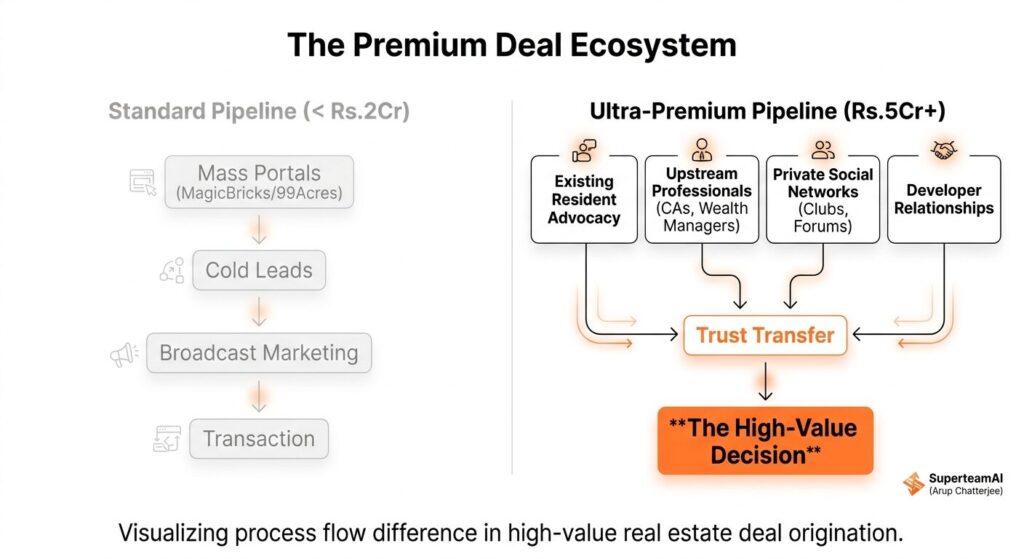
Ultra-premium real estate in India moves through four channels, in rough order of volume.
Existing residents as advocates. The most effective force in selling any Camellias unit is a current resident who mentions, at a dinner or a meeting or in passing, that a unit is available. Not as a broker. As someone sharing information with a peer. The difference in how that lands is enormous. A broker’s recommendation and a resident’s recommendation are categorically different signals.
Upstream trusted professionals. The CA who manages a buyer’s accounts knows when a liquidity event is approaching. The wealth manager knows when a portfolio rebalancing will free capital. The family lawyer knows when an estate is being reorganised. These professionals sit one decision upstream from the real estate transaction. The brokerage that has built genuine relationships with these professionals receives introductions that portals will never generate.
Private social networks. Business associations, golf clubs, alumni networks, industry forums. These are the environments where the mention of an available unit travels to exactly the right person without any broadcast mechanism.
Developer relationships. DLF’s sales team at this price point operates on a relationship model that looks nothing like conventional residential sales. There is a small number of people who understand exactly who in India can and would want to own a Camellias apartment, and they manage those relationships across years, not months.
The insight for a brokerage operating between Rs.2Cr and Rs.20Cr is not that portals are useless. At these price points portals still generate pipeline. But the transactions at the upper end, the deals that change the shape of the business, almost never originate from a portal enquiry.
They originate from relationships that were built before the deal existed.
What a Rs.5Cr Buyer Checks Before They Take the Call
A founder based in Bengaluru received a referral to a brokerage earlier this year. Strong referral, from someone he trusted. He was genuinely interested in a Rs.7.5Cr property in Whitefield.
Before calling the number he had been given, he did what most people at his professional level do.
He searched the firm’s name.
The website had not been updated in over a year. The most recent documented transaction was from eighteen months ago. The Instagram page had fourteen posts, all of them property photos with prices in the caption, the last one from seven months back. There were no case studies. No visible track record at the price point he was considering.
He did not call. He asked the referrer for another recommendation.
The brokerage had a genuine track record. Multiple completions in the Rs.5Cr to Rs.10Cr range. None of it existed anywhere a prospective buyer could find it. The referral created interest. The digital presence killed it before the conversation began.
This is now the standard operating reality for any brokerage serious about working above Rs.3Cr. The buyer does their own due diligence before the first call. What they find in those ten minutes determines whether they call.
They are not checking for design quality or social media follower counts. They are checking for evidence. Is there documentation that this firm has done what I am considering asking them to do? Are there visible signals that the people I will be speaking to understand this market at the price point I am operating in?
The Transferable Principle
DLF Camellias is not a replicable product. The price point, the developer resources, the decade of community-building, the physical infrastructure at Golf Course Road, none of that is available to a brokerage working in Sarjapur Road or Bandra or Hyderabad’s Financial District.
What is available at every price point is the underlying mechanic.
A Rs.3Cr buyer is making the same type of decision. Which community. Which neighbours. What the address communicates about where they are in their life. Whether the brokerage handling this transaction can be trusted with a decision of this magnitude.
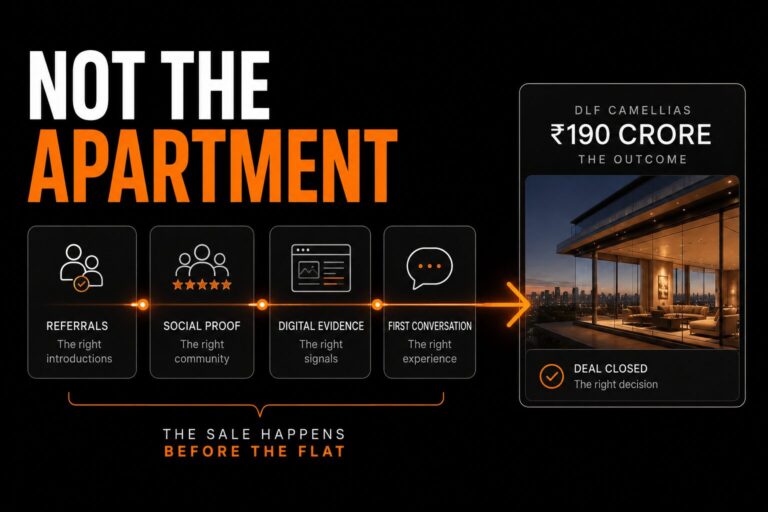
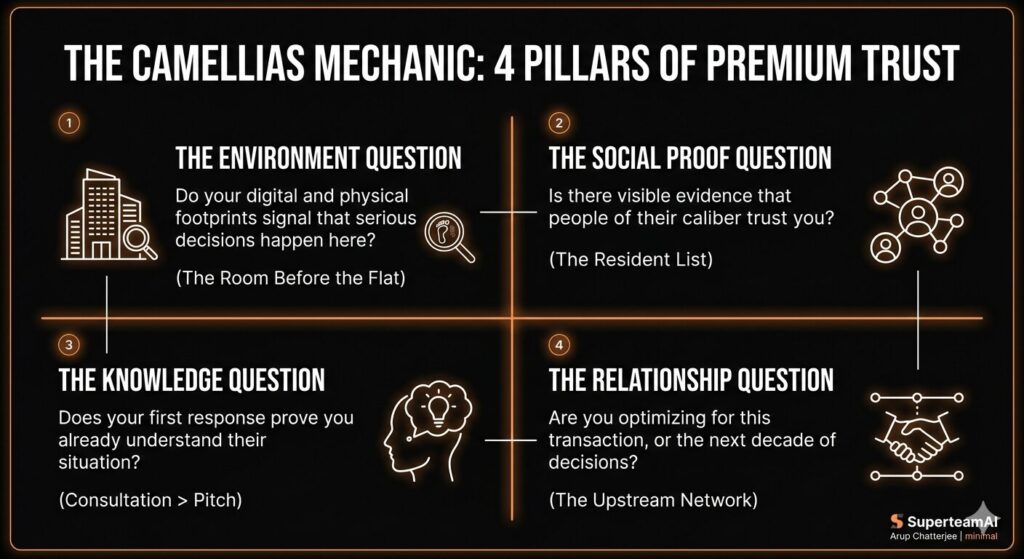
The Camellias model answers four questions correctly, at scale:
The environment question: Does everything about how this firm presents itself signal that serious decisions are made here?
The social proof question: Is there visible, specific evidence that people in the relevant position have trusted this firm with significant decisions?
The knowledge question: Does the first conversation demonstrate that the agent already understands the buyer’s situation?
The relationship question: Is this a transaction, or is this the beginning of something that will serve the buyer across multiple decisions?
The apartment was never what sold the apartment.
It was the room before the apartment. The residents already living in it. The professionals who made the introduction. The evidence that arrived before the conversation.
Every brokerage, at every price point, is sending those signals or failing to.
The Premium Listing Positioning Checklist
14 signals your brokerage sends that either build or break trust with a Rs.5Cr+ buyer, before you speak to them
SECTION 1: DIGITAL EVIDENCE
Signal 1 – Transaction Visibility
A serious buyer at Rs.5Cr+ will look for evidence that your brokerage has done this before, at this level. A strong track record that is invisible online is operationally equivalent to having no track record. The evidence has to exist where the buyer looks.
| What Most Brokerages Do | What To Do Instead |
| A generic “track record” page with no specifics. No documented transactions. Claims but no evidence. | A regularly updated portfolio of completed transactions with context: property type, location, price range, and what the buyer was trying to achieve. |
How to build this:
- List your last eight completed transactions above Rs.3Cr
- For each one, write four lines: property type, area, approximate value, and one sentence on the buyer’s situation
- Create a “Recent Transactions” page on your website
- Update it every time a significant deal closes
Signal 2 – Content That Demonstrates Market Knowledge
The buyer who finds your brokerage through a referral will read whatever you have published before they call. Generic content confirms nothing. Content that demonstrates real understanding of their specific market confirms the referral.
| What Most Brokerages Do | What To Do Instead |
| Property photos with prices on Instagram. Reshared developer marketing. A blog with three posts from two years ago. | Market intelligence specific to the areas and price points you operate in. A buyer researching Koramangala at Rs.6Cr to Rs.10Cr finds an article you wrote this quarter with actual price trend data for that corridor. |
How to build this:
- Pick one micro-market and one price segment your firm works in most
- Write 600 words about what is actually happening there right now: price per sqft trends, which projects are moving and which are stalling, what buyers at this price point are prioritising
- Publish it on your website and LinkedIn
- Repeat monthly. Six months of this changes what a buyer finds when they search
Signal 3 – Agent Credibility
A Rs.7Cr buyer will search the name of the agent they are about to meet. What they find tells them whether they are walking into a conversation with someone who knows this market, or with someone they will need to educate about it.
| What Most Brokerages Do | What To Do Instead |
| Agents with no LinkedIn presence, or profiles listing “real estate agent” with no history and no content. The search returns nothing useful. | Active LinkedIn profiles that document market focus, transaction history in general terms, and content that demonstrates knowledge. A buyer who searches the name before the meeting arrives with more confidence. |
How to build this:
- Have each senior agent spend two hours updating their LinkedIn profile: market focus, approximate transaction volume over the last two years, professional background
- Ask every agent to write one LinkedIn post per month about something they observed in their area, a price trend, a buyer behaviour pattern, a market development
- This is a one-time investment that permanently changes what a buyer finds before the call
Signal 4 – First Response to a Serious Enquiry
At Rs.190Cr, the enquiry does not arrive through a portal form. At Rs.5Cr to Rs.10Cr it often does. The experience of that first response tells the buyer whether they are dealing with a serious firm or an average one.
| What Most Brokerages Do | What To Do Instead |
| An automated message. A call two hours later from whoever was available, opening with “so what are you looking for?” A Rs.7Cr buyer treated identically to every other portal enquiry. | A response within fifteen minutes from a named agent who has reviewed the enquiry and demonstrably knows the property being asked about. The first call is a consultation, not a qualification exercise. |
How to build this:
- Designate one agent per day as the serious enquiry first-responder for all leads above a set price threshold
- That agent reviews every incoming enquiry before calling and prepares two or three specific things to say about the property or area
- Set a fifteen-minute response target during business hours and a two-hour target outside them
SECTION 2: SOCIAL PROOF
Signal 5 – Documented Client Experience
DLF Camellias does not need to tell anyone it is a good place to live. The resident list does that. Your brokerage needs an equivalent at its own scale: documented client experiences specific enough for a prospective buyer to assess.
| What Most Brokerages Do | What To Do Instead |
| Fourteen five-star Google reviews that say “great service, highly recommended” with no details. Testimonials attributed only to “happy client, Bengaluru.” Social proof so generic it could have been written by anyone. | Three to five case studies with enough specificity to be credible: the buyer situation, what they were trying to achieve, what the process involved, and the outcome. Named where the client consents. |
How to build this:
- Identify the last five clients who had a strong outcome with your firm
- Call each one and ask if they would be willing to share their experience
- Write it up as 200 words: their situation, what they needed, what happened
- Add it to your website and ask for a LinkedIn recommendation at the same time
Signal 6 – Community Presence
Rishi Parti did not buy his Rs.190Cr penthouse from a brokerage he found on a portal. He was in networks where that asset found him. Your Rs.5Cr to Rs.15Cr buyers have equivalent networks at their own scale. The brokerage present in those environments before the buyer has a requirement is the one that gets called when it emerges.
| What Most Brokerages Do | What To Do Instead |
| A brokerage known in real estate circles but invisible in the business and professional communities where buyers actually spend their time. No presence before the need arises. | A principal who speaks at a relevant business forum once a quarter. A market intelligence event hosted twice a year for a curated guest list. Relationships in two or three communities that overlap with the target buyer profile. |
How to build this:
- Identify two non-real estate environments where your target buyers are present: entrepreneur forums, alumni groups, industry associations, private clubs
- Join as a participant, not a sponsor
- Spend six months adding value through knowledge and connection before expecting business to emerge
Signal 7 – Referral Network Depth
The deals that define a brokerage’s reputation rarely come through portals. They come through the CA who mentioned your name to a client with new liquidity. The past buyer who told a colleague about their experience. The proportion of your pipeline from these channels is a direct measure of how embedded you are in the trust networks your target buyers operate in.
| What Most Brokerages Do | What To Do Instead |
| Over 80 percent of leads from portals. Referrals happen occasionally and feel like luck. Past clients who had excellent experiences but were never asked to refer anyone. | A referral architecture: systematic contact with past clients, relationships with three to five professionals in adjacent fields (wealth managers, CA firms, corporate lawyers) who serve the same buyer profile. |
How to build this:
- List every buyer who had a strong outcome with your firm in the last three years
- Call each one this month with genuine interest, not a pitch
- Ask if there is anyone in their network who might benefit from a market conversation
- Build relationships with two CA firms and one wealth management practice in your city: host a joint market intelligence breakfast for their clients once a year
SECTION 3: LISTING QUALITY
Signal 8 – Photography Standard
The Rs.190Cr penthouse was not photographed on a phone. The visual presentation communicated, before a single specification was read, that this was a serious asset at a serious price point. Every listing is an environment the buyer experiences before seeing the property.
| What Most Brokerages Do | What To Do Instead |
| Phone photographs on Rs.5Cr+ listings. Inconsistent lighting. Images taken quickly during the last agent visit. Photography that makes a Rs.5Cr apartment look like a Rs.2Cr one. | Professional photography with considered composition and lighting on every listing above the firm’s median price point. A buyer who sees the images before the price concludes: this looks like it costs what it costs. |
How to build this:
- Set a minimum photography standard: for any listing above Rs.3Cr, professional photography is mandatory, not optional
- Brief the photographer on the three or four shots that matter most for that specific property: the view, the kitchen, the master suite, the living room at natural light
- If a seller will not support the photography cost, include it in your commission discussion upfront
Signal 9 – Video That Earns the Site Visit
A Rs.7Cr buyer committing to a site visit is committing significant time, often involving their spouse, sometimes involving travel from another city. Without a proper video, the brokerage is asking for that commitment before making the case that it is worth making. A produced walkthrough changes the quality of buyers who show up.
| What Most Brokerages Do | What To Do Instead |
| No video. Or a phone-filmed walkthrough with traffic noise in the background. Content that reduces confidence rather than building it. | A two to three minute produced walkthrough showing the apartment, the views, the key design details, and the building amenities. A buyer who watches it arrives at the site already interested, not arriving to decide whether they are interested. |
How to build this:
- For every listing above Rs.4Cr, hire a professional camera operator for a two-hour shoot
- Structure the video in three parts: the arrival experience and building, the apartment in natural light, the key features with brief narration
- This costs Rs.15,000 to Rs.30,000 and directly improves the quality of the site visit pipeline
Signal 10 – Listing Description That Demonstrates Knowledge
A listing description written by someone who spent twenty minutes in the apartment reads like it. A listing description written by someone who understands why a buyer would choose this property over the alternatives reads like something very different. The writing tells a buyer whether they are dealing with an agent or an advisor.
| What Most Brokerages Do | What To Do Instead |
| Developer marketing copy pasted directly. A list of specifications. “3BHK, 2100 sqft, 2 parking, North-East facing, vastu compliant, ready to move in.” No context, no analysis, no indication the writer knows why this property is worth its price. | A description that addresses the buyer’s likely priorities. Location context that is specific and useful. A clear articulation of what makes this property distinctive within its price range. Evidence the agent understands the market and has thought about this particular buyer. |
How to build this: Answer these three questions for every listing above Rs.3Cr, then write from those answers.
- Why is this specific location valuable at this price point right now?
- What would a buyer who chose this over the alternatives be prioritising?
- What does this property offer that properties at the same price in a nearby area do not?
Answer those three questions in 200 words and you have a better listing description than 90 percent of what appears on the major portals.
SECTION 4: THE FIRST CONVERSATION
Signal 11 – Agent Preparation Before the Call
DLF’s sales team at the Camellias level knows exactly who they are speaking to before the conversation starts. At Rs.5Cr to Rs.15Cr, this level of preparation is achievable and almost never done. The agent who demonstrates knowledge of the buyer’s situation in the first thirty seconds signals immediately that this firm operates differently.
| What Most Brokerages Do | What To Do Instead |
| The agent asks the buyer to describe what they are looking for, having made no effort to know anything before the call. | The agent opens by demonstrating knowledge. “I can see you were looking at the unit in Koramangala. That particular floor has the best views in the building. Before I tell you more, can I understand specifically what you are looking for?” The buyer’s immediate reaction: this person has done their homework. |
How to build this: Before every call on an inbound lead above Rs.3Cr:
- Look at which property they enquired about and know it well before calling
- Search their name if it is available and note anything professionally relevant
- Have two or three specific, useful things to say before asking any qualifying questions
- This takes five minutes and changes the quality of every first impression
Signal 12 – Consultation Before Pitch
The Rs.190Cr buyer at Camellias was not pitched a penthouse. A relationship was built, over months, by people who understood what he was looking for and waited until the right asset existed. At every price point, the brokerage that listens more than it talks in the first conversation closes at a higher rate.
| What Most Brokerages Do | What To Do Instead |
| The first call is 70 percent the agent talking about the property, the development, and the firm’s credentials. The buyer has to interrupt to explain what they actually need. | The first conversation is 70 percent the agent asking and listening. What is driving the decision? What have they already seen and why did it not work? What matters most and what can be compromised on? Properties are discussed after. When they are, they are genuinely matched rather than broadcast. |
How to build this:
- Before the next five serious first calls, write down the five things you need to know before you can make a useful recommendation
- Ask those five things before mentioning a single property
- Do not share your first property suggestion until you have confirmed you understand the buyer’s priorities
Signal 13 – Follow-Up That Demonstrates Effort
The follow-up after a first conversation is the most visible test of whether a brokerage is an advisor or a listing service. A follow-up that forwards three random properties with no context demonstrates the latter. A follow-up that references what the buyer said and shows curated thinking demonstrates the former.
| What Most Brokerages Do | What To Do Instead |
| A WhatsApp message two days later: “any update?” Or three listings forwarded with no explanation of why they were selected. Nothing from the conversation was demonstrably retained. | A follow-up within 24 hours that references specific details from the conversation, presents two or three properties with reasoning for each, and asks one question that moves the decision forward. |
How to build this:
- After every serious first conversation, write three things the buyer told you that will guide your recommendation
- Only send properties that connect directly to those three things
- For each property in the follow-up, write one sentence explaining why it matches what the buyer said
Signal 14 – Long-Term Relationship Over Single Transaction
The referral network that DLF Camellias runs on, where existing residents introduce prospective buyers, exists because residents trust the decision they made enough to recommend it to people they care about. That level of advocacy is only generated when the buyer believes the brokerage acted in their interest. This is how a brokerage builds a pipeline that does not depend on portals.
| What Most Brokerages Do | What To Do Instead |
| Contact stops immediately after the buyer does not commit on the first or second viewing. Or contact continues but is entirely transactional: “are you ready to proceed?” No value is being added. | The buyer who visited two properties six months ago and did not buy still hears from you quarterly with something genuinely useful: a market update for the area they were considering, a new listing that actually matches what they described, a relevant development in the corridor they were watching. |
How to build this:
- List every buyer who visited a property with your firm in the last twelve months and did not complete a transaction
- For each one, note what area and price range they were considering
- Put them into a quarterly contact schedule
- Every quarter, send one piece of genuinely useful market information specific to their search area. Not a pitch. Not a new listing blast. Information relevant to the decision they are still making.
Reading the Checklist
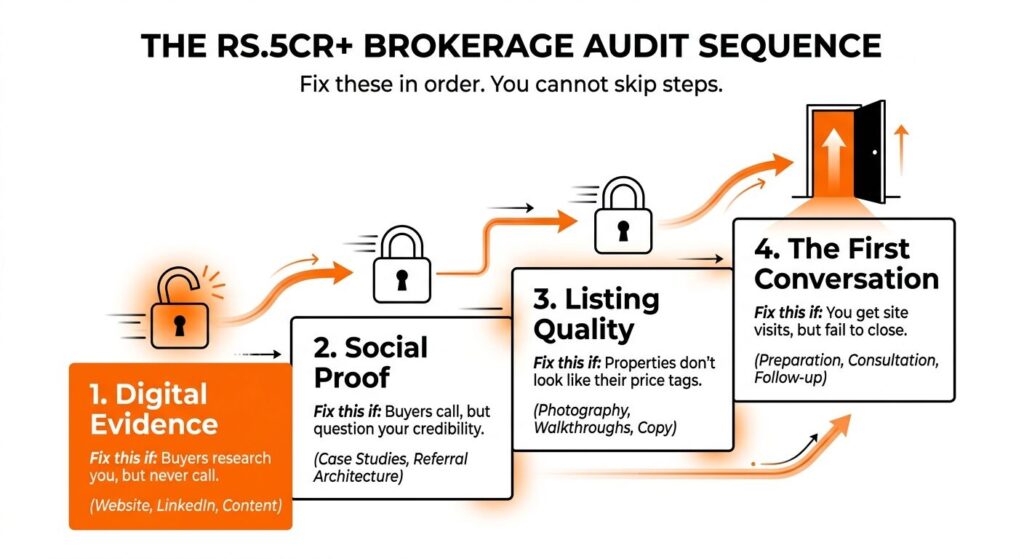
Go through all 14 signals and note which ones have a gap between the left column and the right column in your brokerage right now.
If most gaps are in Section 1 (Digital Evidence): Your positioning is not reaching serious buyers before they make their first judgement about you. Fix the website and content first. Everything else compounds from there.
If most gaps are in Section 2 (Social Proof): Buyers are finding you but not finding evidence that confirms you. Documented transactions and structured referral cultivation are the priority.
If most gaps are in Section 3 (Listing Quality): The properties you are presenting are not being shown at the standard their price point requires. Photography and video are the fastest wins.
If most gaps are in Section 4 (First Conversation): The pipeline is arriving but the conversion is leaking. Agent preparation and consultation discipline are the fix.
Most brokerages will find gaps across all four sections. The sequence matters: fix digital evidence first, because nothing in sections two, three, or four works if a buyer has already decided not to call.