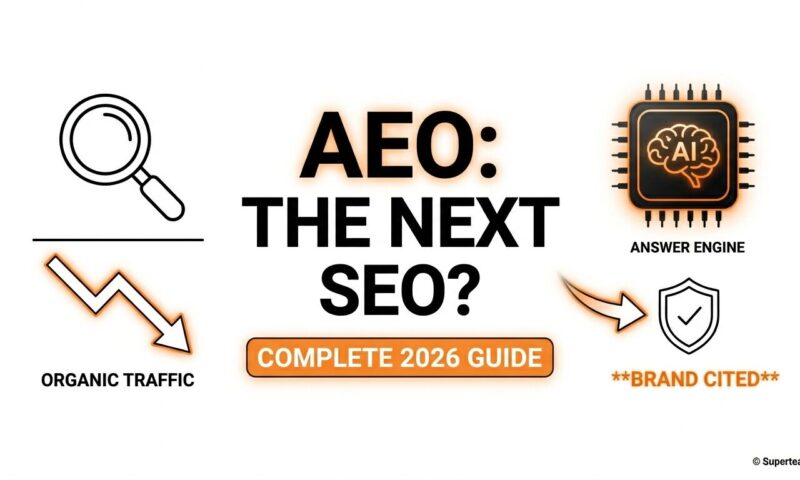
Over 65% of searches today end without a single click to a website. Users get their answer directly from an AI system, a featured snippet, or a voice assistant, and they move on. The click-through rate for the number one ranked result dropped from 0.73 to 0.26 between March 2024 and March 2025, a 64% reduction in 12 months. If your growth strategy depends entirely on ranking on page one, it is producing diminishing returns right now.
This guide explains what answer engine optimization (AEO) is, why it has become essential for any serious content and SEO program in 2026, and how to implement it. We cover the technical mechanism, the strategic framework, platform-specific tactics, and what B2B companies specifically need to know about AI citation.
In our work building AI-powered SEO systems for B2B companies, we have watched this shift accelerate faster than most teams anticipated. The organizations winning in AI search are the ones who restructured their content to be extractable, citable, and authoritative before their competitors did. This guide gives you the framework to do the same.
What Is Answer Engine Optimization (AEO)?
Definition: Answer Engine Optimization (AEO) is the practice of structuring and formatting content so that AI-powered systems can extract it and present it as a direct answer to a user’s query, with a citation back to the original source.
Where traditional SEO focuses on ranking a page at the top of a search engine results page, AEO focuses on becoming the source that an AI system quotes when it generates a response. SEO works at the page level (titles, keywords, backlinks). AEO works at the fact level: clear definitions, citable statistics, and independently understandable sections that AI models can lift and use directly.
The distinction matters because the two goals require different content structures. A page optimized for an organic ranking position needs a compelling meta title and keyword-rich body copy. A page optimized for AI citation needs a clean, direct answer in the first sentence of every section, inline citations to authoritative sources, and structured data that signals to AI crawlers exactly what each piece of content is.
Both are necessary in 2026. Neither replaces the other.
Which Platforms Are Answer Engines?
Answer engines are any AI-powered system that generates a direct response to a user query by pulling from external content sources. The major platforms as of Q2 2026 are listed below.
| Platform | Monthly Active Users | Primary Query Type | AEO Priority |
| ChatGPT (Browse) | 883 million | Research, comparisons, recommendations | Critical |
| Google AI Overviews | Appears in ~55% of all Google searches | Informational, how-to, definitions | Critical |
| Perplexity | 100 million+ | Research-oriented, cited answers | High |
| Gemini | 350 million+ | Conversational, Google-integrated | High |
| Bing Copilot | 140 million+ | Web search, productivity | Medium |
Each platform has a different retrieval approach, content preference, and citation behavior. Platform-specific tactics are covered in detail later in this guide.
Why AEO Matters More Than Ever in 2026
The urgency for AEO in 2026 is not theoretical. The data describes a structural shift already underway.
According to EMARKETER, 31.3% of the US population will use generative AI search in 2026. Gartner forecasts that organic search traffic to commercial websites will decline 25% by the end of 2026 as AI answer engines absorb information-seeking queries that once drove clicks. AI referrals to top websites surged 357% year-over-year between June 2024 and June 2025, and that growth rate has not slowed.
The implication is direct: if you are not optimized for AI citation, you are losing brand visibility in the channel that is growing fastest.
The Rise of Zero-Click Search
Key Stat: 60% of sources cited by AI are not in Google’s top 10 organic results. (2025-2026 research data)
This is the most important number in this guide. More than half of the content getting cited by AI systems today would not be found by a user scrolling through Google’s first page. AI citation and organic ranking are related but separate outcomes. You can rank well and still not get cited. You can also get cited regularly from a position that would never drive meaningful organic traffic on its own.
This creates both a risk and an opportunity. The risk: companies that optimized only for traditional SEO rankings are invisible to the fastest-growing search channel. The opportunity: companies that build AEO into their content strategy now can earn citation presence in AI systems regardless of whether they rank in the top ten for every keyword.
AI Referral Traffic and What It Means for Your Business
AI referral traffic currently accounts for 1.08% of all website traffic across major industries. That figure may seem small. In context, it represents millions of brand impressions happening inside AI-generated answers before a user ever visits your website.
More importantly, the quality of that traffic is significantly higher than traditional search. Users arriving via AI citation convert at 3 to 4 times the rate of standard organic traffic, according to 2026 measurement data. They arrive pre-qualified: the AI has already provided context about your brand, your positioning, and your relevance to their question. When they click through, they already understand why they are there.
ChatGPT accounts for 87.4% of all AI referral traffic across industries, making it the dominant platform by a significant margin. Perplexity and Google AI Overviews follow, but the gap is substantial.
AEO vs. SEO vs. GEO: Understanding the Difference
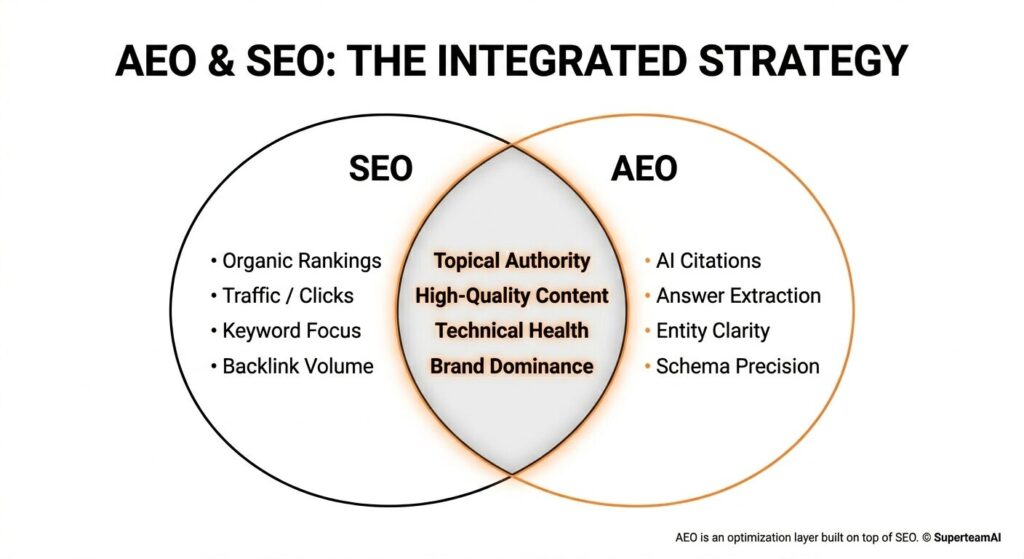
These three terms circulate widely in 2026 with inconsistent definitions. Here is a clear breakdown.
| Dimension | SEO | AEO | GEO |
| Goal | Rank in organic search | Be cited in AI-generated answers | Be recommended across all generative AI platforms |
| Optimizes For | Ranking position, CTR | Citation frequency, answer extraction | Brand visibility, AI recommendation share |
| Key Tactics | Keywords, backlinks, technical health | Answer-first structure, schema, entity clarity | Authoritative sourcing, brand entity signals, topical depth |
| Measured By | Rankings, traffic, clicks | Citation frequency, AI SERP presence | Share of AI recommendations, citation sentiment |
| Platforms | Google, Bing | ChatGPT, Perplexity, Google AI Overviews, Gemini | All generative AI platforms, voice assistants, AI agents |
| Relationship | Foundation layer | Built on SEO | Encompasses both SEO and AEO |
Do You Need AEO If You Already Do SEO?
Yes. A strong SEO foundation is a prerequisite for effective AEO: Google AI Overviews draw heavily from pages already ranking in the top ten. But SEO alone is no longer sufficient. The 64% CTR drop for number one ranked pages illustrates this directly. You can hold the top position and watch organic traffic decline because AI systems are answering the query before users click. AEO is not a replacement for SEO. It is the optimization layer built on top of it.
The Relationship Between AEO and GEO
GEO (Generative Engine Optimization) is the broader discipline covering all strategies for brand visibility across generative AI platforms. AEO is the specific subset focused on the answer-retrieval layer: being cited as a source when an AI generates a direct answer. Most AEO best practices are also GEO best practices. Think of AEO as the tactical execution layer within the broader GEO strategy.
How Answer Engines Actually Work
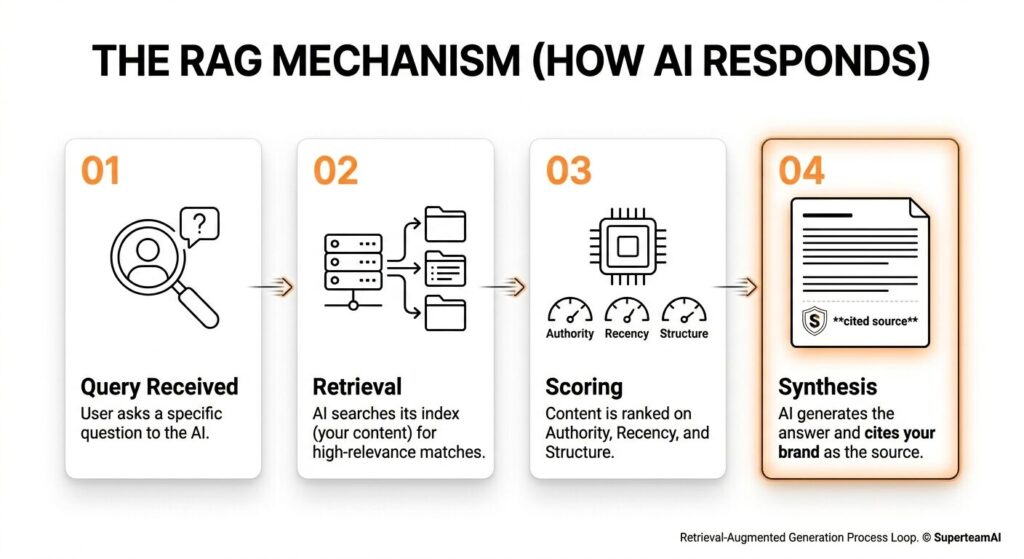
Most answer engines use a Retrieval-Augmented Generation (RAG) process. The system receives a query, searches an indexed content corpus, scores candidate sources, and generates a response that synthesizes the highest-scoring results with citations.
Content gets scored on four primary dimensions: relevance (does this content directly answer the query?), authority (is this source trustworthy and well-cited?), recency (how recently was this content published or updated?), and structural quality (can the AI system extract the answer cleanly without disambiguation?).
Your goal in AEO is to score well across all four dimensions, not just relevance.
What Makes Content “Citable” to AI Systems?
AI systems prefer content that is independently understandable at the section level. Each section must make sense as a standalone answer without requiring the reader to have consumed the rest of the article. A direct answer in the first two sentences of every section dramatically increases extractability. Inline citations to authoritative sources also increase citation probability: AI engines trust content that cites its sources because it signals the information has been verified, not just asserted.
The Freshness Factor
AI-surfaced URLs are 25.7% fresher on average than URLs surfaced by traditional search. Brands leading in AEO update their highest-priority content quarterly, not annually. Refreshing statistics, adding new platform-specific guidance, and updating internal links is often enough to reset the freshness signal without a full rewrite.
The AEO Hierarchy: Where to Start
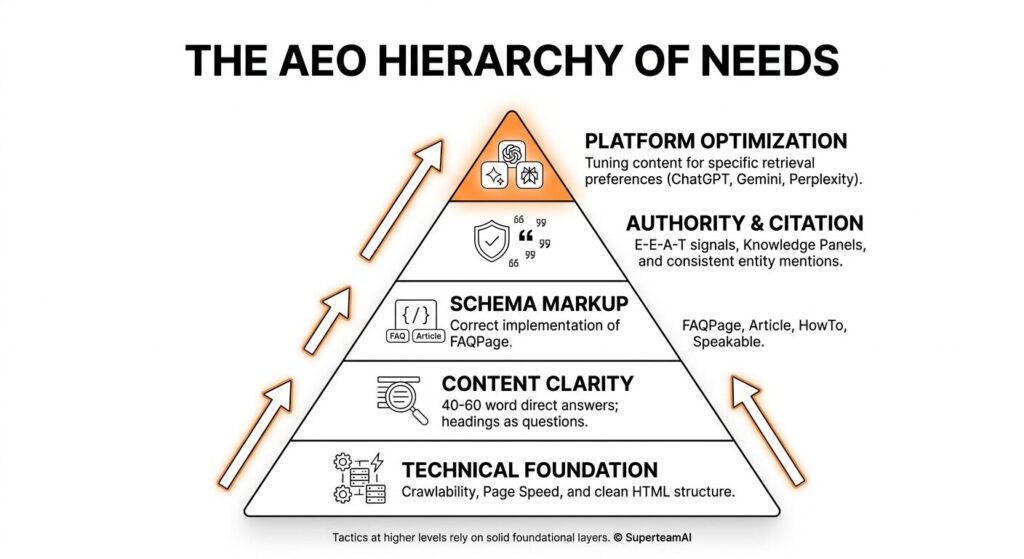
The most common AEO failure we see: a team adds FAQPage schema to their site and wonders why nothing changes. The reason is almost always that foundational layers are not solid yet.
After building AI-integrated SEO programs across dozens of B2B companies, we developed the AEO Hierarchy of Needs. It defines the order in which AEO optimizations create compounding returns. Tactics at a higher level do not work reliably if lower levels are not solid first.
Level 1: Technical Foundation The AI can crawl, render, and index your pages. Pages load quickly. HTML is clean and well-structured. Without this, no AEO tactic above it matters.
Level 2: Content Clarity Every section opens with a direct answer in 40 to 60 words. Headings are framed as questions. Content is structured so individual sections make sense in isolation.
Level 3: Schema Markup FAQPage, Article, HowTo, and Speakable schemas are implemented correctly. This tells AI crawlers exactly what type of content each section contains.
Level 4: Authority and Citation Quality The content cites authoritative external sources. The brand has a clear entity presence (Knowledge Panel, Wikipedia, consistent mentions across high-authority sites). E-E-A-T signals are strong.
Level 5: Platform-Specific Optimization Content is tuned for the specific retrieval preferences of ChatGPT, Perplexity, Google AI Overviews, and Gemini individually.
Most teams jump to Level 5. The brands winning in AI citation have all five levels working together.
Building an AEO-integrated content strategy from scratch? Superteam AI’s AI SEO Workforce executes every layer of this hierarchy for clients, from technical foundation through platform-specific optimization.
Core AEO Optimization Techniques
Write Direct Answers First (The 40-60 Word Rule)
Every section in an AEO-optimized article should open with a direct, self-contained answer in 40 to 60 words. This is the single most impactful structural change most content teams can make. Research shows 55% of AI citations come from the first 30% of a page. Getting your answer in early is not just good for readers: it is what gets you cited.
Compare two openings for a schema markup section. The weak version starts: “Schema markup is an important topic for SEO professionals to understand. In this section, we will walk through the different types of schema…” That delays the answer by two full sentences. The strong version starts: “Schema markup is structured data added to your HTML that tells AI systems exactly what type of content a page contains.” The second version is citable in the first sentence. The first is not.
Use Question-Based Headings
Headings framed as questions directly mirror how users query AI systems. “How does AEO differ from traditional SEO?” outperforms “AEO vs. SEO Overview” for AI citation purposes because it matches the query language exactly. Every H2 and H3 in your content is a potential citation trigger. Frame them as the questions your audience is actually asking.
Implement Schema Markup
| Schema Type | Use Case | AEO Impact | Priority |
| FAQPage | FAQ sections with Q&A pairs | Very High | Required |
| Article | Standard blog posts and guides | High | Required |
| HowTo | Step-by-step instructional content | High | Situational |
| Speakable | Content suitable for voice/audio AI responses | Medium-High | Recommended |
| BreadcrumbList | Site navigation structure | Medium | Recommended |
FAQPage schema is the highest-impact implementation for most sites. It marks up your Q&A content so AI systems can directly extract question-and-answer pairs without interpretation. Speakable schema is increasingly relevant as AI voice assistants and audio-capable AI systems use it to identify content appropriate for spoken delivery.
Optimize for Entity Recognition
AI models process information through entity recognition before keyword analysis. Your brand and core topics need to be recognizable as defined entities, not just keyword strings. Practical steps: maintain an accurate Google Knowledge Panel, build consistent brand mentions across high-authority reference sites, and use one consistent entity name across all content (not “AI SEO,” “AI-powered SEO,” and “SEO AI” interchangeably).
Build Topical Authority Through Content Clusters
AI systems prefer sources that cover a topic comprehensively. A single excellent article on AEO is less citable than a site with 15 articles covering AEO from multiple angles: definition, implementation, measurement, platform-specific guides, and industry applications. Use a cluster architecture: a pillar page covers the broad topic, cluster articles cover specific subtopics, and each reinforces the other’s citation authority.
Keep Your Content Fresh
Quarterly updates are the standard cadence for brands that consistently earn AI citations. Each update should refresh statistics with current data, add any new platform-specific guidance, update internal links to point to recently published content, and check that all cited sources are still live and authoritative. A well-structured content update takes two to three hours and resets the freshness signal for another quarter.
Platform-Specific AEO: How to Optimize for Each Answer Engine
The major answer engines do not all use the same retrieval logic. Optimizing generically produces average results across all platforms. Optimizing specifically produces citation wins on the platforms that matter most for your audience.
| Platform | Content Format Preference | Schema Priority | Freshness Weight | Key Citation Trigger |
| Google AI Overviews | Top-10 organic content, featured snippet format | FAQPage, Article | Medium | Strong SEO + answer-first structure |
| ChatGPT Browse | Long-form, authoritative, well-cited | Article, FAQPage | Low-Medium | Clear definitions, high authority score |
| Perplexity | Fresh, well-cited, research-oriented | Article | High | Recent publication date + inline citations |
| Gemini | E-E-A-T heavy, Google-index-aligned | All schema types | Medium | Google ranking + E-E-A-T signals |
AEO for Google AI Overviews
Google AI Overviews draw primarily from pages already ranking in the top 10 organic positions, which means your SEO foundation directly feeds your citation rate here. Optimize for featured snippets (the structured answer format that most often becomes an AI Overview source), implement FAQPage schema across all informational content, and use H2 and H3 headings that match common query formulations. AI Overviews appear in approximately 55% of all Google searches, making this the highest-volume AEO opportunity for most businesses.
AEO for ChatGPT
ChatGPT accounts for 87.4% of all AI referral traffic, making it the dominant platform for actual website clicks from AI citation. It prioritizes authoritative long-form content with inline source citations and clear entity definitions. One tactic that consistently improves ChatGPT citation: include a “Definition:” formatted statement for every core concept you cover. ChatGPT’s retrieval logic responds strongly to content that defines terms precisely and cites supporting data inline.
AEO for Perplexity
Perplexity weights freshness more heavily than other platforms. It favors recently published or updated articles with visible publication dates and inline citations to research or authoritative reports. A well-cited article published two weeks ago will often outperform a more comprehensive article published 18 months ago. When you update content, make sure the updated date is visible in the HTML and in your Article schema’s dateModified field. Perplexity reads both signals.
AEO for Gemini
Gemini is deeply integrated with Google’s existing search index, so E-E-A-T signals carry significant weight. Content that demonstrates first-hand expertise, cites authoritative external sources, and has strong backlink authority performs best. Gemini often cross-references against Google’s own index, making the SEO-AEO relationship particularly tight for this platform. A strong organic ranking is close to a prerequisite for consistent Gemini citations.
AEO for B2B Companies: What’s Different
Most AEO guides are written for broad consumer search. B2B has a distinct set of dynamics that change the implementation priorities.
B2B Queries Are Different
B2B search queries are more specific, lower in individual volume, and longer-tail than consumer queries. A B2B buyer searching for “multi-channel inventory management software for Indian e-commerce” is far more targeted than a consumer searching for “inventory app.” The lower volume means less competition for AI citation and a higher probability of owning the citation for that specific query entirely.
For B2B AEO, depth on niche topics outperforms breadth on general topics. A comprehensive article on a narrow B2B pain point will earn AI citations more reliably than a generic overview competing with major consumer publications.
The B2B Buying Journey and AEO
In 2026, AI search is involved at multiple stages of the B2B buying journey, not just the awareness stage. When a procurement team asks ChatGPT “who are the best AI SEO agencies for B2B SaaS?” or a founder asks Perplexity “what does a good content operations system look like?”, being cited in that response is the equivalent of appearing on a shortlist before the buyer has even opened a browser tab.
We have seen this dynamic directly with B2B clients. Companies that built AEO-optimized content around their target buyer’s specific questions started appearing in AI-generated research summaries that prospects shared internally during evaluation. That visibility does not show up in traditional attribution models, but it drives real pipeline.
This is the problem our Inbound Lead Engine service was built to solve. We build the full organic growth channel, including AEO-optimized content architecture, so your brand gets cited when the right buyers ask AI systems about your category. You transfer the knowledge. We build and run the system.
Ready to make sure your brand appears when your target buyers ask AI systems about your category? Talk to our team.
How to Measure AEO Performance
AEO measurement is more complex than traditional SEO measurement because citation tracking requires tools beyond Google Search Console. A structured measurement approach covers three layers.
| Metric Category | Specific Metric | How to Measure | 2026 Benchmark |
| Visibility | AI citation frequency | Profound, OmniSEO, BrightEdge | Track week-over-week |
| Visibility | Competitive citation share | AEO monitoring tools | % of category queries where you appear |
| Visibility | Google AI Overview appearances | Google Search Console (AI Overview filter) | Track impressions, not just clicks |
| Engagement | AI referral traffic | GA4 source/medium (AI platforms as referrers) | Benchmark against prior period |
| Engagement | AI referral conversion rate | GA4 goal completions from AI referral sources | Target 3x standard organic rate |
| Business Impact | Pipeline attributed to AI citation | CRM first-touch attribution | Directional; exact attribution is still maturing |
| Business Impact | Brand mention sentiment in AI responses | Manual spot-checking + AI monitoring tools | Positive framing, accurate product description |
Tools for Tracking AEO and AI Citation
The AEO monitoring tooling landscape is still maturing as of 2026. Leading options include Profound (multi-platform AI citation tracking, competitive share of voice), OmniSEO (strong on Google AI Overview monitoring), BrightEdge (enterprise-grade, AI search module built into an existing platform), and Semrush’s emerging AI Toolkit for teams already in the Semrush ecosystem. Treat all AEO benchmark data as directional rather than absolute. The priority now is establishing your baseline and tracking movement quarter-over-quarter, not chasing metric precision.
Common AEO Mistakes to Avoid
Optimizing for AEO before fixing technical foundations. Schema and answer-first writing do nothing if AI crawlers cannot reliably access your pages. Run a technical audit first.
Treating AEO and SEO as competing strategies. The best AEO programs are integrated with SEO, not separate from it. A strong organic ranking feeds AI Overview citations. AEO structure improves featured snippet capture. They compound together.
Writing “answer-first” paragraphs that are too thin. The 40-60 word direct answer at the top is the citation hook. The 400 to 600 words that follow build the authority that makes the source credible enough to cite. Thin supporting content means you get skipped.
Mis-implementing schema markup. Invalid JSON-LD or misapplied schema types actively confuse AI crawlers. Validate every implementation with Google’s Rich Results Test before publishing.
Focusing only on Google while ignoring ChatGPT. ChatGPT drives 87.4% of AI referral traffic. Google AI Overviews drive volume. Both require attention.
Treating AEO as a one-time project. Freshness is a sustained signal. The brands consistently earning citations have built quarterly update cycles into their content operations.
Frequently Asked Questions About Answer Engine Optimization
Q: What is the difference between answer engine optimization and SEO?
SEO optimizes your content to rank on a search engine results page, earning organic clicks. Answer engine optimization (AEO) optimizes your content to be extracted and cited by AI systems like ChatGPT, Perplexity, and Google AI Overviews when they generate direct responses to queries. The two are complementary: a strong SEO foundation supports AEO performance, and AEO-structured content often improves featured snippet capture and reduces pogo-sticking, which benefits organic rankings.
Q: How does answer engine optimization work?
AI answer engines use Retrieval-Augmented Generation (RAG): the system searches an indexed content corpus, scores candidate sources on relevance, authority, recency, and structural quality, then synthesizes a response with citations. AEO structures your content to score well on all four dimensions: answer directly at the top of each section, demonstrate authority through external citations, update regularly, and format content cleanly so AI systems can extract standalone answers without ambiguity.
Q: How long does it take to see results from AEO?
Results vary by platform. On Perplexity, fresh, well-cited content can earn citations within days. On Google AI Overviews, you typically need a top-10 organic ranking first, which takes weeks to months. ChatGPT citation frequency builds steadily over months as content accumulates authority. AEO is a compounding channel: expect meaningful results within 3 to 6 months, with acceleration after that. It is not a paid channel with instant returns.
Q: Do I need to create separate content for AEO, or can I update existing pages?
You do not need separate content. Updating existing high-performing pages is more efficient. Core updates: add 40-60 word direct answers at the top of each major section, reframe H2 and H3 headings as questions, implement FAQPage schema, add inline citations to authoritative sources, and keep Article schema dateModified accurate. For new content, build AEO structure from the start. Citation improvements from updated pages can appear within weeks.
Q: Is AEO the same as GEO (Generative Engine Optimization)?
Related but distinct. AEO focuses on the answer-retrieval layer: being cited as a source when an AI generates a direct answer. GEO covers all strategies for brand visibility across generative AI platforms, including brand recommendation and share of AI-generated content. AEO best practices are a core subset of GEO. Building a strong AEO program creates the foundation that makes broader GEO strategy effective.
Q: Which AI platform should I prioritize for AEO?
Priority order for most B2B businesses in 2026: ChatGPT first (87.4% of AI referral traffic), Google AI Overviews second (highest impression volume), Perplexity third (smaller but high-intent audience). The core AEO practices that help on one platform, answer-first structure, schema markup, authority signals, and regular updates, transfer across all platforms. Platform-specific tuning is the advanced layer once the foundation is solid.
Q: What is the best answer engine optimization tool for tracking AI citations?
Leading tools in 2026: Profound (multi-platform AI citation tracking), OmniSEO (Google AI Overview focus), BrightEdge (enterprise), and Semrush’s emerging AI Toolkit. None match the precision of Google Search Console for traditional SEO yet. Use them for directional insight and quarter-over-quarter tracking. Establish your baseline now and refine your measurement approach as the tooling matures over the next 12 to 18 months.
Q: Do I need an agency or specialist team to implement AEO?
Levels 1 through 3 of the AEO Hierarchy (technical foundation, content clarity, schema markup) are achievable with a capable in-house team. Most teams hit limits at Levels 4 and 5: building topical authority across a full content cluster and optimizing for platform differences across ChatGPT, Perplexity, Google, and Gemini. At that stage, teams often work with specialists like Superteam AI’s AI SEO Workforce, which runs the full AEO-integrated content program with human approval at key checkpoints.
Key Takeaways
The most important things to carry forward from this guide:
- AEO is not optional in 2026. With 60% of AI-cited sources absent from Google’s top 10 and AI referrals surging 357% year-over-year, brands that do not optimize for AI citation are losing visibility in the fastest-growing search channel. This is a structural shift, not a trend.
- AEO and SEO are not competing strategies. They work together. A strong organic ranking position feeds AI Overview citations. AEO-structured content improves featured snippet capture. The highest-performing programs treat them as an integrated system.
- The AEO Hierarchy matters. Schema markup and platform-specific tactics only produce results if the technical foundation and content clarity layers are solid first. Build from the bottom up, not the top down.
- Answer-first structure is the single highest-impact change. Every section opening with a direct 40-60 word answer dramatically increases AI extractability. This is the one technique that delivers improvements across all platforms simultaneously.
- For B2B companies, AI citation is the new shortlist. When your target buyers ask AI systems about your category, being cited in that response is pre-pipeline brand presence. Building AEO into your content strategy now positions your brand before the buying journey formally begins.
The organizations building and running well-structured, AEO-optimized content programs in 2026 are compounding an advantage that will be progressively harder to close. The cost of starting now is a few weeks of content restructuring. The cost of starting 18 months from now is trying to close a citation gap against competitors who have been earning authority signals for a year and a half.
The Fastest Way To Upgrade Your Entire Growth Operation.
For the cost of one software subscription, you get the execution power of an elite team without burnout, overhead, or delays. This is how modern companies scale smarter.


