Here is the uncomfortable truth about voice search SEO: most guides written for it are already out of date.
The strategies that dominated the conversation from 2018 through 2023 (optimize for the featured snippet, target question keywords, speed up your site) were built for a world where Siri or Google Assistant read a position-zero result aloud to a user. That world still exists. But in 2026, it accounts for a shrinking share of how voice-delivered answers actually reach people.
Today, the dominant voice answer systems are ChatGPT voice mode, Perplexity, Google AI Overviews read aloud, and Gemini. These platforms do not simply retrieve a featured snippet and read it verbatim. They synthesize answers from multiple sources, weight content by credibility and structure, and generate a spoken response your content may or may not be cited in.
In building answer engine optimization programs for B2B companies, we have watched this shift happen in real time. The teams that are winning in voice and AI-delivered search in 2026 are not the ones that optimized their meta descriptions for Alexa. They are the ones that treated voice search optimization as part of a broader content authority strategy aimed at AI systems.
This guide covers what voice search SEO actually requires in 2026 and how to build a content program that ranks in both traditional voice results and AI-generated answers.
Why Voice Search SEO Changed in 2026
The shift did not happen overnight, but the cumulative impact is now impossible to ignore.
The Old Voice Search Model (2019-2023)
For most of the last decade, voice search SEO followed a predictable logic. A user would speak a query into Google Assistant, Siri, or Alexa. The device would identify the featured snippet for that query (the short answer box at the top of Google’s search results) and read it aloud. Winning voice search meant winning position zero.
This model drove a specific set of tactics: write concise 40-50 word answers, format content with clear headers and bullet points, target long-tail question queries, and get your page into that featured snippet slot. The playbook was well-defined.
The New Model: Conversational AI as the Voice Layer (2024-2026)
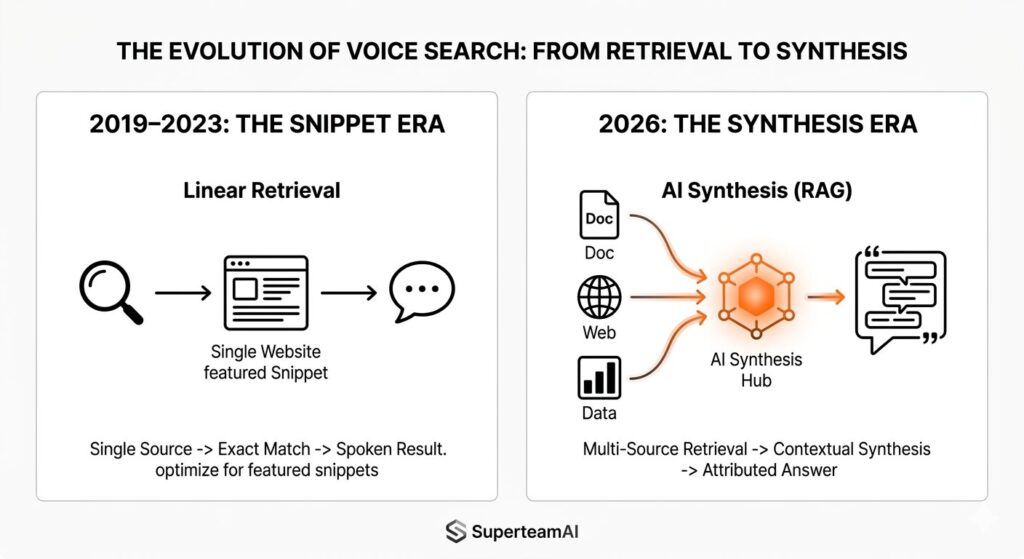
Then came ChatGPT voice mode in late 2023, followed by Perplexity’s voice interface, Google’s AI Overviews being read aloud through Google Assistant, and Gemini Live. Each of these systems handles voice queries fundamentally differently from the old model.
When a user asks ChatGPT a question by voice, the system does not find one featured snippet and read it. It retrieves information from multiple sources using retrieval-augmented generation (RAG), synthesizes a response, and attributes portions of the answer to sources it deems authoritative. Your content may be cited, paraphrased, or excluded entirely based on signals that rank trackers cannot measure.
The result is a two-layer reality in 2026. Traditional voice search (Siri reading position zero) still exists. AI-delivered voice answers (ChatGPT, Perplexity, Gemini) are growing faster and reaching more users. Effective voice search SEO in 2026 means optimizing for both simultaneously.
What Voice Search SEO Means in 2026
Definition: Voice search SEO is the practice of optimizing content to be selected, cited, and delivered as a spoken answer by voice-activated devices and conversational AI platforms. In 2026, this includes traditional voice assistants (Google Assistant, Siri, Alexa), AI answer engines operating in voice mode (ChatGPT, Perplexity, Gemini), and Google AI Overviews rendered audibly. Effective voice search SEO requires content that is conversationally structured, schema-marked, factually dense, and authoritative enough for AI systems to cite with confidence.
This is where voice search SEO and answer engine optimization converge. The content that earns featured snippets and AI citations is the same content that gets delivered as voice answers. They are not separate disciplines. They are the same discipline applied to different delivery surfaces.
Voice Search by the Numbers: What 2026 Data Shows
The scale of voice search justifies the investment. But the right statistics are not the ones most guides lead with.
Table 1: Voice Search and AI Search Statistics (2026)
| Statistic | Figure | Source | Implication |
| Voice assistants in use worldwide | 8.4 billion | DemandSage | More voice interfaces than people: scale is not a future trend, it is now |
| US voice assistant users by 2026 | 157 million | DemandSage | Majority of US internet users have voice access |
| Voice/conversational queries as share of all search | 27%+ | ConnectionModel | More than 1 in 4 queries has a voice or conversational input |
| Voice answers pulled from featured snippets | 40.7% | Backlinko / Semrush | Still critical for traditional voice SEO, but declining share as AI answers grow |
| Voice searches with local intent | 58% | Various | Local SEO remains the highest-volume voice application |
| Voice result page load time vs. average | 52% faster | Backlinko | Page speed is a non-negotiable baseline |
| US AI search adoption | 31.3% | Industry research | AI platforms are the new voice search delivery layer |
| YoY AI referral traffic growth | 357% | Industry research | AI-driven traffic compounds faster than any other channel |
The most important number in this table is not the 8.4 billion devices. It is the 357% YoY AI referral growth. Traditional voice search volumes are stable. AI-delivered voice answers are the growth curve. Your optimization strategy should weight both accordingly.
Voice Search SEO Ranking Factors That Actually Matter in 2026
The old playbook had six factors. The 2026 playbook has the same six plus a seventh that matters more than any of them. Here is how they stack up.
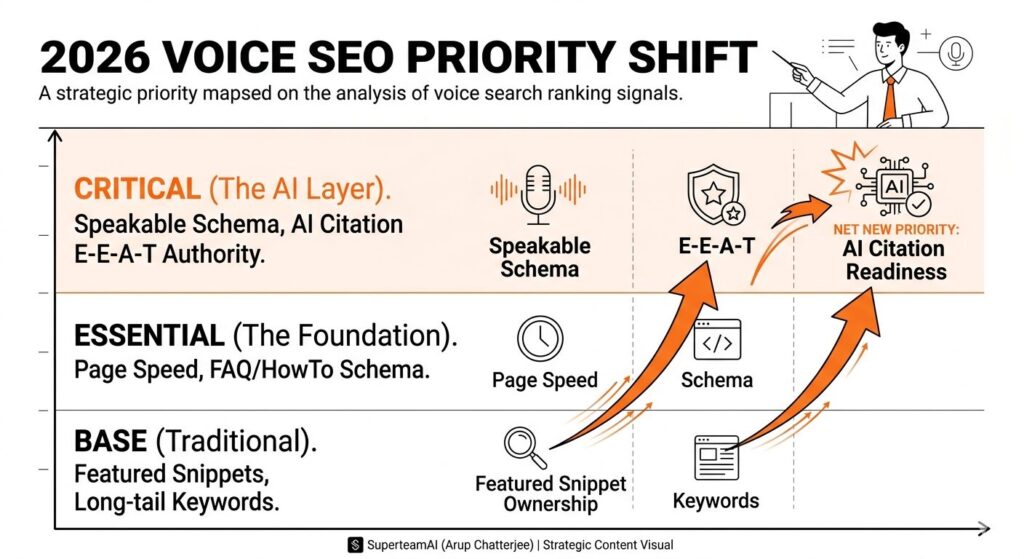
Table 2: Voice Search Ranking Signals: Traditional vs. AI-First (2026)
| Signal | Traditional Voice SEO (2019-2023) | AI-First Voice SEO (2026) | Priority Change |
| Featured snippet / position zero | Critical: primary delivery mechanism | Still important for Google ecosystem | Reduced but not eliminated |
| Conversational keyword structure | Important for query matching | Critical for AI query intent matching | Elevated |
| FAQ and HowTo schema | Helpful for rich results | Essential for AI parser extraction | Significantly elevated |
| Speakable schema | Rarely implemented | High-value signal for text-to-speech delivery | New priority |
| Page speed (LCP under 2.5s) | Table stakes | Table stakes | Unchanged |
| E-E-A-T and content authority | Important for ranking | Critical for AI citation selection | Significantly elevated |
| AI citation readiness | Did not exist | New primary differentiator | Net new requirement |
Conversational Query Structure and Long-Tail Keywords
Voice queries average 4-7 words and arrive as complete questions: “What is the best way to…” or “How do I optimize my website for…” rather than “best website optimization.”
Map question-based queries for every topic your content covers. Start with the six question stems: who, what, when, where, why, and how. Build keyword variants from each. Prioritize queries your actual buyers ask during research phases, not just generic topic keywords. Tools like AnswerThePublic, Google’s People Also Ask feature, and your own Google Search Console query data are the fastest way to build this list.
One common mistake: targeting question keywords without structuring the content to actually answer them. A page titled “How to Optimize for Voice Search” that buries the answer in paragraph five will not earn the voice result.
Featured Snippet and Position Zero Optimization
40.7% of traditional voice answers still come from the Google featured snippet. This channel is not dead. It is just no longer sufficient on its own.
To earn featured snippets: place a concise 40-50 word answer at the top of each page that targets a question query. Follow the direct answer with supporting depth. Use numbered lists for how-to queries (Google pulls these as step-by-step snippets), use tables for comparison queries, and use paragraph format for definition queries.
The discipline of writing clear, direct answer blocks is also what makes content citable by AI systems. The optimization is not either/or.
FAQ Schema, How To Schema, and Speakable Markup
Schema markup is where most voice search SEO programs fall short. Implementing it correctly is one of the highest-impact actions available.
FAQPage schema marks up Q&A content explicitly, making it parseable by both Google’s voice systems and AI engines. HowTo schema applies to step-by-step instructional content. Both tell crawlers: “this content is structured around direct answers to specific questions.”
Speakable schema is the one most teams ignore. It explicitly identifies sections of your page that are appropriate for text-to-speech delivery. Google uses it to determine which portions of a page to read aloud. Implementing Speakable on your key answer paragraphs and definition sections signals directly to the voice delivery layer.
Validate all schema with Google’s Rich Results Test before publishing.
Page Speed and Core Web Vitals
Voice search result pages load 52% faster than the average web page. This is not a coincidence. It is a ranking signal. Aim for LCP (Largest Contentful Paint) under 2.5 seconds and a mobile performance score above 90 in Google PageSpeed Insights.
Speed matters doubly for mobile voice searches, which represent the majority of voice queries. If your site passes Core Web Vitals, this factor is neutralized. If it does not, it actively suppresses your voice search performance regardless of how well your content is written.
E-E-A-T and Content Authority Signals
When we audit client content for AI citability, the single most common failure is content that ranks well on Google but has no structured answer block and no credibility signals for AI extraction. E-E-A-T matters more for AI citation than for traditional ranking, because AI systems need to decide whether your content is trustworthy enough to read aloud to a user.
Specific signals that strengthen voice and AI citation authority: named author credentials, first-person experience language, verifiable data with attribution, external citations to authoritative sources, and consistent publishing history that establishes topical depth.
AI Citation Readiness: The 2026 Addition
This is the signal that separates the 2026 playbook from every guide written before it. AI citation readiness means your content is structured so that AI systems can extract, attribute, and deliver it as part of a synthesized response.
Specific requirements: a clear definitional statement for every key concept you cover, clean Q&A pairs that can be extracted as standalone answers, factually dense paragraphs that give AI systems verifiable information to cite, FAQPage and Speakable schema implementation, and topical authority across a content cluster (not a single optimized page).
This is the point where voice search SEO and answer engine optimization become the same discipline. When you optimize content for answer engines and AI search results, you are simultaneously optimizing for AI-delivered voice answers.
How to Optimize Content for Voice Search and AI Answer Engines
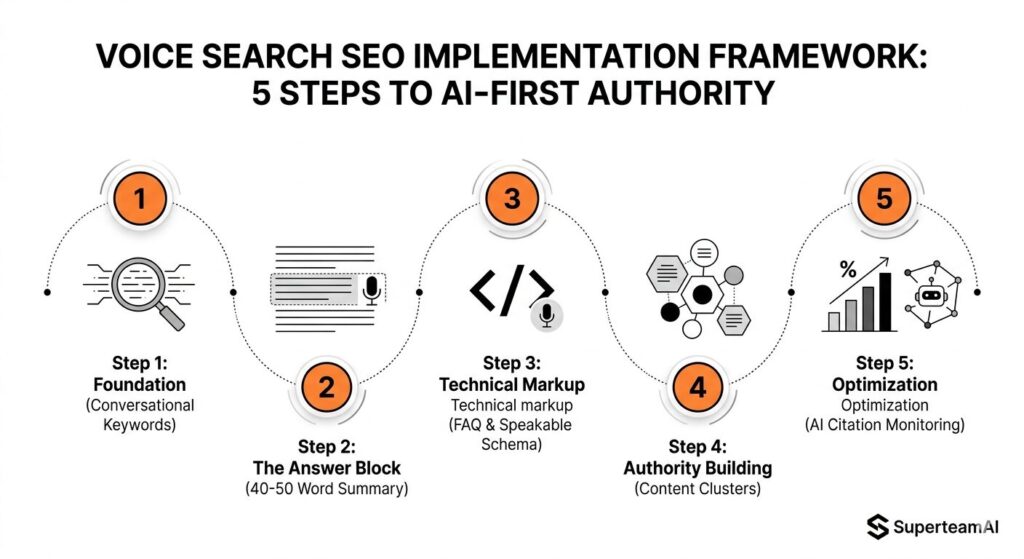
These five steps work together as a sequence. Most voice search SEO failures come from implementing steps 1 and 2 while skipping 3, 4, and 5.
Step 1: Build Your Conversational Keyword Foundation
Start with your existing keyword list and restructure it for conversational intent. Every target topic should have at least three question-based keyword variants: a “what is” variant, a “how to” variant, and a “why does/should” variant.
Use Google’s People Also Ask boxes for your core keywords as a free research tool. Export your Google Search Console queries filtered for 4+ word keywords. These are already conversational in structure and show you what your actual audience is asking. Layer in AnswerThePublic for additional long-tail variations.
Common mistake: adding question keywords to existing pages without restructuring the content to answer them. The keyword and the content format must align.
Step 2: Structure Every Page Around the 40-50 Word Answer Block
Every page targeting a voice or AI query needs a clear, self-contained answer in the first 100-150 words. This block should directly answer the question in the page title, require no context from the rest of the article to be understood, and fit comfortably into a 10-second spoken delivery.
Think of it this way: if someone asked this question on the street and you had 10 seconds to answer, what would you say? Write that answer at the top of the page. Then spend the rest of the article proving it.
Table 3: Voice Search Content Format Templates
| Query Type | Answer Format | Schema Type | Ideal Answer Length |
| “What is [term]?” | Direct definition paragraph | Article + Speakable | 40-60 words |
| “How to [action]?” | Numbered step list (3-7 steps) | HowTo | 50-80 words (summary) + steps |
| “Why does [thing] happen?” | Cause-and-effect paragraph | Article + Speakable | 40-60 words |
| “What is the best [category]?” | Brief recommendation + criteria | FAQPage | 50-80 words |
| “Where can I [action]?” | Direct answer + qualifier | FAQPage + LocalBusiness (if local) | 30-50 words |
| “Is [X] better than [Y]?” | Direct verdict + key reason | FAQPage | 40-60 words |
Step 3: Implement FAQ and Speakable Schema on Every Content Page
If your page has any Q&A content, it needs FAQPage schema. This is table stakes in 2026, not an advanced tactic. Implement it on every blog post, every landing page with an FAQ section, and every resource page that answers specific questions.
Add Speakable schema to your definitional paragraphs and key answer blocks. This is the explicit signal to Google’s text-to-speech delivery that these sections are appropriate for voice delivery.
Use JSON-LD format for all schema implementation. Avoid microdata. Validate with the Google Rich Results Test before and after publishing. A schema error that silently blocks extraction is worse than no schema at all.
Step 4: Build Topical Authority Through Content Clusters
A single optimized page earns one voice search result. A content cluster of 15-25 interlinked pieces covering a topic comprehensively earns AI system recognition as a definitive resource.
AI answer engines weight topical authority more heavily than single-page optimization. When ChatGPT retrieves answers, it evaluates not just the individual page but the surrounding context: how many related pages does this site have on this topic, do they link to each other, do they demonstrate consistent depth? A cluster signals “this is the authoritative source” in a way a standalone page cannot.
This is where the velocity requirement becomes real. Building a 15-20 piece content cluster manually takes months. The Superteam AI AI SEO Workforce produces topically clustered, voice-optimized content at 10-30 pieces per month, with schema integration and E-E-A-T signals built into every output. The cluster that drove 626% traffic growth for EasyOps was built using exactly this system across 14 months and 198 published articles.
Step 5: Monitor AI Citation Performance
Optimizing for voice and AI search without measurement is guessing. Once your content program is running, track these metrics:
- AI citation rate: Use tools like Profound or Otterly AI to monitor how often your brand or content is cited across ChatGPT, Perplexity, and Google AI Overviews
- Featured snippet ownership: Track which of your pages hold featured snippets for voice-intent queries in Search Console
- People Also Ask appearances: Monitor PAA box appearances for your question-based content
- Voice-initiated session traffic: Segment mobile voice traffic in Google Analytics where identifiable
Set a measurement baseline in month one before making optimization changes, then assess citation rate shifts at the 30-day and 90-day marks.
Voice Search SEO for B2B: Does It Apply to You?
This is the question every B2B marketer should be asking. The honest answer: yes, but not in the way consumer-focused voice search guides describe.
B2B buyers are not asking Alexa to recommend enterprise software. But they are asking ChatGPT and Perplexity questions like “What is the best content management tool for a B2B SaaS company with 50 employees?” and “How do I build an inbound lead engine without a full marketing team?” These are exactly the voice and conversational AI queries that are growing fastest in 2026.
B2B companies that optimize your brand for ai-driven search and answer engines are capturing the research phase of the buying journey in a way that traditional SEO cannot replicate. When a buyer’s first exposure to your brand is through a spoken AI recommendation, you enter the consideration set without competing for a click.
The B2B companies we work with consistently underestimate how much of their target audience’s research happens through conversational AI interfaces. We see this in the citation data: brands with strong topical authority content clusters are appearing in AI-delivered answers for B2B research queries at rates that surprise even their own marketing teams.
The practical implication: B2B voice search SEO is less about local intent (which drives 58% of consumer voice search) and more about informational and commercial investigation queries. Your content program should map to the questions your buyers ask during the research and evaluation phases of their buying journey and answer them in the conversational, structured format that AI systems favor.
ReachInbox is a direct example. By building an answer-engine-optimized content program that covered every question their ICP was asking, they grew organic traffic 750% and extended their runway from 6 months to 24 months. That content served voice and AI search simultaneously because the optimization approach was unified from the start.
Building a Voice Search SEO Content Program at Scale
Every tactic in this guide is straightforward. The challenge is never understanding what to do. It is doing it at the volume that actually moves the needle.
After deploying content programs for dozens of B2B companies, the pattern is always the same: teams know the tactics but cannot execute at the required velocity. A single voice-optimized page earns one result. A content cluster of 20 interlinked pages with consistent schema, conversational structure, and E-E-A-T signals earns AI system authority. The difference between those two outcomes is entirely a matter of output volume.
What that volume looks like in practice:
- A startup testing voice and AI search: 5-8 pieces per month, tightly clustered around 2-3 core topics
- A growth-stage B2B company building topical authority: 15-20 pieces per month across a full content cluster
- A scale-stage company competing for category leadership in AI-delivered answers: 25-30 pieces per month with active monitoring and iteration
Publishing 2 articles per month will not build topical authority. It will build a backlog of individually optimized pages with no cluster signal. The execution gap is where most voice search SEO programs fail.
Frequently Asked Questions About Voice Search SEO
What is voice search SEO?
Voice search SEO is the practice of optimizing website content to be selected and delivered as a spoken answer by voice assistants and conversational AI platforms. In 2026, this includes Google Assistant, Siri, Alexa, ChatGPT voice mode, Perplexity, and Google AI Overviews. Effective voice search SEO requires conversational content structure, FAQ and Speakable schema markup, featured snippet optimization, and AI citation readiness.
How is voice search SEO different from regular SEO?
Traditional SEO targets keyword rankings in Google’s text-based search results. Voice search SEO targets the answer layer: the featured snippets, AI-generated responses, and spoken answers that users receive without clicking through to a website. Voice search SEO requires more emphasis on question-based keywords, concise answer blocks, schema markup, and content authority signals that AI systems use to evaluate citation-worthiness.
Does voice search SEO still matter in 2026?
Yes, more than ever. But the definition has expanded. Traditional voice search (Siri, Alexa reading featured snippets) remains active. The growth channel is AI-delivered voice answers through ChatGPT voice mode, Perplexity, and Google AI Overviews. With 8.4 billion voice assistants in use and AI referral traffic growing 357% year-over-year, the combined voice and AI search channel is too large to ignore.
What is the most important voice search SEO ranking factor?
In 2026, AI citation readiness is the factor that most separates content that earns voice answers from content that does not. This means structured answer blocks in the first 100-150 words, FAQPage and Speakable schema implementation, factual density with verifiable data, and topical authority across a content cluster. Featured snippet optimization remains critical for the Google ecosystem specifically.
How do I optimize content for voice search and AI answers at the same time?
The optimization is largely the same: write direct 40-50 word answers for each question your page targets, implement FAQPage and Speakable schema, build topical authority through content clusters, and use E-E-A-T signals throughout. When you optimize content for answer engines and AI search results, you are simultaneously creating content that earns traditional voice search results. The two strategies have converged.
What schema types are most important for voice search SEO?
FAQPage schema marks up Q&A content for AI and voice parser extraction. HowTo schema applies to step-by-step instructional content. Speakable schema explicitly identifies sections appropriate for text-to-speech delivery. All three should be implemented on relevant content pages. Validate with Google’s Rich Results Test after every implementation.
Is voice search SEO worth the investment for B2B companies?
Yes. B2B buyers increasingly use conversational AI platforms to research products and services during the evaluation phase. Queries like “what is the best [category] tool for [use case]” are growing rapidly on ChatGPT, Perplexity, and Gemini. B2B companies that optimize their brand for ai-driven search and answer engines are being cited in these AI-delivered answers. Companies with strong topical authority content clusters see this most clearly. Voice search optimization and answer engine optimization address the same buyer behavior.
How long does it take to see results from voice search SEO?
Content improvements take 4-12 weeks to influence AI citation rates as platforms re-index content and update their retrieval models. Featured snippet positions typically stabilize within 4-8 weeks of a well-optimized piece publishing. Building topical authority through a full content cluster, which drives the most durable voice and AI search results, takes 3-6 months of consistent publishing. Velocity of publication is the primary variable.
Voice Search SEO Is AEO: And the Gap Is Closing
Voice search SEO in 2026 is not the six-tip list it was four years ago. The delivery mechanism has changed. The optimization target has changed. The content that earns voice answers now needs to satisfy both traditional voice assistant retrieval and AI system citation simultaneously.
The core takeaways from this guide:
The old model (optimize for featured snippets so Siri reads you aloud) still applies to the Google ecosystem. The new model (build content that AI systems like ChatGPT, Perplexity, and Gemini cite when delivering voice answers) requires the same underlying content quality but adds schema specificity, topical authority, and AI citation readiness as explicit requirements.
The five-step framework works as a sequence. Conversational keyword foundation first. Answer blocks second. Schema implementation third. Content clusters fourth. Measurement fifth. Skip any step and the program underperforms.
Voice search SEO and answer engine optimization are converging into one discipline. The content that wins AI citations is the content that earns voice answers. Treating them as separate programs means doing the same work twice. Treating them as one program means building the content asset that dominates both channels.
Heading into late 2026 and into 2027, that convergence will only accelerate as multimodal AI interfaces make voice the primary input method for AI-assisted research. The teams that build topical authority now will hold structural advantages that late movers cannot close quickly.


