In our client content audits, the featured snippet question comes up more than any other topic right now. The concern is always the same: “Featured snippet visibility dropped massively in 2025. Should we still bother?”
The short answer is yes. The longer answer is that most teams are drawing the wrong conclusion from the data.
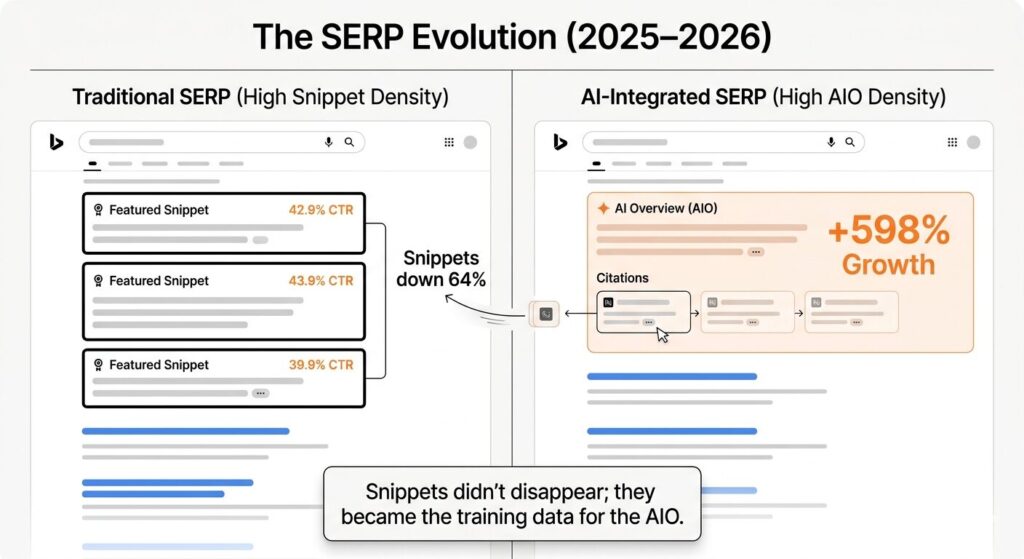
Featured snippet SERP visibility did fall 64% in the first half of 2025, dropping from 15.41% of queries down to 5.53%. That happened because Google AI Overviews grew 598% over the same period and now appear on 58% of queries. On the surface, this looks like the end of featured snippets as a strategy. It is not.
Here is what the data actually shows: Google’s AI Overviews pull heavily from the same pages that hold or compete for featured snippets. The content format that wins position zero (direct answer blocks, structured lists, schema-marked Q&A pairs) is the same format AI Overviews prefer when generating citations. Optimizing to rank in featured snippets in 2026 is not a competing strategy to answer engine optimization. It is the most direct path into it.
This guide gives you the exact framework, the format rules for each snippet type, and the five implementation steps your content team needs to execute it.
Are Featured Snippets Still Worth Pursuing in 2026?
The data story of 2025 scared a lot of SEOs away from snippet optimization at exactly the wrong time.
What Happened to Featured Snippet Visibility in 2025-2026
Between January and June 2025, featured snippet SERP presence fell from appearing on 15.41% of queries to just 5.53%. AI Overviews, which grew 598% over that same period, displaced traditional snippets across a large share of informational queries. When AI Overviews appear, the zero-click rate hits 83%. These numbers, read in isolation, suggest featured snippets are becoming irrelevant.
But read in context, they tell a different story. Featured snippets did not disappear. They consolidated. They now appear most frequently on commercial-investigation and how-to queries where AI Overviews are less prevalent. And critically, the pages that hold featured snippets are the pages that AI Overviews cite when they do appear on informational queries.
The 42.9% click-through rate for pages holding a featured snippet has not collapsed. Featured snippets on how-to and comparison queries retain strong CTRs and represent the clearest ROI opportunity in the SERP real estate that Google is not replacing with AI-generated summaries.
The AI Overview Connection That Changes Everything
Here is the mechanism that transforms how you should think about snippet optimization in 2026.
Google’s AI Overviews are not randomly selecting sources. They favor pages that demonstrate structured, authoritative answers to the query. The same signals that help a page win a featured snippet, including a direct 40-60 word answer block, list formatting for step queries, schema markup, and topical authority, are the signals AI Overviews evaluate when selecting what to cite.
In practice, this means a page that wins a featured snippet for “how to do X” is significantly more likely to be cited in the AI Overview for related queries about X. We track AI citation rates for our clients, and the pattern holds consistently: pages that hold featured snippets appear in AI Overview citations at substantially higher rates than pages ranking at positions 3-7 without a snippet.
Featured snippet optimization is not competing with AI Overviews. It is qualifying for them.
What Is a Featured Snippet?
Definition: A featured snippet is a selected search result that Google displays at the top of the SERP, above all organic rankings, in a formatted answer box. It is also called “position zero” because it appears before the numbered results. Featured snippets answer the user’s query directly on the page without requiring a click and are drawn from pages that already rank on the first page of Google results. In 2026, featured snippets appear most frequently for informational, how-to, and definition queries where AI Overviews are not present.
Featured snippets carry a 42.9% click-through rate when displayed, outperforming the 39.8% CTR of the standard position-one result when no snippet is shown. Despite reduced overall frequency, they remain the highest-CTR placement available in the Google SERP.
The 4 Types of Featured Snippets (And the Format Rules for Each)
Format mismatch is the most common reason a page on page one does not win the featured snippet. Each snippet type has specific format requirements. Getting the format right is not optional.
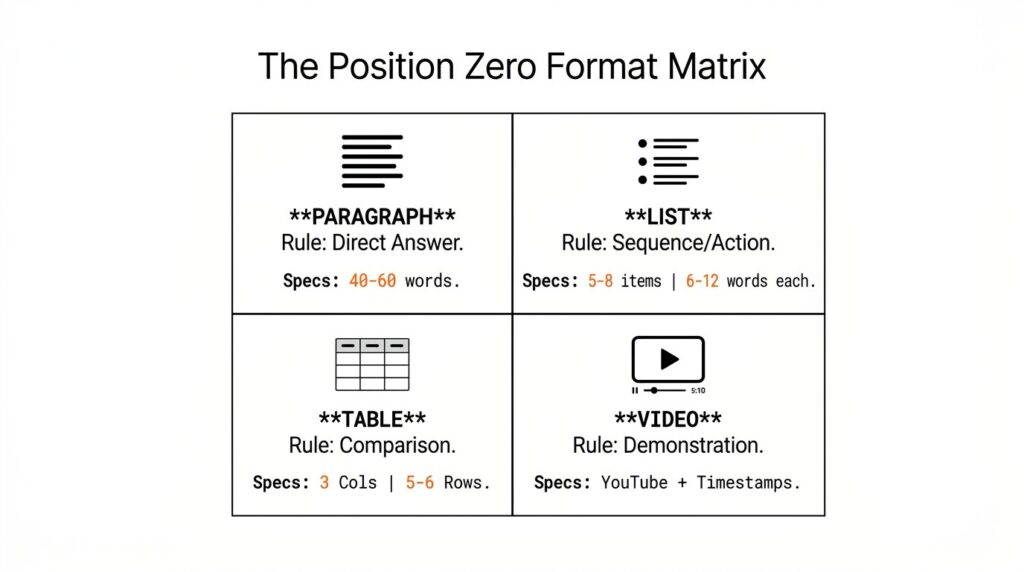
Table 1: Snippet Type Optimization Matrix
| Snippet Type | Trigger Query Pattern | Optimal Format | Length / Size | Schema Type | Example Query |
| Paragraph | “What is,” “Why does,” “How does” | 40-60 word direct-answer paragraph | 40-60 words | Article + Speakable | “What is a featured snippet?” |
| Numbered List | “How to,” “Steps to,” “Ways to” | Numbered list, 5-8 items, 6-12 words each | 5-8 items | HowTo | “How to optimize for voice search” |
| Bulleted List | “Types of,” “Best [category],” “Examples of” | Bulleted list, 5-8 items | 5-8 items | FAQPage or Article | “Types of featured snippets” |
| Table | “Price of,” “[X] vs [Y],” “Compare [X]” | HTML table, 3 columns, 5-6 rows | 3 cols, 5-6 rows | No specific schema | “CRM software pricing comparison” |
| Video | “How to [physical action]” | YouTube video with timestamps | N/A | VideoObject | “How to do a deadlift” |
Paragraph Snippets (The Most Common Type)
Paragraph snippets account for roughly 70% of all featured snippets. They appear for definition and explanation queries: “what is,” “how does,” “why does,” and similar patterns.
The format requirement is precise. Google extracts a 40-60 word paragraph that directly answers the question. The answer must appear immediately after the heading that asks the question. It must stand alone as a complete answer without requiring the rest of the article for context. No hedging, no “it depends,” no filler. State the answer, then support it in the paragraphs that follow.
Common mistake: writing a long introductory section before reaching the answer. Google reads the content nearest to each heading. If your answer is in paragraph three, it will not be extracted.
List Snippets (Numbered and Bulleted)
List snippets trigger for procedural and enumerative queries. Numbered lists win for sequential steps (“how to” queries). Bulleted lists win for non-sequential collections (“types of,” “examples of”).
Google pulls 5-8 list items, each 6-12 words. Write items as action phrases for how-to content (“Add FAQPage schema to the content”) rather than full sentences. Common mistake: embedding explanations inside list items. Google truncates the list display at approximately 8 items, so if you have 12 steps, the first 8 need to be the most actionable.
Table Snippets
Table snippets trigger for comparison, pricing, and data queries. The optimal table for snippet extraction has 3 columns and 5-6 rows. Column headers must be descriptive.
Use HTML table format in your CMS. Markdown tables may not render correctly for snippet extraction depending on how your site renders to Google’s crawler. Keep tables clean and focused: one comparison dimension per table rather than a large multi-variable matrix. Google extracts the simplest, most parseable version.
Video Snippets
Video snippets appear for procedural queries where visual demonstration is the expected format. Google pulls from YouTube and requires timestamps or chapter markers to identify the relevant segment. Video snippet optimization is less controllable than text snippet optimization and is covered here for completeness. For B2B content programs, text snippet optimization delivers higher ROI.
The 3 Prerequisites for Ranking in Featured Snippets
You cannot win a snippet your page does not qualify for. These three conditions must be met before any optimization work will produce results.
Your Page Must Already Rank on Page One
This is a hard prerequisite, not a workaround. Research from Ahrefs confirms 99.58% of featured snippets come from pages already ranking on page one. Approximately 70% come from positions 2-10, not position 1. Snippet optimization is a page-one amplification move: reformat an existing ranking asset to capture the snippet it currently sits below.
If a page does not rank on page one, structural improvements will accomplish nothing. Fix the ranking first, then optimize for the snippet.
Your Query Must Have Snippet Potential
Not all queries trigger featured snippets. Question-based and informational queries (“what is,” “how to,” “why does”) trigger snippets at the highest rate. Transactional queries (“buy X,” “pricing for Y”) and navigational queries rarely produce them.
Check whether your target query currently shows a featured snippet by searching it directly. If a snippet exists, you have a target to displace. If no snippet exists, assess whether the query type is likely to trigger one or whether AI Overviews have absorbed that search format entirely.
Your Content Format Must Match the Query Intent
Mismatched formats lose snippets regardless of content quality. A “how to” page written in paragraph format will not win the list snippet. A definition page using bullet points instead of a direct answer paragraph will not win the paragraph snippet.
Before optimizing any page, identify the expected snippet type using the matrix above, then audit whether the current format matches.
How to Find Your Best Featured Snippet Opportunities
The fastest wins come from your existing page-one content, not from building new pages. Here is how to identify which pages to prioritize.
In our experience, 15-30% of page-one content has unoptimized snippet potential sitting untapped. These are pages that already rank but have never been reformatted to match the snippet structure their target queries require.
Table 2: Snippet Opportunity Scoring Framework
| Criteria | Signal to Look For | Score 1-3 | Notes |
| Current ranking position | Positions 1-5 = 3, positions 6-8 = 2, positions 9-10 = 1 | 1-3 | Top positions have strongest conversion probability |
| Query type | Question-based or how-to = 3, informational = 2, mixed = 1 | 1-3 | Question queries have highest snippet trigger rate |
| Existing snippet on SERP | No snippet present = 3, competitor holds snippet = 2, you hold snippet = 1 (optimize to hold) | 1-3 | No-snippet queries are blue ocean opportunities |
| Content format match | Format matches snippet type = 1, partial match = 2, mismatch = 3 | 1-3 | Score 3 = highest opportunity for quick reformat win |
| Page authority | Strong internal linking + backlinks = 1, moderate = 2, weak = 3 | 1-3 | Lower authority pages need more time |
Scoring: Pages scoring 12-15 are immediate priority targets. Pages scoring 8-11 are secondary priorities after top targets are optimized. Pages scoring below 8 require ranking improvement before snippet optimization adds value.
How to build this list in practice: Export your Google Search Console performance data filtered for queries containing “what,” “how,” “why,” “best,” or “types of” that are returning impressions from positions 1-10. These are your pre-qualified snippet candidates. Run them through the scoring framework above. Start at the top.
How to Optimize Content to Rank in Featured Snippets
These five steps apply to any page that has been identified as a snippet opportunity through the scoring framework above.
Step 1: Write the Answer Block First, Then the Depth
The most impactful structural change you can make is also the simplest. Write a clean 40-60 word answer to the target query in the first paragraph of the relevant section, then follow it with explanatory depth.
Most content does the opposite: it builds context and background before revealing the answer. This approach works for human readers who read linearly. It fails for Google’s snippet extraction, which reads the first substantive content following each heading.
The structure is: heading that asks the question → 40-60 word direct answer → supporting paragraphs with depth. Every page targeting a question-based query should follow this pattern in every major section.
Common mistake to avoid: starting the answer section with “That is a great question” or a sentence restating what the heading already said. Google skips restatements and looks for the answer. Lead with the answer.
Step 2: Match Your Content Format to the Snippet Type
Once the answer block is structured correctly, verify the format matches the expected snippet type.
For definition queries: paragraph format with the answer in the first 60 words. For how-to queries: numbered list with 5-8 items of 6-12 words each. For comparison queries: HTML table with 3 columns and 5-6 rows. For collection queries (“types of,” “examples of”): bulleted list with 5-8 items.
If the current format is wrong, restructure the page. A how-to page in continuous prose needs a numbered list. A comparison page without a table needs one added. These are 15-30 minute edits that shift snippet eligibility immediately.
Step 3: Add FAQPage and HowTo Schema
Schema markup signals the answer structure to Google’s crawlers directly. It does not guarantee snippet selection, but it removes ambiguity about what your content is and how it should be interpreted.
FAQPage schema applies to any section with Q&A pairs. HowTo schema applies to step-by-step instructional content and maps directly to list snippet extraction. Speakable schema identifies key answer paragraphs as appropriate for text-to-speech delivery.
Implement schema in JSON-LD format, not microdata. After implementation, validate with Google’s Rich Results Test before publishing. A silent schema error is worse than no schema because it gives false confidence the implementation is working.
Step 4: Update and Republish Existing Content
Google’s snippet selection favors freshness. A page that was published in 2023 with no updates competes at a disadvantage against a page refreshed in 2026.
For existing page-one content that scores well in the opportunity framework, add a “last updated” timestamp, refresh any statistics that have changed, add 2026-current context, and republish with the current date. Then reformat the answer block and add schema as described in steps 1-3.
This combination (freshness signal, structural optimization, and schema) is the fastest path to snippet capture for existing ranking assets. Many clients see snippet movement within 4-8 weeks of this refresh workflow applied to high-scoring opportunity pages.
Step 5: Build Content Clusters to Reinforce Topical Authority
A single optimized page competes for its snippet. A content cluster of 10-20 interlinked pages covering a topic comprehensively tells Google that your domain is the authoritative resource on that subject, which increases snippet selection rates across the entire cluster, not just individual pages.
This is the compounding approach. EasyOps built a cluster of 198 articles over 14 months using the Superteam AI AI SEO Workforce, achieving 89 keywords in the top 10 and 626% organic traffic growth. Featured snippet ownership across the cluster drove a significant share of that growth, and the topical authority it established raised AI Overview citation rates for related queries.
Building a 15-20 page topical cluster manually takes months. The Superteam AI AI SEO Workforce produces schema-optimized, snippet-structured content at 10-30 pieces per month, closing that gap fast.
How Ranking in Featured Snippets Gets You Cited in AI Overviews
This is the section that makes the rest of the guide strategically irrelevant without it.
Most discussions treat featured snippets and Google AI Overviews as competing formats. They are not. They are sequential stages of the same content selection logic.
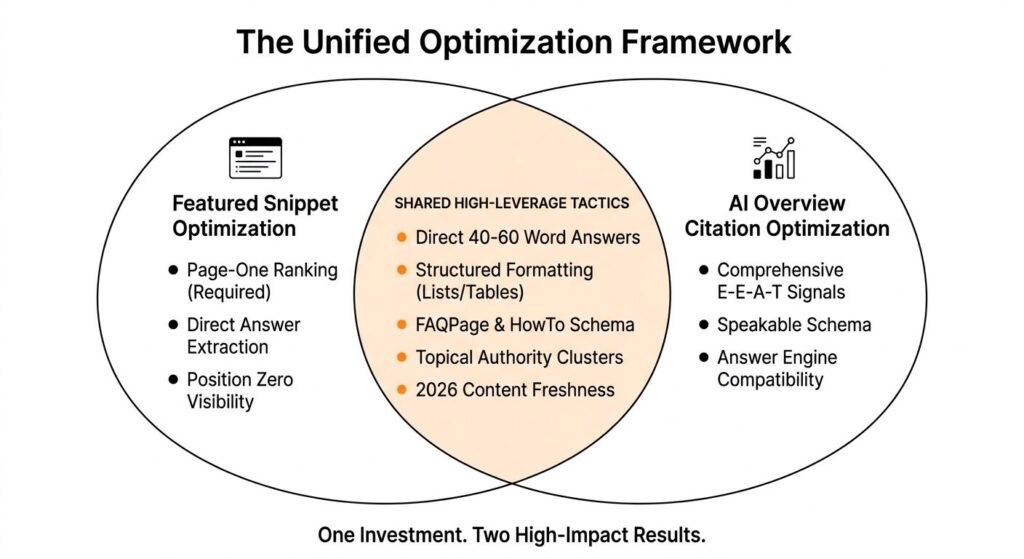
When Google generates an AI Overview for an informational query, it retrieves pages that demonstrate structured, authoritative answers. The content signals it looks for are the same signals that produce featured snippet eligibility: direct answer blocks, structured formatting (lists and tables), schema markup, topical authority from a content cluster, and strong E-E-A-T indicators. A page that has been optimized to rank in featured snippets has, by definition, been optimized for AI Overview citation.
Table 3: Featured Snippet vs. AI Overview Optimization: Signal Overlap
| Optimization Signal | Required for Featured Snippet | Required for AI Overview Citation | Overlap |
| 40-60 word direct answer block | Yes | Yes | Full overlap |
| Question-based heading structure | Yes | Yes | Full overlap |
| Numbered or bulleted list formatting | Yes (for list snippets) | Yes | Full overlap |
| FAQPage schema | Helpful | Helpful | Full overlap |
| HowTo schema | Yes (for step content) | Yes | Full overlap |
| Speakable schema | Partial | Yes | Partial overlap |
| Page-one ranking | Yes | Not strictly required | Partial overlap |
| Topical authority (content cluster) | Helps | Strongly weighted | Full overlap |
| E-E-A-T signals | Important | Critical | Full overlap |
| Content freshness | Important | Important | Full overlap |
The table makes the case clearly. Eight of the ten optimization signals overlap completely. Implementing the featured snippet playbook in this guide covers AI Overview citation optimization too. They are the same work.
Featured snippet optimization is a core component of answer engine optimization. The content format requirements for winning position zero are the same foundation that earns citations across ChatGPT, Perplexity, Gemini, and Google AI Overviews.
After building content programs across dozens of B2B companies, our position is clear: treating featured snippet optimization and AEO as separate programs means doing the same work twice. The unified approach is building structured, authoritative, schema-marked content organized in topical clusters. This covers both channels with one content investment.
Frequently Asked Questions About How to Rank in Featured Snippets
What does it mean to rank in featured snippets?
Ranking in featured snippets means your page has been selected by Google to display its content in the answer box at the top of the SERP, above all organic rankings. This position is called “position zero.” Google pulls a short excerpt, typically 40-60 words for paragraph snippets or a formatted list, and displays it on the results page without requiring a click.
Do you need to rank number one to win a featured snippet?
No. Research from Ahrefs shows that approximately 70% of featured snippets come from pages ranking at positions 2-10, not position 1. However, you do need to rank on the first page of Google results. Pages ranking on page two or lower are excluded from snippet consideration 99.58% of the time. Featured snippets are an amplification strategy for existing page-one assets, not a shortcut for pages that do not yet rank well.
How long does it take to win a featured snippet after optimization?
After implementing the answer block restructuring, format alignment, and schema markup covered in this guide, most pages see snippet movement within 4-8 weeks. Google needs time to re-crawl and evaluate the structural changes. Pages with strong authority and top-five positions tend to move faster. A republish with a current date can accelerate the timeline.
What is the featured snippet click-through rate?
Featured snippets carry a 42.9% click-through rate, compared to 39.8% for the standard position-one result when no snippet is present. This makes featured snippet capture the highest-CTR placement available in Google’s organic results. While AI Overviews have reduced the frequency of snippet appearances on informational queries, snippets on commercial-investigation and how-to queries retain strong CTRs because AI Overviews appear less frequently on those query types.
Are featured snippets still worth optimizing for in 2026?
Yes, and for a reason most guides are not yet addressing. Featured snippet optimization in 2026 is the primary path to Google AI Overview citation. The content signals that earn a featured snippet, including direct answer blocks, structured list formatting, schema markup, and topical authority, are the same signals AI Overviews evaluate when selecting sources. Optimizing for position zero simultaneously optimizes your content for AI Overview citation.
What is the most important thing to do to win a featured snippet?
The single most impactful change is placing a clear, direct 40-60 word answer immediately after the question-formatted heading that matches your target query. Most pages bury the answer after introductory context. Google’s snippet extraction reads the first substantive content following each heading. If your answer is in paragraph three of a section, it will not be extracted regardless of how well-written it is.
How does featured snippet optimization relate to answer engine optimization?
Featured snippet optimization is the foundational layer of answer engine optimization. The content format requirements for winning position zero, including structured answer blocks, list formatting, schema markup, topical authority from content clusters, and strong E-E-A-T signals, overlap almost completely with the requirements for earning AI citations across ChatGPT, Perplexity, Gemini, and Google AI Overviews. A content program built to win featured snippets is also built to earn AI citations. They are not separate strategies.
Which types of queries are most likely to trigger featured snippets?
Question-based and informational queries trigger featured snippets at the highest rate. Queries beginning with “what is,” “how to,” “why does,” “how does,” “what are,” and “steps to” are the most reliable snippet triggers. Transactional queries (“buy,” “pricing,” “discount”) and navigational queries (brand name searches) rarely produce featured snippets. For B2B content programs, targeting educational and how-to queries in your topic cluster provides the highest density of snippet opportunities.
Featured Snippet Optimization Is AEO in Practice
The case for prioritizing featured snippets in 2026 is stronger than it was in 2023, not weaker.
Yes, AI Overviews have displaced traditional snippets on a large share of informational queries. But that shift makes snippet optimization more strategically valuable, not less, because winning a featured snippet is now the clearest signal to Google’s AI systems that your content is structured and authoritative enough to cite.
The five steps in this guide produce two outcomes at once. They improve your probability of capturing position zero on queries where traditional snippets still appear. They simultaneously improve your eligibility for AI Overview citation on queries where AI Overviews have taken over.
The key takeaways:
Featured snippets carry 42.9% CTR and hold strong on commercial-investigation and how-to queries. The 64% visibility drop reflects displacement to AI Overviews on informational queries, not the death of snippets across the board. The optimization signals for both formats are nearly identical. Prerequisites matter: you need page-one ranking first, then optimize format and structure. The fastest wins come from reformatting existing content, not building new pages. Content clusters compound the results across 15-20 interlinked pages.
Teams that implement this approach consistently across their content program are building the topical authority and structural foundation that wins in both traditional and AI-powered search simultaneously. The ability to rank in featured snippets and earn AI Overview citations from a single content investment is what makes this the most practical AEO strategy available today.


