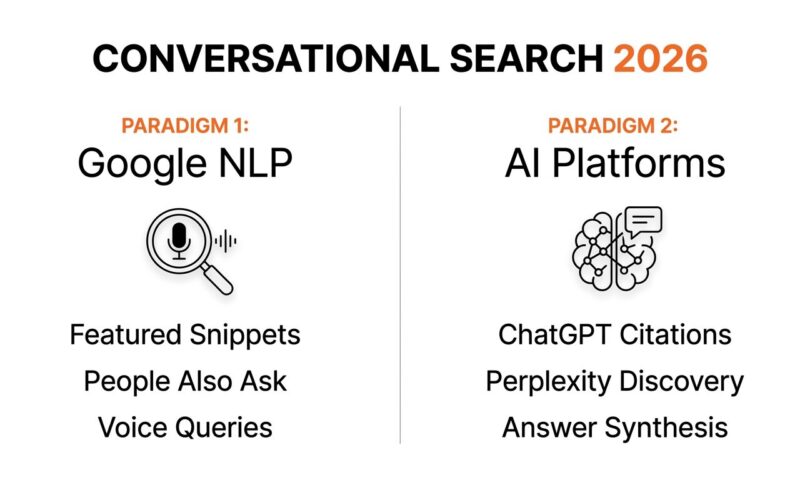
Over 60% of all searches are now conversational. At the same time, ChatGPT processes roughly 3.8 billion monthly visits, with Perplexity and Gemini adding hundreds of millions more. Most businesses are optimizing for one of these realities. The ones growing fastest are optimizing for both.
The problem with almost every conversational search guide published before 2026: they were written when conversational search meant natural language queries in Google. That definition is no longer complete.
In our work building answer engine optimization systems for clients, we have learned that conversational search now operates across two distinct channels. Get both right and you capture visibility on Google and on the AI platforms your audience uses for discovery. Focus on only one and you leave half your potential reach behind.
This guide gives you the framework for both.
What Is Conversational Search? (And Why the Old Definition Is Incomplete)
The Traditional Definition (And Its Blind Spot)
Conversational search refers to queries phrased in natural language: full questions, spoken phrases, or intent-specific sentences rather than short keyword fragments. Traditional search engines process these using natural language processing (NLP) to interpret the meaning and intent behind the words, not just the words themselves.
That definition is correct. It just misses something important. It was written before AI platforms like ChatGPT and Perplexity became primary discovery tools for hundreds of millions of people monthly. When the definition was first published, conversational search had one home: Google.
The Expanded 2026 Definition
Definition: Conversational search in 2026 refers to any natural language query submitted either to a traditional search engine via NLP-optimized interfaces (voice, long-tail text, People Also Ask) or to an AI platform (ChatGPT, Perplexity, Gemini) as a primary discovery channel.
Both channels process the same type of user behavior: people asking questions in natural language. But they surface answers differently, reward different content signals, and require different optimization approaches. Understanding this distinction is what separates a conversational search strategy that works in 2026 from one that stopped working two years ago.
The Two Paradigms of Conversational Search in 2026
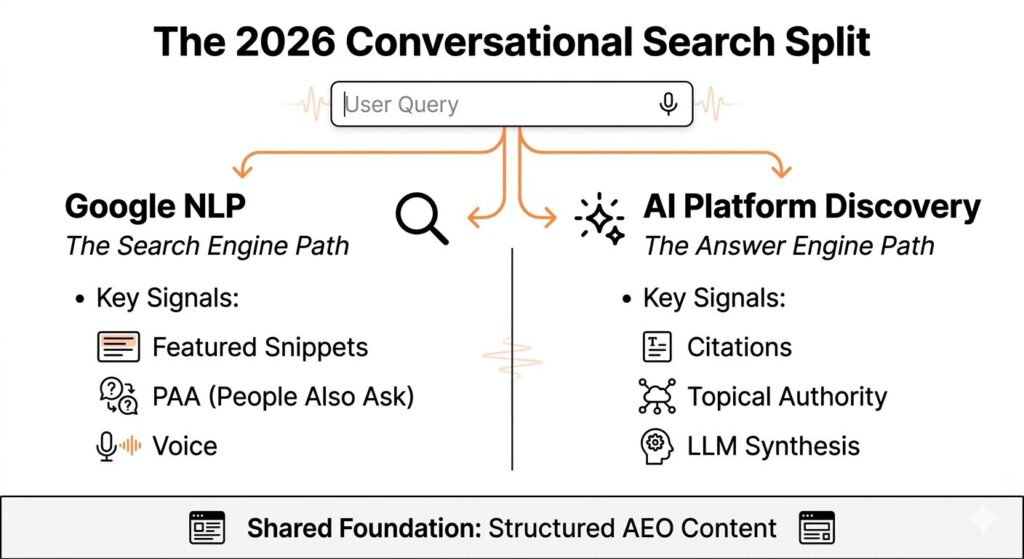
Conversational search does not live in one place. It operates across two parallel channels with different mechanics but a shared content infrastructure requirement.
| Paradigm 1: Google NLP | Paradigm 2: AI Platform Discovery | |
| Interface | Google Search (text + voice) | ChatGPT, Perplexity, Gemini, AI-integrated Bing |
| Query type | Long-tail questions, voice queries, PAA triggers | Full-sentence questions, research queries, multi-turn conversations |
| How answers surface | Featured snippets, AI Overviews, PAA boxes | AI-generated responses citing source content |
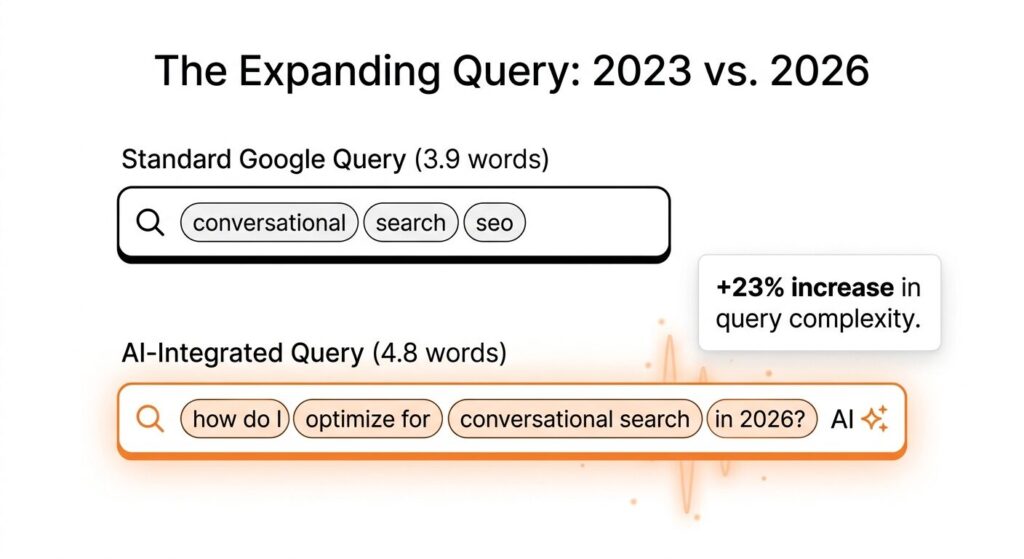
| Average query length | 3.9 words (standard); longer for voice | 4.8 words (AI-integrated Bing) |
| Primary optimization signal | On-page structure, E-E-A-T, schema markup | Topical authority, structured content, citability |
| Content format that wins | Direct-answer paragraphs, FAQ sections, structured lists | Same, plus comprehensive cluster coverage |
Paradigm 1: Google Conversational Queries
In Google, conversational search optimization is largely a featured snippet and People Also Ask problem. Queries like “how does conversational search work” or “what is the best way to optimize for voice search” trigger NLP processing that favors content matching the phrasing and intent of the question, not just the isolated keyword.
Voice search adds another dimension. Voice queries convert at a 76% rate for local searches, and they trigger featured snippets at a higher rate than typed queries. When Google reads a snippet aloud in response to a voice query, that snippet is the entire answer. If your content owns it, your content owns the response.
Paradigm 2: AI Platform Discovery
ChatGPT, Perplexity, and Gemini do not return a list of links. They synthesize an answer and cite sources. Those citations are where the visibility lives in this paradigm.
AI platforms favor content that is clearly structured, demonstrably authoritative, and directly answers the question. The longer average query length on AI-integrated Bing (4.8 words versus Google’s 3.9) reflects how users engage with these platforms. They ask more complete, specific questions and expect comprehensive answers. Thin content and siloed pages do not earn citations. Domains with comprehensive topical coverage do.
What Both Paradigms Have in Common
Both paradigms reward the same content architecture: direct-answer formatting, clear heading structure, FAQ sections, and topical authority built through cluster coverage. This convergence is exactly what makes a unified strategy possible.
People Also Ask boxes appear alongside Google AI Overviews 90.03% of the time. That means PAA optimization is simultaneously a Paradigm 1 ranking signal and an early Paradigm 2 citability signal. For a complete breakdown of PAA strategy, read our People Also Ask optimization guide.
Why Conversational Search Behavior Is Accelerating in 2026
The Numbers Behind the Shift
The behavioral data points in one direction:
- More than 60% of searches are now conversational in phrasing
- PAA boxes appear on 49% of desktop searches and 52% of mobile searches
- ChatGPT processes approximately 3.8 billion monthly visits
- AI-integrated Bing users submit queries averaging 4.8 words versus 3.9 for standard Google queries
- Voice search queries convert at 76% for local searches
The majority of search traffic across both paradigms already flows through conversational interfaces. Brands optimizing primarily for short-tail keywords are increasingly optimizing for a shrinking share of queries.
What Changed Between 2023 and 2026
In 2023, conversational search optimization meant one thing: optimize for Google voice, long-tail, and featured snippets. AI platforms existed but had not yet reached the scale to function as primary discovery channels.
By 2026, that has changed. AI platforms now handle billions of queries independently of Google. A person researching B2B software or professional services is as likely to start with ChatGPT as with a Google search. Content invisible in both channels is invisible to a significant share of its target audience.
How to Optimize for Paradigm 1: Google Conversational Search
Build Content Around Question-Intent Queries
Start with keyword research focused on full-question formats: “how to,” “what is,” “why does,” “best way to.” Target queries of 4 to 6 words where the phrasing reflects specific intent. These outperform single-keyword targets for conversational triggers because they match the NLP patterns Google uses to identify high-relevance answers.
Identify the three to five most common questions your audience asks and build a dedicated section answering each one directly. Lead with a 40 to 60-word direct-answer paragraph before expanding into supporting detail.
Target Featured Snippets as a Mandatory First Step
Featured snippets are the primary gateway to Google AI Overview citation. Pages holding featured snippets earn AI Overview appearances at a substantially higher rate than pages that rank in the top 10 without a snippet. Winning the snippet is how you enter both systems simultaneously.
Three snippet types dominate conversational queries: paragraph snippets for “what is” and “how does” questions, list snippets for “how to” and “best X” queries, and table snippets for comparison questions. Match your content format to the type the target query triggers.
For the complete featured snippet optimization framework, see our guide on how to rank in featured snippets.
Optimize for People Also Ask
PAA boxes are not just a SERP feature to win; they are a map of every question Google associates with your topic. The hierarchy of PAA questions mirrors the same topical structure AI systems use to assess whether a domain has comprehensive authority over a subject.
Answer each PAA question with a self-contained 50 to 80-word response placed under a heading that matches the question phrasing. This is both a snippet-optimization move and an AI citability move.
Quick Win: Adding a 40 to 60-word direct-answer block at the top of any section targeting a PAA question consistently increases snippet capture rate. We see this pattern across the content infrastructure we build for clients.
Structure for Voice Search Queries
Voice search optimization is Paradigm 1 at its most conversational. Write H2 and H3 headings as natural questions where the topic allows it. Include a FAQ section formatted for the phrasing voice assistants favor. For local businesses, structured NAP data is non-negotiable. Voice search converts at 76% for local intent.
Add Speakable schema markup to passages you want Google to read aloud in response to voice queries. This is a direct signal that a passage is formatted and intended for spoken delivery.
How to Optimize for Paradigm 2: AI Platform Discovery
Understand How AI Platforms Select Sources
AI platforms do not use a traditional ranking algorithm. They build an answer and select sources to cite based on which content most credibly covers the topic. The selection signals are observable: clear authority, structured formatting, direct answers, and comprehensive topical coverage.
These signals map closely to E-E-A-T. Content demonstrating genuine experience, expert-level depth, and trust signals earns citations more consistently than content that covers the same ground superficially.
Structure Content for AI Extraction
AI platforms extract specific passages, not full articles. Your content needs clearly delineated answer units: definitions in callout boxes, numbered step sequences, comparison tables, FAQ sections with self-contained answers, and short direct-answer paragraphs that address the query before supporting detail follows.
This structure is functionally identical to what wins Google featured snippets. That is not a coincidence. Featured snippet selection and AI citation are both solved by the same content architecture: lead with the answer, support with depth.
Build Topical Authority Across Your Cluster
Individual pages do not earn sustained AI citations. Domains with comprehensive topical coverage do. AI platforms assess whether a source has deep, interconnected coverage of a subject, not just one strong page on a single question.
When we built the content infrastructure for EasyOps, the results demonstrated exactly what systematic cluster coverage signals to AI platforms and Google alike: 626% traffic growth in 14 months, from 4,200 to 30,500 monthly visits, with 89 top-10 keywords across 198 published articles. The company was acquired at a $21.6 million valuation at 9X ARR. A content cluster built for topical authority was a core part of the acquisition story. That level of organic visibility does not come from isolated page optimization. It comes from a system.
Want to build a content infrastructure that ranks across both Google and AI platforms? See how Superteam AI’s AI SEO Workforce builds and manages complete topic clusters, from research through publication to ranking management. Explore the AI SEO Workforce
Answer Engine Optimization: The Unified Strategy for Both Paradigms
What Answer Engine Optimization Actually Means in 2026
Answer engine optimization is the practice of structuring content to be retrieved and presented as answers: by Google’s featured snippet and AI Overview systems, or by AI platform inference engines. It is the strategic framework that connects both conversational search paradigms under one content approach.
Traditional SEO optimizes for ranking position. AEO optimizes for answer selection. A page ranked at position three provides less visibility than a page selected as the cited answer in a Google AI Overview at position zero, or cited by ChatGPT across millions of queries on the same topic.
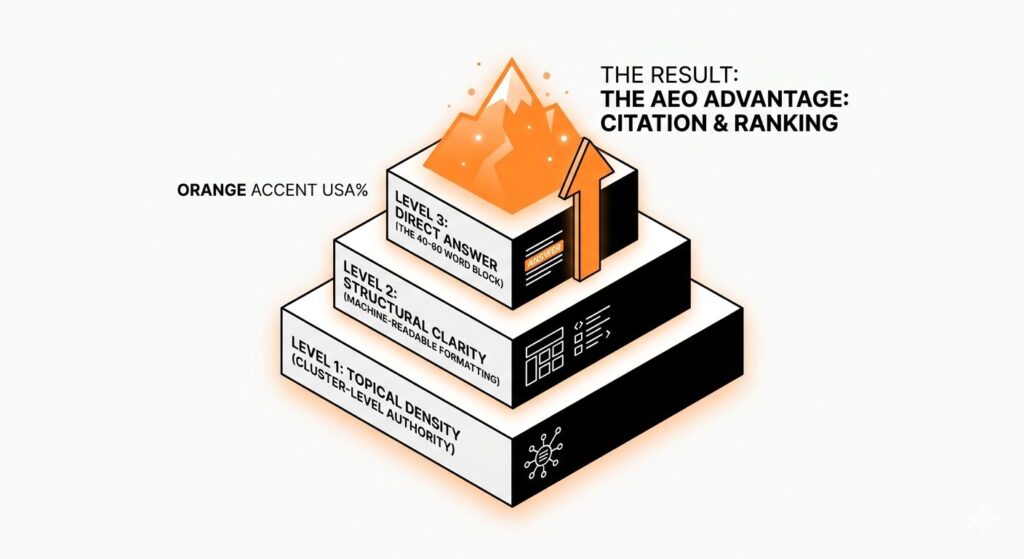
The Three AEO Principles That Work Across Both Paradigms
- Direct answer formatting. Lead every section with the answer to the question the heading poses. Do not build toward the answer through context paragraphs. Put it first, then support it. This is how AI systems extract content and how most users read digital content under time pressure.
- Structural clarity. Use headers, tables, and lists that AI systems and search engines can parse independently of the surrounding prose. A comparison table that conveys its meaning without the paragraphs around it is a table that will get cited. Ambiguous structure is invisible to automated extraction.
- Topical density. Build comprehensive clusters rather than isolated articles. A domain covering a topic from 15 angles earns authority signals that a single optimized page cannot match, regardless of how well-structured that page is.
Building an AEO-Ready Content Infrastructure
Applying these principles at scale is a content system problem, not a single-article problem. Our AI SEO Workforce is built on this infrastructure: pillar and cluster architecture, AEO-formatted content at every level, and systematic coverage of the questions your audience asks across both paradigms.
If you want the full strategic framework before you begin, read our complete guide to answer engine optimization.
Conversational Search Optimization Checklist for 2026
This is the checklist we use when auditing existing pages or briefing new content for conversational search coverage across both paradigms.
| Action Item | Paradigm | Priority | Estimated Impact |
| Target 4 to 6-word question-format keywords | 1 | High | Featured snippet eligibility |
| Lead each section with a 40 to 60-word direct answer | 1 + 2 | High | Snippet capture + AI citation |
| Match content format to snippet type (paragraph/list/table) | 1 | High | Snippet selection rate |
| Include FAQ section with PAA-aligned questions | 1 + 2 | High | PAA ranking + AI citability |
| Add Speakable schema to voice-optimized passages | 1 | Medium | Voice search delivery |
| Add FAQPage schema to FAQ section | 1 + 2 | High | PAA + AI Overview eligibility |
| Add Article schema with datePublished and dateModified | 1 + 2 | Medium | Freshness signals |
| Write crisp definitions in callout boxes | 1 + 2 | High | Featured snippet + AI extraction |
| Build comparison tables for competitive queries | 1 + 2 | Medium | Table snippets + AI citation |
| Create internal cluster links to related topic pages | 1 + 2 | High | Topical authority signals |
| Use natural-language phrasing in H2s and H3s | 1 + 2 | Medium | Voice + PAA alignment |
| Publish supporting cluster articles on the same topic | 2 | High | AI platform domain authority |
FAQ
What is conversational search and how does it differ from traditional search?
Conversational search uses natural language questions rather than short keyword fragments. In traditional search, a user types “conversational search SEO.” In conversational search, they ask “how do I optimize my website for conversational search in 2026?” NLP processing rewards content matching the intent of the full question, not just the isolated keywords within it.
Does conversational search only apply to voice search?
No. Most conversational searches are typed, not spoken; they simply use natural, question-based phrasing. Conversational search also includes AI platform queries through ChatGPT, Perplexity, and Gemini, typically submitted as full questions. Optimizing for conversational search in 2026 means covering all of these channels, not just voice.
How do AI platforms like ChatGPT decide which content to cite?
AI platforms select sources based on observable signals: authority, structure quality, directness of the answer, topical comprehensiveness, and trust indicators like verifiable claims. There is no public algorithm, but the pattern is consistent: content that wins Google featured snippets earns AI citations at a higher rate than top-10 content without a snippet.
What is the difference between conversational search optimization and answer engine optimization?
Conversational search optimization covers making content rank for natural-language query formats across Google and AI platforms. Answer engine optimization (AEO) is the broader framework governing how content should be structured to be selected as an answer across Google’s AI Overviews, featured snippets, and AI platforms alike. AEO is the framework; conversational search optimization is one of its primary application areas.
How long does content need to be to rank for conversational queries?
Length matters less than structure and directness. A 1,500-word article with clear direct-answer formatting will outperform a 4,000-word article that buries the answer. That said, AI platform citations favor domains with comprehensive topical coverage: a cluster of well-structured pieces on the topic, rather than a single page trying to cover everything.
Does optimizing for conversational search affect desktop performance?
Yes. Featured snippet improvements apply to both desktop and mobile simultaneously. PAA boxes appear on 49% of desktop searches. The structural improvements that earn AI citations (direct answers, FAQ sections, clear heading architecture) are content quality signals that Google weighs across all device types. Conversational search optimization is not a mobile-only strategy.
How does People Also Ask connect to conversational search?
PAA boxes show the question tree Google associates with a topic, which mirrors how AI systems assess topical authority. PAA questions are, by definition, conversational queries. Winning PAA positions is both a conversational search ranking outcome and a topical authority signal, and PAA appears alongside AI Overviews 90.03% of the time.
Can Superteam AI help with conversational search optimization across both paradigms?
Yes. Superteam AI’s AI SEO Workforce handles the full conversational search optimization pipeline: topic cluster architecture, AEO-structured content creation, PAA and featured snippet targeting, and schema implementation across both Google NLP and AI platform paradigms. Our clients maintain a 4.7/5 satisfaction rating. You can learn more at superteamai.com.
The Path Forward
Conversational search is not one thing. It is two parallel channels that share a content infrastructure requirement, and that shared requirement is where the opportunity lives.
The brands winning in 2026 are not choosing between Google optimization and AI platform visibility. They are building content systems that serve both paradigms: direct-answer formatting, comprehensive cluster coverage, PAA and featured snippet targeting, and the topical authority signals that earn AI citations. Answer engine optimization is the framework that connects both under one strategy.
The three moves that matter most: build content around question-intent queries, win featured snippets as your gateway to AI Overview citation, and invest in cluster-level topical authority. Conversational search rewards brands that build for answers, not just rankings.Ready to build a conversational search and AEO content system that works across both paradigms? Superteam AI’s AI SEO Workforce handles the entire pipeline: from topic cluster architecture to AEO-structured content to ongoing ranking management. Get started with the AI SEO Workforce


