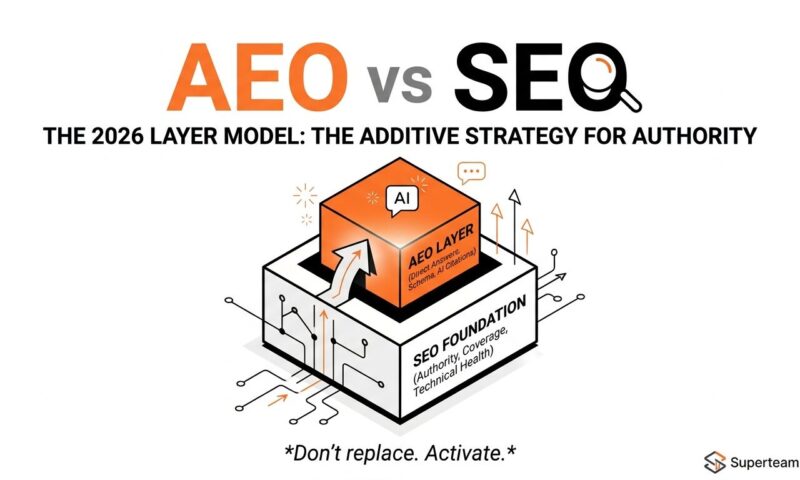
Sixty percent of searches now end without a click. That single statistic explains why answer engine optimization vs SEO has become one of the most searched questions in digital marketing in 2026, and why most brands are handling the answer wrong.
The two most common mistakes: treating AEO as a synonym for SEO (same thing, different name) or treating it as a replacement (do AEO instead of SEO). Both framings lead to the wrong strategy and wasted effort.
In our work building content systems that need to perform in both traditional Google results and AI platform responses, we have found that the most effective brands treat answer engine optimization as a layer built on top of a working SEO foundation. Not a competitor to SEO. Not a synonym. A next layer.
This guide gives you the complete picture: what each discipline actually does, where they overlap, where they diverge, and a practical decision framework for allocating effort between them.
What Is the Difference Between SEO and Answer Engine Optimization?
The simplest version: SEO competes for position in search results. AEO competes to be chosen as the answer.
Definition: SEO: Search Engine Optimization is the practice of improving a website’s visibility in traditional search engine results pages (SERPs) through on-page optimization, technical infrastructure, backlink acquisition, and E-E-A-T signals. Success is measured in rankings, organic traffic, and click-through rates.
Definition: Answer Engine Optimization (AEO): Answer Engine Optimization is the practice of structuring content to be retrieved and presented as a direct answer: by Google’s featured snippet and AI Overview systems, or by AI platforms like ChatGPT, Perplexity, and Gemini. Success is measured in snippet ownership, AI citation frequency, and zero-click visibility.
SEO: Optimizing for Search Engine Rankings
Traditional SEO works through a well-established mechanism: Google crawls your content, indexes it, and ranks it based on hundreds of signals: E-E-A-T, backlinks, page experience, topical relevance, and user behavior. The goal is to appear at or near the top of the results page for queries your target audience types.
SEO targets the ranking algorithm. The reward is a blue link that users click to reach your site. Traffic, then conversion, then revenue.
Answer Engine Optimization: Optimizing for Answer Selection
AEO works through a different mechanism. Rather than competing for a ranking slot in a list of results, AEO-optimized content competes to be selected as the single cited answer: either in a Google featured snippet or AI Overview, or as a cited source in a ChatGPT or Perplexity response.
The goal is not to be ranked. It is to be chosen. Content that wins this selection is typically structured around direct-answer paragraphs, FAQ sections, comparison tables, and schema markup that tells AI systems exactly what a passage means.
The Core Distinction in One Sentence
SEO puts you on the shelf. AEO gets you recommended.
AEO vs SEO: Full Comparison
| Dimension | SEO | Answer Engine Optimization (AEO) |
| Primary goal | Rank in SERP results pages | Be selected as the cited answer |
| Target system | Google/Bing ranking algorithms | Featured snippets, AI Overviews, AI platforms |
| Content format | Comprehensive long-form content | Direct-answer paragraphs, FAQ sections, comparison tables |
| Success metrics | Rankings, organic traffic, CTR | Snippet ownership, AI citation rate, zero-click visibility |
| Core signals | Backlinks, E-E-A-T, page experience, keyword relevance | Structured content, schema markup, topical cluster depth, directness |
| Role of keywords | Central; keyword strategy drives content planning | Supporting; intent and question format matter more than keyword density |
| Schema markup | Helpful but optional for many content types | Near-mandatory for featured snippet and AI citation eligibility |
| Link building | Core investment for domain authority | Secondary; authority is prerequisite, not primary AEO lever |
| Content depth preference | Long-form comprehensive coverage ranks well | Concise extractable answer units within comprehensive content |
| Time to results | 3 to 12 months for new content | Faster for retrofitted page-1 content; dependent on SEO foundation |
The most important insight: AEO does not eliminate any row of SEO investment. It adds new requirements on top of them.
Does AEO Replace SEO? The Layer Model
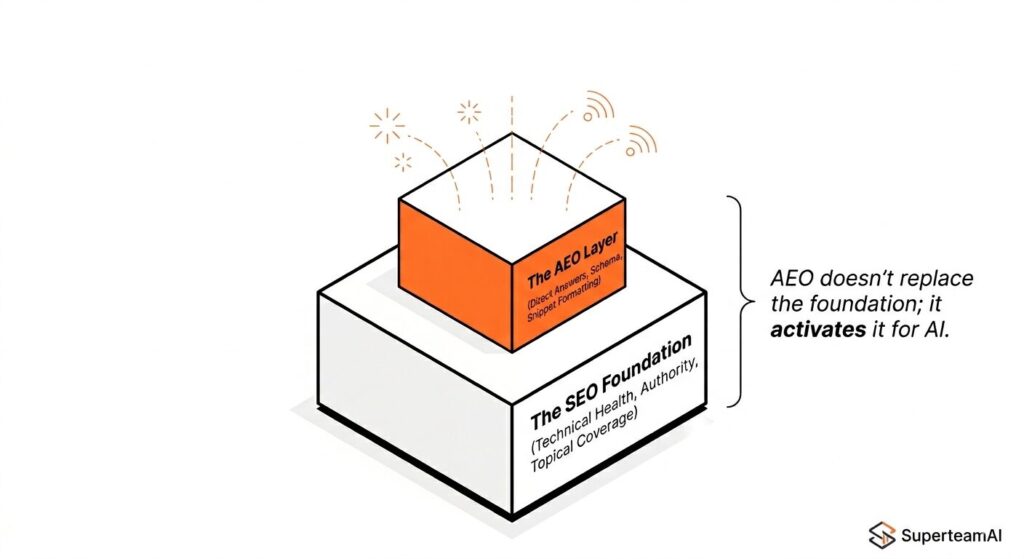
No. And the reason is architectural, not diplomatic.
AEO cannot produce results without the foundation that SEO builds. Schema markup on a domain Google does not trust does not earn AI citations. Direct-answer paragraphs on a site with thin topical coverage will not be selected over a competitor with 30 articles on the same subject. Featured snippet optimization on a page that ranks on page 3 captures zero snippets.
The SEO foundation (domain authority, technical health, topical coverage, backlink profile) is not optional context for AEO. It is the prerequisite.
The layer model in one sentence: Build the SEO foundation first (authority, coverage, trust), then apply AEO formatting to convert that foundation into citations and zero-click visibility.
Why AEO Cannot Function Without an SEO Foundation
Three SEO outputs are prerequisites for AEO results:
- Domain authority. AI platforms favor credible sources. That credibility is informed by the same signals driving Google rankings: backlink quality, brand entity recognition, and E-E-A-T. A low-authority domain cannot shortcut this with good formatting.
- Topical coverage. AI systems favor domains with deep, interconnected coverage over domains with one well-structured page. Topical coverage is a long-form SEO investment; AEO inherits its authority from the cluster architecture SEO builds.
- Crawlability and indexability. If Google cannot crawl and index your content, no amount of AEO formatting earns citations. Technical SEO is the prerequisite for any search visibility, including AI-mediated visibility.
What AEO Adds on Top of SEO
Once the SEO foundation is established, AEO adds specific formatting and structural layers:
- Direct-answer paragraphs at the top of each section (40 to 60 words, leading with the answer)
- Callout definition boxes with crisp, extractable definitions of key terms
- FAQ sections structured for FAQPage schema
- Speakable schema on voice-optimized passages
- Comparison tables designed for table-snippet extraction
- Topical cluster completeness as an AI citation signal
These additions do not require rebuilding content from scratch. They are applied to content that already has SEO value, which is why they are a layer, not a replacement.
The Failure Mode: AEO Without SEO
The most common error we see: brands invest in AEO formatting on a domain with weak authority and incomplete topical coverage. The content is well-structured, but AI platforms favor more authoritative sources on the same question and the AEO investment produces no citations.
The fix is not more AEO tactics. It is building the SEO foundation first.
The Tactic Overlap Map
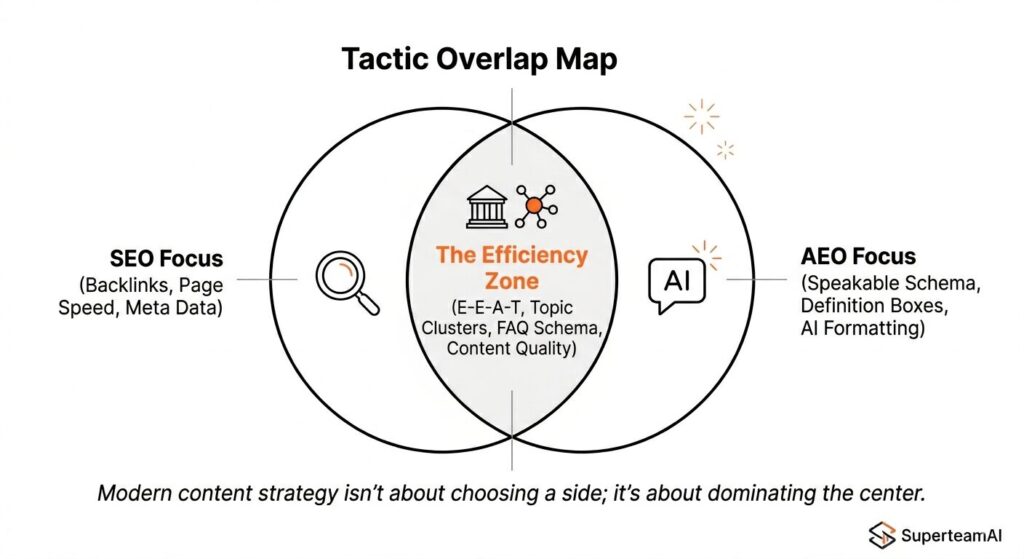
This is the map we use when auditing client content for AEO readiness. It shows which tactics are SEO-only, which are AEO-only, and which serve both. The majority of high-value tactics are in the “both” column, which is the strongest practical argument for the layer model.
| Tactic | Benefits SEO | Benefits AEO | Priority |
| Long-tail question keyword research | ✓ | ✓ | High: both |
| Heading hierarchy (H1 to H3) | ✓ | ✓ | High: both |
| E-E-A-T signals (author bio, citations) | ✓ | ✓ | High: both |
| Internal linking / topic clusters | ✓ | ✓ | High: both |
| Backlink acquisition | ✓ | indirect | High: SEO primary |
| Page speed / Core Web Vitals | ✓ | indirect | High: SEO primary |
| Direct-answer paragraph structure | partial | ✓ | High: AEO primary |
| FAQ section | ✓ | ✓ | High: both |
| FAQPage schema | partial | ✓ | High: AEO primary |
| Speakable schema | ✗ | ✓ | Medium: AEO only |
| Callout definition boxes | partial | ✓ | High: AEO primary |
| Comparison tables | ✓ | ✓ | Medium: both |
| Featured snippet formatting | ✓ | ✓ | High: both |
| Meta title and description optimization | ✓ | partial | High: SEO primary |
| Topical cluster completeness | ✓ | ✓ | High: both |
Notice that only two tactics are AEO-only (Speakable schema and callout definition boxes). Everything else either benefits both or primarily benefits SEO with secondary AEO effects. This overlap is why building for both simultaneously is the most efficient approach for any content created in 2026.
When to Prioritize SEO vs AEO: A Decision Framework
The question is not which strategy is better. The question is which layer to focus on given your current starting point.
Prioritize SEO When…
Your site meets any of these conditions:
- Domain authority is below 40 (or equivalent in your preferred tool)
- Existing content is not yet ranking on page 1 for target keywords
- Unresolved technical SEO issues exist (crawl errors, indexing problems, Core Web Vitals failures)
- Backlink profile is thin or built primarily from low-quality sources
- Topical coverage is incomplete, meaning fewer than 5 to 10 articles in your core topic cluster
In these conditions, AEO formatting will not produce results regardless of how well it is applied. Build the foundation first.
Prioritize AEO Layering When…
Your site meets these conditions:
- Existing content ranks on page 1 but does not own featured snippets
- Domain has established topical authority in the target cluster
- Organic traffic exists but zero-click visibility (AI Overviews, PAA) is low
- AI platforms are a meaningful discovery channel for your target audience
- Content production cadence is stable enough to maintain the layer, not just apply it once
These conditions describe a site where the SEO foundation is strong enough to support AEO, and where AEO will produce measurable additional visibility relatively quickly.
Build for Both Simultaneously When…
This is the default for any new content created in 2026 on a domain with established authority. When writing a new article for a site that already ranks, incorporating AEO structure from the start adds approximately 15 to 20% to production time. Retrofitting AEO optimizations onto existing content later costs three to four times more effort per piece.
In our experience, the brands that adopt the layer model from the start of a content program, building every piece for both SEO ranking and AEO citation from day one, consistently outperform brands that treat AEO as a phase-two project.
For the complete AEO framework, see our guide to answer engine optimization.
How to Build an Integrated AEO and SEO Strategy
The layer model is not a philosophy; it is a four-step process.
Step 1: Audit Your SEO Foundation
Before adding any AEO layer, establish your baseline: domain authority, technical health, existing content rankings, and topical coverage gaps. A standard SEO audit gives you this picture. The output is a list of what is already AEO-ready and what foundation-building needs to happen first.
Step 2: Identify Your AEO Opportunities
From your existing page-1 rankings, find content that does not yet own a featured snippet or appear in AI Overviews. These are your highest-leverage AEO entry points; the SEO foundation is already there, and you are adding the layer to content that is already trusted and indexed.
Step 3: Apply the AEO Layer
For each identified piece, add: a direct-answer block at the top of key sections, a FAQ section with FAQPage schema, callout definition boxes for key terms, and a comparison table where applicable. For new content, incorporate all of these from the first draft.
Step 4: Build the Cluster
AEO at scale requires comprehensive topical coverage, not just individual page optimization. When we built the content infrastructure for EasyOps with both SEO and AEO principles integrated from the start, the results demonstrated what systematic cluster coverage produces: 626% traffic growth in 14 months, from 4,200 to 30,500 monthly visits, 89 top-10 keywords across 198 published articles, and a $21.6 million acquisition at 9X ARR. The SEO+AEO layer model, applied at cluster scale, was central to that outcome.
Superteam AI’s AI SEO Workforce handles this entire process: SEO foundation audit, AEO layering, cluster architecture, and ongoing performance management, all in one system. See how it works
Measuring SEO and AEO Success
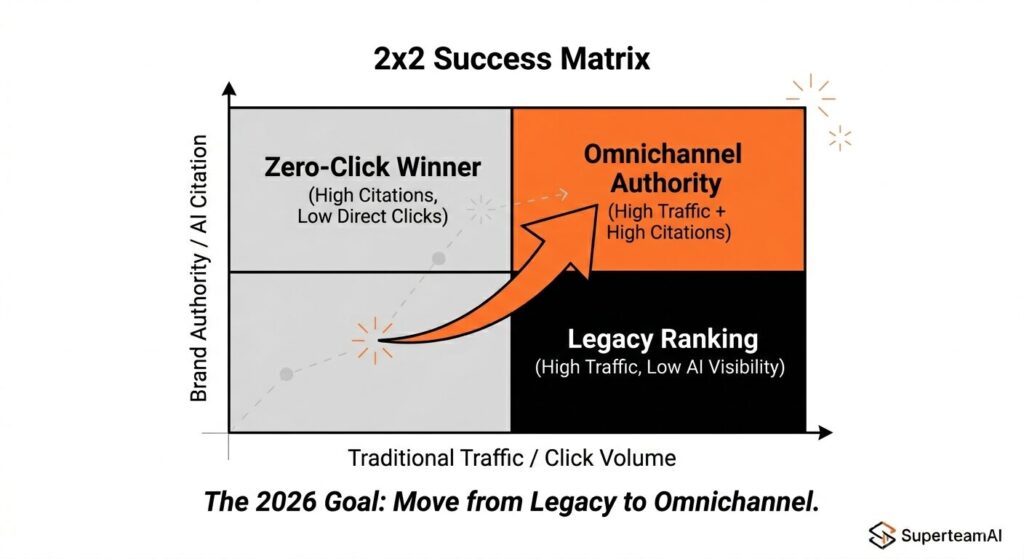
A common mistake in AEO adoption: evaluating performance using only SEO metrics. AEO can be generating AI citations and featured snippet ownership while organic click traffic stays flat. That is the zero-click dynamic, not failure. You need different metrics to see it.
| Metric Category | What SEO Measures | What AEO Measures |
| Visibility | Rankings by keyword, SERP position | Featured snippet ownership rate, AI Overview appearances |
| Traffic | Organic sessions, new users from search | Direct traffic uplift from AI platform referrals, brand search volume |
| Engagement | Bounce rate, time on page, pages per session | PAA box wins, voice search appearances |
| Brand | Branded search volume | AI citation frequency (tracked via brand monitoring tools) |
| AI-specific | AI Overview click contribution | Perplexity/ChatGPT citation tracking, AI search share |
| Business outcome | Conversions from organic traffic | Pipeline from AI-referred sessions, discovery-stage lead quality |
Track both columns. A brand optimizing for both SEO and AEO should expect rankings and traffic to grow alongside snippet ownership and AI citation frequency. If rankings grow but snippet ownership stays flat, the AEO layer needs attention. If snippet ownership grows but traffic declines, the zero-click dynamic is operating and brand-signal tracking becomes more important.
AEO, SEO, and GEO: Clarifying the Three-Term Landscape
A legitimate source of confusion in 2026 is the appearance of a third term: GEO, or Generative Engine Optimization. Here is where it fits.
SEO optimizes for traditional search ranking. AEO optimizes for being cited as an answer across search features and AI platforms. GEO is a more specific application of AEO focused exclusively on being cited within generative AI responses: ChatGPT, Perplexity, Gemini, and similar platforms.
In practice, GEO is a subset of AEO. The tactics that earn AEO results (direct-answer structure, topical authority, schema markup, E-E-A-T signals) are the same tactics that earn GEO results. The SEO+AEO layer model already covers what GEO describes.
The distinction is useful for measurement and prioritization. If your audience primarily discovers your brand through AI platforms rather than Google search, GEO-specific tracking (monitoring citations in ChatGPT and Perplexity) becomes more important. But the content investment is the same.
FAQ
What is the main difference between AEO and SEO?
SEO optimizes content to rank in traditional search engine results pages through signals like backlinks, keyword relevance, and E-E-A-T. Answer engine optimization structures content to be selected as a direct answer: in Google’s featured snippets and AI Overviews, or cited by AI platforms like ChatGPT and Perplexity. SEO competes for ranking position; AEO competes to be chosen as the answer.
Does answer engine optimization replace SEO?
No. AEO is a layer built on the SEO foundation, not a replacement for it. Domain authority, technical health, and topical coverage (all built through SEO) are prerequisites for AEO results. Schema markup and direct-answer formatting on a low-authority domain will not earn AI citations regardless of how well the content is structured. Build the SEO foundation first, then apply the AEO layer.
Can the same content rank in SEO and earn AEO citations?
Yes, and this is the core argument for the layer model. The majority of high-value SEO tactics also benefit AEO: topic clusters, internal linking, E-E-A-T signals, FAQ sections, and long-tail question keywords all serve both. Adding AEO-specific formatting (direct-answer blocks, schema markup, callout definitions) to SEO-optimized content converts SEO authority into AEO citations without rebuilding the content.
What metrics should I use to measure AEO performance?
AEO requires different metrics than SEO. Where SEO tracks rankings and click traffic, AEO tracks featured snippet ownership rate, AI Overview appearances, PAA box wins, and AI citation frequency. A brand generating AI citations may see flat click traffic; that is the zero-click dynamic, not a failure. Track brand search volume and direct traffic uplift alongside snippet metrics to see the full picture.
What is GEO and how does it relate to AEO and SEO?
Generative Engine Optimization (GEO) refers to optimizing content to be cited specifically within generative AI responses from ChatGPT, Perplexity, Gemini, and similar platforms. GEO is a subset of AEO rather than a separate discipline. The content tactics that earn AEO results (topical authority, structured formatting, schema markup, direct-answer paragraphs) are the same tactics that earn GEO results. The SEO+AEO layer model covers GEO without requiring a third separate strategy.
How long does it take to see results from AEO optimization?
Results depend on your SEO foundation. For existing page-1 content with established authority, applying AEO formatting can produce featured snippet wins within weeks. For newer domains, AEO cannot produce citations until the SEO foundation (authority, topical coverage, trust signals) is in place, which typically takes 6 to 12 months of consistent content and link-building work.
Which is more important for a new website: SEO or AEO?
SEO is the priority for any new website. Without domain authority, crawlability, and topical coverage, AEO tactics produce no results. New sites should focus entirely on building their SEO foundation for the first 6 to 12 months: creating comprehensive content, earning quality backlinks, resolving technical issues, and building topical cluster coverage. Once the foundation is solid and content starts ranking on page 1, AEO layering becomes the logical next investment.
Can Superteam AI help with both SEO and AEO strategy?
Yes. Superteam AI’s AI SEO Workforce manages the full integrated pipeline: SEO foundation, AEO layering, topic cluster architecture, and ongoing performance management across both Google rankings and AI platform citations. Our clients maintain a 4.7/5 satisfaction rating across this process. Learn more at superteamai.com.
What This Means for Your Content Strategy
The answer engine optimization vs SEO debate resolves cleanly once you adopt the layer model. SEO is not competing with AEO. AEO is SEO’s logical extension for the 2026 search landscape, where 60% of searches end without a click and AI platforms handle billions of queries independently.
Three takeaways to carry forward: SEO builds the foundation that makes AEO possible, so sequence matters. The majority of high-value content tactics benefit both channels simultaneously, so building for AEO does not mean starting over. And the brands that apply the layer model consistently, at cluster scale rather than page by page, are the ones that compound visibility across both traditional and AI-mediated search. Answer engine optimization and SEO are not a choice. They are a sequence.


