AI-driven sessions convert at 14.2% compared to 2.8% for traditional organic traffic. That gap is the commercial consequence of being the source an AI chooses to cite when a buyer asks a question.
But most guides on answer engine optimization best practices leave practitioners more confused than when they started. They hand you a flat list of 10 to 15 practices with no guidance on which are prerequisites, which produce results in 30 days, and which only pay off after six months.
In our work building AEO content systems for clients, the most common implementation failure is not choosing the wrong practices. It is applying the right practices in the wrong order.
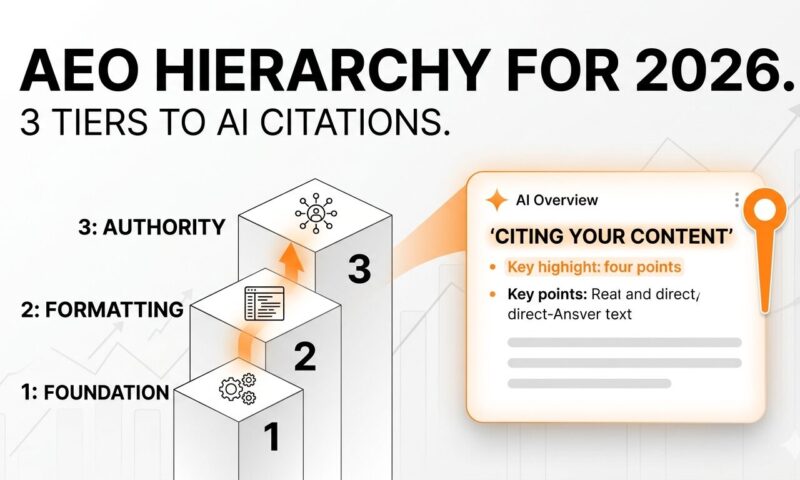
This guide fixes that. We built a three-tier hierarchy for answer engine optimization best practices, a practical answer to how to optimize content for answer engines best practices, organized by what to do first, what to do next, and where to invest for compound growth.
Why Flat Best Practices Lists Set You Up to Fail
Every other guide on best practices for optimizing content for answer engines delivers the same list: use structured data, create FAQ pages, target question-based keywords, build topical authority. The advice is not wrong. But presenting it as a flat, unordered list implies every practice is equally urgent and accessible, regardless of where your domain stands today.
That framing causes three predictable failures. First, practitioners skip Foundation practices because they look more like long-term strategy than concrete action, so schema markup and FAQ pages get prioritized over the prerequisites that make those tactics work. Second, Formatting practices get implemented on pages that lack the domain authority floor AI systems require before page-level signals become the deciding factor. The formatting is correct; the domain is not ready for it. Third, Authority practices like topic cluster building are treated as optional add-ons rather than the compound investment that determines long-term AI citation dominance.
The sequence is not arbitrary. Foundation enables Formatting. Formatting amplifies Authority. Authority compounds over time in ways no single-page optimization ever will.
The Three-Tier AEO Best Practices Hierarchy
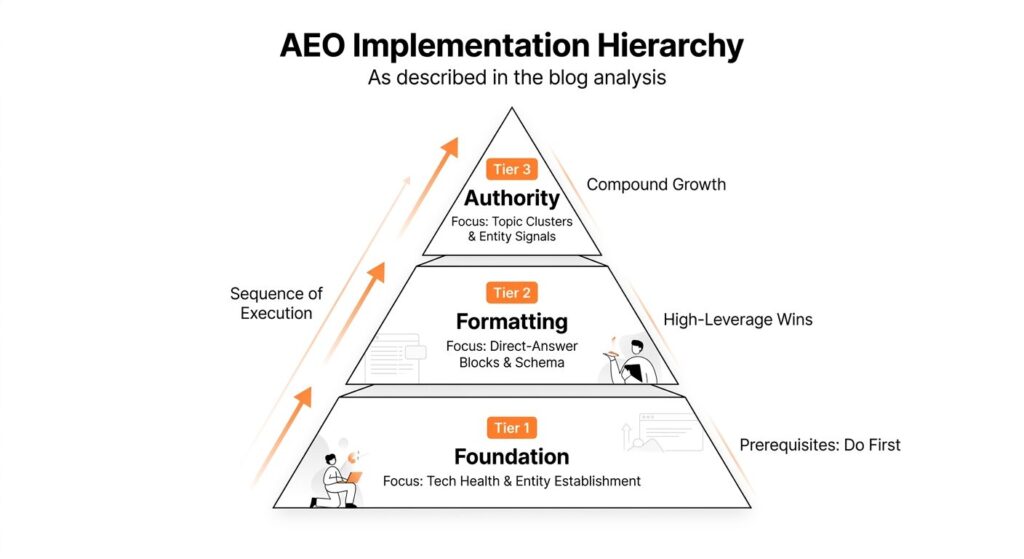
The three-tier hierarchy organizes every answer engine optimization best practice into the tier where it belongs: what must be in place first (Foundation), what produces the fastest results once the foundation is stable (Formatting), and what builds sustained AI citation dominance over months (Authority).
| Tier | Category | What It Covers | Why This Order | Time to Impact |
| Tier 1 | Foundation | Technical health, entity establishment, authority baseline | Without these, Tier 2 and 3 produce inconsistent results | Weeks 1 to 4 |
| Tier 2 | Formatting | Direct-answer blocks, FAQ architecture, schema, question-intent headings | Highest returns once Foundation is stable | Weeks 4 to 10 |
| Tier 3 | Authority | Topic cluster architecture, internal linking, entity signals | Compounds over time into sustained topic-level dominance | Months 3 to 9+ |
Tier 1: Foundation Practices: The Prerequisites You Cannot Skip
Foundation practices are not background investments to get to eventually. They are prerequisites. AI systems and Google’s selection filters assess domain-level signals before evaluating page-level signals. A page with perfect FAQPage schema on a domain that fails Core Web Vitals will not earn a featured snippet. Foundation is the floor that everything else stands on.
Technical Health and Crawlability
The technical prerequisites for AEO are the same prerequisites that determine whether Google can access and render your content at all. Core Web Vitals passing thresholds (Largest Contentful Paint under 2.5 seconds, Cumulative Layout Shift under 0.1, Interaction to Next Paint under 200ms), mobile-first rendering, and clean crawl accessibility are the baseline conditions under which any search optimization investment functions.
The AEO-specific relevance: AI systems selecting content for featured snippets and AI Overviews rely on the same Googlebot-rendered version of your page that informs traditional ranking. Pages Google cannot render efficiently cannot earn citations regardless of content quality. Resolve technical issues before touching anything else in this framework.
Entity Establishment and Knowledge Graph Presence
Definition: Entity recognition in AEO is the process by which AI systems associate content with a specific, verifiable entity (brand, person, or organization) rather than treating it as anonymous. Content tied to recognized entities earns citations at higher rates because AI systems can assess the entity’s authority independently of page-level signals.
AI citation systems favor entities they can verify. Practical steps: ensure your brand appears consistently across LinkedIn, industry publications, and structured citations. Use Organization schema on your homepage to connect your content to your verifiable entity.
Domain Authority and Topical Coverage Baseline
AEO amplifies domain authority; it does not replace it. A domain with DA 20 implementing perfect AEO formatting will not consistently outperform DA 60 competitors for competitive queries. Before investing in Tier 2, assess your domain’s authority baseline relative to the queries you are targeting. If the gap is significant, build domain authority through link acquisition and topical coverage in parallel with Formatting implementation on your strongest existing pages.
For a full breakdown of how AEO and SEO interact, read our AEO vs SEO guide.
Tier 2: Formatting Practices: The High-Leverage Quick Wins
Tier 2 practices are what most practitioners think of when they hear “AEO best practices”: direct-answer structure, FAQ architecture, schema markup, and question-intent headings. These techniques produce results within 30 to 60 days on pages with a stable Foundation layer. Without that foundation, Formatting produces inconsistent results.
The Direct-Answer Block Formula
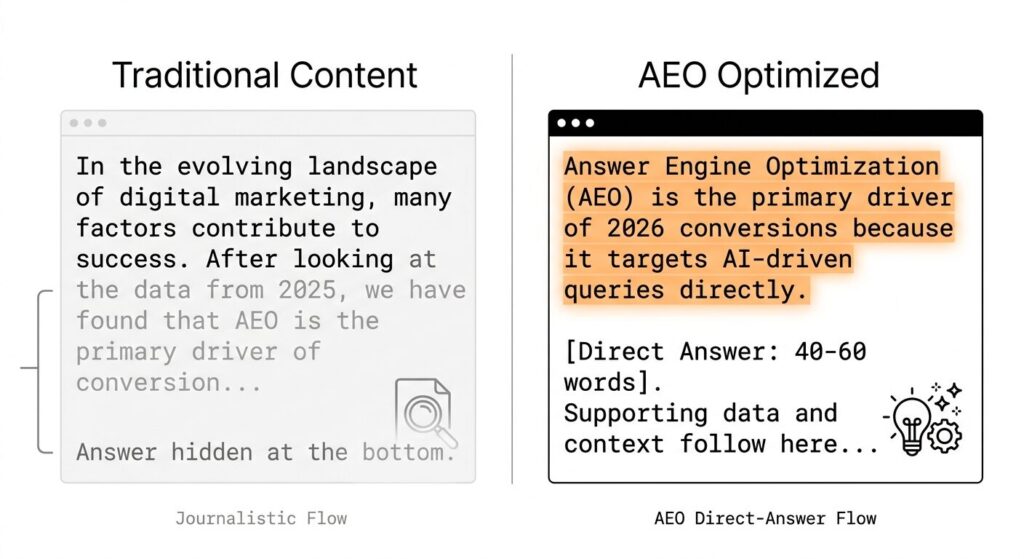
The most reliable single formatting change for AEO is the direct-answer block: a 40-to-60-word paragraph placed at the top of each section that states the answer before providing supporting detail. This inverts the traditional journalistic structure, where context leads to conclusion.
Google’s featured snippet algorithm and AI extraction systems identify the sentence or paragraph that most directly answers a query. Front-loading the answer reduces signal noise for the extraction algorithm. In our work building AEO content systems, pages with direct-answer openings earn featured snippet positions at significantly higher rates than pages that build toward the answer through context-first paragraphs.
For guidance on capturing specific snippet formats, see our guide onhow to rank in featured snippets.
FAQ Section Architecture for AI Citation
FAQ sections serve two functions simultaneously: they provide AI systems with cleanly structured question-answer pairs for direct extraction, and they address the People Also Ask questions appearing alongside 52% of mobile searches in 2026.
Key architecture guidelines:
- Write each answer as a self-contained unit that makes sense without the surrounding article.
- Keep answers between 50 and 80 words; longer answers dilute directness.
- Phrase questions in natural language patterns, not keyword-stuffed formulations.
- Apply FAQPage schema to every FAQ section.
For the full PAA strategy, read our People Also Ask optimization guide.
Schema Markup for AEO
Schema markup is a legibility layer, not a ranking factor in isolation. It tells AI systems how to classify and extract your content rather than forcing them to infer structure from HTML and prose. The priority stack:
| Schema Type | What It Signals | When to Use | Priority |
| FAQPage | Structured Q&A pairs for direct extraction | Every article with a FAQ section | High |
| Article | Content type, authorship, publication dates | All blog content | High |
| Speakable | Voice-optimized passages for audio response | Voice-targeted content | Medium |
| HowTo | Sequential step-by-step instructions | Process and implementation guides | Medium |
| BreadcrumbList | Page position in topical hierarchy | Site-wide | Medium |
| DefinedTerm | Formal concept definitions | Articles with glossary content | Low |
Implement FAQPage and Article schemas first. They address the two highest-priority citation targets before investing time in other schema types.
Question-Intent Heading Structure
Your heading hierarchy is both an NLP signal for Google’s conversational search algorithms and a topical map for AI platform discovery systems. Headings written as natural questions match the phrasing patterns that trigger PAA placements and conversational queries. When your H2 or H3 matches the way a searcher phrases a question, the probability of earning a featured snippet or AI citation for that section increases.
For a full framework on structuring content for both Google NLP and AI platform discovery, read our conversational search optimization guide.
Tier 3: Authority Practices: The Compound Growth Investments
Tier 3 practices do not produce results within 30 days. That is the nature of compound investments, not a weakness of the strategy. Sustained AI citation dominance requires comprehensive topical coverage that AI systems can verify at the domain level. Individual page optimization cannot deliver that.
AI platforms do not evaluate pages in isolation. They assess whether the domain has demonstrated comprehensive coverage of the topic. Brands with 15 to 20 deeply researched articles in a topic cluster consistently outperform brands with one or two well-optimized articles, even when the individual articles of the lower-coverage domain are technically superior.
Topic Cluster Architecture for AI Platform Citation
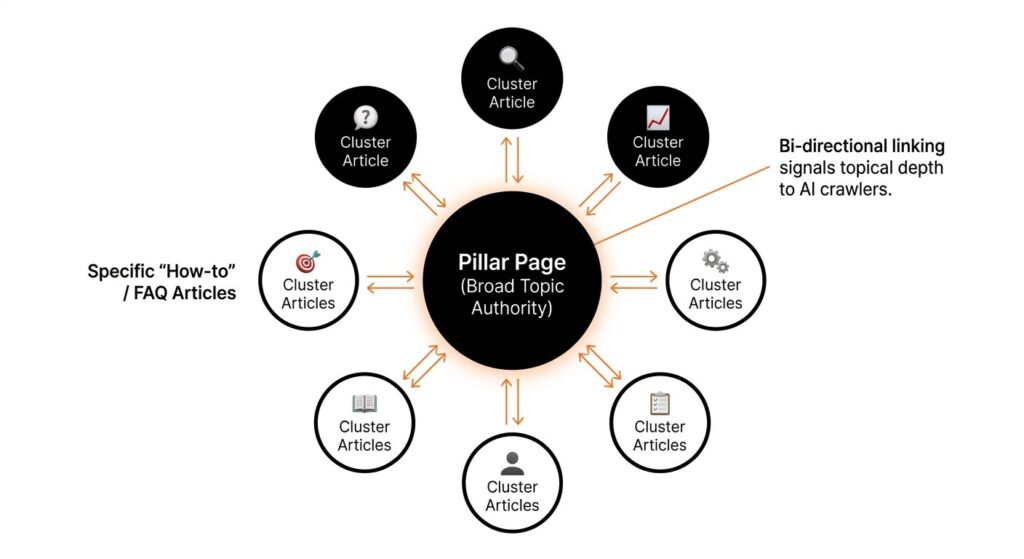
A topic cluster is a content system: one pillar article addressing the broad topic, surrounded by cluster articles each addressing a specific sub-question the audience asks, all bi-directionally interlinked. Research shows that systematic cluster architecture increases AI citation probability by 2.7 times compared to siloed individual articles on the same topic. The mechanism: AI systems can traverse the internal link structure and assess breadth and depth of coverage across the cluster before deciding whether to cite the domain.
When we built the content infrastructure for EasyOps, a B2B logistics software company, the approach was exactly this: build a topic cluster system covering every sub-question an operations buyer would ask, with each cluster bi-directionally linked. Results over 14 months: 626% traffic growth (4,200 to 30,500 monthly visits), 89 top-10 keyword rankings across 198 published articles, and a $21.6M acquisition at 9X ARR. Topical authority at scale compounds in ways isolated ranking wins do not.
Building and maintaining a content cluster of this size requires systems, not just effort. Superteam AI’s AI SEO Workforce builds and manages complete topic clusters: research, content creation, publication, and ranking management. See the AI SEO Workforce.
Internal Linking as an AI Citation Signal
Internal linking is the mechanism through which cluster architecture becomes legible to AI systems. Without systematic bi-directional linking, a domain can have 20 articles on a topic and an AI system may still treat them as 20 isolated pages.
Bi-directional linking means every cluster article links to the pillar, and the pillar links back to every cluster article. Consistent anchor text reinforces topical relationships for NLP processing. Body-content placement carries stronger weight than navigation widgets with both Google and AI traversal patterns.
Entity Signals and Third-Party Authority Building
The final compound investment is building off-page entity signals that increase AI citation confidence at the brand level: verified mentions from sources AI systems already recognize as authoritative, not links for PageRank transfer.
Practical investments: thought leadership in industry publications, brand mentions in research reports, guest contributions to recognized authorities in your vertical, and podcast appearances that generate brand citations across multiple formats. In our experience working with clients across B2B SaaS and professional services, the brands with the fastest AI citation growth are investing in third-party brand authority alongside on-page optimization. The compounding effect of entity authority is disproportionate to the investment at scale.
The Complete AEO Best Practices Checklist
Use this checklist as the implementation companion to the three-tier hierarchy. Complete each tier fully before moving to the next.
| Practice | Tier | Priority | Difficulty | Time to Impact |
| Core Web Vitals passing thresholds | Foundation | Critical | Medium | Weeks 1 to 4 |
| Mobile-first rendering verified | Foundation | Critical | Low | Weeks 1 to 2 |
| Crawl accessibility audit complete | Foundation | Critical | Low | Week 1 |
| Organization schema on homepage and About page | Foundation | High | Low | Week 1 |
| Brand entity established across third-party platforms | Foundation | High | Medium | Weeks 2 to 4 |
| Consistent brand signals across web properties | Foundation | High | Low | Weeks 2 to 3 |
| Domain authority assessed vs. target query competition | Foundation | High | Low | Week 1 |
| Direct-answer blocks on all key content pages | Formatting | Critical | Low | Weeks 2 to 6 |
| FAQ sections added to all target articles | Formatting | High | Low | Weeks 2 to 6 |
| FAQPage schema on all FAQ sections | Formatting | High | Low | Weeks 2 to 6 |
| Article schema with datePublished and dateModified | Formatting | High | Low | Weeks 2 to 4 |
| Speakable schema on voice-optimized passages | Formatting | Medium | Medium | Weeks 4 to 8 |
| H2 and H3 headings in question-intent format | Formatting | High | Low | Weeks 3 to 8 |
| BreadcrumbList schema site-wide | Formatting | Medium | Medium | Weeks 4 to 8 |
| Pillar article published for each target topic cluster | Authority | Critical | High | Months 1 to 3 |
| 8 to 12 cluster articles per pillar | Authority | Critical | High | Months 2 to 6 |
| Bi-directional internal linking across all clusters | Authority | High | Medium | Months 2 to 4 |
| Third-party brand mentions in authoritative publications | Authority | High | High | Months 3 to 9+ |
| Quarterly content refreshes on cluster articles | Authority | Medium | Medium | Ongoing |
How Long Does AEO Take to Work?
Tier 1 (Foundation): Weeks 1 to 4. Technical fixes and entity schema deployment are implementation tasks. The impact is not measurable in isolation; it shows up as improved Formatting performance once the Foundation layer is stable.
Tier 2 (Formatting): Weeks 4 to 10 for existing content. Pages with established domain authority that receive direct-answer blocks and FAQ sections with schema typically begin appearing in featured snippets and AI citations within 30 to 60 days of the formatting update. New content on moderate-authority domains can take 60 to 90 days to reach citation-level visibility.
Tier 3 (Authority): Months 3 to 9+ for cluster-level impact. Research tracking AI citation rates for brands implementing systematic cluster coverage shows improvement from 12% citation rate to 41% for pillar topics within 90 days of completing a full cluster. The compounding effect continues as cluster articles age and accumulate their own authority signals.
The full picture: brands implementing all three tiers in sequence typically see measurable featured snippet gains within 60 days and meaningful AI citation growth within 90 to 120 days. Sustained topic-level dominance is a 6-to-9-month investment.
Frequently Asked Questions
What are the most important answer engine optimization best practices for a new website?
For a new website, Foundation practices are the only tier that matters initially. Focus on technical health, brand entity establishment, and building enough topical content to demonstrate an authority baseline. Attempting Formatting practices before domain authority is established produces inconsistent results. The practical minimum: 15 to 20 well-researched articles in your target topic area and a domain that passes Core Web Vitals thresholds.
How does answer engine optimization differ from traditional on-page SEO?
Traditional on-page SEO optimizes for keyword relevance and page-level signals: title tags, headings, internal links, and word count. Answer engine optimization adds a layer focused on direct extractability by AI systems: direct-answer blocks, schema markup signaling content structure, and topic cluster coverage that lets AI systems verify domain-level authority. Both share the same Foundation; Formatting and Authority practices are AEO-specific investments built on top.
What schema markup is most important for best practices for optimizing content for answer engines?
FAQPage schema is the highest priority because it creates structured question-answer pairs that AI systems can extract directly. Article schema with datePublished and dateModified is the second priority, signaling content freshness and authorship to both Google and AI citation systems. Implement these two schemas first before investing time in less impactful types such as Speakable or DefinedTerm.
How long before AEO best practices produce measurable results?
Formatting practices on established-authority pages typically produce featured snippet and AI citation results within 30 to 60 days. Foundation practices contribute through improved Formatting performance, not standalone impact. Authority investments produce compound gains starting around 90 days post-cluster completion. The full three-tier pipeline delivers measurable AI citation growth within 60 to 120 days when implemented in sequence.
Can small teams implement AEO best practices without a large content budget?
Yes, with prioritization. Direct-answer blocks and FAQPage schema are formatting updates to existing content, not new content creation. A small team can audit and reformat 20 to 30 high-priority pages within a few weeks. The real constraint for small teams is Tier 3: building topic clusters at the scale required for sustained AI citation dominance requires significant content volume, which is where AI-powered content systems create a structural advantage.
What is the biggest mistake brands make when implementing AEO?
The most consistent mistake is skipping Foundation and investing directly in Formatting. Teams implement FAQ sections and schema markup on pages where the domain lacks the authority floor AI systems require. The schema is correct; the domain signal is not strong enough for the page to qualify. The result: correct implementation that produces no visible impact, leading teams to conclude AEO does not work when the real issue is sequencing.
How can Superteam AI help with answer engine optimization best practices?
Superteam AI’s AI SEO Workforce handles the full AEO implementation pipeline: Foundation audits, AEO-structured content creation with direct-answer blocks and FAQ sections built in, schema markup implementation, and topic cluster architecture for sustained AI citation growth. The system holds a 4.7/5 customer satisfaction rating. For teams that want systematic AEO execution without building the infrastructure in-house, it is the most direct path to scale. Learn more at superteamai.com/ai-seo-workforce.
The Sequence Is the Strategy
Answer engine optimization best practices work. The question is never whether to implement them but in what order. Foundation before Formatting. Formatting before Authority. Skipping that sequence does not save time; it guarantees inconsistent results until the missing prerequisites are addressed.
Use Tier 1 to make your content accessible and your brand recognizable. Use Tier 2 to make your existing authority legible to AI systems. Use Tier 3 to build the topical coverage that determines who AI platforms cite when competitive queries in your industry come up.
That sequence is the difference between winning one featured snippet and owning a topic.


