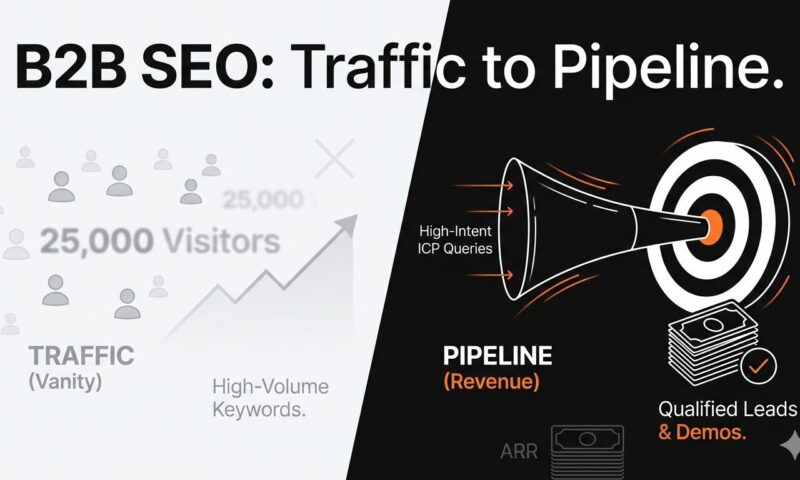
Most definitions of B2B SEO describe it as “increasing organic traffic for B2B websites.” That definition optimises for the wrong outcome. After building AI SEO Workforces for 50+ B2B companies, I have found that the teams who treat B2B SEO as a traffic channel consistently underperform the teams who treat it as a pipeline channel. In my experience, the definition shapes every content decision that follows. The definition shapes the entire programme.
This article answers what is B2B SEO with the precise definition, the four structural differences from B2C SEO, a buyer journey map, and a stage-gated investment framework for your current ARR.
The One-Sentence Definition (and Why Most Are Wrong)
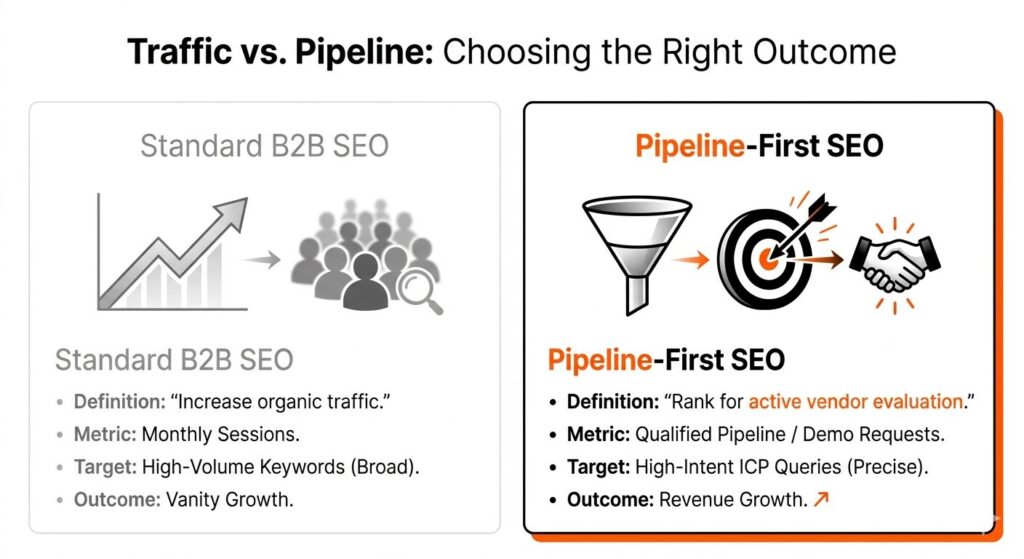
B2B SEO (business-to-business search engine optimisation) is the practice of ranking a B2B website for the queries your ideal customer profile searches during an active vendor evaluation: the goal is qualified pipeline, not traffic volume.
The standard definition, “increasing organic search traffic for B2B websites,” is technically accurate but strategically misleading. It points teams toward high-volume keywords that attract the widest audience. In B2B, the widest audience is almost never the right audience; 66% of B2B buyers use internet search when researching purchases (Semrush 2024), but the high-intent queries happen in low-volume clusters that standard SEO tools systematically undervalue.
A keyword searched 50 times per month by CFOs evaluating software is worth more pipeline than one searched 5,000 times per month by students writing university essays. B2B SEO is the practice of finding and ranking for the 50-search keyword, not the 5,000-search keyword.
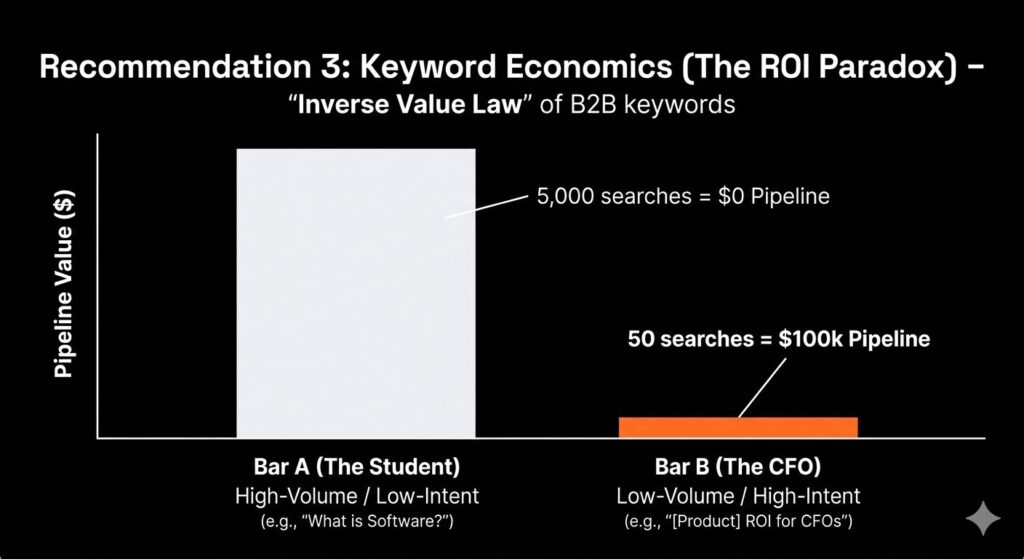
The precise definition: B2B SEO is ranking for the queries that signal active buying intent within your ICP, present at every stage of a multi-stakeholder evaluation cycle.
How B2B SEO Works: The 4 Components
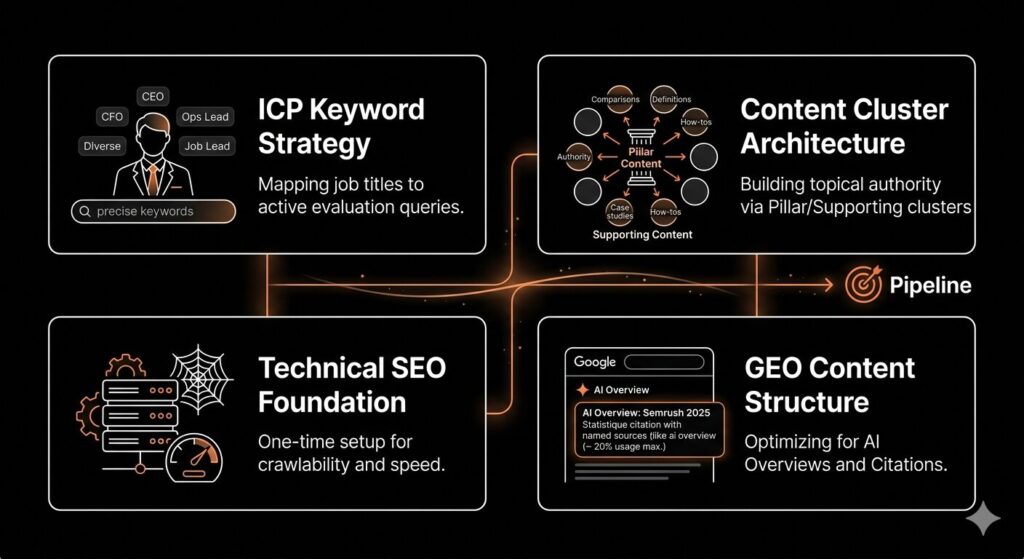
B2B SEO works by combining four components that I apply consistently across every deployment: ICP keyword strategy built around buyer intent, content cluster architecture that builds topical authority, technical SEO that ensures the site is crawlable and indexable, and GEO structure that positions content for AI citation.
ICP keyword strategy. Rather than targeting the highest-volume keyword in a category, B2B keyword strategy maps every job title in the buying committee to the specific queries they type during an active vendor evaluation. A CFO searches for ROI benchmarks, an operations lead searches for integration capabilities, and an end user searches for ease-of-use comparisons. Each persona requires different content at different funnel stages.
Content cluster architecture. A pillar article covers the core topic completely. Eight to twelve supporting articles cover related buyer questions (comparisons, definitions, how-tos, case studies) that surround the buyer’s entire research process. Cluster completeness builds topical authority: the condition where a domain ranks for all related queries in a category, not just individual articles.
Technical SEO foundation. Crawlability, indexation accuracy, page speed, schema markup, and internal link structure. These are a one-time foundation, not an ongoing weekly initiative. Done correctly once, they amplify the work of the keyword and content layers indefinitely.
GEO content structure. 13.14% of Google queries now trigger AI Overviews (Semrush 2025), more than doubling from 6.49% in January 2025. AI-referred visitors convert 4.4 times better than standard organic visitors (BrightEdge 2025). Every article must open each H2 with a direct-answer sentence, use exact-match FAQ formatting, and attribute statistics to named sources inline, the signals AI systems use to extract and cite content.
B2B SEO vs B2C SEO: 4 Structural Differences That Change Everything
In my work across 50+ deployments, B2B SEO differs from B2C SEO in four structural ways: the audience size, the keyword economics, the content depth required, and the primary success metric.
Audience size. B2C targets thousands or millions of individual consumers searching for similar products. B2B targets a defined set of decision-makers; often 50 to 500 companies constitute the entire addressable ICP for a niche SaaS product. Low search volume is not a failure signal in B2B; it is a structural characteristic of a correctly targeted strategy.
Keyword economics. B2C optimises for search volume because more searches mean more potential buyers. B2B optimises for intent precision because the buyer is a specific job title at a specific company size; an exact-match evaluation query outperforms any high-volume keyword attracting a mixed audience. Long-tail buying committee keywords convert at 2.5 times the rate of short-tail traffic terms (Backlinko 2025).
Content depth. B2C content often converts on emotional appeal at or near the first visit. B2B content must serve an average of 11 stakeholders (Gartner 2024) across a buying cycle that can run 3 to 24 months. The content library must cover the full arc from problem recognition through vendor shortlisting and final selection. A B2B company with strong awareness content but nothing at the decision stage produces traffic that cannot convert.
Success metric. B2C SEO is measured by traffic volume and transaction revenue. B2B SEO is measured by pipeline sourced from organic: qualified leads, demo requests, and closed revenue that originated from organic search. Organic leads close at 14.6% versus 1.7% for outbound (HubSpot 2024). Teams measuring sessions instead of pipeline make the wrong content investment decisions.
The B2B Buyer Journey B2B SEO Must Cover
The B2B buyer journey has three stages B2B SEO must cover simultaneously: awareness, where the buyer recognises a problem; consideration, where the buyer evaluates solution categories; and decision, where the buyer selects a specific vendor.
Each stage requires different content targeting different queries. Awareness queries are broad and definitional: “what is inventory management software”, “why is our cost per lead too high”, “how does B2B SEO work.” These articles introduce the brand before any active evaluation begins.
Consideration queries are comparative and evaluative: “best inventory management software for ecommerce”, “B2B SEO agency vs in-house team”, “AI content tools comparison.” These articles intercept buyers who have defined the problem and are now evaluating solution categories. This is where topical authority compounds: a brand with 8 consideration-stage articles ranks for the entire evaluation process, not just a single query.
Decision queries are high-intent and vendor-specific: “EasyOps review”, “AI SEO Workforce pricing”, “superteam ai vs [competitor].” These articles have the lowest search volume and the highest conversion rate. A buying committee of 11 stakeholders consumes an average of 27 pieces of content before selecting a vendor (Gartner 2024). The brand present across all 27 touchpoints wins category consideration before the first sales call.
Most B2B companies publish predominantly awareness-stage content and miss the high-intent consideration and decision queries where purchasing decisions are made.
What Makes B2B SEO Different to Execute
B2B SEO is harder to execute than B2C SEO for three specific reasons I see consistently: the feedback loop is longer, the content requires genuine domain expertise, and pipeline attribution requires CRM integration that most B2B marketing teams have not built.
Longer feedback loop. B2B SEO results typically take 3 to 6 months to show ranking movement and 6 to 12 months to compound into measurable pipeline contribution. Most B2B companies abandon the channel before the return begins, citing early results that are structurally impossible in the first 60 days.
Domain expertise requirement. B2B buyers are professionals evaluating a purchase for their organisation. They immediately recognise shallow content that lacks genuine practitioner insight. B2B SEO content must be written or reviewed by someone who has operated in the problem domain. Generic content that passes a keyword checklist but fails the expertise test will not convert a B2B buying committee.
Attribution complexity. Connecting an organic search session to a closed deal 6 months later requires UTM parameters on organic CTAs, CRM integration, and a reporting framework most B2B marketing teams have not built. Without attribution, the channel appears to produce traffic but no revenue, and loses budget to paid channels whose conversion attribution is immediate and visible. I have seen this pattern in nearly every B2B company that approaches us without attribution in place.
These execution realities explain why B2B companies outsource to an agency or deploy a system like the AI SEO Workforce, which handles the full pipeline without requiring an internal specialist. For a practical framework on where to start, the B2B SEO tips article covers the 7 highest-ROI tactics ranked by pipeline impact.
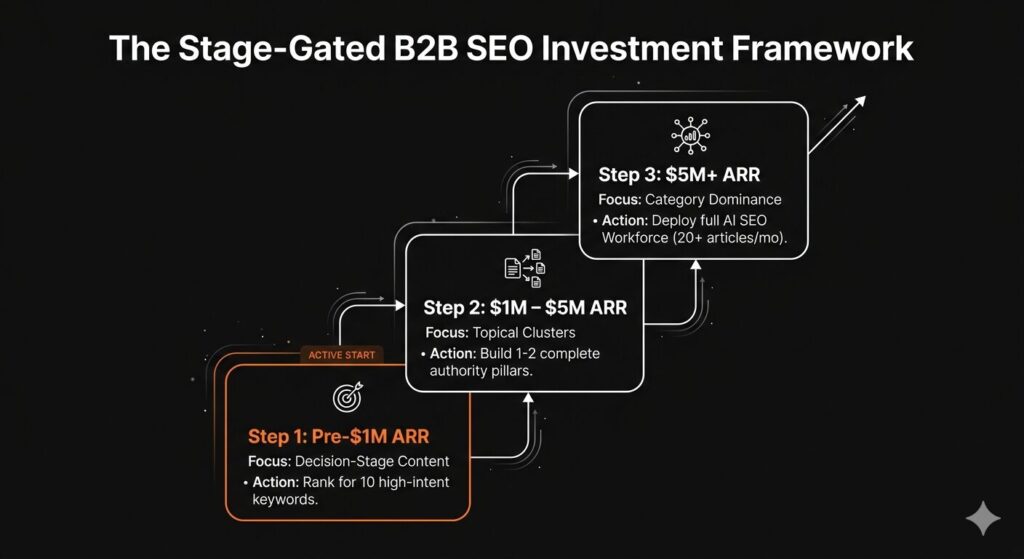
Is B2B SEO Worth It? A Stage-Gated ROI Framework
The investment makes strategic sense when your ICP has a definable search behaviour, you have consistent content capacity, and you are measuring success over 6 to 12 months rather than 30 days.
The return depends heavily on your current stage, and I recommend following this sequence precisely:
Pre-$1M ARR. Publish decision-stage content on your 10 highest-converting keywords only. Volume is low but intent is high; this produces the highest pipeline-per-article ROI with minimal content investment. Focus entirely on keywords that a buyer in active vendor evaluation would type.
$1M to $5M ARR. Build 1 to 2 complete topical clusters at 4 to 8 articles per month. One complete cluster with a pillar and 8 supporting articles consistently outperforms 20 disconnected articles in pipeline contribution within 6 months of completion.
$5M ARR and above. Deploy full cluster architecture across 3 to 5 topic areas at 20 or more articles per month. At this stage, B2B SEO should be producing measurable monthly pipeline contribution to organic revenue. B2B SEO ROI compounds; the highest return is observed after 24 to 36 months of consistent publishing (FirstPageSage 2025).
What B2B SEO Looks Like When It Works: Proof
Two B2B SaaS companies show what B2B SEO produces when all four components are applied consistently. I have run both deployments using the methodology described in this article.
EasyOps, a B2B SaaS inventory management platform, deployed the AI SEO Workforce across 3 complete topical clusters at 24 to 25 articles per month. CEO Rajiv Mehta: “We were invisible in the market. Our paid ads brought some traffic, but the costs were unsustainable.” In 8 months: organic traffic from 4,200 to 30,500 monthly visitors (626%), MRR from $50,000 to $200,000, CPL from $127 to $43. Unicommerce acquired EasyOps for $21.6 million at month 14. This is B2B SEO functioning as a pipeline channel, not a traffic channel.
ReachInbox, a B2B email outreach SaaS 180 days from shutdown, deployed the AI SEO Workforce at 25 to 28 articles per month with decision-stage content mapped to ICP evaluation criteria as the first priority. CEO Anup Sharma: “We went from 2,000 visitors to 17,000, and our conversion rates more than doubled.” In 12 months: traffic 2,000 to 17,000 (750%), runway from 6 to 24 months, MRR from $65,000 to $150,000.
Both results were built on the four-component model above. The full methodology is in the B2B SEO case studies article. For the complete strategic framework, the B2B SEO pillar covers cluster architecture, keyword methodology, and execution sequencing. For the decision on which model fits your current stage and budget, the B2B SEO solutions guide covers the full cost and option comparison.
Frequently Asked Questions
What is the difference between B2B SEO and B2C SEO?
B2B SEO and B2C SEO differ in four structural ways: audience size (B2B targets specific decision-makers at defined company types; B2C targets broad consumer demographics), keyword economics (B2B optimises for intent precision over search volume; B2C optimises for volume), content depth (B2B content must serve an 11-person buying committee across months; B2C content converts individual consumers often at first touch), and success metric (B2B measures pipeline sourced from organic; B2C measures transactions and traffic revenue). The technical SEO foundations are similar; the strategy built on top is entirely different.
How long does B2B SEO take to produce results?
B2B SEO typically shows first ranking movements in 3 to 6 months and measurable pipeline contribution in 6 to 12 months. The compounding return builds over 18 to 36 months of consistent publishing. Companies that abandon the channel before month 6 exit before the return curve begins. The channel rewards patience and execution consistency above any other organic acquisition channel.
What is B2B SEO used for?
B2B SEO is used to generate qualified inbound pipeline from organic search: specifically, to attract decision-makers who are actively evaluating solutions in your category and convert their search sessions into demo requests, trial signups, or direct sales enquiries. Secondary uses include reducing cost-per-lead relative to paid channels and building topical authority that positions the brand as the category expert in AI search citations.
Is B2B SEO the same as content marketing?
B2B SEO and content marketing overlap but are not the same. Content marketing is the broader practice of producing valuable content across email, social, events, and expert content with no SEO intent required. B2B SEO is specifically the practice of optimising content to rank for queries your ICP searches in Google and AI tools. In practice, effective B2B SEO programmes produce content that serves both goals: articles written for ranking also function as content marketing assets across other channels.
What does a B2B SEO strategy include?
A B2B SEO strategy includes five components: ICP and buying committee keyword research (mapping every job title to their evaluation queries), content cluster architecture (pillar plus 8 to 12 cluster articles per topic), technical SEO audit and remediation (crawlability, indexation, schema markup, page speed), GEO content structure (direct-answer H2 openings, exact-match FAQs, inline source citations), and pipeline attribution setup (UTM parameters, CRM integration, organic revenue reporting). The AI SEO Workforce executes all five components at 24 to 28 articles per month, producing the publishing cadence required for topical authority without an internal specialist.


