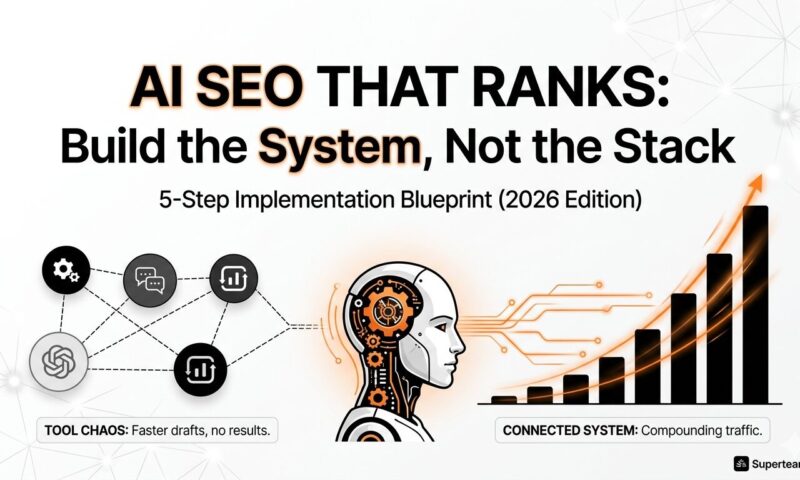
75% of teams that try ai for seo report no meaningful improvement in output or rankings within six months. The tools are not broken. The approach is.
Here is what actually happens: a team adds ChatGPT for first drafts, Surfer SEO for optimisation scoring, and maybe an AI keyword tool. The workflow stays manual. A human still briefs the writer (now an AI). A human still reviews and edits the AI output. A human still cross-checks technical elements and publishes. What has changed is the individual task speed, not the system. Output increases by maybe 20%. Costs drop by maybe 15%. The bottleneck moves from writing to review, and the team is no more scalable than before.
The gap between ai seo that delivers results and ai seo that disappoints comes down to one thing: whether the team is running isolated tools or a connected system. Using AI for SEO correctly is not about faster individual tasks. It is about redesigning the workflow so AI executes end to end, with humans approving at defined strategic moments instead of managing every step.
Having deployed AI for SEO across 50+ businesses at Superteam AI, we have seen every version of this mistake. We have also seen what happens when teams get the operating model right: 3x the content output, 77% reduction in per-article cost, and a compounding organic traffic curve that starts paying dividends by month six.
This guide gives you the exact framework we use. Five steps, in the right order, with the failure modes we have encountered at each stage.
What “AI for SEO” Actually Means in Practice
Definition: AI for SEO is the practice of deploying artificial intelligence systems to execute search engine optimisation workflows, from keyword research and content briefing through writing, editing, technical optimisation, and performance tracking, while also structuring content so that AI-powered search systems can retrieve and cite it.
That definition contains two separate problems. The first is operational: using AI to do the work faster and at higher volume. The second is structural: building content that gets found and cited by AI-powered search engines like Google AI Overviews, Perplexity, and ChatGPT.
Both matter. In 2026, a business that solves the operational problem but ignores the structural one is producing content faster than it gets cited. A business that solves only the structural problem is optimising for AI search with a workflow that still takes three weeks per article. The businesses seeing the most significant results are addressing both simultaneously.
For a full explanation of what AI SEO means and how these two problems converge, see our complete guide. This article focuses on the operational challenge: how to build and run an AI for SEO system that compounds.
The Three Operating Levels: Tools, Agents, and Workforces
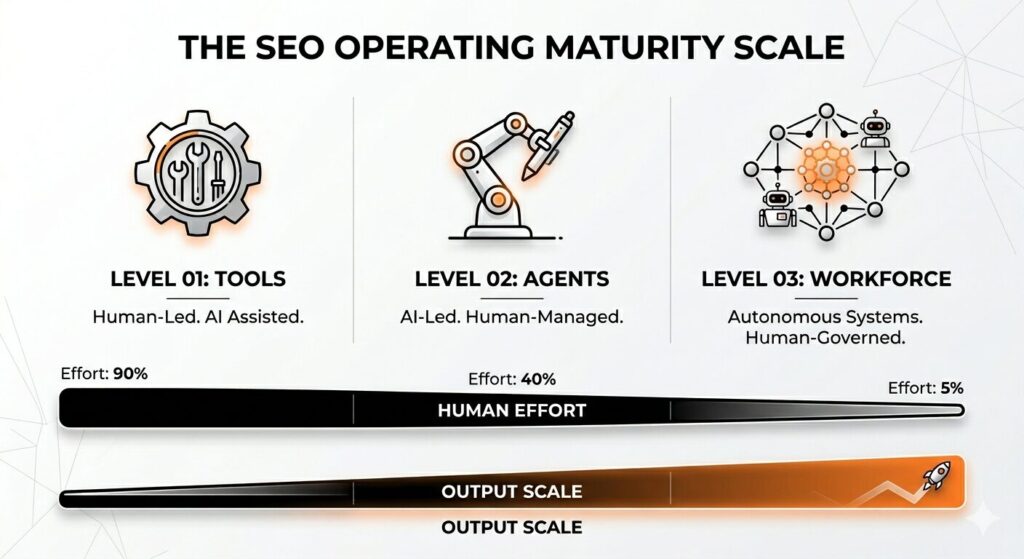
Most content on AI for SEO treats the category as flat. It is not. There are three distinct operating levels, and they produce fundamentally different results.
| Level | What It Automates | Human Effort Required | Best For |
| AI SEO Tools | Individual tasks (keyword research, content scoring, meta generation) | High: human directs and coordinates every step | Teams producing 1–3 articles/month, getting started with AI |
| AI SEO Agent | A single end-to-end workflow (research through brief, or brief through content) | Medium: agent acts, human reviews output | Teams needing 5–15 pieces/month without adding headcount |
| AI SEO Workforce | The full SEO lifecycle via 15+ coordinated agents | Low: human approves at 2 strategic checkpoints | Teams needing 20+ pieces/month or agencies managing multiple clients |
Most teams start at the tool level and get stuck there. The jump from tools to an ai seo agent is the first place significant output and cost improvements appear. The jump from an agent to a coordinated workforce is where the economics become genuinely transformational.
Why Most AI for SEO Experiments Fail Within 90 Days
The failure pattern is consistent across the implementations we have seen stall: teams start with the wrong stage. They automate content production before they have fixed their research and briefing process. The result is fast, high-volume, low-quality output that neither ranks nor reads well. After two or three months of underwhelming results, the conclusion becomes “AI for SEO does not work for us,” when the real issue was sequencing.
We will cover each of these failure modes in detail later. First, the implementation framework.
Step 1: Audit Your Current SEO Operation Before Touching Any AI
The single most common mistake in any AI for SEO implementation is skipping the baseline measurement step. If you do not know your current output volume, your current cost per piece, and your current organic traffic trend before introducing AI, you have no way of knowing whether the system is working at month three.
In every deployment where we skipped the audit stage, the team reached month four without a clear answer to whether the AI investment was paying off. The numbers were there. They just had not been documented before the transition.
Do this step before you evaluate any tool, agent, or workforce platform.
The Four Numbers You Need Before You Start
| Metric | Where to Find It | What It Tells You |
| Monthly article output | Content calendar or CMS publish history | Your current production velocity baseline |
| Brief-to-published time | Project management tool or ask your team | Where the biggest time bottleneck currently sits |
| Cost per published piece | Finance records, contractor invoices, or staff time allocation | What you are paying per unit of output today |
| Organic traffic trend (12-month) | Google Search Console or your analytics platform | Whether the content produced to date is compounding or flat |
These four numbers define the benchmark against which every future measurement gets compared. Write them down. If you skip this step and introduce AI, you are flying without instruments.
Step 2: Choose What to Automate First (The Priority Framework)
Not all SEO tasks return equal value when automated. Sequencing matters more than tool selection. The teams that see the fastest results from AI for SEO are not the ones that automate the most tasks at once. They are the ones that automate the highest-ROI task first, measure the result, then build outward.
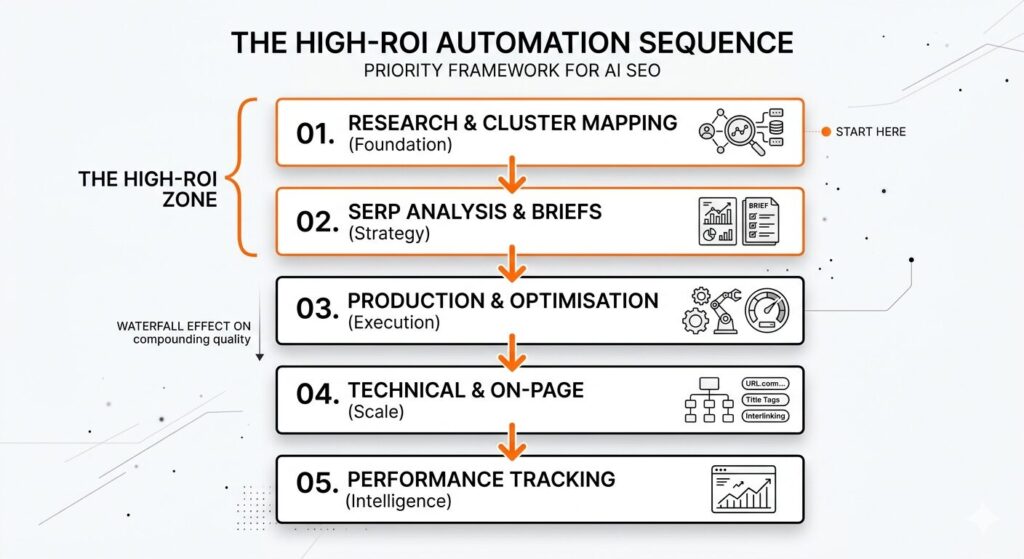
Here is the sequence that has produced the most consistent results across our 50+ deployments.
Priority 1: Keyword Research and Cluster Mapping
Why first: Keyword research is time-intensive, highly structured, and rules-based. It is the task where AI executes with the highest accuracy relative to human effort, and it is upstream of everything else. Better keyword architecture means better briefs, which means better content, which means better rankings. Automating this stage first creates a compounding quality improvement downstream.
What AI handles: Identifying target keywords, mapping semantic clusters, prioritising by search intent and competitive opportunity, and determining content type for each target. A keyword research agent does not just pull a list. It produces a full cluster architecture that determines what to create, in what order, and for what purpose, before a single word is written.
Human role at this stage: Review and approve the cluster architecture. Make strategic calls about which clusters align with your business priorities. This takes 20–30 minutes rather than 6–8 hours.
Priority 2: SERP Analysis and Content Brief Generation
Why second: Brief quality determines content quality more than any other single variable. A strong brief gives a writer agent, or a human writer, everything needed to produce a piece that outranks the competition. A weak brief produces content that is technically correct but strategically thin.
A SERP research agent collects the top 10–20 ranking pages for each target keyword and runs a gap analysis across topic coverage, data depth, content freshness, and structural completeness. A brief-generation agent synthesises those findings into a structured, human-reviewable document.
This is the first human checkpoint: brief approval. The human reviews the brief, confirms the angle and structure are strategically correct, and approves it before any content is written. Nothing moves forward without that approval.
Human role at this stage: 15–20 minutes of brief review and approval. This is where strategy gets validated.
Priority 3: Content Production and Optimisation
Why third, not first: Most teams reach for the most visible part of the workflow and automate writing first. The result is fast, high-volume content based on shallow keyword targeting and no SERP analysis. Starting with content production before completing Priorities 1 and 2 is the source of Failure Mode 2, which we will cover shortly.
Once the brief is approved, writer agents produce the full draft. An editor agent reviews for clarity, brand voice consistency, and flow. A QA agent validates keyword integration, readability, and technical SEO requirements. The content does not advance until it passes the quality threshold.
Human role at this stage: Final content review. This is the second and last human checkpoint. Brand nuance, creative direction, and strategic alignment get applied here. Everything between brief approval and final review runs autonomously.
Priority 4: Technical SEO and On-Page Elements
Why fourth: Technical optimisation is mechanical, consistent, and cross-article in scope. A meta agent produces the optimised title tag, meta description, URL slug, and schema markup for each piece. An interlinking agent identifies internal linking opportunities across the full content library without a human manually cross-referencing every published article.
At scale, this stage is where the compounding effect becomes visible. A human team cannot maintain consistent interlinking across 300 published articles. An interlinking agent does it automatically every time a new piece goes live.
Priority 5: Performance Tracking and Iteration
Why last: Closing the feedback loop is what turns a workflow into a compounding system. Performance data from published content feeds back into keyword prioritisation, influencing which clusters the research agent targets next. Articles ranking on page two get flagged for refresh. Content generating strong organic traffic informs structure and angle decisions for related pieces.
Without this stage, AI for SEO is a production pipeline. With it, it becomes a learning system.
| Priority | Task | Automation Level | Speed to ROI | Recommended Model | Human Role |
| 1 | Keyword research and cluster mapping | High | Fast (within days) | Tool or agent | Approve cluster architecture |
| 2 | SERP analysis and brief generation | High | Fast (1–2 weeks) | Agent | Review and approve brief |
| 3 | Content production and optimisation | High | Medium (4–6 weeks to publish) | Agent or workforce | Final content review |
| 4 | Technical SEO and on-page elements | Very high | Fast (immediate on publish) | Workforce | Spot check |
| 5 | Performance tracking and iteration | Medium | Long (3–6 months to compound) | Workforce | Monthly metric review |
Step 3: Match the Operating Model to Your Team’s Stage
Once you know what to automate and in what order, the next decision is which type of system to use. The right answer depends on your team size and monthly output needs, not on which platform has the most features.
When AI SEO Tools Are the Right Starting Point
For: Founders, solo marketers, and early-stage teams producing 1–3 articles per month.
Tools like Surfer SEO, Clearscope, and AI-powered keyword research features inside Ahrefs or Semrush are the correct starting point here. They augment individual tasks: keyword suggestions, content scoring, optimisation recommendations. The human still manages the full workflow, but specific tasks run faster.
Use this stage to get familiar with the workflow before introducing agents. Learn what good brief output looks like. Understand where your current process has gaps. Plan the automation sequence before buying an agent-level system.
When you have outgrown this stage: When you are regularly producing 4–5 pieces per month and spending more than 15–20 hours per article on coordination and editing, the tool model is no longer cost-efficient.
When You Need an AI SEO Agent
For: Growing teams needing 5–15 pieces per month without adding a junior SEO or content writer to headcount.
An ai seo agent covers a defined end-to-end workflow. Most commonly: research through brief, or brief through published content. The human triggers the workflow and reviews the output. The agent handles everything in between.
Genuine ai-powered seo agents execute multi-step processes autonomously: researching, analysing, producing, validating, and handing off to the next stage without human input at each step. What most tools market as “AI agents” in 2026 are single-step automations with a chatbot interface. The distinction is autonomous decision-making between workflow steps, not just faster execution of one step.
When you have outgrown this stage: When a single-agent workflow cannot cover your full production needs, or when you are managing multiple clients and need consistent quality across different brand voices simultaneously.
When a Full AI SEO Workforce Makes Sense
For: Teams needing 20+ pieces per month, agencies managing multiple clients, or any operation where the output ceiling of a human-plus-tools model is visibly limiting growth.
A coordinated workforce of ai-powered seo agents covers the full SEO lifecycle. At Superteam AI, our SEO Workforce uses 18+ specialised agents: one for SERP research, one for gap analysis, one for brief generation, writer agents, an editor agent, a QA agent, a meta agent, and an interlinking agent. A manager model orchestrates the workflow, assigns tasks, and manages quality gates between stages.
The human approves at two checkpoints: brief and final content. Everything between those two points runs autonomously.
The cost comparison is direct:
| Model | Typical Monthly Cost | Monthly Output | Approx. Cost Per Article |
| In-house SEO + content writer | $3,000–$5,000/month | 4–8 articles | $375–$1,250 |
| Agency retainer | $3,000–$8,000/month | 4–12 articles | $400–$2,000 |
| Superteam AI Scale Plan | $399/month | 30 articles | ~$13 |
If your team needs 20+ pieces per month, the Superteam AI SEO Workforce replaces the tool stack and the execution team in a single subscription. The Pro Plan starts at $79/month for 5 articles. The Scale Plan is $399/month for 30 articles across 10 users. Start a trial or book a demo to see all 18 agents execute on a live keyword from your business.
Step 4: Build Human-in-the-Loop Checkpoints (And Never Skip Them)
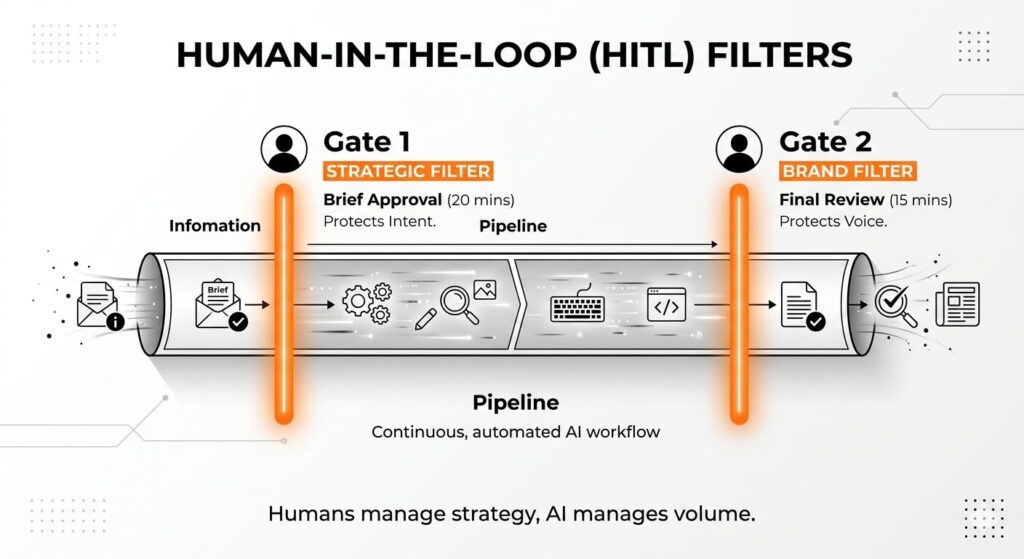
The most damaging advice circulating in the AI for SEO space in 2026 is “automate everything and review at the end.” We have run that experiment. It does not produce better content faster. It produces technically compliant content that misses the strategic point.
There are two non-negotiable human checkpoints in any well-designed AI for SEO workflow.
Checkpoint 1: Brief Approval The human reviews the AI-generated brief before any content is written. This checkpoint protects strategy: is the agent researching the right angle, the right competitors, the right content depth for this keyword? A misaligned brief produces misaligned content at scale. Catching it here costs 20 minutes. Catching it after 10 articles have been published costs months of re-ranking effort.
Checkpoint 2: Final Content Review The human reviews the completed content before publication. This checkpoint protects brand: does the content sound like us? Are there nuances in our positioning or competitive stance that the agent could not have known? Is the CTA appropriate for this specific piece?
We learned this the hard way at Superteam AI. In our early implementations, fully automated runs without the brief checkpoint produced content that was technically optimised for the keyword but positioned us incorrectly in the competitive landscape. The brief checkpoint is not an efficiency bottleneck. It is a strategic filter.
Everything between these two checkpoints can and should run autonomously. The checkpoints themselves are where your judgment belongs.
Step 5: Measure Whether It’s Working (The Right Metrics)
Rankings are an output. Most teams measure outputs and wonder why they cannot improve inputs. The metrics that tell you whether your AI for SEO system is working are the inputs that drive rankings, not the rankings themselves.
The 60-2-3 Benchmark: How to Evaluate Any AI for SEO Investment
At Superteam AI, every agent in our system must simultaneously clear three benchmarks: at least 60% reduction in workflow time, at least 2x return on investment through cost savings or revenue impact, and at least 3x the speed of equivalent human execution.
We derived these numbers from 100+ business implementations. Any system that meets only two of the three is delivering automation theatre: impressive in one dimension, failing in another. We recommend applying this benchmark to any AI for SEO investment you evaluate, including our own. If a vendor cannot tell you their time savings percentage, their ROI impact, and their speed multiplier versus human baseline, it is a feature, not a system.
The Four Metrics That Tell You the System Is Compounding
| Metric | How to Calculate | Good Signal | Warning Signal | Review Frequency |
| Month-over-month organic traffic growth | GSC: compare 30-day sessions to prior 30-day period | Consistent 5–15% MoM growth from month 3 onward | Flat or declining after month 6 | Monthly |
| Cost per ranking article | Total SEO spend divided by number of articles in top 10 positions | Decreasing quarter over quarter | Increasing while traffic is also increasing | Quarterly |
| Content output volume | Published pieces per month | At or above the production target | Below target for two consecutive months | Monthly |
| Lead attribution from organic | CRM or analytics: leads with organic first touch | Growing as a percentage of total leads | Flat while traffic is growing (a conversion problem, not an SEO problem) | Monthly |
Review these four numbers at the end of each month for the first six months. If organic traffic is growing, cost per ranking article is decreasing, and output is holding steady or increasing, the system is compounding correctly.
The Five Failure Modes of AI for SEO (From 50+ Real Deployments)
We have deployed AI for SEO operationally across more than 50 businesses. Across those deployments, five failure patterns appear with enough consistency to be treated as predictable risks, not one-off mistakes. Each has a clear cause and a clear fix.
Failure Mode 1: Treating AI as a Writing Tool, Not a Workflow Tool
This is the entry-level mistake. The team adopts AI for content production, keeps everything else manual, and measures whether the AI is writing well. It is measuring the wrong thing.
The value of AI for SEO is not in better sentences. It is in a connected workflow where research informs the brief, the brief informs the content, the content informs the on-page elements, and performance data informs the next research cycle. Treat AI as a writing tool and you get marginally better first drafts. Build it as a workflow tool and you get a compounding content operation.
Fix: Before evaluating any AI tool on output quality, map where it fits in your workflow sequence. If it does not connect to the stage before it and the stage after it, it is not adding system value.
Failure Mode 2: Automating Content Production Before Research and Briefing
The most common sequencing mistake. Teams reach for the most visible part of the workflow and automate writing first. The result is fast, high-volume content based on shallow keyword targeting and no SERP analysis. It does not rank. The team concludes that AI for SEO does not work.
Failure Mode 2 is the one we encounter most often in the first 30 days of a new deployment. The fix is enforcing the priority sequence: keyword research and cluster mapping before brief generation, brief generation before content production. No exceptions.
Fix: Apply the Priority Framework from Step 2. Do not start content production until Priorities 1 and 2 are producing consistent, approved output.
Failure Mode 3: Removing Human Checkpoints in the Name of Efficiency
Some teams, after a few weeks of brief review, decide the checkpoint is slowing them down and remove it. Publish rates go up. Content quality goes down in ways that do not show up until month four, when rankings fail to materialise and the content is reviewed retrospectively.
The brief checkpoint takes 20 minutes. It protects 6–8 weeks of downstream execution. Removing it to save 20 minutes is a poor trade at any output volume.
Fix: Treat the two human checkpoints as fixed costs of the system, not optional reviews. Build them into your content calendar as non-negotiable scheduled events.
Failure Mode 4: Measuring Rankings Instead of System Health
Rankings are a lagging indicator with a 6–12 month delay on competitive keywords. Teams that check rankings in month two and conclude the system is not working are measuring the wrong thing at the wrong time.
The metrics that predict ranking outcomes are system health metrics: output volume, brief quality, content depth, and organic click-through rate trends. These are visible in weeks, not months. Rankings follow from system health, not the other way around.
Fix: Use the four-metric dashboard from Step 5 for the first six months. Add rankings as a primary KPI only once the system is producing consistent output and the content is indexed.
Failure Mode 5: Buying Tools Individually Instead of Building a Connected System
The final failure mode is the most expensive. A team buys a keyword tool, then a writing tool, then an optimisation tool, then a technical audit tool. Each solves one problem. The team still coordinates manually between them. The total cost is $800–$1,500/month in tool subscriptions, the workflow is still manual, and output has not meaningfully increased.
A connected system, whether an ai seo agent covering one workflow or a full workforce covering the lifecycle, eliminates the coordination cost. The tools communicate with each other. Output from one stage feeds the next automatically.
Fix: Before adding another tool, audit your current stack for connection points. If tools are not exchanging data automatically, you have a tool collection, not a system.
Frequently Asked Questions About AI for SEO
What is AI for SEO?
AI for SEO is the use of artificial intelligence to execute and scale search engine optimisation workflows, including keyword research, SERP analysis, content briefing, writing, editing, technical optimisation, and performance tracking. It also includes structuring content so that AI-powered search systems like Google AI Overviews, Perplexity, and ChatGPT retrieve and cite it in their generated answers. In 2026, businesses using AI for SEO effectively are solving both the operational problem (executing faster and at higher volume) and the structural problem (building content that AI search systems can extract and cite).
How do I start using AI for SEO?
Start with Step 1 of the implementation framework: audit your current operation. Document your monthly output, brief-to-published time, cost per piece, and organic traffic trend before touching any tool. Then introduce AI at Priority 1 (keyword research and cluster mapping) and build outward in sequence. Do not start with content production. Teams that automate writing before fixing their research and briefing process produce faster output that does not rank.
Does Google penalise AI-generated SEO content?
No. Google’s stated position, confirmed through their Search Central guidelines, is that they evaluate content on quality, usefulness, and relevance, not on whether it was produced by a human or an AI. AI-generated content that is helpful, original, well-structured, and backed by genuine expertise is treated the same as human-written content that meets those criteria. What Google penalises is content that is thin, repetitive, keyword-stuffed, or produced at mass scale without quality control. The answer is not avoiding AI; it is maintaining quality gates regardless of who or what produces the content.
How long does it take to see results from AI for SEO?
The ranking timeline is the same regardless of AI or human production: 6–12 months for meaningful organic traffic from competitive keywords. What changes with AI for SEO is the volume of content entering that pipeline simultaneously. A team publishing 30 articles per month builds topical authority 6–10x faster than a team publishing 4–5. The timeline per article does not shorten, but the aggregate traffic outcome at month 12 is far larger because there are far more ranking assets compounding at once.
What is the best AI tool for SEO in 2026?
The right choice depends on what you need the system to do. For individual task augmentation at low output volume, Surfer SEO and Clearscope are strong for content optimisation; Ahrefs and Semrush have capable AI features for keyword research. For teams needing a single ai seo agent covering research through content production, look for platforms with genuine multi-step autonomous execution, not just a chatbot interface over a single model call. For teams needing 20+ pieces per month with full workflow coverage, a coordinated AI SEO workforce replaces the tool stack and the execution coordination in a single subscription.
Can AI for SEO replace an SEO agency?
It replaces the execution layer that agencies sell: keyword research, content production, on-page optimisation, technical audits, and reporting. It does not replace the strategic judgment, client communication, and competitive positioning decisions that good agencies provide. The practical outcome for most businesses is that an AI for SEO system replaces 2–4 execution roles and the agency retainer cost, while one strategic lead focuses on direction and measurement rather than managing production. Businesses previously paying $3,000–$8,000/month to an agency for 4–12 articles typically see equivalent or greater output at $399/month with an AI workforce.
How much does it cost to use AI for SEO?
Individual AI SEO tool subscriptions run from $50 to $500 per month per seat. Comprehensive AI for SEO platforms covering the full workflow start lower: Superteam AI’s Pro Plan is $79/month for 5 articles, the Business Plan is $199/month for 15 articles, and the Scale Plan is $399/month for 30 articles across 10 users. The metric that matters more than subscription cost is cost per published, ranking article. At the Scale Plan level, that is approximately $13 per article. A comparable agency or freelance model runs $375–$2,000 per article at equivalent quality.
Build the System First. Add Tools Second.
Most AI for SEO conversations start with tool selection. Which writing tool? Which optimisation tool? Which keyword tool? That sequence produces a tool collection, not a system. Tool collections do not compound.
The businesses pulling ahead in organic search in 2026 made one decision differently: they designed the workflow before they chose the tools. They knew which tasks to automate in which order. They built human checkpoints before they needed them. They defined what “working” looked like before they hit month six.
Three things this guide has established. First, the sequence matters more than the tool: keyword research and cluster mapping before brief generation, brief generation before content production, never the other way around. Second, the operating model you choose (tools, agent, or workforce) should match your team’s actual output needs, not the most impressive marketing claim. Third, the system only compounds when you measure system health metrics in the first six months, not rankings.
AI for SEO works. The evidence is in the output of the 50+ teams we have helped build it correctly. The question now is whether you build the system yourself or deploy one that is already proven.
Start the Superteam AI Pro Plan at $79 per month to run your first 5 articles through the 18-agent workflow. Or book a demo to watch all 18 agents execute on a live keyword from your business. No agency rates. No long-term contract. Just the system.


