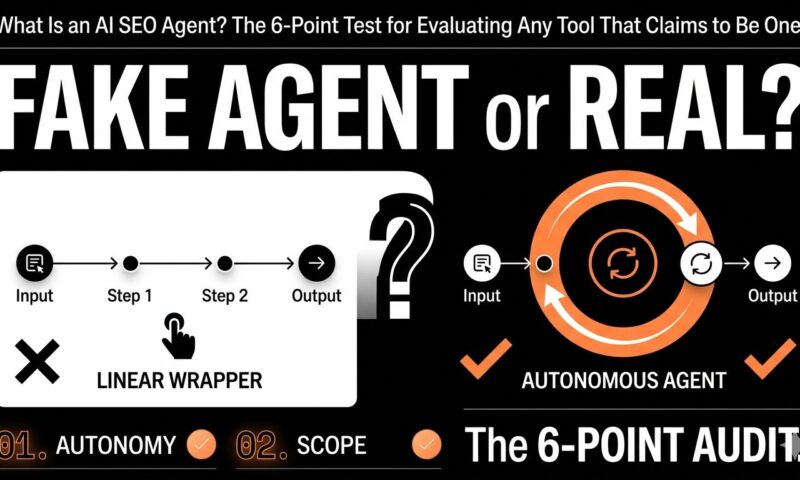
“AI SEO agent” is the most overused label in search marketing in 2026. Nearly every AI writing platform, SEO tool, and content automation suite has rebranded itself with the term. Nearly none of them qualify.
This matters because buyers who cannot define the category cannot evaluate it. Teams are signing up for tools marketed as ai seo agent systems that are, in practice, prompt wrappers with a multi-step UI. They get a chatbot that produces content one section at a time if you keep clicking “next.” They pay agent-level pricing and get tool-level output.
The confusion is not accidental. “Agent” commands a premium in both price and perception. When the label inflates, it benefits vendors and harms buyers.
We built an 18-agent SEO system from the ground up at Superteam AI. The six criteria in this guide are the ones we used to define what genuinely belongs in the ai seo agent category and what does not. Every tool you evaluate should clear all six. Most will not.
This guide also explains where an ai seo agent fits in the broader AI SEO landscape, when the agent model is the right choice for your team, and when the output ceiling of a single agent means you need something more.
What Is an AI SEO Agent? (The Definition That Holds Up in 2026)
Definition: An AI SEO agent is an AI system that executes a defined SEO workflow autonomously across multiple steps, making decisions between stages without human input at each transition. It takes a starting input (a target keyword or approved brief), executes a connected sequence of research, analysis, writing, and validation tasks, and produces a finished, publication-ready output, all without the human managing each step in between.
The key word is autonomous. A genuine AI SEO agent decides what happens next based on its own output, not based on a human instruction at every stage. This is the criterion that most tools claiming the agent label fail to meet.
An AI SEO agent also differs from a general AI assistant. A general assistant responds to prompts. An agent executes a workflow. If you have to keep typing instructions to move the process forward, you are using an assistant. If the process moves forward on its own, you are using an agent. That distinction sounds simple. It eliminates the majority of 2026’s “AI SEO agents” from the category.
The Architecture Behind a Genuine AI SEO Agent
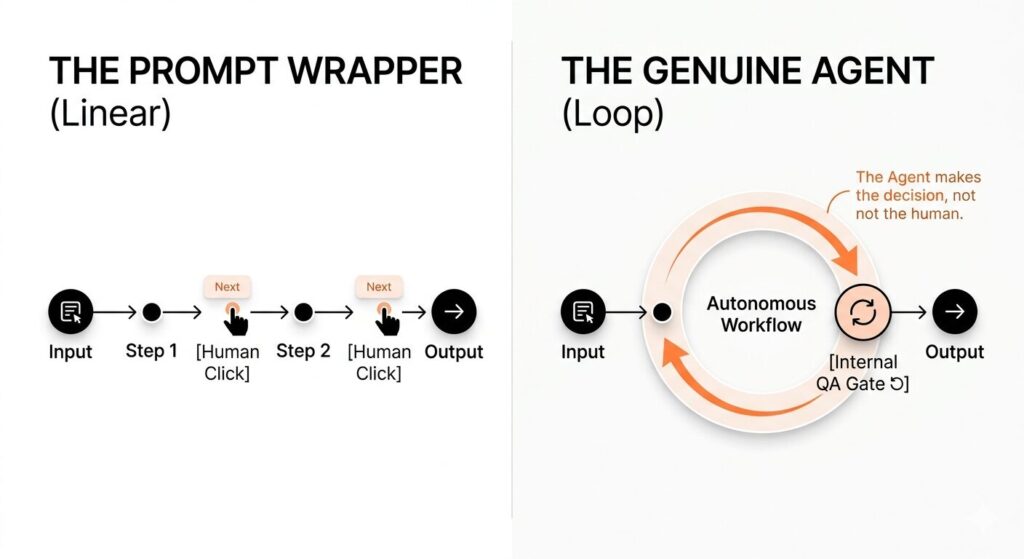
A genuine AI SEO agent operates through a decision-making loop at each stage of the workflow. It produces output, evaluates whether that output meets a defined quality standard, and either advances to the next stage or iterates until the standard is met. The human did not design that evaluation loop for each individual run. The agent manages it consistently, across every keyword it processes.
Compare this to what most marketed “AI SEO agents” actually do: the user inputs a keyword, the tool runs one model call, returns content, and waits. The user reviews and clicks to continue. The tool runs another model call. This is sequential automation with a human in the coordination role at every transition. It is not an agent. It is a workflow tool with a progress bar.
When we evaluated what our own multi-agent system needed to do at the architectural level, the requirement we kept returning to was this: the human should be a strategic approver at two defined checkpoints, not a task manager at every step. That requirement is what genuine agentic architecture delivers.
Building it taught us that most of what passes for agent architecture in the market is, on closer inspection, automation with extra steps. The practical test is straightforward: remove the human from between the steps and see if the system still produces a coherent, usable output. Most tools stop working the moment you do. A genuine agent does not.
| Workflow Step | What the Agent Does | What Triggers the Next Step | Human Involvement |
| Keyword intake | Validates keyword, identifies search intent, maps cluster context | Intent and cluster data complete | None |
| SERP analysis | Collects top 10–20 results, runs gap analysis across 14 dimensions | Gap analysis report generated | None |
| Brief generation | Synthesises SERP data into structured, reviewable brief | Brief formatted and ready | Brief approval (Checkpoint 1) |
| Content production | Writer agent produces full draft from approved brief | Draft complete | None |
| QA validation | QA agent checks keyword integration, brand voice, and readability | All checks passed | None |
| On-page elements | Meta agent generates title tag, description, slug, and schema markup | Elements complete | None |
| Final output | Complete content package assembled and delivered | Package ready for review | Final review (Checkpoint 2) |
What an AI SEO Agent Covers End to End
A genuine AI SEO agent handles the complete sequence from keyword intake to publication-ready output: SERP analysis, competitive gap mapping, brief generation, content production, editorial QA, and on-page element creation. Each stage uses the output of the previous one as its direct input. The agent carries context through the entire workflow without the human re-entering it at each stage.
If a tool claims to be an AI SEO agent but only handles content writing, or only handles keyword research, it is not an agent. It is a single-function tool performing one step of what a genuine agent covers as a connected whole.
AI SEO Agent vs. AI SEO Tool vs. AI SEO Workforce: The Honest Breakdown
All three models have legitimate use cases. The problem is not that tools exist, or that workforces are oversized for some teams. The problem is that vendor marketing has blurred the distinctions to the point where buyers cannot make an informed choice without an independent reference point.
What an AI SEO Tool Is (And What It Is Not)
An AI SEO tool handles one function: keyword scoring, content optimisation, meta generation, technical audit, or readability checking. The human directs it at every step. It waits for the next instruction. It does not make decisions about what to do next, and it does not connect its output to the next stage of the workflow automatically.
Tools are the right starting point for teams producing 1–3 pieces per month, getting familiar with AI-assisted workflows, or augmenting capacity on specific tasks without rebuilding the whole operation. They are not agents, regardless of how they are marketed.
What Distinguishes a Real AI SEO Agent
A genuine AI SEO agent covers a multi-step workflow end to end. It makes decisions between steps. It maintains context across the workflow without human re-entry. It validates its own output before advancing. And it operates between two human checkpoints rather than with a human directing every transition.
This is what genuine ai-powered seo agents deliver: one trigger in, one completed output package out, with autonomous execution connecting the two. The human’s role shifts from task manager to strategic approver.
What a Multi-Agent AI SEO Workforce Does Differently
A coordinated multi-agent workforce is not a larger version of a single agent. It is a different architecture. Instead of one generalised agent handling every function, 15+ specialised agents each handle one: a SERP research agent, a gap analysis agent, a brief-generation agent, writer agents, an editor agent, a QA agent, a meta agent, and an interlinking agent. A manager model orchestrates the sequence, assigns work to the correct agent, and manages quality gates between every handoff.
The result is higher quality at each stage (each agent is optimised for one function rather than spread across all) and higher throughput (the workforce processes multiple keywords simultaneously without quality degradation at scale).
| AI SEO Tool | AI SEO Agent | AI SEO Workforce | |
| What it automates | One task | One end-to-end workflow | Full SEO lifecycle |
| Human effort | High: human directs every step | Medium: human approves at 2 checkpoints | Low: human approves at 2 checkpoints |
| Context retention | None: human re-enters context each time | Full: context carried through the workflow | Full: shared memory across all agents |
| Quality gate between steps | None | Between defined workflow stages | Between every agent handoff |
| Output per session | Single task output | Complete content package | Multiple content packages simultaneously |
| Cost model | Per seat or per feature | Per workflow or subscription | Monthly subscription, full lifecycle |
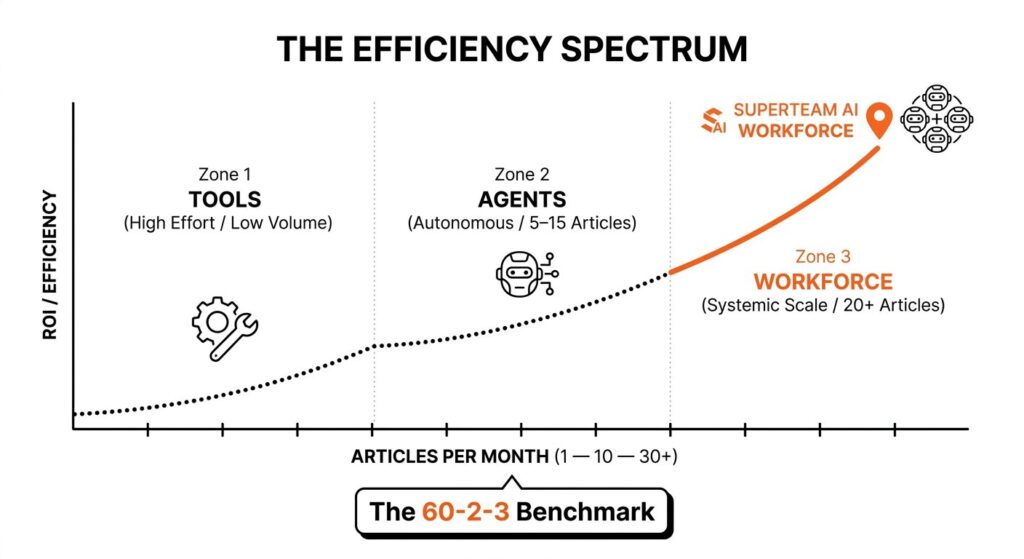
| Right for | 1–3 articles/month | 5–15 articles/month | 20+ articles/month |
The 6-Point Agent Test: How to Evaluate Any Tool Claiming to Be an AI SEO Agent
Before committing to any platform claiming the agent label, apply these six tests. They are the same six criteria we used internally at Superteam AI when defining what qualified as a genuine agent during our own system development.
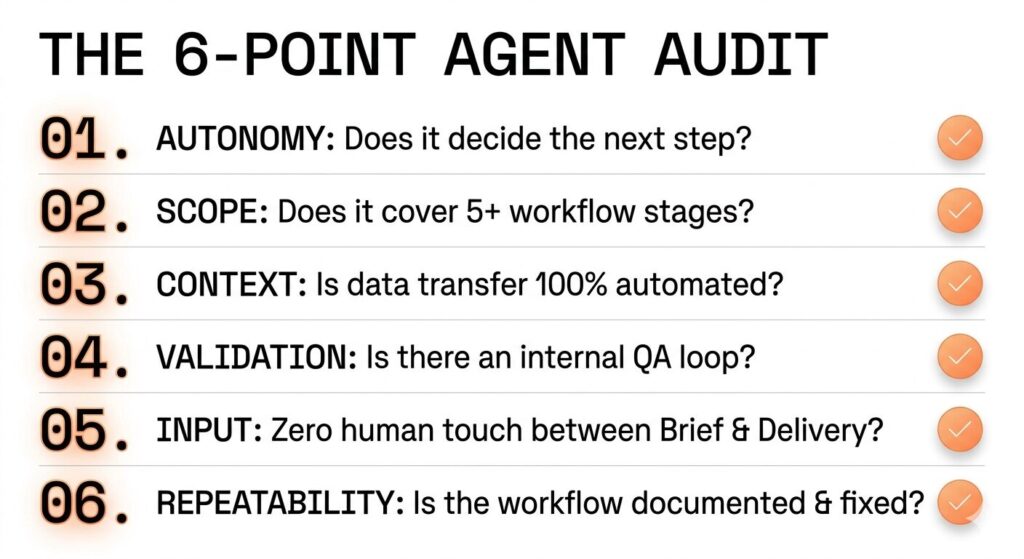
A genuine AI SEO agent passes all 6. A prompt wrapper passes 0–2. Most tools marketing themselves as AI SEO agents in 2026 pass 2–3. Here is how to tell which you are looking at.
Test 1: Does It Make Decisions Between Steps, or Do You?
Ask the vendor to walk you through what happens after you input a keyword. Does the system determine the next action based on its own output, or does it wait for your instruction at each transition? If you are clicking “next,” “continue,” or “generate” at every stage, you are directing an automation. A genuine agent determines its own next action from its own output and advances without prompting.
Buyer action: Ask for a live demo where you input a keyword and watch the system run to final output without you providing further instructions.
Test 2: Does It Handle Multiple Workflow Stages, or Just One?
An agent covers a defined sequence: research, analysis, brief, content production, QA, on-page elements. A tool covers one of those. Ask the vendor to specify the complete workflow the system executes end to end. If the answer names a single function, such as “content generation” or “keyword research,” what you are looking at is a tool.
Buyer action: Request the full workflow specification in writing before signing up. Count the stages. A genuine agent should cover at least five.
Test 3: Does It Maintain Context Across the Full Workflow?
A genuine AI SEO agent uses the output from stage one as the direct input to stage two, automatically. You should not need to copy keyword data into a brief tool, copy the brief into a writing tool, or copy the draft into a QA tool. If the stages do not connect and transfer data automatically, you have a tool stack, not an agent.
Buyer action: Ask specifically: does the research output feed the brief stage automatically, and does the brief feed the content stage automatically, without manual data transfer by the user?
Test 4: Does It Have a Quality Gate Before Passing Output Forward?
A genuine agent validates its output before advancing to the next stage. It checks whether the content meets defined criteria (keyword integration, word count, brand voice requirements, readability score) before moving to QA, and the QA stage must pass before the output reaches you. Prompt wrappers produce output and stop. There is no internal validation loop.
Buyer action: Ask what happens if the system’s output fails a quality check mid-workflow. Does it iterate and try again, or does it deliver the failed output for you to correct manually?
Test 5: Does It Operate Without Human Input Between Brief Approval and Final Delivery?
The two legitimate human checkpoints in a properly designed AI SEO workflow are brief approval and final content review. Everything between those two points should run autonomously in a genuine agent. If the system requires your input at any stage between brief and final output, including mid-content direction, topic confirmation, or section-by-section approval, it is not operating as an agent.
Buyer action: Time the workflow from brief approval to final output delivery. Count the number of times you are asked to provide input in between. A genuine agent: zero times.
Test 6: Does It Have a Defined, Repeatable Scope of Work?
A genuine AI SEO agent has a defined beginning (keyword or brief input), a defined end (publication-ready content package), and a documented, consistent process connecting them. It is not open-ended. If the system’s primary interface is a chat box where you type instructions and it responds, you are using a conversational AI assistant, not a search optimisation agent.
Buyer action: Ask for the system’s documented workflow specification. If no spec exists, the workflow is not defined, not repeatable, and not an agent.
When an AI SEO Agent Is the Right Model for Your Team
An AI SEO agent is the right model for growing teams in the 5–15 article per month range that need to increase output without adding headcount. It replaces the junior SEO coordinator and content writer roles in the execution layer, freeing one strategic lead to focus on direction, brief approval, and final review rather than production management.
What an agent replaces: keyword research and cluster mapping coordination, the writing and editing production cycle, on-page element creation, and the QA review cycle before final handoff.
What an agent does not replace: strategic positioning decisions, competitive differentiation choices, brand voice development, and the judgment that makes content genuinely original rather than competently optimised. An agent executes a strategy. It does not set one.
In our deployments, single-agent systems produce strong and consistent results up to around 15 articles per month. At higher volumes, the coordination demands begin to outpace what a single-agent architecture can handle efficiently: running multiple keywords simultaneously, maintaining quality consistency across a growing content library, and managing systematic interlinking across hundreds of published pieces. At that point, a coordinated workforce architecture is the correct operating model.
Signs you have outgrown the agent model:
- You need 20+ pieces per month with consistent quality
- You are managing multiple client brands with different voices and competitive positions
- Interlinking and technical SEO elements need systematic management across a large, growing content library
- You need simultaneous multi-keyword execution without output quality declining at volume
The transition from agent to workforce is not a major operational disruption. The workflow structure stays the same: keyword in, brief approval, content review, publication. What changes is the number of specialised agents executing each stage, the quality consistency at scale, and the system’s ability to process multiple keywords simultaneously without output degrading.
Most teams make this transition between months four and eight of running a single-agent workflow, when organic traffic has started compounding and the content demand has outpaced what one agent architecture can produce at consistent quality. The ceiling is predictable, and the step up is worth planning for before you hit it.
The Business Case: AI SEO Agent vs. Freelancer vs. Agency vs. Workforce
Before committing to any model, the financial comparison should be direct. These figures reflect actual market rates and Superteam AI’s pricing as of Q2 2026.
| Model | Monthly Cost | Monthly Output | Cost Per Article | Quality Consistency | Strategic Coverage |
| Freelance writer + SEO coordinator | $2,000–$4,000 | 4–8 articles | $250–$1,000 | Variable (human-dependent) | Execution only |
| SEO agency retainer | $3,000–$8,000 | 4–12 articles | $400–$2,000 | Process-dependent | Strategy included |
| AI SEO agent (mid-market platforms) | $200–$600/month | 10–20 articles | $10–$60 | System-enforced | Execution only |
| AI SEO Workforce (Superteam AI Scale Plan) | $399/month | 30 articles | ~$13 | Multi-agent QA enforced | Execution only |
The figures above show why the agent model is financially compelling for teams in the 5–15 article per month range. An AI SEO agent at $200–$600 per month delivers 10–20 articles at $10–$60 per piece. A freelance writer plus SEO coordinator at the same volume costs $2,000–$4,000 per month. That is a 10x to 20x cost efficiency difference at equivalent output, without the scheduling, briefing, and review overhead of managing a human production team.
The financial case for genuine ai-powered seo agents over freelance or agency models is direct at any output volume above 5 pieces per month. The comparison that matters most is not total monthly spend but cost per published, ranking article, because SEO value is generated by indexed, optimised content, not by hours billed.
Apply the 60-2-3 benchmark to every agent system you evaluate: at least 60% reduction in workflow time versus manual execution, at least 2x return on investment through cost savings or organic traffic revenue, and at least 3x the production speed of equivalent human teams. Any system that cannot demonstrate all three is not performing at the agent level, regardless of the label it carries.
The Superteam AI Pro Plan starts at $79 per month for 5 articles through our 18-agent workflow. The Scale Plan is $399 per month for 30 articles across 10 users. Start a trial or book a demo to run a live keyword through the full system and see what the output looks like at the execution layer.
Frequently Asked Questions About AI SEO Agents
What is an AI SEO agent?
An AI SEO agent is an AI system that executes a multi-step SEO workflow autonomously, making decisions between stages without human input at each transition. It handles research, SERP analysis, brief generation, content production, QA validation, and on-page element creation as a connected sequence, carrying context across stages and delivering a complete, publication-ready content package for human review at two defined checkpoints. The distinguishing feature is autonomous decision-making between steps, not just faster execution of individual tasks.
How does an AI SEO agent differ from an AI SEO tool?
An AI SEO tool handles one function and waits for human direction at every step. An AI SEO agent handles a multi-step workflow end to end, advancing autonomously from stage to stage based on its own output. The practical difference: a tool speeds up individual tasks while keeping you in the coordination role at every transition. An agent removes you from coordination entirely between two defined human checkpoints, brief approval and final review.
Can an AI SEO agent replace my SEO team?
It replaces the execution layer: keyword research, brief generation, content production, editorial review, and on-page optimisation. It does not replace strategic direction, brand voice development, or competitive positioning decisions. Most teams find that a genuine AI SEO agent replaces 1–2 execution roles and shifts the remaining human focus from production management to strategic oversight and quality approval.
What should I look for when choosing an AI SEO agent?
Apply the 6-point test in this guide. Ask whether the system makes decisions between steps autonomously, whether it handles multiple workflow stages end to end, whether it maintains context automatically across the workflow, whether it has a built-in quality gate before advancing output, whether it operates without human input between brief and delivery, and whether it has a documented, repeatable scope of work. A platform that passes fewer than five of the six is not a genuine agent.
How much does an AI SEO agent cost?
Mid-market AI SEO agent platforms run from $200 to $600 per month for 10–20 articles per month. At the workforce level, Superteam AI’s Pro Plan covers 5 articles at $79 per month, the Business Plan covers 15 articles at $199, and the Scale Plan covers 30 articles at $399. The metric that matters more than subscription cost is cost per published, ranking article. Genuine agent and workforce systems typically run 10x to 20x more cost-efficient than agency or freelance models at equivalent output volumes.
What is the difference between an AI SEO agent and an AI SEO workforce?
An AI SEO agent is a single system executing a defined workflow autonomously. An AI SEO workforce is a coordinated team of 15+ specialised agents, each optimised for one function, orchestrated by a manager model that manages quality gates between every handoff. The practical difference is quality ceiling and scale: a single agent generalises across all SEO functions, while a workforce assigns each function to a specialist agent, producing higher quality per stage and handling multiple keywords simultaneously without performance degradation.
Are ai-powered seo agents better than SEO agencies?
For execution at scale, yes, at almost any volume above 5 articles per month. For strategic direction, client communication, and competitive positioning expertise, strong agencies still provide value that agent systems do not replicate. The businesses getting the best results in 2026 use ai-powered seo agents or coordinated workforces for the execution layer while keeping one strategic lead for direction and measurement, effectively replacing the agency retainer and the junior execution team simultaneously.
Know What You Are Buying
The AI SEO agent category will keep expanding through 2026 and into 2027. More tools will adopt the label. The confusion will grow before it settles. Buyers who know exactly what a genuine AI SEO agent is, and who have a concrete test for evaluating every tool that claims to be one, will consistently make better investments than those who rely on vendor marketing.
Three things this guide has established. First, genuine AI SEO agent systems are defined by autonomous decision-making between workflow steps, not by how many steps exist or how polished the dashboard looks. Second, the 6-point test is vendor-agnostic and time-stable: it will work today and as the category evolves through 2027. Third, the right model matches output volume: tools for 1–3 articles per month, a genuine ai seo agent for 5–15, and a coordinated workforce for 20 and above.
The market has more noise than signal right now. The 6-point test cuts through it.
If you are ready to see what a genuine AI SEO agent workflow looks like in practice, start the Superteam AI Pro Plan at $79 per month and run your first 5 articles through our 18-agent system. Or book a demo to watch a live keyword move from research through publication-ready output without a single manual handoff.


