
Most lists of ai seo tools make the same mistake. They rank Ahrefs next to Surfer SEO, Clearscope next to Semrush, and Outranking.io next to Frase, as if these tools solve the same problem. They do not.
After running AI SEO systems for dozens of clients and building our own AI-powered SEO workforce at Superteam AI, we have learned that the tool you choose matters far less than matching the tool to the right problem. An AI research tool cannot replace an AI content optimisation platform. And neither can replace a system that handles the entire workflow end to end.
The ai seo landscape has expanded dramatically in 2026. Nearly every SEO platform has added the word “AI” to its marketing. What separates the tools that genuinely automate decision-making from those that offer a prompt box you have to fill manually? That is the question this guide answers.
We reviewed nine of the best ai seo tools across three functional categories: AI SEO research, AI content optimisation, and AI SEO workflow automation. For each, we cover what it actually automates, what it leaves to you, real 2026 pricing, and who it is best suited for.
By the end, you will know exactly which category of tool your team needs, and which specific tool within that category is worth your budget.
Why Most AI SEO Tool Lists Get It Wrong
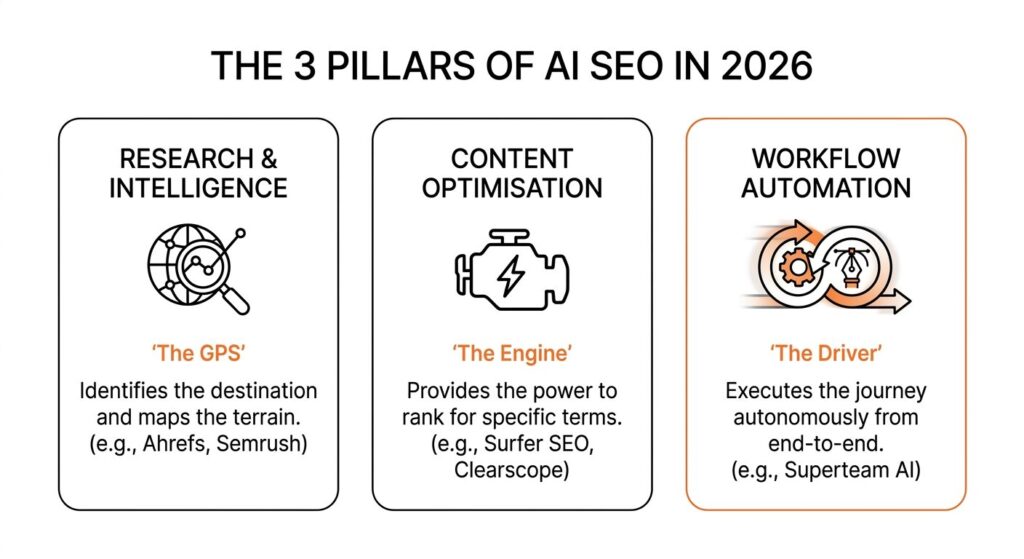
Comparing Ahrefs to Surfer SEO in a single ranked list is like ranking a GPS and a car engine side by side. Both contribute to getting somewhere, but they serve entirely different functions at entirely different stages of the journey
Most seo ai tools lists conflate three fundamentally different product categories:
- AI SEO Research Tools: platforms that collect, process, and surface data about keywords, backlinks, and competitors
- AI Content Optimisation Tools: platforms that analyse top-ranking pages and tell you how to improve your content to match them
- AI SEO Workflow Automation: systems that execute multiple SEO steps autonomously, from research through to published content
A business choosing between these categories is making a fundamentally different decision depending on where its bottleneck sits. If you need better keyword data, you need Category 1. If your content is underperforming, you need Category 2. If you need SEO to run as a managed system rather than a collection of manual tasks, you need Category 3.
This guide organises every tool by what it actually does, so you can stop comparing the incomparable.
How We Evaluated Every Tool on This List
Superteam AI builds and deploys AI-powered SEO systems for clients across SaaS, B2B, and e-commerce. In evaluating these tools, we applied five criteria to every platform:
- Actual AI automation depth: does the tool make autonomous decisions, or does it require constant human instruction?
- 2026 update status: is the tool’s data and feature set current, or operating on 2024 assumptions?
- GEO and AEO readiness: does the tool track visibility in AI-generated results (ChatGPT, Perplexity, Gemini), not just Google’s blue links?
- Pricing transparency: are published prices accurate and feature tiers clearly differentiated?
- Fit for non-enterprise teams: we prioritised tools that serve growing businesses, not just enterprise budgets
One disclosure: Superteam AI is reviewed in Category 3. You will find the same structured format applied to it as to every other tool, including limitations.
For a deeper look at what distinguishes a genuine AI SEO system from a feature-rich platform, see our pillar guide.
Our Top 3 AI SEO Tools in 2026
If you need a fast answer before the full breakdown, these are the three tools we would recommend first, each for a different reason.
#1: Superteam AI SEO Workforce: Best for Full Workflow Automation
The only tool on this list handling research, strategy, content production, optimisation, and reporting as a unified autonomous workflow. You transfer knowledge once; the team executes from there. For businesses that need SEO to run as a system rather than a collection of managed tasks, nothing else comes close. Starts at $79/month.
#2: Ahrefs: Best for AI-Powered SEO Research
The deepest data set of any research tool on this list, with the strongest AI layer for surfacing actionable insights. If your team runs its own SEO strategy but needs better intelligence to direct it, Ahrefs is the clear starting point. Starts at $129/month.
#3: Surfer SEO: Best for AI Content Optimisation
Real-time content scoring against live SERP data, with the most practical optimisation workflow available at this price point. For content teams lifting the performance of existing and new content, Surfer is the tool we recommend most consistently. Starts at $49/month.
All the Best AI SEO Tools at a Glance
This ai seo tools comparison covers all nine platforms reviewed in this guide, organised by category.
| Tool | Category | Best For | Starting Price | GEO/AEO Tracking |
| Superteam AI | Workflow Automation | Full AI SEO workforce | $79/month | Yes |
| Ahrefs | Research | Keyword and backlink intelligence | $129/month | No |
| Semrush | Research | All-in-one SEO suite | $139.95/month | Partial |
| Keyword Insights | Research | Keyword clustering at scale | $58/month | No |
| Surfer SEO | Content Optimisation | Real-time content scoring | $49/month | Yes (2026) |
| Clearscope | Content Optimisation | Enterprise content teams | $189/month | Yes |
| Frase | Content Optimisation | Brief creation and optimisation | $49/month | No |
| Rankability | Content Optimisation | SERP-first content grading | $149/month | Yes |
| Outranking.io | Workflow Automation | Automated content pipelines | $79/month | No |
Category 1: AI SEO Research Tools
An AI SEO research tool collects, processes, and surfaces intelligence about keywords, backlinks, competitors, and search trends at a speed and scale no human team can match. These are data and decision-support platforms. They tell you what to target and why. They do not write, publish, or optimise your content.
If your core bottleneck is understanding the landscape (finding the right keywords, understanding competitor authority, identifying content gaps), one of these three tools will address it directly.
Ahrefs: Best for Keyword and Backlink Intelligence
Ahrefs is the gold standard for SEO data depth. Its keyword database covers over 23 billion queries across 170 countries, and its backlink index is updated continuously. In 2026, the Content Audit tool uses AI to cluster pages by performance and flag underperforming content automatically, while Keywords Explorer uses machine learning to predict keyword difficulty and traffic potential.
AI Features: AI-generated content audit recommendations, keyword difficulty predictions, content gap analysis, automatic topic clustering.
Best For: Teams building their own SEO strategy who need the most reliable data foundation available. Particularly strong for link building, competitive research, and identifying high-opportunity keywords.
Pricing: $129/month (Lite) to $449/month (Agency)
Pros:
- Best-in-class backlink and keyword database
- AI content audit reduces manual site analysis time significantly
- Transparent data sourcing and regular index updates
Cons:
- No content optimisation features; you need a separate tool for that
- Pricing climbs steeply for teams that need API access or multiple users
- GEO and AI visibility tracking not yet included
Semrush: Best for All-in-One SEO Intelligence
Semrush is the closest thing to an all-in-one platform in Category 1. Beyond keyword and backlink research, it includes AI writing assistance (ContentShake AI), topic research, on-page SEO recommendations, and partial tracking of Google AI Overview appearances added in 2026.
AI Features: ContentShake AI for draft generation, AI-powered keyword clustering, Topic Research, AI-driven on-page recommendations, partial AI Overviews tracking.
Best For: Marketing teams that want a single platform covering most of their SEO intelligence needs without stitching together multiple tools. Also well-suited to agencies managing multiple accounts.
Pricing: $139.95/month (Pro) to $499.95/month (Business)
Pros:
- Broadest feature set of any research tool in this category
- AI Overview tracking gives a partial window into GEO performance
- Strong agency and multi-seat features at the Business tier
Cons:
- Data depth on keywords and backlinks is marginally behind Ahrefs
- ContentShake AI produces serviceable drafts but requires significant editing
- Price-to-value ratio weakens if you only need research features
Keyword Insights: Best for Keyword Clustering at Scale
Keyword Insights does one thing extremely well: it takes a raw keyword list and uses AI to cluster queries by search intent and SERP similarity. For content operations mapping hundreds or thousands of keywords to the right pages, it removes a process that would otherwise take days.
AI Features: AI intent classification, SERP similarity clustering, keyword-to-page matching, content brief generation from clustered groups.
Best For: Content teams managing large keyword sets, SEO agencies processing client lists, and growth teams building topical authority across a cluster.
Pricing: $58/month (starter), scales by query volume
Pros:
- Fastest and most accurate keyword clustering tool available in 2026
- Intent classification is well-calibrated across informational, commercial, and transactional queries
- Affordable entry point relative to the time it saves
Cons:
- Narrow focus: not a replacement for Ahrefs or Semrush for broad research
- No content optimisation or writing features
- Reporting and visualisation are minimal
If your primary need is data and intelligence, one of these three tools will cover it. But if you need a system to act on that data, that is where Category 3 becomes relevant.
Category 2: AI Content Optimisation Tools
AI content optimisation tools analyse the top-ranking pages for a given keyword and give writers a target to aim for. They score content against NLP signals, entity coverage, word count, and structural patterns. They are execution-support tools, not strategy tools.
This is the most crowded category in the market. The differentiators matter more here than anywhere else on this list.
Surfer SEO: Best for Real-Time Content Scoring
Surfer SEO’s Content Editor is the most widely adopted AI content optimisation tool in the market. In 2026, it added two meaningful upgrades: a restructured pricing model that opens the platform to smaller teams, and AI Visibility tracking that monitors Google AI Overview appearances for targeted keywords.
AI Features: NLP-based Content Score, real-time heading and term recommendations, AI-generated content outlines, keyword density monitoring, AI Visibility tracking (new 2026).
Best For: Content teams producing multiple articles per week who need a consistent optimisation target for every piece. Also strong for freelancers and small agencies on a budget.
Pricing: $49/month (Discovery) to $199/month (Business)
Pros:
- Real-time content scoring is the clearest feedback loop available for writers
- AI Visibility tracking adds a meaningful 2026 dimension at no extra cost
- Discovery tier is a credible entry point for smaller operations
Cons:
- Content Score can encourage shallow over-coverage of terms at the expense of genuine expertise
- No keyword research or backlink features; needs pairing with a Category 1 tool
- AI outline generation is a starting point, not a strategy substitute
Clearscope: Best for Enterprise Content Teams
Clearscope rebranded itself as a “content discoverability platform” in early 2026, reflecting a genuine product shift: the platform now tracks how well content performs in AI-generated summaries across multiple engines, not just traditional search rankings.
AI Features: AI-powered content grading, entity and term recommendations, content inventory management, AI engine visibility tracking, team workflow and approval tools.
Best For: Enterprise content teams where quality control and cross-team collaboration matter as much as the optimisation signals. Marketing organisations at Series B and beyond that need management-layer reporting alongside content scoring.
Pricing: $189/month (Essentials), custom (Business)
Pros:
- The most mature content team workflow in Category 2
- GEO tracking across multiple AI engines is a genuine 2026 differentiator
- Reporting depth gives content managers full inventory visibility
Cons:
- Most expensive tool in this category by a significant margin
- The “discoverability platform” rebrand is partly marketing; core features remain close to competitors
- Overkill for small teams that do not need enterprise workflow features
Frase: Best for Brief Creation and Optimisation
Frase sits at the intersection of research and content optimisation. Its AI analyses top search results for a keyword, aggregates People Also Ask questions, and produces a structured content brief in minutes. The optimisation scoring then keeps writers on track through the drafting process.
AI Features: AI content brief generation, SERP analysis aggregation, PAA and Reddit question scraping, content optimisation scoring, AI-assisted writing.
Best For: Content managers spending significant time briefing writers, and small teams that need brief-generation and optimisation support without managing two separate tools.
Pricing: $49/month (Starter) to $114.99/month (Team)
Pros:
- Fastest brief-generation workflow in this category
- Combines research aggregation and optimisation in a single editor
- Competitive pricing for the feature set
Cons:
- Optimisation scoring is less precise than Surfer or Rankability
- No GEO or AI visibility tracking
- AI writing assistance needs editorial polish to be publication-ready
Rankability: Best for SERP-First Content Grading
Rankability built its content grading system directly on live SERP data rather than a static NLP model, which gives it a precision advantage in competitive niches where the SERP shifts frequently. Its AI visibility tracking covers four AI engines: ChatGPT, Perplexity, Gemini, and Google AI Overviews, the broadest coverage in Category 2.
AI Features: SERP-calibrated content grading, entity coverage analysis, AI visibility tracking across 4 engines, competitor content dissection, content brief generation.
Best For: SEO professionals who want grading that reflects what is currently ranking rather than a normalised benchmark. Strong for fast-moving niches and teams that prioritise AI visibility data.
Pricing: $149/month
Pros:
- Live SERP-calibrated scoring outperforms static NLP models in fast-moving niches
- Broadest AI engine visibility tracking in Category 2 (4 engines)
- Content brief generation is tight and well-structured
Cons:
- Price sits awkwardly between Surfer and Clearscope without fully matching either on features
- Newer platform with less community support and fewer integrations
- AI writing assistance is limited compared to Frase
The right Category 2 tool depends on your team structure: Surfer for practitioner-led teams, Clearscope for enterprise content operations, Frase for brief-driven workflows, Rankability for SERP-first accuracy. If you need the content produced for you rather than optimised by you, scroll to Category 3.
Category 3: AI SEO Workflow Automation
This is where the category lines matter most. The ai seo software in Categories 1 and 2 provides intelligence and guidance. The tools in Category 3 take action. They do not score your content and leave execution to you; they move through multiple SEO steps (keyword selection, content planning, writing, optimisation, internal linking) autonomously or near-autonomously.
This is the category evolving fastest, and where the gap between tools is widest.
Outranking.io: Best for Automated Content Production Pipelines
Outranking.io automates the content production stage. You input a keyword, set your audience and tone, and Outranking produces an optimised draft mapped to the SERP. For teams producing content at volume, it removes the brief-writing and first-draft bottleneck.
AI Features: Automated article generation from keyword input, auto-internal linking suggestions, SERP-informed outlines, on-page SEO scoring, content calendar management.
Best For: Content teams producing five or more articles per week who need to accelerate the pipeline without proportionally increasing headcount. Also useful for agencies running high-volume content programmes.
Pricing: $79/month (Starter) to $199/month (Growth)
Pros:
- Reduces first-draft production time substantially for high-volume operations
- Internal linking automation saves meaningful editorial time at scale
- Clean editor with real-time SEO feedback
Cons:
- Automates production, not strategy; keyword selection still requires human input
- Drafts are consistent but rarely distinctive and need editorial polish
- No GEO or AI visibility tracking
- Does not handle backlink outreach, technical SEO, or reporting
Outranking is the right tool if your bottleneck is production speed. If the bottleneck is the entire SEO operation: targeting, execution, and tracking, that requires a different kind of system.
Superteam AI SEO Workforce: Best for Full AI-Driven SEO Execution
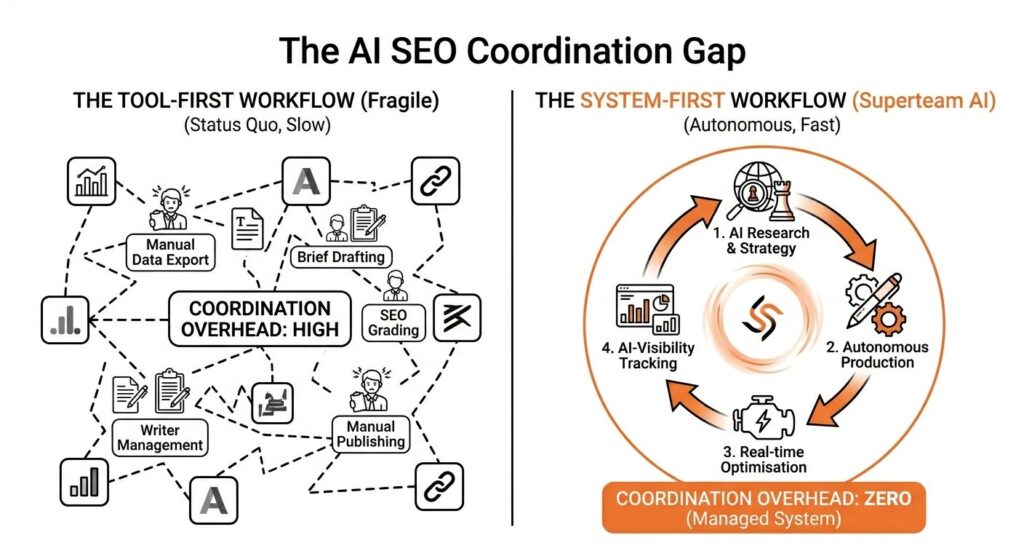
We built the SEO Workforce because we kept seeing the same problem: clients had great tools but no system to connect them. Ahrefs data not acted on. Surfer scores sitting in draft folders. Content pipelines stalling the moment one team member was unavailable. The tools were there. The coordination was not.
Superteam AI’s SEO Workforce is not a tool in the same sense as anything else on this list. It is a coordinated AI team handling the complete SEO workflow: keyword research, content strategy, brief creation, article production, optimisation, internal linking, and performance tracking. Clients transfer knowledge once. The workforce executes from there.
How It Works: After onboarding, the SEO Workforce runs a continuous research and production loop. Each cycle surfaces high-priority keyword opportunities, creates and optimises content to target them, and updates the reporting dashboard. No tool stack to manage, no brief template to maintain.
Best For: Founders and marketing leads at growing companies who need SEO to run as a managed system rather than a series of tasks to oversee. Most valuable where the bottleneck is coordination and throughput, not data access.
Pricing:
- Pro: $79/month (5 articles/month)
- Business: $199/month (15 articles/month)
- Scale: $399/month (30 articles/month, 10 users)
What Makes It Different: Every other tool on this list automates one stage of the SEO workflow. The SEO Workforce automates the connections between stages. That is where the real inefficiency lives for most growing teams.
“You don’t need more tools. You need a system that uses them for you.”
Pros:
- The only solution covering research through to published, optimised content
- No ongoing tool management or workflow coordination required
- AI visibility tracking built into reporting across major AI engines
- Clear pricing tiers scaled by output volume
Cons:
- Not suited to teams wanting hands-on control of each content decision
- Volume is tier-defined; teams needing over 30 articles per month need a custom arrangement
- Requires thorough onboarding knowledge transfer to perform at full capability
View Superteam AI pricing and get started
See also: how Superteam AI’s AI SEO agent architecture differs from traditional platform-based approaches.
AI Visibility Tracking: The New Dimension Every Tool Is Adding
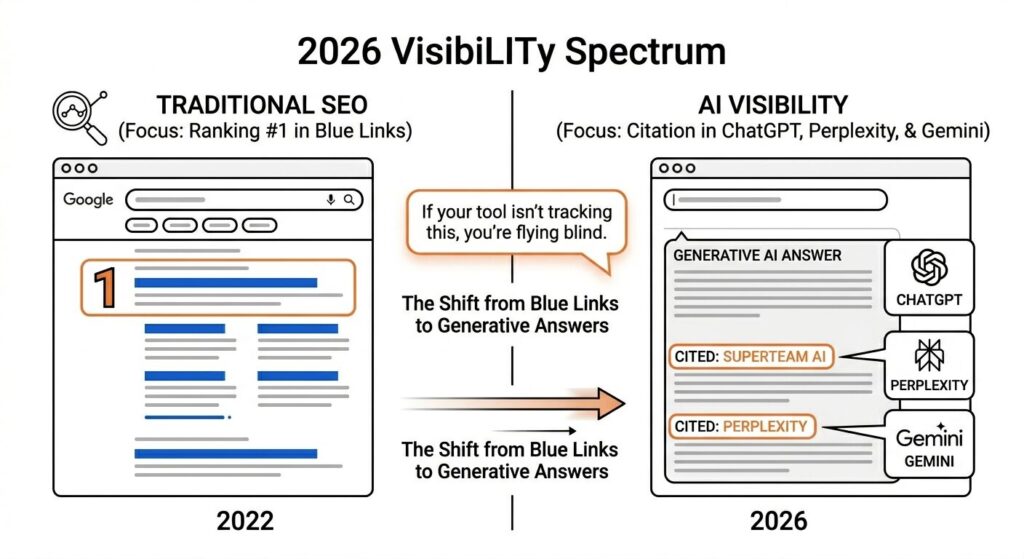
There is a shift underway in how people find information, and the best ai tools for seo in 2026 are only beginning to account for it.
As of 2026, a growing share of informational searches now begin in AI interfaces: ChatGPT, Perplexity, Gemini, and Google AI Overviews are generating answers that cite, or fail to cite, your content. Whether your brand appears in those answers is no longer a question for a future strategy session. It is a present-day performance metric.
At Superteam AI, we started tracking GEO (Generative Engine Optimisation) and AEO (Answer Engine Optimisation) metrics for clients in late 2025, after seeing referral traffic from AI-generated summaries increase sharply for several accounts in the SaaS space. The pattern was consistent enough that we integrated AI visibility reporting as a standard component of our SEO Workforce output.
The tools in this guide are at different stages of responding to this shift.
| Tool | AI Visibility Tracking | Platforms Covered |
| Superteam AI | Yes | All major AI engines (built into reporting) |
| Clearscope | Yes | Multiple AI engines (core to rebrand) |
| Rankability | Yes | ChatGPT, Perplexity, Gemini, Google AI |
| Surfer SEO | Yes (new 2026) | Google AI Overviews |
| Semrush | Partial | Google AI Overviews only |
| Ahrefs | No | Not available |
| Frase | No | Not available |
| Outranking.io | No | Not available |
| Keyword Insights | No | Not available |
What to look for in AI visibility tracking: the strongest implementations show which specific queries trigger AI-generated answers that include your content, which answers cite competitors instead of you, and how that visibility correlates with organic traffic over time. Clearscope and Rankability are currently closest to this standard; Surfer’s 2026 addition tracks appearances but does not yet provide competitor citation data.
GEO and AEO are not replacements for traditional SEO. They are an additional layer of visibility measurement that any serious 2026 content strategy needs to account for.
How to Choose the Right AI SEO Software for Your Team
The question is not which of the best ai seo tools is objectively the best. The question is which problem you are solving. These three profiles identify where your constraint most likely sits.
“I need better keyword data and competitor intelligence”
Your constraint is information. You have the team to run a content strategy; you need better data to direct it.
Start with: Ahrefs for backlink intelligence and keyword depth. Semrush for a single platform covering most research needs. Keyword Insights for clustering large keyword sets at scale. In most cases, Ahrefs and Keyword Insights together cover the full research workflow at a lower combined cost than Semrush.
“I need to improve the ranking performance of my content”
Your constraint is output quality. Content is being published, but it is not performing against the pages it should be beating.
Start with: Surfer SEO for a cost-effective real-time scoring workflow. Clearscope for enterprise teams that need management-layer reporting alongside optimisation signals. Rankability for fast-moving niches where SERP-calibrated scoring matters. Frase if brief creation is where your time is lost.
“I need SEO to run as a system, not a series of tasks I manage”
Your constraint is operational. The bottleneck is not data or content quality; it is the coordination overhead of running a consistent programme across research, production, and tracking.
This is where using AI for SEO as a workflow system changes the equation. Outranking.io suits teams whose bottleneck is production volume. Superteam AI’s SEO Workforce suits teams whose bottleneck is the full programme.
If you need the full workflow handled for you,start with Superteam AI.
Frequently Asked Questions
What is an AI SEO tool?
An AI SEO tool is a software platform that uses artificial intelligence to automate or enhance one or more stages of the search engine optimisation process. This includes keyword research, content optimisation, competitor analysis, and, in more advanced systems, the full content production workflow. The term covers a wide range, from data platforms like Ahrefs to content optimisation tools like Surfer SEO to workflow automation systems like Superteam AI’s SEO Workforce.
What is the best AI SEO tool in 2026?
There is no single best ai seo tool for all use cases. The right tool depends on where your bottleneck sits. For research and data, Ahrefs leads the field. For content optimisation, Surfer SEO offers the strongest balance of capability and price. For full workflow automation (research, content production, optimisation, and reporting as a unified system), Superteam AI’s SEO Workforce is the only tool on this list that covers the complete scope.
How is an AI SEO tool different from traditional SEO software?
Traditional SEO software surfaces data and requires users to act on it manually. An AI SEO tool adds automation that either interprets that data (recommending which keywords to target, which content to improve) or acts on it directly by producing and optimising content. The meaningful time savings come from reducing interpretation and execution steps, not just faster data retrieval.
Can AI SEO tools replace an SEO team?
It depends on what your SEO team actually does. Senior strategists running complex technical programmes cannot be replaced by current ai tools for seo. But for most growing businesses needing consistent keyword targeting, content production, and performance tracking, an AI workflow automation system can handle the full programme effectively. Superteam AI’s SEO Workforce is built for exactly this use case. See our guide to AI SEO agents for more detail.
What is GEO and why does it matter for SEO in 2026?
GEO (Generative Engine Optimisation) is the practice of optimising content to appear in AI-generated search answers from ChatGPT, Perplexity, Gemini, and Google AI Overviews. AEO (Answer Engine Optimisation) structures content to be cited as a direct answer by these systems. Both matter because a growing share of informational queries now resolve in AI interfaces rather than traditional search results, making AI citation a significant and growing traffic channel.
How much do AI SEO tools cost in 2026?
Pricing varies by category. Research tools range from $58/month (Keyword Insights) to $139.95/month (Semrush Pro). Content optimisation tools range from $49/month (Surfer SEO, Frase) to $189/month (Clearscope). Workflow automation ranges from $79/month (Outranking.io, Superteam AI Pro) to $399/month (Superteam AI Scale). The meaningful comparison is cost per output: a $49/month tool requiring 20 hours of manual work per month costs more in practice than a $199/month system that removes that overhead.
Choosing the right ai seo tools starts with an honest assessment of where your operation is actually losing time and momentum. Research tools give you a better map. Content optimisation tools help you execute against it more effectively. Workflow automation tools run the whole journey for you.
The 2026 SEO landscape has added one more consideration to every tool decision: AI visibility. As a growing share of search behaviour moves into AI interfaces, the tools tracking and influencing that visibility gain a clear advantage over those that do not. Of the nine tools reviewed here, five now offer some form of GEO or AEO tracking, a number that was effectively zero eighteen months ago.
If your team needs better data, start with Ahrefs. If your content needs to perform better, start with Surfer SEO. And if you need the entire ai seo programme to run without you managing it piece by piece, the Superteam AI SEO Workforce is built for exactly that.
The right tool is the one that removes your specific constraint. Everything else is overhead.


