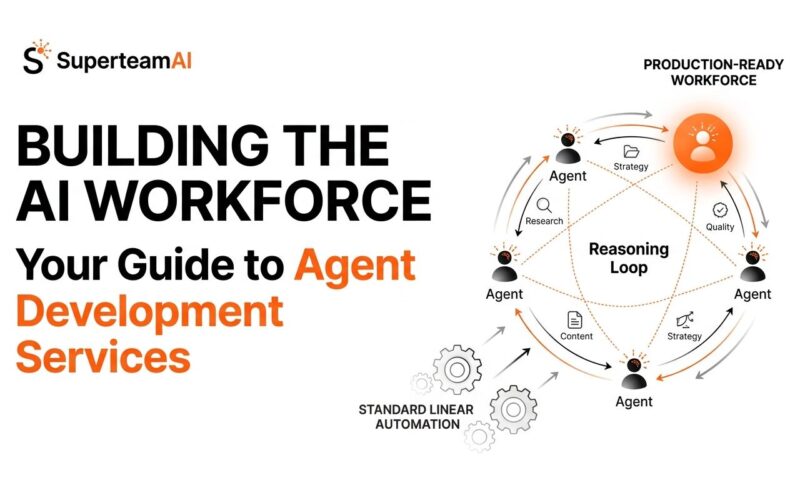
Most AI agent development services look identical on the surface. Every provider offers discovery, architecture, build, and deployment. Every website shows a process diagram and a list of enterprise logos. The differences that actually matter: deployment speed, vertical expertise, data privacy standards, and what happens after go-live. These rarely appear on the service page.
This guide cuts through that. It explains what AI agent development services genuinely include, what separates a strong provider from a weak one, and what you should realistically expect to pay in 2026. The six-question framework in the evaluation section will save you from the most common hiring mistakes.
We have deployed AI agent workforces for 50+ organizations, including BlueFocus Group, BCG, Brandigo, and WhiteKube. Every observation comes from production deployments, not vendor positioning.
If you want to understand AI agent development at a technical and strategic level before evaluating services, start with our complete guide to AI agent development.
What Are AI Agent Development Services?
AI agent development services are the end-to-end work of designing, building, integrating, and deploying AI agents for business workflows: the strategy, architecture, engineering, testing, and ongoing management required to take an agent from concept to production.
The term covers a wide range of engagements. At the narrow end, it means building a single-task agent that handles one defined workflow. At the full-stack end, it means deploying a coordinated multi-agent workforce that automates an entire business function with human review checkpoints built in at each stage.
AI Agent Development vs. AI Automation Services
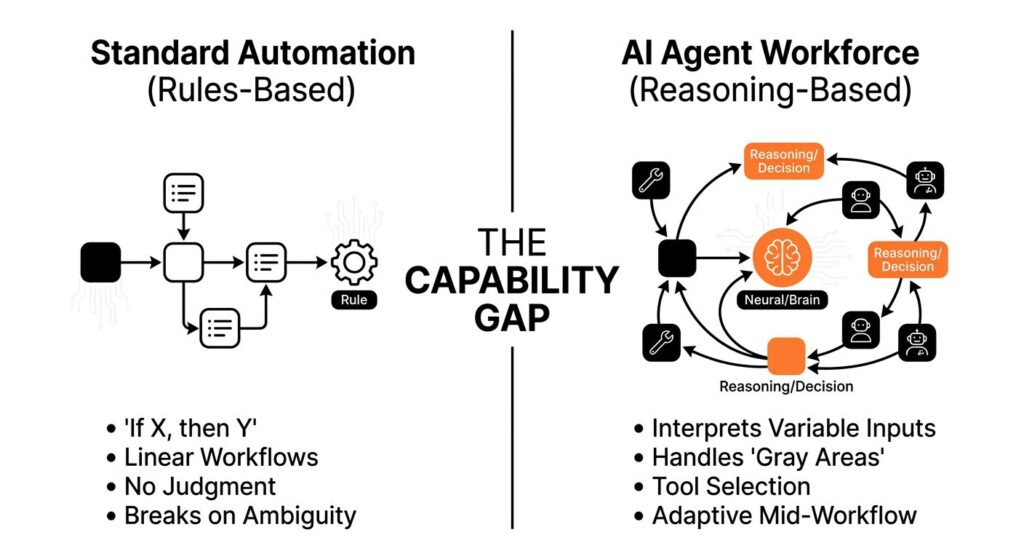
These two terms are often used interchangeably and should not be. The distinction matters before you sign anything.
AI automation services apply rules to predictable, structured workflows. If X, then Y. They are fast to implement, reliable for routine tasks, and incapable of handling ambiguity, judgment calls, or changing conditions.
AI agent development services build systems that reason. The agents interpret variable inputs, select appropriate tools, handle unexpected outcomes, and adapt mid-workflow. For complex, high-volume business processes where conditions change with every input, this is the capability gap that determines whether a deployment succeeds or stalls.
Before scoping any engagement, confirm which category you actually need. Many organizations pay for AI agent development when automation would solve the problem faster and cheaper.
What AI Agents Are Actually Capable Of in 2026
In 2026, production-grade AI agents handle full workflows with minimal human intervention. A content production agent receives a keyword, scrapes competitive pages, identifies gaps, generates a brief, writes, and runs quality checks. A lead enrichment agent researches firmographic data, scores the lead, and routes it to the appropriate sales stage. These are active daily production workflows at organizations that have moved past the evaluation stage.
What Should Be Included in Any AI Agent Development Service
The Five Components Every Engagement Should Cover
AI agent development services include the full process of designing, building, integrating, and deploying AI agents for business workflows: discovery and scoping, agent architecture and model selection, build and integration, human-in-the-loop oversight design, and ongoing deployment and monitoring. The best providers also include quality calibration, security guardrails, and post-launch iteration support.
Here is what each of those components means in practice.
Discovery and Workflow Scoping
The first deliverable from any credible AI agent development service is a scoped workflow definition: a precise description of what the agent will do, what inputs it receives, what outputs it produces, and what success looks like. This is not a discovery call. It is a structured audit of your current process, the data and tools involved, and the quality standards the agent must meet.
Providers who skip this step or rush through it produce agents that work in demos and fail in production. A narrow, well-scoped workflow produces a reliable agent. A vague brief produces an unpredictable one.
Agent Architecture and Model Selection
Architecture determines whether the deployment is a single-task agent or a multi-agent system. Most complex business workflows require multi-agent systems: specialized agents handling individual tasks, coordinated by an orchestration layer. The architecture decision also covers model selection. Open-source models keep your data on controlled infrastructure. Frontier models from providers like OpenAI and Anthropic offer strong performance but route your content through external servers. For organizations with client data sensitivity, this distinction is not optional.
Build, Integration, and Testing
The build phase covers prompt engineering, tool wiring and API integrations, context management, and multi-agent orchestration. Testing covers quality evaluation across defined benchmarks, edge cases, and failure modes. This is where most in-house attempts stall: it requires prompt optimization, systems integration, and evaluation expertise most organizations do not have on staff.
Human-in-the-Loop Oversight Design
Every production AI agent deployment should include defined human review checkpoints. Not because the agents cannot produce quality output, but because fully autonomous systems fail in real-world environments where brand voice, regulatory constraints, and client relationships add requirements that models cannot evaluate independently. A credible AI agent development service designs the human review layer as a first-class feature, not an afterthought.
Deployment, Monitoring, and Ongoing Maintenance
Deployment is the beginning of the engagement, not the end. Production AI agent systems require continuous monitoring: tracking output quality, updating prompts as models evolve, and adjusting integrations as APIs change. Ask any provider specifically what their post-launch support covers and for how long. Providers who hand off and disappear create systems that drift out of calibration within weeks.
How to Evaluate an AI Agent Development Services Provider
The AI implementation space grew significantly in 2025 and 2026. Not every provider who claims production capability has it. Here is the evaluation framework we recommend to any organization making this decision.
Six Questions to Ask Before Signing Anything
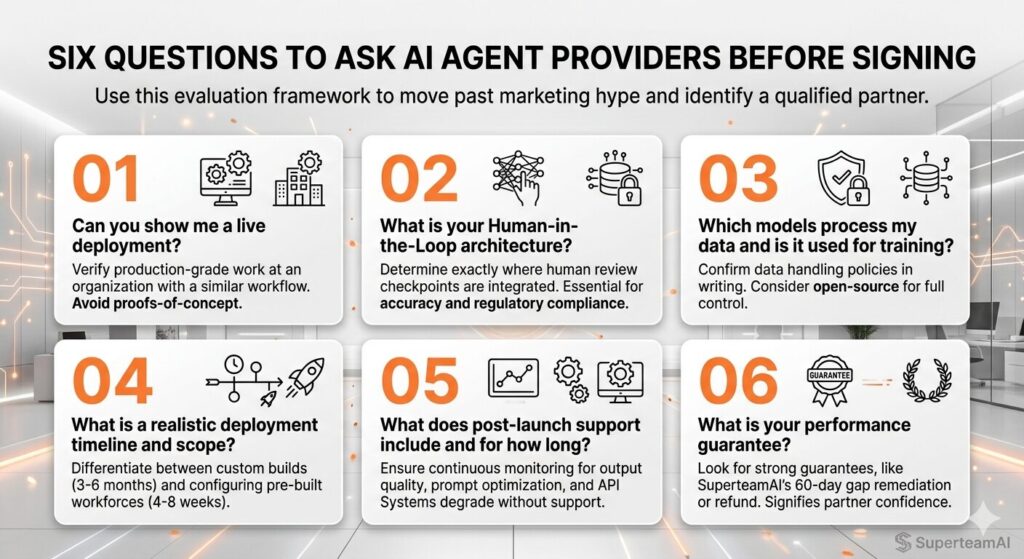
1. Can you show me a live deployment at an organization with a similar workflow? Prototypes and scripted demos are not proof of production capability. Any credible provider can show you a live system running in a real organization with a comparable workflow type. If they cannot, they have not shipped production-grade work.
2. What does your human-in-the-loop architecture look like? Ask specifically where human review points are built into the workflow. A credible answer names the checkpoints and explains what gets reviewed. A vague answer about “human oversight” signals a system that has not been deployed in a real client-services environment.
3. Which model providers process my data, and is that data used for training? This is a data privacy question with legal implications for organizations handling client data. Get a specific answer and confirm it in writing before signing. Open-source model stacks eliminate this risk entirely.
4. What is a realistic deployment timeline, and what does that include? Four to eight weeks is the realistic range for a properly configured, tested, and calibrated deployment of a pre-built AI workforce. Custom builds from scratch take three to six months. Any provider claiming full production readiness in under two weeks for a multi-agent system should be questioned.
5. What does your post-launch support include, and for how long? Models evolve. APIs change. Prompts drift. Post-launch maintenance is not optional. It is the difference between a system that performs for 12 months and one that degrades within 90 days. Get the support scope in writing.
6. What is your performance guarantee? The best providers back their deployments with a formal guarantee. SuperteamAI’s 60-day performance guarantee includes gap remediation or a full refund. A provider unwilling to offer any performance assurance has limited confidence in their own deployment quality.
Want to run these questions past our team before you decide? Book a 30-minute discovery call. No pitch, just a direct conversation about your workflows and whether our AI agent development services are the right fit.
AI Agent Development Services: Industry-Specific vs. General Providers
Why Vertical Expertise Matters
Most AI agent development services position themselves as general enterprise providers. They serve financial services, healthcare, logistics, manufacturing, and retail from the same service model, adapting to each engagement. For organizations with standard enterprise workflows, this approach works reasonably well.
For marketing agencies and real estate firms, it consistently underdelivers.
The reason is context. AI agents for content production require calibration against SEO quality standards, editorial brand voice, and publishing workflows that a general enterprise provider has no baseline for. AI agents for real estate lead enrichment require calibration against property data sources, CRM structures, and compliance requirements that are specific to how brokerages and property management firms operate. Gartner forecasts that by end of 2026, 40% of enterprises will have task-specific AI agents in production [VERIFY]. The organizations hitting that number fastest are those who worked with providers who already understood their workflows.
A vertical-specialist provider arrives with pre-built architectures, calibrated quality standards, and production data from comparable deployments. A general provider starts from zero on every engagement. The difference shows up in deployment timelines, output quality, and first-year reliability.
What AI Agent Development Services Cost in 2026
AI agent development services pricing varies significantly by engagement type. Here is the honest breakdown.
| Engagement Type | Typical Cost Range | Timeline | What Is Included |
| Single-task custom agent | $5,000 to $15,000 [VERIFY] | 2 to 4 weeks | Scoping, build, basic testing, handoff |
| Mid-complexity multi-integration agent | $15,000 to $75,000 [VERIFY] | 4 to 8 weeks | Full architecture, integrations, QA, deployment |
| Full multi-agent production system | $75,000 to $300,000+ [VERIFY] | 3 to 6 months | End-to-end build, ongoing maintenance team |
| Pre-built AI workforce deployment | $2,500 entry; $500 to $5,000/month | 4 to 8 weeks | Configured deployment, human-in-the-loop, monitoring |
The Real Cost of AI Agent Development: Hidden Factors
Hidden costs add 30 to 50% to custom build estimates in year one. Model API fees, infrastructure, prompt iteration, and post-launch maintenance compound the initial figure. A $75,000 build routinely exceeds $110,000 over its first 12 months.
Organizations we work with report 70 to 85% reductions in content delivery cost after deploying a pre-built AI workforce, with payback periods under 30 days on a $2,500 entry investment for teams producing 20+ articles per month.
What SuperteamAI’s AI Agent Development Services Include
SuperteamAI builds and deploys production-grade AI agent workforces exclusively for marketing agencies and real estate firms. We do not serve general enterprise. This focus means every architecture, workflow template, quality standard, and calibration benchmark we use was built from production deployments in your vertical.
Who We Serve
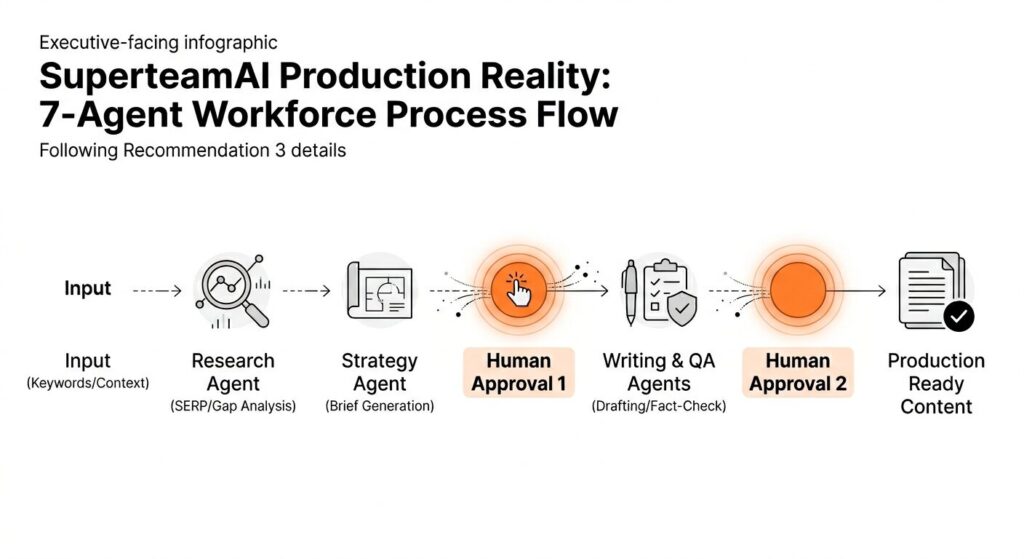
Marketing agencies use our AI agent workforces primarily for SEO content production and lead enrichment automation. Our 7-agent SEO Content Workforce handles the complete content production cycle: SERP analysis, competitive scraping, gap identification, brief generation, writing, and QA, with human review at two defined checkpoints. Total human time per article: approximately one hour, compared to eight to nine hours before deployment. Brandigo, WhiteKube, BlueFocus Group, and Scholz & Friends run this workflow in active daily production.
Real estate firms use our AI agent workforces for property listing content, lead qualification, prospect research, and follow-up automation. Our workforces are configured for CRM integrations, property data APIs, and the compliance requirements specific to residential and commercial real estate operations.
Every Tier 1 workforce can be white-labeled and offered to your clients as a proprietary service, generating new revenue lines at 70%+ margins versus traditional delivery.
What Deployment Actually Looks Like
We deploy in four to eight weeks. The process covers: workflow audit and scope definition, workforce configuration and calibration against your quality standards and brand guidelines, integration with your existing tools and CRM, testing and quality threshold validation, go-live with monitored production, and 60-day performance review with remediation if benchmarks are not met.
You provide your knowledge base, brand guidelines, and workflow context. We configure, test, and deploy. Your team manages the output quality through the built-in human review checkpoints, not the infrastructure underneath.
Ready to see what a deployment looks like for your specific operation? Book a discovery call with the SuperteamAI team. We work exclusively with marketing agencies and real estate firms, and we will tell you directly within 30 minutes whether we are the right fit.
Frequently Asked Questions About AI Agent Development Services
What do AI agent development services include?
AI agent development services cover discovery and workflow scoping, agent architecture and model selection, build and integration engineering, human-in-the-loop oversight design, testing and quality calibration, deployment, and ongoing monitoring and maintenance. The scope varies significantly by provider: some offer a subset of these components while others cover the full lifecycle.
How long do AI agent development services take to deliver results?
It depends on the engagement model. Custom AI agent development from scratch takes three to six months for production-grade multi-agent systems [VERIFY]. Deploying a pre-built AI workforce through a specialist partner takes four to eight weeks, because the core architecture already exists and is being configured and calibrated for your specific workflows rather than built from scratch. Single-task custom agents can be delivered in two to four weeks.
What is the difference between a general AI agent development company and a vertical specialist?
A general AI agent development company builds custom agents for any industry and workflow type. They start from zero on each engagement and adapt their approach to the client’s context. A vertical specialist has pre-built architectures, calibrated quality standards, and production data from multiple deployments in your specific industry. For organizations in defined verticals like marketing agencies or real estate, a specialist delivers faster deployment, higher first-deployment quality, and lower risk than a generalist starting fresh.
How much do AI agent development services cost for a marketing agency?
For marketing agencies, the most cost-effective path is typically deploying a pre-built AI workforce rather than commissioning custom development. Pre-built deployment starts at $2,500 entry with managed service from $500 to $5,000 per month, depending on workflow volume and complexity. Custom multi-agent development for agency workflows typically runs $25,000 to $150,000 depending on scope and integration requirements [VERIFY]. For agencies producing 20 or more articles per month, the payback period on a pre-built deployment is typically under 30 days.
Do AI agent development services expose client data to third-party model providers?
It depends on the provider’s model stack. Services built on frontier models route your content through providers like OpenAI, Anthropic, or Google for processing. Services built on open-source models run on controlled infrastructure where your data stays within your environment. Always ask explicitly which providers process your content and whether that data is used for model training before signing any engagement.
Can a marketing agency offer AI agent services to its own clients?
Yes. Every pre-built AI workforce deployed by SuperteamAI can be white-labeled and offered to agency clients as a proprietary service. An agency running an AI content workforce at $15 per article can offer AI-powered content services to clients at $80 to $150 per article, generating margins of 70% or higher versus traditional delivery costs. The Lead Generation and Enrichment Workforce and other workforces are also available for white-label resale with agency-branded delivery environments.
Making the Right Choice for Your Organization
Choosing AI agent development services is a build-versus-buy-versus-partner decision with meaningful financial and operational stakes. The right engagement delivers production-grade automation within weeks. The wrong one delivers a demo that stalls before it reaches your clients.
The organizations making the fastest progress work with providers who have already deployed similar systems in their vertical, commit to specific timelines and performance guarantees, and design human oversight into the architecture from the start.
If you are a marketing agency or real estate firm ready to move from evaluation to deployment, [book a 30-minute discovery call with the SuperteamAI team]. We will give you a direct, honest answer on fit within the first conversation.


