Custom AI agent development costs between $25,000 and $300,000. It takes three to six months to build a production-grade system from scratch. Most business leaders discover these numbers only after they have already committed budget, team bandwidth, and internal credibility to a build that stalls before it ships.
The organizations that avoid this mistake share one thing: they understood what AI agent development actually involves before committing to a path. They knew the difference between an AI writing tool and a true AI agent. They could describe, clearly, why one deployment approach fit their resources and another did not.
We have built and deployed AI agent workforces for 50+ organizations, including BlueFocus Group, BCG, and Brandigo. This guide reflects what we learned from production deployments, not from theory. By the end, you will understand what AI agent development involves, what it realistically costs, and which of three available paths fits your situation.
What Is AI Agent Development?
AI agent development is the process of designing, building, training, testing, and deploying AI agents: software systems that use large language models to reason, plan, and take action to complete complex tasks without step-by-step human instruction.
Unlike a simple chatbot that responds to prompts, an AI agent perceives its environment, sets sub-goals, calls external tools, and adjusts its behavior based on outcomes. A practical example: an agent that receives a keyword input, searches the web for competitive content, analyzes the results, drafts a structured content brief, writes an article, and runs quality checks. All in one automated workflow, with human review at defined checkpoints.
AI agent development covers the full lifecycle: goal definition, system architecture, model and framework selection, building and testing, and ongoing deployment with monitoring. Organizations can build agents from scratch using languages like Python or JavaScript, or use AI agent frameworks like LangChain, CrewAI, or AutoGen to accelerate the process.
The question most decision-makers face is not how to build an AI agent from scratch. It is whether to build one, buy an existing tool, or deploy a pre-built workforce configured for their workflows.
The Core Components of Every AI Agent
Every AI agent, regardless of complexity, is built from five core components:
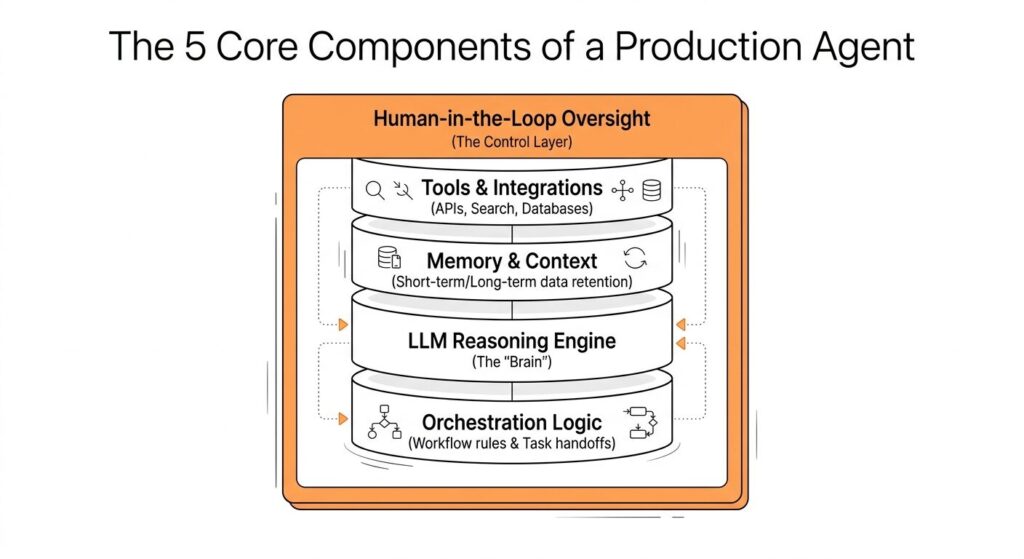
- The LLM model: The reasoning engine that reads inputs, processes context, and decides what action to take next.
- Tools and integrations: The APIs, search functions, databases, and external services the agent can call to act in the real world.
- Memory and context management: How the agent retains information across steps in a workflow, so it does not restart from scratch at every action.
- Orchestration logic: The rules governing how agents hand off tasks in multi-agent systems and how the overall workflow moves from input to output.
- Human oversight layer: The review checkpoints, approval gates, and feedback loops that keep human managers in control of output quality and direction.
Understanding these five components helps any team evaluate an AI agent deployment, whether they are building one, buying one, or assessing a vendor’s offering.
AI Agents vs. AI Automation Tools: Why the Distinction Matters
Many teams conflate AI agents with AI automation tools. The difference matters for anyone making a deployment decision.
AI automation tools follow fixed rules. If X happens, do Y. They are reliable and fast for routine, predictable processes. They cannot reason, adapt, or handle judgment calls.
AI agents reason and make decisions. They interpret ambiguous inputs, select the right tool for the situation, handle unexpected outcomes, and adjust their approach based on feedback. This makes them capable of handling complex, variable workflows such as SEO content production, lead enrichment, or contract review, where conditions change with every input.
For high-volume operations, the gap in capability between a point tool and a true multi-agent system is the difference between partial automation and full production throughput.
Why Organizations Are Getting Serious About AI Agent Development in 2026
In 2026, the pressure to demonstrate AI capability has shifted from competitive edge to competitive requirement. Clients and stakeholders are asking whether their vendors use AI. Competing organizations are advertising AI-native delivery. Volume demands grow while budgets compress.
AI-referred web sessions grew by 527% in a five-month period in 2025 [VERIFY], signaling a fundamental shift in how audiences discover content. Organizations that cannot produce content at scale or optimize for AI search features including Google AI Overviews, Perplexity, and ChatGPT are already losing organic visibility. That external pressure is making AI agent development a leadership-level conversation across industries.
The Business Case in Plain Numbers
| Metric | Traditional Approach | With AI Workforce |
| Time per 2,500 to 3,000 word article | 8 to 9 hours | ~1 hour (brief review + content review) |
| Cost per article | $50 to $100+ | ~$15 per completed piece |
| Writer management overhead | High | Near zero |
| Quality benchmark | Varies by writer | Calibrated to top 10% output |
An operation producing 20 articles per month at $75 average cost spends $1,500 per month before accounting for editor time, revision cycles, and project management overhead. The same volume through a production AI workforce runs at roughly $300 per month in direct production cost.
See how organizations are deploying AI workforces in production today: [explore the SEO Content Workforce].
How AI Agent Development Works: A Non-Technical Walkthrough
You do not need to understand AI agent development at a code level to make good decisions about it. You need to understand what each stage involves, where the complexity lives, and why certain stages require specialized expertise most teams do not have in-house.
Step 1: Define the Goal and Scope
The first step is defining exactly what problem the agent will solve and what success looks like. A narrow, well-defined scope produces a reliable agent. A broad, vague scope produces one that fails in unpredictable ways. “Generate a publication-ready SEO article from a keyword input” is buildable and testable. “Handle all our content marketing” is neither.
The more clearly you can describe the current manual process, including its inputs, outputs, and quality standards, the more tractable the development process becomes.
Step 2: Choose Your Architecture: Single Agent or Multi-Agent System
Single-agent systems work well for narrow, contained tasks. Complex workflows almost always require multi-agent systems: multiple specialized agents, each scoped to one task, coordinated by an orchestrator. A content production workflow requires separate agents for SERP analysis, scraping, gap identification, brief generation, writing, and quality review. No single agent handles all of these simultaneously without sacrificing speed or quality.
The move from single to multi-agent architecture is where most in-house projects underestimate the complexity. Each agent requires its own prompt engineering, tool wiring, and systematic testing.
Step 3: Model, Framework, and Tool Selection
Model selection determines capability and cost. Open-source models run on your own infrastructure and keep sensitive data off frontier provider servers. Frontier models from providers like OpenAI and Anthropic offer strong performance but introduce data privacy considerations for organizations handling confidential information.
Framework selection determines build speed and long-term maintainability. Common options include LangChain, CrewAI, and AutoGen. One important reality from the 2026 Google Cloud AI Agent Bake-Off: agent frameworks can become obsolete within months. A framework that is standard today may need to be replaced within 12 months, a genuine maintenance risk for teams building in-house.
Step 4: Build, Train, and Test
The build phase is where AI engineering expertise becomes non-negotiable. It involves prompt engineering for each agent, wiring tools and integrations, calibrating output quality against defined benchmarks, and systematic evaluation across edge cases and failure modes.
This is where most in-house attempts stall. The required skills, including AI engineering, prompt optimization, and systems integration, are specialized, rare, and expensive. Most organizations without dedicated AI teams do not have them on staff.
Step 5: Deploy, Monitor, and Iterate
Deployment is the starting point for ongoing operation, not the finish line. A production AI agent system requires continuous monitoring: tracking output quality, updating prompts as models evolve, and adjusting integrations as APIs change. This ongoing maintenance is one of the hidden costs that makes in-house builds more expensive than initial projections suggest.
The Three Paths to AI Agent Capability
Every organization evaluating AI agents faces three realistic paths to deployment. The right choice depends on your resources, timeline, and risk tolerance.
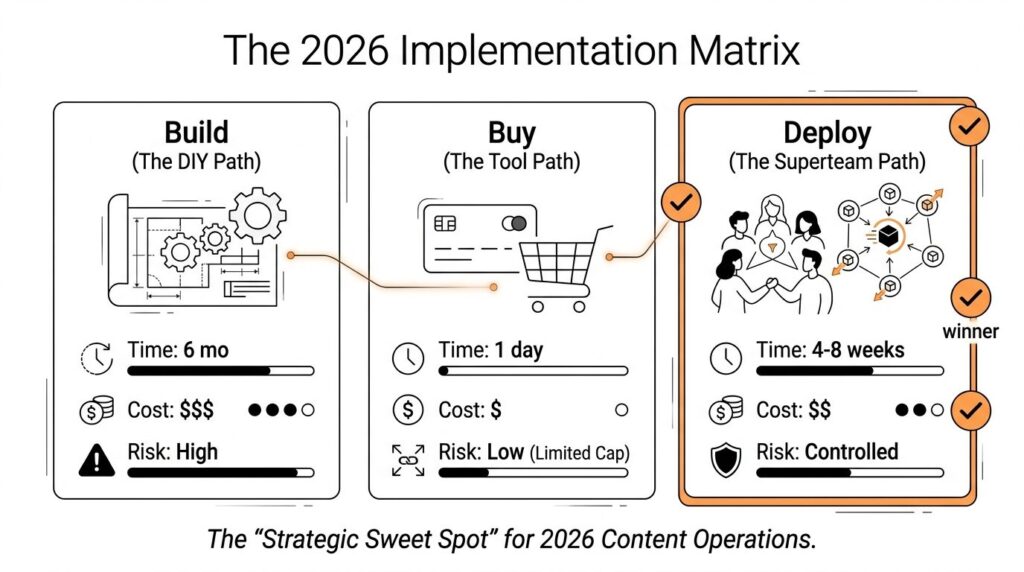
| Path 1: Build In-House | Path 2: Buy Point Tools | Path 3: Deploy Pre-Built Workforce | |
| Timeline | 3 to 6 months | Immediate | 4 to 8 weeks |
| Upfront cost | $25,000 to $300,000+ [VERIFY] | $0 to $500/month | $2,500 entry |
| Ongoing cost | Engineering team + infrastructure | $100 to $1,000+/month | $500 to $5,000/month managed |
| Technical team required | Yes | No | No |
| Data privacy | Depends on model stack | Often frontier-model exposure | Open-source, data stays with you |
| Time-to-value | 3 to 6 months | Immediate, limited ceiling | 4 to 8 weeks, production-grade |
| Best for | Teams with dedicated AI engineers | Early-stage exploration | Organizations ready to scale AI delivery |
Path 1: Build Your Own AI Agents In-House
Building your own AI agent system gives you full control over architecture, data handling, and customization. For organizations with a dedicated AI engineering team and genuine long-term reasons to own proprietary technology, this path makes strategic sense.
The realistic picture: a production-grade multi-agent system costs between $25,000 and $300,000+ to build [VERIFY], and timelines run three to six months for well-resourced teams, often longer when organizations underestimate the prompt iteration, integration testing, and quality calibration required. Frameworks evolve rapidly and may require partial rebuilding within months.
Build in-house if: you have a dedicated AI engineering team, your data requirements demand fully proprietary infrastructure, and you can absorb three to six months before seeing production-grade value.
Path 2: Buy AI Writing and Point Tools
Point tools like Jasper, Writer, and SurferSEO offer immediate value for individual tasks. They are genuinely useful for writers accelerating first drafts, researchers conducting analysis, and teams standardizing specific prompts.
Their ceiling is equally real. Point tools follow instructions. They do not reason, adapt, or handle the sequential complexity of a full production workflow. A writer using an AI tool is still producing one output at a time. A team with a deployed AI workforce has replaced most of that workflow entirely. Most point tools also route content through frontier model providers, creating data exposure for organizations handling confidential materials.
Buy point tools if: your immediate need is individual task acceleration rather than workflow replacement.
Path 3: Deploy a Pre-Built AI Workforce
The third path is deploying a pre-built, production-tested multi-agent workforce configured for your specific workflows. Pre-built workforces are already deployed and calibrated across dozens of real environments. Deployment timelines run four to eight weeks. Entry investment starts at $2,500, with managed service from $500 to $5,000 per month. The workforce runs on an open-source model stack, so sensitive data never touches a frontier model provider’s infrastructure.
Human-in-the-loop architecture means your team reviews and approves output at defined checkpoints, managing the workforce rather than doing its work.
See how SuperteamAI deploys a production-ready AI workforce in 4 to 8 weeks: [book a live 30-minute demo].
What a Production AI Agent Deployment Actually Looks Like
Here is what it looks like when an organization deploys a production-grade multi-agent AI workforce for content operations. Every agent in the workflow below operates in active daily production at organizations including Brandigo and WhiteKube.
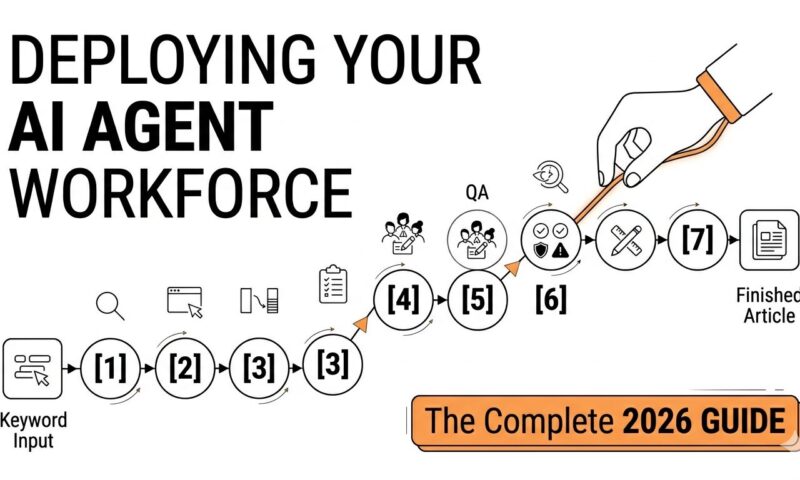
Inside the 7-Agent SEO Content Workforce
I built the 7-agent workflow below after watching organizations repeatedly hit the same quality ceiling with single-prompt AI tools. The problem was not the model. It was forcing one agent to do the work of an entire specialized production team.
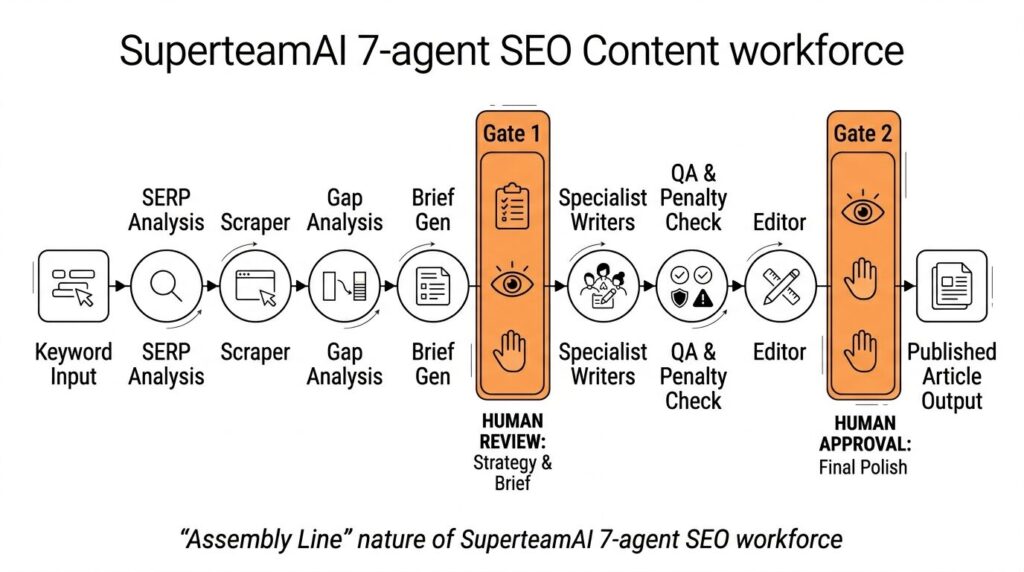
Agent 1: SERP Analysis Agent. Receives the target keyword, executes live searches, and analyzes top-ranking results for content type, heading structure, and competitive gaps. Every downstream agent references this output.
Agent 2: Scraper Agent. Fetches and processes full content from the top five ranking URLs, extracting heading structures, content organization patterns, and topical coverage.
Agent 3: Gap Analysis Agent. Runs a 214-point analysis comparing the competitive landscape against available content opportunities, producing a prioritized gap inventory.
Agent 4: Brief Generation Agent. Synthesizes all upstream data into a structured content brief covering intent mapping, keyword placement, heading structure, CTA locations, and brand voice guidelines.
Human checkpoint 1. The team manager reviews and approves the brief before any writing begins.
Agent 5: Writer Agents (Specialized). Dedicated agents handle specific content types: listicle sections, how-to structures, comparison tables, CTA copy, and internal linking.
Agent 6: QA Agents. Review finished content against keyword density, plagiarism risk, search penalty exposure, and tone calibration.
Agent 7: Editor and Rework Agent. Structures the final output, manages the human review cycle, and executes approved revisions.
Human checkpoint 2. The team manager reviews the final article before delivery.
Total human time: approximately one hour per article. Before deployment, that same article required eight to nine hours of combined writer, editor, and project management time.
The Human-in-the-Loop Standard
Fully autonomous AI agents fail in production environments. Brand voices, regulatory constraints, and commercial judgment calls require human review at defined points. Human-in-the-loop architecture distributes that oversight without creating bottlenecks: your team sets direction at the start and approves output at the end.
We have put together a free AI Workforce Deployment Checklist covering the exact setup process. [Grab it here].
AI Agent Development Costs and Timelines: What to Expect in 2026
AI agent development cost is the question every leader has but rarely gets a straight answer to. Here is the honest picture.
| Development Approach | Typical Cost Range | Timeline | Maintenance | Dev Team Needed |
| Simple single-task agent | $5,000 to $15,000 [VERIFY] | 2 to 4 weeks | Low | Minimal |
| Mid-complexity multi-integration agent | $15,000 to $75,000 [VERIFY] | 4 to 8 weeks | Medium | Yes |
| Full multi-agent production system | $75,000 to $300,000+ [VERIFY] | 3 to 6 months | High | Yes, ongoing |
| Pre-built workforce deployment | $2,500 entry; $500 to $5,000/month managed | 4 to 8 weeks | Managed | No |
Hidden costs compound every headline number. Model API fees, infrastructure hosting, prompt engineering iteration, and ongoing maintenance all add to the total. A $75,000 build can run $120,000 when the first twelve months of maintenance are included.
Organizations we work with report 70 to 85% reductions in content delivery cost after deploying a pre-built AI workforce. The payback period on a $2,500 entry investment, for an operation producing 20 articles per month at $75 each, is typically under 30 days.
Data Privacy and the Open-Source Model Advantage
Most AI writing tools and agent platforms built on frontier models send content to providers like OpenAI, Anthropic, and Google for processing. For many use cases, this is a non-issue. For organizations handling confidential client data, unreleased product information, or materials in regulated industries such as financial services, healthcare, or legal, it is a genuine data exposure.
We chose an open-source model stack because the organizations we work with cannot afford to have sensitive information sent to third-party providers for processing or training. An open-source AI agent stack runs on controlled infrastructure. Data stays within your environment.
When evaluating any AI agent development path, ask explicitly: which providers process my content? Is that data used for training? Those two questions will immediately eliminate several options from your shortlist, particularly if you serve enterprise clients or operate in regulated sectors.
How to Evaluate an AI Agent Development Partner
If Path 3 is right for your organization, the next decision is who to work with. The AI implementation space has expanded significantly in 2026, and not all options deliver equivalent results.
Five Questions to Ask Before You Commit
[IMAGE: Checklist graphic of the 5 partner evaluation questions | Alt text: “how to evaluate an AI agent development partner” | Suggested type: infographic]
1. Can you show me a live deployment at an organization similar to mine? Prototypes and scripted demos are not proof of production capability. Ask to see a live deployment at an organization with a comparable workflow and team size. If they cannot show you one, they do not have one.
2. What does your human-in-the-loop architecture look like? Ask specifically: at which points in the workflow does a human review or approve output? A credible answer will be specific and operational. A vague answer signals a system that has not reached real production.
3. Where does my data go? Ask which model providers process your content and whether that data is used for training. For enterprise relationships, get this in writing before signing anything.
4. What is the realistic deployment timeline? Four to eight weeks is the realistic range for a properly configured, tested, and calibrated deployment. Any claim of production readiness in under two weeks for a full multi-agent system should be questioned.
5. What happens if it does not deliver? The best deployment partners offer a formal satisfaction guarantee. SuperteamAI’s 60-day guarantee includes gap remediation or a full refund. This removes the adoption risk that causes most leaders to hesitate.
Frequently Asked Questions About AI Agent Development
What is AI agent development?
AI agent development is the process of designing, building, testing, and deploying software systems that use large language models to reason and take action on complex tasks without step-by-step human instruction. Unlike rule-based automation, AI agents make judgment calls, handle variable inputs, and adapt their behavior based on outcomes. It is the foundation for deploying AI workforces that automate high-volume workflows across content production, lead enrichment, research, and operations.
What is the difference between an AI agent and an AI automation tool?
AI automation tools follow fixed rules: if X, then Y. They are reliable for predictable tasks but cannot handle judgment calls or adapt to unexpected inputs. AI agents reason and make decisions. They interpret ambiguous inputs, select the right tool for the situation, and adapt mid-workflow. A content tool that generates text on demand is an automation tool. A multi-agent system that researches a topic, writes structured content, and runs quality checks is an AI agent system. The capability gap is significant for any production workflow where conditions change with every input.
How long does AI agent development take?
It depends on the approach. A simple single-task agent built from scratch takes two to four weeks. A mid-complexity agent with multiple integrations takes four to eight weeks. A full production-grade multi-agent system takes three to six months [VERIFY]. Deploying a pre-built AI workforce through a specialist partner takes four to eight weeks, because the core architecture already exists and is being configured for your workflows rather than built from zero.
How much does AI agent development cost in 2026?
Custom AI agent development ranges from $5,000 for simple single-task implementations to $300,000 or more for enterprise multi-agent systems [VERIFY]. Mid-complexity systems typically run $15,000 to $75,000 for initial development, with ongoing maintenance adding significantly to year-one totals. Deploying a pre-built workforce starts at $2,500 with managed service from $500 to $5,000 per month. For most teams without dedicated engineering resources, the ROI math favors deployment over custom build.
Can an organization deploy AI agents without a development team?
Yes. Pre-built AI workforces deployed by specialist partners require no engineers or technical staff on the buyer’s side. The partner handles architecture, prompt engineering, integration, testing, and ongoing maintenance. The organization provides workflow context, knowledge base materials, and brand guidelines. Human review checkpoints are built in so existing team members manage output quality without needing to understand the technical infrastructure.
What does a real production AI agent deployment look like?
At organizations we work with, a production AI content workforce handles the full SEO content cycle: SERP analysis, competitive scraping, gap identification, brief generation, writing, and QA review. The manager reviews the brief and reviews the final article before delivery. Total human time is approximately one hour per article, compared to eight to nine hours before deployment. Brandigo and WhiteKube run this workflow in active daily production.
Do AI agents expose sensitive data to third-party providers?
It depends on the model stack. Agents built on frontier models send content to providers like OpenAI, Anthropic, or Google for processing; whether that data is used for training varies by provider and contract terms. Agents built on open-source models run on controlled infrastructure where data stays within your environment. When evaluating any AI agent partner, ask specifically which providers process your content and whether that data leaves your infrastructure.
What business functions benefit most from AI agent deployment?
Content production, lead generation and enrichment, competitive research, and internal knowledge management are among the highest-ROI applications in 2026. These are high-volume, repeatable workflows where agent systems reduce time-per-output by 70 to 90% while maintaining quality consistency. Any workflow where a human currently completes a structured, multi-step process from a defined input is a candidate for AI agent automation.
AI agent development is not a single decision. The organizations getting the most value from AI in 2026 matched the right approach to their resources and moved into production the fastest.
Five things to carry forward:
- AI agents are not AI tools. The capability gap is significant for production workflows.
- Custom AI agent development costs $25,000 to $300,000+ and takes three to six months. That is the honest range.
- Most organizations without dedicated AI engineering teams get more value from deploying a pre-built workforce than from building in-house.
- Human-in-the-loop architecture is the standard that makes AI agent deployment viable in client-services environments.
- Open-source model stacks keep data within your infrastructure. For organizations with enterprise clients or in regulated industries, this is often the deciding factor.
Organizations deploying AI workforces today, including BlueFocus Group, BCG, Brandigo, Scholz & Friends, and WhiteKube, are compressing delivery costs and building capabilities their competitors cannot replicate without significant investment and time.
SuperteamAI works exclusively with marketing agencies and real estate firms. If your organization operates in one of those verticals and is ready to move from evaluating AI to deploying it, [book a discovery call with the SuperteamAI team]. We will show you exactly what a deployment for your specific workflows looks like and give you a realistic timeline and investment estimate.