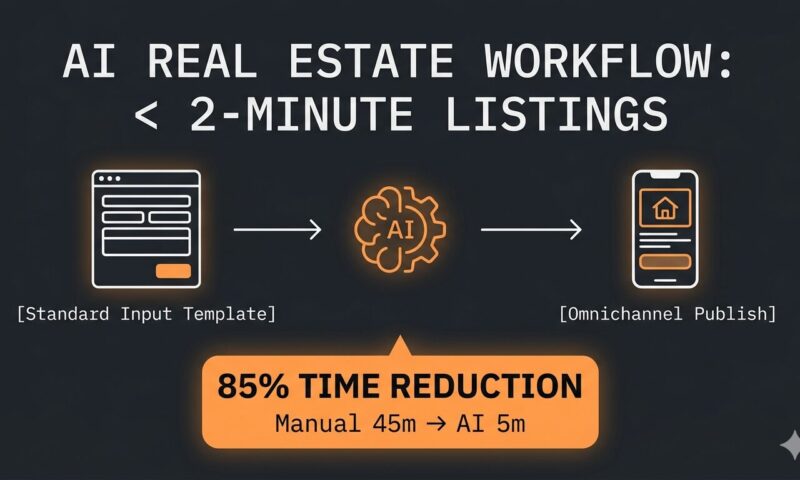
An AI real estate listing generator takes structured property data and produces a portal-ready listing description in under 30 seconds. The workflow has four steps: the agent inputs property details, the generator produces formatted copy, the agent reviews for accuracy, and the description publishes to the assigned portal. The output quality depends entirely on the quality of the inputs.
What an AI Real Estate Listing Generator Actually Does (and What the Workflow Looks Like End to End)
A listing generator is not a search engine and it is not a creative writing tool. It is a structured input-to-output pipeline. Property data goes in: type, size, features, target buyer, portal destination. Formatted, portal-ready prose comes out. The model does not invent features, prices, or neighbourhood details. It arranges the facts you provide into the vocabulary buyers in your market actually search with. The same property can produce three different outputs from the same generator session: a 400-word portal description formatted to MagicBricks field limits, a three-sentence WhatsApp broadcast copy, and a one-sentence Instagram caption with a call to action. A properly configured generator produces all three from one input. Most agents produce one and spend 20 additional minutes writing the other two manually. For the full depth piece on AI-generated description quality across property types and markets, see how AI real estate listing descriptions are structured at brokerage scale.
The two modes of listing generation: manual input vs database-connected
In manual mode, the agent opens the generator, fills a structured input form, generates the description, reviews it, and copies it to the portal listing field. Total time: three to five minutes per listing. In database-connected mode, the property record already contains the required fields, the generation fires automatically when the record is created, and the description arrives in the agent’s WhatsApp inbox for one-tap approval before publishing. Total agent time: 60 seconds for the review. The tool selection and the workflow design are two separate decisions. The second one determines whether the first delivers any ROI. For a solo agent with five listings per month, a standalone free tool is sufficient. For a brokerage processing 50 listings per month across 20 agents, database-connected is the only mode that does not create a new data-entry bottleneck.
The Four-Step Listing Generator Workflow Used by High-Volume Brokerages
The four-step workflow is the same regardless of which generator tool the brokerage uses. The tool determines the quality of the generation step. The workflow determines whether the generation step happens reliably for every listing, every time.
Step 1: Property data upload
The agent or listing coordinator completes a standardized input template: property type, configuration, size in accurate units (sqft or sqm), three to five specific named features, target buyer type, portal destination, tone instruction, price, location details, and any agent-observed notes not already in the database record. This template is the quality control mechanism. Vague inputs produce vague copy. The template forces specificity before generation begins.
Steps 2 through 4: Generate, review, publish
Step 2: the generator produces formatted copy from the completed template in under 30 seconds. Step 3: the agent reads the output once for factual accuracy: sqft correct, bedroom count correct, no hallucinated features or amenities. This review takes 60 seconds. If something is wrong, the agent corrects the input and regenerates. Step 4: the description publishes to the portal listing field, either manually copied by the agent or auto-pushed if the generator connects to the portal’s API.
Time Savings: Manual Writing vs AI-Assisted Generation at Brokerage Scale
The individual calculation is straightforward. Forty minutes per listing manually versus five minutes with AI means 35 minutes saved per listing. For an agent managing 10 active listings per month, that is six hours reclaimed for activities that require human judgment: site visits, buyer calls, negotiations.
The individual agent calculation
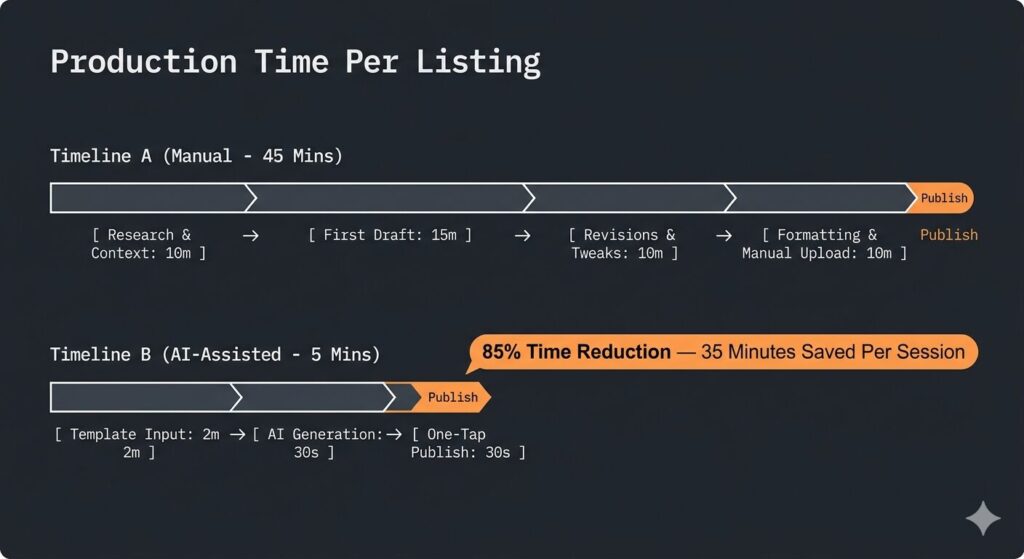
The agents who experience the clearest ROI from listing generators are those in the 10 to 30 listings per month range. At that volume, the time cost of manual writing is material but not yet high enough that a standalone free tool becomes a bottleneck. Below 10 listings per month, the ROI is real but modest. Above 30 listings per month across multiple agents, the generator needs a workflow layer around it to remain consistent.
The brokerage-scale calculation and the quality variance problem
The quality variance problem is as significant as the time problem. A brokerage with 40 agents listing properties in the same developer’s project produces 40 different quality levels if every agent writes manually. One agent leads with the floor plan. Another leads with the payment plan. Another leads with the view. None of these is wrong, but the inconsistency signals to buyers that the firm has no consistent point of view on its own inventory. A standardized generator input template, used across all 40 agents, produces consistent vocabulary, consistent structure, and consistent quality regardless of which agent triggers the generation.
Prompt Templates for Three Markets: US MLS, MagicBricks (India), and Bayut (Dubai)
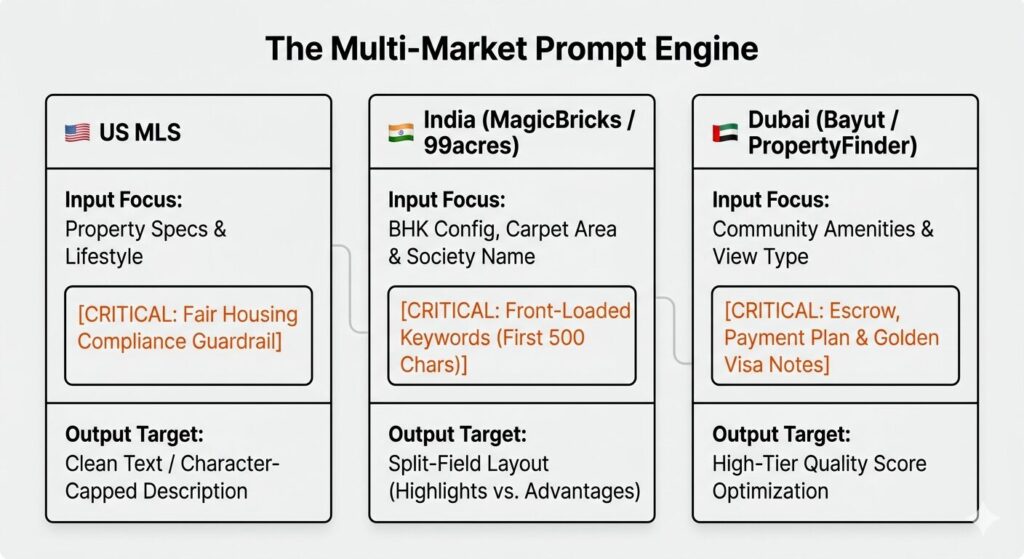
The prompt template is the most critical part of the generator workflow. The tool matters less than the template. Below are working prompt structures for each market, ready to copy and adapt.
US MLS prompt template
“Act as a real estate copywriter for the US residential market. Write a listing description for a [property type] in [city, state]. Configuration: [sqft], [bedrooms] bedrooms, [bathrooms] bathrooms. Features: [3-5 specific named features]. Target buyer: [first-time buyer / move-up buyer / investor]. MLS destination. Maximum [character count]. Tone: [warm and lifestyle-focused / investment-oriented]. Do not include any language that could violate Fair Housing laws.”
MagicBricks and 99acres prompt template for India
“Act as a real estate copywriter for the Indian residential property market. Write a listing description for a [BHK configuration, sqft carpet area, floor, facing direction] apartment in [society name], [locality], [city]. Specific features: [3-5 named features using exact names]. Target buyer: [end-user / NRI investor / renter]. Portal: MagicBricks. Lead the first sentence with [primary keyword] and [secondary keyword]. Maximum 500 words. Tone: [modern and aspirational / investment-focused / urgent].”
For 99acres, add: “Generate two separate sections (project highlights and locality advantages) as distinct paragraphs for the 99acres split-field structure.”
Bayut and PropertyFinder prompt template for Dubai
“Act as a real estate copywriter for the Dubai property market. Write a listing description for a [property type] in [community name], Dubai. Configuration: [sqm], [bedrooms / studio], [bathrooms]. View: [specific view]. Features: [3-5 amenities from the community by exact name]. Target buyer: [investor / Golden Visa buyer / end-user]. Include payment plan structure if off-plan, DLD fee note if applicable, Golden Visa eligibility note if price exceeds AED 2 million. Portal: Bayut. Tone: [premium investment / lifestyle / urgent].”
The Tools Worth Using and Where Each One Fits the Workflow
The tool choice follows the workflow design. For a step-by-step guide to free generator tools, see how to write a real estate property description using free AI tools.
Tools for US brokerages
ListingAI includes a Fair Housing compliance monitor (the only tool in the category with a built-in US compliance check) and supports output in 22 languages for multilingual buyer segments. ListingCopy.ai connects directly to MLS feeds, eliminating the manual input step for agents already inside an MLS-connected workflow. ChatGPT on the free GPT-4o tier gives the most control and works for any US market with the right prompt template at zero cost, with the limitation that there is no template memory across listings and no compliance monitoring.
Tools for India and Dubai brokerages
Write.homes is built for the Indian property market and understands the terminology natively: BHK configurations, carpet area versus super built-up area, vastu compliance as a listing feature, and society amenities as a distinct category from unit features. Output reads naturally for Indian buyers without the US-centric phrasing that ChatGPT defaults to when given Indian property inputs without a market-specific role instruction. For Dubai, Hypotenuse AI produces consistently structured output across large listing volumes, which makes quality review faster when one person is checking 50 descriptions per week.
What Breaks When You Deploy a Listing Generator Without a Workflow Around It
The tool is not the system. Every failure mode in AI listing generation comes from workflow gaps, not tool deficiencies.
The adoption problem
The most common outcome of a listing generator rollout is that three agents use it, two generate one description each, and the rest return to manual writing because no one told them when to use the tool, what template to follow, or who checks the output. A training session followed by a suggestion does not fix this. A defined trigger fixes it: the generator fires when the property record reaches a specific pipeline stage, making the tool part of the process rather than an option alongside it.
The hallucination risk and the 60-second fix
AI generates from inputs. If the input template is incomplete, the model fills gaps with plausible-sounding but inaccurate details. An agent who skips the accuracy review publishes a listing that claims a rooftop pool the society does not have, or states a metro station is six minutes away when it is six kilometers away. The 60-second review step is not optional. It is the quality control mechanism that makes AI-generated output publishable. For teams with a defined review step built into the workflow, hallucination risk is negligible. For teams that treat AI output as publish-ready without review, it is a recurring liability.
Scaling the Generator Across a Team of 20 or More Agents
Twenty agents using ChatGPT independently produce 20 different prompt structures, 20 different quality levels, and 20 different interpretations of what belongs in the first paragraph. The generator is consistent. The inputs are not.
What a team-scale listing generator deployment requires
Three infrastructure pieces must be in place before a listing generator scales reliably across a team. First, a standardized input template with required fields that every listing must complete before generation triggers. This is the single most important piece because it controls output quality before the tool is even involved. Second, a defined approval step with a named owner who checks the output for accuracy before publication. Third, a measurement system that tracks generation time, edit-to-publish time, and inquiry volume per listing over 90 days, because without measurement the tool either quietly stops being used or quietly starts being blamed for problems that originate in the inputs. For the full AI stack surrounding the listing generator across lead handling and pipeline management, see how AI tools for real estate agents work at team scale.
When the Generator Becomes a Module: Brokerage-Level Listing Automation
In a properly built brokerage content system, the listing generator is not a tool agents open. It is a module that fires automatically when a new property record enters the inventory database with the required fields populated.
What a triggered generation module looks like
The module produces three outputs simultaneously: the portal description formatted for the assigned platform, the WhatsApp broadcast copy, and the Instagram caption variant. These go to the listing agent for one-tap WhatsApp approval. On approval, the portal description publishes, the WhatsApp copy queues for broadcast, and the Instagram caption stages for posting. The agent’s only role is the 60-second accuracy check.
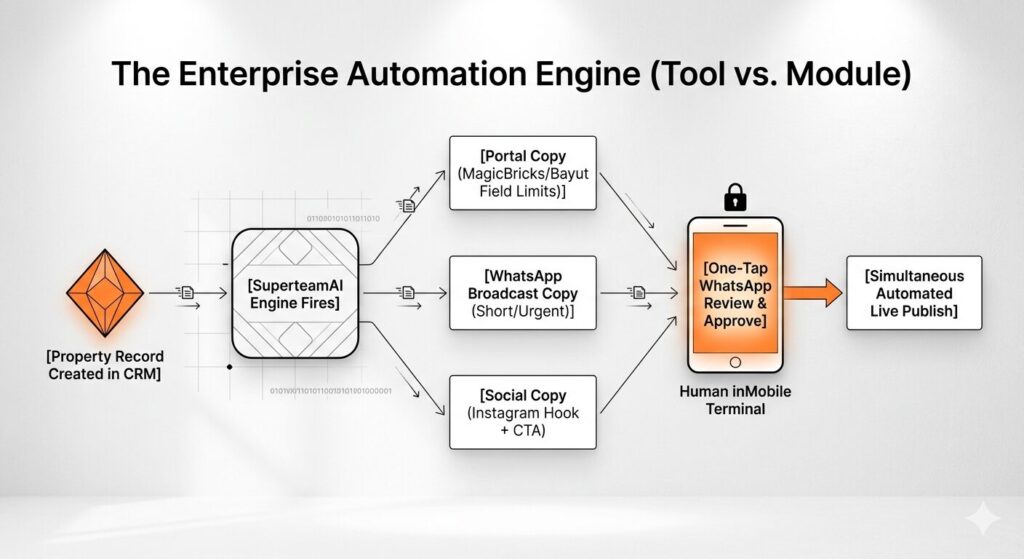
A listing generator is a productivity tool for a solo agent. A listing module is operational infrastructure for a brokerage. The tool can be implemented in an afternoon. The module requires a workflow design, a database connection, an approval chain, and a publishing integration. The difference in outcome is proportional to the difference in investment.


