
Free AI tools generate real estate property descriptions from structured inputs: property type, size, features, target buyer, and portal destination. With the right inputs, a tool like ChatGPT produces publishable copy in under two minutes. Without structured inputs, it produces generic filler that no portal visitor reads past the first sentence. The difference is the prompt, not the tool.
What Free AI Tools for Real Estate Property Descriptions Actually Do (and What They Cannot Do Without You)
The three free tools worth using for listing descriptions are ChatGPT on the GPT-4o free tier, Google Gemini, and Microsoft Copilot. All three work on the same principle: you provide structured property data as text input, the model generates formatted prose, and you review the output before publishing. The generation takes 15 to 30 seconds. The review takes 60 seconds. The total is under two minutes per listing for a first-draft description that a manually written version cannot reliably match.
The generation mechanic in plain terms
You are not asking the AI to imagine a property. You are giving it facts and asking it to arrange those facts into portal-ready prose using the vocabulary buyers in your market actually search with. The model knows what “ready to move,” “modular kitchen,” “gated community,” “payment plan,” and “Golden Visa eligible” mean to a buyer. It knows how to open with a lifestyle statement rather than a bedroom count. What you are providing is the raw material. What the AI is providing is the arrangement.
What AI does not know about your listing (and why that matters)
Language models generate descriptions from the data they are given and have no access to real-time property records, neighbourhood updates, or agent-observed details not included in the prompt, meaning any feature or fact not explicitly stated by the agent cannot appear accurately in the output.
The AI does not know that the society management changed six months ago and maintenance collection is now on time. It does not know that the unit on the third floor has a better view than the one on the seventh. It does not know that the new metro station opening in Q1 2027 will change the commute calculation for every buyer who currently dismisses the location. It generates from what you give it. Give it vague data, and it produces vague copy. Give it specific, named, verifiable details, and it produces specific copy that a buyer finds credible.
The Five Inputs That Determine Whether AI Produces Useful Copy or Generic Filler
Output quality is a direct function of input quality. Five fields determine whether the AI produces something publishable or something you delete and rewrite yourself.
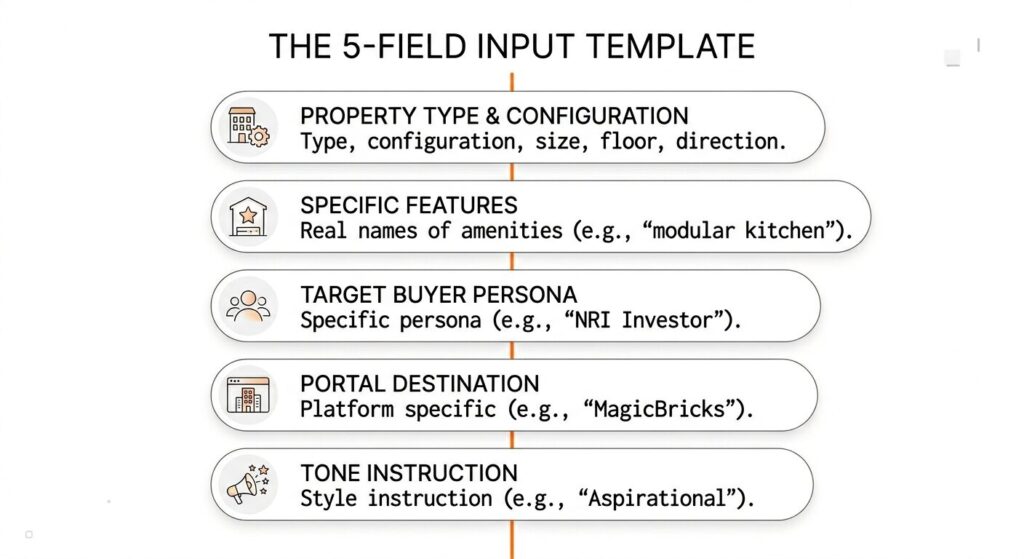
The input template (all five fields)
Field one: property type and configuration. Not “apartment” but “2BHK apartment, 1,100 sqft carpet area, second floor, east-facing.” Field two: specific features using real names. Not “good amenities” but “modular kitchen with granite counters, attached balcony with garden view, covered parking, 24-hour security, rooftop pool, and club membership included.” Field three: target buyer type. Investor, end-user, NRI, renter, or Golden Visa buyer. This single field changes the vocabulary register of the entire output. Field four: portal destination. MagicBricks, 99acres, Housing.com, Bayut, or PropertyFinder. Each platform has different character limits and keyword priorities. Field five: tone instruction. Luxury, mid-market, urgent, or investment-focused. The model calibrates word choice, sentence length, and emphasis across the entire description based on this instruction.
Studies on AI content quality consistently show that structured input templates produce descriptions rated significantly higher in specificity and perceived conversion value than unstructured free-text prompts given to the same language model.
What happens when you skip a field
“Spacious apartment in good location with modern amenities” is what AI generates when you give it “big flat, nice area, good facilities.” The agents who conclude that AI does not work for listing descriptions are almost always the agents who gave the tool the same minimal data they would have written manually. A structured template takes two minutes to complete. The output that follows is better than what a 45-minute manual effort typically produces.
Step-by-Step: How to Write a Listing Description Using ChatGPT at No Cost
Open ChatGPT on the free GPT-4o tier. No subscription required. The following steps take a property record from raw data to publishable listing copy in under three minutes.
Setting up the role instruction
Start your prompt with a role instruction: “Act as a real estate copywriter for the Indian residential market” or “Act as a real estate copywriter for the Dubai property market.” Without this, GPT-4o defaults to US framing and US portal conventions. The role instruction is one sentence, but it changes the vocabulary register of everything that follows.
The prompt structure that works
After the role instruction, include all five fields in sequence: property details, target buyer, portal destination, character or word limit, and tone instruction. A complete prompt for a Koramangala 3BHK looks like this: “Act as a real estate copywriter for the Indian residential market. Write a listing description for a 3BHK apartment in Koramangala, Bangalore. Configuration: 1,650 sqft carpet area, third floor, south-facing. Features: modular kitchen, two balconies, servant quarters, covered parking, swimming pool, gym. Target buyer: NRI investor, Bangalore origin. Portal: 99acres, project highlights field. Maximum 400 words. Tone: aspirational, investment-focused.” That prompt produces a description that answers the NRI buyer’s question before they ask it.
Get the structured input template used inside a SuperteamAI listing workflow
Before and After: Three Examples
The difference between manual and AI-generated copy is not style. It is specificity. Manual copy answers “what is it.” AI copy with structured inputs answers “what is it like to live or invest here, and why does that match my situation.”
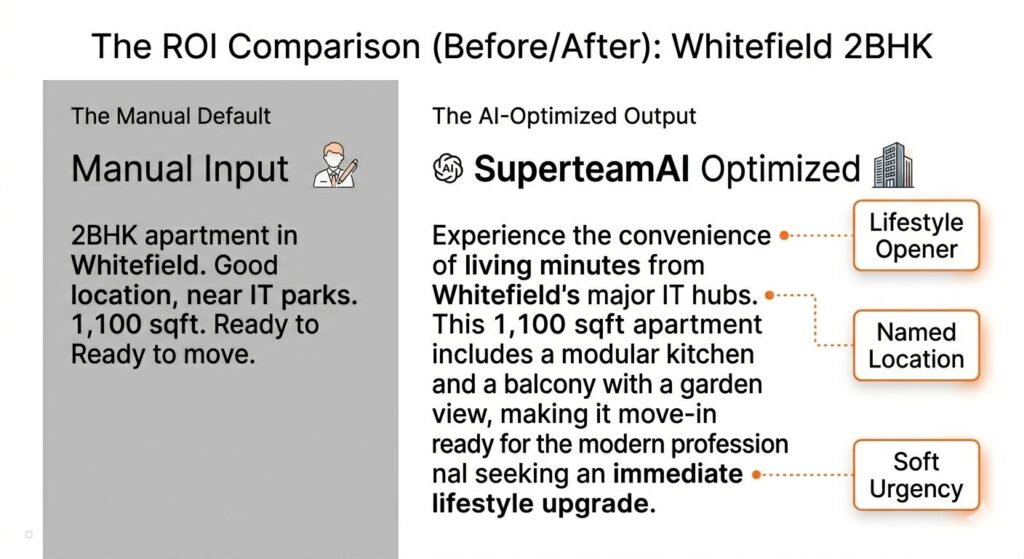
Example 1: 2BHK Whitefield, Bangalore (MagicBricks, end-user)
Manual copy: “2BHK apartment available in Whitefield, Bangalore. Good location, near IT companies. 1,100 sqft. Well maintained. Parking available. 2 bathrooms. Ready to move.”
AI-generated copy from the same inputs, targeting an end-user IT professional on MagicBricks: opens with the working professional’s daily reality in Whitefield, names the IT parks within commute range, describes the balcony and kitchen in specific terms, and closes with a move-in statement that creates soft urgency without stating it.
Listings with detailed, feature-specific descriptions receive significantly more qualified inquiries than listings using basic factual copy on Indian property portals, based on engagement data comparing description length and inquiry volume on platforms including MagicBricks and 99acres.
Example 2: 3BHK Koramangala (99acres, NRI buyer)
Manual copy: “3BHK flat in Koramangala. Spacious. Good society. Vastu compliant. Price negotiable.”
AI-generated copy targeting an NRI investor for the 99acres project highlights field: opens with Koramangala’s capital appreciation over the past five years, names the society and its amenity set by category, states carpet area and super built-up area as separate figures, references vastu compliance as a primary feature, and closes with a rental yield estimate the NRI reader can use before calling.
Example 3: Studio Dubai Marina (Bayut, investor)
Manual copy: “Studio apartment in Dubai Marina. Fully furnished. Sea view. Good condition. Call for price.”
AI-generated copy from structured inputs targeting an investor, off-plan, Q4 2026 completion, for Bayut: leads with the investment rationale for Dubai Marina studios in the current market cycle, states the payment plan structure, references the DLD transfer fee treatment for off-plan purchases, and closes with the Golden Visa eligibility qualifier for buyers at or above the AED 2 million threshold.
Portal-Specific Requirements That Free AI Tools Don’t Know About
A free AI tool does not know that MagicBricks indexes the first 500 characters most heavily, that 99acres separates project highlights from locality advantages into distinct fields, or that Bayut uses a completeness weighting that affects search ranking. Add these requirements to your prompt alongside the five standard fields.
India portals: MagicBricks and 99acres
MagicBricks accepts up to 4,000 characters in the description field, but its internal search indexes the first 500 characters most heavily. Instruct the AI to lead with the two strongest buyer-relevant keywords in the first sentence. 99acres separates “project highlights” and “locality advantages” into distinct input fields. Generate modular copy: one block for project highlights, one block for locality advantages, not a single description that you manually split after the fact.
MagicBricks and 99acres use keyword indexing within listing description text as part of their internal search ranking systems, making the language in description copy a direct factor in listing visibility to portal users.
Dubai portals: Bayut and PropertyFinder
Bayut uses a completeness weighting that gives higher search visibility to listings including the community name, key amenities named explicitly, and the property’s specific view or orientation. Instruct the AI to include all three in the output. PropertyFinder uses a listing quality score that rewards area-specific terminology, property specifications, and lifestyle descriptors. Generic copy of any length scores lower than specific copy that uses actual place names and feature names from the listing record.
PropertyFinder’s internal listing quality score assigns higher visibility rankings to listings that include complete descriptions containing area-specific terminology, property specifications, and lifestyle descriptors, directly affecting how prominently the listing appears in search results on the platform.
The Four Things You Should Never Let AI Write Without Human Review
Free AI tools produce useful first drafts for most listings. Four situations require more than a 60-second factual check before publishing.
The four situations that require considered human review
Luxury properties above roughly Rs 3 crore in India or AED 1.5 million in Dubai, where description quality is read by buyers as a direct signal of the firm’s own standards. Off-plan Dubai listings that must accurately state payment plan structures, completion dates, and DLD registration details, where errors carry regulatory weight. Any listing where the agent has observed something specific about the property or neighbourhood that does not appear in the database record, because the AI can only work with what it is given. Resale listings in India where the property’s age and condition must be reflected accurately, not overstated by aspirational copy.
Research on buyer trust and AI-generated content in high-value property transactions indicates that high-net-worth buyers are significantly more likely to disengage when listing content is perceived as formulaic or inaccurate, compared to mid-market buyers in the same search session.
In all four cases, AI remains useful as a first draft. The review step moves from 60 seconds to five or ten minutes, which is not a reason to avoid it.
Scaling From One Listing to Fifty: When Free Tools Stop Being Sufficient
For a solo agent handling three to five listings per month, ChatGPT on the free tier is sufficient indefinitely. The per-listing time investment is low and the output quality is meaningfully better than manual copy for most standard configurations in established residential areas.
The volume threshold where free tools become the constraint
At an average of 40 minutes per listing description without AI assistance and five minutes per listing with structured AI-assisted generation, a brokerage with 50 new listings per month recovers approximately 29 hours of agent time monthly, equivalent to nearly four full working days.
The constraint appears at two points. First, at roughly 20 listings per month, the per-listing input step becomes the bottleneck: the structured template requires specific data the agent has to retrieve from the property record, and that retrieval takes longer than improvising a description from memory. The fix is connecting the AI tool to the inventory database so property data pulls automatically. Second, at 50-plus listings per month across a team, the problem is consistency. Twenty agents using ChatGPT differently produce 20 different quality levels for listings in the same developer’s project. A workflow layer with a defined template and approval step resolves this.
The Brokerage Workflow That Eliminates the Free-Tool Ceiling
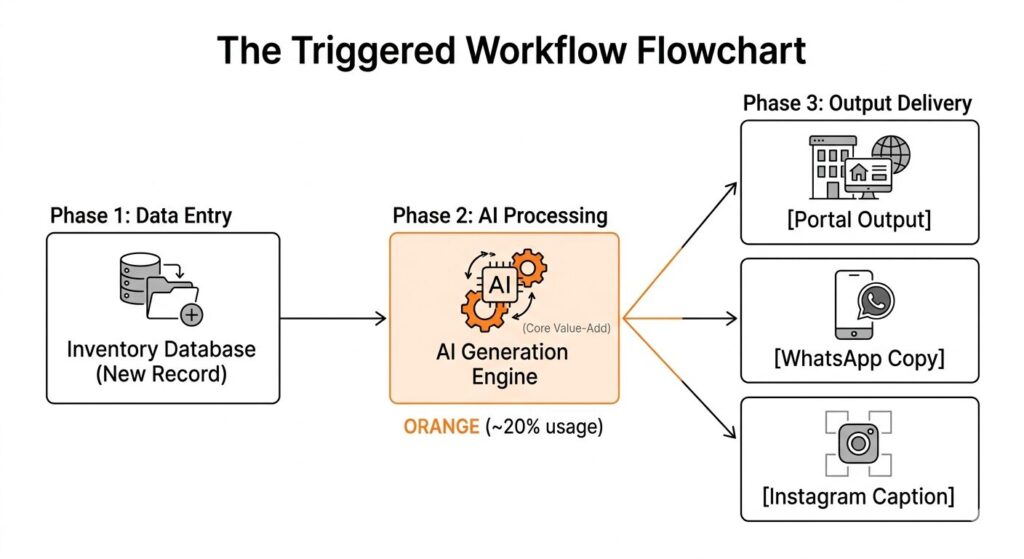
In a properly built brokerage content system, the agent never opens ChatGPT. Generation fires automatically when a new property record enters the inventory database with the required fields populated. The description exists because the listing exists.
What a triggered listing description workflow looks like
The pipeline produces three outputs simultaneously: the portal description formatted for the assigned platform, the WhatsApp broadcast copy, and the Instagram caption variant. These go to the listing agent for one-tap WhatsApp approval. On approval, all three publish to their destinations. For the full listing description workflow at brokerage scale, see how AI real estate listing descriptions work across a brokerage’s content pipeline. For the video content layer, see AI UGC video creators for real estate. For the full lead capture pipeline, see what a real estate AI agent covers across the brokerage operation.
At an average of 40 minutes per listing description and 200 new listings per month, a mid-size brokerage loses approximately 133 hours of agent time monthly to manual listing copy production, equivalent to more than three full working weeks at standard working hours.
Start with the free tool. Calibrate your prompt over 10 listings. When the volume or the consistency problem appears, that is the moment to upgrade the infrastructure.
See how listing description automation runs inside the SuperteamAI real estate AI OS


