
An AI real estate listing description is property copy generated by a language model from structured inputs such as property type, size, features, location, and target buyer. The AI produces a formatted, publishable description in seconds. Agents use these tools to eliminate blank-page time, maintain consistent tone across large listing volumes, and adapt copy for multiple portals without rewriting.
There was an agent at a brokerage in Pune or Manhattan who was spending 45 minutes per listing writing descriptions. Across 18 active listings, that was 13.5 hours a month on a task that produced no differentiated outcome. The copy was functional. It was not good. It did not reflect the actual quality of the properties. It was what you produce when you are exhausted and staring at a cursor that is not moving. AI has closed that gap in a way that is genuinely useful for most listings and still requires judgment for some of them. This article explains which is which.
What an AI Real Estate Listing Description Actually Is
How the generation process works
The generation process is straightforward. An agent inputs structured property data: type, size, bedrooms, area, key features, and target buyer. The language model produces a formatted description calibrated to those inputs. The agent reviews the output and publishes it. Most tools complete this in 30 to 90 seconds from input to output. Some tools connect directly to MLS or portal feeds and pull the property data automatically, eliminating even the manual input step. The description is not written from the AI’s imagination. It is structured output from structured input, which is precisely why input quality determines output quality. Feed the tool vague data, and you get vague copy.
Where AI wins consistently: speed, consistency across high listing volumes, no blank-page paralysis, and the ability to scale to any number of listings without proportional effort. Where AI still requires human judgment: emotional authenticity for luxury listings, neighbourhood-specific details the model does not know (the new metro line opening six months from now, the fact that a particular society is unusually quiet for its density), and compliance-sensitive language in regulated markets. The agent who treats AI output as a first draft requiring a 90-second review publishes better copy faster than the agent who writes everything from scratch.
Why AI Listing Descriptions Outperform Manual Copy in Most Situations
Speed and consistency across high listing volumes
SEO optimisation built into the output
AI listing tools are trained on published portal data and produce naturally keyword-rich descriptions without requiring agents to consciously insert search terms. Phrases like “open-plan living,” “en-suite bathroom,” “south-facing balcony,” “gated community,” and “ready to move” appear in the right context automatically. Portal search algorithms on platforms including 99acres and Bayut use keyword matching within listing descriptions as a ranking signal, meaning description copy directly affects how prominently a listing appears to portal searchers. This is a practical SEO advantage that most agents do not capture when writing manually, because they are focused on describing the property rather than on how a buyer would search for it.
Tone matching by buyer type
AI tools that include a buyer-type input produce meaningfully different copy for the same property depending on whether you specify investor, end-user, renter, or NRI buyer. An investor prompt produces yield and capital appreciation language. An end-user prompt produces lifestyle and community language. [VERIFY: Research on real estate buyer behaviour shows that investor-focused buyers and end-user buyers respond to fundamentally different description frameworks, with investors prioritising rental yield data and appreciation signals over lifestyle descriptors.] Most agents write one description and publish it everywhere. AI makes writing two or three buyer-specific variants cost essentially nothing in additional time.
Before and After: What AI Actually Produces
A 2BHK apartment in Bangalore: manual vs. AI
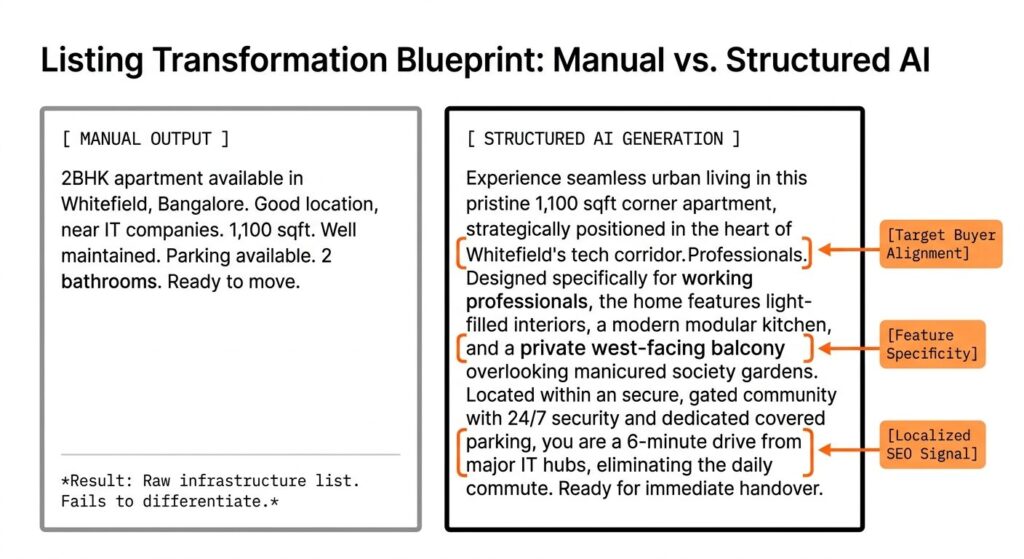
Manual copy, which represents what most Indian agents produce under time pressure: “2BHK apartment available in Whitefield, Bangalore. Good location, near IT companies. 1,100 sqft. Well maintained. Parking available. 2 bathrooms. Ready to move.”
AI-generated copy from structured inputs including buyer type (end-user, IT professional), key features (modular kitchen, balcony with garden view, 24/7 security, covered parking), and portal destination (99acres): a three-paragraph description that opens with the lifestyle benefit for a working professional, develops the feature set with specific names rather than vague descriptors, and closes with location context that references the actual employment hubs within reach.
An off-plan studio in Dubai Marina: manual vs. AI
Manual copy from a smaller Dubai agency: “Studio apartment in Dubai Marina. Fully furnished. Sea view. Good condition. Call for price.”
AI-generated copy from structured inputs including buyer type (investor), property status (off-plan, Q4 2026 completion), key features (furnished, full sea view, flexible payment plan, Golden Visa eligibility threshold met): a structured description that leads with the investment rationale, states the payment plan structure, references the DLD transfer fee implication for off-plan purchases, and closes with the Golden Visa qualifier for buyers meeting the threshold. The AI output is doing work the manual version is not. It qualifies the right buyer, surfaces the right facts, and reduces time wasted on enquiries from buyers for whom this property is not the right fit.
The Inputs That Determine Output Quality
The six fields that matter most
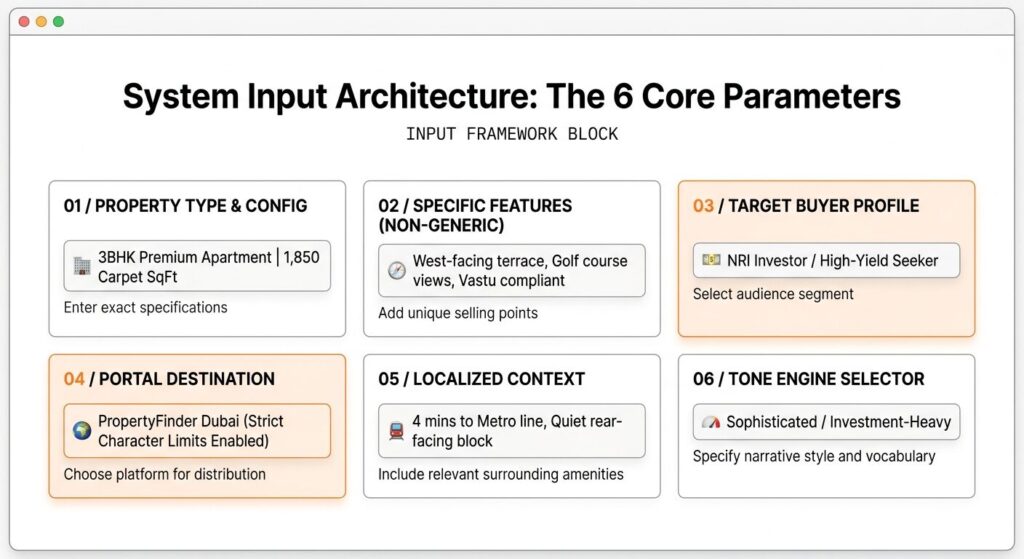
Output quality is a direct function of input quality. The six inputs that determine whether an AI description is useful or generic are: first, property type, which tells the model the correct structural template to apply; second, size and configuration in accurate units, such as sqft or sqm, along with bedrooms and bathrooms; third, three to five specific features using actual names rather than category labels (not “nice view” but “west-facing balcony with golf course view,” not “good location” but “six minutes from Hebbal flyover by car”); fourth, target buyer type from a defined list such as investor, end-user, renter, NRI, or Golden Visa buyer; fifth, portal destination, which determines character limits and keyword priority; and sixth, tone instruction such as luxury, mid-market, or urgent, which determines vocabulary register across the entire output.
What happens when you give AI bad inputs
Vague inputs produce vague output. “Spacious apartment in good location with modern amenities” is what AI generates when you enter “big flat, nice area, good facilities.” The agents who conclude that AI does not work for listing descriptions are almost always the agents who gave the tool the same minimal data they would have written manually. The fix is a structured input template: a defined form with required fields that every listing must complete before description generation is triggered. [VERIFY: Studies on AI content quality consistently show that structured input templates produce descriptions rated significantly higher in specificity and perceived conversion value than unstructured free-text prompts given to the same language model.] A 10-field template takes two minutes to complete and produces output that a 45-minute manual effort cannot reliably match.
Portal-Specific Guidance: India and Dubai
MagicBricks and 99acres: format requirements and character limits
MagicBricks accepts up to 4,000 characters in the description field, but the platform’s internal search indexes the first 500 characters most heavily. AI-generated MagicBricks copy should lead with the two strongest buyer-relevant keywords in the first sentence, followed by the property configuration and location. 99acres separates “project highlights” and “locality advantages” into distinct input fields, which means AI can generate modular copy that slots directly into the correct field rather than producing a single block of text that must then be manually split. MagicBricks and 99acres both use keyword indexing within listing description text as part of their internal search ranking systems, making the language in description copy a direct factor in listing visibility to portal users.] For Indian brokerages managing listings across both portals, a single AI generation session can produce portal-specific variants from one structured property input.
Bayut and PropertyFinder: SEO fields and multilingual considerations
PropertyFinder’s internal listing quality score assigns higher visibility rankings to listings that include complete descriptions containing area-specific terminology, property specifications, and lifestyle descriptors, directly affecting how prominently the listing appears in search results on the platform.Bayut uses a similar completeness weighting. AI-generated descriptions that include the community name, key amenities by name, and the property’s specific view or orientation consistently score higher on both platforms than generic descriptions of the same length. Arabic-language listings receive separate search traffic on both platforms. AI translation tools can produce Arabic variants from English inputs, but the output requires review by an Arabic-speaking team member before publishing. Culturally adapted language, not literal translation, is what converts on Arabic-language property searches in Dubai.
The WhatsApp broadcast is the third output format that most Indian and Dubai brokerages overlook entirely. A portal description is too long and too formal for a buyer broadcast list. AI can generate a three-to-four sentence WhatsApp variant from the same structured inputs: property type, price, one key feature, urgency signal, and a contact prompt. This takes 20 additional seconds of generation and produces copy that matches the conversational register buyers actually expect on WhatsApp, rather than a condensed version of portal text that reads as out of place in a messaging context.
Free AI Tools Worth Using and Their Honest Limits
ChatGPT with a structured prompt: best for control
A ChatGPT prompt structure for listing descriptions: role instruction, then property details, then target buyer, then portal destination, then character limit, then tone instruction. Example: “Act as a real estate copywriter for the Indian market. Write a listing description for a 3BHK apartment in Koramangala, Bangalore. Target buyer: end-user, IT professional. Portal: MagicBricks. Maximum 600 characters. Tone: modern, aspirational. Features: corner unit, two balconies, modular kitchen, club membership included.” Advantage: full control, no subscription required, adaptable to any market or property type. Limitation: no compliance monitoring, no template memory across listings, output is not pre-formatted to specific portal field structures.
ListingAI: best for volume with compliance monitoring
ListingAI reached over 31,000 users across more than 20 countries as of its 2025 annual review, having generated more than 59,000 listing descriptions since launch. The platform supports multiple AI models including Claude and GPT variants, includes a Fair Housing compliance monitor for US and Canadian markets, and supports output in 22 languages. Pricing starts at a free tier with limited monthly generations. Honest limitation: the compliance monitor is calibrated for North American regulation. Agents in India and Dubai need to verify RERA-relevant advertising language independently, as the tool does not currently monitor for Gulf or Indian regulatory requirements.
Hypotenuse AI is strong for teams with a defined template format that requires consistent heading and paragraph structure across large listing volumes. The output follows a predictable layout, which makes quality review faster when one person is checking 50 descriptions per week. Limitation: less configurable for non-US portal formats, and the structured output style reads as slightly formal for Indian mid-market listings where conversational tone converts better.
Write.homes is built for Indian and international real estate markets and understands Indian property terminology natively: BHK configurations, carpet area versus super built-up area, vastu compliance as a listing feature, society amenities as a category separate from unit features. Output reads naturally for Indian buyers without the US-centric phrasing that ChatGPT defaults to when given Indian property inputs without specific market instructions. Limitation: the underlying model is smaller than GPT or Claude, which shows in complex luxury descriptions requiring nuanced language.
Customise vs. Automate: The Decision Framework
When full automation is safe
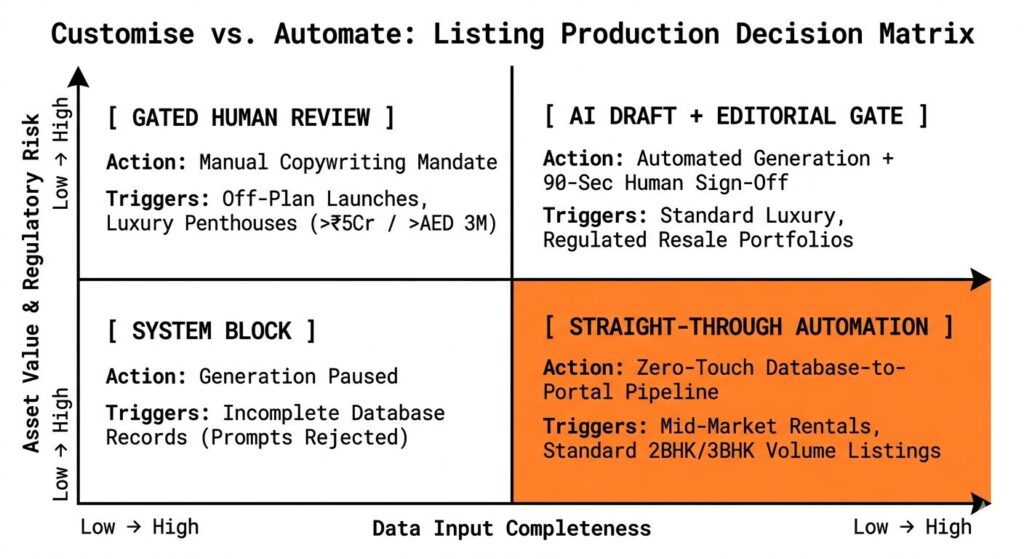
Full automation from input to portal publication, with a 60-second agent review for factual accuracy, is safe when four conditions are met. The listing is mid-market or below in price tier. The property is a standard configuration that the AI’s training data covers thoroughly, such as a 2BHK apartment in an established residential area. The portal destination has clear formatting requirements that the tool already supports. And the brokerage has a structured input template that captures all six key fields before generation begins. When these four conditions are true, AI output goes from generation to portal in under two minutes, and the agent’s only role is checking that the sqft figure and bedroom count are correct.
When human review is mandatory
Human review beyond a factual check is mandatory in four situations. First, luxury properties above roughly ₹3 crore in India or AED 1.5 million in Dubai, where description quality is read by buyers as a direct signal of the firm’s own standards. Second, off-plan Dubai listings that must accurately state payment plan structures, completion dates, and DLD registration details, where errors carry regulatory weight. Third, any listing where the agent has observed something specific about the property or neighbourhood that does not appear in the database record, because the AI can only work with what it is given. Fourth, resale listings in India where condition and age of a property must be reflected accurately, rather than producing aspirational copy that overstates the state of an older flat. In all four cases, AI remains useful as a first draft. It simply requires more than 60 seconds of considered review.
What Brokerage-Scale Listing Description Automation Looks Like
The triggered workflow: from inventory database to published copy
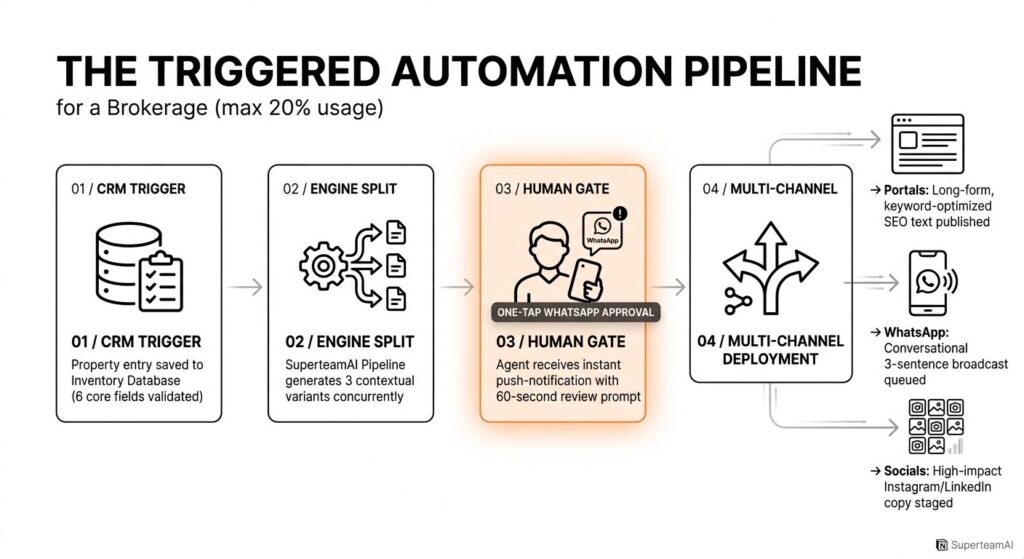
In a properly built brokerage content system, description generation is not a manual step. When a new property record enters the inventory database with all six required fields populated, the generation pipeline fires automatically. The AI produces three outputs simultaneously: the portal description formatted to the assigned platform, the WhatsApp broadcast copy, and the Instagram caption variant. These outputs go to the listing agent for one-tap approval via WhatsApp. On approval, the portal description publishes, the WhatsApp copy queues for broadcast, and the Instagram caption stages for posting. The agent does not open a tool. The agent does not face a blank page. The description exists because the listing exists. The only judgment the agent exercises is the 60-second approval review. For the pipeline that connects listing content to lead capture after publication, see how AI handles real estate lead generation. For AI video content that can accompany the same listing, see AI UGC video creators for real estate.
At an average of 40 minutes per listing description and 200 new listings per month, a mid-size brokerage loses approximately 133 hours of agent time monthly to manual listing copy production, equivalent to more than three full working weeks at standard working hours. A solo agent with five listings loses under four hours a month to this task. A brokerage with 40 agents and 200 listings loses the equivalent of nearly a full-time employee’s monthly output to a task that is entirely automatable with the right infrastructure. The blank page problem also compounds quality. Descriptions written by 40 different agents for the same developer’s project will reflect 40 different quality levels and 40 different interpretations of what the listing should emphasise. A triggered workflow eliminates both the time cost and the quality variance simultaneously.


