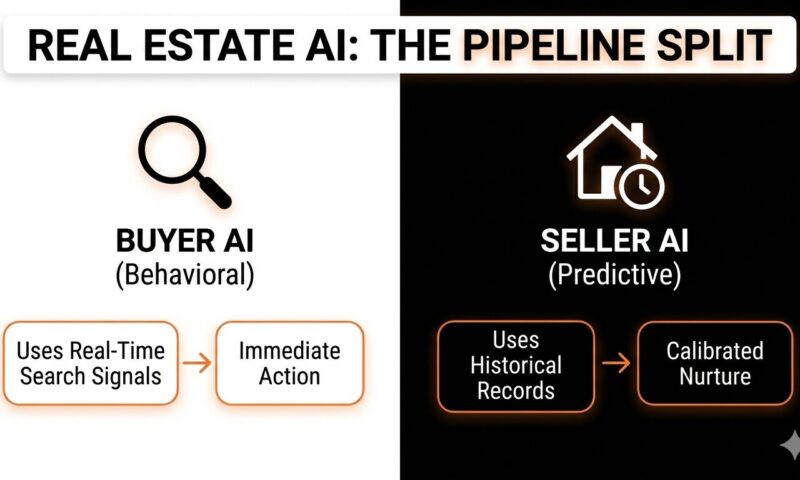
AI lead generation for real estate uses machine learning to identify, score, and follow up with potential buyers and sellers automatically. The category splits into two architecturally distinct pipelines: buyer leads scored on behavioral intent data and seller leads scored on predictive public records analysis. Each pipeline requires different data inputs, model training approaches, and response protocols.
Most evaluation guides treat buyers and sellers as a single problem and recommend the same platform for both. The result is consistent underperformance: the platform is optimized for one pipeline and produces weak outputs for the other. This guide covers what separates the two architectures, why the data requirements differ at each stage, and the system constraints that determine whether any AI lead generation implementation will improve conversion or add complexity.
What AI Lead Generation for Real Estate Actually Involves
The Two Pipelines That Most Platforms Collapse Into One
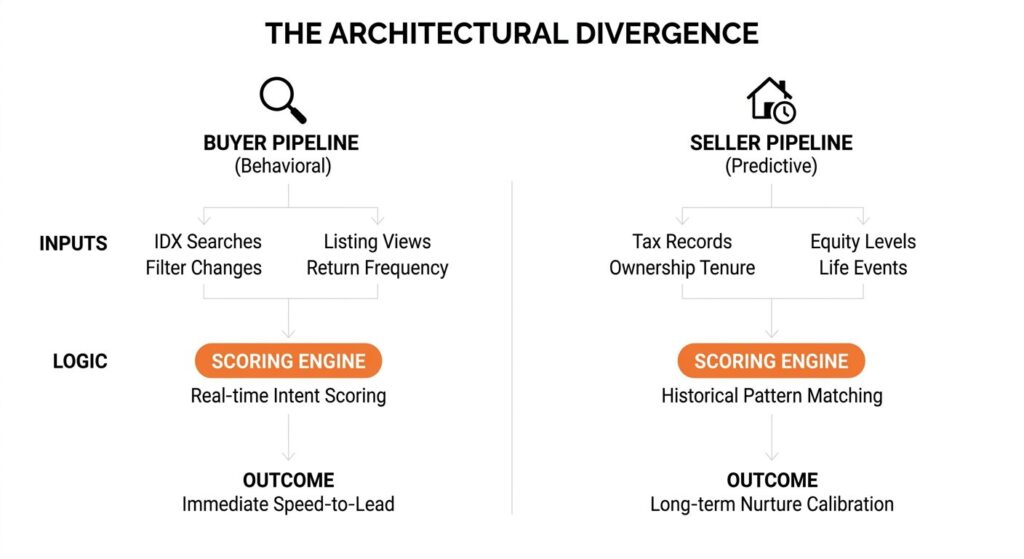
Buyer lead generation and seller lead generation share a name and a CRM destination but little else. Buyer leads are generated by capturing behavioral signals: IDX property searches, listing page views, return visit frequency, and email engagement patterns. These signals indicate where a prospect is in the evaluation cycle. The scoring model ranks contacts by purchase timeline likelihood based on the recency, frequency, and progression of those signals.
Seller lead generation depends on different inputs entirely. Sellers rarely announce intent through digital behavior the way buyers do. The signals that predict seller readiness are largely structural: how long a homeowner has held the property, whether life events associated with relocation have occurred, local equity levels, and geographic turnover rates in comparable segments. The scoring model for seller leads trains on historical public records rather than real-time behavioral data.
Platforms that advertise both buyer and seller capabilities are typically stronger in one and bolt on the other. Evaluating which pipeline a platform was originally built around is the most important early step in any procurement decision.
What Automation Handles Versus What Requires Human Judgment
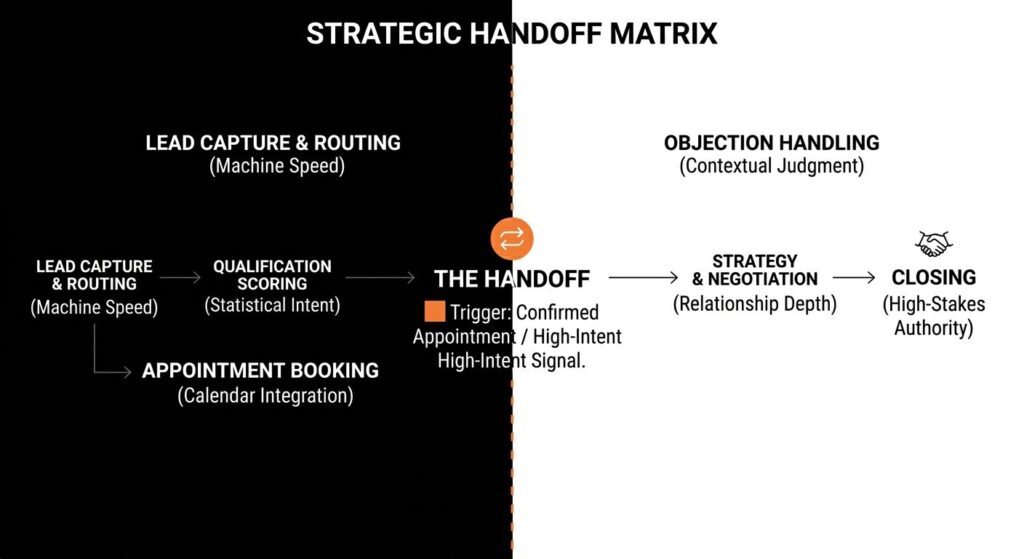
AI handles the parts of the pipeline where volume and speed exceed what human attention can sustain: initial lead capture and routing, qualification scoring, appointment scheduling, and routine follow-up sequences. These are stages where the inputs are structured, the decision rules are consistent, and the volume is high enough that human involvement introduces more latency than value.
Human judgment is required where context, relationship quality, and adaptive communication determine whether a relationship progresses. Objection handling, offer strategy, and contract negotiation depend on the ability to read a specific person in a specific situation. The division between automation and human involvement is not fixed by platform capability; it is set by pipeline architecture. Teams that define the handoff threshold explicitly before implementation consistently outperform those that allow agents to intervene based on personal timing preferences.
The Buyer Pipeline: How Behavioral Intent Data Drives Scoring
IDX Search Behavior as the Primary Scoring Signal
IDX integration gives AI lead generation platforms access to property search behavior occurring within a brokerage’s own listings environment. Search queries, filter adjustments, saved searches, listing favoriting, and inquiry form completions all produce signals that indicate purchase proximity. A contact that narrows search criteria, revisits the same listing multiple times, and adjusts price range filters within a two-week window produces a materially different scoring profile than one who browses broadly without narrowing.
The quality of buyer scoring depends on IDX coverage depth. Platforms that track only page views produce thinner signal data than those capturing filter-level search behavior and return visit patterns. Before selecting a platform, verify which IDX behavioral events it captures and how those events are weighted. A platform that weights all events equally will produce weaker prioritization than one that applies decay curves and sequence modeling to the same data.
What Listing Engagement Patterns Indicate About Purchase Timeline
Engagement pattern analysis moves beyond single events to sequences. A contact who views a listing, leaves, and returns three days later exhibits different purchase intent than one who views fifty listings in a single session. Sequence modeling allows AI scoring to distinguish active evaluation from passive browsing, which are the two behavioral patterns that most often appear similar at the individual signal level but predict entirely different conversion timelines.
Platform-level sequence modeling varies considerably. Some platforms score each engagement event independently, assigning point values to page views and email opens without regard for order or recency. Better implementations weight event sequences and apply score decay when engagement stalls, producing prioritization lists that reflect current intent rather than accumulated historical activity.
The Seller Pipeline: Why Public Records Require a Different Model
The Data Inputs That Power Predictive Seller Scoring
Seller lead scoring platforms aggregate county assessor records, deed transfer data, equity position estimates, and life event indicators into a predictive score estimating the probability a homeowner will list within a specified timeframe. The model trains on historical sales outcomes in a target geography and uses the pattern of pre-listing signals to identify current properties matching the established pre-list profile.
[VERIFY: Predictive seller scoring platforms report accuracy rates of 40 to 70 percent in identifying homeowners who list within a 12-month window in high-volume urban markets, with substantially lower accuracy in rural and low-transaction-rate geographies]
The data layer for seller scoring is fundamentally different from buyer intent data. It is backward-looking and structural rather than real-time and behavioral. Ownership duration, equity accumulation, and geographic cohort behavior update on timelines measured in months rather than days. This structural difference makes seller scoring unsuitable for the same platform configuration used to score buyer leads. The two pipelines require separate data sources, separate model training, and separate outreach logic calibrated to longer conversion timelines.
Life Event Signals and Why They Are High-Conversion Triggers
Life events associated with relocation produce the highest seller score lifts: divorce filings, probate records indicating inherited property, tax delinquency suggesting financial pressure, and employment changes indicated by employer database updates. These events compress the decision timeline for homeowners who might otherwise hold a property for years.
[VERIFY: Seller leads triggered by life event signals including divorce, probate, and tax delinquency report conversion rates 2.5 to 4 times higher than demographically similar non-triggered leads across multiple platform-cited studies in residential real estate]
Not every platform has access to all life event signal types. Probate and divorce record access varies by county and data aggregator partnership. Before selecting a seller-focused platform, verify which life event signal categories are included in the data model and which geographies those signals cover reliably. Gaps in life event coverage create systematic blind spots that no configuration adjustment can compensate for.
Speed-to-Lead as a System Constraint, Not a Best Practice
The Conversion Data Behind the Five-Minute Threshold
[VERIFY: Real estate leads contacted within 5 minutes of inquiry convert at rates approximately 100 times higher than leads contacted at the 30-minute mark, based on industry studies examining response time effects in residential real estate lead conversion]
The gap between what conversion data recommends and what most agents deliver is significant. [VERIFY: Average agent response time to new real estate leads in North American residential markets is approximately 15 hours, with approximately 40 percent of inbound calls going unanswered during active business hours]
These numbers reframe speed-to-lead from a performance metric to a system architecture problem. If the average response time is 15 hours and the conversion premium is concentrated at the 5-minute threshold, improved lead scoring alone will not close that gap. A pipeline that scores leads accurately but routes them to agents who respond hours later captures almost none of the conversion advantage that prioritization is supposed to produce.
How Pipeline Architecture Determines Whether Speed Is Achievable
AI-powered initial response solves the speed problem by removing the dependency on agent availability. Automated text and email responses within seconds of inquiry submission, AI-driven qualification conversations via SMS or chat, and calendar-integrated appointment scheduling allow the pipeline to operate at machine speed for the initial touchpoints where the conversion premium is highest.
The constraint is integration completeness. Platforms that capture leads from multiple sources, including paid digital campaigns, IDX registration, referral networks, and inbound calls, must route all of them through the same automated response layer to achieve consistent response times. A single lead source that bypasses the automation creates response time variance that erodes the conversion advantage across the entire pipeline.
Data Quality: The Upstream Dependency Most Platforms Skip
Why Clean CRM Data Is a Prerequisite, Not a Nice-to-Have
AI lead scoring models produce outputs that reflect the quality of input data. A scoring model applied to a CRM with duplicate contacts, missing fields, incorrect property associations, and stale engagement history will produce scores that rank noise rather than opportunity. The model processes complete and fragmented records equally, assigning scores that appear confident regardless of underlying data quality.
[VERIFY: AI lead generation implementations that include a data quality audit and remediation phase prior to model activation report significantly higher early-stage scoring accuracy than implementations that apply AI scoring to existing CRM data without prior remediation]
Data quality assessment should occur before platform selection. The assessment should cover contact completeness rates, duplicate contact rate, engagement history depth, and source attribution consistency. Firms with significant data quality issues should complete remediation before activating the scoring model. A model trained on a smaller but clean contact set will consistently outperform one trained on a larger set with systematic input errors.
The Signal Noise Problem When Input Data Is Incomplete
Signal noise compounds as the model accumulates more data from a degraded input layer. A contact appearing twice in the CRM under different email addresses generates split engagement histories the scoring model cannot interpret correctly. A property incorrectly associated with a contact produces false seller signals. These errors do not create obviously wrong scores; they produce plausible-looking scores that turn out to be unreliable when agents act on them.
The most expensive outcome of skipping data remediation is not a single bad lead score. It is the gradual erosion of agent confidence in the scoring layer. When agents experience consistent inconsistency between high scores and actual conversion, they stop trusting the prioritization output and return to self-directed outreach. At that point the AI scoring system is still running and consuming platform cost, but the prioritization benefit has been eliminated entirely by behavioral workarounds.
How AI and Human Roles Divide Across the Pipeline
What AI Handles Reliably at Volume
AI handles pipeline stages defined by volume, repetition, and speed requirements. Lead capture from all sources is automatically routed and logged. Initial qualification conversations via SMS and chat run at machine speed regardless of inquiry volume. Appointment scheduling integrates with agent calendars and confirms bookings without agent input. Routine follow-up sequences for leads below the handoff threshold run on defined intervals with content adjusted based on recent engagement patterns.
These are the stages where human involvement produces marginal improvement while consuming disproportionate time.AI lead generation tools across the residential real estate category have largely standardized automation at these pipeline stages, with meaningful platform differentiation occurring in scoring quality, data coverage, and integration completeness rather than in automation capability itself.
Where Human Involvement Produces Better Outcomes Than Automation
Human involvement improves outcomes at the stages where individual context and adaptive communication determine whether a relationship progresses. Objection handling, offer strategy, contract negotiation, and closing conversations require judgment that AI cannot replicate at the quality level those interactions demand. A prospect with a specific concern about timing or pricing needs a response calibrated to their individual situation, not a sequence selected from a decision tree.
The AI lead generation research base is consistent: AI improves conversion at the top and middle of the pipeline by ensuring high-quality leads reach agents rather than being lost to slow response or poor prioritization. It does not improve conversion at the bottom, where agent skill is the primary variable. Teams that attempt to automate objection handling consistently report worse outcomes than those that reserve those stages for humans while automating everything upstream. The handoff trigger that defines this boundary should be configured explicitly before implementation: appointment confirmed by the prospect, a qualifying score above a defined threshold, or a positive response to a specific question in the qualification sequence.
Market Variation: Where Predictive Models Break Down
Why Rural and Low-Volume Markets Underperform Model Expectations
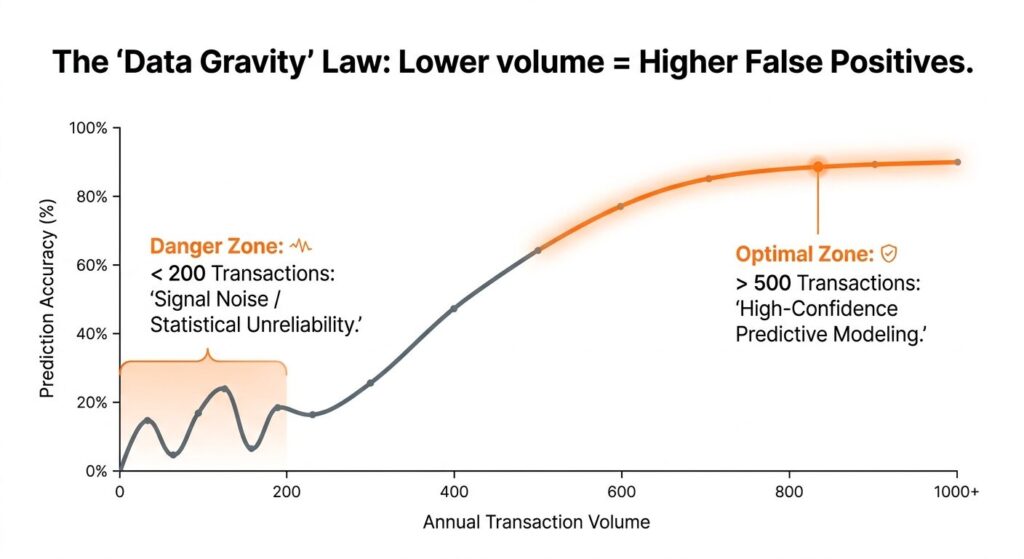
Predictive seller scoring models train on historical transaction data. In high-volume urban markets with hundreds or thousands of annual transactions, the model has sufficient training examples to identify which pre-listing signal patterns reliably predict seller activity. In rural markets or low-volume suburban segments, the transaction history is too thin to produce statistically reliable pattern recognition. The model identifies correlations in the available data, but those correlations reflect small-sample noise rather than generalizable patterns.
[VERIFY: Predictive seller scoring models require a minimum of several hundred annual transactions in a target geography to produce reliable outputs; markets with fewer than 200 annual transactions per year show substantially higher false positive rates in platform-cited accuracy benchmarks]
The practical implication is that a platform with strong urban accuracy claims may perform significantly worse in the specific geography where a firm operates. Accuracy benchmarks should always be requested for markets with volume and composition similar to the target geography. Vendors that cannot provide market-specific accuracy data are relying on aggregate benchmarks that obscure significant performance variation.
The Minimum Transaction Volume Threshold and How to Address It
Transaction volume is not the only variable affecting model reliability. Turnover rate, property type homogeneity, and county records coverage also matter. A market with 300 annual transactions concentrated in a consistent property segment with strong records coverage may support reliable seller scoring. A market with 300 transactions spread across diverse property types with inconsistent county records access may not meet the effective threshold.
Firms operating in thin markets have two structural options. The first is to extend the geographic scope of the scoring model by including adjacent markets in the training data, which increases transaction volume and can improve calibration when the adjacent markets are compositionally similar. The second is to supplement AI scoring with direct outreach targeting high-equity, long-tenure homeowners, treating the AI score as a rough prioritization filter rather than a high-confidence prediction.
For firms where market data limitations are the primary constraint on AI for lead generation performance, a custom scoring model incorporating proprietary local data sources may produce meaningfully better results than any off-the-shelf platform. The AI agent development infrastructure required to build at that level of market specificity represents a larger investment, but it is often justified when platform-level accuracy falls consistently below pipeline requirements and no configuration adjustment can close the gap.
Frequently Asked Questions
What is the difference between AI lead generation for real estate and traditional lead generation software?
Traditional real estate lead generation software captures and distributes leads but applies manual or rule-based qualification. AI lead generation adds predictive scoring, behavioral intent analysis, and automated outreach personalization. The functional difference is that AI systems prioritize leads by conversion likelihood and initiate contact automatically, while traditional systems require agent involvement from the first touchpoint with no predictive ranking applied.
Which AI lead generation platforms are most used in real estate?
Platforms commonly used in residential real estate include Ylopo for buyer-focused behavioral scoring and IDX integration, Offrs and Catalyze AI for predictive seller lead generation using public records data, iSpeedToLead for speed-to-lead routing and automated initial response, and Lindy for AI-driven qualification and appointment scheduling. Platform selection depends primarily on whether buyer leads, seller leads, or both pipelines are the primary use case, since most platforms are significantly stronger in one category.
How much does AI lead generation software cost for real estate agents?
Entry-level AI lead generation platforms for individual agents typically start from $200 to $500 per month. Team and brokerage-level platforms with predictive seller scoring, CRM integration, and outreach automation typically run $500 to $2,000 per month. Enterprise platforms with custom data integrations typically start at $15,000 per year. [VERIFY: pricing ranges across agent, team, and brokerage tiers for AI lead generation platforms in residential real estate are approximate and subject to annual revision by individual vendors]
How long before AI lead generation improves conversion rates in real estate?
Speed-to-lead improvements from automated initial response are visible immediately after implementation. Scoring accuracy improvements, which depend on the model accumulating sufficient conversion data, typically stabilize between months three and six. Seller scoring predictions for longer-cycle leads may require six to twelve months of local transaction history before output quality justifies full reliance on model rankings over agent intuition.
Can AI lead generation work for individual agents or only large brokerages?
Individual agents can use AI lead generation platforms, though the data volume available for scoring model training is smaller than at the brokerage level. Entry-level platforms for individual agents focus on speed-to-lead automation and basic behavioral scoring rather than predictive seller models, which require transaction volume that individual agents rarely generate independently. Team-level and brokerage-level implementations produce better model accuracy by pooling historical pipeline data across multiple agents.


