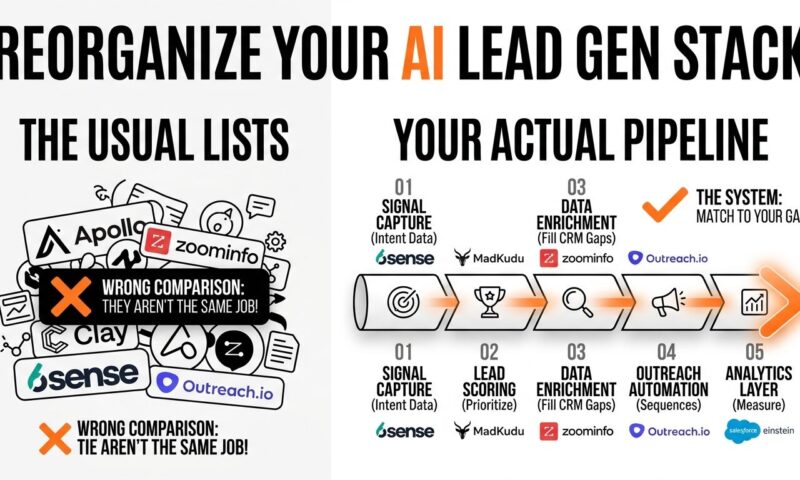
Every published list of AI lead generation tools ranks Apollo against Clay against ZoomInfo against 6sense as if they are competing for the same job. They are not. Each of these platforms serves a different stage of the lead generation pipeline, and buying the wrong category of tool for where your pipeline actually has a gap is one of the most common and expensive mistakes in sales ops.
AI lead generation tools fall into five functional categories: signal capture platforms that identify intent, lead scoring systems that prioritize contacts, data enrichment tools that fill CRM gaps, outreach automation platforms that run sequences, and analytics layers that measure pipeline performance. Choosing the right tool means matching each category to the stage in your pipeline where you have the biggest gap.
This guide organizes the tools by what they actually do, explains what makes a tool in each category worth buying versus skipping, covers how to negotiate pricing across your stack, and explains when building custom AI agents makes more economic sense than buying off-the-shelf platforms.
Why Apollo, Clay, and ZoomInfo Are Not Competing Products
The top-ranking articles for “AI lead generation tools” list somewhere between 7 and 15 platforms in order of the author’s preference. Apollo appears on almost every list. So does ZoomInfo. So does Clay. They are treated as alternatives to each other, which means a reader comparing them walks away confused rather than informed.
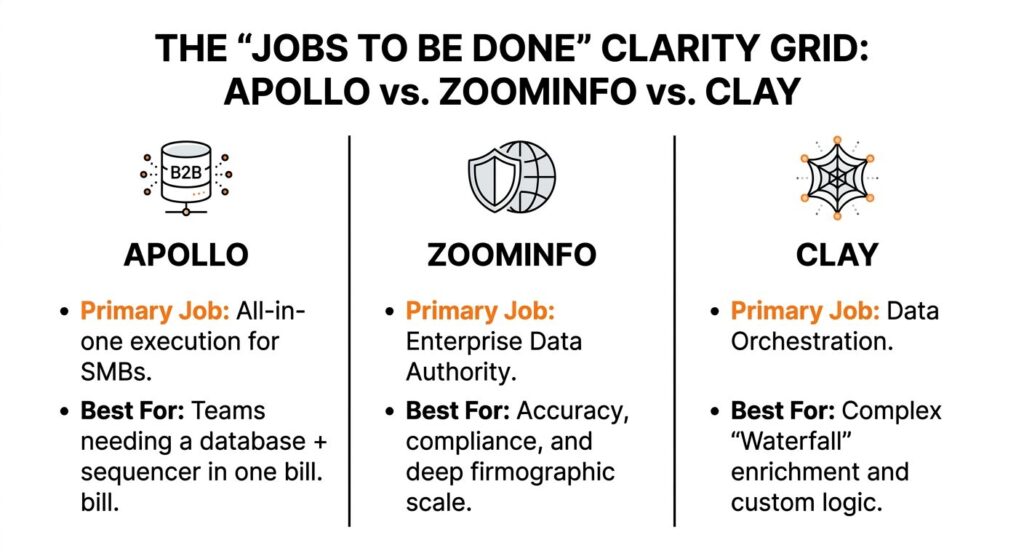
Apollo is primarily a B2B contact database with built-in outreach automation. ZoomInfo is an enterprise-grade data intelligence platform focused on firmographic accuracy and compliance. Clay is a data orchestration layer that sits on top of 150-plus data providers and lets you build custom enrichment and scoring workflows. These tools do not compete. A firm that needs scored leads does not choose between Apollo and ZoomInfo the way it chooses between two vendors selling the same product. It needs to understand which stage of its pipeline each tool addresses and whether that stage is the actual bottleneck.
The AI lead generation system overview explains the five-stage architecture that connects these tools. This guide focuses on which specific tools belong at each stage, how to evaluate them, and when to stop buying tools altogether and build instead.
How the Five Tool Categories Map to Your Pipeline Stages
The five tool categories correspond directly to the five stages of an AI lead generation system. Signal capture tools handle stage one: identifying which companies and contacts are showing buying intent right now. Scoring platforms handle stage two: ranking those contacts by how likely they are to convert based on your historical pipeline data. Enrichment platforms handle stage three: filling in the gaps in contact records so scoring and outreach have accurate inputs. Outreach tools handle stage four: running personalized, multichannel sequences at scale. Analytics and attribution tools handle stage five: measuring what is working so the earlier layers can be calibrated.
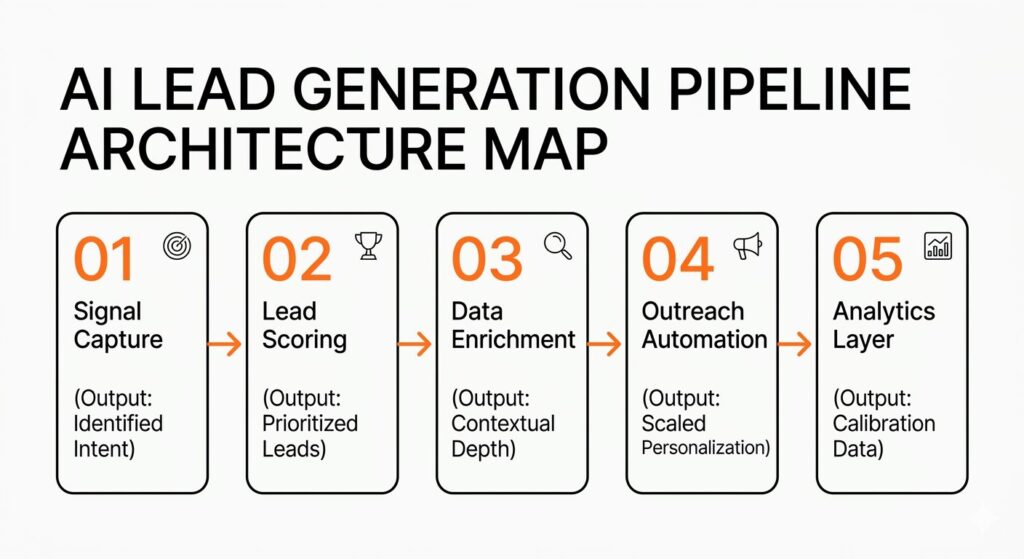
Each category is a dependency. Outreach tools produce better results when they pull from enriched, scored contacts. Scoring models produce better output when signal capture is feeding them current behavioral data. The implementation sequence for AI lead generation explains the order in which to build these layers. This article explains which specific tools to consider once you know which layer to build next.
Before going category by category, the master comparison table below maps every platform covered in this guide to its primary function, pricing tier, and CRM integration. Use it as a reference alongside the category analysis.
| Tool | Category | Best For | Starting Price | CRM Integration |
| 6sense | Signal Capture | Enterprise account targeting | ~$60,000/yr [VERIFY] | Salesforce, HubSpot |
| Bombora | Signal Capture | B2B intent network | ~$24,000/yr [VERIFY] | Major CRMs |
| Dealfront | Signal Capture | Mid-market, EU compliance | ~$500/mo [VERIFY] | HubSpot, Salesforce |
| RB2B | Signal Capture | LinkedIn visitor identification | Free + paid tiers [VERIFY] | HubSpot, Slack |
| HubSpot Scoring | Lead Scoring | HubSpot-native teams | Included in Enterprise [VERIFY] | HubSpot native |
| MadKudu | Lead Scoring | B2B SaaS predictive models | ~$1,000/mo [VERIFY] | Salesforce, HubSpot |
| Salesforce Einstein | Lead Scoring | Salesforce-native teams | Included in Sales Cloud | Salesforce native |
| Breadcrumbs.io | Lead Scoring | Mid-market custom scoring | Custom pricing | HubSpot, Salesforce |
| ZoomInfo | Enrichment | Enterprise data breadth | ~$15,000–40,000/yr [VERIFY] | All major CRMs |
| Clearbit | Enrichment | HubSpot ecosystem | Included in HubSpot | HubSpot native |
| Apollo.io | Enrichment + Outreach | SMB and mid-market | Free–$49+/mo [VERIFY] | HubSpot, Salesforce |
| Lusha | Enrichment | Mobile phone accuracy | ~$36/user/mo [VERIFY] | HubSpot, Salesforce |
| Clay | Enrichment Orchestration | Custom enrichment workflows | Credit-based [VERIFY] | API, Zapier, CRMs |
| Outreach.io | Outreach | Enterprise sequences | ~$100–150/user/mo [VERIFY] | Salesforce, HubSpot |
| Salesloft | Outreach | Enterprise multichannel | ~$100–150/user/mo [VERIFY] | Salesforce, HubSpot |
| Instantly | Outreach | High-volume cold email | ~$37/mo [VERIFY] | Limited native |
| Reply.io | Outreach | Mid-market multichannel | ~$60/user/mo [VERIFY] | HubSpot, Salesforce |
| Ylopo | Real Estate | Buyer and seller lead gen | Custom pricing | Real estate CRMs |
| SmartZip | Real Estate | Predictive seller ID | Custom pricing | Real estate CRMs |
Stage One Tools: Signal Capture and Intent Data
What Signal Capture Platforms Actually Track
Signal capture tools identify intent before a prospect fills out a form or responds to outreach. First-party tools track page visits, content downloads, email opens, and return visits on your own assets. Third-party intent platforms aggregate signals across publisher networks, review sites, and job boards to identify companies researching topics relevant to your product. The combination of both produces the strongest signal capture layer: first-party data tells you which known contacts are active, while third-party data surfaces companies that have not yet engaged with you directly.
Signal Capture Tools Worth Evaluating
The dominant third-party intent platforms are 6sense, Bombora, and Leadfeeder (now Dealfront). [VERIFY: pricing ranges, 6sense enterprise pricing from $60,000 per year; Bombora from $24,000 per year; Dealfront starting around $500 per month for SMB tiers] 6sense and Bombora target enterprise buyers and offer deep intent data sourced from large publisher networks. Dealfront sits in the mid-market range and focuses on website visitor identification with European data compliance. RB2B is a newer entrant focused specifically on identifying individual LinkedIn profiles behind anonymous US website visits. [VERIFY: RB2B pricing and match rate claims]
The key evaluation question for any signal capture tool is match rate: what percentage of anonymous visitors or intent signals get matched to an identified company or contact. Match rates vary significantly by data source and geography, and vendors are not always transparent about them. Ask for a pilot against your actual traffic before committing.
Stage Two Tools: Lead Scoring Platforms
What Separates a Reliable Scoring Platform from a Weighted Checklist
A lead scoring platform takes behavioral and firmographic inputs and produces a ranked output. The meaningful distinction between tools is whether the model is rules-based or predictive.
Rules-based scoring assigns point values to actions: 10 points for a pricing page visit, 20 for a matching job title. This is better than nothing but is essentially a manual judgment disguised as a system. Predictive models train on your historical pipeline data, learn which combinations of signals preceded closed deals, and produce probability scores rather than point totals. Predictive models outperform rules-based scoring once you have sufficient historical data. [VERIFY: predictive vs. rules-based scoring accuracy comparison, vendor benchmarks typically cite 2x to 3x improvement in MQL-to-SQL conversion rates with predictive models]
Lead Scoring Tools Worth Evaluating
HubSpot’s predictive lead scoring is included in Marketing Hub Enterprise and is the most accessible entry point for teams already on HubSpot. [VERIFY: HubSpot Marketing Hub Enterprise pricing, approximately $3,600 per month for 2,000 contacts] MadKudu is a standalone predictive scoring platform that integrates with Salesforce and HubSpot and is purpose-built for B2B SaaS models. [VERIFY: MadKudu pricing, starting around $1,000 per month] Salesforce Einstein Lead Scoring is available within Sales Cloud and works well for Salesforce-native teams with sufficient pipeline history. Breadcrumbs.io is a mid-market option that allows custom model configuration without requiring a data science team.
The minimum data requirement for any predictive scoring tool to produce reliable output is 500 to 1,000 historical leads with defined outcomes. [VERIFY: data minimums across major scoring vendors] Teams below that threshold should use simple rules-based scoring as a placeholder while historical data accumulates.
If you are not sure which tool categories your pipeline is missing, SuperteamAI audits your current stack and maps the gaps to specific tool categories before any build begins.Talk to the team
Stage Three Tools: Data Enrichment Platforms
What Enrichment Platforms Deliver That You Cannot Source Manually
Data enrichment tools pull verified contact and company attributes into your CRM automatically: direct email addresses, mobile phone numbers, LinkedIn profiles, job seniority, company headcount, technology stack, funding history, and recent hiring signals. For a lead scoring model, these attributes are inputs that improve prediction accuracy. For an outreach team, they are the context that makes personalization possible without manual research before each send.
The practical case for enrichment is not just convenience. Manual research takes 5 to 15 minutes per contact record. A rep covering 50 accounts per week loses 4 to 12 hours weekly to research that enrichment platforms replace in seconds. The savings compound when enrichment feeds scoring: richer records produce more accurate scores, which means less time on contacts that were never going to convert.
Enrichment Tools Worth Evaluating
ZoomInfo remains the standard for enterprise B2B enrichment, with the broadest contact database and the strongest compliance infrastructure for US markets. [VERIFY: ZoomInfo pricing, enterprise contracts typically $15,000 to $40,000 per year; SMB tiers from $7,000 per year] Clearbit, now part of HubSpot, integrates natively with the HubSpot ecosystem and is the default enrichment layer for teams on that stack. Apollo.io offers enrichment alongside its outreach functionality at a lower price point and is a strong option for smaller teams that need both in one contract. [VERIFY: Apollo.io pricing tiers, free tier with 50 credits per month; paid plans from $49 per month] Lusha focuses on mobile phone number accuracy and performs well for teams where phone outreach is a primary channel. [VERIFY: Lusha pricing, starting around $36 per user per month] Clay is not a traditional enrichment platform but deserves mention here: it pulls from 150-plus data providers in a waterfall configuration, meaning it tries each source in sequence and only charges a credit when a match is found.
[VERIFY: enrichment platform match rates, ZoomInfo claims 95 percent email accuracy; Clearbit cites 85 percent match rate; actual independently verified rates are typically lower]
Stage Four Tools: AI-Powered Outreach and Sequencing
Sequence Platforms vs. AI Personalization Layers: The Distinction Matters
AI-powered outreach tools split into two functional types that are often confused with each other. Sequence platforms (Outreach.io, Salesloft, Instantly, Reply.io) manage the structure and timing of multichannel outreach: how many steps, which channels, at what intervals, with what follow-up logic. AI personalization layers (tools like Lavender, Smartlead’s AI features, or Clay-generated snippets) use lead data to customize message content for individual contacts.
These are not substitutes. A sequence platform without personalization sends well-timed but generic messages. A personalization layer without a sequence platform produces strong first messages with no follow-up structure behind them. Most teams need both, though not necessarily as separate tools if their sequence platform includes credible AI personalization.
Outreach Tools Worth Evaluating
Outreach.io and Salesloft are the enterprise standards, both offering sequence management, call logging, inbox management, and increasingly native AI personalization. [VERIFY: Outreach.io and Salesloft pricing, both typically $100 to $150 per user per month at enterprise tiers] Instantly is a high-volume cold email platform with strong deliverability infrastructure built for teams running large outbound campaigns and is priced significantly below the enterprise platforms. [VERIFY: Instantly pricing, starting around $37 per month] Reply.io is a mid-market option with multichannel sequencing including LinkedIn and WhatsApp steps alongside email. For teams already on Apollo.io, its built-in sequences remove the need for a separate outreach platform at the cost of some feature depth compared to dedicated tools.
Deliverability is the underrated evaluation criterion for outreach tools. Send volume, domain warm-up support, and spam filter detection features determine whether messages actually reach the inbox. [VERIFY: deliverability benchmarks, tools with built-in warm-up infrastructure typically achieve 85 to 95 percent inbox placement rates vs. 60 to 70 percent without warm-up]
All-in-One Platforms vs. Best-of-Breed Stacks: How to Decide
The Case for an All-in-One Platform
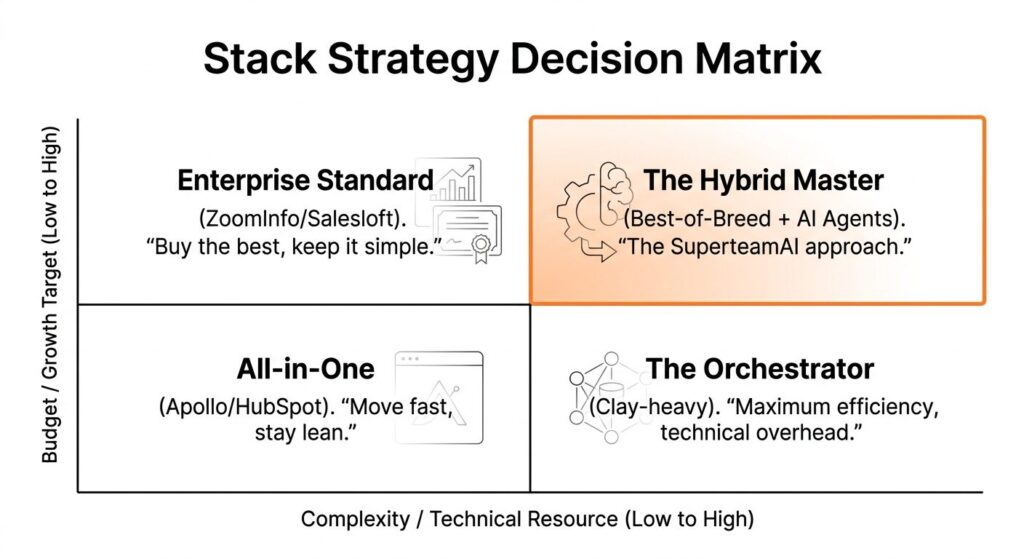
All-in-one platforms like Apollo.io, Amplemarket, or HubSpot Sales Hub offer signal capture, enrichment, scoring, and outreach in a single product. The core advantages are integration reliability (no data handoff problems between tools), lower total contract cost at entry-level, and a single vendor to hold accountable when something breaks.
For teams early in their AI lead generation investment or with limited technical resources, an all-in-one platform is usually the right starting point. The trade-off is that all-in-one platforms do each job adequately rather than exceptionally: enrichment match rates are lower than ZoomInfo’s, scoring models are simpler than MadKudu’s, and outreach features have less depth than Outreach.io’s. This matters more as volume grows.
The Case for a Best-of-Breed Stack
Best-of-breed means selecting the strongest tool in each category and integrating them: 6sense for signal capture, MadKudu for scoring, ZoomInfo for enrichment, Salesloft for outreach. Each component performs at a higher level than its all-in-one equivalent. The trade-offs are higher total cost, integration complexity between tools, and the need for either technical resources or a vendor to manage the connections. [VERIFY: total cost comparison, best-of-breed enterprise stack can reach $80,000 to $150,000 per year all-in vs. $20,000 to $40,000 for a comparable all-in-one]
There is a third option: building custom AI agents for specific pipeline functions where off-the-shelf tools consistently underperform. Custom scoring models trained on proprietary pipeline data outperform vendor-provided models when a firm’s ICP is distinct enough that general training data cannot capture its patterns. Custom enrichment workflows can pull from sources no commercial vendor covers: niche job boards, proprietary databases, real-time trigger event monitoring. The threshold for building custom is when the gap between what commercial tools produce and what your pipeline needs is costing more than the build investment. The AI agent development cost analysis covers how to make that calculation.
The Hybrid Approach Most Mid-Market Firms Land On
Most mid-market firms land on a hybrid: an all-in-one platform as the operational core (usually Apollo or HubSpot) with one or two best-of-breed tools added where performance gaps become costly. The most common add-on is a third-party intent data platform layered on top of native enrichment. The second is a dedicated outreach platform replacing the all-in-one’s module once volume makes deliverability and sequence depth limiting factors.
How to Negotiate and Optimize Your Tool Stack Costs
Stack pricing is highly negotiable, and most buyers leave significant money on the table by accepting the first number offered. Annual contracts typically run 20 to 30 percent below equivalent monthly pricing across most platforms in this category. [VERIFY: average annual vs. monthly contract discount across major sales tech vendors] For any tool above $1,000 per month, request a 30 to 90 day paid pilot before committing to an annual contract. Reputable vendors will accommodate this, and it protects you from discovering poor match rates or integration problems after you have already signed a year.
Credit-based tools (Apollo, Clay, Lusha) require honest usage estimation before committing to a tier. Overestimating credits and paying for unused capacity is one of the most common waste drivers in sales tech budgets. Pull three months of actual usage data before selecting a credit tier, and negotiate a mid-year upgrade option into the contract so you are not forced to buy a full new tier if you hit your limit early.
Vendors that sell multiple products across categories (Apollo covers enrichment and outreach; HubSpot covers CRM, scoring, and enrichment) offer bundle pricing that reduces total cost compared to equivalent best-of-breed alternatives. If you are already using one product from a vendor and evaluating a second, negotiate the bundle before signing either renewal. Timing also matters: the final six weeks of a vendor’s fiscal year is consistently when the strongest discounts are available, as sales teams are driving toward annual targets. [VERIFY: typical SaaS fiscal year patterns for major vendors in this category]
What the Right Stack Looks Like for Marketing Agencies and Real Estate Firms
Marketing Agencies: A Functional Stack for Client Acquisition and White-Label Delivery
Marketing agencies need a lead generation stack for their own client acquisition, and often need to build or recommend stacks for clients. The agency’s own stack can be leaner than a large enterprise’s because the sales cycle is shorter and the ICP is narrower. A common configuration is Apollo.io for enrichment and outreach plus a dedicated intent tool for website visitor identification, connected to a CRM with basic scoring rules.
For client delivery, agencies building AI lead generation systems for clients typically work with best-of-breed components because clients expect category-leading performance from each layer. Custom AI agents are increasingly part of this delivery model: agencies that can offer bespoke scoring models or proprietary enrichment workflows differentiate on output quality in ways that resellers of standard platforms cannot. The top AI agent development companies that agencies partner with for technical build-out are relevant here, particularly for clients that require custom scoring models or non-standard CRM integrations.
Real Estate Firms: Stack Differences Between Buyer and Seller Lead Pipelines
Real estate firms need different signal capture approaches for buyer versus seller pipelines. Buyer intent signals are behavioral and immediate: property search activity, inquiry volume, mortgage content engagement. Seller intent signals are predictive and longer-cycle: equity research, home value content, neighborhood market reports.
Most B2B intent and enrichment platforms are not designed for real estate consumer data. Ylopo and SmartZip are purpose-built for real estate lead generation and include predictive seller identification with accuracy rates that general B2B tools cannot match. [VERIFY: SmartZip seller identification accuracy claims, cited at 72 percent accuracy for identifying likely sellers within 6 to 12 months] For firms running both consumer and agent pipelines, the stack typically splits: real-estate-specific tools for consumer lead generation, standard B2B tools for recruiting and vendor relationships.
SuperteamAI designs and builds AI lead generation stacks for marketing agencies and real estate firms, from tool selection through custom integration. See what that looks like for your pipeline
Frequently Asked Questions
Do I need all five tool categories to run an effective AI lead generation system?
No. Most firms start with two or three categories and expand as the pipeline matures. The minimum viable stack is an enrichment platform connected to a CRM with basic scoring rules and an outreach tool. Signal capture becomes the priority once those layers are stable and the team is ready to act on real-time intent data.
Is Clay a lead generation tool or something else?
Clay is a data orchestration platform, not a traditional lead generation tool. It does not generate leads itself. It pulls from 150-plus data providers in waterfall sequence, querying each source until a match is found. Teams use Clay to build custom enrichment and scoring workflows that would otherwise require expensive enterprise contracts or significant engineering resources, making it especially useful for firms whose ICP is too specific for off-the-shelf enrichment coverage.
When does building custom AI agents make more sense than buying tools?
Custom AI agent development becomes the right call in three situations. First, when your ICP is specific enough that commercial scoring models cannot learn your conversion patterns from their general training data: a niche vertical, an unusual deal structure, or a buying committee that does not match standard firmographic categories. Second, when you need to pull from data sources that no commercial enrichment vendor covers, such as proprietary databases, real-time monitoring of specific trigger events, or industry-specific signals. Third, when the combined annual cost of the commercial tools you would need to replicate specific capabilities exceeds what a purpose-built custom agent would cost to build and maintain. The AI lead generation system architecture provides context for where custom agents most commonly replace off-the-shelf components.
Should the outreach tool or the enrichment platform come first?
Enrichment first. Outreach personalization quality depends directly on the contact data feeding into it. Buying an outreach tool before enrichment is stable means sending lower-quality messages to contacts you know less about, which damages sender reputation and undercuts the outreach tool’s value simultaneously.
How much does a complete AI lead generation stack cost?
Cost varies by approach and team size. An all-in-one platform for a small team runs $500 to $2,000 per month. An enterprise best-of-breed stack can reach $80,000 to $150,000 per year. Most mid-market firms land between $2,000 and $8,000 per month for a functional hybrid stack. Custom-built components can reduce ongoing tool costs where they replace high-license platforms, though the build investment needs to be weighed against those savings.


