The search for how to use AI for lead generation returns the same content everywhere: a list of tools, a handful of use cases, and a vague suggestion to “start automating your outreach.” What those articles skip is the part that actually determines whether the investment pays off.
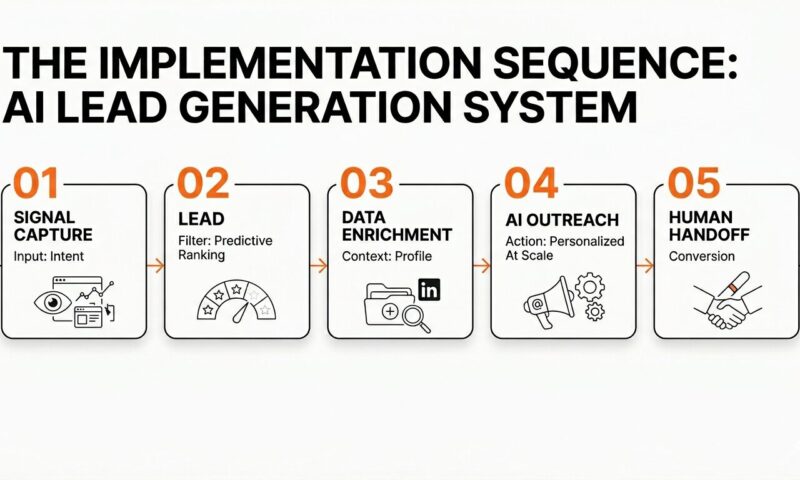
Using AI for lead generation means deploying a sequence of systems that capture intent signals, score leads automatically, enrich contact data, and personalize outreach at scale. The order matters: firms that start with outreach before their scoring layer is stable see high send volume and low conversion. The sequence runs from signal capture through to structured human handoff.
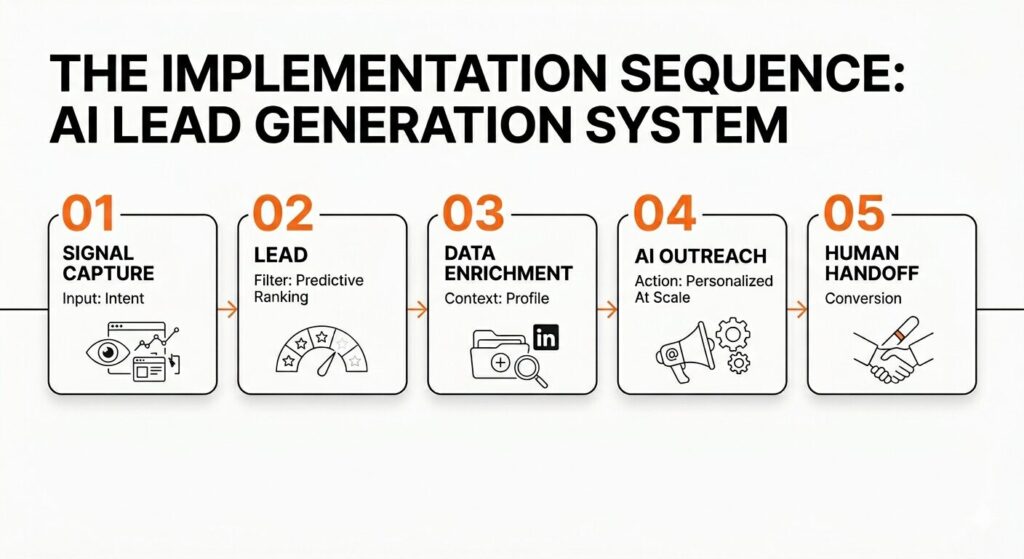
This guide walks through that sequence in order, explains what each layer requires before you build it, and identifies the patterns that cause firms to abandon AI tools after three months of underwhelming results.
What Using AI for Lead Generation Actually Involves
The Difference Between an AI Tool and an AI Lead Generation System
An AI tool does one job: it enriches a contact record, scores a lead, or drafts a sequence. An AI lead generation system connects those tools into a pipeline that runs without manual intervention at each handoff point.
The distinction matters because most firms buy tools one at a time without a plan for how they connect. You add a scoring layer. Six months later you add an enrichment platform. The outreach tool you chose first does not integrate cleanly with the scoring model you built second. By the time the system is complete, three people are manually moving data between stages because the integrations never quite worked.
A system approach means deciding the full architecture before purchasing anything and building each layer in the sequence that makes each subsequent layer more effective. That is what the implementation sequence is designed to produce.
Why the Sequence Matters More Than the Software
The most common question firms ask before implementing AI for lead generation is: which tools should we use? The more useful question is: in what order should we build?
A well-sequenced implementation with mid-tier tools will outperform a poorly sequenced one with premium software. Signal capture feeds scoring. Scoring feeds enrichment decisions. Enrichment improves outreach targeting. Each layer depends on the one before it producing clean, reliable output. Build in the wrong order and you will spend months debugging data quality problems that a better sequence would have prevented.
Firms that reverse the order typically over-invest in outreach automation before their scoring and enrichment layers are producing accurate data. The result is high message volume with low conversion, which often leads to domain reputation damage and deliverability problems that take months to recover from. Sequence discipline is not bureaucratic caution; it is what protects the ROI of every tool you buy.
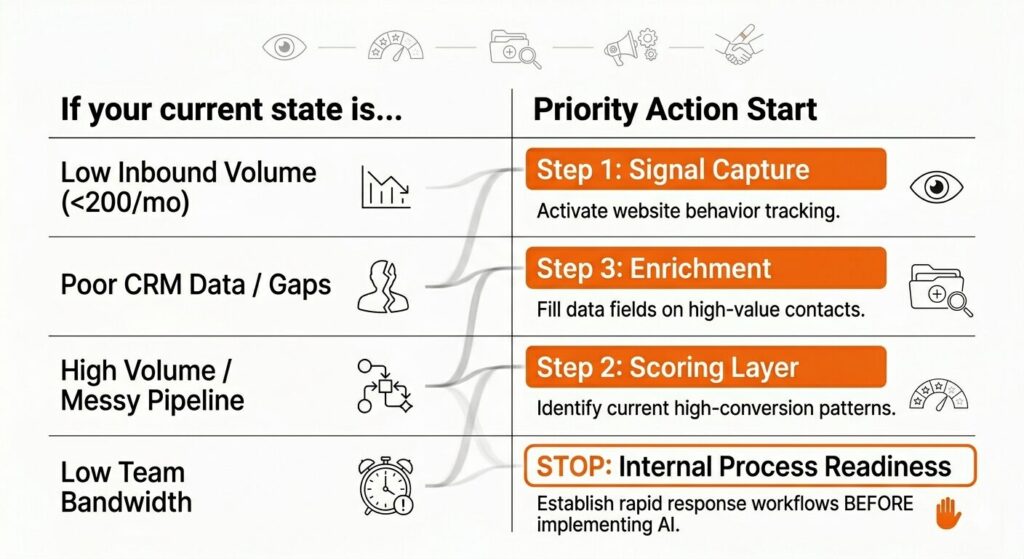
The Three Variables That Determine Where You Start
Your Current Lead Volume and Pipeline Visibility
If your firm generates fewer than 200 inbound signals per month, a sophisticated scoring model will not have enough data to produce reliable predictions. [VERIFY: minimum data threshold, most scoring vendors cite 500 to 1,000 historical leads for model calibration] At low volume, the priority is expanding signal capture before investing in scoring infrastructure.
If you have high inbound volume but limited pipeline visibility, meaning your team cannot tell you which sources produce closed deals, the priority is instrumentation: making sure lead sources, touchpoints, and conversion events are being tracked before you ask AI to score anything.
Your CRM Data Quality
AI lead scoring runs on historical data. If your CRM contains incomplete records, duplicate contacts, or inconsistent field values from manual data entry, a scoring model trained on that data will produce unreliable output.
Before building the scoring layer, run a data quality audit. Check field completion rates on your most important attributes: company size, industry, job title, source, and deal stage. If completion rates fall below 70 percent on critical fields [VERIFY: CRM data quality benchmarks for scoring readiness], enrichment should come before scoring, not after.
Your Team’s Capacity to Review and Act on AI Output
AI lead generation systems produce recommendations, not decisions. A scoring model flags high-priority leads. The sales team still has to call them. An outreach sequence generates messages. A human still manages replies that fall outside the expected pattern.
If your team does not have the bandwidth to act on AI output within 24 hours, the system will underperform regardless of how well it is built. Process readiness is not a technology question, but it is a prerequisite to getting value from the technology.
Step One: Deploy Signal Capture Before Anything Else
Behavioral Signals vs. Demographic Signals: What to Prioritize First
Signal capture involves two distinct types of data. Behavioral signals are actions a prospect takes: visiting your pricing page, opening a sequence email, downloading a resource, or returning to the site multiple times within a short window. Demographic signals are firmographic attributes: company size, industry, revenue range, and technology stack.
Behavioral signals are higher intent and more immediate. A prospect who visits your pricing page three times in a week is further along the evaluation process than one who simply matches your ideal customer profile. Start your signal capture infrastructure on the behavioral side: make sure your website is instrumented to capture page-level intent data before you invest in demographic data sourcing.
The Tools That Handle Signal Capture Well
Intent data platforms vary significantly in what they capture and how they define intent signals. [VERIFY: pricing ranges, entry-level intent tools from $500 to $2,000 per month; enterprise platforms from $30,000 to $100,000 per year] The meaningful differences are in match rates (what percentage of anonymous visitors get identified) and signal granularity (whether the platform tracks page-level behavior or only domain-level visits).
Before selecting a tool, confirm it integrates with your CRM without requiring custom development. Signal data that does not flow automatically into the scoring layer creates manual work for someone on your team, which defeats the purpose of the system.
Step Two: Build Your Lead Scoring Layer
What Makes a Scoring Model Actually Predictive
A lead scoring model takes behavioral and demographic signals as inputs and produces a priority ranking as output. The model is only as good as the signals it receives and the historical outcomes it was trained on.
For a scoring model to be genuinely predictive rather than a weighted checklist, you need at minimum 90 days of historical pipeline data with defined outcomes: which leads converted, which were lost, and at what stage they dropped out. [VERIFY: 90-day minimum data window, standard recommendation across HubSpot, Salesforce, and major scoring vendors] Without that baseline, the model cannot learn what high-converting leads actually look like in your specific pipeline.
The Most Common Mistake: Scoring Before You Have Baseline Data
The most frequent cause of early scoring model failure is implementation before there is enough data to train on. Firms launch a scoring layer in month one of their AI investment, generate scores that do not correlate with actual conversion behavior, and conclude that AI lead scoring does not work.
The actual problem is sequencing. Scoring models need baseline data. If your pipeline is new or your historical records are incomplete, spend the first 60 to 90 days on signal capture and instrumentation. Let the data accumulate. Then build the scoring model against a dataset that can actually teach it what good looks like.
If you are not sure which layer to build first, SuperteamAI maps your current pipeline state to a phased deployment plan so you do not pay for outreach automation before your scoring foundation is in place. Talk to the team
Step Three: Layer in Data Enrichment
What Enrichment Adds That Scoring Cannot
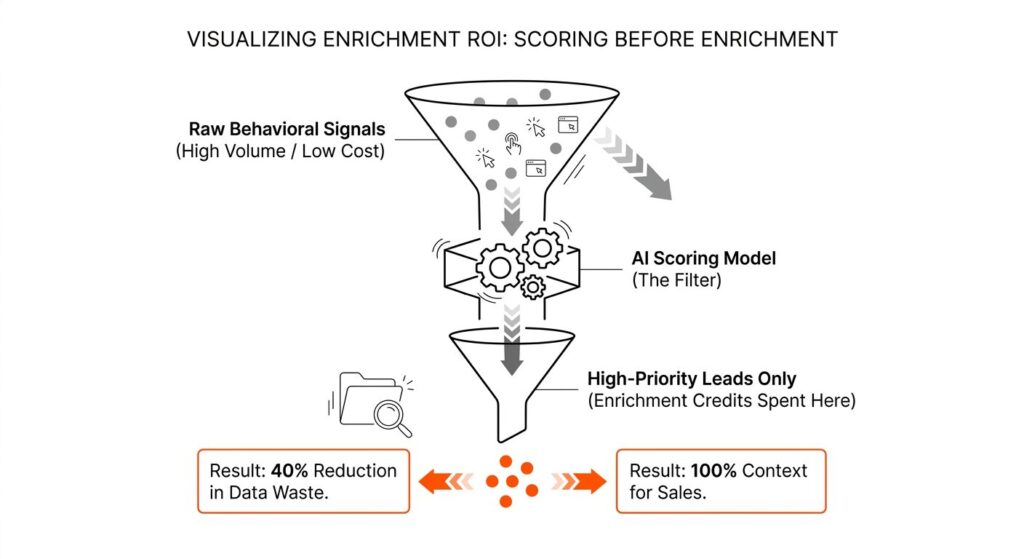
Lead scoring tells you which contacts are most likely to convert based on the signals you have already captured. Data enrichment fills in the gaps in your contact records so the scoring model has more accurate inputs and your outreach team has more context.
Enrichment typically adds or verifies: direct phone numbers, LinkedIn profiles, job title and seniority, company headcount, technology stack, and funding history. [VERIFY: enrichment match rates, top platforms claim 80 to 95 percent match rates on B2B contact records] These attributes both improve scoring accuracy and give your outreach team the context needed to personalize messages without manual research before each send.
The sequencing principle here is that enrichment should run after scoring has been established, not as a precondition of it. If you enrich every lead before scoring, you spend enrichment credits on low-priority contacts. Run scoring first to identify which contacts are worth enriching.
Enrichment Platforms Worth Evaluating in 2026
The dominant enrichment platforms differ primarily in their data sources, update frequency, and pricing model. [VERIFY: platform comparison, ZoomInfo, Clearbit, Lusha, Apollo.io, pricing from $50 per month for small teams to $50,000 per year for enterprise contracts with full API access]
Evaluate platforms on three dimensions: coverage for your target market by industry and geography, data freshness measured by how often records are re-verified, and integration depth with your CRM. A platform with high coverage but poor CRM integration will require manual data handling that erodes the time savings enrichment is supposed to create.
Step Four: Introduce AI-Powered Outreach Last
Sequence Design vs. Message Personalization: Which to Build First
AI-powered outreach involves two distinct functions: sequence design and message personalization. Sequence design determines how many touches a lead receives, at what intervals, and across which channels. Message personalization uses lead data to customize message content for each individual contact.
Build the sequence structure first. Define the number of steps, the timing, and the channel mix before adding personalization logic. A well-designed sequence with generic copy will outperform a poorly designed one with personalized messages. Personalization amplifies a good sequence; it cannot fix a broken one.
When AI-Generated Copy Works and When It Breaks Conversion
AI-generated outreach copy performs well when it pulls from specific, verified data points: the contact’s job title, company size, a recent trigger event, or a technology the company uses. It breaks down when input data is sparse or inaccurate, because the personalization reads as templated rather than researched. [VERIFY: personalization lift, AI-personalized emails show 15 to 35 percent higher reply rates vs. generic sequences in multiple vendor-cited studies]
The practical implication is that AI-powered outreach only delivers its full lift when the signal capture, scoring, and enrichment layers beneath it are producing clean, current data. This is why outreach goes last in the sequence, not first.
How to Measure Whether the Sequence Is Working
The Three Metrics That Matter in the First 90 Days
Most teams that implement AI for lead generation measure the wrong things early. They track email open rates, sequence completion rates, and total lead volume. These metrics describe activity, not whether the system is producing results.
The three metrics that indicate whether the sequence is functioning are: reply rate on AI-personalized outreach [VERIFY: industry benchmark, 5 to 12 percent reply rate on AI-assisted sequences depending on channel and persona], MQL-to-SQL conversion rate measuring whether the leads the scoring model surfaces are actually converting to sales-qualified [VERIFY: MQL-to-SQL conversion rate, industry average around 13 percent, with AI-scored pipelines reporting 20 to 30 percent in vendor case studies], and cost per qualified lead compared to your pre-AI baseline [VERIFY: cost per qualified lead reduction, firms implementing the full sequence report 30 to 50 percent reductions].
If reply rates are low, the problem is usually in outreach design or data quality. If MQL-to-SQL conversion is low, the scoring model needs recalibration. If cost per qualified lead is not improving after 90 days, revisit the order in which the layers were deployed.
What This Looks Like for Marketing Agencies and Real Estate Firms
Marketing Agencies: Building the Sequence for Client Acquisition and White-Label Delivery
For marketing agencies, AI for lead generation serves two purposes: acquiring new clients for the agency, and building lead generation systems for clients as a service offering.
For agency client acquisition, the implementation sequence above applies directly. The typical starting point is behavioral signal capture on the agency website and LinkedIn channel, followed by scoring against ICP attributes, followed by enrichment and targeted outreach. Agencies that have implemented the sequence for their own pipeline are better positioned to deliver it for clients because they have direct experience with where each layer can fail. They understand, for example, that a scoring model deployed before baseline data exists will underperform and damage client confidence in the overall AI investment.
The top AI agent development companies that agencies partner with for technical build-out play a meaningful role in this delivery model, particularly when custom scoring model development or CRM integration work is involved.
Real Estate Firms: Adapting the Sequence for Buyer and Seller Funnels
Real estate lead generation involves two separate buyer journeys with different intent signals, different data requirements, and different outreach timing. Buyer leads show intent through property search behavior, inquiry volume, and pre-approval stage. Seller leads show intent through home value search behavior, listing views, and equity-related content engagement.
The implementation sequence remains the same, but the scoring models need to be built separately for buyer and seller pipelines. Mixing them produces a model that performs poorly on both. Real estate firms early in their AI implementation should choose one funnel to start, build a functional scoring layer, and replicate the architecture for the second funnel once the first is producing reliable output. The cost implications of phasing the build this way are covered in detail in AI agent development cost.
Frequently Asked Questions
How long does it take to see results from AI lead generation?
Most firms see meaningful signal capture and scoring data within 60 to 90 days. Reply rates and MQL conversion typically stabilize by month four as the scoring model accumulates enough conversion data to produce reliable predictions. Rushing the timeline by skipping earlier layers is the most common cause of slow results.
Do you need a large existing database to use AI for lead generation?
You do not need a large database, but you need enough historical pipeline data to train a scoring model. A firm with 500 to 1,000 historical leads and defined conversion outcomes can build a functional scoring layer. Firms below that threshold should prioritize signal capture first and delay scoring model deployment until sufficient data exists.
What is the difference between AI lead generation and traditional marketing automation?
Traditional marketing automation executes predefined workflows: if a contact opens an email, send a follow-up after three days. AI lead generation adapts based on patterns across the full dataset, identifying which combination of signals, attributes, and timing correlates most strongly with conversion and adjusting lead prioritization accordingly. The two approaches work together; AI lead generation typically runs on top of a marketing automation infrastructure.
Can a small team implement this without a dedicated technical resource?
Signal capture and outreach layers can be deployed by a non-technical team using platform tools. The scoring layer, particularly custom model development, typically requires either a technical resource or a managed service provider. The AI lead generation system overview covers the build-vs-buy decision in more detail.
How does this connect to broader AI agent development?AI lead generation is one application built on AI agent development infrastructure. The scoring models, enrichment integrations, and outreach personalization engines that power a lead generation system are forms of AI agents operating within a defined workflow. Firms that invest in AI lead generation infrastructure often find that the same underlying systems can extend to support client onboarding, proposal generation, and follow-up automation.


