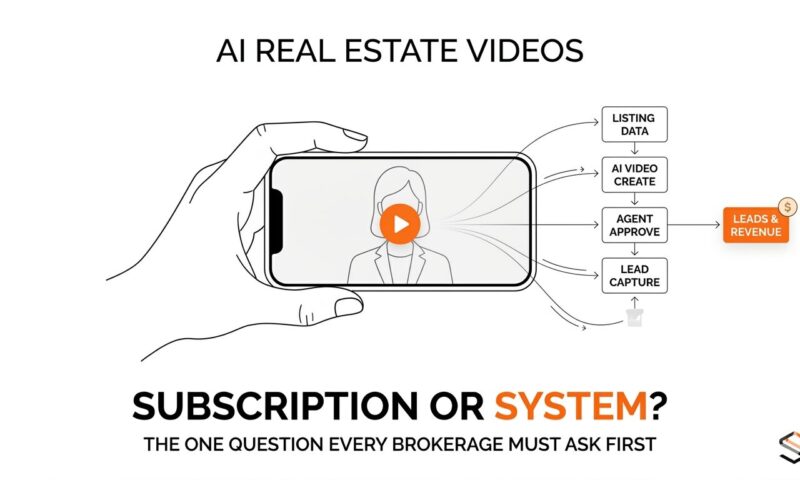
AI UGC video creators for real estate are tools that generate listing walkthrough videos, social media clips, and agent spokesperson content using AI avatars, property photos, and automated scripts, without a camera crew or video editor. They are used by agents and brokerages to produce listing videos in minutes rather than days, at a fraction of traditional production costs.
A brokerage owner in Hyderabad sent a Creatify login to 32 agents in January. Six weeks later, he checked the usage analytics: three agents had logged in, one had published a video, and the subscription was sitting unused at roughly ₹14,000 a month. The tool was not the problem.
This review is not written for the solo agent making content for three listings a month. It is written for the person who decides whether to put a tool in front of 30 people and pay for it. That is a different question, and it requires a different answer.
What AI UGC Video Tools for Real Estate Actually Do
The three categories of output
AI video tools for real estate produce three distinct types of content. First, AI avatar and spokesperson videos: a synthetic agent, or a clone of the real one, presents a property or market update directly to camera. Second, property walkthrough videos: the tool animates static listing photos into a cinematic sweep, simulating camera movement across rooms. Third, social media clip generators: the tool auto-formats content into Reels or TikTok clips with captions, background music, and platform-specific aspect ratios. Some tools do one of these well. A few do all three. Knowing which you need before choosing saves the trial-and-error month most brokerages go through.
What “UGC-style” means and why it matters for real estate leads
UGC stands for user-generated content: the kind of video that looks like it was made by a person, not a production company. In real estate, the distinction matters because buyers trust people more than brands. A polished brand video signals distance. A creator-style walkthrough with a real, or convincingly real, agent talking through the kitchen layout signals proximity and honesty. In Indian and Gulf real estate markets specifically, where buyer decisions are heavily shaped by personal trust in the agent, this is not a minor aesthetic detail. It is a lead conversion variable.
The Tools That Are Worth Your Time: Honest Reviews
Creatify — best for volume at the lowest cost per video
Creatify’s URL-to-video feature is the reason brokerages look at it first. [VERIFY: At base tier pricing, Creatify produces videos at approximately $1.27 per video, with batch production capacity allowing a single operator to generate content for 100 listings in under an hour.] You paste a listing URL, select an AI avatar and voiceover style, and Creatify generates a formatted video. At brokerage scale, this is the only tool that makes the economics straightforward. The honest limitation: the AI avatars sit just below the threshold where they read as convincingly human in 2026.
HeyGen — best for multilingual and agent spokesperson content
HeyGen supports over 175 languages with native lip-sync capability, making it the strongest AI video tool for real estate firms operating across language boundaries. For a brokerage in Dubai handling Arabic-speaking, Russian-speaking, and Hindi-speaking buyer segments simultaneously, this is a genuine operational advantage, not a feature list item. An agent records once in English; HeyGen translates and lip-syncs the video into three languages without a reshoot. The cost per video is higher, closer to $3 to $5 at standard usage, which makes a per-listing selection strategy necessary rather than deploying it across all inventory.
Arcads — best for premium realism when the brand demands it
Arcads enters at $110 or more per month, with API access required for mass-production workflows across large listing volumes, and offers no free trial at any tier. The AI actors sit noticeably closer to the human threshold than any other tool reviewed here. For firms positioning in the HNI segment where the visual quality of content is read as a signal of the firm’s own quality, this premium matters. The practical limitation: the cost structure only makes sense when the per-listing value justifies it. Arcads is a selective tool for the listings that warrant it.
PhotoAIVideo — best for property-first cinematic walkthroughs
PhotoAIVideo does not create spokesperson content. It creates cinematic property presentations from static listing photos, using spatial AI to simulate camera movements such as dolly zooms and pull-outs that would require a $2,000 gimbal setup on location. [VERIFY: PhotoAIVideo offers direct MLS integration, automatically pulling listing data to reduce manual input requirements per video.] For portal publishing and listing pages where the property itself is the subject, this is the strongest output quality in the category.
Argil — best for agents who want a digital clone of themselves
Argil’s model is distinct: an agent records a two-minute selfie video, Argil trains a digital clone from that footage, and the agent then generates unlimited videos of their own likeness from scripts. The output is agent-branded content that looks like the agent made it, because in a meaningful sense they did. For personal brand building in competitive micro-markets where agent recognition drives referrals, this is a high-value use case. The operational limitation at scale is real: setting up 40 individual agent clones requires 40 individual recording sessions and 40 individual training processes. It is not a system a brokerage ops manager can deploy in a week.
AutoReel — best for high-volume listing feeds with exterior-heavy properties
AutoReel’s flythrough simulation pulls from satellite imagery and listing photos to generate aerial-perspective walkthroughs without drone footage. For large acreage properties, villa communities, and developments where the neighbourhood and site context are primary selling points, this fills a gap that other tools leave open. [VERIFY: AutoReel produces full property walkthrough video renders in approximately 10 minutes per listing from photo input to export-ready file.] Interior quality lags behind PhotoAIVideo, which makes AutoReel most effective as one component in a multi-tool workflow.
The Honest Comparison Table
Traditional professional real estate video production costs between $300 and $1,200 per listing, compared to $8 to $25 for AI-generated alternatives, a saving of more than 95 percent at scale. The table below shows the key variables for a purchase decision. It does not show the operational cost of getting agents to use each tool consistently, which is where most video budgets disappear.
| Tool | Best For | Price/Month | Cost Per Video | Brokerage Scale | Free Trial |
| Creatify | Volume, batch production | $19 | ~$1.27 | Small to large | 2 videos |
| HeyGen | Multilingual, spokesperson | $29+ | $3 to $5 | Small to medium | Limited |
| Arcads | Premium realism, HNI | $110+ | $5.50 to $11 | Selective use | None |
| PhotoAIVideo | Property walkthroughs | $29 | ~$1.50 | Any | Yes |
| Argil | Agent digital clone | $39+ | ~$2 | Solo to small | 5 days |
| AutoReel | Exterior, aerials | Volume pricing | Varies | Medium to large | Limited |
Where Every One of These Tools Breaks
The adoption problem no review mentions
The Hyderabad brokerage that cancelled its Creatify subscription did not have a tool problem. It had an adoption problem. There was no upload template telling agents what photos to use. There was no weekly schedule telling agents when to create content. There was no performance feedback loop showing agents that the listings with videos were getting more inquiries. Enterprise software adoption research consistently shows that tools without structured onboarding workflows and assigned ownership see active usage rates below 20 percent within 60 days of initial deployment in sales teams. It sat unused, costing money monthly. For the full AI stack that real estate agents actually adopt, see the AI tools guide for real estate agents.
The post-video problem: where does the lead go?
A buyer watches a walkthrough video on Instagram, gets interested, and taps the contact link. If that link goes to a portal that does not capture the enquiry into a CRM, the video generated interest that nobody followed up on. If it goes to a WhatsApp number that three agents share and nobody owns, the response is late, inconsistent, or never happens. The video is the top of the funnel. Every tool reviewed here handles the top of the funnel. None of them close the funnel. For the pipeline management layer that sits beneath the content layer, see how AI handles real estate lead generation.
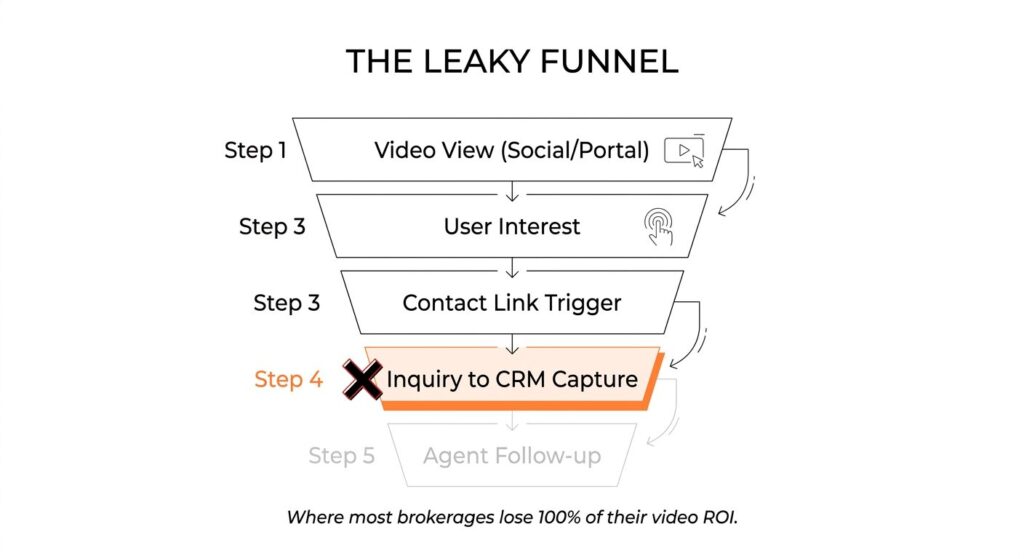
What the Brokerage Owner’s Question Should Be
The tool is not the system
The right question is not “which AI video tool should we use?” The right question is: where does the listing data live, who triggers video creation, who reviews the output, where does the video publish, and what happens to the viewer after they watch it? Until those five questions have answers, the tool choice does not matter.
What a brokerage video content layer actually looks like
In a properly built content system, the workflow looks like this: a property record enters the inventory database, video creation is triggered automatically using the listing data, a default branded template is applied, the listing agent receives a WhatsApp notification with the draft video for one-tap approval, and on approval the video publishes simultaneously to the portal listing page, the brokerage’s Instagram account, and the agent’s own WhatsApp broadcast list. No blank page. No tool login required from the agent. No manual step.
The Luxury Property Exception
When AI video builds trust and when it destroys it
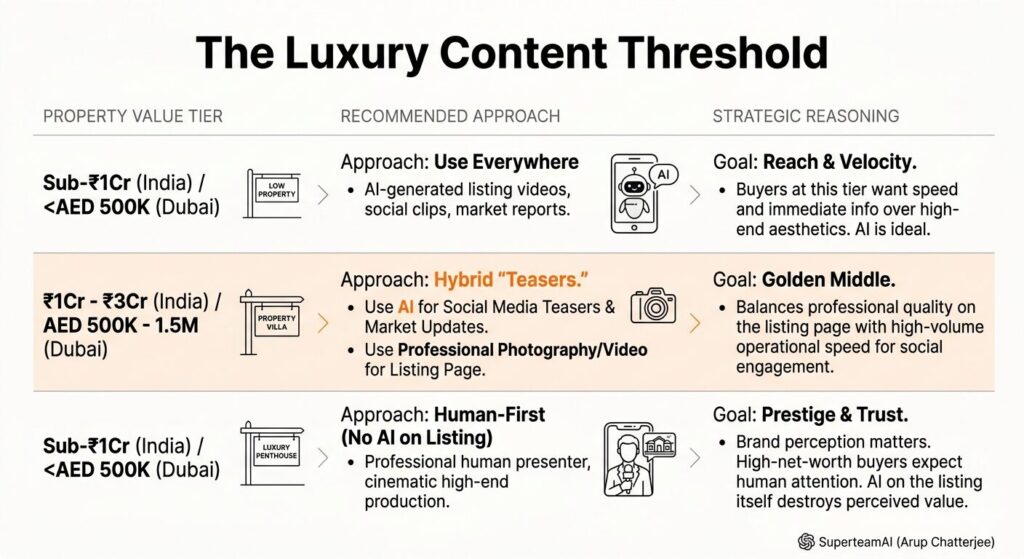
There is a threshold above which AI-generated video becomes a liability rather than an asset, and every brokerage selling into the HNI and UHNW segment needs to know where that threshold sits for their specific market. [VERIFY: Research on buyer trust and AI-generated content in high-value property transactions indicates that high-net-worth buyers are significantly more likely to disengage when content is perceived as AI-generated, compared to mid-market buyers in the same search session.] The practical framework works across three tiers. For listings below roughly ₹1 crore in India or AED 500,000 in Dubai, AI video is the obvious choice and buyers in that segment want information, not cinema. Between ₹1 crore and ₹3 crore, or AED 500,000 to AED 1.5 million, a hybrid approach works: AI for social media teasers, professional photography for the portal listing. Above ₹3 crore or AED 1.5 million, use AI for operational content such as market reports, area updates, and milestone communications, but not for the listing presentation itself.
How to Choose the Right Tool for Your Situation
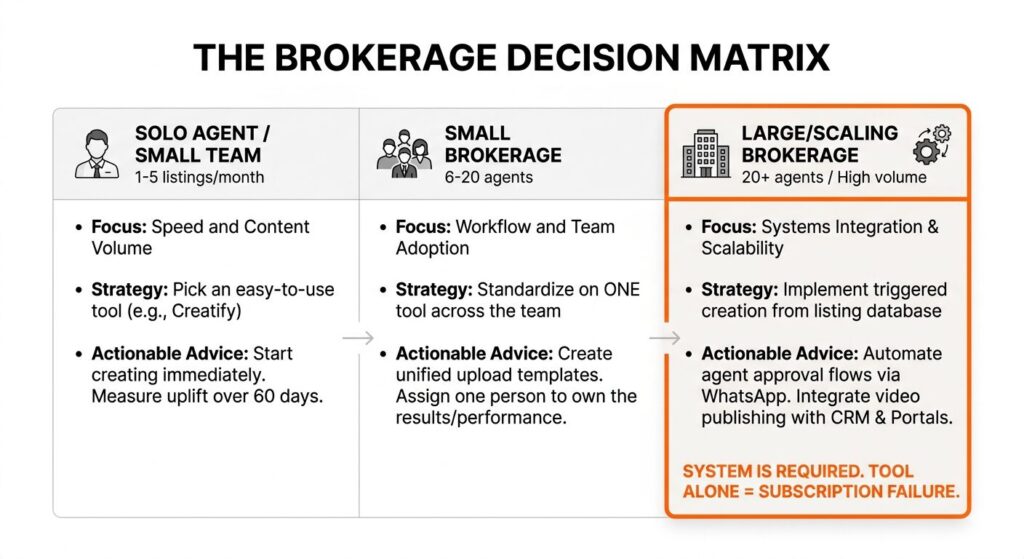
Decision matrix by brokerage size and market
A solo agent or a team of two to three can make a straightforward decision: pick Creatify if volume matters most, pick HeyGen if you operate across language segments, pick Argil if personal brand recognition is your primary acquisition channel. Start, measure inquiry uplift over 60 days, and adjust.
A small brokerage of six to twenty agents needs one additional step: standardise on a single tool, create one upload template, define one publishing protocol, and assign one person to own the results. Without ownership, the tool becomes the Hyderabad outcome.
A brokerage with twenty or more agents and two hundred or more listings is in a different situation entirely. At that scale, a tool is not sufficient. What is needed is a workflow layer with triggered creation from the inventory database, an agent approval flow via WhatsApp, auto-publishing to portals and social accounts, and a lead capture mechanism on every video view. For the listing automation component that connects to this workflow, see how AI real estate listing descriptions work at brokerage scale.
The Bottom Line
The six tools reviewed here are genuinely useful. Creatify wins on volume economics. HeyGen wins on multilingual capability. Arcads wins on premium realism. PhotoAIVideo wins for property-first cinematic content. Argil wins for personal brand builders. AutoReel wins for exterior-heavy listings and villa developments.
If you are a solo agent or small team, pick one and start this week.
If you are running a brokerage with twenty or more agents, the tool decision is not the important decision. The important decision is who owns the workflow, what triggers video creation, and where the lead goes after the viewer watches. A tool in the hands of agents who have no workflow around it is a subscription. Not a system.


