AI cold calling for real estate uses voice AI to handle outbound and inbound calls automatically: qualifying inbound leads, following up on missed calls within seconds, re-engaging cold contacts, and booking appointments without agent involvement. The system runs four distinct workflows and integrates with the brokerage CRM, so every conversation is logged and every lead actioned regardless of office hours.
What an AI Voice Agent Actually Does in a Real Estate Brokerage
A voice AI agent is not an IVR menu and it is not a chatbot with a speaker attached. It is a real-time conversational system that handles a call the way a trained ISA would: it asks qualifying questions, listens to the answers, adjusts its follow-up based on what the caller says, and routes the conversation to a booked appointment, a CRM update, or a warm handoff to a human agent depending on the lead’s response.
The difference between a voice AI and a human ISA is not conversation quality on a first call. It is the fact that the voice AI picks up on the first ring at 2am on a Sunday and routes the same lead the same way every time, without fatigue, without variance, and without the brokerage paying Rs 25,000 per month for the privilege. For the full AI stack surrounding the voice agent, see what a real estate AI agent covers across the brokerage operation.
How the voice call pipeline works
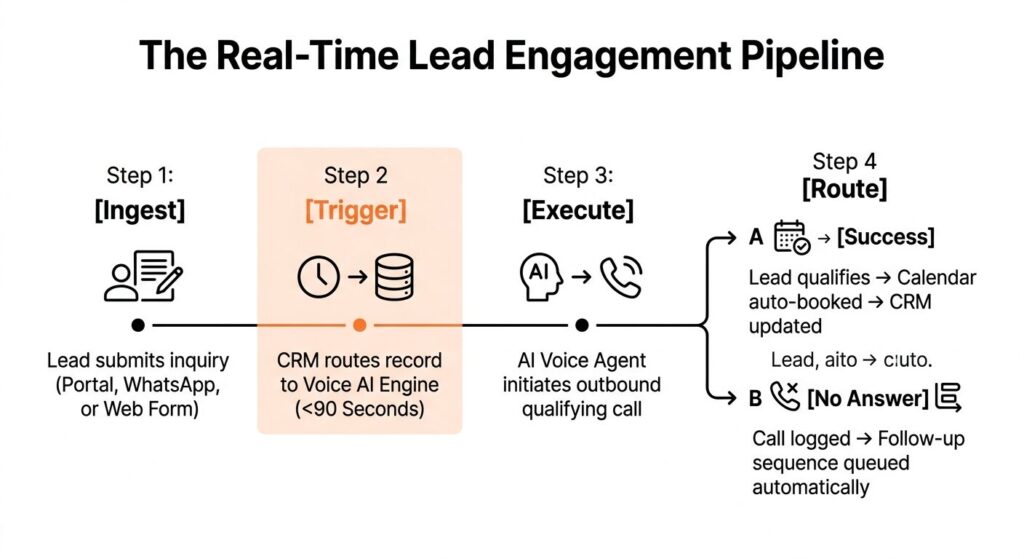
The call pipeline has four points of contact. The lead submits an inquiry through a portal listing, a WhatsApp broadcast, or a website form. The CRM receives the inquiry record and triggers the voice agent within a defined time window, typically 90 seconds or less. The voice agent places the outbound call, runs through the qualifying script, and updates the CRM with the outcome: qualified and booked, qualified and pending, or unqualified with the stated objection logged. If the lead qualifies and accepts an appointment, the calendar books automatically. If the lead does not pick up, the agent queues a follow-up sequence. No human is involved until a qualified appointment exists.
The Four Workflows a Real Estate AI Voice Agent Runs
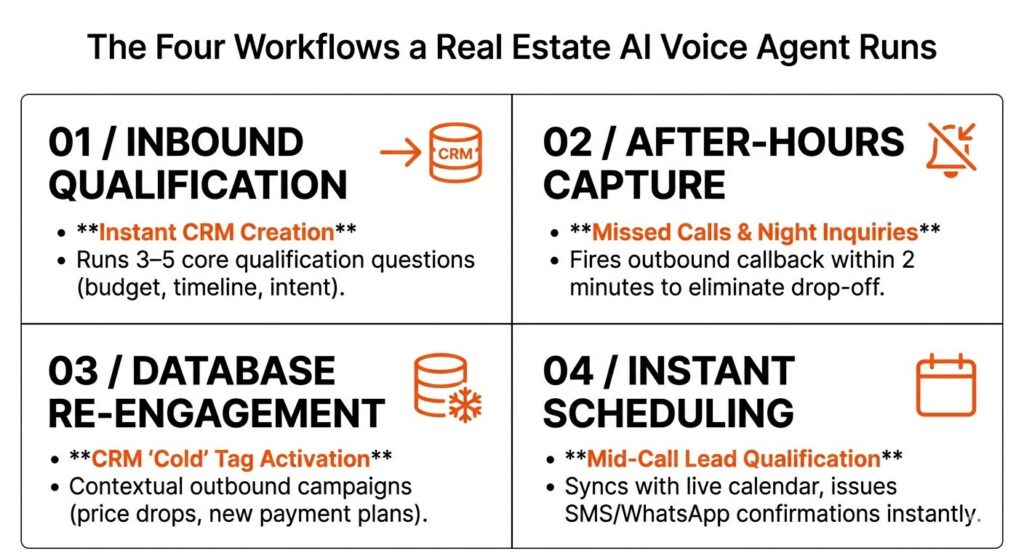
The voice agent is not a single workflow. It is four distinct automated processes that address the four scenarios where leads fall through in a brokerage that relies on human agents alone.
Workflow 1: Inbound lead qualification reply
A new lead arrives from MagicBricks, Bayut, Zillow, or a WhatsApp broadcast. The voice agent calls the number within 90 seconds. It identifies itself as the brokerage’s assistant, confirms the property the lead inquired about, and runs through three to five qualifying questions: budget range, timeline, whether the lead is an end-user or investor, and preferred viewing window. If the lead qualifies, the agent books the appointment on the calendar and sends a confirmation SMS. The agent does not wait for a human to see the lead arrive. It fires automatically the moment the CRM record is created.
Workflow 2: Missed call and portal inquiry follow-up
A lead called the office at 7pm, got no answer, and moved on to the next listing. Without a voice agent, that lead is gone unless an agent happens to see the missed call the next morning and remembers to call back. With a voice agent, the missed call triggers an automatic outbound call within two minutes, regardless of when the original call came in. The same applies to portal inquiry forms submitted outside office hours. The lead who submitted a Bayut inquiry at 11pm on Thursday gets a qualifying call at 11:02pm, when their interest is at its highest. The agent who arrived in the office at 9am on Friday gets a CRM entry showing a qualified lead with a booked Saturday viewing.
Workflow 3: Cold lead re-engagement
Every brokerage has a CRM full of leads that went quiet three months ago. An agent followed up twice, got no response, and moved the record to cold. A voice agent runs a re-engagement campaign against that database: it calls each lead with a specific reason to reconnect, whether that is a new listing in the area they inquired about, a price change on a property they viewed, or a new payment plan announcement from a developer. The call is outbound, the trigger is a CRM tag or a date condition, and the script is tailored to the reason for the call. For the full lead generation pipeline that feeds this database, see how AI real estate lead generation fills the brokerage CRM.
Workflow 4: Appointment booking and confirmation
The agent qualifies the lead and the conversation reaches an appointment slot. Without automation, the ISA reads off available times, the lead picks one, the ISA enters it in the calendar, and someone remembers to send a confirmation. With a voice agent, the moment the lead accepts an appointment, the system reads live calendar availability, confirms the slot in the same call, books it, sends a confirmation SMS and WhatsApp message, and queues an automated reminder 24 hours before the viewing. The appointment exists in the CRM and the calendar simultaneously, attributed to the lead source, the inquiry date, and the voice agent that booked it.
AI Voice Agent vs Human ISA: The Cost and Performance Comparison
This is the calculation most brokerages run once and then do not need to revisit, because the conclusion does not change at any volume above 50 monthly inquiries.
The monthly cost comparison by market
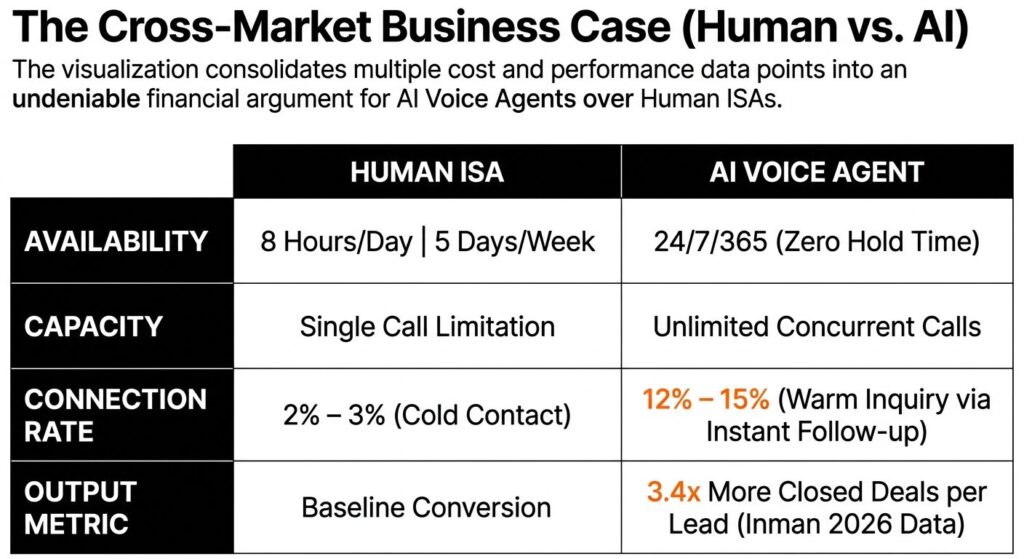
A human ISA in the United States costs between $3,000 and $4,500 per month in salary, with an additional $800 to $1,200 in benefits, training, and HR overhead. That ISA handles one call at a time, works an eight-hour shift, and is unavailable on weekends without overtime. An AI voice agent in the same market costs between $1,000 and $2,000 per month, handles unlimited concurrent calls, operates 24 hours a day and seven days a week, and does not require onboarding time when the brokerage adds a new listing type or expands into a new geography.
In India, the ISA cost is Rs 15,000 to Rs 35,000 per month depending on city and experience level. In Dubai, AED 4,000 to AED 8,000 per month is the typical range for an inside sales agent with residential real estate experience. In both markets, the AI voice agent cost is lower and the operational coverage is wider.
See the AI voice agent SuperteamAI deploys for brokerage clients in India, Dubai, and the US
The performance numbers that inform the decision
The two numbers that move the business case are connection rate and cost per appointment. Traditional cold calling on cold contact lists achieves a 2 to 3 percent connection rate. AI voice agents working warm portal inquiry leads achieve 12 to 15 percent connection rates. The cost per booked appointment via AI is 60 to 80 percent lower than ISA manual booking at the same lead volume. The combination of lower cost, higher connection rate, and 24/7 coverage means that a brokerage with 200 monthly portal inquiries converts more of them to appointments with a voice agent than it would with an ISA working the same lead list on office hours.
India and Dubai Market Requirements for AI Voice Agents
A generic English-language voice AI built for the US market does not work in Bangalore or Dubai without configuration. The market requirements are different enough that a misconfigured agent creates the wrong first impression for the lead and the wrong outcome for the brokerage.
Language, tone, and market-specific script requirements
In India, the agent needs to handle calls in English and Hindi at minimum, with regional language capability in markets like Bangalore (Kannada), Chennai (Tamil), or Hyderabad (Telugu). The tone calibration for Indian buyers differs from the US context: the initial call should be warmer and less transactional, the qualifying questions should include family configuration alongside budget, and reference to specific developer names and society names carries weight that generic property type references do not. In Dubai, the agent needs English and Arabic capability, with tone calibration that reflects the market mix of investor buyers, end-users, and Golden Visa seekers. The script for an off-plan inquiry in Dubai includes payment plan structure and DLD fee context in ways that a standard residential qualifying script does not cover.
A Live Brokerage Setup: Tech Stack and Call Flow
The voice agent does not exist in isolation. It sits in a specific position inside a brokerage’s technology stack and connects to a defined set of tools. The setup determines whether the agent delivers the outcome described above or produces a disconnected experience that damages the lead relationship.
The tech stack and integration points
The standard configuration has four components. The CRM serves as the trigger layer: when a lead record is created or a defined field is updated, the CRM sends a signal to the voice agent platform. Real estate-specific CRMs such as Sell.Do in India, Salesforce, or HubSpot can all be configured to fire this trigger. The voice agent platform, which includes options like Bland AI, Retell AI, or a custom build on Twilio with an LLM layer, handles the call itself. The calendar integration receives the appointment booking and sends confirmation messages through Google Calendar, Calendly, or the brokerage’s internal scheduler. The listing database provides the property-specific context the agent needs to answer questions about the exact property the lead inquired about, rather than giving generic answers that lose the call before the first qualifying question lands. For the content layer that feeds leads into this pipeline, see how AI real estate listing descriptions integrate with the brokerage lead pipeline.
The Four Broker Objections to AI Cold Calling (and What the Evidence Shows)
Most brokers who have not deployed a voice agent hold one of four objections. The evidence addresses each one specifically.
How the evidence addresses each objection
The first objection is that AI sounds robotic and will put leads off. Consumer research from 2026 shows that fewer than 30 percent of leads correctly identify the caller as AI during a well-configured voice agent call. The leads who do identify it show no statistically significant difference in appointment acceptance rate compared to those who do not, provided the agent handles the call professionally and delivers value immediately rather than reading from a rigid script.
The second objection is that the agent will give wrong information about the listing and create liability. This is resolved by architecture: the voice agent is connected to the listing database and answers only from the data in the record. It does not speculate. When a lead asks a question outside the data the agent has access to, it flags the question for human follow-up and logs it in the CRM with the lead’s contact details.
The third objection is that agents will resist using it because it makes them feel replaceable. The voice agent does not replace the agent. It handles the qualification work the agent did not want to do and delivers warm, booked leads directly to the agent’s calendar. Agents who resist cold calling as a task adopt the voice agent faster than agents who embrace it, because the agent does the work they avoided.
The fourth objection is that the setup is too complex. A standard voice agent integration with a CRM and a calendar takes two to three working days to configure. The prompt engineering and script calibration take one additional day. The brokerage is running calls by day five.
Compliance: TCPA, DNC, and RERA
AI voice agents automate outbound calls at scale. In every market, that automation intersects with telecommunications regulations that carry real financial penalties for non-compliance.
What to configure before the first call goes out
In the United States, the Telephone Consumer Protection Act governs automated outbound calls. TCPA violations carry fines of $500 per call for negligent violations and $1,500 per call for willful violations, with no statutory cap on aggregate liability. The configuration requirements are specific: the call must begin with an identification statement naming the business placing the call, the lead must have provided prior express written consent for automated calls, the DNC registry must be checked and excluded before every campaign runs, and the calling window is restricted to 8am to 9pm in the recipient’s local time zone. A brokerage running AI voice outreach in the US without TCPA compliance configuration is running a litigation risk on every call, not a smarter lead system.
In India, the Telecom Regulatory Authority of India governs commercial communications. Calls to mobile numbers without prior consent registered through the TRAI framework carry penalties and the risk of number blacklisting, which terminates the brokerage’s outbound calling capability on that line. In Dubai, RERA regulations govern agent-to-client communications and the representation of off-plan properties in any medium, including voice. The AI agent’s script must not make representations about developer timelines, project completion dates, or investment returns that the developer has not formally published.
Deploying the Voice Agent: The Sequence That Avoids Adoption Failure
The difference between a voice agent that works at 90 days and a voice agent that gets turned off at three weeks is the deployment sequence, not the tool itself.
The four-step deployment that avoids the common failure modes
Step one: define the qualification criteria before configuring the script. The agent asks questions. The answers need to route somewhere. Without defined qualification criteria agreed on by the brokerage leadership and the agents who receive the warm leads, the agent books appointments that agents consider unqualified and the trust relationship breaks down in week two.
Step two: start with one workflow, not four. The inbound lead qualification reply workflow has the highest ROI and the lowest compliance risk. It is triggered entirely by an incoming inquiry, which means the lead has already expressed interest and consented to contact. Run this workflow for 30 days, measure appointment volume and show-up rate, and then add the missed call follow-up workflow.
Step three: give agents visibility into every call the agent makes. The CRM entry should show the full call transcript, the qualification outcome, and the reason for any failed contact attempt. Agents who see what the voice agent is doing trust it. Agents who receive appointments with no context for how they were generated do not.
Step four: measure cost per booked appointment from week one, not call volume. A voice agent that places 500 calls and books 40 appointments has a specific cost per booked appointment. An ISA who places 200 calls and books 15 appointments has a different one. The comparison tells you whether the agent is performing at or above human baseline. If it falls below, the qualification script needs recalibration, not the platform.
Book a call to see the SuperteamAI voice agent running live on a real estate lead


