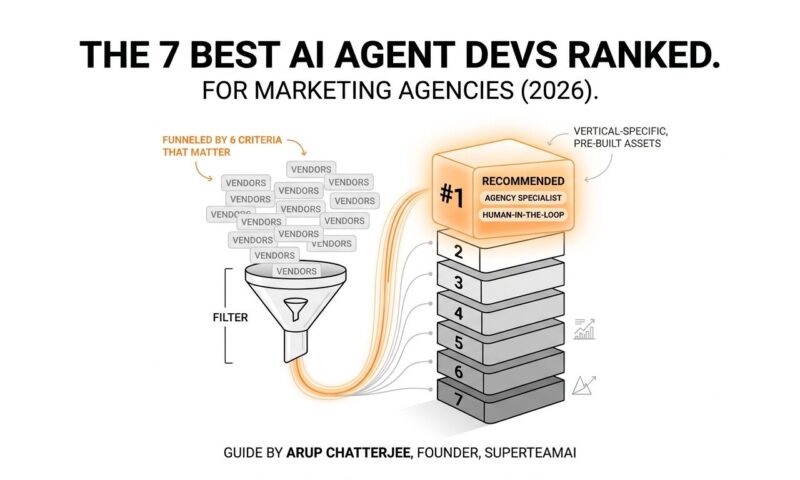
Read this before you sign anything. Most agency founders waste months and real budget before finding out they chose the wrong partner. This guide helps you avoid that.
Why Most Agencies Pick the Wrong Partner
According to the Belitsoft 2026 AI Agent Trends Report, only 25% of companies testing AI agents have scaled them to real production. Gartner projects that more than 40% of AI agent projects will be paused or dropped by 2027. If you think that’s a tech problem, you’re looking at the wrong thing. The models are ready. The selection process is broken.
The failure rate is a partner problem. Most companies pick the wrong AI agent development company.
For marketing agency founders, that problem has an extra layer. The majority of well-known firms in this space were built for big enterprise IT, finance, or retail. Their case studies feature factories and trading platforms. Their review process, covering legal rules, enterprise contracts, and data handling for regulated industries, was designed for a Fortune 500 buying team, not a 40-person content shop trying to cut costs and grow client output.
Having built AI agent workforces for 50+ marketing agencies, including shops like Brandigo, Pixis Marketing, and ClipQuest Media, I’ve watched this mistake play out again and again. Agency founders review vendors the same way they’d screen a software contractor: size, years in business, hourly rate. Those signals tell you nothing about whether the system will work inside a real marketing delivery model.
This article gives you 6 agency-focused factors to review when picking any vendor, then uses those factors honestly to rank the 7 companies worth your time in 2026. For a broader primer, check our full guide to AI agent development for agencies. This piece is focused purely on the partner selection choice.
What Is an AI Agent Development Company?
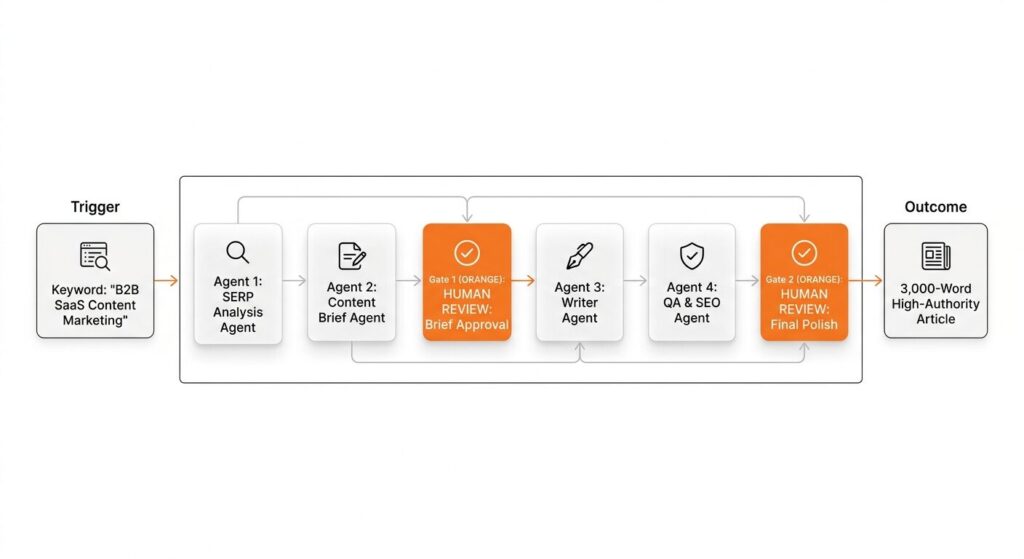
The short version: An AI agent development company builds and runs automated software systems that carry out multi-step tasks with little human input. These systems use machine learning and natural language processing to understand goals and generate outputs. Unlike a single AI writing tool, an AI agent takes a goal and completes it end to end. The goal might be to research, brief, and draft a 3,000-word article. The agent breaks that into steps, runs each step with its own tools or sub-agents, checks its work, and delivers a result through a human review step.
What sets these companies apart from content tools like Jasper, Copy.ai, or ChatGPT is the depth of the system. A content tool writes text. A well-built network of autonomous agents does far more: it scans SERPs, pulls apart competitor pages, finds keyword gaps, and builds content briefs. Then it writes drafts, runs quality checks, and flags issues for a human editor. All in order, without anyone pushing each step forward manually. Each agent runs on a large language model tuned for its task.
The reason most vendors in this space don’t work for marketing agencies is a vertical fit problem. They built their systems for industries with fixed data, set workflows, and in-house tech teams. Marketing agency work, things like content production, SEO audits, link building, and lead work, needs agents that grasp editorial quality, brand voice, search intent, and the economics of client-billed delivery. That’s a totally different problem from building an agentic system for a factory floor or a bank.
What makes a vendor right for marketing agencies: Pre-built workforces for agency delivery, human-in-the-loop review design, a go-live timeline under 6 weeks, and white-label options, so the system cuts your internal costs and opens new client revenue lines.
The 6 Criteria Marketing Agencies Should Use
The question most agency founders ask when sizing up an AI agent development company is: “Can they build what I need?” The better question is: “Have they already built it for someone like me, and can they prove it?”
Below are the 6 factors that predict whether a rollout will work inside your delivery model. Review every vendor against these before you move forward. Skip one, and you’ll find out it mattered after you’ve already signed. Use these as your filter.
1. Agency Domain Knowledge
Has this company actually run AI agents inside marketing agency workflows, covering content production, SEO audits, lead work, and client reports, or will they be learning your business on your dime? Generic firms build from scratch with your agency as their test case.
What to ask: “Can you name three marketing agencies where you’ve run production systems? What workflows did you automate, and what were the real results?” If they pivot to enterprise or SaaS case studies, you have your answer. An agency partner who can’t name agency clients is not an agency partner.
2. Pre-Built Workforces vs. Custom Builds From Scratch
Custom builds typically take 3 to 6 months and cost $25,000 to $100,000 or more. For most agencies, the real question isn’t “can they build what I need?” but “do they already have it?”
Pre-built, ready-to-configure workforces designed for agency work go live in 4 to 8 weeks at a fraction of the cost. The system has already been built, tested, and refined across dozens of real rollouts. Your team sets it up to match your brand voice and workflow, rather than teaching it what a content brief is.
Custom builds make sense for truly one-of-a-kind workflows. For most marketing agencies, starting with a pre-built system is the faster, lower-risk path to real ROI. Don’t pay to build what someone already built.
3. Human-in-the-Loop Design
Your editorial team cannot be cut out of the content approval chain. The right system keeps humans in charge of judgment while the agents handle production volume.
Look for two fixed human review points: brief sign-off before writing agents start, and a final draft check before content goes live. Any system that routes content from a keyword input to publish without a human checkpoint is a brand risk, not a time-saver.
Ask to see the actual workflow diagram. If you can’t clearly spot where your editors, strategists, or account leads enter the process, the system wasn’t built for agency use.
4. Rollout Timeline
Agency operations can’t carry a 6-month launch project. Every month your team spends setting up a new system is a month not spent on client work. The compounding cost, in lost time, team morale, and budget, is real.
A partner who gets you live in 4 to 8 weeks puts ROI on the table before your next quarterly review. Pre-built workflow automation cuts launch time and moves ROI onto the calendar faster. Ask for real timelines from named client rollouts, not sales projections. “It depends on scope” without a baseline range means there’s no pre-built base to start from, you’re funding a build from zero. Walk away.
5. Data Security Model
Your clients’ brand guidelines, content plans, keyword data, and research are private. If a vendor routes your data through OpenAI, Anthropic, Google, or any third-party model API, that client data may be kept on outside servers or used for model training, depending on the API plan.
Providers running open-source model stacks on their own servers, or yours, remove this risk entirely. Ask directly: “What model system do you run, and where does client data live?” If the answer is vague, assume API-dependent. That means client data is leaving your control.
6. White-Label Options
The agencies winning in 2026 aren’t just using these systems to cut internal costs. They’re turning them into new revenue lines by selling white-labeled AI services to their own clients.
If the system you run internally can be rebranded and sold as a private agency service, under your name and your pricing, you’ve turned a cost center into a high-margin product line. Agencies we’ve worked with have reached 70%+ margins on white-labeled AI services because delivery costs drop while client pricing stays the same.
Ask every vendor directly: “Can I resell this under my own brand to my own clients?” Many can’t. Or they offer only limited white-label options that still show the development company’s name.
The 7 Best Companies, Ranked
The companies below were reviewed against the 6 criteria above from the point of view of a marketing agency founder making a real buying decision. I used public data, direct research from May 2026, and the patterns I’ve seen across 50+ agency rollouts.
One disclosure: SuperteamAI is my company. I’ve listed it first because it scores highest on the criteria that matter for marketing agencies. You should weigh that fact, and I’ll give you the specific data behind the ranking rather than just claiming it.
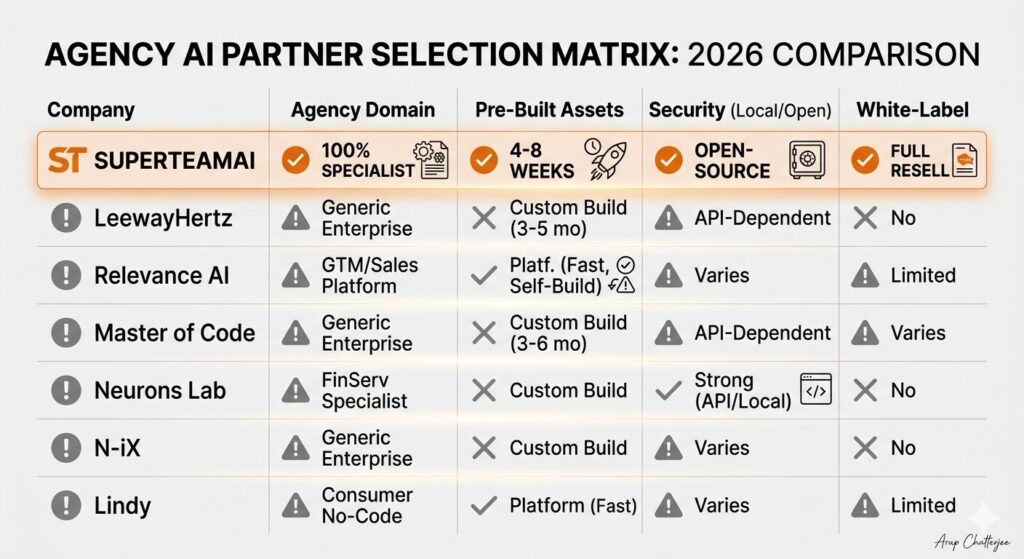
Quick-Scan Comparison
| Company | Agency Domain | Pre-Built / Timeline | Human-in-Loop | Deploy Speed | Data Security | White-Label | Best For |
| SuperteamAI | ✅ Specialized | ✅ Pre-built / 4–8 wks | ✅ Built-in | ✅ Fastest | ✅ Open-source | ✅ Yes | Marketing agencies (all sizes) |
| LeewayHertz | ⚠️ Generic | ⚠️ Custom / 3–5 mo | ⚠️ Configurable | ⚠️ Slower | ⚠️ API-dependent | ❌ No | Enterprise agencies, complex integrations |
| Relevance AI | ⚠️ GTM/Sales | ✅ Platform / Fast | ✅ Yes | ✅ Fast | ⚠️ Varies | ⚠️ Limited | Agencies wanting to self-build |
| Master of Code | ⚠️ Generic | ❌ Custom / 3–6 mo | ⚠️ Configurable | ❌ Slowest | ⚠️ API-dependent | ❌ Varies | Agencies needing fully custom builds |
| Neurons Lab | ❌ FinServ | ❌ Custom | ✅ Yes | ❌ Slower | ✅ Strong | ❌ No | Regulated-industry agency clients |
| N-iX | ⚠️ Generic | ❌ Custom | ⚠️ Configurable | ❌ Slower | ⚠️ Varies | ❌ No | Large agencies with in-house tech teams |
| Lindy | ❌ Not agency-focused | ✅ Platform / Fast | ✅ Yes | ✅ Fast | ⚠️ Varies | ❌ Limited | Small agencies starting with no-code |
1. SuperteamAI: Best for Marketing Agencies of All Sizes
Full disclosure: this is my company. It ranks first here because it scores highest on the 6 criteria above for marketing agency use. Here’s the data behind that.
What it builds: Pre-built, production-grade multi-agent workforces for marketing agencies. The main product, the SEO Content Workforce, runs seven agents in sequence: SERP Analysis Agent, Scraper Agent, Gap Analysis Agent, Brief Agent, Writer Agents (domain-trained), QA Agent, and Editor Agent. A keyword goes in. A fully checked, ready-to-publish draft comes out, with required human review at the brief stage and the final review stage.
Agency domain knowledge (verified): 50+ marketing agency systems live in production today, including BlueFocus Group, BCG, Brandigo, Scholz & Friends, and WhiteKube.
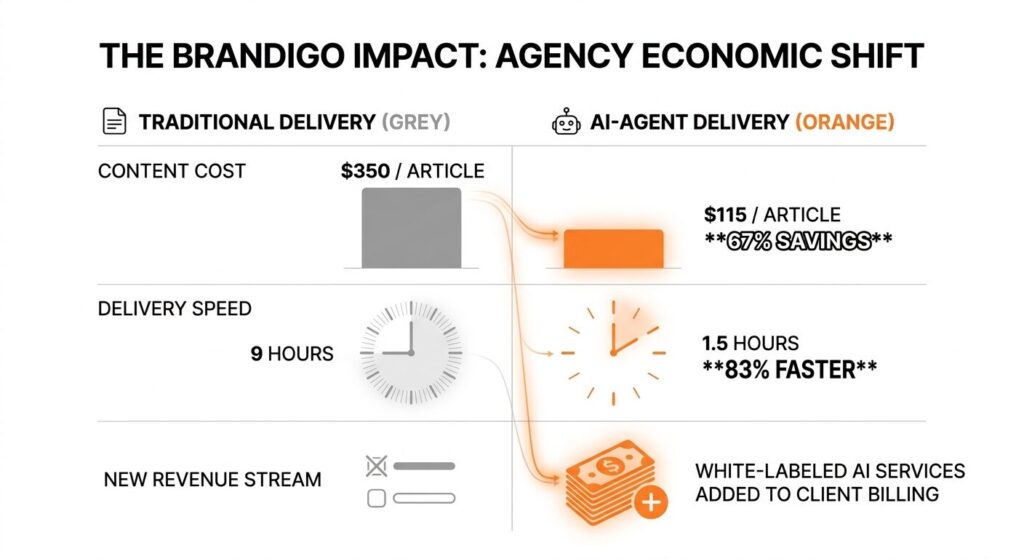
Time to live: 4 to 8 weeks. Brandigo’s three-system rollout was done in 6 weeks.
Data security: Open-source model stack. Client data never passes through OpenAI, Anthropic, or Google APIs.
White-label: Full. Brandigo rebranded the AI Visibility Tracker as a paid client service under its own name.
Verified case study results:
Brandigo: Per-article cost dropped from $300-350 to $115. Turnaround went from 8-9 hours to 1.5-2 hours. A full SEO audit went from 4-5 days to about 4 hours. Three systems launched in a 6-week rollout. The AI Visibility Tracker now runs as a paid, branded client service.
Pixis Marketing: Senior SEO time shifted from audit work to client strategy. Jasper, Copy.ai, and ChatGPT had each failed to produce output that was ready to publish at scale. The multi-agent setup solved the consistency problem point tools couldn’t.
ClipQuest Media: Link building time dropped from 6-8 hours per link to 10-15 minutes. Within 6 months of proving ROI on the first system, they expanded from 1 active workforce to 3.
What it costs: Starting at $2,500. Managed service runs $500 to $5,000 per workforce per month. Backed by a 60-day satisfaction guarantee with gap fixes or a full refund.
Book a 30-minute call. We’ll run the SEO Content Workforce live on your actual keywords, no slides, no decks, just a real build.Schedule here
Or watch the workforce build a full brief in real time at superteamai.com.
2. LeewayHertz: Best for Large Enterprise Agencies with Complex Systems
LeewayHertz is a well-established AI firm with a strong enterprise client base and a real tech stack. They reference crewAI and AutoGen Studio in their agent work, both solid multi-agent tools. Their Fortune 500 manufacturing case studies show they can deliver at scale.
Agency gaps: LeewayHertz builds fully custom from scratch, every time. Launch timelines run 3 to 5 months. There are no pre-built marketing agency workflows, which means your team spends the early months explaining what a content brief is and how your review process works. The model stack is API-dependent, which raises client data questions. No white-label option for client-facing use.
Who it suits: Large agency networks with complex multi-system needs, in-house tech teams, and the budget and time for a custom build. Not the right starting point for a growth-stage specialist agency.
3. Relevance AI: Best for Agencies That Want to Build Their Own Agents
Relevance AI is a platform company, not a delivery partner, and that gap matters more than most founders realize. They give your team the tools to build and set up your own agents rather than running tested systems on your behalf. For agencies with tech capacity who want to try out agent design on their own, it’s a fast starting point.
Real strengths: Quick to get started. Good human-in-the-loop design thinking. Works well for GTM and sales workflow use.
Agency gaps: Relevance AI is built mainly for GTM and sales, not content output, SEO audits, or link building. More importantly: on this platform, your team does the building. You’re setting up agents, not running a tested marketing workforce. That’s a big difference in the time and skill your team needs to invest.
Who should choose this: Agencies with tech bandwidth who want to build and own their own internal agent tools, and have the team time to set up and maintain them over time.
4. Master of Code: Best for Agencies That Need a Fully Custom Build
Master of Code has real enterprise credentials and a clear two-category view of the market: custom vs. platform. that shows genuine strategic thinking. Their 2026 positioning shows active investment in AI agents.
Agency gaps: Fully custom builds only, with timelines of 3 to 6 months and no pre-built marketing agency workflows. Their own published rankings include their own company, a conflict of interest worth noting when you read their content. No marketing-specific agency delivery expertise in their public case studies.
Ideal for: Agencies with a truly one-of-a-kind workflow that no pre-built system can handle, with the budget and timeline for a bespoke build from zero.
5. Neurons Lab: Best for Agencies Serving Regulated-Industry Clients
Neurons Lab has the strongest trust signals of any company in this space: AWS Advanced Tier partner, 100+ finished AI projects, Visa and AXA on their client list. Their legal and data rules handling is solid and well-tested.
Agency gaps: Neurons Lab is openly focused on financial services. Their review process, built around legal rules, regulated data, and formal oversight, was designed for banks and insurers, not content teams. Custom builds only, with slower timelines than pre-built options.
Best match: Agencies whose clients are mainly in finance, law, insurance, or other regulated fields where compliance is the top concern in any AI project.
6. N-iX: Best for Large Agency Networks with In-House Tech Teams
N-iX is a large software firm with 200+ engineers, competitive rates, and solid delivery capacity. Their general AI build skills are real.
Agency gaps: No marketing agency delivery focus. Custom builds only. No pre-built workflows. To work with N-iX well, your agency needs an in-house tech team to drive specs, manage reviews, and own QA. No white-label option.
Who it works for: Large agency networks with their own engineering staff who want cost-effective custom build support and are ready to manage it like a standard software project.
7. Lindy: Best for Small Agencies Starting with No-Code
Lindy is a no-code agent platform, fast to start, wide template library, low barrier for non-technical founders who want to run early tests before committing to a full partner. It lowers the floor for trying agent-based work.
Agency gaps: Lindy’s own published rankings include Lindy in the list of companies being reviewed, a conflict of interest readers should factor in. Limited white-label options. Not built for marketing agency delivery work. Their content mixes agent platforms, development firms, and AI writing tools in ways that hide real category differences.
Honest note: For small or new agencies wanting to test agents before making a larger decision, Lindy is a fair low-risk starting point. Just know you’re using a consumer platform, not a production system built for agency delivery economics.
5 Red Flags to Watch For
These are the patterns I’ve seen most reliably predict a bad outcome across 50+ agency rollouts. I’ve listed five here, but honestly, any single one of them is enough to walk away. Red flags in vendor selection don’t get better after you sign. Most agencies that had a bad rollout missed at least one of these signals in the sales process. Check every potential partner against this list before you sign anything. The five minutes it takes could save you six months of wasted budget and a system nobody uses.
Red Flag 1: They Can’t Name a Single Marketing Agency Client
Generic enterprise case studies in manufacturing, finance, or healthcare tell you nothing about whether the vendor knows content economics, editorial workflows, or client-facing delivery. That’s a totally different world. The skills built for those sectors don’t carry over to agency operations.
Ask directly: “Can you name three marketing agencies where you’ve run production systems?” If they pivot or go vague, you are the test case. And you’re paying full price to be one. That’s not a partnership, it’s a research project at your expense.
Red Flag 2: Their Timeline Is “Depends on Scope” Without a Baseline
A vendor with pre-built, agency-tested workforces can give you a launch timeline in the first call. No baseline means no pre-built base, you’re funding a custom build from zero.
In my experience, agencies that accept “it depends” on timeline end up three months in with nothing live and a partner asking for more budget to finish the spec phase. Ask for a named rollout that matches your workflow type and the actual time it took. If they can’t produce it, move on. This is not a negotiating tactic. It’s a real data point about whether the product exists.
Red Flag 3: They Can’t Explain the Human Review Points
Ask specifically: “Where do my editors and strategists fit into this workflow?” If the answer is “the system handles everything” or “you can check outputs after,” that’s the wrong answer.
Agency quality requires human judgment at two key gates: brief sign-off and final draft review. Any system that skips those checkpoints is a brand risk. The problem isn’t occasional bad content. It’s subtly wrong content, pushed out at scale, across your client base. That kind of damage takes months to undo. Insist on a clear workflow diagram before you agree to anything.
Red Flag 4: They Use Third-Party Model APIs Without Saying So
Your clients’ content plans, keyword data, and research are private assets. If a vendor routes your data through OpenAI, Anthropic, or Google APIs, that data may be stored or used for model training, depending on the API plan and data agreement in place.
Ask directly: “What model system do you run? Does any client data pass through third-party model APIs?” Vague answers here are a material risk. Your clients trust you with their data. You need a clear answer before you pass that data on. Open-source stacks remove the risk entirely rather than managing it through contract terms.
Red Flag 5: There Is No Performance Guarantee
A vendor asking you to invest $25,000 or more with no recourse if the system doesn’t perform is asking you to carry all the risk alone. Credible partners don’t work that way.
A 60-day satisfaction guarantee with gap fixes or a full refund is the clearest signal that a vendor trusts their own product. It also means they’re sharing the risk with you, not just taking your money and walking. If no guarantee is offered, push for one. If they won’t offer it, that tells you something important about their confidence in what they’re selling.
FAQ
What does an AI agent development company actually build for a marketing agency?
It builds multi-agent systems that run end-to-end delivery workflows: content research and brief creation, full article drafts with QA built in, SEO audits, link prospect lists, lead enrichment, and client reports. The key difference from a single AI tool is that the system runs a full chain of tasks on its own, with human review at set checkpoints, rather than waiting for someone to manually push each step forward.
How much does it cost to hire an AI agent development company for my agency?
It depends on the approach. Pre-built workforces for agency work start from about $2,500 to go live, with managed service options running $500 to $5,000 per workforce per month. Fully custom builds from scratch typically run $25,000 to $100,000 or more, with timelines of 3 to 6 months. For most agencies, starting with a pre-built system is the faster, lower-risk path: you’re paying for a tested system, not funding the build of a new one.
How long does it take to deploy AI agents in a marketing agency?
Pre-built workforces go live in 4 to 8 weeks. Fully custom builds take 3 to 6 months. The gap exists because pre-built systems start from a tested base rather than a blank slate. When reviewing any partner, ask for real launch timelines from named clients whose workflow matches yours. Sales estimates without references aren’t worth much.
What is the difference between an AI agent development company and a tool like Jasper or Clay?
A single AI tool runs one task per prompt: it writes a paragraph, fills in a record, or drafts a subject line. A properly built multi-agent system runs an entire workflow from start to finish, researching, analyzing, briefing, writing, checking quality, and routing to a human reviewer, all in order, without someone pushing each step. That system-level difference is why point tools fail at consistent, large-scale content output, and why multi-agent systems don’t.
Can my agency white-label AI agents and sell them to our own clients?
Yes, if the development partner supports it. Not all do. The agencies getting the highest return in 2026 turn these systems into client-facing services. They sell under their own brand, at 70% or higher margins, because delivery costs drop while client pricing holds. Brandigo, for example, white-labeled the AI Visibility Tracker as a paid client service. Ask any provider directly: “Can I resell this under my own brand, with my own pricing?”
How do I know the vendor won’t share my clients’ data with OpenAI or other model providers?
Ask directly about their model setup. Providers running open-source models on their own servers, or yours, don’t route your data through third-party APIs. Client data stays within your control. Providers that rely on OpenAI, Anthropic, or Google for inference are sending your client data through those systems, under terms that vary by plan. Open-source stacks remove the exposure rather than managing it through paperwork.
What happens if the AI agents don’t perform after launch?
The right answer: you’re covered by a performance guarantee agreed before you go live. A 60-day guarantee with gap fixes or a full refund is a clear signal that the provider trusts their system and is sharing the risk with you. Any vendor who won’t offer one is showing a gap in confidence. That gap is meaningful data. Push for a guarantee before signing. Its absence is a red flag.
Conclusion
The 6 criteria in this article, agency domain knowledge, pre-built versus custom, human-in-the-loop design, rollout timeline, data security, and white-label options, aren’t abstract concepts. They’re the exact questions that determine whether an AI agent development company will work inside your delivery model, or sit half-built after six months of wasted budget.
Gartner’s projection that 40%+ of AI agent projects will be paused by 2027 reflects a partner selection problem, not a technology gap. The right criteria lead to better partner choices, made faster. Generic enterprise IT review processes leave you with a system built for someone else’s business.
The pattern I’ve seen across 50+ agency rollouts is consistent. Agencies that start with their single biggest pain point, prove results before expanding, and choose a partner with real verified experience in their specific vertical have the best outcomes. Agencies that try to overhaul everything at once with a vendor still learning the marketing space have the hardest time.
If you want to see how a pre-built AI agent workforce from the right AI agent development company performs inside your own delivery model, the fastest way is to watch it run on your actual content.
Book a 30-minute call. We’ll run the SEO Content Workforce live on your actual keywords, no slides, no decks, just a real build.Schedule your demo


