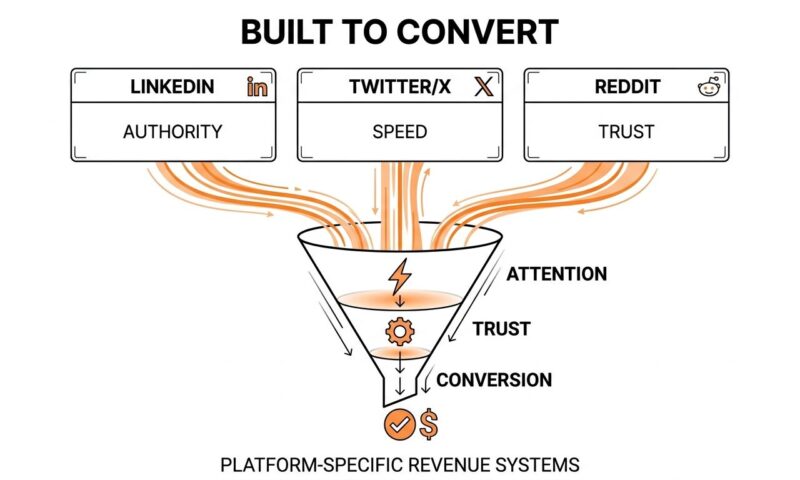
Most businesses are playing social media wrong. Not because they are posting too little or using the wrong hashtags. They are wrong at the strategy level. They are optimising for reach when they should be optimising for resonance. They are building for the algorithm when they should be building for the reader.
Here is the result: they get occasional spikes of attention, a few hundred likes on a post that went mildly viral, and almost zero business outcomes to show for it. We have seen this pattern across dozens of companies we have worked with. A business posts consistently for 6 months, racks up followers, and converts almost none of them into revenue. When we dig into why, the answer is almost always the same: the content was optimised to be noticed, not to be useful.
This guide is written for business owners, growth teams, and content leads who are tired of that cycle. We are going to cover the real profile of each major social media platform, what kind of content actually works on each one, who you are targeting, and the frameworks that build a social media funnel that converts attention into trust, and trust into revenue. We will also show you why consistently useful content compounds into something that viral posts never can: authority.
Why Useful Beats Viral (And the Data to Prove It)
Let’s start with an uncomfortable truth. A post that reaches 100,000 people and converts none of them is objectively worse for your business than a post that reaches 1,000 people and converts 10. Yet most businesses are still measuring success by reach, impressions, and follower counts.
Viral content gets noticed. Useful content gets trusted. Trust is what converts.
In 2026, this distinction matters more than it ever has. Search behavior has shifted. AI-powered discovery tools surface content based on relevance and credibility, not just engagement signals. Buyers are doing more research independently before engaging a vendor. The average B2B purchase decision in 2026 involves 6 to 10 touchpoints, and social media is increasingly where those touchpoints happen. Those touchpoints, taken together, are your social media funnel. If every touchpoint you have with a potential buyer is a polished promotional post with no real information value, you are not building a case for the purchase. You are just adding noise.
Useful content, by contrast, does three things that viral content rarely achieves:
It attracts the right audience. A post that teaches something specific attracts people with that specific problem. That is self-selection at its finest. You are not building a generic audience; you are building an audience of potential buyers.
It builds compounding authority. Every useful post is a data point in the reader’s mental model of you. Over time, 20 useful posts make you the go-to expert on a topic in that reader’s mind. No single viral post achieves that.
It converts at a measurably higher rate. Across the companies we work with, content that teaches, explains, or solves a specific problem consistently outperforms brand awareness content in downstream conversion metrics, including demo requests, newsletter signups, and inbound sales conversations.
The framework is not complicated. Stop asking “how do we get people to share this?” Start asking “what does our ideal buyer need to know right now, and can we be the ones to teach it?”
That is the entire strategic shift.
The Foundation: Building a Social Media Funnel That Converts
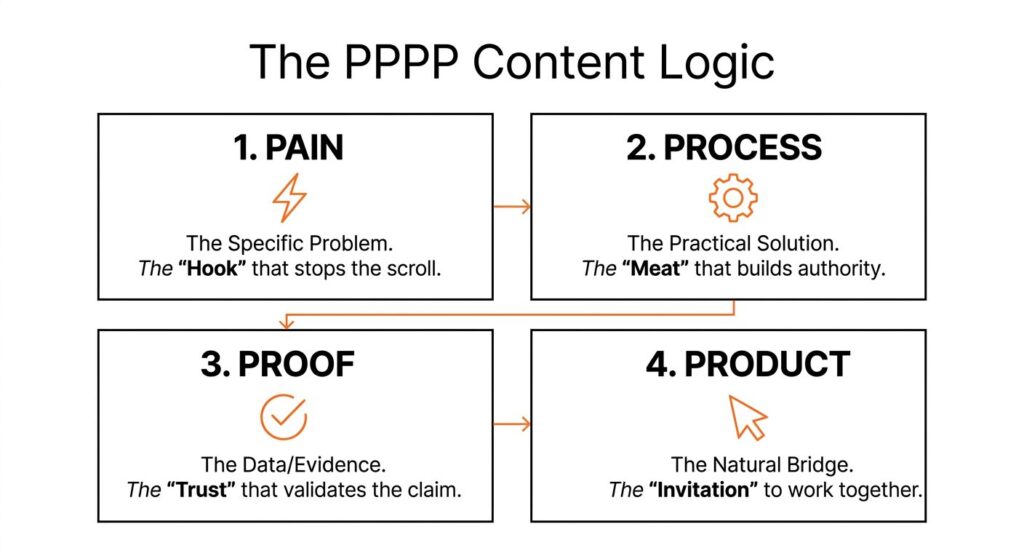
Before we go platform by platform, you need one master framework that every effective social media funnel is built on. Everything else adapts from here.
We call it the Pain-Process-Proof-Product sequence, and we use it across every piece of content we build for clients.
Pain
Open with the specific problem your reader is experiencing. Not a vague pain. Not “growing a business is hard.” Something concrete: “Your content team is producing 4 posts a week and getting 12 total engagements across all of them.” The more specific the pain, the more the right person recognises themselves in it.
Process
Give them something genuinely useful. A framework. A step. A decision filter. The actual answer to the question implied by the pain. This is where most businesses hold back because they are afraid of giving too much away. That is the wrong instinct. The more value you put in the process section, the more authority you build. Readers do not stop buying from you because you taught them something. They buy from you because you taught them something.
Proof
Show evidence that the process works. This can be a case study, a specific metric from a client’s experience, a before-and-after comparison, or your own observed results. Proof transforms the process from theory to fact in the reader’s mind.
Product
Close with relevance to your offering. Not a hard sell. A natural next step: “If you want this done for you instead of by you, here is how we work.” The product section should feel like a helpful suggestion from an expert, not a pitch.
Every platform executes this sequence differently. The tone, format, length, and delivery mechanism shift. But the underlying architecture is the same.
LinkedIn: The Professional Network That Rewards Substance
Platform Profile
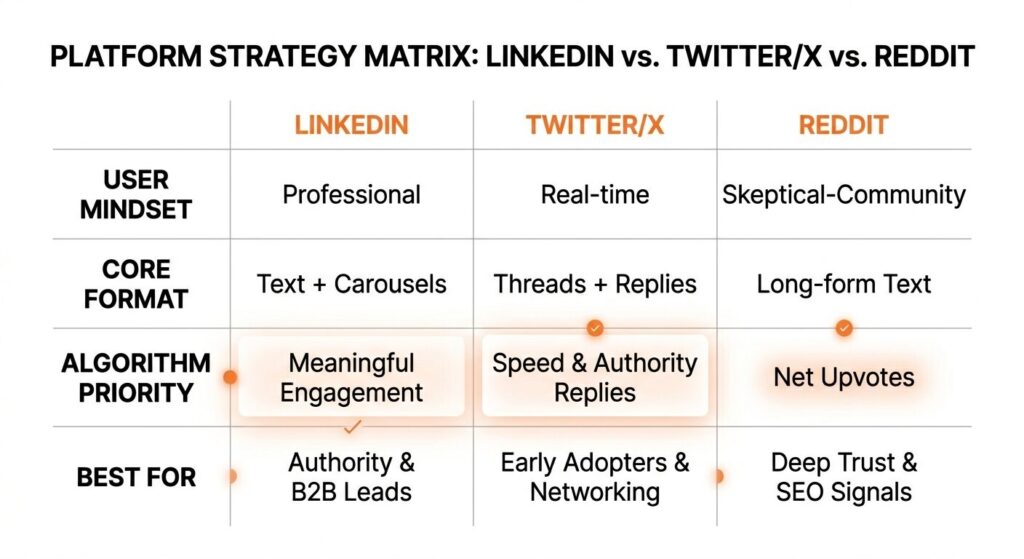
LinkedIn is the world’s largest professional network with over 1 billion members as of 2026. But raw numbers are not the point. What matters is the intent people bring to the platform. LinkedIn users are in a professional mindset when they scroll. They are thinking about their careers, their companies, their industries, and their problems at work. That context shapes everything about how content lands.
The LinkedIn algorithm in 2026 prioritises content that generates what it calls “meaningful engagement,” which in practice means comments, saves, and shares from people who are genuinely engaged with the content, not mass-reactions from people who scrolled past. A post with 30 thoughtful comments from relevant professionals will outperform a post with 500 likes from a generic audience almost every time.
LinkedIn also weights creator credibility heavily. Your profile’s perceived authority in a topic area shapes how broadly your content gets distributed. This is why posting consistently about one core topic compounds over time in ways that posting about random subjects does not. For B2B businesses, LinkedIn sits at the top and middle of your social media funnel: it is where buyers first discover you through content, then evaluate you through your track record.
Who Is on LinkedIn (And Who You Are Actually Targeting)
LinkedIn’s audience skews toward decision-makers. C-suite executives, VP-level operators, founders, managers, and senior individual contributors are all active on the platform. For B2B businesses especially, this is the single most direct line to the buyer.
But “everyone” is not your target. Your target on LinkedIn is the specific job title, company size, and industry that matches your ICP. The good news is that LinkedIn’s professional context means your content self-selects. If you write about challenges that only a Head of Marketing at a 50-person SaaS company faces, then the Heads of Marketing at 50-person SaaS companies are the ones who stop scrolling. Everyone else keeps moving. That is not a failure. That is the system working correctly.
What Content Works on LinkedIn
Practitioner insights with a specific lesson. “Here is what I learned after running 200 cold outreach campaigns” performs far better than “5 tips for cold outreach.” The former signals lived experience. The latter signals generic advice.
Short frameworks explained visually. LinkedIn’s algorithm favors posts that use its native carousel format. A 6 to 10 slide carousel that walks through a process, framework, or comparison consistently outperforms long-form text posts in raw reach. The key is density: each slide should contain one complete idea, not one heading.
Contrarian takes backed by data. LinkedIn rewards posts that challenge conventional wisdom, as long as the challenge is supported by evidence. “LinkedIn engagement doesn’t predict revenue. Here’s what does.” followed by a specific data-backed argument will drive meaningful discussion from exactly the kind of people you want talking to you.
Behind-the-scenes operational content. Posts that show your process, your team’s decision-making, or real situations you navigated perform well because they are inherently specific. No one else has had your exact experience. Specificity is credibility.
Client results framed as lessons. Not case studies in the traditional sense. More like: “A client came to us with X problem. Here is exactly what we did. Here is what worked and what did not.” The teaching frame is what makes it valuable rather than promotional.
The LinkedIn Content Framework
Every LinkedIn post should follow this structure:
Line 1 (The Hook): This is the only line visible before the “see more” fold. It must stop the scroll. Use a specific number, a bold statement, or a pain point described precisely. Avoid starting with “I” (LinkedIn’s algorithm treats it as lower engagement). Start with the insight or the number.
Lines 2 to 5 (Context and Credibility): One to two sentences of context. Why does this matter? What experience are you drawing from? Keep it brief. The reader has not committed yet.
Lines 6 to 15 (The Substance): The actual value. The framework, the process, the lesson. Use short paragraphs and line breaks. LinkedIn is not a blog. Walls of text get scrolled past.
Lines 16 to 20 (The Proof): One specific result, example, or data point that validates what you just said.
Final Line (The CTA): Keep it conversational. “If this is relevant to your situation, I’m happy to share the full framework. Drop a comment.” Or simply end with a question that invites discussion.
What to Avoid on LinkedIn
Motivational content with no business relevance. Posts that start with “Grateful for this journey…” are personal branding for career advancement, not business development content. They do not convert buyers.
Posting about too many topics. Choose 2 to 3 core themes and stay there. LinkedIn’s algorithm builds a topical profile for your account. When you post about everything, you become the expert on nothing.
Engagement bait. “Agree or disagree?” “Type 1 if you relate.” These tactics do generate engagement but they attract the wrong audience and signal low-quality content to LinkedIn’s quality filters.
Twitter/X: The Real-Time Arena Where Speed and Specificity Win
Platform Profile
Twitter/X is the most unforgiving platform for businesses. The half-life of a tweet is measured in hours. The audience is chronically online, highly opinionated, and faster to dismiss than any other platform. For most industries, the organic reach on Twitter/X is lower than LinkedIn, and the conversion path from follower to buyer is longer.
So why should businesses bother?
Because the upside, when you get it right, is disproportionate. Twitter/X is where industries have their real-time conversations. It is where the most engaged segment of your audience lives, the people who follow every development in your space, discuss new ideas publicly, and are the first to try new solutions. These are your early adopters and your most vocal advocates. If you can build credibility with this group, the downstream effects are significant.
The X algorithm in 2026 has evolved significantly under its current ownership structure. It now heavily favors content from users with Premium subscriptions in terms of reply visibility and distribution. It also prioritizes long-form content through the “Articles” feature, and rewards posts that generate replies from high-follower accounts. Essentially, the people who respond to your content matter as much as the content itself.
Who Is on X (And Who You Are Actually Targeting)
X’s active user base in 2026 skews toward tech, media, finance, politics, and startup culture. If your business operates in any of these verticals, your buyers are likely present and active. If you run a B2B SaaS company, a marketing agency, or an AI-adjacent business, X is where your ICP has real-time conversations about the exact problems you solve.
Your targeting on X is less about demographics and more about communities and conversations. You are not targeting “25-45 year old marketing managers.” You are targeting “people who talk about marketing attribution in their tweets.” The platform rewards participation in existing conversations as much as original broadcast content.
What Content Works on X
Hot takes with evidence. X is built for opinions. But the opinions that build business credibility are the ones backed by data, experience, or a novel observation. “Most SEO agencies are selling you a service that AI makes redundant by 2027. Here’s what to do instead.” That drives conversation from the exact people who should be in your ecosystem.
Real-time commentary on industry news. When something significant happens in your industry, your take on it, posted within hours, positions you as someone who is deeply plugged in. This is not about being contrarian for the sake of it. It is about having a perspective that your audience finds valuable.
Threads that go deep on one topic. The thread format allows you to take a complex topic and break it down systematically. A well-structured 10-tweet thread that genuinely explains something difficult is one of the highest-performing formats on X for building follower counts of the right kind. Each tweet should be a complete, standalone idea that also pulls the reader to the next one.
Behind the numbers content. X audiences respond to specificity. Not “we grew fast.” Instead: “We went from 0 to 4,000 monthly organic visitors in 5 months. Here is the exact strategy, week by week.” Numbers, timelines, and mechanics outperform narrative claims every time.
Replies and engagement. This is the most underused content format on X for businesses. Finding the 10 to 15 most influential voices in your space and engaging genuinely with their content, adding data, nuance, or a different angle, puts you in front of their audience regularly. Over time, consistent high-quality replies build credibility that original tweets alone cannot.
The X Content Framework
For standalone tweets:
- Lead with the most interesting, specific, or counterintuitive part of what you want to say.
- Follow with one sentence of context.
- Close with either the implication or an open question.
- 280 characters, used fully or nearly fully. Shorter is not always better on X.
For threads:
- Tweet 1: The hook. State the specific, surprising, or valuable thing you are about to explain.
- Tweets 2 to 8: One idea per tweet. Each should be able to stand alone. Avoid cliffhangers that require reading the next tweet to make sense of the current one.
- Tweet 9 or 10: Summary and the practical takeaway.
- Final tweet: CTA. Keep it light: “Full breakdown in the thread above. Follow if you want more of this.”
What to Avoid on X
Posting only promotional content. X audiences will unfollow or mute brands that post product updates, sale announcements, or marketing copy. Every post needs to have independent value.
Engaging in flame wars or responding defensively to criticism. The X community watches how brands respond under pressure. A measured, data-grounded response to criticism builds credibility. A defensive or dismissive response destroys it.
Chasing trending hashtags that are not relevant to your business. Jumping on a trending topic to get visibility when it has nothing to do with your business reads as opportunistic and dilutes your topical authority.
Reddit: The Community-First Platform That Punishes Everything Else
Platform Profile
Reddit is categorically different from every other platform on this list, and it deserves its own section because most businesses get it catastrophically wrong.
Reddit is not a broadcasting platform. It is a community platform. The 100,000+ active subreddits are each their own culture, with their own norms, vocabulary, running jokes, and collective memory. The people who are active on Reddit in 2026 are some of the most ad-literate, marketing-skeptical, and community-protective audiences on the internet. They can identify a brand trying to use their community for marketing within seconds, and they will respond by downvoting the content into oblivion and sometimes making it a public example of bad marketing.
This is not a reason to avoid Reddit. It is a reason to approach it with radical honesty.
The Reddit algorithm is fundamentally democratic. Posts are ranked by net votes (upvotes minus downvotes). There is no follower network to build in the traditional sense. Every post competes on its own merit within the community it is posted to. The implication for businesses is significant: you cannot rely on an existing audience. Every post has to earn its place.
In 2026, Reddit has also become an increasingly important SEO signal. Google surfaces Reddit content in AI Overviews and Knowledge Panels more than any other UGC platform. Being a genuine, respected contributor to relevant subreddits has downstream benefits well beyond the platform itself.
Who Is on Reddit (And Who You Are Actually Targeting)
Reddit’s demographics have shifted significantly since 2020. It is no longer primarily a young male tech audience. As of 2026, Reddit has over 500 million registered users, and its demographic spread increasingly mirrors the general internet population, particularly among people aged 18 to 45.
More importantly, Reddit users are self-segmented by interest with extreme precision. There are subreddits for every industry, profession, product category, and business challenge. r/marketing has 1.8 million members. r/entrepreneur has 3.5 million. r/SaaS, r/startups, r/SEO, r/growthmarketing, and dozens of profession-specific communities are where your exact buyers go to ask questions, share frustrations, and get peer advice.
Your targeting on Reddit is not demographic. It is topical. You want to be present in the communities where your ICP goes to ask questions that your business solves.
What Content Works on Reddit
Genuine answers to questions. The most valuable thing a business can do on Reddit is answer questions in their area of expertise. Not a pitch. Not a link to a blog post. A real, complete, useful answer, written in natural language, that leaves the reader better informed than before they read it. If your answer is genuinely the most helpful response in the thread, Reddit will surface it. And if it happens to mention that your company does this professionally and invite people to reach out if they want help, that is entirely acceptable. The key is that the value comes first, always.
Transparent posts about your own business experiences. Reddit communities reward vulnerability and authenticity. A post in r/entrepreneur titled “We spent 8 months building a product nobody wanted. Here is everything we learned” will drive massive engagement from exactly the right audience. The post has to be real. Fabricated vulnerability is detectable and will backfire.
Resource sharing without strings attached. Sharing a genuinely useful framework, template, or tool without requiring an email signup is one of the fastest ways to build credibility in a Reddit community. You will get engagement, direct messages, and profile traffic that converts into actual leads over time.
AMAs (Ask Me Anything) done right. If you have genuine expertise and a meaningful track record, an AMA in a relevant subreddit can drive extraordinary exposure. The key is that the AMA must be genuinely interesting to the community, not just an excuse to talk about your product. “I’ve helped 100+ B2B SaaS companies build their first organic channel. AMA about what actually works in 2026.” That is a compelling proposition. “I’m the CEO of [Your Company]. AMA.” is not.
The Reddit Content Framework
Before posting anything on Reddit, spend two weeks just reading and participating in the communities you are targeting. Understand the language, the recurring debates, the personalities that drive the most engagement, and the norms about what is and is not acceptable. Every subreddit is different.
When you do post, follow this sequence:
Step 1: Lead with the experience or the question, not with yourself. “Has anyone else found that [specific problem]?” or “We ran an experiment on [topic]. Here is what we learned.” Starting with yourself or your company is the fastest way to signal that this is a promotional post.
Step 2: Deliver complete value in the post itself. Do not tease value and then ask people to click a link to get it. Reddit communities have a cultural norm against this. Put the actual content in the post. If you have a related resource, you can mention it at the end after delivering the full value.
Step 3: Engage with every comment. Reddit rewards engagement. Respond to every comment, even the critical ones, and do so thoughtfully. Community members notice when a poster engages authentically versus when they post and disappear.
Step 4: Be honest about who you are. If you are the founder of a company that provides the solution you are discussing, disclose it. Reddit communities do not punish relevant expertise. They punish deception. “Full disclosure: we built a tool that does exactly this, but I want to share the framework first because it is useful regardless of what tool you use” is far better received than pretending to be a neutral participant.
What to Avoid on Reddit
Posting links to your blog without providing context or value in the post itself. This is the most common mistake businesses make on Reddit, and it is almost universally downvoted.
Creating accounts specifically for promotion. Reddit users check post history. An account with 10 posts all promoting the same company is immediately flagged and removed.
Using marketing language. Phrases like “best-in-class,” “industry-leading,” and “scalable solution” are red flags that trigger instant community skepticism. Write like a person, not a press release.
Asking for upvotes, shares, or engagement. Reddit’s rules prohibit vote manipulation, and communities enforce this strictly.
Cross-Platform Strategy: How to Work Smarter, Not Harder
Running three distinct social media presences sounds like a lot of work. It is, unless you build a systematic approach to content repurposing. The goal is a single social media funnel that feeds from one content source into multiple platform-specific expressions of that same expertise.
The core principle is the content waterfall: one substantial piece of content at the top generates multiple smaller pieces flowing from it.
The Waterfall Sequence:
- Start with a long-form asset. A detailed blog post, a case study, a research summary, or an in-depth analysis. This is your source of truth.
- From that asset, extract 3 to 5 core insights. Each insight becomes a LinkedIn post following the Pain-Process-Proof-Product framework.
- From the most counterintuitive or data-rich insight, build an X thread. The thread format is perfect for the “here is something most people do not know, and here is the evidence” structure.
- If the asset addresses a question that gets asked frequently in a relevant subreddit, write a Reddit-native version of the answer that stands alone, without linking back to the blog post.
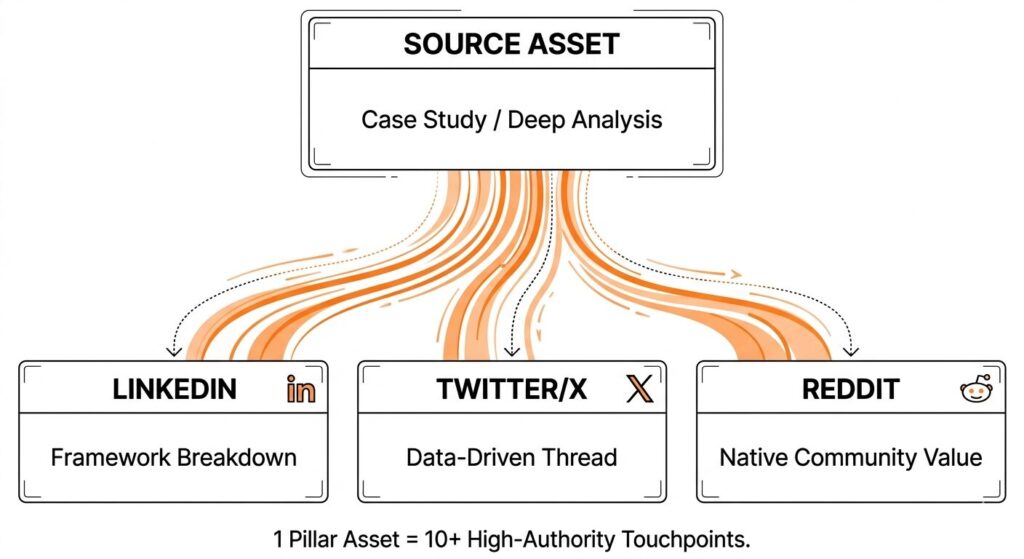
Each platform gets content that is native to its format and culture, but all of it is rooted in the same underlying research and insight. This is how a 4-person content team can maintain a credible presence across all three platforms without burning out.
The adaptation rules:
- LinkedIn wants structured arguments with business relevance. Take the insight and frame it as a professional lesson.
- X wants speed, specificity, and a point of view. Take the most surprising data point and build from there.
- Reddit wants authenticity and community contribution. Take the experience or framework and present it as a peer sharing what they learned.
The content is not copy-pasted. It is translated. Each platform speaks a different language, and you need to use the right one.
Building a Social Media Funnel System, Not Just a Content Calendar
A content calendar tells you what to post and when. A social media funnel system tells you how to produce content consistently, maintain quality, improve over time, and connect every post to a downstream business outcome.
Most businesses have the former and not the latter. The result is inconsistent posting, reactive content creation, and burnout in the team member assigned to “do social media.”
A functional content system has four components:
A content brief process. Every piece of content, even a single LinkedIn post, benefits from a one-paragraph brief that answers: What is the specific pain we are addressing? What is the process or insight? What proof do we have? What is the natural next step for the reader? This takes 5 minutes and prevents the vague, generic content that fails to connect.
A repurposing workflow. Define explicitly how each long-form asset gets broken down across platforms. Who writes the LinkedIn post? Who adapts it for X? When does the Reddit version get written? Clarity on the workflow eliminates the “someone should probably post about this” conversations that never result in anything.
A quality filter. Before any post goes live, one person should answer two questions: Does this teach, inform, or genuinely help someone? Would I find this useful if I were the reader? If the answer to either question is no, the post does not go out.
A learning loop. Review performance data monthly, not to optimize for vanity metrics, but to answer: What posts drove direct business outcomes (inbound messages, demo requests, profile visits that converted)? What patterns do those posts share? Do more of that.
This system is not complex. It is disciplined. The difference between businesses that build real social media presence and those that spin their wheels is almost never talent. It is systems.
At Superteam AI, we have built AI-powered content systems that execute exactly this workflow at scale, from content briefing through drafting, repurposing, and distribution. Our Inbound Lead Engine service builds the entire organic presence for a business, including the social content infrastructure, powered by AI systems that execute the heavy lifting while the client focuses on knowledge transfer. The client’s only job is to share what they know. We handle the system that distributes it.
The Metrics That Tell You If Your Social Media Funnel Is Working
Stop measuring reach. Reach is the vanity metric that makes a broken social media funnel look like it is performing. A post reaching 50,000 people with zero business intent in your audience is worse than zero. It inflates your perceived performance while delivering nothing.
The metrics that matter for businesses:
Profile visits from non-followers. This is the most direct signal that your content is pulling in new, relevant people. On LinkedIn especially, a spike in profile visits after a post indicates the content reached beyond your existing network and that people found it credible enough to want to know more about you.
Inbound messages referencing specific content. When someone reaches out and mentions a specific post, that is the highest-quality lead generation signal social media can produce. Track this. When it happens, understand what that post had in it that others do not.
Saves and bookmarks. On LinkedIn, saves are the single strongest engagement signal to the algorithm. They also indicate that the reader found the content worth returning to, which is a direct proxy for usefulness. Posts with high save rates are the ones doing their job.
Comment quality over comment quantity. A post with 100 one-word comments is algorithmically similar to a post with 10 substantive comments, but the latter is the one where real relationships and business conversations start. Read your comments. Are they reflective and specific, or generic? That tells you whether the right people are engaging.
Downstream conversion rate. This is the most important metric in your social media funnel. It requires a CRM or at minimum a manual tracking process. When new leads come in, ask where they first encountered you. Over time, you will build a picture of which social media content types are at the beginning of your buyer journeys. Those are the ones to double down on.
Frequently Asked Questions
How many times a week should a business post on each platform?
Consistency matters more than frequency. One strong post per week on LinkedIn that is genuinely useful outperforms 5 mediocre ones. For X, 3 to 5 posts or engagements per day is a sustainable floor for building presence. Reddit contribution should be tied to community activity, not a fixed schedule. Post when you have something genuinely worth contributing. A realistic starting cadence: 2 to 3 LinkedIn posts per week, daily X engagement (a mix of original posts and replies), and 2 to 4 Reddit contributions per week in your target communities.
Should a business use its brand account or have leaders post personally?
Both, but with clear roles. Brand accounts work for product updates, company news, case studies, and formal content. Personal accounts from founders and senior leaders work for practitioner insights, opinions, and community engagement. Personal accounts almost always outperform brand accounts on LinkedIn and X because people engage with people, not logos. If you are a business owner, your personal LinkedIn presence is one of your most underused growth assets.
How long does it take to see results from a social media content strategy?
Expect 3 to 4 months before you see consistent, measurable engagement. Expect 6 to 9 months before your social media funnel becomes a reliable, predictable lead generation channel. This timeline is longer than most businesses want, which is why so many abandon the strategy before it works. The compounding nature of authority building means the returns accelerate significantly once you pass the threshold, but you have to earn the threshold first.
What is the single biggest mistake businesses make on social media?
Treating every platform the same way. Copying a LinkedIn post directly to X and Reddit is not a content strategy. It signals to every community that you do not understand their platform, and it dramatically underperforms compared to content written natively for each context. The single biggest opportunity most businesses have is simply learning what each platform rewards and writing specifically for it.
How do we handle negative comments or criticism on social media?
Respond, do not react. The distinction is meaningful. A response is thoughtful, acknowledges the criticism, and adds data or context. A reaction is defensive, dismissive, or emotional. Public criticism, handled well, is actually one of the most credible things a brand can do on social media. It demonstrates confidence in your position and respect for your community. The response should always be shorter than the original criticism, grounded in facts, and free of personal language.
Is it worth running paid ads alongside organic social media content?
Yes, but only after you have validated that your organic content converts. Paid amplification of content that does not convert organically will not fix the conversion problem; it will just spend budget on it faster. The correct sequence is: prove organic conversion first, then amplify what works. This usually means running paid traffic to your top 10% of organic posts, not to promotional content.
How do AI tools change the social media content landscape in 2026?
AI has dramatically lowered the cost of producing average content, which means average content is now worth almost nothing. The bar for what “useful” means has risen because the floor of mediocre AI-generated content is so high. The advantage now goes to businesses that can combine AI execution speed with genuine human expertise and original experience. Use AI to handle the production work, the research, the formatting, and the repurposing. Keep the human insight, the real data, and the practitioner voice at the center of every piece. That combination is what your competitors cannot replicate.
Build the System. Earn the Authority.
Useful content is not a tactic. It is the foundation of a social media funnel that compounds over time. When you commit to being the most helpful voice in your industry’s social media conversations, you are not playing for this quarter’s metrics. You are building the kind of authority that makes buyers seek you out rather than requiring you to chase them.
The platforms are different. LinkedIn is the professional arena where substance wins. X is the real-time conversation where speed and specificity give you an edge. Reddit is the community where authenticity is the only currency. Each one requires a different execution approach, but they all reward the same underlying commitment: show up with something genuinely useful every single time.
The businesses that win on social media in 2026 are not the ones with the biggest budgets or the most posts. They are the ones that treat every post as a genuine opportunity to make a reader’s problem easier to solve. Do that consistently, and the business outcomes follow.If you want to build this kind of social media funnel without building the entire execution infrastructure from scratch, that is exactly what our Inbound Lead Engine is designed to do. We build the complete organic content system for you, from social media content frameworks through AI-powered production and distribution, so your team focuses on the knowledge and expertise while we handle the system that scales it. Learn how the Inbound Lead Engine works book a call with us.


