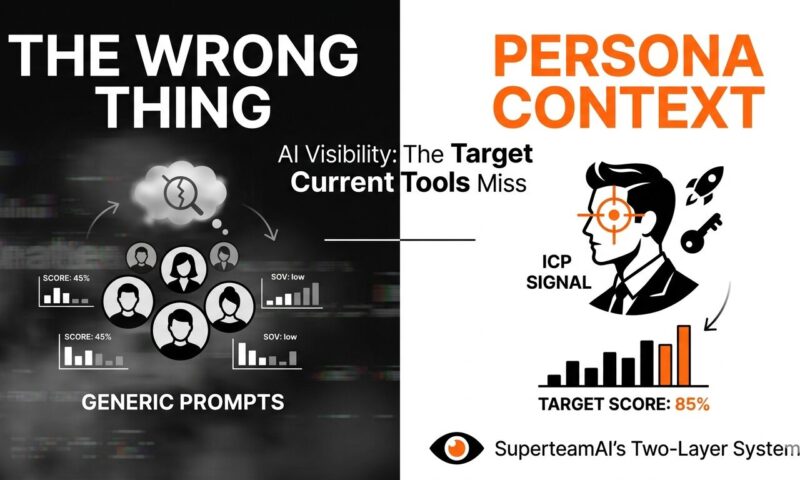
AI visibility software tracks how and where your brand appears in AI-generated answers across platforms like ChatGPT, Perplexity, Gemini, and Google AI Overviews. The software monitors which prompts surface your brand, how often you are cited, and what competitors appear alongside you. Advanced platforms additionally track visibility by searcher persona and context rather than by prompt alone.
The category has expanded rapidly. Dozens of platforms now claim to track your AI visibility, and most of them do something real: they run queries against major AI engines, record whether your brand appears, and trend that data over time. The problem is not that these tools are inaccurate. The problem is that they are measuring something other than the visibility that determines whether your target buyer finds you.
This article explains why, introduces a two-layer tracking methodology that addresses the gap, and evaluates the leading platforms against that standard.
What AI Visibility Software Actually Measures
The Prompt-Tracking Assumption Every Platform Is Built On
Every major AI visibility platform follows the same measurement model. You define a set of queries relevant to your category: “best CRM software,” “top project management tools,” “enterprise cybersecurity vendors.” The platform runs those queries against ChatGPT, Perplexity, Gemini, and other engines at regular intervals, records whether your brand appears in the generated answers, and calculates a visibility score based on citation frequency and position.
This model is borrowed from traditional keyword rank tracking, applied to AI-generated answers. It produces a number that answers the question: how often does my brand appear when someone asks this prompt? [VERIFY: most leading GEO platforms including Otterly AI, Profound, SE Ranking Visible, and Semrush AI track visibility at the prompt or query level without structured persona contextualization as a first-class feature]
What Prompt-Level Data Can and Cannot Tell You
Prompt-level tracking is useful for establishing a category baseline. If your brand does not appear when the generic industry query is run against a major AI engine, you have a visibility problem that needs addressing regardless of other factors. Monitoring that baseline over time tells you whether content and citation-building efforts are producing lift.
What prompt-level data cannot tell you is how your brand appears to a specific type of buyer asking that same query. And that distinction matters far more than most visibility software currently acknowledges.
Why AI Is a Contextual Recommendation Engine, Not a Search Engine
How AI Engines Use Persona Context to Shape Recommendations
A traditional search engine matches query text to indexed content. It does not know who you are. The same search for “best CRM” returns approximately the same results for every searcher, because the algorithm is matching text, not modeling the person asking.
AI engines work differently. Large language models infer context from everything in the conversation: the phrasing of the question, the platform being used, previous messages in the session, and any explicit information the user provides. That inferred context shapes what the model recommends, because the model is optimizing for a contextually appropriate answer rather than a universally ranked result.
A query submitted with no context will receive a generic response. The same query submitted after the user has described their situation, their company type, their constraints, or their goals will receive a materially different response. The AI is not returning a ranked list; it is making a recommendation to a specific perceived recipient. [VERIFY: LLMs produce meaningfully different brand recommendations for the same category query when given different persona contexts, confirmed across testing of ChatGPT, Perplexity, and Gemini with varied buyer persona framing]
The Same Query, Two Different Buyers, Two Different Answers
Consider the query “what CRM should I use?” submitted by two different buyers. The first is a real estate business owner running a team of ten agents, prioritizing contact management, deal pipeline visibility, and mobile access. The second is a SaaS founder scaling from seed to Series A, prioritizing product-led growth integrations, usage data syncing, and API flexibility.
Both buyers are asking the same question. The AI engine, if it has any context about who is asking, will recommend entirely different products. The real estate owner may receive Follow Up Boss, LionDesk, or HubSpot with a real estate workflow framing. The SaaS founder may receive Salesforce, HubSpot with a SaaS framing, or a developer-friendly CRM with API coverage emphasized.
A visibility score that averages both responses tells neither buyer anything useful. It tells the brand being tracked that they appear in some percentage of “CRM” queries across all inferred personas, which may have no relationship to how frequently they appear to the specific buyer type they are actually selling to.
The Persona Problem in Current Visibility Tracking
Why Generic Prompt Rankings Overstate and Understate Visibility Simultaneously
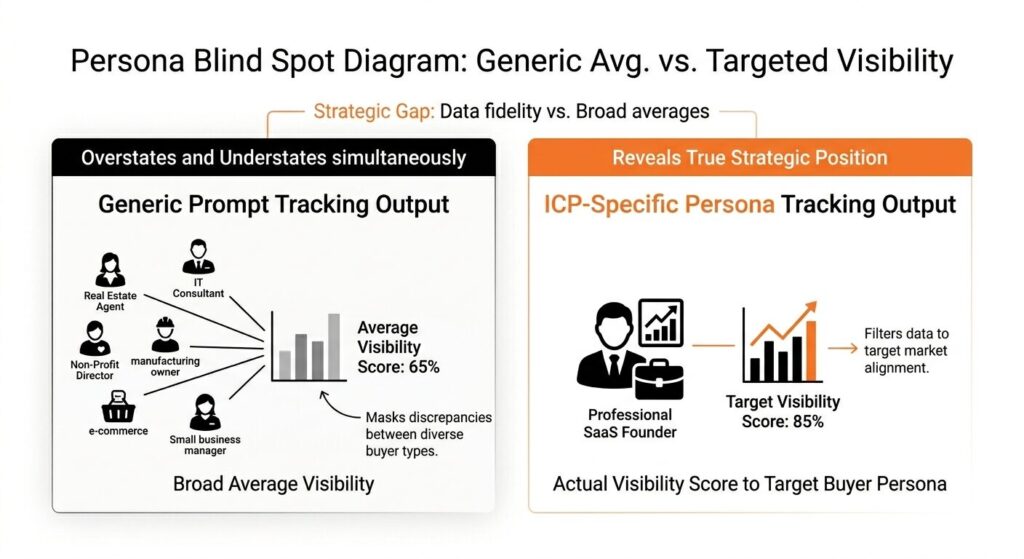
Generic prompt tracking produces a visibility score that is both higher and lower than the reality your target buyer experiences. For some brands, the generic score is inflated: the brand appears frequently in broad-category prompts because it is well-known, but it does not appear in the contextualized prompts that resemble how their actual ICP buyer searches. They are visible to everyone in the abstract and underperforming with the buyer that matters.
For other brands, the generic score is deflated: they are a strong fit for a specific vertical or buyer profile but do not appear in the generic category prompt because their positioning is too specific to surface on undifferentiated queries. Their actual visibility to their ICP is higher than the platform reports.
Both distortions have the same root cause: the visibility score is a statistical average across all possible personas who might submit that prompt, not a measurement of visibility to the persona you are trying to reach. [VERIFY: the same brand may appear in 60 to 80 percent of generic category prompts but significantly less frequently when the AI is given persona context that does not match the brand’s core ICP, based on prompt testing across ChatGPT and Perplexity]
The ICP Blind Spot: Measuring Visibility to No One in Particular
The practical consequence of persona-blind tracking is that brands optimize for the wrong signal. They see a low visibility score on a generic prompt and produce content designed to improve that score, without establishing whether the generic prompt resembles how their ICP buyer actually interacts with AI engines.
Most B2B buyers do not submit bare category queries to AI engines. They describe their situation, their constraints, and what they are trying to accomplish, and ask the AI what it recommends. That interaction is persona-rich by design. Tracking performance on stripped-down generic prompts tells you how you rank in a context that may not exist in your buyers’ actual AI usage patterns.
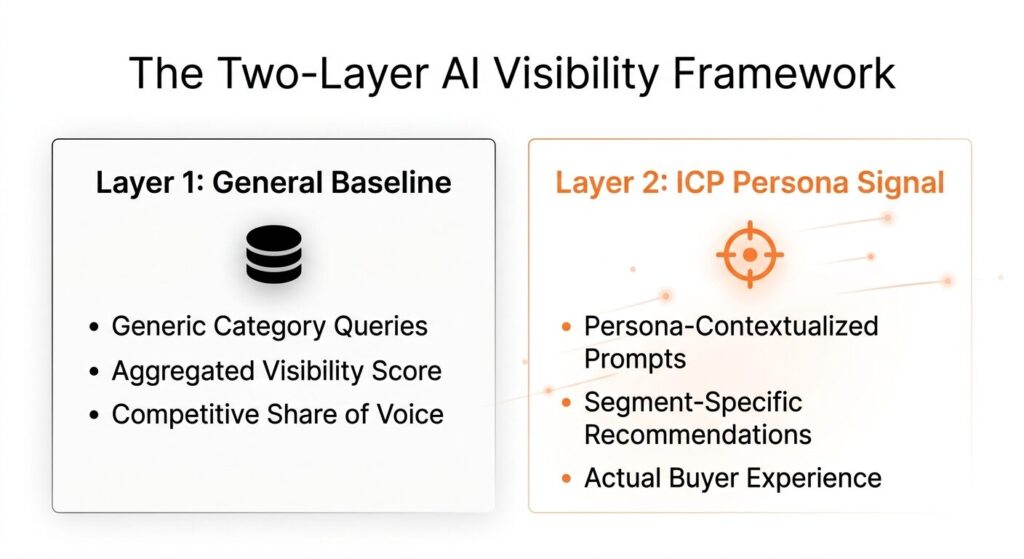
The solution is a two-layer tracking approach that measures both the general baseline and the ICP-specific signal.
Layer One: General Prompt Tracking and What It Tells You
Setting the Baseline: What General Tracking Is Good For
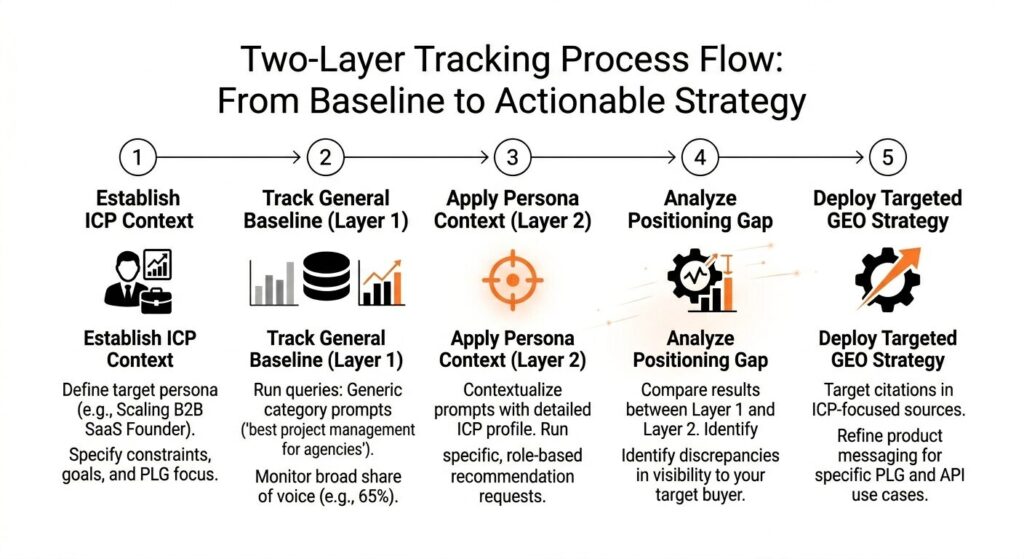
Layer one uses standard industry queries run without persona context. These are the prompts that every GEO platform tracks: category queries, comparison queries, problem-solution queries. Running these at regular intervals produces a baseline visibility score that tells you how your brand performs relative to competitors in undifferentiated AI search.
This baseline is necessary and useful. It tells you whether you have a broad citation problem, which platforms favor or disfavor your brand, and how your position trends over time as you publish content and earn citations. It is the foundation of any AI SEO program, and off-the-shelf platforms handle it adequately. [VERIFY: leading GEO tracking platforms cover 5 to 12 AI engines including ChatGPT, Perplexity, Gemini, Claude, Copilot, and Google AI Overviews, with variation in engine coverage across platform tiers]
The limitation of the general layer is not that it produces wrong data. It is that the data it produces answers a question that is only partially relevant to pipeline: how visible is our brand, on average, to an unspecified type of searcher?
Layer Two: ICP Persona-Based Tracking
Why Persona-Contextualized Prompts Produce Different Visibility Scores
Layer two adds persona context to the prompt before the query fires. Instead of submitting “best project management software for agencies,” the layer-two prompt first establishes the searcher: “I run a 20-person digital marketing agency serving B2B SaaS clients. We manage 15 accounts simultaneously and our main bottleneck is cross-client resource allocation and deadline visibility. What project management tools do you recommend?”
The AI engine processes this as a recommendation request from a specific type of buyer. The brands it cites reflect fit with that profile rather than general category prominence. [VERIFY: fewer than 3 of the top 15 GEO platforms offer structured ICP persona prompt configuration as a first-class tracking feature, with Gumshoe and Maximus Labs representing partial exceptions in the current market]
Running this persona-contextualized prompt at the same cadence as the general layer produces a second visibility score: not how often your brand appears overall, but how often it appears when the AI believes it is addressing your ICP buyer. The gap between the two scores is diagnostic: a large gap indicates that your brand is generically prominent but not well-positioned for your specific buyer profile.
How the Two Layers Work Together to Give You Actionable Data
The two layers answer different questions. Layer one answers: does our brand have a citation and visibility problem at the category level? Layer two answers: does our brand appear when the AI is reasoning about our specific buyer type?
Layer one informs broad content strategy: which topics, formats, and platforms produce citation lift across undifferentiated queries. Layer two informs ICP positioning strategy: whether your brand’s described capabilities, customer evidence, and use case framing align with what the AI model associates with your buyer profile. [VERIFY: brands that align content and positioning specifically to ICP buyer language and context see meaningfully different AI visibility scores on persona-contextualized prompts compared to generic prompts, based on agency-reported testing]
SuperteamAI builds ICP persona-based AI visibility tracking systems for marketing agencies and B2B firms that need to know where they stand with the specific buyer profile they are targeting, not with the average of all possible searchers.Talk to the team
How to Build ICP Persona Prompts That Mimic Your Target Buyer
The Prompt Structure: Establish Persona Context First, Then Query
An ICP persona prompt has two components. The first block establishes who is asking: their role, their company type and size, their industry, their current situation, their constraints, and their primary goals. The second block asks the recommendation question.
The persona block should reflect how your actual ICP buyer would describe themselves in a real AI conversation, not how you would describe them in a sales qualification call. Buyers use natural language, mention their pain points unprompted, and describe their situation in terms of what they are trying to accomplish.
A weak persona block: “I am a marketing manager at a B2B company with 50 employees looking for CRM software.” A stronger persona block: “I run marketing for a consulting firm that does about three million in annual revenue. We have a small sales team and grow mostly through referrals and inbound. I need to track follow-ups without a lot of admin overhead and I don’t want to spend six months on implementation.” The stronger version gives the AI the context it needs to make a recommendation that reflects your buyer’s actual situation.
Calibrating Persona Fidelity: The Variables That Change AI Recommendations
The persona variables that most reliably change AI recommendations are company type, company size and stage, budget orientation, technical capacity, and existing tool context. Each of these shifts the recommendation logic in ways that affect which brands appear. [VERIFY: AI engine recommendations shift most significantly in response to persona variables including industry vertical, company stage, budget framing, and technical sophistication, with brand recommendation sets changing by 30 to 60 percent between low-context and high-context persona prompts in category testing]
Building a library of ICP persona prompts means creating variants across these dimensions for each key buyer profile. A firm targeting both SMB and enterprise buyers needs separate persona prompt sets for each, because the AI recommendations for those two contexts overlap minimally. Three to five well-calibrated persona prompts per core ICP profile, run monthly, produce significantly more actionable visibility data than a hundred generic prompts run weekly.
Leading AI Visibility Platforms Evaluated Against the Two-Layer Standard
Platforms With General Prompt Tracking Only
Most leading GEO platforms fall into this category. Otterly AI tracks citation frequency across ChatGPT, Perplexity, Gemini, Claude, and Copilot at the prompt level, with strong multi-engine coverage and competitive benchmarking. SE Ranking Visible runs real AI engine responses rather than simulations, tracking brand presence, sentiment, and share of voice across standard query sets. Profound offers comprehensive general tracking with enterprise-grade reporting and real front-end data capture across ten-plus AI engines.
These platforms handle layer one well. None currently offer structured persona prompt configuration as a built-in feature that lets you track the delta between generic and ICP-specific visibility. Brands using them for strategic decision-making are working with layer-one data only. [VERIFY: the AI visibility software category has expanded significantly since 2024 as AI-generated answers now surface in the majority of commercial and informational queries, driving rapid platform development across Profound, Otterly, SE Ranking, and Semrush]
Platforms With Emerging Persona or Context-Aware Tracking
Gumshoe approaches visibility from the persona side, allowing teams to define buyer segments and track how different profiles encounter AI-generated answers. Maximus Labs uses ICP avatar sessions, running queries through persona-contextualized browser sessions to simulate how different buyer types experience AI recommendations. Both represent movement toward layer-two tracking, though neither yet offers the structured, repeatable ICP prompt library configuration that a full two-layer system requires.
For firms that need the full two-layer approach today, the practical answer is a hybrid: use an off-the-shelf platform for layer one, and build the layer two ICP persona tracking internally using direct API access to the major AI engines. The top AI agent development companies that build these systems configure the persona prompt library, the query cadence, the data storage layer, and the reporting output as a single custom build. The infrastructure is significantly lighter than a fullAI agent development engagement and can often be scoped as a standalone visibility tracking system.
If the leading GEO platforms are not showing you visibility data that reflects your actual ICP, SuperteamAI builds the persona-tracking layer that does.See how the system works
Frequently Asked Questions
What is the difference between AI visibility software and traditional SEO rank tracking?
Traditional rank tracking measures where your pages appear in search engine results for specific keywords. AI visibility software measures whether your brand is cited or recommended in AI-generated answers across platforms like ChatGPT, Perplexity, and Google AI Overviews. The two systems track distinct surfaces: rank tracking covers search results; AI visibility tracking covers generative answers.
Why do different AI engines show different visibility scores for the same brand?
Each AI engine uses a different model, training data, and retrieval architecture. A brand well-cited in sources that Perplexity retrieves may appear less frequently in ChatGPT’s training-weighted responses. Tracking across multiple engines is necessary because your ICP buyers may concentrate their AI usage on one or two platforms, and visibility on those specific platforms matters more than aggregate cross-engine averages.
How many prompts should a basic AI visibility tracking setup monitor?
For general prompt tracking, 15 to 30 category and comparison prompts cover most B2B use cases. For ICP persona tracking, three to five carefully calibrated persona prompt variants per core buyer profile are sufficient. More prompts do not produce proportionally more insight; persona fidelity and prompt quality matter more than volume.
Can AI visibility be improved directly, or does it require broader content strategy changes?
Both. Direct improvements include earning citations in sources the AI engines retrieve frequently and structuring content so it is easily quoted in generative answers. These improvements lift general prompt visibility. ICP persona visibility additionally requires that your content uses the language, framing, and use case descriptions that match how your buyer type describes their situation to AI engines.
Is building an in-house AI visibility tracker practical for small teams?
Yes, with scoped expectations. A lightweight persona tracking system using API access to ChatGPT, Perplexity, and Gemini, running a defined prompt library monthly, can be built and maintained by a single technical resource. It will not match the reporting interface of enterprise GEO platforms, but it will produce ICP-specific visibility data that no current off-the-shelf platform provides at the same fidelity.


