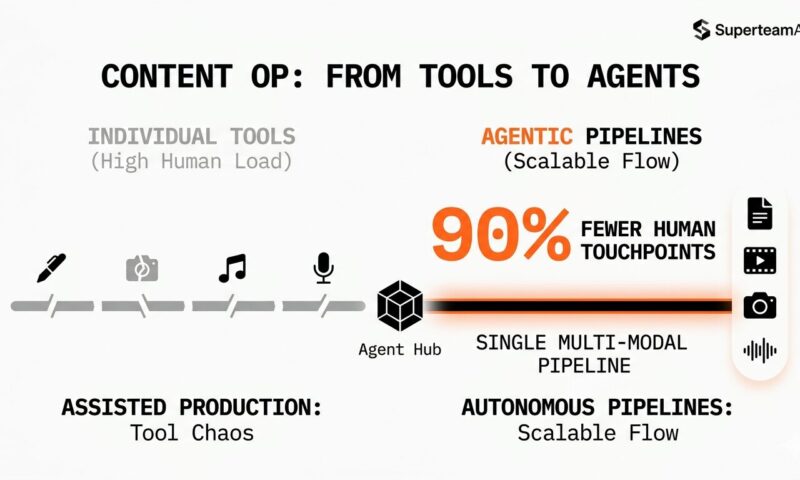
Generative AI features for creators span text generation, image and visual synthesis, video production, and audio and voice generation. Each category produces content from natural language prompts or reference inputs. The leading platforms combine modalities in a single workflow, and the most advanced connect these features to AI agents that direct production tasks without requiring human input at each step.
The question most creators and content teams are asking in 2026 is not whether these features exist. It is which ones actually move production forward and which ones require so much human correction that the time savings disappear. The answer depends heavily on how the features are used: individually as assistants, or connected into pipelines where AI agents direct the sequence of tasks from brief to finished asset.
This guide covers what each feature category does, where it sits on the assisted-to-autonomous spectrum, and which combinations enable the kind of agentic content production that reduces human involvement to brief input and final approval.
What Generative AI Features for Creators Actually Cover
The Four Core Feature Categories and How They Map to Creator Workflows
Generative AI features for creators fall into four distinct categories, each corresponding to a different output type and a different stage in a typical content production workflow.
Text generation produces written content from prompts or instructions: articles, scripts, social copy, email sequences, product descriptions, and long-form editorial content. Image and visual generation produces static visual assets from text descriptions or reference images: illustrations, product photography, brand imagery, and design components. Video generation produces motion content from text prompts, image sequences, or existing footage: short-form clips, explainer videos, and scene-by-scene narrative sequences. Audio and voice generation produces spoken narration, music, sound effects, and cloned voice outputs from text or audio reference inputs.
Each category has its own maturity level, quality ceiling, and set of prerequisites for operating autonomously within a production pipeline. [VERIFY: the average content creator currently spends 60 percent or more of production time on technical execution rather than creative direction, with the highest time costs in video editing, visual sourcing, and multi-channel content adaptation]
The Two Production Tiers: Assisted Creation vs. Autonomous Agent-Directed Output
Every generative AI feature operates in one of two production tiers. In the assisted tier, a human initiates each generation step, reviews the output, applies corrections, and moves the asset to the next stage manually. The AI accelerates individual tasks but the human is present at every decision point.
In the autonomous tier, an AI agent receives a content brief and directs the generation sequence across multiple feature categories without waiting for human approval at intermediate steps. The human defines the brief and reviews the final output. The agent handles task sequencing, prompt engineering, quality checking against defined criteria, and asset handoff between generation stages.
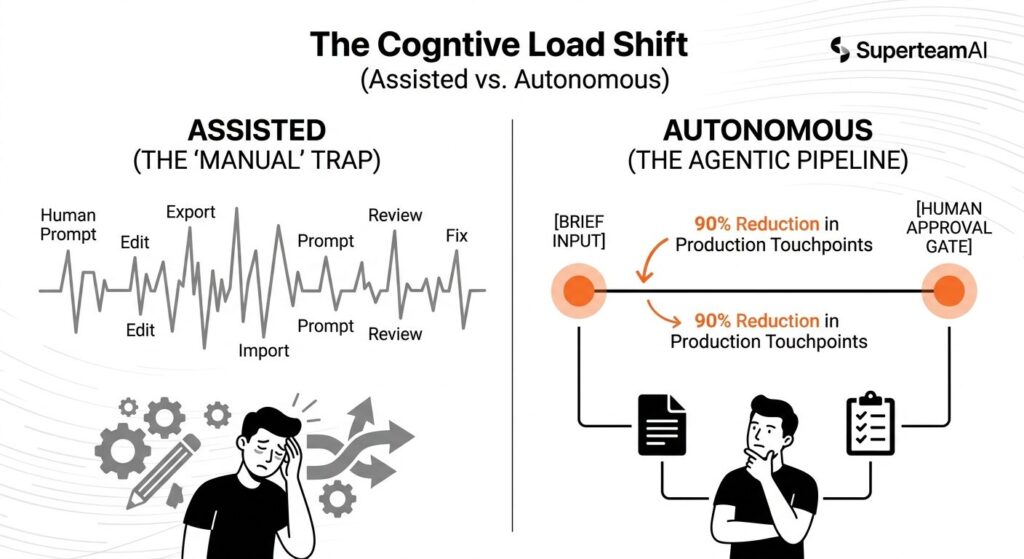
Most creators are currently operating in the assisted tier. The gap between the two tiers is not primarily about which features are available; it is about whether the features are connected to AI agents with the orchestration logic to direct them in sequence.
Text Generation: From Drafting Assistant to Autonomous Content Engine
What Text Generation Does at the Feature Level
Text generation in 2026 operates across a wide range of output types and quality levels. At the basic end, it produces first drafts from prompts or outlines that require significant editorial revision. At the advanced end, it produces brand-voice-consistent long-form content that requires light copy-editing rather than substantive rewrites. [VERIFY: leading large language models in 2026 produce long-form content requiring light editorial review rather than full rewrites for standard content types when given detailed, well-structured briefs with clear tone and format specifications]
The feature gap that matters most for production workflows is not raw output quality but consistency. A text generation model that produces strong output on one prompt and weak output on the next requires human review of every asset, which prevents autonomous operation. Platforms that support fine-tuning on brand voice data, structured output formats, and self-evaluation loops produce more consistent output and are closer to autonomous operation.
When Text Generation Operates Autonomously and When It Requires Human Review
Text generation reaches autonomous operation for well-defined, repeatable content types: product descriptions, social media adaptations of existing content, email subject line variants, meta descriptions, and FAQ entries based on existing documentation. For these types, the output requirements are specific enough that a quality-checking function can evaluate each generation against defined criteria without human judgment.
Text generation still requires human review for original editorial content, brand-sensitive communications, content that requires factual verification, and any output where tone judgment is highly contextual. The practical implication for content teams is that autonomous text generation is a viable production mode for a significant subset of their output volume, even if not all of it.
Image and Visual Generation: From Prompt-to-Asset to Agent-Directed Visual Production
Core Image Generation Capabilities Available in 2026
Image generation in 2026 produces outputs at commercial resolution with sufficient quality for most digital publishing, social media, and web design applications. Core capabilities include text-to-image generation from descriptive prompts, image-to-image transformation from reference inputs, inpainting and outpainting for editing specific regions of existing images, and style transfer for applying consistent visual aesthetics across an asset library. [VERIFY: leading image generation models in 2026 produce outputs at commercial resolution with style consistency features that enable brand-aligned asset production across large volumes without manual styling at each generation step]
The most significant capability advance for production workflows is style and character consistency: the ability to generate multiple images that share visual attributes across different scenes or compositions. This is the feature that makes image generation viable for brand asset libraries rather than just one-off illustrations.
Style Consistency and Brand Alignment: The Feature Gap That Limits Autonomous Visual Production
The primary constraint on autonomous image generation is brand alignment. Generating a single on-brand image from a well-crafted prompt is achievable. Generating a library of images where every asset is consistently aligned with brand color, typography context, character representation, and compositional style requires either a human reviewer at each step or a quality-checking agent trained on brand criteria.
Platforms that support reference image injection, style lock parameters, and negative prompt libraries are closer to enabling autonomous visual production for brand-consistent asset creation. Even with these features, visual brand consistency remains one of the more human-dependent quality dimensions in generative AI production workflows.
Video Generation: The Feature Tier Reshaping Long-Form Content Production
Text-to-Video and Image-to-Video: What Each Enables for Creators
Video generation currently operates through two primary input modes. Text-to-video generates motion content directly from written descriptions, making it accessible for creators who want to produce visual content without existing image assets. Image-to-video animates still images or sequences of images into video clips, giving creators more compositional control over the visual content before motion is applied.
For most professional production use cases, image-to-video workflows produce more predictable results because the visual content is already defined before the motion layer is applied. Text-to-video is better suited to exploratory content, social-format clips, and cases where production speed matters more than precise compositional control. [VERIFY: leading video generation models in 2026 support clip lengths ranging from seconds to several minutes, with multi-scene narrative coherence remaining an active development area as model context windows for video extend]
The Coherence Problem in Long-Form Video Generation
The primary constraint on agentic video production is coherence across longer sequences. Short clips of 5 to 15 seconds generate with high visual quality and reasonable consistency. Multi-scene sequences that need to maintain character continuity, environmental consistency, and narrative progression across several minutes are prone to visual drift between scenes.
This means that fully autonomous video production is currently more reliable for short-form content types than for long-form narrative video. An agent directing short-form video production can operate with minimal human intervention. An agent producing long-form scripted video still requires human review at scene boundaries to catch coherence failures before the full sequence is assembled.
Audio and Voice Generation: The Feature Layer Most Creators Underuse
Voice Cloning, Text-to-Speech, and Music Generation: Distinct Features, Distinct Use Cases
Audio generation covers three distinct feature types that serve different production purposes. Text-to-speech converts written scripts into spoken audio using synthetic or cloned voices, making it the primary feature for narration, voiceover, and podcast content production. Voice cloning creates a synthetic replica of a specific voice from a reference audio sample, enabling consistent character voice across production runs without re-recording. Music generation produces original background scores, intros, and audio branding elements from text or mood descriptions. [VERIFY: leading voice synthesis platforms in 2026 produce cloned voice outputs that are indistinguishable from originals to most listeners under standard listening conditions, with content watermarking becoming standard practice for provenance tracking]
For content creators producing high volumes of narrated content, text-to-speech with a consistent cloned voice is one of the highest-ROI generative AI features available, because it eliminates recording sessions, studio overhead, and re-recording costs for script corrections entirely.
Where Audio Generation Connects to Agent-Directed Content Pipelines
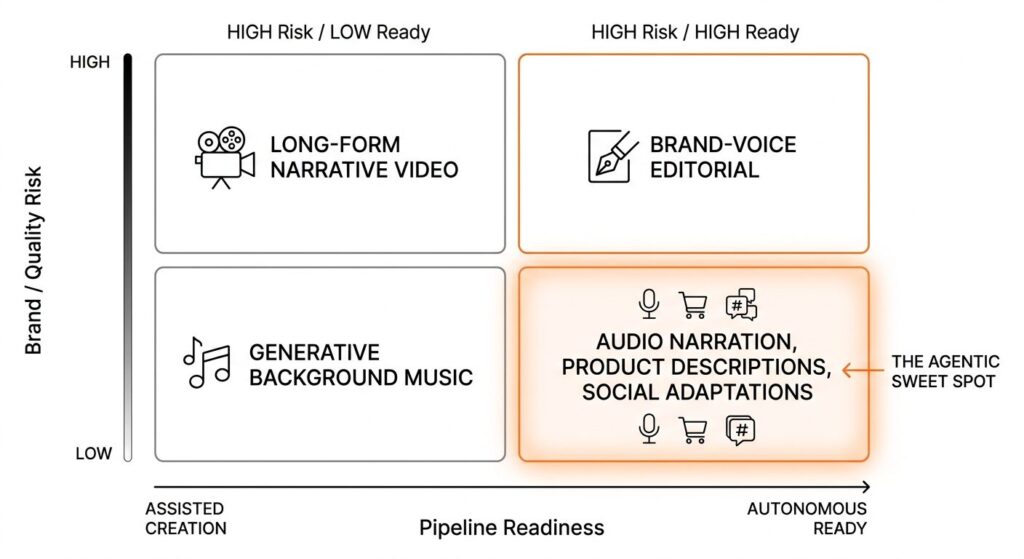
Audio generation is the most pipeline-ready of the four feature categories because the output quality criteria are relatively well-defined: does the narration match the script, is the pacing appropriate, and does the voice sound natural? These criteria can be evaluated programmatically without human judgment in most standard cases.
An AI agent that produces a written script using text generation can pass that script directly to a voice synthesis function and produce a narrated audio file without human intervention. This makes audio generation the natural connection point between text generation and the broader multi-modal pipeline, and the feature layer where autonomous operation is most reliably achievable today. [VERIFY: audio narration generation from completed scripts operates at near-100 percent automation rate in production environments where voice model and pacing parameters are pre-configured, with human review reserved for first-run voice model approval and pronunciation corrections]
Multi-Modal Features: When Text, Image, Video, and Audio Work Inside a Single Pipeline
What a Connected Multi-Modal Workflow Looks Like in Practice
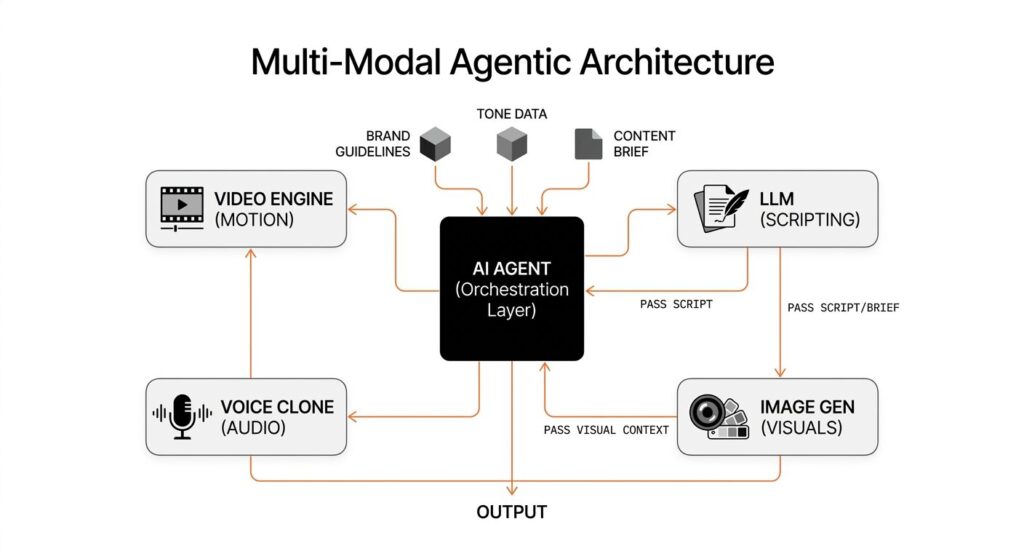
A connected multi-modal workflow takes a single content brief as input and produces a complete asset set as output: written copy, accompanying visuals, a video version, and a narrated audio track, all adapted to the specified formats and channels without separate human initiation of each generation step.
The agent directing this workflow receives the brief, sequences the generation tasks in the correct order (typically text first, then image, then video if required, then audio), passes outputs between steps as inputs, and checks each output against defined quality criteria before advancing. [VERIFY: fewer than 20 percent of creator teams currently run fully connected multi-modal pipelines; the majority use generative AI feature categories independently with manual handoffs between tools rather than automated pipeline connections]
The Integration Gap: Why Most Creators Use Modalities Separately
The gap between individual feature use and connected multi-modal pipelines is not primarily a technology gap. The features exist and the APIs are accessible. The gap is an orchestration gap: someone has to build the agent logic that sequences the tasks, passes data between generation steps, handles failure modes, and routes outputs to the correct quality-checking function.
Most creators encounter generative AI features through single-purpose platforms that do not expose an API or that require manual export and re-import between tools. Connecting them requires either a platform that natively supports multi-modal workflow orchestration or a custom AI agent development build that wraps the individual APIs in a coordinated pipeline.
SuperteamAI builds multi-modal content production pipelines that connect generative AI features into a single agent-directed workflow, from brief to published asset without manual handoffs between tools.Talk to the team
Which Features Enable Agentic Content Production
The Feature Prerequisites for Autonomous Agent-Directed Output
Not every generative AI feature is ready for autonomous operation in a production context. The features that enable reliable agent-directed output share three characteristics: they accept structured inputs that an agent can generate programmatically, they produce outputs whose quality can be evaluated against defined criteria without human aesthetic judgment, and they expose an API that allows an external agent to initiate and retrieve generation tasks without a human present at the interface.
Text generation, audio narration, and short-form image generation meet all three criteria in most production contexts. Long-form video generation and brand-sensitive image production currently require human review at key quality gates. [VERIFY: agent-directed content pipelines meet publishable quality standards in 60 to 80 percent of production runs for well-specified, repeatable content brief types, with the remaining requiring human revision before publication]
Understanding which features are agent-ready and which require human direction is the prerequisite for scoping an autonomous content production system. The AI agent development cost analysis covers how feature readiness affects build scope and timeline. The top AI agent development companies that build these pipelines typically begin with a content audit to identify which output types in a client’s production mix are agent-ready before recommending a pipeline architecture.
What Human Direction Is Still Required and Why
Human direction remains necessary at three points in any current agentic content pipeline. The first is brief definition: the agent needs a clear content brief that specifies output type, format, tone, brand parameters, and quality criteria. A poorly defined brief produces poor outputs regardless of how capable the generation features are. Investing time in brief quality compounds across every production run the pipeline executes. The brief is the highest-leverage human input in an autonomous pipeline: it sets the quality ceiling for everything the agent produces downstream.
The second is quality gate review for brand-sensitive or reputation-sensitive content: anything that speaks for the brand publicly, addresses a sensitive topic, or requires factual accuracy beyond what a quality-checking function can verify. The third is exception handling: the agent needs a human escalation path for generation failures, unexpected outputs, or content that falls outside its defined quality criteria. Within those boundaries, the production workflow runs continuously without human initiation at each step, which is what makes the transition from assisted to autonomous production economically meaningful for high-volume content operations.
If you are ready to move from using generative AI features individually to running them inside an autonomous production pipeline, SuperteamAI builds the agent layer that connects them.See how the pipeline works
Frequently Asked Questions
What is the difference between generative AI features and AI agents for content creation?
Generative AI features are individual capabilities: text generation, image synthesis, video production, audio generation. AI agents are the orchestration layer that sequences those features, passes outputs between generation steps, and evaluates quality without waiting for human input at each handoff. Features produce assets; agents direct the production workflow that connects features into a pipeline.
Which generative AI feature produces the most immediate time savings for creators?
For most creator workflows, text generation for repeatable content types (social adaptations, email variants, product descriptions) produces the fastest time savings because the output quality is sufficient for production use without significant revision. Audio narration is the second highest-ROI feature for creators who produce narrated content at volume, because it eliminates recording overhead entirely.
Can generative AI features maintain brand consistency across a large asset library?
Yes, with appropriate configuration. Image generation platforms that support style lock parameters, reference image injection, and brand-specific fine-tuning produce more consistent outputs than default generation. Text generation platforms fine-tuned on brand voice data produce more consistent tone and vocabulary. Consistency at scale requires these configuration steps and does not emerge automatically from the base features.
How much technical expertise does it take to connect generative AI features into a multi-modal pipeline?
Connecting individual generative AI features into a coordinated pipeline requires API access to each tool, orchestration logic to sequence tasks and pass data between steps, and quality-checking functions to evaluate outputs programmatically. This is typically beyond what a non-technical creator can configure without support, which is why most teams either use platforms that bundle multi-modal features natively or work with an AI agent development partner to build the integration layer.
What content types are best suited to fully autonomous generative AI production in 2026?
Content types best suited to full automation are those with well-defined format requirements and low brand risk: product description variants, FAQ entries, social media adaptations of existing articles, short-form narrated explainers from existing scripts, and email subject line testing variants. High-brand-risk content, original editorial, and long-form video with character continuity still require human review at key production stages.


