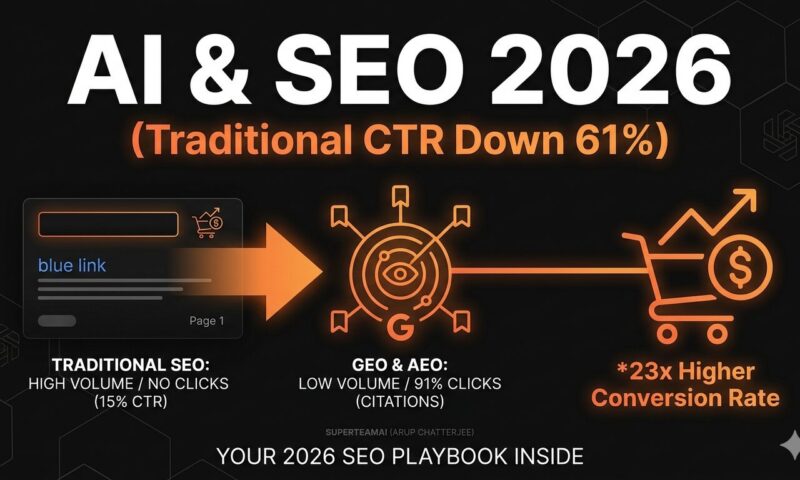
Organic click-through rates have dropped 61% for queries where Google shows an AI Overview. When an AI Overview is present, only 8% of users click an organic result. Zero-click searches now account for 83% of those sessions.
If those numbers sound alarming, they are. But they do not mean SEO is over. They mean that understanding the relationship between ai and seo in 2026 requires separating two conversations that most guides treat as one.
At Superteam AI, we manage SEO programmes for clients across SaaS, B2B services, and e-commerce. The difference between accounts that are growing in 2026 and those that are stalling comes down to one thing: recognising that AI and SEO is not a single shift. It is two distinct shifts happening simultaneously, each requiring a different response. Businesses that treat them as one are optimising for the wrong thing. Those that understand both are pulling ahead.
This is the practitioner’s guide to both. By the end, you will have a clear framework for what to do first, what to do second, and what to stop doing entirely.
The Two Ways AI and SEO Interact in 2026 (And Why Most Guides Only Cover One)
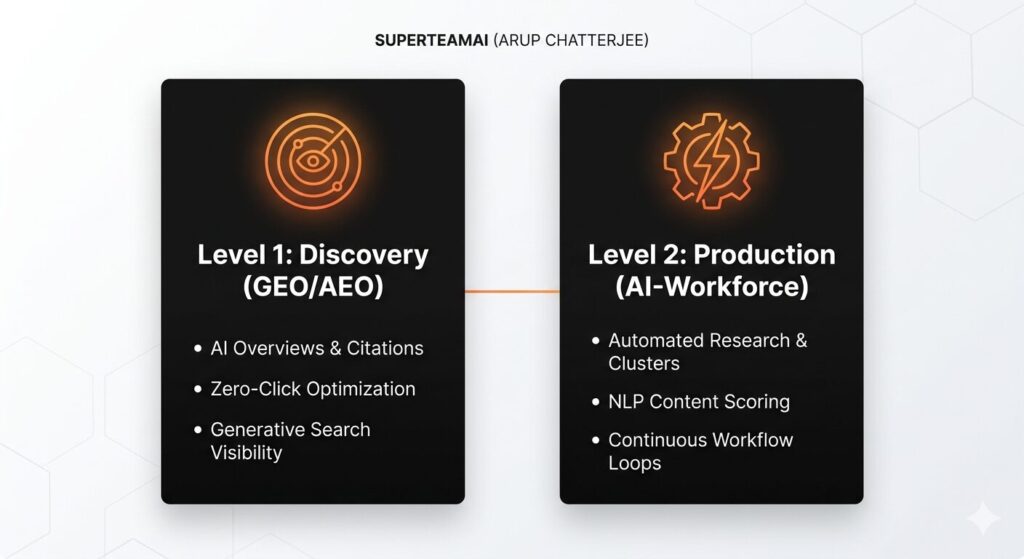
The relationship between seo and artificial intelligence operates on two separate levels, and confusing them leads to the wrong strategy.
The first level is about discovery. AI systems have changed where search results appear, how many users click through to websites, and what it means to be “visible” in search. This is the story about AI Overviews, zero-click searches, GEO, and AEO.
The second level is about production. AI tools have changed how you research keywords, produce content, optimise it, and scale your output. This is the story about AI-powered research platforms, content scoring tools, and workflow automation.
Most articles about how ai is changing seo cover the discovery layer and stop there. A few cover the production layer in isolation. Almost none explain how the two connect, or what a strategy that addresses both actually looks like. That is the gap this guide fills.
Part 1: AI Is Changing How People Find Your Content
Search behaviour has shifted structurally in 2026. The change is not subtle and it is not coming: it is already reflected in the data from Q1 2026. A meaningful share of informational queries now resolve inside AI-generated answers, and even queries that reach traditional search results are increasingly intercepted before users click.
Understanding this layer clearly is the prerequisite for adapting your ai seo strategy effectively.
The Numbers Behind the Shift
The data from Q1 2026 tells a consistent story across multiple measurement sources. Each statistic has a specific strategic implication.
AI Overviews now appear in 25.11% of Google searches (Conductor, Q1 2026 analysis of 21.9 million queries). For informational queries specifically, that rate is significantly higher. If your content targets high-volume informational keywords, you are operating in a SERP where one in four queries never reaches a traditional ranked result.
Organic CTR has dropped from 1.76% to 0.61% for queries with an AI Overview present: a 61% decline (Search Engine Land, 2026). The implication is direct: position 1 for an informational keyword with an AI Overview above it is worth far less in traffic terms than position 1 was twelve months ago.
Zero-click searches have climbed to 83% when AI Overviews are active, compared to approximately 60% without them. This means that for a significant portion of your target queries, the majority of users are reading an answer in the SERP and leaving.
Generative AI traffic is growing at 165 times the rate of organic search traffic. That growth rate signals where discovery is heading, not where it is today. Building visibility in AI-generated answers now is the equivalent of building organic rankings before the market became competitive.
When a Google AI Overview is present, only 8% of users click an organic result. Without one, the rate nearly doubles to 15%.
GEO and AEO: The New Visibility Metrics
Definition: GEO (Generative Engine Optimisation) is the practice of optimising content to appear as a cited source within AI-generated search answers, across Google AI Overviews, ChatGPT, Perplexity, and Gemini.
Definition: AEO (Answer Engine Optimisation) is the related discipline of structuring content to be extracted and cited as a direct answer by AI systems, rather than simply ranking in traditional results.
These are not replacements for AI SEO fundamentals. They are an additional layer of visibility that determines whether your brand is cited when AI systems generate answers in your topic area. As of 2026, ChatGPT alone accounts for 87.4% of all AI referral traffic to the web. Ignoring GEO and AEO means ignoring the fastest-growing discovery channel available.
We added GEO tracking to all client reporting in late 2025 after observing consistent AI referral traffic growth across accounts in the SaaS and B2B space. The pattern was clear enough that it warranted its own reporting column alongside traditional organic, paid, and direct.
The signals that drive GEO performance overlap substantially with traditional E-E-A-T: authoritative content, clear definitional language, structured data, FAQ formatting, and topical authority across a content cluster. The difference is the emphasis on clarity and extractability: ai overviews seo citation favours content that answers questions in 30 seconds or less, not content that buries the answer in a 4,000-word essay.
What Traditional SEO Fundamentals Still Do
Traditional SEO is not the problem. Treating it as the only channel is.
The fundamentals remain essential: technical site health, backlink authority, internal link architecture, structured data, site speed, and topical coverage. These are the same signals that AI citation systems use to assess trustworthiness. A page that ranks well in traditional search is far more likely to be cited in an AI Overview than one that does not.
What has changed is what traditional SEO delivers for different query types. For transactional queries, local searches, and navigational intent, traditional ranking positions still drive meaningful click-through rates. Users looking to buy, find a local service, or reach a specific brand still click. For informational queries where AI Overviews dominate, the value of a traditional ranking has declined substantially.
A complete ai seo strategy still requires traditional fundamentals as its base. The adjustment is in how you prioritise effort across query types. Chasing position 1 for high-volume informational keywords where AI Overviews capture 83% of sessions is a poor use of resource in 2026. Protecting and strengthening rankings for transactional and commercial queries remains as important as it has ever been.
One further point: the technical signals that power traditional SEO rankings (domain authority, structured data quality, topical depth, page speed) are also the signals that AI citation systems use to assess trustworthiness. This means that investment in traditional SEO fundamentals is simultaneously investment in GEO performance. The two are not competing priorities. They share the same foundation.
Part 2: How AI SEO Content Production Has Changed
The second dimension of the ai and seo relationship is on your side of the equation. AI tools have compressed the time required for every stage of SEO content production: keyword research, content planning, writing, optimisation, and reporting. Used well, they allow a small team to operate at the throughput of a much larger one. Used without strategy, they produce content that is technically optimised but lacks the expertise signals that both algorithms and AI citation systems reward.
AI for Research and Opportunity Identification
The most effective use of ai for seo begins with research. AI-powered research tools have made it possible to process a full content gap analysis, keyword cluster map, and competitive opportunity assessment in hours rather than days.
Specifically: AI keyword clustering tools (Keyword Insights) can classify thousands of raw keywords by intent and SERP similarity in minutes. AI-powered content audit tools (Ahrefs) identify underperforming existing content and surface improvement opportunities automatically. AI-driven competitor gap analysis tools (Semrush) identify topics your competitors rank for that you do not.
The strategic decisions remain human. Which cluster to build first, which competitor gaps are worth closing, and which keyword opportunities align with your commercial goals still require judgment that AI tools do not provide. The tools compress the time spent gathering and organising data; they do not replace the thinking applied to that data. For a full breakdown of which AI SEO tools serve each stage of this workflow, our tools guide covers the category in detail.
AI for Content Creation and Optimisation
AI content optimisation tools (Surfer SEO, Clearscope, Rankability) have made the content scoring stage substantially faster. NLP-based Content Score metrics, entity coverage analysis, and real-time term recommendations allow writers to calibrate content against SERP expectations without manual competitor analysis for every article.
The risk is real and we have seen it clearly in client content: articles that score highly on optimisation tools but lack genuine first-hand perspective rarely appear in AI Overview citations. The structure helps. The substance wins the citation. AI content scoring can tell you which terms to include and how to format your headings. It cannot tell you what to say that your competitors have not already said.
The winning approach in 2026 is using AI to accelerate production and human expertise to provide the substance. Content that combines optimisation-tool compliance with original analysis, first-person experience signals, and specific data points outperforms content that does one without the other.
AI for Workflow Automation and Scale
The most impactful application of AI in SEO is not at the individual tool level. It is in automating the connections between stages: from keyword research to brief creation to content production to optimisation to internal linking to performance tracking, running as a continuous loop rather than a sequence of disconnected tasks.
Most teams use AI tools point-by-point. A keyword tool here, a content scorer there, a reporting dashboard somewhere else. The gaps between those tools are where time and momentum are lost. Every manual handoff between stages is an opportunity for delay, inconsistency, or dropped context. Teams that close these gaps with a coordinated workflow see compounding output over time rather than linear effort-to-output ratios.
An AI SEO agent that coordinates across stages removes those gaps and allows the programme to build momentum continuously. Superteam AI’s SEO Workforce is built around this principle: running the full research-to-published-content workflow as a managed loop, so the programme does not stall when individual team members are occupied elsewhere.
The Conversion Data Nobody Is Using to Make Decisions
Here is the most important data point in the AI and SEO landscape that is not appearing in strategy guides.
AI-referred visitors convert at 23 times the rate of organic search visitors. Brands cited in AI Overviews earn 35% more organic clicks and 91% more paid clicks than comparable brands that are not cited. ChatGPT outbound referral traffic to the web grew 206% in 2025 (AI Search and SEO Statistics 2026).
This changes the ROI calculation for where to invest. A business earning 1,000 AI-referred visits per month with 23 times the conversion rate of organic traffic is generating more commercial value from that AI visibility than from 15,000–20,000 equivalent organic sessions under the old model. Lower volume, dramatically higher intent.
This matches what we observe in client analytics: AI-referred sessions from Perplexity and ChatGPT consistently show shorter sales cycles and higher purchase intent than equivalent organic sessions for the same keywords. The user arriving via an AI citation has already had their question answered by the AI system. They are clicking through to act, not to learn.
AI-referred visitors convert 23 times higher than organic search visitors. GEO is not just a visibility play. It is a revenue play.
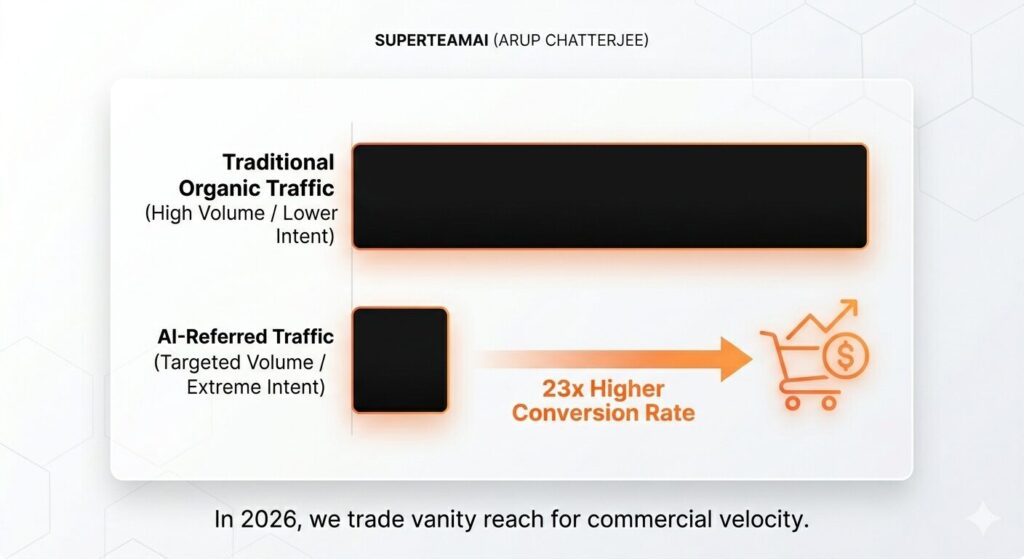
The implication for strategy is direct. Businesses that treat GEO as a “nice to have” future investment are underweighting the channel with the highest current conversion quality in search. Optimising for AI citation is not about chasing a trend. It is about capturing the highest-intent traffic available in 2026.
The 2026 Priority Framework: What to Do First, Second, and Stop
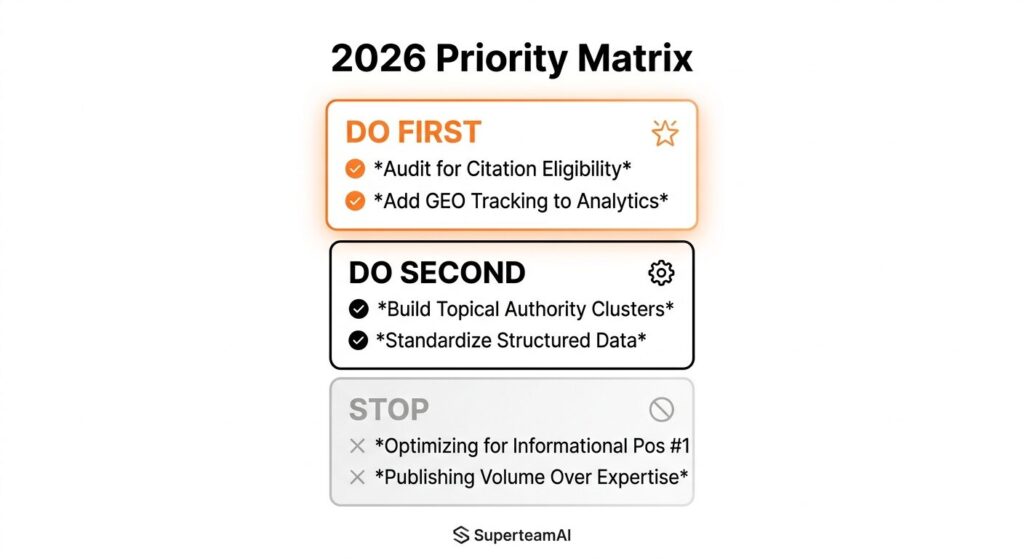
Navigating seo in the age of ai means being ruthless about where effort goes. Most guides add to the reader’s task list. This section is about removing from it.
Do First:
- Audit your highest-traffic informational content for AI citation eligibility. Does each piece have a clear definitional statement in the first paragraph? Is there a FAQ section? Is FAQPage schema implemented? These are the structural signals AI systems use to identify citable content.
- Add GEO tracking to your analytics reporting. You need to know which AI engines are referring traffic, which content they are citing, and how that traffic converts compared to organic sessions. Most analytics setups do not capture this by default.
- Map your target keywords against AI Overview prevalence. For keywords where AI Overviews appear in more than 50% of queries, recalibrate your traffic expectations and shift the goal from ranking to citation.
Do Second:
- Build topical authority clusters deliberately. AI citation systems favour brands that demonstrate consistent expertise across a topic, not pages that rank for a single keyword. A cluster of ten well-linked, expert-level articles on a topic outperforms ten isolated articles targeting individual keywords.
- Strengthen structured data implementation across all content types (Article, FAQPage, HowTo, BreadcrumbList). These are not optional enhancements in 2026. They are the signals that allow AI systems to parse and cite your content accurately.
- Integrate the AI production layer systematically. Select tools by what they actually automate (research, optimisation, or full workflow) and build a workflow that connects them rather than using each in isolation.
Stop Doing:
- Optimising purely for position 1 on informational queries where AI Overviews dominate. If 83% of users are not clicking, position 1 does not deliver what it used to.
- Treating content publication volume as the primary SEO metric. AI citation quality is determined by expertise signals and content structure, not by how many articles you publish per month. Twenty well-constructed articles with strong E-E-A-T will generate more AI citations than a hundred generic pieces.
- Running SEO and content as separate disciplines. AI visibility requires both to operate from the same brief: editorial expertise informing technically structured content. The teams that separate these functions are producing content that serves neither channel optimally. Citation eligibility is determined by both the substance of what you write and the structure in which you present it; separating the teams responsible for each means neither dimension gets full attention.
Frequently Asked Questions About AI and SEO
What is the relationship between AI and SEO?
The relationship between ai and seo in 2026 operates on two levels. First, AI systems have changed how people find content: AI Overviews intercept clicks before users reach organic results, and AI assistants like ChatGPT and Perplexity now function as discovery engines alongside Google. Second, AI tools have changed how SEO content is produced: AI-powered research, writing, and optimisation tools have compressed the time required for every stage of the workflow. Understanding both dimensions is essential for building an effective 2026 SEO strategy.
Is SEO still worth investing in with AI changing search?
Yes, but the definition of “SEO” needs updating. Traditional ranking for informational queries has become less valuable as AI Overviews capture the majority of clicks. But SEO for transactional, local, and navigational queries remains as effective as ever. More importantly, the technical fundamentals of SEO (authority, structured data, topical coverage, E-E-A-T) are the same signals that AI citation systems use to select citable sources. Investing in strong SEO is also investing in GEO performance.
What is the difference between GEO and SEO?
Traditional SEO optimises content to rank in Google’s blue-link results. GEO (Generative Engine Optimisation) optimises content to be cited within AI-generated answers across Google AI Overviews, ChatGPT, Perplexity, and Gemini. The two disciplines share many signals (authority, structured data, clear answers, E-E-A-T) but differ in emphasis: GEO prioritises definitional clarity, extractable content chunks, and FAQ structure over keyword density and backlink volume alone.
How do AI Overviews affect organic traffic?
AI Overviews reduce organic CTR significantly. Data from Q1 2026 shows organic click-through rates drop from 1.76% to 0.61% when an AI Overview is present, a 61% decline. Zero-click search rates climb to 83% for those queries. However, brands that are cited within the AI Overview itself see 35% more organic clicks and 91% more paid clicks than uncited brands. The goal in 2026 is not to rank below an AI Overview but to be cited within one.
How can AI help with SEO content production?
Using ai for seo content production typically operates across three stages: research (AI clustering tools identify keyword opportunities and content gaps faster than manual analysis), optimisation (AI content scoring tools calibrate articles against SERP expectations), and workflow automation (AI systems that connect research through to published content without manual handoffs between stages). Superteam AI’s SEO Workforce handles all three stages as a continuous, managed programme. See our pricing page for details.
How do I know if my content is being cited in AI-generated results?
Several tools now track AI visibility directly. Rankability tracks citations across ChatGPT, Perplexity, Gemini, and Google AI Overviews. Clearscope and Surfer SEO have added partial AI visibility tracking for Google AI Overviews specifically. For a baseline, you can manually query your target keywords in ChatGPT, Perplexity, and Google AI Overviews and note whether your brand or content is referenced. We recommend adding AI referral source tracking in Google Analytics 4 to capture traffic arriving from these platforms as a complement to citation tracking.
The ai and seo landscape in 2026 is more complex than it was two years ago, but the complexity is manageable once you separate the two dimensions clearly. AI has changed where people find content and how you produce it. Both shifts require a response. Neither can be ignored in favour of the other.
The businesses that are winning are not doing twice as much work. They are doing the right work in the right order: building content that earns AI citations, using AI tools to produce it efficiently, and running the whole programme as a system rather than a collection of individual tasks.
If you need the dual-channel AI and SEO programme managed for you, the Superteam AI SEO Workforce handles both dimensions as a single, continuous workflow.
The question is not whether AI has changed SEO. It has. The question is whether your programme has changed to match it.