An AI voice assistant for a real estate CRM costs between $400 and $2,000 per month depending on whether the brokerage uses a self-configured API stack or a managed deployment. Setup fees run $500 to $2,000. API-tier per-minute rates are $0.05 to $0.12. Most brokerages reach positive ROI within 60 to 90 days through ISA salary savings alone.
What an AI Voice Assistant for a Real Estate CRM Actually Does
The term covers three different products at three different price points. Understanding which one a vendor is selling is the first step in evaluating whether the number they quote is real.
The four components behind the monthly price tag
Every AI voice assistant runs on four stacked layers. Automatic speech recognition converts the caller’s voice to text in real time. A large language model interprets that text and generates the appropriate response. Text-to-speech converts the response back into spoken audio. Telephony routing connects the whole system to an actual phone network so calls can be placed and received.
AI voice assistants for real estate CRMs operate on four cost layers: ASR (speech-to-text), LLM inference, TTS (text-to-speech), and telephony routing. API-tier platforms including Retell AI, Bland AI, and Vapi price these layers bundled into a single per-minute rate of $0.05 to $0.12, while infrastructure-first platforms such as Google Dialogflow CX and Amazon Lex bill each component separately, increasing billing complexity and making total cost harder to forecast from the advertised rate alone.
Some platforms bundle all four into a single per-minute figure. Others bill each layer separately. The advertised rate is almost always the platform fee alone, not the total cost per minute once telephony is added.
How a voice assistant differs from a CRM power dialer
A power dialer places outbound calls from a pre-built list and connects the rep when someone answers. It does not hold a conversation. An AI voice assistant holds the conversation, qualifies the lead, books the appointment, and writes the outcome back to the CRM without a rep on the line. The dialer requires a human ready for every connected call. The voice assistant does not. For the full calling workflow this sits inside, see how the CRM-dialer setup feeds the voice assistant.
How AI Voice Assistants for Real Estate Are Priced
Per-minute pricing on API-layer platforms
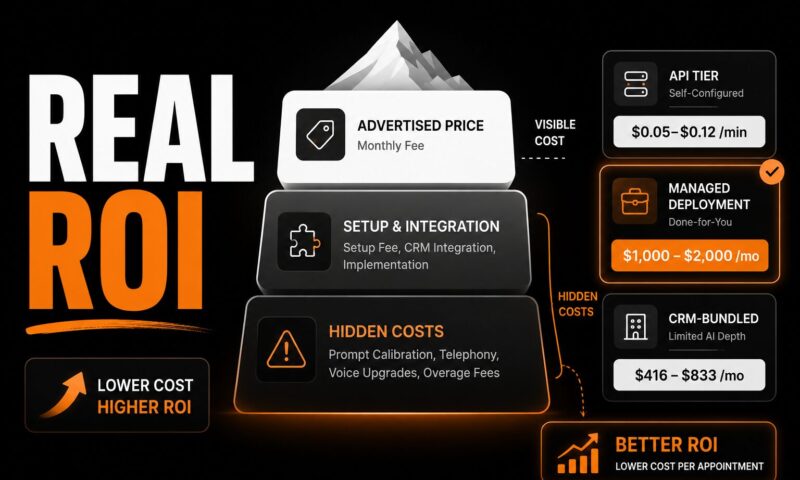
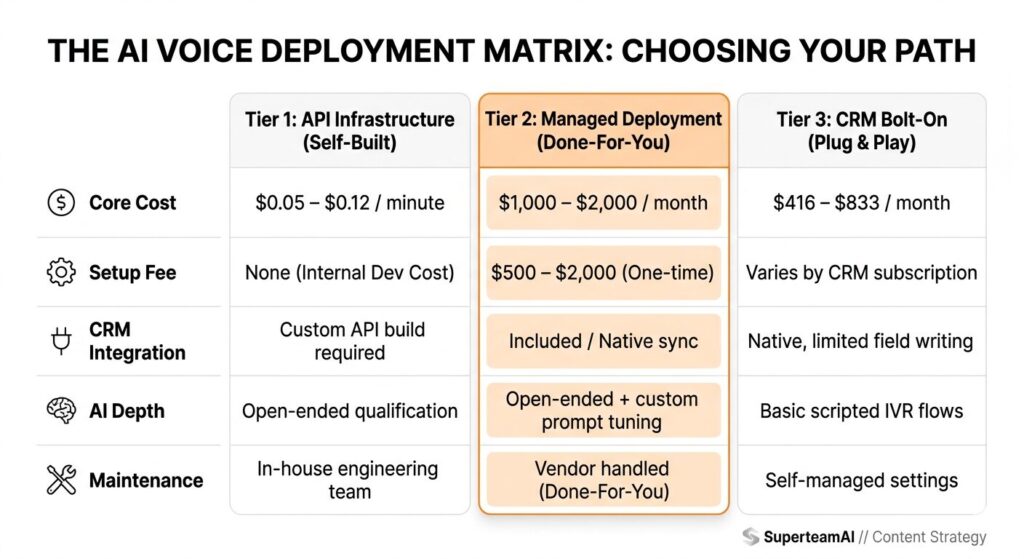
The API/infrastructure tier is the cheapest entry point. Retell AI charges $0.07 per minute. Bland AI charges approximately $0.09 per minute. Vapi ranges from $0.05 to $0.12 per minute depending on the LLM and voice tier selected. These rates bundle ASR, LLM inference, and TTS into a single per-minute figure. Telephony costs from the brokerage’s chosen carrier are billed on top.
Retell AI, Bland AI, and Vapi are the three API-tier platforms most commonly used in real estate brokerage AI calling stacks in 2026, with per-minute pricing of $0.07, $0.09, and $0.05 to $0.12 respectively before telephony provider costs, making them the lowest-cost entry point for brokerages with in-house technical capacity to configure and maintain the integration.
A brokerage handling 200 portal inquiries per month with an average call duration of four minutes consumes roughly 800 minutes of calling time. At $0.07 per minute plus a typical telephony add-on of $0.02 per minute, the monthly platform cost lands at approximately $72. That number is accurate, but it excludes setup, CRM integration build, and ongoing prompt maintenance.
Managed monthly pricing for done-for-you deployment
A managed deployment is what most brokerages without an AI engineering team actually need. The vendor configures the voice agent, connects it to the CRM and calendar, writes and calibrates the scripts, and operates the system on an ongoing basis. The monthly retainer for this model typically runs $1,000 to $2,000 for a brokerage handling 100 to 500 portal inquiries per month.
The setup fee covers initial configuration. The monthly retainer covers operations, script updates, number health monitoring, and CRM sync maintenance. No per-seat charges. No overage surprises tied to call volume spikes during a new project launch.
CRM-bundled pricing when voice is a bolt-on feature
Some real estate CRMs include a voice module as part of a broader subscription. Lofty (formerly Chime) bundles this at $416 to $833 per month for 10 to 30 users. The voice component is less capable than a purpose-built AI caller: it typically handles scripted IVR flows with some AI enhancement rather than full open-ended qualification conversations.
What Is Included in the Base Price
CRM integration, call logging, and outcome tagging
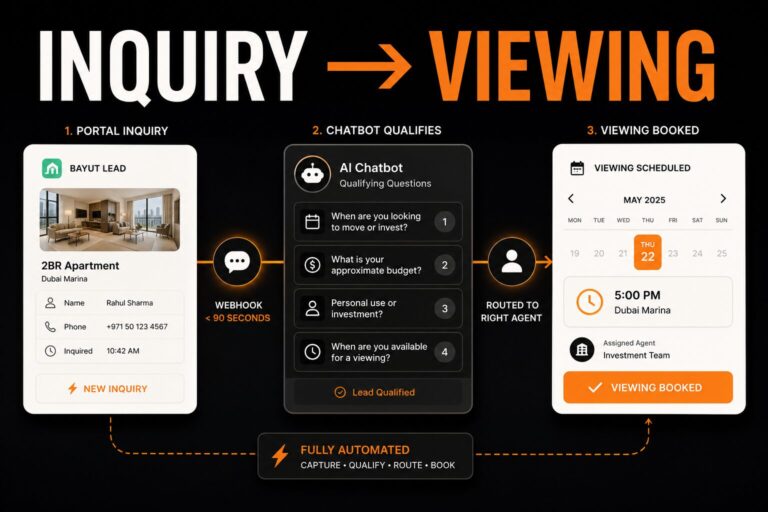
On API-tier platforms, CRM integration is not included. The brokerage’s technical team or a development partner builds the connection between the voice agent and the CRM. Native connectors exist for HubSpot, Salesforce, and Follow Up Boss through platforms like Retell and Bland, but they require configuration time. For managed deployments, CRM integration is included in the setup fee. The call outcome, qualification status, and full transcript write back to the lead record automatically.
Call transcription, summary, and calendar booking
Transcription is bundled into most API-tier platforms at the per-minute rate. Call summaries and automatic calendar booking are available on higher tiers or as add-ons. For the four workflows that require transcription and calendar integration to close the loop, see how AI cold calling for real estate handles every missed lead.
Hidden Costs Brokerages Consistently Miss
Setup, integration, and prompt calibration fees
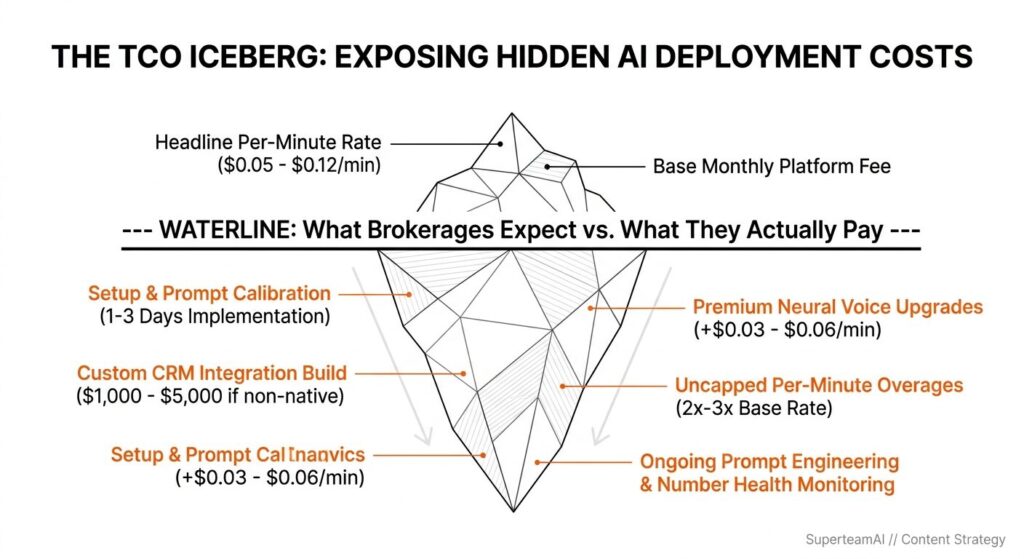
Setup and onboarding fees for AI voice deployments in real estate run $500 to $2,000 one-time, and custom CRM integration builds add $1,000 to $5,000 for brokerages where no native connector exists, making the true first-month cost significantly higher than the advertised monthly platform rate for brokerages on API-tier self-configured stacks.
Prompt calibration is the third hidden cost. Writing the qualifying script, testing edge cases, and tuning the agent’s behavior to match the brokerage’s market takes one to three days of technical implementation work. Managed deployments absorb this cost inside the setup fee. API-tier deployments do not.
Per-minute overages and voice tier upgrades
Per-minute overage charges on subscription-tier AI voice platforms run 2 to 3 times the base rate once monthly minute allowances are exceeded, and upgrading from a standard synthetic voice to a premium neural voice tier adds $0.03 to $0.06 per minute to the blended cost, both of which are consistently underestimated in initial cost projections by brokerages evaluating AI voice tools for the first time.
AI Voice Assistant vs. ISA: Cost Comparison by Market
US market cost and coverage gap
A single inside sales agent in the US costs $3,000 to $4,500 per month in base salary. Benefits, payroll taxes, and HR overhead add $800 to $1,200. Total cost: $3,800 to $5,700 per month for an agent who works an eight-hour shift, handles one call at a time, and is unavailable on weekends without overtime.
A human ISA in the US costs $3,000 to $4,500 per month in base salary with an additional $800 to $1,200 in benefits and overhead, totaling $3,800 to $5,700 per month for single-shift, single-call-at-a-time coverage, compared to an AI voice assistant operating at $400 to $2,000 per month for 24/7 coverage with unlimited concurrent call capacity.
India and Dubai: what an ISA costs versus what the AI covers
In India, an inside sales agent costs Rs 15,000 to Rs 35,000 per month depending on city and experience. That covers one shift and one call at a time. A portal lead submitted on MagicBricks at 10pm gets seen by the agent the next morning, if they remember to check. In Dubai, an experienced inside sales agent runs AED 4,000 to AED 8,000 per month. A Bayut inquiry at 11pm on a Thursday is a missed appointment if no one calls back within 15 minutes.
ISA cost in India runs Rs 15,000 to Rs 35,000 per month depending on city and experience level, and in Dubai AED 4,000 to AED 8,000 per month for a residential inside sales agent with relevant experience, making the cost differential between a human ISA and a managed AI calling deployment narrower in India than in the US but structurally identical in terms of coverage limitations: one call at a time, single shift, no after-hours response.
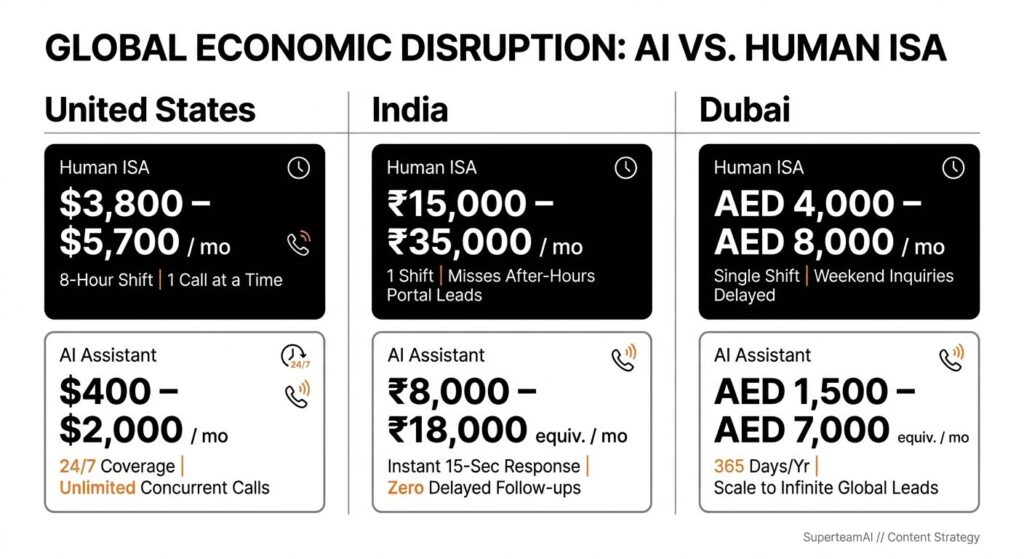
The AI voice assistant costs the same regardless of when the inquiry arrives, how many inquiries arrive simultaneously, or what time zone the lead is in. That structural difference is what changes the ROI math.
ROI Calculator: How to Run the Numbers for Your Brokerage
The three inputs that determine ROI
Monthly portal inquiries. Average call duration in minutes. ISA monthly cost in your market. Those three numbers produce two outputs: cost per booked appointment via AI and cost per booked appointment via ISA. The comparison determines payback period.
ROI table: 100, 200, and 500 monthly portal inquiries
Assumptions: 15 percent connect-to-appointment rate, average call duration 4 minutes, managed AI deployment at $1,500 per month, US ISA at $4,500 per month.
| Monthly Inquiries | AI Calling Cost | Appointments Booked | AI Cost Per Appointment | ISA Cost Per Appointment |
| 100 | $1,500 | 15 | $100 | $300 |
| 200 | $1,500 | 30 | $50 | $150 |
| 500 | $1,700 | 75 | $23 | $60 |
A brokerage handling 200 monthly portal inquiries with a 15 percent connect-to-appointment rate and a managed AI voice deployment at $1,500 per month produces a cost per booked appointment of approximately $50, compared to $150 per appointment when the same lead volume is handled by a human ISA at $4,500 per month, representing a 67 percent reduction in cost per appointment at moderate brokerage lead volume.
Brokerages that track cost per booked appointment as the primary ROI metric for AI voice deployments report measurable positive returns within 60 to 90 days of going live, with the cost advantage over human ISA-produced appointments widening as monthly lead volume increases beyond 150 portal inquiries per month, because the AI calling cost remains largely fixed while the ISA cost scales linearly with volume.
For the lead generation pipeline that fills this calling queue, see how AI real estate lead generation fills the brokerage CRM.
Questions to Ask Before Committing to a Pricing Tier
Questions that surface hidden costs before you sign
Is the per-minute rate published without requiring a sales conversation? Is telephony included in the base rate or billed separately by the carrier? What is the overage rate when monthly minutes are exceeded? Is CRM integration native to the platform or routed through a third-party connector? Is the setup fee disclosed upfront or in the contract only? What is the minimum contract length and cancellation policy?
Red flags in pricing pages
Pricing available on request only, with no published per-minute or monthly rate. No mention of telephony costs. Overage rates not listed. CRM integration described as available without specifying whether it is native or connector-based. Setup fee disclosed only after a demo is booked. These patterns consistently signal that the true monthly cost is significantly higher than the headline number.
When the Pricing Model Determines the Architecture
The pricing model is not a line item. It is an architectural decision. A per-minute API stack requires someone to configure the voice agent, build the CRM integration, calibrate the scripts, monitor number health, and update the agent when the brokerage adds a new listing type or expands into a new geography. If the brokerage has that capability in-house, the API tier produces the lowest total cost. If it does not, the true cost of the API tier includes the engineering time to build and maintain the system, and the managed monthly retainer becomes the more cost-efficient choice at the same lead volume.
Book a call to see the SuperteamAI voice OS pricing for your lead volume