Every AI writing tool launched in the last 18 months has added “agent” to its product page. Most of them should not have.
The difference matters more than vendors want you to think. A genuine ai-powered seo agent takes a keyword, runs autonomous research, generates a brief, produces content, validates quality, and delivers a publication-ready package, all without you managing each step. A prompt wrapper does one of those things and then waits for you to click “next.” Both are marketed identically in 2026.
We built Superteam AI’s 18-agent SEO system from the ground up. We have evaluated every major platform claiming the ai-powered seo agent label and applied the same six criteria we used to define our own architecture. The difference between tools that pass and tools that fail is not subtle.
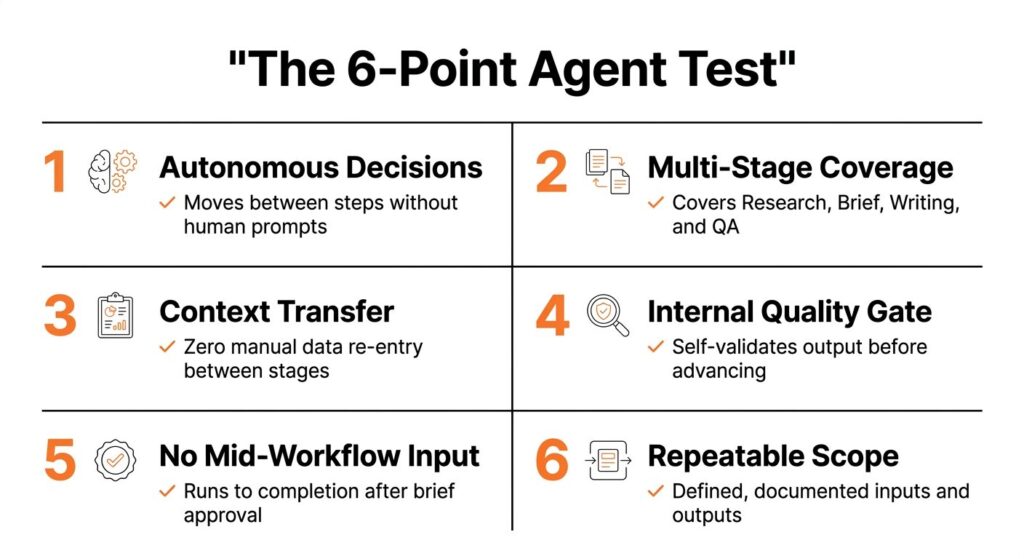
This ranking uses a methodology we call the 6-Point Agent Test. It evaluates autonomy, multi-stage execution, context retention, internal quality gates, human-in-the-loop requirements, and defined repeatable scope. A genuine agent passes all six. Most tools in this category pass two or three.
We rank Superteam AI’s AI SEO Workforce first because it passes all six criteria and operates on a coordinated multi-agent architecture. We are direct about that upfront, and equally direct about where every other tool lands on the same criteria.
If you want the independent criteria before the rankings, the 6-Point Agent Test is documented in full at What Is an AI SEO Agent?. For the broader ai seo landscape context, start there.
How We Evaluated Every Tool on This List
Rankings for tools this technical require transparent methodology. Here is exactly how we assessed each platform.
The 6-Point Agent Test
Every tool was evaluated against the same six criteria we use to define a genuine AI-powered SEO agent:
- Autonomous decisions between steps: Does the system determine its next action from its own output, or does it require a human instruction at each transition?
- Multi-stage workflow coverage: Does the system cover at minimum five connected stages: research, analysis, brief generation, content production, and QA?
- Automatic context transfer: Does output from one stage feed the next automatically, without manual data re-entry?
- Internal quality gate: Does the system validate its output before advancing to the next stage or delivering to the user?
- No mid-workflow human input: After brief approval, does the system run to final output without asking for decisions in between?
- Defined, repeatable scope: Does the system have a documented workflow with a defined input and a defined output?
Each tool receives a score from 0 to 6. Tools scoring 5 or 6 are genuine ai-powered seo agents. Tools scoring 3 or 4 are partial agents with specific limitations. Tools scoring 0 to 2 are AI SEO tools with agent branding.
Supporting Criteria
Beyond the 6-Point Agent Test, we evaluated output quality across a standardised keyword set, true cost per article at realistic volumes, performance consistency at 5, 15, and 30 articles per month, and transparency of each vendor’s workflow documentation.
Conflict of Interest Disclosure
We operate Superteam AI, which ranks first on this list. We have applied the same six criteria to our platform as to every other. Verify claims with a live demonstration before committing. The criteria are documented publicly so you can apply them independently.
Rankings at a Glance
The table below summarises all seven platforms by agent test score, tier classification, and entry-level pricing. Full details for each tool follow below.
| # | Tool | Agent Test Score | Tier Classification | Starting Price |
| 1 | Superteam AI SEO Workforce | 6/6 + multi-agent | Tier 1: Full Workforce | $79/month |
| 2 | Alli AI | 4/6 | Tier 2: Genuine Agent | $299/month |
| 3 | Outranking.io | 3/6 | Tier 2: Partial Agent | $79/month |
| 4 | Surfer SEO | 2/6 | Tier 3: AI Tool | $99/month |
| 5 | MarketMuse | 2/6 | Tier 3: AI Tool | $149/month |
| 6 | Semrush AI Writing | 1/6 | Tier 3: AI Tool | Included in Semrush plans |
| 7 | Frase | 2/6 | Tier 3: AI Tool | $45/month |
Tier 1: Full AI SEO Workforces
#1: Superteam AI SEO Workforce
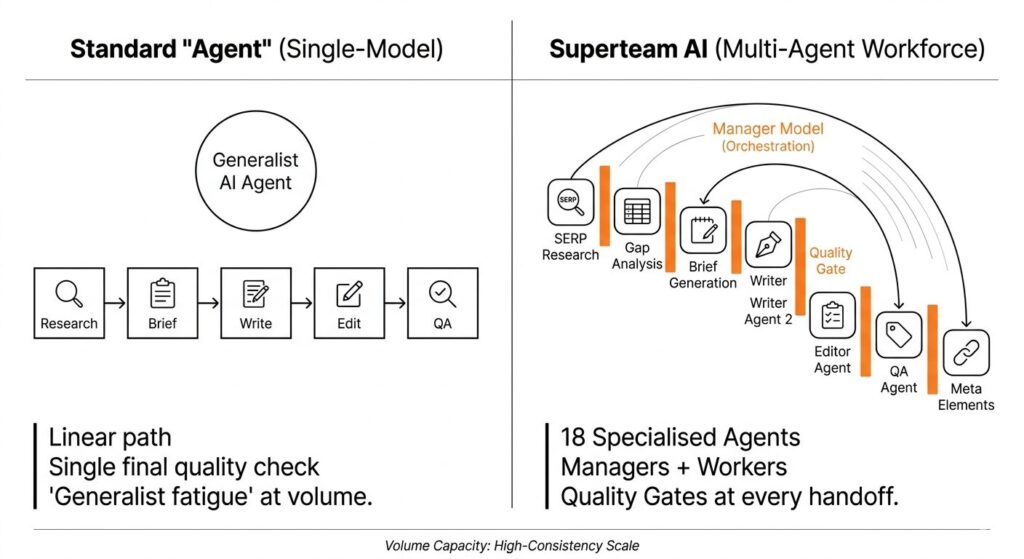
Transparency note: We built this. It ranks first because it passes all six agent criteria and operates on a fundamentally different architecture from everything else on this list: 18 specialised agents working in coordination rather than one generalised agent handling the entire workflow.
Overview
The Superteam AI SEO Workforce is a coordinated system of 18 specialised agents, each responsible for one stage of the SEO workflow. A SERP research agent, gap analysis agent, brief-generation agent, writer agents, editor agent, QA agent, meta element agent, and interlinking agent all operate in sequence under a manager model that orchestrates handoffs and enforces quality gates between every stage.
When we built this system, the requirement we kept returning to was that the human should be a strategic approver at two defined checkpoints, not a task manager at every transition. Meeting that at scale required specialised agents rather than a generalised one: a specialist at each stage does its function at higher consistent quality than a generalist context-switching across all of them.
The result is higher throughput and more consistent output quality. Multiple keywords process simultaneously without quality declining at volume, which is the ceiling single-agent architectures reliably hit between months four and eight of consistent deployment.
Key Capabilities
- End-to-end workflow from keyword intake to publication-ready content package, with two human approval checkpoints (brief review and final content review)
- 18-agent architecture with specialised agents at every stage, coordinated by a manager model
- Quality gate at every agent handoff, not only a final check before delivery
- Simultaneous multi-keyword processing without quality degradation at volume
- Systematic internal linking management across the growing content library
Best For
Teams producing 20 or more articles per month that need consistent quality at scale. Also the right model for agencies managing multiple client brands or companies building topical authority across large content clusters.
Pricing
| Plan | Monthly Price | Articles/Month | Users |
| Pro | $79/month | 5 | 1 |
| Business | $199/month | 15 | 3 |
| Scale | $399/month | 30 | 10 |
Pros
- Only platform on this list that passes all 6 agent criteria
- Multi-agent specialisation delivers quality consistency that single-agent tools cannot replicate at volume
- Systematic interlinking and on-page element generation included in every plan
Cons
- Pro plan (5 articles/month) is better suited to teams building their content operation than those needing high volume from day one
- More infrastructure than a team producing 1 to 2 articles per month needs
Tier 2: Genuine AI-Powered SEO Agents
These tools pass 3 or 4 criteria from the 6-Point Agent Test. They deliver genuine autonomous execution for specific parts of the SEO workflow but fall short of full end-to-end autonomy due to narrower scope, mid-workflow human input requirements, or limited quality validation.
For teams in the 5 to 15 article per month range, these are the honest middle of the market. They automate real bottlenecks. They are not automation all the way through.
#2: Alli AI
Overview
Alli AI is the closest thing to a genuine AI-powered SEO agent at mid-market price. Its primary strength is autonomous on-page optimisation: once configured, it identifies opportunities across a site, generates recommendations, and implements approved changes automatically without requiring manual execution of each individual fix. The multi-step execution and context transfer between its analysis and recommendation stages are genuine.
Where it falls short: content production capability is narrow. Alli AI does not cover the full sequence from keyword research through brief generation to draft production. The internal quality gate between stages, while present, is less rigorous than the highest-scoring agents maintain. You get genuine autonomy within a more limited scope than a complete SEO workflow.
Key Capabilities
- Autonomous on-page optimisation with automated deployment of approved changes across large websites
- Bulk technical and content fix implementation without manual execution of individual changes
- A/B testing for title tags and meta descriptions with automated winner selection
- Real-time content scoring benchmarked against current SERP competitors
- Automated schema markup generation and deployment
Best For
Technical SEO and on-page optimisation at scale. Teams managing websites with 100 or more pages that need autonomous implementation of fixes, not just a list of recommendations to action manually.
Pricing: $299 to $599 per month depending on page count and feature tier.
Pros
- Genuine autonomous execution for on-page tasks, not just a recommendation list
- Handles bulk implementation across large sites without manual execution overhead
- Passes 4 of 6 agent criteria: meaningful autonomy within its defined scope
Cons
- Does not cover content creation or the full keyword-to-publication workflow
- Strategy and new content production remain manual responsibilities outside Alli AI’s scope
#3: Outranking.io
Overview
Outranking.io connects keyword research to content planning to content production within a single platform, and the context from the research stage transfers to the content editor automatically. That automatic transfer eliminates one manual data re-entry step compared to disconnected tool stacks. It is a meaningful workflow improvement over managing four separate tools manually.
Where it falls short: the workflow requires human decisions at multiple mid-stages. The content production phase does not operate autonomously; the user guides the writing process section by section rather than the system executing from brief to draft independently. There is no internal quality validation before delivery. The accurate classification is a connected AI content workflow with reduced manual handoffs, not an autonomous ai-powered seo agent.
Key Capabilities
- Integrated keyword research, SERP analysis, and content brief generation with automatic context transfer between stages
- AI-assisted writing within a content editor that stays connected to live SERP data throughout
- Competitor content gap analysis embedded in the brief stage
- Content scoring updated against top-ranking results in real time as you write
- First draft generation from the structured brief with research context pre-loaded
Best For
Content teams wanting more workflow connectivity than standalone AI writers deliver, without the infrastructure of a workforce model. A good fit for 5 to 10 articles per month with a hands-on writer overseeing production.
Pricing: $79 to $149 per month depending on plan.
Pros
- Genuine workflow integration between research and content stages at an accessible price point
- Live SERP-connected content scoring is useful throughout the writing process
- Reduces manual data transfer compared to disconnected tool combinations
Cons
- Requires consistent human direction through content production: not autonomous execution
- No internal quality gate: what is produced is what the user receives, without automated validation
Tier 3: AI SEO Tools with Agent Branding
These platforms score 0 to 2 on the 6-Point Agent Test. They are useful tools that perform real functions within an SEO workflow. The concern is not their capability within their designed scope. The concern is classification: they are not genuine ai-powered seo agents, and marketing them as such creates false expectations for buyers expecting autonomous end-to-end execution.
#4: Surfer SEO
Surfer SEO is among the best content optimisation tools in the market. Its content editor provides real-time guidance on keyword usage, structure, and topical coverage that measurably improves content quality. Surfer AI generates first drafts from a brief with output that is competitive for the price.
What it is not: an ai-powered seo agent. The human provides the keyword, manages research, approves the brief structure, directs the AI writing process, and reviews output before publishing. Two criteria are partially met: multiple content-related steps and some context persistence within a session. Autonomous decision-making and internal quality gates are absent.
Best For: Content teams wanting real-time SEO scoring while writing, with AI-assisted first drafts. Strong for teams that have an editorial process and want better data to inform it.
Pricing: $99 to $219 per month.
| Evaluation Dimension | Assessment |
| Agent Test Score | 2/6 |
| Output quality within scope | High |
| Workflow autonomy | None |
| Correct classification | AI content optimisation tool |
Pros: Best-in-class real-time content scoring; strong topical coverage analysis; widely supported CMS integrations.
Cons: Human-directed at every stage; no autonomous execution; “agent” marketing misrepresents what the tool is.
#5: MarketMuse
MarketMuse is a sophisticated content strategy and research platform. Its topic modelling, content clustering, and competitive content analysis are among the most thorough in the market, with research depth that most alternatives cannot match.
Where the agent claim breaks down: MarketMuse produces research and strategy recommendations. It does not execute the workflow that follows. The human takes MarketMuse analysis and decides what to do with it. Two criteria are partially met: multiple research stages and maintained topical context within a session. End-to-end execution and autonomy are absent.
Best For: Content strategists needing deep topical research and competitive gap analysis before directing a production team. Enterprise teams building structured content clusters with planned editorial calendars.
Pricing: $149 to $399 per month.
| Evaluation Dimension | Assessment |
| Agent Test Score | 2/6 |
| Output quality within scope | High |
| Workflow autonomy | None |
| Correct classification | AI content research and strategy tool |
Pros: Deep topical authority analysis; strong competitive content gap identification; enterprise-grade research depth.
Cons: No content production or autonomous execution; high entry price without an attached execution workflow; misclassified as an agent.
#6: Semrush AI Writing
Semrush ContentShake AI is an AI-assisted writing tool built into Semrush subscriptions. It provides topic ideas, content outlines, and first drafts with SEO guidance embedded. For existing Semrush users, it adds content production capability to a platform they already use for research and auditing.
As an agent: it scores 1/6, assisting with one stage of a human-directed process. There is no connected research-to-production pipeline, no workflow autonomy between stages, and no internal quality validation before delivery. It is a well-executed AI writing assistant attached to a leading SEO data platform, genuinely useful for the right team, but not a genuine ai-powered seo agent.
Best For: Existing Semrush subscribers wanting AI writing assistance without an additional subscription. Not a replacement for genuine agent-level automation.
Pricing: Included in Semrush Guru ($229/month) and Business ($449/month) plans.
| Evaluation Dimension | Assessment |
| Agent Test Score | 1/6 |
| Output quality within scope | Moderate to High |
| Workflow autonomy | None |
| Correct classification | AI writing assistant within an SEO platform |
Pros: No additional cost for existing Semrush subscribers; benefits from Semrush’s keyword and competitive data; acceptable draft quality.
Cons: Single-function writing assistant; no autonomous workflow execution; lowest agent test score on this list.
#7: Frase
Frase connects research to content optimisation within a single interface. SERP analysis feeds directly into the content editor, removing one manual transfer step compared to disconnected tools. Content scoring against top-ranking results updates in real time as you write. At $45 per month for the entry plan, it is the most accessible tool on this list.
Like the other tools in this tier, Frase requires human direction at every stage. Research informs the writing; the human executes the writing. Two criteria are partially met: connected stages within a session and real-time context transfer from research to the editor. Autonomous decision-making and quality gates are absent.
Best For: Freelance writers and small teams wanting SERP-connected research and content optimisation in one tool at an accessible price. Good for solo operators and very small teams without the volume to justify more automated solutions.
Pricing: $45 to $115 per month.
| Evaluation Dimension | Assessment |
| Agent Test Score | 2/6 |
| Output quality within scope | Moderate |
| Workflow autonomy | None |
| Correct classification | AI-assisted content research and optimisation tool |
Pros: Clean research-to-content workflow in one interface; competitive pricing; real-time content scoring against SERP competitors.
Cons: No autonomous execution; human direction required at every stage; agent positioning in marketing is misleading.
How to Choose the Right AI-Powered SEO Agent for Your Team
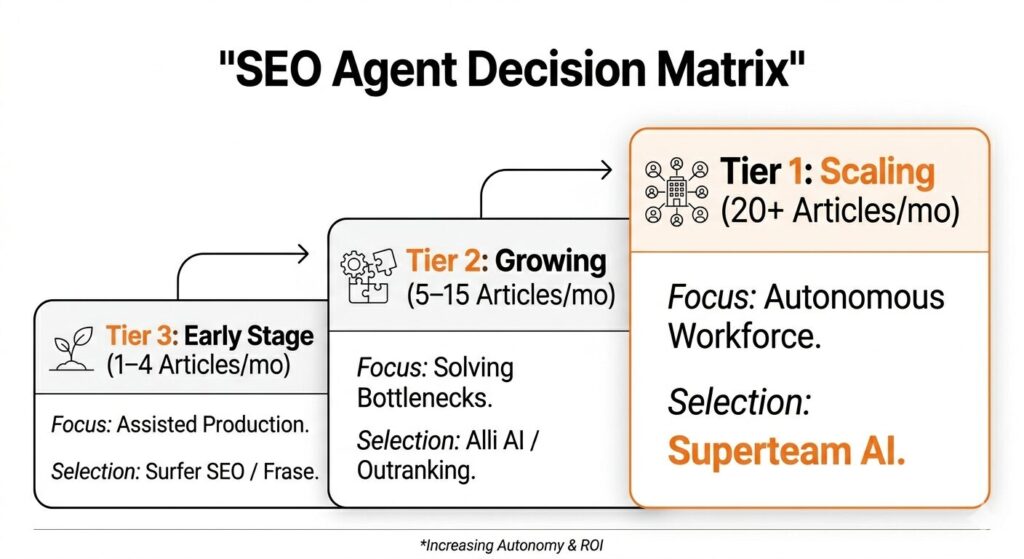
The right tool matches your output volume, team structure, and growth trajectory, not simply the most powerful option on the list.
Founders and Early-Stage Teams (1 to 4 Articles Per Month)
At this output level, automation infrastructure is unlikely to produce returns that justify the investment. A Tier 3 tool like Surfer SEO or Frase gives you AI-assisted production with real-time optimisation guidance at a price that fits an early-stage budget ($45 to $100 per month). Reassess when you consistently need more output than you can manage manually, which typically happens between months three and six if content is a core growth channel.
Growing Teams (5 to 15 Articles Per Month)
This is where genuine automation starts delivering measurable returns. Coordinating research, writing, and QA across 10 articles per month manually is expensive in time and difficult to scale without adding headcount.
Alli AI is the right choice at this stage if your primary bottleneck is on-page optimisation across an existing large-page-count website. Outranking.io is worth evaluating if you want more workflow connectivity than a standalone AI writer without full workforce infrastructure.
For teams where content production volume is the primary bottleneck, the Superteam AI Business plan ($199 per month, 15 articles) delivers more genuine end-to-end automation than either Tier 2 option at a comparable total cost per article. This is the crossover point where workforce economics begin making sense against Tier 2 alternatives.
Scaling Teams and Agencies (20+ Articles Per Month)
At 20 or more articles per month, coordination costs across individual AI tools become a real operational drag. You are either hiring coordination capacity or accepting quality inconsistency as the cost of volume.
A multi-agent workforce is the correct model at this scale. The Superteam AI Scale plan ($399 per month, 30 articles, 10 users) processes high volume with consistent quality at roughly $13 per article, one-fifth to one-tenth of what freelance or agency production costs at equivalent quality.
Match the model to the volume. Tier 3 tools for early-stage operations. Tier 2 agents for growing teams with specific automation bottlenecks. Tier 1 workforce when volume, consistency, and cost efficiency are all requirements simultaneously.
Frequently Asked Questions
Q1: What is the difference between an AI SEO tool and a genuine AI-powered SEO agent?
An AI SEO tool handles one function and requires human direction at each step. A genuine AI-powered SEO agent handles multiple connected workflow stages autonomously, making decisions between steps without human input at each transition. The practical difference: a tool waits for your next instruction after every output. A genuine agent runs from keyword input to completed content package with human involvement at only two defined points: brief approval and final review. Most tools marketed as AI SEO agents in 2026 score 2 to 3 out of 6 on the agent criteria, making them sophisticated tools with agent branding, not genuine agents.
Q2: How do I apply the 6-Point Agent Test to a tool I am evaluating?
Request a live demonstration: provide a target keyword and watch the system run to final output without providing further instructions between stages. Check all six criteria: autonomous decisions between steps, at least five connected stages covered, automatic context transfer between stages, output validation before advancing, no mid-workflow human input required, and a clearly defined repeatable scope. A genuine agent passes all six. The full test is at What Is an AI SEO Agent?.
Q3: Is a multi-agent workforce different from a single AI-powered SEO agent?
Yes, meaningfully so. A single AI-powered SEO agent is one system handling multiple workflow stages sequentially as a generalist. A multi-agent AI SEO workforce is a coordinated team of specialised agents, each optimised for one function, with quality gates enforced between every handoff. Specialist agents outperform generalists on their respective tasks, producing higher quality per stage and higher throughput as multiple keywords process simultaneously. The single-agent model suits 5 to 15 articles per month. The workforce architecture is correct at 20 or more.
Q4: Can I use an AI-powered SEO agent alongside my existing tools?
It depends on the agent. Alli AI and Outranking.io integrate into existing workflows and work alongside current tools. A full workforce like Superteam AI replaces the research, brief generation, writing, QA, and on-page element creation stages entirely, making existing tools for those functions redundant. What remains useful are tools covering strategic decisions outside the workflow scope: competitive positioning, brand direction, and keyword cluster prioritisation.
Q5: At what monthly volume should I switch from Tier 3 tools to a genuine agent or workforce?
The transition makes financial and operational sense at 10 or more articles per month. Below that threshold, automation setup overhead can outweigh the benefit. Above it, the cost per article at agent or workforce level ($13 to $40 depending on plan) is substantially lower than combined tool, writing, and coordination costs at equivalent quality. The AI for SEO guide covers the transition thresholds in detail.
Q6: How consistent is output quality from AI-powered SEO agents at higher volumes?
This varies significantly between the tiers. Tier 1 multi-agent workforces maintain quality consistency because specialised agents do not degrade under volume. The same SERP research agent and the same QA agent process article 30 at the same standard as article 1. Tier 2 single-agent systems maintain reasonable consistency up to about 15 articles per month, after which context limitations and coordination demands begin affecting output. Tier 3 tools show the most quality variance at volume because the human coordinating the workflow is the consistency variable, and human coordination does not scale without growing headcount.
Q7: Does Superteam AI offer a way to trial the AI SEO Workforce before committing?
Yes. You can see the full workflow demonstrated before committing. Visit our pricing page to review plan options or request a live demonstration from keyword input through to publication-ready output. We recommend using a keyword from your actual target cluster so the output is directly comparable to what you currently produce.
Know What You Are Buying
The ai-powered seo agents category has a labelling problem that costs buyers real money. Tools assisting one stage of a human-directed workflow are marketed with the same language as systems that execute the entire workflow autonomously. The difference in what you receive is significant. The pricing, in many cases, is not.
Apply the 6-Point Agent Test before committing to any platform. Require a live demonstration. Watch the system run from keyword input to final output without you providing instructions between stages. A genuine ai-powered seo agent passes without your involvement. A prompt wrapper needs you to keep clicking.
From seven tools evaluated against the same six criteria: one passes all six on a multi-agent architecture. Two demonstrate genuine autonomy within narrower scopes. Four are useful tools doing real work within human-directed workflows, which is a more limited thing than “agent” implies.
Match the model to the requirement. Do not accept a tool-level result when your volume calls for genuine agent-level execution.If you are ready to see what a genuine AI SEO Workforce delivers, start your Superteam AI plan today and run your first keyword cluster through the system.


