Most guides to AI SEO automation are tool lists dressed up as strategy. They tell you which platforms to subscribe to, which features to enable, and which dashboards to connect, then stop there as if picking the right tools is the hard part.
It is not. The hard part is knowing what to automate, what not to automate, and how to connect the components into a system that compounds rather than degrades. After building AI SEO automation systems for clients across B2B SaaS, professional services, and e-commerce, we have found that the failure mode is almost never a tool problem. It is an architecture problem.
This guide gives you the system design framework we use: a decision matrix for what belongs in automation versus what should stay human, a breakdown of the six SEO functions worth automating in 2026, the quality control layer that makes automation sustainable, and a measurement framework that connects the program to business outcomes. You will not find a ranked tool list here. You will find the blueprint for an AI SEO automation program that compounds.
The AI SEO landscape in 2026 has matured past the question of whether to automate SEO tasks. The question now is how to design the system correctly from day one.
What AI SEO Automation Actually Means
The phrase “ai seo automation” covers a lot of ground, and the lack of a clear definition is part of why so many programs are built on shaky foundations. Before building anything, it is worth being precise about what the term actually means in 2026.
Definition: AI SEO Automation is the use of AI-orchestrated systems to execute SEO research, content production, technical optimization, and performance analysis at speed and scale, with humans in the loop for strategy, quality oversight, and editorial direction.
The critical distinction for 2026 is between AI-assisted SEO and AI-orchestrated SEO systems. AI-assisted SEO, the 2023 and 2024 paradigm, means using AI tools to help humans do SEO faster: a writer drafts with an AI tool, an SEO clusters keywords with an AI platform. The human is still the executor; the AI is a support layer.
AI-orchestrated SEO systems, the 2026 standard, means AI executes the workflow autonomously, with humans setting strategy, reviewing output, and approving at defined checkpoints. The human is the director; the AI is the execution layer.
This distinction matters enormously for system design, because AI-assisted SEO does not require architecture; it just requires tool subscriptions. AI-orchestrated systems require workflow design, quality controls, and a clear decision framework for where automation ends and human judgment begins.
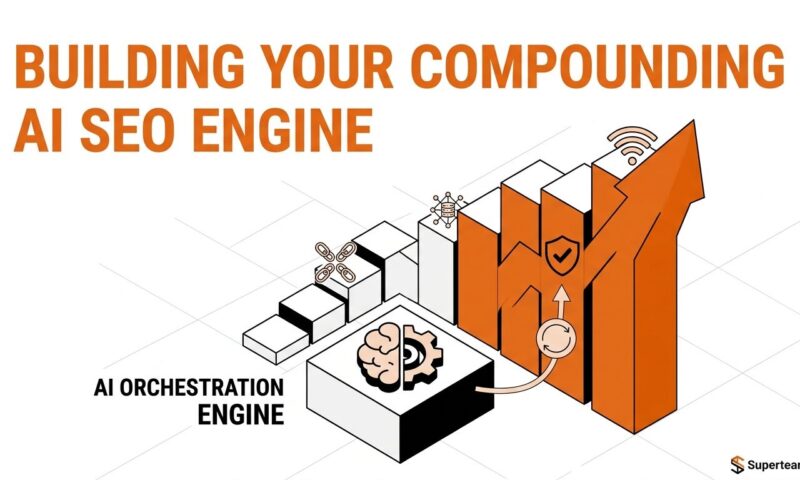
The seo automation benefits that accrue from orchestrated systems are qualitatively different from what AI-assisted SEO delivers. Each month of operation builds topical authority, calibrates output quality, and widens the gap between your program’s coverage and a competitor running manually.
The Automation Decision Framework: Automate, Augment, or Keep Human
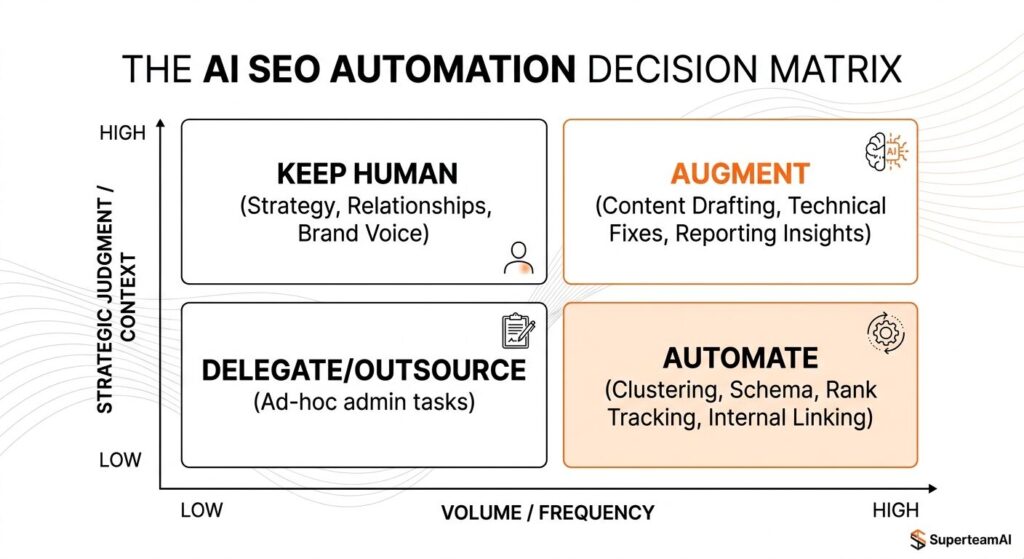
The most important decision in any AI SEO automation program is not which tools to use. It is which tasks belong in each of three categories: fully automated, AI-augmented, or fully human. Getting this wrong in either direction creates problems. Over-automation degrades quality; under-automation negates the efficiency gains that make the program financially viable.
When we set up AI SEO automation for a new client, this framework is the first thing we map. Every task in the SEO workflow gets assigned to one of three categories before a single tool is selected or a single workflow is designed.
| Task Category | Approach | Why |
| Repetitive, rule-based, high-volume | Fully Automate | Consistent input-output logic; AI executes faster and more accurately at scale |
| Requires judgment and execution | Augment (AI + Human) | AI handles data processing and drafting; human makes the final call |
| Business context, strategy, brand integrity | Keep Human | AI cannot replicate contextual judgment, client relationships, or novel strategic thinking |
What Should Be Fully Automated
Tasks that belong in the automate column share one clear characteristic: they have a predictable input-output structure that can be validated programmatically. Keyword data ingestion and clustering, meta description drafting, internal link suggestion, rank tracking alerts, crawl error detection, schema markup generation, and SEO task automation for reporting all qualify. The decision about whether a given output is correct can be made by an automated QA check without human review every time.
The automation criteria is straightforward: if you could write a checklist of what good output looks like, and an AI agent could check against that checklist accurately, the task belongs in automation. If the checklist would require judgment calls that change based on business context, it does not.
What Should Be Augmented (AI + Human)
The augment category is where most content production work lives. AI generates the keyword cluster map, the content brief, and the article draft; a human reviews and approves before publication. AI identifies technical SEO issues and recommends fixes; a human makes the call on site architecture changes. AI generates reporting insights; a human decides what they mean for strategy.
The augment model is not a compromise. It is the operating model that extracts the speed of automation while preserving the judgment quality that keeps the program producing durable results. AI content automation for SEO that removes the human augmentation layer from content production is the single most consistent cause of program failure we have observed.
What Should Stay Human
Three categories should remain human-led regardless of automation maturity: competitive strategy, brand editorial direction, and stakeholder relationships. Competitive strategy covers what topics and angles to pursue and how to position against alternatives in the market. Brand editorial direction covers the voice, perspective, and intellectual property that makes the content uniquely valuable rather than a well-optimized version of what everyone else is publishing. Stakeholder relationships cover any decision where trust between people is the operating currency.
Automation does not compete with these functions. It creates the operational capacity to execute them well, because when the execution layer runs autonomously, human attention stays focused on the decisions that actually require it.
The 6 SEO Functions Worth Automating in 2026
Not all SEO functions benefit equally from automation. The six below consistently deliver the strongest ROI when automated correctly, meaning with the right system design and quality controls in place. Each function covers what AI handles, what the human reviews, and what the quality gate requires.
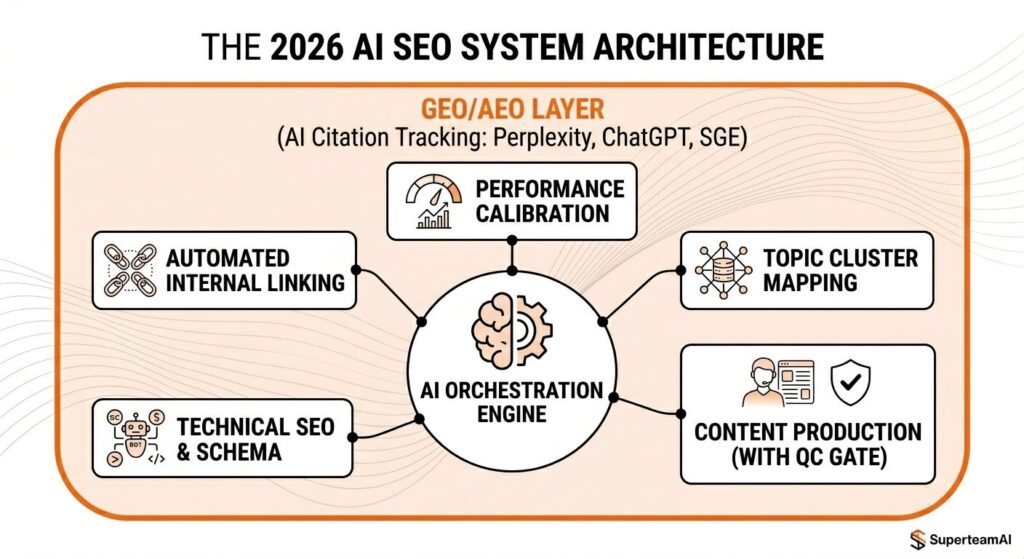
Keyword Research and Topic Cluster Mapping
AI changes keyword research from a manual sampling process into a comprehensive NLP analysis of an entire topic landscape. To automate keyword research with AI effectively, the output should not be a keyword list; it should be a prioritized content cluster architecture with each article’s purpose defined within the cluster. AI-powered research maps full topic ecosystems: clustering semantically related terms, tagging intent across thousands of queries simultaneously, and surfacing content gaps against competitor coverage.
The human’s role is reviewing the cluster map for business relevance, approving priorities, and flagging topic areas the AI cannot assess from search data alone, including competitive sensitivities, product roadmap alignment, and sales cycle fit.
Content Production and On-Page Optimization
AI content automation for SEO can take a program from brief to published article at a pace no traditional content team matches. A well-designed system using quality AI SEO automation software at full velocity produces 20 to 30 optimized articles per month. The operational advantage is not just volume; it is topical authority accumulation speed. At 25 articles per month, a program reaches comprehensive cluster coverage in 4 to 6 months; the same coverage at traditional agency velocity takes 18 to 24 months.
The quality gate requirements for this function are non-negotiable: every article must pass E-E-A-T compliance checks, brand voice validation, factual accuracy review, and structural completeness checks before publication. Content production automation without this gate degrades in quality progressively over time.
Technical SEO Auditing
Automating technical SEO at the audit layer is one of the highest-ROI automation decisions in the program. Crawl scheduling, schema markup generation, redirect mapping, duplicate content detection, and page speed flagging all execute faster and more comprehensively with AI tooling than with manual audit processes. An automated SEO audit cycle can run weekly or daily, with alerts triggering only when action is required rather than requiring a human to initiate each review.
The 2026-specific addition to technical automation is LLM crawlability monitoring: confirming that AI crawlers from Google, Perplexity, and other platforms can parse your content cleanly. This means checking for content buried in JavaScript that AI crawlers cannot render, validating clean heading hierarchies, and confirming FAQ schema deployment site-wide.
Internal Linking
Automate technical SEO for internal linking and the cluster architecture maintains itself at scale. Automated internal linking runs continuously against the published content base, suggesting and in some systems inserting contextually relevant internal links as new content goes live. Managing a 200-article content base manually for internal link consistency is not practical; running it through an automated system is.
The human review here is light but important: periodic spot-checking that anchor text is natural and that link destinations match reader intent at the point of linking.
Reporting and Performance Analysis
Automated SEO reporting shifts the cycle from monthly retrospectives to near-real-time performance signals. Rank movement alerts, traffic anomaly detection, and content calibration triggers all run automatically. The human’s role changes from compiling data to making decisions based on it.
The practical output is a calibration queue: a weekly list of underperforming content with specific gap signals attached, ready for targeted revision. This is fundamentally different from the traditional approach of publishing content and reviewing performance quarterly, and it is what allows an automated program to improve its output quality continuously rather than coasting on initial setup decisions.
AI Search Citation Tracking (GEO/AEO Layer)
This is the AI SEO workflow automation layer absent from virtually every competitor guide in 2026, and it is where the largest untapped advantage exists. Automation that stops at traditional search leaves a growing share of search impressions (those generated by AI Overviews, Perplexity, and ChatGPT) entirely unmeasured and unoptimized.
Automating AI citation tracking means monitoring weekly appearances across AI-generated answer surfaces, tracking citation rate trends by topic cluster, and feeding that data back into the content production system to prioritize the formats that earn citations most consistently. Programs running this layer in 2026 are building a compounding visibility advantage that programs without it are not even measuring.
The Quality Control Layer Nobody Talks About
Every guide to AI SEO automation covers which tasks to automate. Almost none covers the architecture that makes automation sustainable. The quality control layer is what separates an AI SEO automation system that compounds from one that degrades, and it is the piece that tool vendors have a structural incentive to underemphasize.
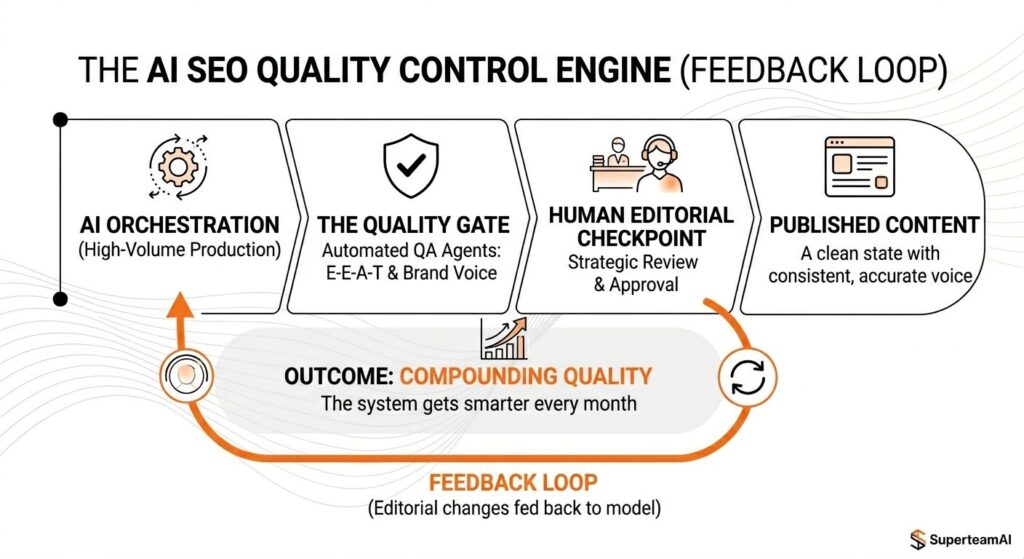
Every system we build at Superteam AI has a quality gate as a non-negotiable component. The ones without one fail within 90 days, not dramatically, but through a gradual drift that is hard to reverse once it has compounded. The automation produces high volume in the early weeks, rankings hold or improve slightly, confidence builds, and then quality erodes as the system drifts from the guardrails that were implicit in the initial setup.
A well-designed quality control architecture has five components. First, automated QA agents that check every piece of content against a defined checklist before it reaches human review: E-E-A-T signal presence, brand voice compliance, structural completeness, and factual claim validation against the knowledge base. Second, a human editorial checkpoint where a reviewer confirms the QA pass signal and catches anything the automated checks miss. Third, a feedback loop that captures every editorial revision and uses it to update the QA checklist and the production model’s calibration over time.
Fourth, a content decay monitoring system that flags published articles whose performance drops below threshold, triggering a revision workflow. Fifth, a brand integrity check that ensures no content drifts from the company’s positioning, value framing, or factual claims about its products.
A seo automation strategy without this architecture is not a strategy. It is a volume engine without brakes, and the results show it within three months.
If you want to understand what a fully managed AI SEO automation system with quality controls built in looks like, our AI SEO services covers the complete architecture.
How to Build Your AI SEO Automation System
The sequencing of an AI SEO automation build matters as much as the components. The most common mistake is building automation before building architecture: selecting tools before mapping the workflow, automating tasks before defining the quality gate, scaling production before validating output quality. The three-phase approach below is the sequence that produces the fastest time to compounding results.
Phase 1: Foundation (Weeks 1 to 2)
Phase 1 is architecture before automation. Complete a technical SEO audit covering crawl health, schema coverage, and LLM crawlability. Build the keyword and topic cluster map that every subsequent automation decision serves. Define the Automate/Augment/Human decision matrix for your specific program.
Select platforms based on workflow requirements, not feature lists. Set baseline metrics across traditional rankings and AI citation surfaces before any automation goes live.
The deliverable at the end of Phase 1 is a documented system design: what each automation component does, where the human checkpoints sit, what the quality gate checks, and what the reporting infrastructure tracks. Without this document, the build phase produces a collection of disconnected tools rather than an integrated system.
Phase 2: Automation Build (Weeks 3 to 4)
Phase 2 activates the automation stack in a defined sequence. Keyword research and topic clustering automation goes live first, producing the prioritized content calendar. Content production automation starts with a controlled batch: 5 to 10 articles run through the full workflow, reviewed carefully before volume increases.
Technical SEO automation and reporting infrastructure activate simultaneously. The quality gate is validated in this phase by checking every automation output against the QC checklist before the program scales.
This is where AI driven SEO automation programs either establish the foundation for compounding results or create problems requiring expensive rework. Getting the quality gate right in Phase 2 pays back across every piece of content the system produces afterward.
Phase 3: Calibration and Scale (Weeks 5 to 8)
Phase 3 scales volume and introduces the GEO/AEO citation tracking layer. By week 5, there is enough performance data to calibrate: which content formats earn citations fastest, which topic areas need deeper cluster coverage, where the quality gate is generating too many revisions (a signal the production model needs recalibration), and where initial ranking movement is appearing. The SEO automation workflow for agencies running multiple client programs adds client-specific QC parameters and reporting segmentation in this phase.
By week 8, the system should be running at full velocity with calibrated quality controls, measurable ranking movement for early target keywords, and initial AI citation appearances for well-structured definition and FAQ content.
| Phase | Key Actions | Deliverables | Human Time Required |
| Weeks 1 to 2: Foundation | Technical audit, cluster map, system design, baseline metrics | Architecture document, content calendar, baseline report | 6 to 8 hours |
| Weeks 3 to 4: Build | Automation activation, QC validation, first content batch | Live automation stack, validated quality gate, 5 to 10 published articles | 4 to 6 hours/week |
| Weeks 5 to 8: Calibration | Volume scaling, GEO layer activation, performance calibration | Full-velocity program, citation tracking live, calibration report | 2 to 4 hours/week |
If you want the system built rather than built by you, the AI SEO Workforce is the complete automation architecture: 18 coordinated agents, quality controls built in, and a calibration cycle that produces a system that understands your business more deeply with every month of use.
Measuring AI SEO Automation: The Metrics That Matter
The programs that stall out are the ones measuring output without measuring outcome. Output metrics (articles published, crawl errors resolved, schemas deployed) tell you the automation is running. Outcome metrics tell you whether it is producing results. A complete measurement framework tracks both layers and connects them to business performance.
The operational metrics exist to diagnose whether the automation system is functioning correctly. The outcome metrics exist to evaluate whether the program is achieving its purpose. Conflating them, or reporting on only one layer, produces either false confidence (everything is running but nothing is ranking) or missed signals (rankings are moving but quality is drifting).
The seo automation benefits that matter to a business are rankings, traffic, qualified pipeline, and the compounding growth trajectory those metrics reveal over 6 to 12 months of consistent operation.
The AI citation rate metric is the key 2026 addition to the standard SEO reporting stack: the percentage of target queries for which your content is cited in an AI-generated answer, tracked across Google AI Overviews, Perplexity, and ChatGPT. This metric does not replace traditional rank tracking. It supplements it with the growing share of search impressions that no traditional rank tracker captures.
| KPI | Layer | Definition | Measurement Tool |
| Content velocity | Operational | Published articles per month | CMS |
| Crawl health score | Operational | % of pages with no critical technical errors | SEO platform |
| Organic keyword rankings | Outcome | Position for target keyword set | Rank tracker and Search Console |
| Organic traffic volume | Outcome | Sessions from organic search | Analytics platform |
| Topic cluster coverage | Outcome | % of target topic map published | Content audit |
| AI citation rate | Outcome | % of target queries with AI citations | AI search monitoring tools |
| Google AI Overview appearances | Outcome | Articles cited in AI Overviews | Search Console AI features report |
| Pipeline from organic | Business | Qualified leads attributed to organic | CRM attribution |
Common Automation Mistakes and How to Avoid Them
Five mistakes account for the majority of AI SEO automation program failures. Each is avoidable with the right system design in place before production begins.
1. Automating production before the quality gate. The most expensive mistake we encounter consistently. Running content production at scale without a QC layer produces high volume for 6 to 8 weeks, then a gradual quality decline that can take months to recover. Build the quality gate before scaling production, not after.
2. Treating AI SEO automation tools as a strategy. Tools are the execution layer. They are not the strategy. An AI SEO automation software stack without a defined workflow, decision framework, and quality architecture is a collection of subscriptions that will underperform expectations. Start with architecture; add tools to serve it.
3. Over-automating the content strategy layer. Topic selection, competitive angle, and content positioning require business context that AI cannot access from search data alone. These decisions benefit from AI data inputs, but the judgment calls belong to humans. Programs that fully automate strategy produce content that is topically correct but strategically undifferentiated.
4. Skipping the calibration cycle. AI SEO automation systems that are launched and left produce diminishing returns within 90 days. The calibration cycle (reviewing what is ranking, what is earning citations, what is generating too many QA revisions) is what keeps the system improving rather than drifting.
5. Ignoring the GEO/AEO automation layer. In 2026, traditional search optimization and AI search citation are distinct surfaces requiring distinct automation components. Programs that do not track and optimize for AI citation appearances are building visibility on one surface while leaving the faster-growing surface entirely unaddressed.
Frequently Asked Questions
What is AI SEO automation?
AI SEO automation is the use of AI-orchestrated systems to execute SEO tasks, including keyword research, content production, technical auditing, internal linking, and performance analysis, at speed and scale, with humans providing strategic direction and quality oversight. In 2026, a complete AI SEO automation program covers two layers: automating the SEO execution workflow and automating the tracking and optimization of AI search citations across Google AI Overviews, Perplexity, and ChatGPT. The two layers run simultaneously in well-designed programs, with each reinforcing the other.
What SEO tasks can be automated with AI?
The highest-value automation candidates are keyword clustering and topic mapping, meta description and schema generation, content brief production, internal link suggestion, technical SEO auditing, rank tracking and alert triggering, and AI citation monitoring. Content drafting can be automated with a quality gate in place. Tasks that should stay in the augment or human categories include content strategy, competitive positioning, editorial direction, and any judgment call that requires business context the AI cannot derive from search data.
How long does it take to see results from AI SEO automation?
Initial ranking movement for lower-competition keywords typically appears within 4 to 8 weeks of consistent publication. For competitive terms, expect 3 to 6 months. AI citation appearances in Google AI Overviews, Perplexity, and ChatGPT typically begin within 8 to 12 weeks for well-structured definition and FAQ content. The compounding advantage of automation over a traditional content team becomes measurable at the 90-day mark, when topic cluster coverage has reached a density a manual program could not match in the same period.
Is AI SEO automation different for agencies versus in-house teams?
Yes, in two meaningful ways. First, seo automation for agencies requires multi-client workflow management: separate QC parameters, content calendars, and reporting for each client program running through the same automation stack. This requires more sophisticated workflow orchestration than a single in-house program.
Second, the build-versus-buy decision differs. In-house teams often benefit from the AI SEO Workforce’s self-serve model, which provides the full automation architecture without requiring custom development. Agencies managing multiple client programs typically evaluate between the Workforce’s multi-seat Scale plan and Superteam AI’s Done-For-You service, which includes full program management at custom pricing.
Do I need technical expertise to implement AI SEO automation?
The expertise required depends entirely on how you implement. Building a custom automation stack using workflow tools like n8n or Make requires technical knowledge to design and maintain the connections between components. Using a purpose-built platform requires no technical setup; the agent workflow, quality controls, and reporting infrastructure are pre-built.
The tradeoff is customization: custom-built stacks offer more flexibility; pre-built platforms offer faster time to production and lower maintenance overhead. For most B2B companies without a dedicated technical SEO team, understanding what to automate in SEO before selecting tools is the more important question than build-versus-buy.
The Bottom Line on AI SEO Automation in 2026
AI SEO automation is not a tool category. It is a system design discipline, and the programs producing compounding results are the ones that treated it that way from day one.
The decision framework, the quality control layer, the phased build sequence, and the dual-layer measurement structure in this guide are the components that separate programs that compound from programs that plateau. No combination of tools produces those outcomes without the design decisions that connect them.
Three things to take from this guide: build the architecture before selecting tools, treat the quality gate as foundational rather than optional, and activate the GEO/AEO citation tracking layer from the start, because the programs that deferred it are already 12 to 18 months behind the ones that did not.The six-function breakdown, the implementation phases, and the KPI framework here give you the blueprint. If you want ai driven SEO automation handled without building the system yourself, the AI SEO Workforce delivers the complete architecture: 18 coordinated agents, quality controls built in, and a calibration cycle that improves with every month of use.