Most teams that invest in ai seo content discover the same problem within the first quarter: the volume is there, the cost per article is low, and the output looks structured. What is missing is performance. The content does not rank in competitive SERPs, does not earn citations in AI search systems, and does not contribute to the pipeline. The tool worked as advertised. The content programme did not.
The gap between “content we produced with AI” and “ai seo content that performs” is the execution problem that most guides in this category do not address. They explain what AI SEO content is, what tools exist, and why the category matters in 2026. They do not tell you how to produce content that consistently clears the quality bar for competitive Google rankings while simultaneously earning citations in Google AI Overviews, Perplexity, and ChatGPT Search.
In building ai seo content programmes for clients across B2B sectors, our team encountered the same failure modes repeatedly. This guide shares the operational framework we developed in response: a quality measurement approach (the Output-to-Publish Ratio), a dual-surface optimisation methodology, and a clear-eyed view of when AI writing tools are sufficient and when a programme needs an autonomous content agent instead.
By the end, you will have a concrete, actionable framework for ai seo content that performs on both search surfaces that matter in 2026.
What Is AI SEO Content?
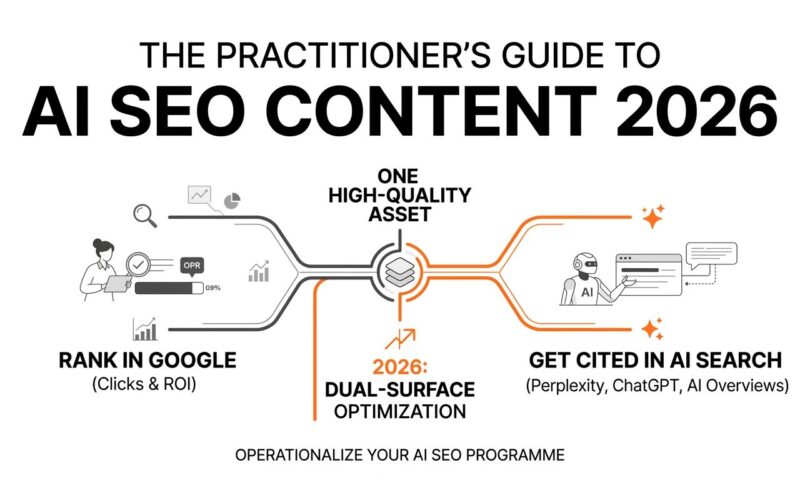
Definition: AI SEO content is content produced with AI assistance and designed to perform on both traditional search engines (Google) and AI-generated search surfaces (Google AI Overviews, Perplexity, ChatGPT Search), structured to meet the quality, expertise, and structural standards required on both channels simultaneously.
The term covers a wide range of production approaches. At the simplest level, ai generated seo content is a keyword input processed by an AI writing platform into a structured article, typically requiring significant editing before it is competitive in a real SERP. At the more sophisticated end, ai powered seo content is produced by an autonomous agent system that conducts its own research, structures the content around competitive SERP data, applies GEO optimisation, and delivers publication-ready output without requiring a human editing pass.
What the category does not include: content generated by a tool and published without quality review, content optimised for Google rankings without consideration of AI search citation, or content that prioritises keyword density over genuine expertise signals. In 2026, those approaches are not ai seo content strategy. They are content production practices that measurably underperform against the rising quality bar in competitive SERPs, as Google’s Helpful Content systems have continued to raise the expertise threshold for ranking content in every major vertical.
The distinction between a volume-first AI content tool and a genuine ai seo content strategy matters because the term is used loosely enough to describe both a $14-per-month generator with an Output-to-Publish Ratio (OPR) of 0.3 and a full autonomous content programme delivering OPR 0.95 output. Knowing which category a platform or approach falls into is the starting point for building a programme that actually performs. For a broader view of the platforms in this category, see our guide to the best AI SEO tools in 2026.
Why Most AI SEO Content Fails (And How to Fix It)
The Output-to-Publish Ratio Problem
OPR is the single most useful metric for assessing ai seo content quality before investing in a platform or programme. It measures how much editing raw AI output requires before it is fit to publish, scored from 0 to 1.0.
Definition: Output-to-Publish Ratio (OPR) is a quality metric that measures how much editing an AI-generated piece requires before publication. A score of 1.0 means the content publishes with a light review. A score of 0.3 means substantial rewriting is required.
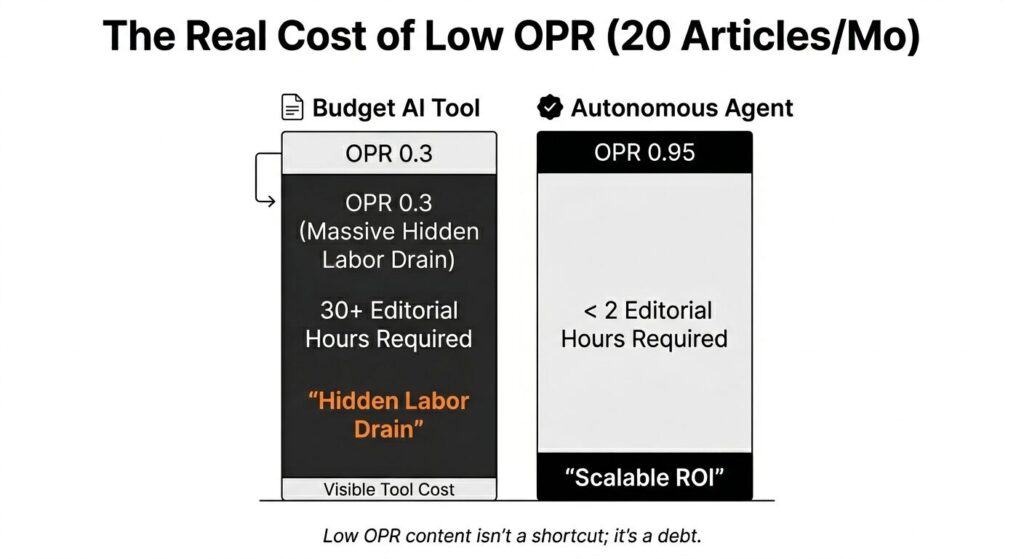
When we evaluate ai seo content for client programmes, OPR is the first number we calculate. Budget AI writing tools typically score between 0.3 and 0.55. Research-led assisted platforms score 0.60 to 0.70. Autonomous content agents (the only category delivering OPR above 0.90) produce output that clears the publication quality bar without a full editorial pass.
The difference between 0.3 and 0.95 is not just content quality. It is 45 to 90 minutes of editing per article that does not appear in the tool’s marketing, multiplied by every article in a month’s production volume. A team producing 20 articles per month at OPR 0.3 is also scheduling 15 to 30 hours of editorial work that erodes the cost advantage the tool appeared to offer.
The Three Most Common AI Content Failures
We see this pattern consistently when auditing programmes that come to us after AI content tools have underdelivered:
- High volume, low OPR. Teams produce 20 to 50 articles per month but spend more time editing than they saved in generation. The cost advantage disappears; the quality gap remains. The tool was priced correctly. The total cost of ownership was not.
- No GEO structure. Content is optimised for traditional Google rankings but has no extractable definitions, no FAQ schema, and no comparison tables for AI search systems to parse and cite. In 2026, that content is largely invisible to Google AI Overviews and other AI discovery engines, which drive a growing share of B2B discovery traffic, particularly at the top of funnel where brand awareness begins.
- No expertise signals. The output reads as informed but generic: structured correctly, factually neutral, professionally written, and indistinguishable from every other AI article on the same keyword. Google’s Helpful Content systems are specifically calibrated in 2026 to identify and deprioritise this type of content in competitive SERPs. No amount of on-page optimisation compensates for the absence of genuine practitioner depth.
Each of these failures has a specific remedy. The sections that follow address all three directly.
The 2026 Dual-Surface Challenge: Google Rankings and AI Search Citations
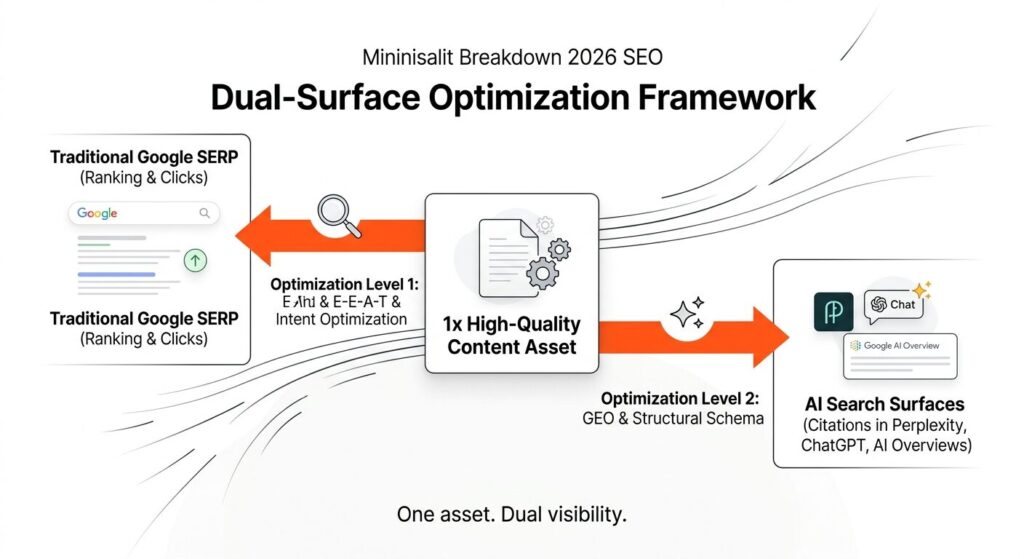
The strategic complexity of ai seo content in 2026 is that content must perform on two surfaces that evaluate authority differently and reward different structural choices.
As Search Engine Land’s 2026 content strategy analysis noted, traffic and visibility have decoupled. A piece of content can lose Google clicks while gaining LLM citations in the same quarter. The reverse is equally common: content that holds its Google rankings may be entirely absent from AI-generated answer surfaces. For most programmes, both surfaces drive meaningful outcomes and both require deliberate optimisation.
How Google Evaluates AI SEO Content
Google’s evaluation of ai generated seo content in 2026 is not fundamentally about whether AI was used in production. It is about whether the content meets the quality standard that the Helpful Content system rewards: genuine depth, first-hand experience signals, authoritative sourcing, structured accessibility, and a clear primary audience that benefits from reading it.
Content that passes this bar ranks, regardless of production method. Content that reads as volume-first and expertise-free does not, regardless of keyword targeting precision. The OPR framework aligns directly with this standard: content with an OPR above 0.7 typically carries the expertise signals and editorial quality needed to compete in the Google SERP. Content at OPR 0.3 does not, in most competitive verticals.
How AI Search Systems Evaluate Content
Perplexity, ChatGPT Search, and Google AI Overviews evaluate content differently from traditional Google ranking. They are looking for clean, extractable, credible content that can be synthesised into a cited answer without losing accuracy or nuance.
The structural characteristics that consistently earn AI citations are: clear extractable definitions (formatted as callout boxes or precise opening sentences), comparison tables that AI systems can parse, numbered step-by-step processes, FAQ sections with direct question-to-answer formatting, and E-E-A-T signals that establish the source as credible enough to cite. Optimising for AI search citation is not a separate strategy from SEO. It is an extension of good content structure that serves both human readers and AI parsing systems simultaneously.
| Evaluation Dimension | Google Ranking Criteria | AI Search Citation Criteria |
| Content Quality | Expertise, depth, original perspective | Accuracy, credibility, extractability |
| Structure | Clear H1-H4 hierarchy, scannable format | Definitions, tables, numbered lists, FAQ |
| E-E-A-T | Experience signals, demonstrated authoritativeness | Source credibility, verifiable claims |
| Keywords | Intent alignment, natural density | Entity clarity, specific answerable queries |
| Freshness | Current data and updated perspective | Recent, verifiable, up-to-date claims |
How to Create AI SEO Content That Performs on Both Surfaces
The four elements below form the operational framework for every piece of ai seo content creation that needs to perform on both search surfaces. They are not a one-time checklist; they are the repeatable workflow that separates content that performs from content that merely exists.
Start With Research That Goes Deeper Than a Prompt
Prompt-based ai seo content generation produces content without a strategic foundation. The AI writes to the keyword, not to the competitive SERP landscape. In practice, this means the content covers the obvious angles, misses the differentiated positions that ranking content occupies, and provides no structural advantage over the other AI-generated articles already competing for the same keyword.
The research layer that actually matters in ai seo content creation covers five areas: SERP analysis of the top 10 ranking pages (what topics they cover, what they miss, what their heading structures reveal about what Google rewards), question extraction from People Also Ask boxes and related searches (the specific questions that need to be answered to earn both rankings and AI citations), entity mapping (the people, tools, frameworks, and concepts that belong in authoritative content on this topic), topical gap identification (what subtopics are underdeveloped in the current SERP), and competitor OPR assessment (what quality level the top-ranking content demonstrates). This research takes 20 to 40 minutes per article when done manually and is the single most consequential investment in content quality before any generation step begins.
Structure for Humans and AI Systems Simultaneously
The structural requirements for dual-surface performance are more specific in 2026 than in prior years. Content that consistently earns both Google rankings and AI search citations shares these seven structural characteristics:
- A clear H1 that contains the target keyword and communicates the article’s precise value proposition (not a generic title, but a specific answer to what the reader will get)
- A definition callout or precise opening definition in the first 100 words, formatted for extraction by AI Overviews
- H2 and H3 headings that answer specific questions rather than labelling topic areas (for example, “How AI Search Systems Evaluate Content” outperforms “AI Search Evaluation” as a heading for both scannability and AI citation)
- At least one comparison table for AI parsability (tables are one of the highest-cited content formats in AI-generated answers)
- A FAQ section with direct, concise answers of 50 to 100 words each, structured for People Also Ask capture
- External citations to authoritative sources to establish source credibility for AI search systems
- First-person experience signals distributed across multiple sections, not confined to a single author note
Content that hits all seven of these markers consistently outperforms content that hits two or three, across both Google and AI search surfaces.
Apply the E-E-A-T Standard Before Publishing
E-E-A-T is not a content feature to add. It is a quality gate to pass before publishing, particularly for ai seo content targeting competitive niches. Before any piece publishes, it should clear four checks:
Experience: Does the content include specific first-person signals (“in our work,” “we have seen,” “when we built”) that demonstrate the author has actually operated in this domain and is not synthesising secondary sources?
Expertise: Does the content go beyond what a generalist could produce from a prompt? Does it include original frameworks, sector-specific nuance, or analytical depth that requires domain knowledge to generate?
Authoritativeness: Does the content cite external authoritative sources? Does it demonstrate that credible voices in the field support the claims being made, not just assert them?
Trustworthiness: Does the content present balanced perspectives where relevant, acknowledge limitations honestly, and avoid overclaiming results that cannot be verified?
Content that clears all four checks will typically score above OPR 0.7 before any additional editing. Content that fails two or more checks is the ai generated seo content that underperforms in rankings regardless of keyword targeting or on-page optimisation quality.
Optimise for AI Search Citation (GEO)
Generative Engine Optimisation is the practice of structuring content for citation by AI search systems. The GEO elements that raise citation probability most reliably are: extractable definitions (structured as callout boxes or clear opening sentences), comparison tables with consistent columns and row labels, numbered step-by-step processes (which AI systems extract and present as procedural answers), FAQ sections with direct question-to-answer formatting, and citations to authoritative external sources that establish the content as credible enough for an AI system to recommend.
These are not separate optimisation efforts added after the content is written. They are structural features of well-built content that serve human readers and AI parsing systems simultaneously. The difference between content for ai search that earns citations and content that does not is almost always structure rather than topic: the same information, presented without FAQ formatting, without extractable definitions, and without comparison tables, will be underrepresented in AI-generated answers relative to its quality.
Tools vs. Agents: Choosing Your AI SEO Content Execution Approach
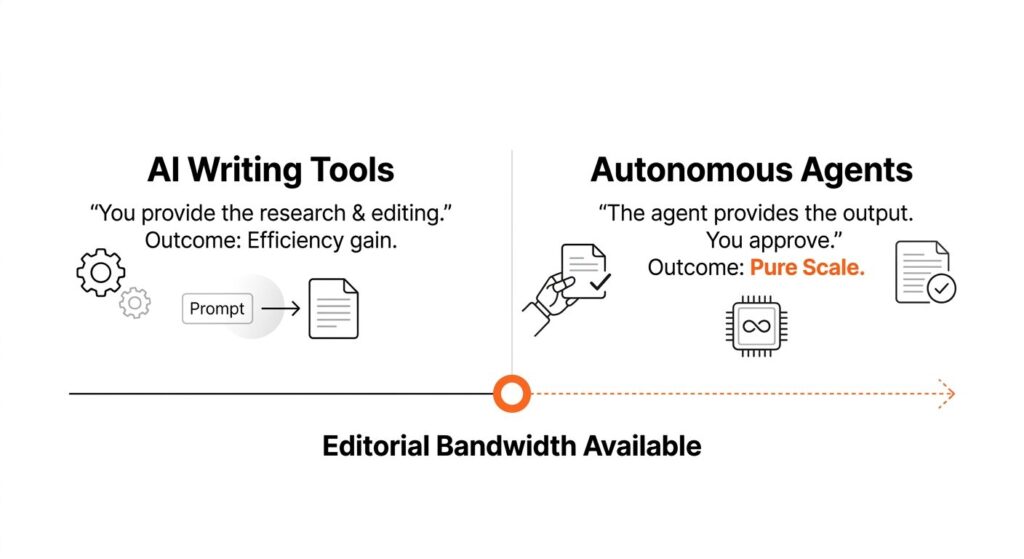
The most consequential execution decision in ai seo content strategy is one that most guides in this category do not address directly: whether your programme needs an AI writing tool or an autonomous content agent. The difference is not about sophistication or feature sets. It is about which part of the pipeline is automated and which part still falls to a human.
When AI Writing Tools Are the Right Choice
AI writing tools (platforms that generate a structured draft from a keyword input and require a human editorial pass before publication) are the right choice when your programme has available editorial bandwidth, targets low-to-medium competition keywords, and is primarily constrained by writing speed rather than output quality.
The OPR calculation determines whether the economics hold. A tool at OPR 0.55 producing 20 articles per month also produces approximately 10 to 15 hours of editorial work per month. When editorial bandwidth is genuinely available and the content targets niches where 0.55 OPR output is competitive, the cost advantage is real. When bandwidth is constrained, or the content targets competitive B2B SERPs that require OPR above 0.7 to rank, the editing time consumes the benefit. For a detailed breakdown of the leading AI writing tools by OPR score and use case, see our guide to the best AI SEO blog writers →.
When You Need an Autonomous Content Agent
In our experience, the decision between an AI writing tool and an autonomous content agent comes down to a single operational question: how much editing time can your content programme actually absorb at current volume?
When the honest answer is “not much,” an autonomous agent is not a premium upgrade; it is the structurally correct choice for the programme’s constraints. Autonomous agents take a keyword brief and brand parameters as input and deliver publication-ready output without requiring human effort at the production stage. The human role shifts from writer and editor to approver.
The Superteam AI SEO Workforce operates at OPR 0.95: output that requires a final review rather than a full editorial pass. It covers GEO optimisation as a built-in component of every article, not a post-production step. For B2B SaaS teams, professional services firms, and agencies building competitive ai seo content programmes, the Workforce removes the editing overhead that makes high-quality content production unsustainable at scale.
See how the Superteam AI SEO Workforce executes autonomous content programmes →
For a full side-by-side comparison across 15 platforms, see our AI SEO tools comparison →.
| Criteria | AI Writing Tool | Autonomous Content Agent |
| OPR Range | 0.3 to 0.70 | 0.90 to 0.95 |
| GEO Coverage | Basic to none | Built-in, full coverage |
| Editorial Time Required | 30 to 90 minutes per article | Light review only |
| Best For | Volume with editorial bandwidth available | Quality at scale without editorial capacity |
| Starting Price | From $9/mo | From $79/mo |
Building an AI SEO Content Programme That Scales
The framework above covers what good ai seo content creation looks like at the article level. This section covers how to operationalise it as a repeatable programme that compounds authority over time rather than producing isolated pieces.
The AI SEO Content Workflow
A functioning ai seo content programme runs in five steps, each with a clear owner and a specific output:
- Keyword and intent research. Identify target keywords, classify search intent (informational, commercial investigation, transactional), and assess competitive difficulty against your domain authority. This step determines what gets produced, in what order, and at what quality level. Topics with high competitive difficulty require higher OPR output and stronger E-E-A-T, both factors that affect execution approach selection.
- Brief creation and approval. Build a content brief specifying keyword targets, search intent classification, content structure (headings, word count), E-E-A-T requirements, internal linking plan, and GEO structural elements. Human approval at this stage ensures the strategic direction is correct before any production resource is committed.
- Content generation. Execute production via your chosen tool or agent. For AI writing tools, this step produces a draft that moves to the editorial pass. For autonomous agents, the Workforce executes the full production pipeline within the approved brief parameters and returns publication-ready content.
- Quality review: OPR and E-E-A-T check. Before publishing, verify the content clears your minimum OPR threshold for the target niche and passes the four-point E-E-A-T check. Content that does not pass should be revised or regenerated, not published below the quality standard needed to compete.
- Publish and track both surfaces. After publication, monitor performance on Google (rankings, organic traffic, click-through rate) and AI search (citation frequency in Perplexity, Google AI Overview appearances, ChatGPT Search mentions). The two-track measurement approach is the only way to see the full picture of content performance in 2026.
Measuring What Matters
Traditional SEO metrics remain essential in any ai seo content programme: keyword rankings, organic traffic volume, click-through rate, and conversion attribution. They need a second track alongside them in 2026: AI search visibility.
Monitoring tools for AI citation include Perplexity itself (search your target topics and check whether your content is being cited), BrandMentions and similar LLM tracking platforms, and the emerging category of AI citation monitoring tools. The practical goal is to identify content that holds Google rankings but earns no AI citations; that gap consistently signals a structural or E-E-A-T deficiency that can be corrected with targeted edits rather than a full rewrite. Closing those gaps is the fastest lever for increasing total search visibility across both surfaces.
Frequently Asked Questions
What is AI SEO content?
AI SEO content is content produced with AI assistance and designed to perform on both traditional search engines and AI-generated search surfaces. In 2026, effective ai seo content meets three criteria: it demonstrates genuine expertise that passes Google’s Helpful Content quality standard, it is structured for AI citation using definition callouts, comparison tables, and FAQ formatting, and it clears a minimum Output-to-Publish Ratio that reflects the editing investment required before it is competitive in a real SERP.
Does AI-generated SEO content rank on Google in 2026?
Yes, when it meets the right quality standard. Google’s Helpful Content systems evaluate content quality rather than production method. AI-generated content that demonstrates genuine expertise, first-person experience signals, and genuine depth ranks in competitive SERPs. Content that reads as volume-first and expertise-free does not, regardless of keyword targeting precision. The OPR framework provides a practical quality gate: content scoring above 0.7 OPR typically carries the expertise signals needed to compete. Content at OPR 0.3 typically does not, in most competitive verticals.
What is the difference between AI SEO content and regular SEO content?
The production method differs; the quality standard does not. Effective ai generated seo content meets the same expertise, depth, and E-E-A-T requirements as content written by a skilled human writer. The difference is production speed and cost at scale. Where AI SEO content fails is when production speed is prioritised over quality, generating volume at OPR 0.3 rather than investing in the research, structure, and expert perspective that raises OPR above 0.7 and earns sustained rankings in competitive SERPs.
What is GEO and why does it matter for AI SEO content?
GEO (Generative Engine Optimisation) is the practice of structuring content to be cited by AI-generated search systems. In 2026, AI search tools including Google AI Overviews, Perplexity, and ChatGPT Search generate direct answers to queries using cited sources. Content structured with extractable definitions, comparison tables, FAQ sections, and authoritative external citations is consistently more likely to be selected as a cited source. For programmes where AI search drives meaningful discovery traffic, GEO structural elements are not optional additions to an ai seo content strategy; they are baseline requirements.
How much editing does AI SEO content typically require?
It depends on the platform. Budget AI writing tools score OPR 0.3 to 0.55, requiring 45 to 90 minutes of editing per article for content targeting competitive keywords. Research-led platforms like Frase score approximately 0.65, reducing editing time meaningfully. Autonomous content agents like the Superteam AI SEO Workforce produce content at OPR 0.95, requiring only a final review rather than a full editorial pass. The right OPR target depends on your programme’s editorial bandwidth and the competitiveness of your target keywords. Teams with limited bandwidth need OPR above 0.85 to make content production sustainable at scale.
What is the best AI SEO content strategy for B2B companies in 2026?
For B2B companies targeting competitive keywords, the optimal ai seo content strategy combines three elements: research-first content production that goes beyond prompt-based generation, dual-surface optimisation that structures content for both Google rankings and AI search citation simultaneously, and an execution approach matched to the programme’s actual editorial bandwidth. Teams with limited editing time should evaluate autonomous content agents rather than high-volume writing tools. The Superteam AI SEO Workforce is built specifically for B2B programmes that need publication-ready content at scale without the editing overhead that volume tools require.
The Bottom Line
AI SEO content in 2026 is not a question of whether AI can produce content; it demonstrably can. The question is whether the content it produces meets the quality standard required to rank in competitive SERPs, earn citations in AI search systems, and contribute to a programme that generates real business outcomes.
The framework in this guide gives you three concrete decisions to make clearly. First, what quality standard your ai seo content needs to meet: use OPR as the diagnostic metric, with 0.7 as the minimum threshold for competitive content and 0.95 as the standard for fully autonomous, publication-ready output. Second, which search surfaces you need to perform on: use the dual-surface framework to optimise for both Google and AI search simultaneously rather than treating them as separate strategies. Third, which execution approach fits your programme: use the Tools vs. Agents distinction to match the right solution to your editorial bandwidth and output quality requirements.
Teams that build their ai seo content programme around these three decisions consistently outperform teams that optimise for volume alone.If your programme needs publication-ready ai seo content at scale, without the editing overhead that budget tools require,explore the Superteam AI SEO Workforce →.