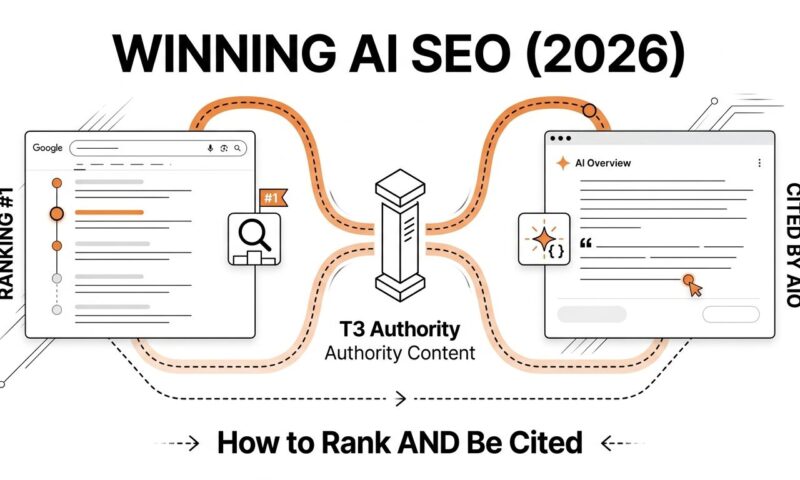
According to 2026 data from SEOmator, AI-generated search visits convert at 4.4 times the rate of traditional organic clicks, and Google AI Overviews now appear on a substantial proportion of informational queries. Despite this, the vast majority of guides to “ai seo optimization” still define the discipline as “using AI tools to do SEO better.” That definition covers half the picture, and the half it misses is where the biggest competitive gaps currently exist.
At Superteam AI, we run both dimensions of AI SEO optimization for our clients: building the AI-powered production systems and tracking citation appearances across AI-generated search surfaces simultaneously. What we have consistently found is that most organizations running ai seo optimization programs are optimizing for only one surface, which means they are leaving a compounding visibility advantage unclaimed.
This guide gives you a complete framework for both dimensions: what each involves, how they interact, and what a structured 90-day program looks like when both are running. You will also find specific guidance for B2B and SaaS companies, a KPI framework that covers both dimensions, and answers to the questions practitioners most commonly ask.
What AI SEO Optimization Actually Means in 2026
The phrase “seo optimization with ai” has been used to describe two very different activities, and the conflation has caused real strategic confusion in how companies approach ai powered seo optimization. Separating them clearly is the starting point for any coherent program.
Definition: AI SEO Optimization: the practice of (1) using AI systems to execute SEO research, content production, and technical optimization at scale (Dimension 1), and (2) structuring content to earn citations in AI-generated search results including Google AI Overviews, Perplexity, and ChatGPT (Dimension 2).
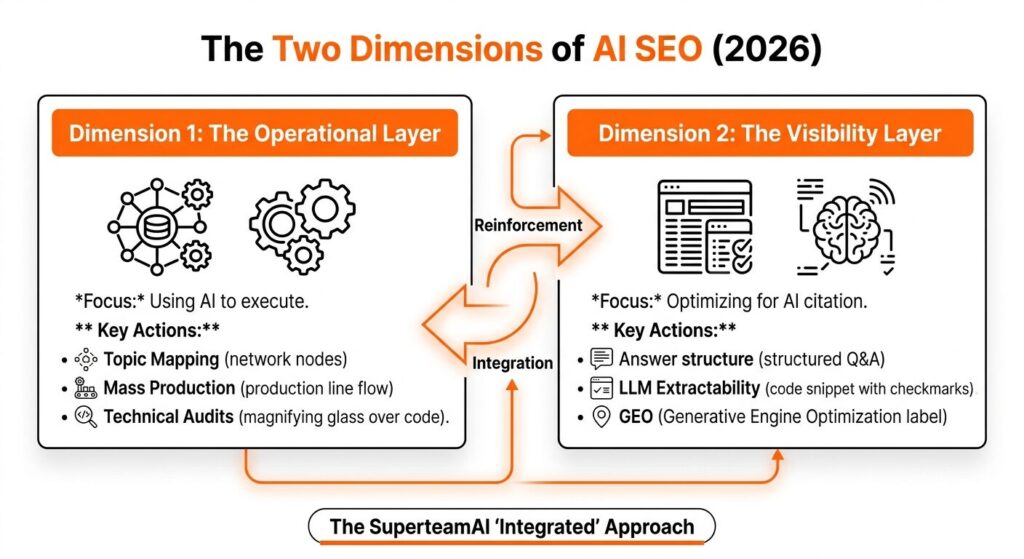
Dimension 1 is the operational layer. It is about using AI to do the work of SEO faster, at greater volume, and with better data inputs than a traditional team can manage. Keyword research, content production, technical audits, and performance analysis are all tasks that AI can execute more efficiently at scale. The human role shifts from execution to quality oversight and strategic direction.
Dimension 2 is the visibility layer. It is about ensuring that the content your AI-powered system produces is structured in a way that AI search engines can interpret, extract from, and cite in their generated answers. This is what is often called generative engine optimization (GEO) or answer engine optimization, which operates on different principles from traditional ranking optimization and requires deliberate structural decisions at the content level.
In 2025 and earlier, the definition of ai seo optimization was essentially synonymous with Dimension 1 alone. The AI-generated SERP surface was nascent enough that most practitioners could defer it without material cost. In 2026, with AI Overviews embedded across a significant share of informational queries and AI assistants functioning as primary research tools for professional buyers, Dimension 2 has become equally critical to any serious program.
Dimension 1: Using AI to Execute SEO at Scale
Dimension 1 covers the operational use of AI in your SEO program. The four core functions (keyword research, content production, technical SEO, and performance analysis) all benefit substantially from AI integration, though the mechanism and impact differ for each.
AI-Powered Keyword Research and Topic Mapping
AI changes keyword research from a manual sampling process to a comprehensive NLP analysis of your full topic landscape. Traditional keyword research identifies individual terms; AI-powered research maps entire topic ecosystems, clustering semantically related terms, identifying intent patterns across thousands of queries simultaneously, and surfacing content opportunities that a manual process would miss entirely.
When we set up keyword and topic mapping for a new client, we typically surface three to five times as many valid content opportunities as a manual research process would identify, because the NLP clustering layer catches semantic relationships that human researchers miss. This expanded topic map is not simply a larger keyword list. It is the architecture for a content program that builds topical authority systematically rather than opportunistically, with each article serving a defined purpose within a cluster rather than existing in isolation.
The output of AI-powered topic mapping is a content cluster plan: pillar pages and supporting articles organized by intent layer, with clear internal linking architecture and a sequenced publication order. This foundation is what makes everything else in Dimension 1 more effective and what makes Dimension 2 achievable at scale.
AI-Orchestrated Content Production
AI content production in a well-designed system moves from brief to published article in a fraction of the time a traditional workflow requires. The critical component is not the AI writing itself; it is the editorial quality gate that sits between the AI draft and publication.
AI-generated content without a rigorous editorial quality gate will not produce durable rankings. The quality gate checks for E-E-A-T compliance (experience signals, factual accuracy, source attribution), brand voice consistency, and structural completeness before any piece is published. This gate is what separates ai content optimization seo programs that compound over time from those that generate content volume without ranking impact.
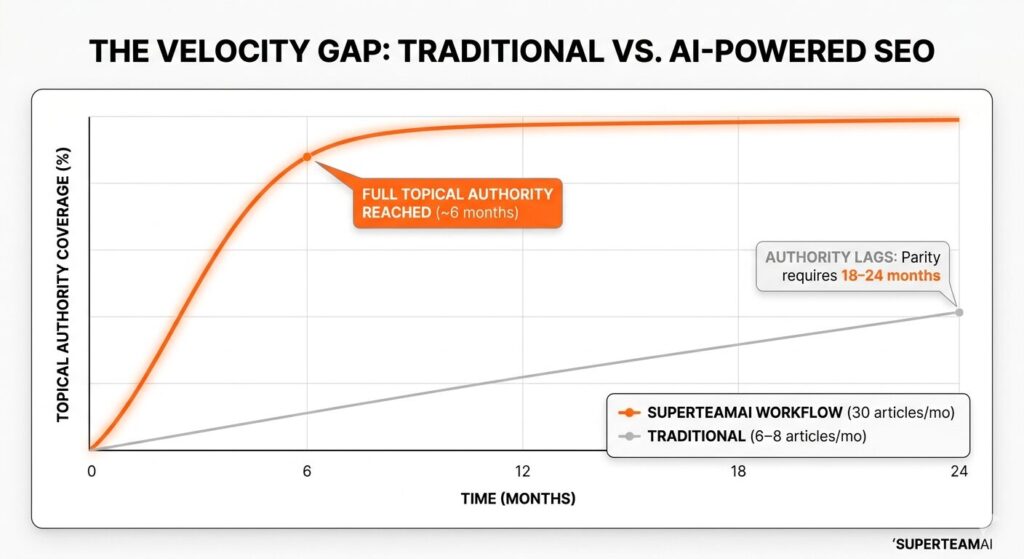
At a standard production tier, a well-architected AI SEO program publishes 20 to 40 optimized articles per month. The velocity advantage is not just about volume; it accelerates topical authority accumulation at a pace no traditional content team can match. A program publishing 30 articles per month reaches comprehensive topical coverage in 4 to 6 months. The equivalent at traditional agency velocity of 6 to 8 per month takes 18 to 24 months.
Technical SEO Automation
AI handles the diagnostic layer of technical SEO exceptionally well: crawl error identification, schema generation, redirect mapping, duplicate content detection, and page speed flagging all run faster and more comprehensively with AI tooling than with manual audit approaches. What still requires human judgement is site architecture strategy, canonical decision-making, and JavaScript rendering choices where the right answer depends on business context.
In 2026, technical SEO for AI-powered programs includes a specific additional layer: LLM crawlability. This means ensuring AI crawlers from Google, Perplexity, and other platforms can parse your content cleanly. Practical implications include avoiding content buried inside JavaScript that AI crawlers cannot render, maintaining clean heading hierarchies, and deploying FAQ schema and structured data that give AI systems explicit signals about content organization.
Performance Analysis and Continuous Calibration
AI-powered performance analysis shifts the reporting cycle from monthly to near-real-time, and changes the quality of decisions the data supports. Traditional SEO reporting shows what happened last month; AI analytics identifies which content is gaining or losing ground and flags optimization opportunities before they become material problems.
The practical output of this layer is a calibration cycle: underperforming content is revised based on specific gap signals (missing semantic coverage, outdated data, thin topical depth), and the content calendar is updated continuously based on what performance data shows. This is materially different from the traditional approach of publishing and leaving content static for months.
Dimension 2: Optimizing Content for AI-Generated Search Results
Dimension 2 is the less-understood half of ai seo optimization, and in 2026 it is where the largest competitive gaps exist. Most programs have no structured approach to ai search optimization at all, which means organizations that implement it now are building a compounding advantage that compounds each month they run ahead of their competitors.
How AI Search Engines Select Content to Cite
AI search engines do not simply rank pages and cite the top result. They assess content for factual accuracy, structural clarity, source credibility, and topical completeness, then synthesize an answer by drawing from multiple sources. Getting cited consistently means meeting those criteria at a higher level than competing content on the same topic.
The factors that most consistently predict citation selection are: clear, direct answers to the implicit query in the opening sentences of each section; factual claims that can be verified against other indexed sources; structured content (definitions, numbered lists, comparison tables) that AI systems can parse and extract without ambiguity; and demonstrated topical authority through comprehensive coverage of the subject area. This is what optimize for ai search means in practical terms, and it is distinct from the tactics that earn traditional rankings.
Traditional search ranking is a prerequisite for AI citation, not an alternative to it. AI systems primarily cite content that is already indexed, credible, and visible in traditional search. You cannot build meaningful AI citation presence without a foundation of traditional SEO credibility. This is why Dimension 1 and Dimension 2 must run simultaneously rather than sequentially.
Content Structure for AI Extractability
To optimize content for ai overviews and other AI-generated answer surfaces, the structural decisions made at the content level matter significantly more than most practitioners expect. The aim is to make your content as easy as possible for an AI system to parse, understand, and extract from without ambiguity.
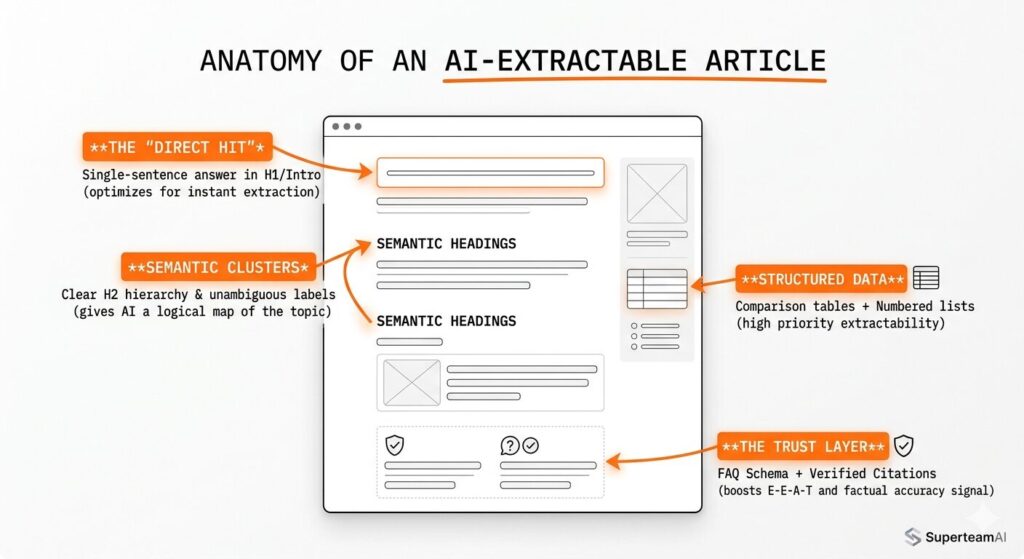
The most effective structural decisions include: opening every major section with a direct, single-sentence answer to the implied question; using numbered lists for sequential processes; using comparison tables for any head-to-head analysis; including a clear definition at the top of articles covering a specific term or concept; and deploying FAQ schema markup on question-and-answer pairs throughout the article. These structural choices also improve traditional ranking signals, which is not coincidental. AI systems use extractability logic that overlaps significantly with how Google’s featured snippet algorithm selects content.
For llm optimization seo specifically, clean heading hierarchies and deliberate internal linking architecture are critical signals. AI crawlers use heading structure to understand the topical coverage of a page and to identify which sections contain answers to which questions, so heading clarity directly affects citation probability.
Building the Topical Authority That Earns LLM Citations
A single well-optimized article will not consistently earn AI citations. What earns consistent, compounding citation is topical authority: a body of content that comprehensively covers a topic space, with clear semantic relationships between articles and a recognizable authority signal across the whole cluster.
In our program work with B2B and SaaS clients, we track AI citation appearances across Google AI Overviews, Perplexity, and ChatGPT on a weekly basis. The data shows consistently that citation frequency tracks topical authority density, not individual page rankings. A site with 50 well-structured articles covering a topic cluster earns citations at materially higher rates than a site with 5 high-ranking pages on isolated keywords, even when those isolated pages rank higher individually for their specific terms.
The practical implication is that Dimension 1 and Dimension 2 are architecturally dependent. The content velocity of Dimension 1 is what builds the topical authority base that Dimension 2 requires to generate consistent citations. Without Dimension 1’s production capability, Dimension 2 optimization is applied to too thin a content base to compound meaningfully.
| Dimension | Primary Objective | Core Tactics | Primary KPIs | Time to First Results |
| Dimension 1: AI-Powered Production | Produce and rank content at scale | Keyword clustering, AI-orchestrated content, technical automation, calibration | Organic rankings, traffic volume, keyword coverage | 4 to 12 weeks |
| Dimension 2: AI Search Optimization | Earn citations in AI-generated results | Content structure, schema markup, topical authority building, citation tracking | AI citation rate, AI Overview appearances, Perplexity and ChatGPT mentions | 8 to 20 weeks |
How the Two Dimensions Reinforce Each Other
The most common mistake in ai seo optimization strategy is running one dimension in isolation. Both failure modes are predictable once you understand how the dimensions interact.
Running Dimension 1 without Dimension 2 produces content at scale that ranks in traditional search but earns no AI citation presence. As the proportion of queries answered by AI-generated results continues to grow, a program with no GEO/AEO layer is building visibility on a surface whose share of total search attention is gradually declining relative to AI-generated results. The traffic arrives, but the AI search visibility advantage compounds for competitors who are already optimizing for it.
Running Dimension 2 without Dimension 1 means trying to build topical authority for AI citation without the content volume needed to achieve it. An isolated well-structured article occasionally earns an AI citation; a comprehensive topic cluster earns citations consistently. Without the production capability of Dimension 1, the content base needed for Dimension 2 to compound simply does not reach the density required.
The compounding effect of running both simultaneously is significant and measurable. Dimension 1 produces the content volume and topical depth that Dimension 2 requires. Dimension 2 structures that content in ways that also improve traditional ranking signals (structured data, E-E-A-T, clean semantic architecture). Each dimension makes the other more effective, and the advantage over single-dimension competitors widens each month.
A 90-Day AI SEO Optimization Plan
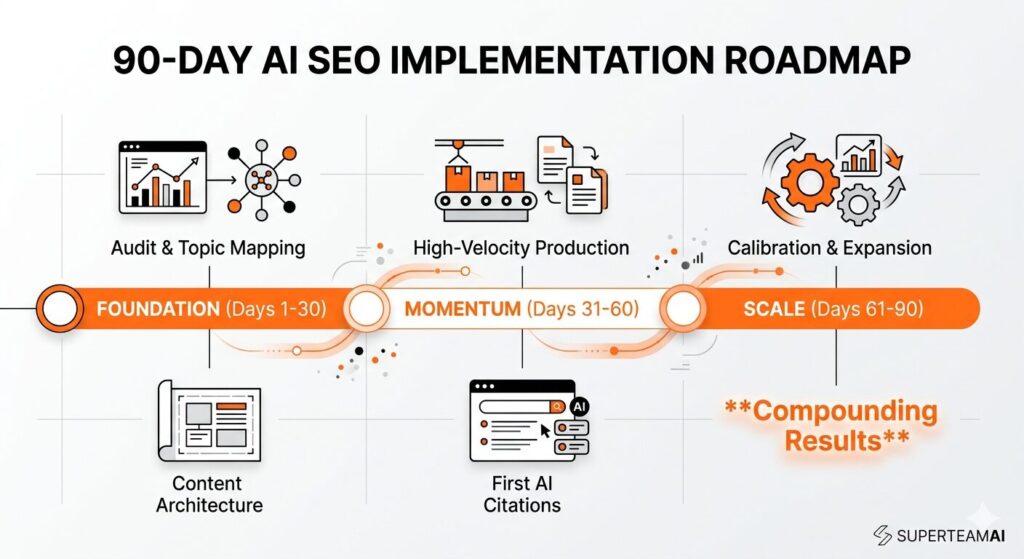
A 90-day program is the standard initial period for ai driven seo optimization to produce measurable results across both dimensions. The sequencing matters as much as the tactics: running steps out of order consistently produces slower outcomes than following the architecture below.
Days 1 to 30: Audit, Architecture, and First Production
The first month establishes the foundation for everything that follows. Begin with a technical SEO audit focused on crawlability (including LLM crawlability), site speed, and schema coverage. Complete the keyword and topic cluster map, identify the highest-priority content gaps against competitor coverage, and build the content calendar for months two and three.
By day 30, the first 10 to 15 articles should be published. These are not placeholder articles; they are the first layer of your topic cluster architecture, structured from the start with Dimension 2 principles built in: direct section-opening answers, FAQ schema where applicable, and clear heading hierarchies. Baseline metrics should be established across both traditional rankings and AI citation surfaces before this phase ends, so that month-two progress is measurable against a real baseline.
Days 31 to 60: Velocity, GEO Integration, and First Data
By the second month, content production should reach full velocity. All new content is produced with Dimension 2 structural principles integrated at the brief stage, not retrofitted after publication. Schema markup should be deployed site-wide during this period, and the internal linking architecture from the topic cluster plan should be implemented as new articles go live.
The first AI citation data arrives in this period. Expect initial Google AI Overview appearances for well-structured definition and FAQ content before broader citation presence builds. Use this early data to identify which content formats and topic areas are earning citations fastest, and adjust the calendar accordingly. The citation data from month two typically reveals 2 to 3 high-potential topic areas worth accelerating.
Days 61 to 90: Calibration, Expansion, and Compounding
By the third month, you have 60-plus days of performance data across both dimensions. The priority shifts to calibration: revising underperforming content based on specific gap signals, expanding the highest-performing topic clusters, and building the reporting infrastructure for ongoing program management.
Traditional ranking movement should be clearly visible by day 90 for target keywords in lower to mid-competition tiers. AI citation appearances should be consistent for topic areas where the content base has reached sufficient topical authority density. The strategy for months four through six should be driven by what the 90-day data shows, not the initial planning assumptions.
| Phase | Key Actions | Deliverables | Primary KPIs |
| Days 1 to 30 | Technical audit, topic map, content calendar, first 10 to 15 articles | Audit report, cluster architecture, baseline metrics | Crawl health score, topic coverage % |
| Days 31 to 60 | Full production velocity, schema deployment, GEO integration | 20 to 40 published articles, schema live, citation baseline | Rankings movement, first AI citations |
| Days 61 to 90 | Calibration, cluster expansion, reporting infrastructure | Performance review, revised strategy, expansion plan | Traffic growth, citation frequency, pipeline attribution |
AI SEO Optimization for B2B and SaaS Companies
AI SEO optimization for b2b operates differently from consumer or media SEO in several ways that directly affect how the program should be sequenced and measured. Getting these nuances right significantly improves time-to-pipeline-impact.
The most important difference is the relationship between content depth and conversion. B2B buyers use content to build a mental model of a solution space before they engage with any vendor. Shallow content that ranks but does not answer substantive questions builds traffic without building trust, and in B2B those two are not interchangeable. AI SEO optimization techniques for B2B must therefore prioritize depth and accuracy over volume in the early stages, even if this means slower initial publication velocity.
Working with B2B SaaS clients specifically, we have found that the sequencing of AI SEO optimization matters more than the individual tactics. Companies that try to build AI citation presence before they have sufficient topical authority in their ICP’s problem space consistently see slower results than those who invest in content depth first. The recommendation is to establish comprehensive topic cluster coverage for your ICP’s three or four primary problem areas before broadening the program to adjacent or upper-funnel topics.
The measurement framework is also different for B2B. In consumer SEO, traffic is often a useful proxy metric. In B2B, the relevant outcome is qualified pipeline, which means the keyword and topic map must be built around your ICP’s research journey rather than raw search volume.
A B2B AI SEO program that cannot connect content performance to pipeline attribution within 90 days is not measuring what matters. If you want to understand what AI SEO services cover in more detail before making program decisions, our guide to the full service landscape is a useful reference point.
Measuring AI SEO Optimization: KPIs for Both Dimensions
Most SEO reporting frameworks are built entirely around Dimension 1 metrics (rankings, traffic, keyword coverage). Adding Dimension 2 requires extending the measurement infrastructure to cover AI citation surfaces and connecting both to business outcomes rather than channel metrics.
The citation rate metric is the key Dimension 2 KPI: the percentage of target queries for which your content is cited in an AI-generated answer, tracked across Google AI Overviews, Perplexity, and ChatGPT. This metric does not replace traditional rank tracking; it supplements it with the additional visibility surface that represents a growing share of total search impressions. The two metrics together give you a complete picture of your program’s search presence.
Connecting both dimensions to business outcomes means tracking not just where traffic comes from but what it does after arrival. AI search visitors convert at significantly higher rates than average organic visitors, which means even a modest improvement in AI citation rate can have a disproportionate effect on pipeline and revenue metrics. Building the attribution chain from AI citation through to qualified pipeline from the start makes the program’s ROI clear and defensible.
| KPI | Dimension | Definition | Measurement Approach |
| Organic keyword rankings | 1 | Position for target keyword set | Search console and rank tracker |
| Organic traffic volume | 1 | Sessions from organic search | Analytics platform |
| Content velocity | 1 | Published pieces per month | Content management system |
| Topic cluster coverage | 1 | % of target topic map covered | Content audit |
| AI citation rate | 2 | % of target queries with AI citations | Manual spot-check and AI tracking tools |
| Google AI Overview appearances | 2 | Articles cited in AI Overviews | Google Search Console AI features report |
| Perplexity and ChatGPT mentions | 2 | Brand and content mentions in AI answers | AI search monitoring tools |
| Pipeline from organic | 1 and 2 | Qualified leads attributed to organic | CRM attribution |
Frequently Asked Questions
What is the difference between AI SEO optimization and traditional SEO?
Traditional SEO focuses on optimizing individual pages for specific keywords to rank in the ten blue links. AI SEO optimization extends this across two additional dimensions: using AI systems to execute SEO tasks at speed and scale (Dimension 1), and structuring content to earn citations in AI-generated search results like Google AI Overviews and Perplexity (Dimension 2). The ai seo best practices for 2026 require all three layers to be running, because traditional ranking credibility is the prerequisite for AI citation, while AI citation is increasingly where new professional buyer discovery happens.
How long does it take to see results from AI SEO optimization?
Dimension 1 results (traditional ranking movement) typically appear within 4 to 12 weeks for lower-competition keywords and 3 to 6 months for competitive terms, depending on domain authority and content quality. Dimension 2 results (AI citation appearances) typically begin within 8 to 12 weeks for well-structured definition and FAQ content, and build consistently as topical authority accumulates. A well-executed 90-day program should show measurable movement across both dimensions before the end of the third month.
What ai seo optimization techniques matter most in 2026?
The most impactful techniques differ by dimension. For Dimension 1: NLP-based topic cluster mapping, AI-orchestrated content production with an editorial quality gate, and technical SEO focused on LLM crawlability alongside traditional signals. For Dimension 2: opening every section with a direct extractable answer, deploying FAQ schema and structured data throughout, and building comprehensive topic cluster coverage rather than optimizing isolated pages. The ai seo optimization tools most relevant to each dimension also differ: Dimension 1 uses keyword research and content production platforms; Dimension 2 uses AI citation tracking and structured data validation tools.
Is AI SEO optimization different for B2B companies?
Yes, meaningfully so. ai seo optimization for b2b must prioritize content depth over volume in the early program stages, because B2B buyers use content to evaluate solutions and shallow high-volume content builds traffic without converting them. The keyword and topic map must be built around your ICP’s research journey and decision questions rather than raw search volume, with the measurement framework connecting content performance to qualified pipeline from the start of the program.
Do I need separate tools for Dimension 1 and Dimension 2?
Generally, yes. Dimension 1 is served by established SEO platforms combined with AI content production tooling; Dimension 2 requires AI citation monitoring tools capable of tracking appearances across Google AI Overviews, Perplexity, and ChatGPT, along with structured data validation tooling. Most practitioners in 2026 use a combination of platforms across both dimensions rather than relying on a single tool, though an alternative to assembling a multi-tool stack is deploying an AI SEO workforce that handles both dimensions within one integrated system.
The Bottom Line on AI SEO Optimization in 2026
AI SEO optimization is no longer a single-dimension practice. The search landscape in 2026 requires both the operational capability to produce content at scale and the structural discipline to ensure that content earns citations in AI-generated results. Most current guides address only the first dimension, and most programs run only the first dimension.
That gap is an exploitable advantage for any organization that implements both simultaneously.
When we designed the AI SEO Workforce, both dimensions were built in from day one rather than added later. That architecture decision reflects what our program data consistently shows: organizations that treat AI-powered production and AI search optimization as separate initiatives, or that defer Dimension 2 until after Dimension 1 is “established,” leave significant compounding value unrealized. The organizations seeing the strongest results are those where both dimensions are running within a single integrated program from the start.
The 90-day plan in this guide gives you the implementation sequence. The KPI framework gives you the measurement structure. If you want ai driven seo optimization handled without building the system yourself, the AI SEO Workforce is built for exactly this.


