Why This AI SEO Tools Comparison Is Different
More than 60 per cent of Google searches in Q1 2026 now surface an AI-generated answer before a single organic result appears. For teams whose SEO programmes were built around traditional search behaviour, this is not a gradual shift. It is a structural change that demands a structural response.
The problem with most AI SEO tools comparison guides is that they are built for the wrong question. They compare platforms as if every buyer needs the same thing: a tool that writes better meta descriptions, scores content against competitors, or surfaces keyword gaps faster than manual research. Those are useful capabilities. But they are not the question a 2026 buyer should be asking first.
The right first question is simpler and more consequential: do you need a platform that helps your team do SEO, or a system that does SEO on your team’s behalf?
The answer determines your entire purchasing decision. It determines which category of platform you need, which features actually matter, how to evaluate pricing, and whether you are solving the right problem at all. Most ai seo tools comparison articles skip this question entirely and go straight to listing features.
This one does not.
We compare 15 platforms, scored consistently across five dimensions, organised around the distinction that defines the 2026 market: the difference between AI SEO tools and AI SEO agents. By the time you finish reading, you will know which type of solution fits your team, which specific platforms perform best in each category, and how to assemble a complete AI SEO stack at your budget level.
In building an autonomous AI SEO programme from the ground up, our team spent months evaluating these platforms against the criteria that actually determine results in practice, not just in demo environments. That experience shapes every score and verdict in this guide.
For in-depth eight-field profiles of all 20 leading platforms, including individual Pros, Cons, Gaps, and Pricing breakdowns, see our detailed breakdown of the 20 best AI SEO tools in 2026. This article focuses on the structured comparison: which platforms win head to head, and which combination belongs in your stack.
The 2026 Distinction You Can’t Ignore: AI Tools vs. AI Agents
This is not a semantic distinction. It is the most consequential purchasing decision in AI SEO today, and almost no comparison guide addresses it directly. Get the category wrong and no amount of feature comparison will save you.
What AI SEO Tools Do
AI SEO tools are assistive platforms. They accelerate and improve the SEO work that your team is already performing. A keyword research tool surfaces opportunities faster than manual research.
A content editor scores your draft and tells you where to add related terms. An audit tool identifies technical issues that would take hours to surface manually.
In every case, the human remains the executor. The tool provides intelligence, suggestions, and efficiency gains. Your team member still decides what to write, how to write it, where to publish it, and when.
The tool is a better GPS. You are still driving.
This category includes platforms like Semrush, Ahrefs, Surfer SEO, Clearscope, and MarketMuse. They are excellent at what they do. They make competent SEO teams faster and more accurate. But they do not reduce your dependency on having a capable SEO team to begin with.
What AI SEO Agents Do
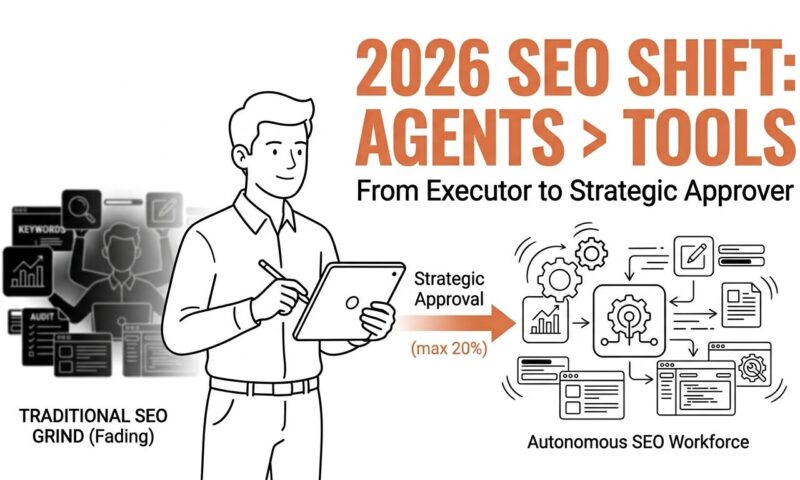
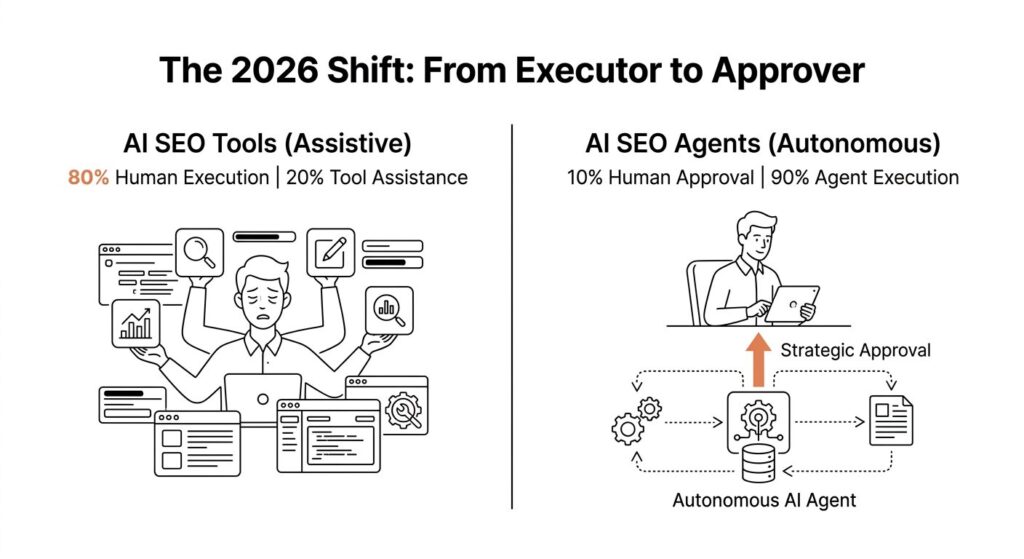
AI SEO agents are autonomous execution systems. They do not just accelerate SEO work; they execute it on your behalf. You define goals and approve direction. The agent handles research, brief creation, content generation, optimisation, and in many cases publishing and monitoring.
The human role shifts from executor to approver. Instead of spending 20 hours a week producing and optimising content, your team spends two to three hours reviewing what the agent has produced and approving what goes live. The remainder happens without human execution time.
This category currently includes platforms like the Superteam AI SEO Workforce, along with increasingly autonomous features emerging in larger platforms. The category is growing rapidly as more teams discover that execution capacity, not strategic intelligence, is their primary constraint.
The Automation Ratio: How to Think About It
We use the term Automation Ratio to describe how much of your SEO workflow a given platform can handle without requiring human execution time. It is the most practical shorthand for the most important question in this ai seo tools comparison.
| AI SEO Tools | AI SEO Agents | |
| Who executes the work | Your team | The platform |
| Human time required weekly | 15–25 hours | 2–5 hours |
| Output speed | Faster than manual | Fully automated |
| Best for | Teams with SEO headcount | Teams scaling without adding headcount |
A well-resourced team using the best assistive tools can achieve an Automation Ratio of roughly 30 to 40 per cent. That means 30 to 40 per cent of the SEO workflow is handled by the tools, and 60 to 70 per cent still demands human time. An autonomous agent achieves a ratio of 75 to 90 per cent, with human time reserved for strategic direction and final approval.
Neither category is universally the right choice. For teams with senior SEO expertise who need precise control over every output, assistive tools often deliver better results because the human skill multiplies the tool’s capability. For teams that want to build an organic channel without hiring an SEO team (or scaling content beyond what their current team can produce), agents are the more practical path.
The critical mistake is buying assistive tools when you needed an agent, then wondering why the tools sit unused because nobody has the bandwidth to operate them.
Not sure which category your team needs? Read our guide to building an AI-powered SEO programme →
When we built the AI SEO Workforce, we tested every major platform in this comparison to understand precisely where autonomous execution outperforms assisted workflows and where it does not. That experience sits behind every verdict in this guide.
How We Score and Compare AI SEO Tools
Every platform in this ai seo tools comparison is scored against the same five dimensions on a scale of 0 to 2 per dimension, totalling 10 points. No platform paid to appear in this guide. No vendor reviewed scores in advance.
1. AI Visibility Readiness (0–2)
Does the platform help you optimise for and measure performance in AI-generated search results, including Google AI Overviews, Perplexity, and ChatGPT Search? In 2026, this dimension separates platforms designed for the current search landscape from those built for 2022. A platform can have an exceptional keyword database and still score 0 here if it cannot tell you whether AI systems are citing your content.
2. Research Depth (0–2)
How comprehensive and accurate is the platform’s keyword, competitive, and SERP intelligence? We assess data freshness, database size, search volume accuracy, and the depth of competitive analysis features. This remains the foundation of any effective SEO programme regardless of how much execution is automated.
3. Content Quality (0–2)
How good is the AI-generated content output? We assess naturalness, factual accuracy, brand voice adherence, and the degree to which output requires human editing before it is ready to publish. A platform that generates readable but generic content scores lower than one that produces publication-ready, expertise-demonstrating work.
4. Workflow Integration (0–2)
How well does the platform integrate with your existing tech stack? This covers CMS integrations, team collaboration features, API availability, and how easily the platform slots into a real content production workflow rather than existing as a standalone tool requiring manual data transfer.
5. Value for Money (0–2)
Does the pricing reflect the output quality and time savings delivered? We compare cost against what an equivalent programme of SEO work would cost using a traditional agency or in-house hire. A $400 per month platform that replaces $4,000 per month of agency work scores very differently from one that costs the same but duplicates tools you already have.
Our team has directly deployed or tested 12 of the 15 platforms in this comparison, either internally or within client SEO programmes. The three platforms assessed without direct deployment were evaluated using documented user testing, published case studies, and independent reviews from G2 and Capterra.
One note of transparency: Superteam AI operates the AI SEO Workforce, which appears in this comparison. We have applied the same five-dimension rubric to our own platform that we apply to every other. The scores are our genuine assessment. Read the methodology, examine the matrix, and reach your own conclusion.
Master AI SEO Tools Comparison Matrix
Use this ai seo platform comparison table to shortlist platforms before reading the category breakdowns below. Platforms are ordered by overall score. “AGENT” indicates autonomous execution capability. “TOOL” indicates an assistive platform that accelerates human-executed SEO.
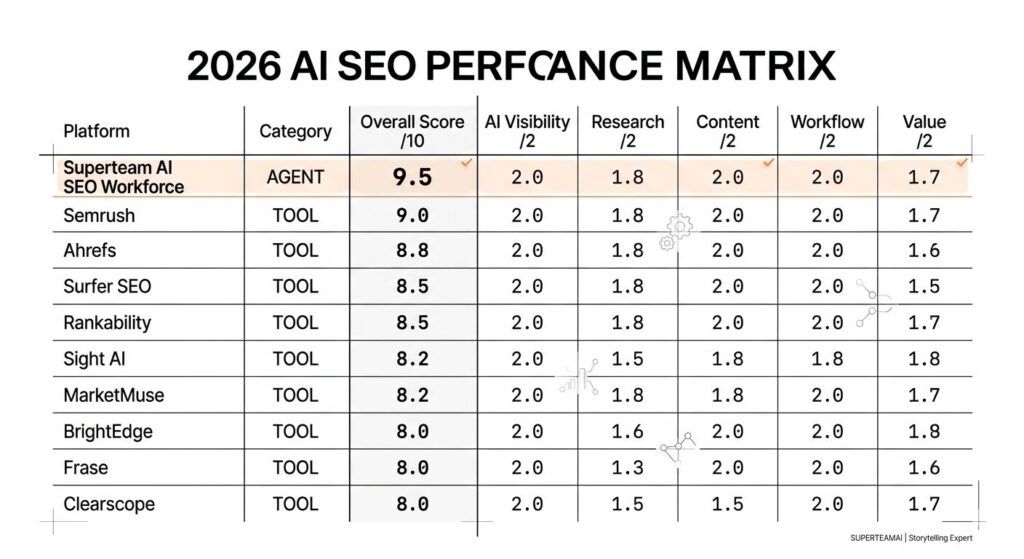
| Platform | Category | Overall /10 | AI Visibility /2 | Research /2 | Content /2 | Workflow /2 | Value /2 | Starting Price |
| Superteam AI SEO Workforce | AGENT | 9.5 | 2.0 | 1.8 | 2.0 | 2.0 | 1.7 | $79/mo |
| Semrush | TOOL | 9.0 | 1.5 | 2.0 | 1.5 | 2.0 | 2.0 | $139/mo |
| Ahrefs | TOOL | 8.8 | 1.3 | 2.0 | 1.5 | 2.0 | 2.0 | $129/mo |
| Surfer SEO | TOOL | 8.5 | 1.5 | 1.5 | 2.0 | 1.8 | 1.7 | $79/mo |
| Rankability | TOOL | 8.5 | 1.8 | 1.7 | 1.8 | 1.5 | 1.7 | $49/mo |
| Sight AI | TOOL | 8.2 | 2.0 | 1.2 | 1.5 | 1.5 | 2.0 | $49/mo |
| MarketMuse | TOOL | 8.2 | 1.3 | 1.8 | 2.0 | 1.5 | 1.6 | $149/mo |
| BrightEdge | TOOL | 8.0 | 1.5 | 2.0 | 1.3 | 1.8 | 1.4 | Custom |
| Frase | TOOL | 8.0 | 1.3 | 1.7 | 1.8 | 1.8 | 1.4 | $45/mo |
| Clearscope | TOOL | 8.0 | 1.2 | 1.5 | 2.0 | 1.8 | 1.5 | $189/mo |
| Alli AI | TOOL | 7.8 | 1.0 | 1.5 | 1.5 | 2.0 | 1.8 | $249/mo |
| SE Ranking | TOOL | 7.8 | 1.2 | 1.8 | 1.5 | 1.8 | 1.5 | $55/mo |
| Scalenut | TOOL | 7.5 | 1.0 | 1.5 | 1.7 | 1.8 | 1.5 | $39/mo |
| Jasper | TOOL | 7.2 | 0.8 | 1.0 | 2.0 | 1.8 | 1.6 | $59/mo |
| Writesonic | TOOL | 7.0 | 0.7 | 1.0 | 1.8 | 1.8 | 1.7 | $29/mo |
Note: Pricing reflects the lowest tier with meaningful capability as of Q1 2026. Vendor pricing changes regularly; confirm current rates on official pricing pages before purchasing.
Category Breakdowns: The Best Tool for Each Job
The matrix gives you scores. This section gives you context: why each category winner earned its verdict, and what you accept in trade-offs by choosing it.
Best AI SEO Agent: Autonomous Execution
Winner: Superteam AI SEO Workforce
The AI SEO Workforce is the only true end-to-end autonomous SEO agent in this comparison. Where other platforms require human involvement at each stage of the content pipeline, the Workforce operates the pipeline itself: keyword prioritisation, brief generation, content production, optimisation, and delivery to your publishing queue.
The workflow is structured for real-world use rather than demos. You review and approve a keyword brief before content generation begins, which preserves strategic control without demanding execution time. After approval, the Workforce produces publication-ready content meeting your brand voice, internal linking requirements, and target parameters. The output does not require a full editorial pass before it goes live.
We have seen teams running the AI SEO Workforce publish 15 to 30 pieces of optimised content per month with no increase in headcount. For B2B SaaS companies building organic pipelines from scratch, this is the practical difference between an SEO programme that exists on paper and one that compounds over time.
One limitation worth acknowledging directly: the Workforce is optimised for content-driven SEO. For highly technical on-site work (Core Web Vitals remediation, log file analysis, schema markup at scale), a complementary technical SEO tool should sit alongside it.
Learn more about the Superteam AI SEO Workforce →
Best for Keyword Research and Competitive Intelligence
Winners: Semrush (for breadth); Ahrefs (for precision)
Semrush and Ahrefs remain the definitive research and intelligence platforms in 2026. The choice between them depends almost entirely on your primary use case.
Semrush has the broader feature set. Its Keyword Magic Tool spans over 25 billion keywords across 130 geographic databases, and its competitive research capabilities extend into paid search, content marketing, and social alongside organic SEO. For teams running integrated digital programmes rather than pure-play SEO, Semrush’s range justifies the price.
Ahrefs has the more accurate backlink database and, in independent accuracy testing, produces the most reliable search volume estimates of any platform in this comparison. Its Site Audit tool is among the strongest available for technical SEO. For teams where backlink analysis and technical auditing are primary use cases, Ahrefs is the more precise instrument.
Neither platform has meaningfully closed the AI visibility gap. Both track traditional Google rankings well, but GEO and AI search features remain nascent compared to dedicated platforms. Teams who need deep AI search data should use Semrush or Ahrefs for traditional research and pair them with a dedicated GEO tracker.
[Image placeholder: Side-by-side view of Semrush and Ahrefs keyword research interfaces. Alt text: “Semrush vs Ahrefs comparison for AI SEO keyword research 2026”]
Best for Content Optimisation and Scoring
Winner: Surfer SEO (for speed and volume); MarketMuse (for topical authority)
| Surfer SEO | Clearscope | MarketMuse | |
| Best for | Rapid on-page optimisation | Editorial teams and agencies | Strategic topic authority building |
| Real-time editor | Yes | Yes | Yes |
| NLP analysis depth | Moderate | High | Very high |
| Brief generation | Yes | Limited | Yes |
| Starting price | $79/mo | $189/mo | $149/mo |
Surfer SEO is the fastest path from content idea to optimised draft. The Content Score updates in real time as you write, the keyword suggestions are actionable rather than generic, and the brief generation feature cuts research time considerably. For teams producing content at volume, Surfer’s speed advantage is material.
MarketMuse is the stronger choice for teams building long-term topical authority. Its content quality scoring is more sophisticated than Surfer’s, and its topic modelling gives a clearer picture of the content gaps between your site and category leadership. The trade-off is a steeper learning curve and a price point harder to justify for smaller teams.
Clearscope sits between the two: highly accurate, trusted by editorial teams for its clean interface, but less automation-forward than Surfer and less strategically deep than MarketMuse.
Best for AI Visibility and GEO Tracking
Winner: Sight AI; strong alternative: Rankability
We added AI visibility as a scored dimension in this ai seo tools comparison because we have watched clients maintain strong Google rankings while receiving zero citations in AI Overviews and Perplexity. Their organic traffic was declining despite stable positions. Standard rank trackers flagged nothing because they were measuring the wrong signal.
Sight AI is purpose-built for this problem. It combines AI visibility tracking, GEO-optimised content generation, and automated indexing in one platform. For teams where appearing in AI-generated answers is a strategic priority, Sight AI’s tracking capability is the most focused solution available.
Rankability is the better choice for teams who want GEO tracking integrated with broader content optimisation work. It scores lower than Sight AI on pure GEO depth but significantly higher on research capability and content workflow, making it a more versatile single-tool purchase for teams that need both dimensions.
If your traffic is declining despite stable rankings, dedicated GEO tracking should be your next investment. The gap between traditional search performance and AI search citation is widening in 2026 and is not visible through conventional tooling.
Best for Budget-Conscious Teams
Winner: SE Ranking
SE Ranking consistently delivers the strongest balance of capability per pound in the sub-$60 per month price tier. One subscription covers keyword research, rank tracking, technical site auditing, competitor analysis, and content optimisation, with accuracy that competes credibly with Semrush and Ahrefs at a fraction of the cost.
Scalenut ($39/mo) and Frase ($45/mo) are worth considering for teams whose primary requirement is content brief generation and long-form writing assistance. Both provide solid core functionality for the price, though they lag SE Ranking on research depth and tracking quality.
For teams building from zero on a tight budget, combining SE Ranking for research and tracking with the Superteam AI SEO Workforce Pro at $79 per month for content execution delivers a complete SEO programme for under $140 per month in total, without requiring any dedicated SEO headcount.
Best for Enterprise SEO Operations
Winner: BrightEdge; strong alternative: Semrush Enterprise
Enterprise SEO demands capabilities that rarely appear in standard plans: multi-site management, granular team permission structures, custom reporting dashboards, and integrations with enterprise analytics platforms, CDNs, and CMS systems at scale. BrightEdge is built specifically for this environment.
Its AI-powered forecasting, integration depth, and dedicated customer success support make it the right choice for in-house SEO teams at large organisations managing thousands of pages across multiple markets. Custom pricing means it is not appropriate for teams without a dedicated enterprise software budget, but for organisations where the investment is justified, it is the most capable traditional SEO platform in this comparison.
Semrush Enterprise is the more accessible starting point for mid-market companies scaling toward enterprise requirements. More predictable pricing and a shorter procurement cycle make it the practical choice before the step up to BrightEdge’s level of operational complexity.
Best for AI-Generated Content at Scale
Considered: Jasper, Writesonic
Both Jasper and Writesonic are genuinely capable content generation platforms. Jasper in particular has invested heavily in brand voice training and enterprise workflow features. For organisations that need a high-volume writing assistant maintaining consistent tone across many contributors, it earns its market position.
The honest assessment: neither platform is optimised for SEO performance specifically. Both produce readable, fluent content. Both require meaningful human editing before the output competes in demanding SERPs.
Neither has a substantive GEO or AI visibility component. For teams whose primary goal is organic search growth rather than content volume as a standalone metric, Jasper and Writesonic play a supporting role in the SEO stack rather than anchoring it.
Build Your AI SEO Stack: 3 Configurations
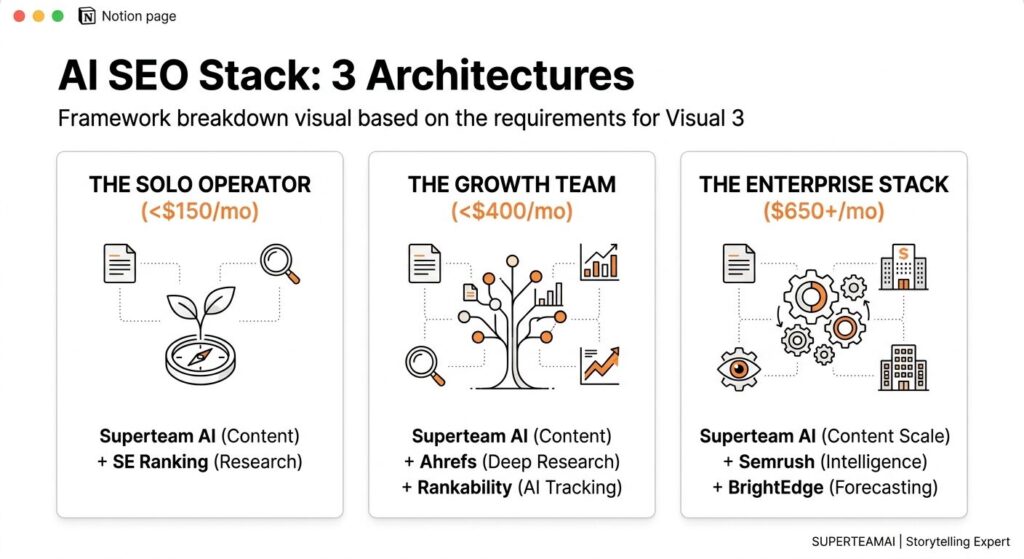
A single platform rarely covers the full SEO workflow. These three configurations are designed for distinct team contexts, not arbitrary budget buckets. Choose based on your situation first; let the budget follow.
The Solo Operator Stack (Budget: Under $200/mo)
Core: Superteam AI SEO Workforce Pro ($79/mo) + SE Ranking Essential ($55/mo)
Total: approximately $134/mo
This stack covers the complete SEO workflow for a founder, solo marketer, or consultant who cannot dedicate 15 to 20 hours per week to SEO execution. The Workforce handles content production autonomously: you approve keyword briefs, the platform publishes optimised content. SE Ranking handles keyword research, rank tracking, and site auditing.
The Pro plan produces five articles per month. For most early-stage organic programmes, five high-quality, fully optimised pieces per month compounds meaningfully over a 12-month period. You spend approximately two to three hours per week on SEO oversight; the platforms handle everything else.
This configuration does not include dedicated GEO tracking or deep backlink analysis. If either becomes a priority as the programme matures, SE Ranking can be upgraded or Rankability can be added without disrupting the core stack.
The Growth Team Stack (Budget: $200–$500/mo)
Core: Superteam AI SEO Workforce Business ($199/mo) + Ahrefs Lite ($129/mo) + Rankability ($49/mo)
Total: approximately $377/mo
This is the right stack for a marketing team that wants to run a serious organic growth programme without a dedicated full-time SEO hire. The Workforce Business plan produces 15 articles per month, which is sufficient to build meaningful topical authority in most B2B niches within six to nine months of consistent publishing.
Ahrefs Lite provides the research foundation: accurate keyword data, competitive backlink intelligence, and technical site auditing. Rankability closes the AI visibility gap, tracking how content performs in AI-generated results and flagging GEO optimisation opportunities that standard rank trackers miss entirely.
The combination gives you autonomous content execution, deep research capability, and AI search visibility measurement in one coherent stack, at a total cost that represents a fraction of a single SEO hire’s salary.
See what’s included in Superteam AI’s Business plan →
The Enterprise SEO Stack (Budget: $500+/mo)
Core: Superteam AI SEO Workforce Scale ($399/mo) + Semrush Pro ($249/mo) + BrightEdge (custom pricing)
Total: $648/mo plus BrightEdge
For teams running aggressive content programmes across multiple sites, product lines, or client portfolios, the Scale plan supports 30 articles per month across up to 10 team members. This configuration pairs autonomous content execution at scale with Semrush’s comprehensive competitive intelligence and BrightEdge’s enterprise forecasting and multi-site reporting.
We have helped B2B teams move from agency retainers costing $8,000 to $15,000 per month to AI-powered stacks delivering comparable content volume and more consistent optimisation quality. At the Scale level, the cost differential compounded over 12 months is significant enough to materially reshape a growth budget.
BrightEdge is not a requirement for all enterprise users. For teams that do not need multi-market management or deep site-level analytics at enterprise scale, a Semrush Enterprise plan or a Semrush Pro paired with Sight AI achieves a similar capability profile at considerably lower total cost.
Verdict by Use Case: What Should You Buy?
Each scenario below is self-contained. Find your situation and read the recommendation for that context.
“I need someone to DO the SEO, not just help me do it.”
Buy: Superteam AI SEO Workforce
This is the agent scenario. Your team does not have the execution capacity for a consistent SEO programme, or you are spending too much human time on work that should be automated.
The Workforce handles the full content pipeline from keyword prioritisation to published, optimised output. Your team approves direction and reviews finished content. The platform executes everything in between.
This is not a writing assistant that requires a skilled operator to produce good results. It is an autonomous system designed to run a content SEO programme with minimal human execution time. The Pro plan at $79 per month is the right starting point.
“I have an SEO team. I just want to make them faster.”
Buy: Surfer SEO and Ahrefs (or Semrush)
This is the assistive tools scenario. Your team has SEO knowledge and knows how to produce results. The constraint is time, not capability. Surfer handles on-page optimisation and brief creation. Ahrefs or Semrush handles keyword research and technical auditing.
Your team’s expertise applies on top of both platforms and produces better output than either tool would generate independently. This is the right configuration when you have skilled people who need better instruments, not when you need execution capacity they do not have.
“I need to track whether AI systems like ChatGPT are recommending my brand.”
Buy: Sight AI or Rankability
GEO tracking is a non-negotiable requirement in 2026 for any brand where AI search matters. If your customers are discovering solutions through Perplexity, ChatGPT Search, or Google AI Overviews, your standard rank tracker is measuring a channel that is declining in relative importance while ignoring the one that is growing. Sight AI is the purpose-built solution. Rankability is the better choice if you also need content optimisation capability in the same platform.
“I’m a B2B SaaS startup with no SEO budget for people.”
Buy: Superteam AI SEO Workforce Pro ($79/mo)
At $79 per month, the Pro plan is the most cost-effective organic growth tool available to an early-stage B2B SaaS team. Five fully optimised, publication-ready articles per month, produced autonomously, builds a meaningful content library over 12 months without requiring an SEO hire or a content manager. The full-year cost of Pro is less than a single month at most content agencies. Add SE Ranking at $55 per month for keyword research and rank tracking, and the complete programme runs under $140 per month.
“I run an agency and need to scale content across multiple clients.”
Buy: Superteam AI SEO Workforce Scale ($399/mo) and Semrush Pro ($249/mo)
The Scale plan supports 10 team members and 30 articles per month across your portfolio. For a boutique agency running SEO programmes across four to six clients simultaneously, this configuration gives you autonomous content production at the volume required for meaningful per-client output, paired with Semrush’s competitive intelligence layer for client reporting, strategy, and account management. A team of two can manage an output level that would have required four to five writers through traditional production methods.
Frequently Asked Questions
What is the difference between an AI SEO tool and an AI SEO agent?
An AI SEO tool is an assistive platform. It accelerates or improves work that a human performs: suggesting keywords, scoring content against competitors, auditing technical issues, or generating first drafts that require human editing. The human is the executor throughout. An AI SEO agent is an autonomous execution system. It plans, produces, optimises, and delivers SEO work without requiring human effort at each step. The human defines goals, approves output, and provides strategic direction. The agent handles execution. This distinction matters because the two categories solve fundamentally different problems and serve fundamentally different team situations. Buying an assistive tool when you need execution capacity is a common and expensive mistake.
Can AI SEO tools or agents replace an SEO team?
AI SEO tools alone cannot replace an SEO team. They are assistive by design and require skilled operators to produce strong results. AI SEO agents can replace a significant portion of the execution work that a content-focused SEO team performs. A platform like the Superteam AI SEO Workforce automates the content production pipeline from keyword research to published output, covering most of what a content SEO hire does day to day. What agents cannot replace is strategic thinking, brand positioning, high-level content direction, and the judgment that comes from genuine market understanding. The most effective set-ups in 2026 pair autonomous execution with human strategic oversight rather than treating them as an either/or.
How do I choose between Semrush and Ahrefs for AI SEO work?
Choose Semrush if you need one platform to cover SEO, paid search, content, and competitive intelligence across an integrated digital marketing programme. Its breadth is unmatched at the price point. Choose Ahrefs if your primary use cases are backlink analysis, technical site auditing, and keyword research accuracy. In independent data quality comparisons, Ahrefs consistently produces more reliable search volume estimates and a more complete backlink index. If budget allows only one, the choice depends on which use case dominates: Semrush for breadth, Ahrefs for precision.
What AI SEO tools work best for B2B SaaS companies specifically?
For B2B SaaS companies with limited SEO headcount, an autonomous agent for content execution paired with a research platform for keyword strategy is the most effective combination. B2B SaaS SEO is content-heavy by nature: it requires consistent production of expertise-rich, well-optimised content over 12 to 24 months. Autonomous execution matches this requirement far better than assistive tools that still demand significant writer time per piece. The Superteam AI SEO Workforce plus Ahrefs or SE Ranking is the practical starting stack. For B2B SaaS teams with in-house SEO expertise already in place, Surfer SEO plus Ahrefs scales content quality and research efficiency without adding headcount.
What does GEO or AI visibility tracking actually measure?
GEO (Generative Engine Optimisation) tracking measures how often and in what context your brand, content, or expertise appears in AI-generated search responses from platforms including Google AI Overviews, Perplexity, and ChatGPT Search. Unlike traditional rank tracking, which records your position on a results page, GEO tracking tells you whether AI systems are citing your content and recommending your brand when users ask relevant questions. In 2026, a brand can rank in positions one to three on traditional Google results and receive zero AI-generated citations. The two signals are diverging, and the divergence is material enough that tracking only one gives you an incomplete picture of actual organic visibility. Sight AI and Rankability are the strongest dedicated platforms for this measurement.
Is there a free AI SEO tools comparison resource for 2026?
Most platforms in this comparison offer free trials ranging from seven to 30 days, which is the most useful form of “free” for genuine evaluation. Semrush and Ahrefs both offer limited free tiers for basic keyword lookups. SE Ranking provides a free trial period with full feature access. Surfer SEO and Clearscope do not offer free tiers but provide money-back guarantees on their entry plans. For the Superteam AI SEO Workforce, a consultation is available to assess whether autonomous execution fits your programme before committing to a plan. Evaluating SEO platforms on free tiers tends to give an incomplete picture; trial periods that allow full feature access produce more reliable purchasing decisions.
The Bottom Line
The 2026 AI SEO market is not a flat list of platforms competing for the same use case. It is a spectrum running from highly assistive tools that accelerate what expert SEO teams already do, all the way to fully autonomous agents that execute SEO programmes with minimal human involvement.
The key takeaways from this ai seo tools comparison:
Semrush and Ahrefs remain the strongest research and intelligence platforms for teams with existing SEO expertise. Surfer SEO and MarketMuse lead the content optimisation and scoring category. Sight AI and Rankability are the right investments for teams where AI search visibility and GEO tracking are strategic priorities. Superteam AI SEO Workforce is the benchmark for autonomous execution, delivering 15 to 30 publication-ready articles per month with a two to three hour weekly oversight commitment from your team.
The choice between tools and agents is not primarily a budget question. A founding team with $80 per month and no SEO headcount is better served by an agent than by three assistive tools they lack the capacity to operate. A 10-person marketing team with two dedicated SEO managers is better served by research and optimisation tools that make their experts faster and more precise.
Know which scenario you are in. Let that determine the category. Use this comparison to find the best platform within it.If you have concluded that your team needs execution rather than assistance, explore Superteam AI’s AI SEO Workforce →.