Most teams approach answer engine optimization strategy the same way they approach a gym membership in January: they sign up for every machine at once and wonder why nothing works by February. They add FAQPage schema on a Tuesday, rewrite a few intro paragraphs on a Wednesday, and check for citations on Thursday. Two weeks later, nothing has changed.
After building AEO-integrated content programs across dozens of B2B companies, we have watched this pattern consistently. The problem is almost never effort. It is sequence. AEO is a build discipline, not a checklist. Tactics that produce results at month four produce nothing at month one if the foundational layers are not in place first.
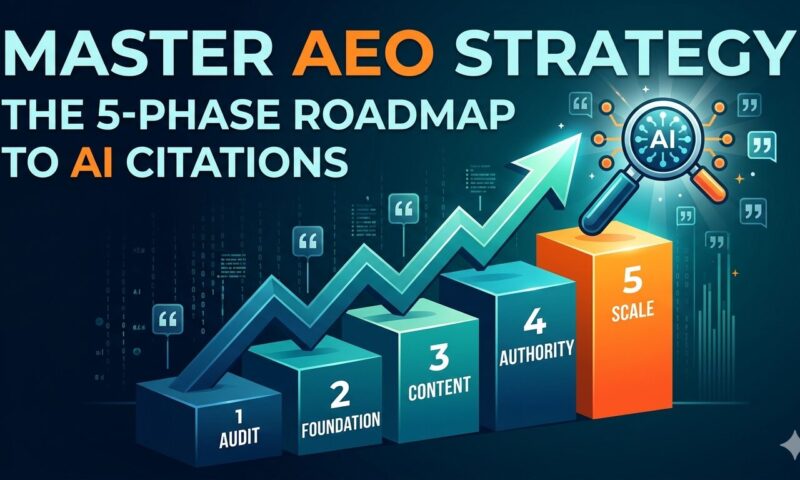
This guide delivers the exact answer engine optimization strategy we use with clients: a five-phase implementation roadmap with real timelines, phase-specific priorities, and the prerequisites most AEO guides skip. Work through these phases in order. The compounding effect depends on it.
Why Most AEO Strategies Fail Before They Start
The majority of AEO strategy attempts fail for one of three reasons: teams start at Phase 4 when they need Phase 1, they treat AEO as a campaign instead of a channel, or they optimize for a single platform while ignoring the others that drive most of their audience’s research.
The Opportunity: Only 20% of organizations have begun any form of AEO implementation as of early 2026, yet AI referral traffic surged 357% year-over-year between June 2024 and June 2025. The gap between organizations that have started and those that have not is widening every quarter.
The structure problem runs deeper than it looks. Consider that 60% of sources cited by AI systems are not in Google’s top 10 organic results. AEO performance is not an extension of your existing SEO program. It requires a distinct build sequence. An organization that jumps to schema implementation without answer-first content structure will see schema produce nothing. An organization that optimizes content structure without a clean technical foundation will see AI crawlers bounce without indexing.
Gartner forecasts a 25% decline in organic search traffic to commercial websites by the end of 2026 as AI systems absorb information queries. EMARKETER places 31.3% of the US population in the generative AI search user category for 2026. A systematic answer engine optimization strategy built on a solid foundation converts this urgency into a real competitive advantage.
The AEO Strategy Foundation: What You Need Before Tactics
A functioning AEO strategy requires three prerequisites before the phased roadmap begins. Skipping any one of them means the subsequent phases produce partial results at best.
Prerequisite 1: A Crawlable, Indexable Technical Base
AI crawlers need clean, reliable access to your pages. Googlebot and other AI platform crawlers must be able to render your content, Core Web Vitals must pass on mobile and desktop, JavaScript rendering must not block key content sections, and robots.txt must not restrict pages you want cited. If AI systems cannot read your pages cleanly, no amount of content optimization produces citations.
Prerequisite 2: At Least One Content Asset Per Core Topic
AEO amplifies existing content and accelerates its citation velocity. It does not replace the content itself. Before running a full AEO strategy, you need at least one published piece per core topic cluster. These do not need to be AEO-optimized yet. They just need to exist and be indexed.
If your site has fewer than ten indexed, substantive pages, content production must run in parallel with AEO implementation from day one, not after the strategy is built.
Prerequisite 3: Entity Clarity
AI systems process brand identity before they process content. Your brand needs to be a recognizable entity: a Google Knowledge Panel that accurately reflects your business, consistent name and description across your website, social profiles, and third-party mentions, and presence in high-authority reference sources.
Without entity clarity, AI systems attribute content to your brand inconsistently. You may earn citations that never trace back to you.
AEO Readiness Checklist
| Dimension | Check | Status |
| Technical | Googlebot can crawl all target pages | Pass / Fail |
| Technical | Core Web Vitals pass on mobile | Pass / Fail |
| Technical | JavaScript not blocking content rendering | Pass / Fail |
| Technical | robots.txt not restricting indexable content | Pass / Fail |
| Content | At least 1 published piece per target topic cluster | Pass / Fail |
| Content | Content is indexed (visible in Google Search Console) | Pass / Fail |
| Content | Pages have unique, descriptive H1 headings | Pass / Fail |
| Entity | Google Knowledge Panel exists and is accurate | Pass / Fail |
| Entity | Consistent brand name/description across all platforms | Pass / Fail |
| Entity | Brand mentioned on at least 3 high-authority external sites | Pass / Fail |
If more than three of these checks fail, address them before running Phase 1.
The 5-Phase Answer Engine Optimization Strategy Roadmap
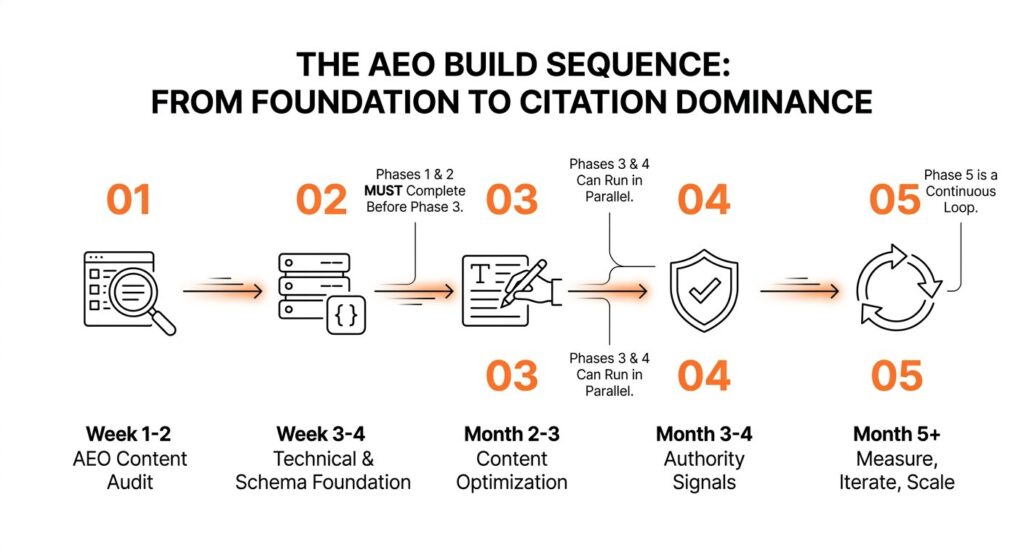
The following roadmap is the exact build sequence we use for AEO-integrated content programs. Each phase has a primary goal, a key output, and a realistic timeline. Phases 1 and 2 must complete before Phase 3 begins. Phases 3 and 4 can run in parallel. Phase 5 runs continuously from month 5 onward.
| Phase | Name | Primary Goal | Timeline | Key Output |
| 1 | AEO Content Audit | Know what you have and what it needs | Weeks 1-2 | Prioritized content inventory with AEO scores |
| 2 | Technical and Schema Foundation | Make content readable and classifiable by AI | Weeks 3-4 | Schema deployed, technical issues resolved |
| 3 | Content Optimization and Production | Restructure existing content, produce new assets | Months 2-3 | AEO-optimized content library at scale |
| 4 | Authority and Citation Signal Building | Make your brand citable and trustworthy | Months 3-4 | External signals, entity strength, E-E-A-T |
| 5 | Measurement, Iteration, and Scale | Track citation share, iterate, expand | Month 5 onward | Ongoing citation growth and cluster expansion |
Phase 1: AEO Content Audit (Weeks 1-2)
The AEO content audit establishes your baseline. Its output is a prioritized inventory of every content asset on your site, scored across four dimensions, with a clear action category for each: AEO-ready, needs optimization, or not viable for AEO.
The four scoring dimensions are: Answer Clarity (does the section open with a direct, extractable answer?), Schema Status (is structured data implemented and valid?), Freshness (when was this page last updated?), and Authority (does this page have backlinks and inline source references?).
When we run this audit for a new client, the first thing we look for is answer clarity. In our experience, more than 70% of existing content has the right information but buries the key answer in paragraph three or four. That single issue, answer placement, accounts for the majority of fixable AEO gaps on most sites. It is also the fastest to fix, which is why it drives Phase 3 prioritization.
| URL | Answer Clarity (1-3) | Schema Present (Y/N) | Last Updated | Authority Score (1-3) | AEO Priority |
| /blog/example-post-1 | 1 | N | 18+ months ago | 2 | Low |
| /blog/example-post-2 | 3 | Y | 3 months ago | 3 | High |
| /blog/example-post-3 | 2 | N | 6 months ago | 2 | Medium |
Scoring guide: Answer Clarity: 3 = direct answer in first sentence, 2 = answer in first paragraph, 1 = answer buried or absent. Authority Score: 3 = has backlinks and cited sources, 2 = some external links, 1 = no external signals.
Phase 2: Technical and Schema Foundation (Weeks 3-4)
The technical and schema foundation phase makes your content classifiable to AI systems. Without this layer, AI systems see words on a page. With it, they see a structured, typed content object they can confidently extract and attribute.
Deploy schema types in this priority order:
- Article schema on all blog posts and guides: include datePublished, dateModified, author, and publisher fields. The dateModified field is a freshness signal that Perplexity reads directly.
- FAQPage schema on any page with a Q&A section: the single highest-impact schema implementation for AEO citation frequency.
- HowTo schema on step-by-step and implementation guides.
- Organization schema on your homepage: establishes entity identity at the domain level.
- Speakable schema on key definitions and summary sections: increasingly relevant as AI voice and audio platforms cite content.
Validate every schema implementation with Google’s Rich Results Test before publishing. Invalid JSON-LD or misapplied schema types confuse AI crawlers and can suppress citation frequency.
Address any JavaScript rendering issues identified in the prerequisites check. AI platforms like Perplexity and ChatGPT’s browse function retrieve content similarly to Googlebot. If your content requires JavaScript to render, some platforms will miss it entirely.
Phase 3: Content Optimization and Production (Months 2-3)
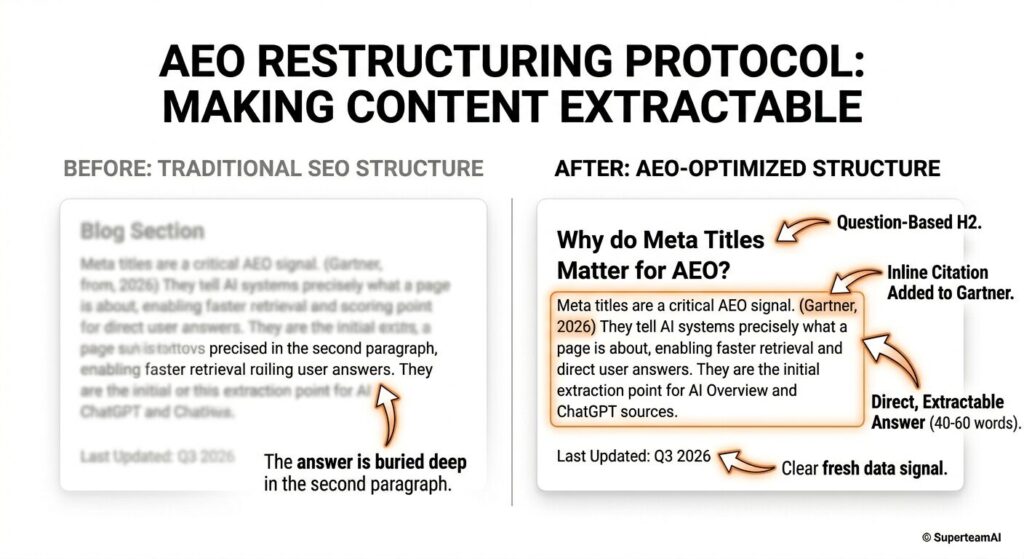
Content optimization is the highest-impact phase of the AEO strategy. Start with your highest-authority, highest-traffic pages before producing any new content. Restructuring a page that already has backlinks and indexing history produces citation results faster than publishing a new page from scratch.
The core optimization protocol for each existing page:
- Rewrite the opening of every H2 section to lead with a direct, self-contained answer in 40 to 60 words.
- Reframe H2 and H3 headings as questions that mirror how users query AI systems.
- Add inline citations to authoritative external sources (one per major data claim).
- Verify that each section makes sense as a standalone answer without surrounding context.
- Update any statistics older than 12 months with current data.
- Update the dateModified field in Article schema after every optimization pass.
After restructuring high-priority existing pages, shift production capacity to new content targeting AEO-specific topic gaps. Use the audit output from Phase 1 to identify which topic areas have no coverage and which competitor content is thin, outdated, or low-authority.
Build content in clusters: one pillar article covering the broad topic, supported by five to ten cluster articles covering specific subtopics. AI systems prefer sources that demonstrate topical authority across a theme, not isolated excellent articles.
| Content Type | AEO Optimization Priority | Time to First Citation | Recommended Action |
| Existing high-authority pages | Highest | 2-4 weeks post-optimization | Restructure first |
| Existing medium-authority pages | High | 1-2 months post-optimization | Batch restructure in Phase 3 |
| New pillar articles | High | 1-3 months post-publication | Produce with AEO structure from start |
| New cluster articles | Medium | 2-4 months post-publication | Build as a batch after pillars |
| Low-authority, outdated pages | Low | Unpredictable | Consolidate or redirect |
Running Phase 3 at scale requires either a large content team or a system built for volume without quality loss. Superteam AI’s AI SEO Workforce handles the full content lifecycle, from AEO-optimized brief generation through editorial QA, with 18 coordinated agents and human approval at every checkpoint.
Phase 4: Authority and Citation Signal Building (Months 3-4)
AI systems do not cite randomly. They cite sources they recognize as authoritative and trustworthy. Phase 4 builds the external signals that make your brand a reliable citation source.
Digital PR and earned mentions. Get your brand referenced on high-authority external sites: trade publications, industry reports, and guest contributions. Each mention reinforces your entity in AI training data and real-time retrieval.
Original data publication. AI systems strongly prefer content with original research. Proprietary data (a benchmark report, a survey, a dataset) gets cited repeatedly because no competitor can replicate it.
Authoritative inline sourcing in your own content. Citing EMARKETER, Gartner, or peer-reviewed research signals to AI systems that your content is reliable. Content that cites authoritative sources earns more trust than content making the same claims without attribution.
Backlink-to-entity connection. Prioritize links from sites in your topic space over high-DA links with no topical relationship. Topical relevance reinforces entity credibility more directly than raw domain authority.
In our experience, the fastest path to citation authority is digital PR combined with original data. A single well-placed industry report can generate citations for 18 to 24 months.
Phase 5: Measurement, Iteration, and Scale (Month 5 Onward)
Phase 5 converts AEO strategy into a self-improving system through a feedback loop that tells you what is earning citations, what is not, and why.
Weekly tracking: AI citation frequency by platform (Profound, OmniSEO, or BrightEdge), AI referral traffic in GA4, and changes in competitor citation presence.
Monthly tracking: Competitive citation share, AI referral conversion rate vs. standard organic rate, and a freshness audit identifying which pieces need updated statistics.
Scale signals (when to expand to the next cluster): your existing cluster earns citations for 70%+ of target queries, AI referral traffic has grown for two consecutive months, and your topical authority is category-leading.
Platform-Specific Strategy Adjustments
The 5-phase roadmap applies across all platforms, but each answer engine weights the phases differently. The table below maps phase priority by platform.
| Phase | Google AI Overviews | ChatGPT | Perplexity | Gemini |
| 1: Audit | High | Medium | Medium | High |
| 2: Schema Foundation | Critical | Medium | Medium | Critical |
| 3: Content Optimization | Critical | Critical | Critical | Critical |
| 4: Authority Building | High | Critical | High | Critical |
| 5: Measurement and Scale | High | High | Critical | High |
Google AI Overviews depend most on organic ranking and authority. A strong top-10 organic position is close to a prerequisite for consistent AI Overview citations.
ChatGPT weights content quality and authority most heavily. It accounts for 87.4% of all AI referral traffic, making it the most important platform for citation-to-click outcomes. Comprehensive, well-cited long-form content (Phases 3 and 4) drives ChatGPT citation frequency.
Perplexity is the most freshness-sensitive platform. Regular content updates with accurate dateModified signals (Phase 5) drive Perplexity performance as much as initial optimization.
Gemini mirrors Google’s ranking signals most closely. Phase 2 (schema) and Phase 4 (authority) are particularly high-impact because Gemini cross-references Google’s index heavily.
Adjusting Your Content Cluster Strategy by Platform
For Perplexity-dominant audiences (common in technical B2B markets), build narrow, deep clusters with frequent updates. For Google AI Overviews, prioritize topical breadth and organic ranking. ChatGPT rewards both: comprehensive cluster coverage with long-form anchor pieces produces the most consistent citation frequency.
AEO Strategy for B2B Companies: What’s Different
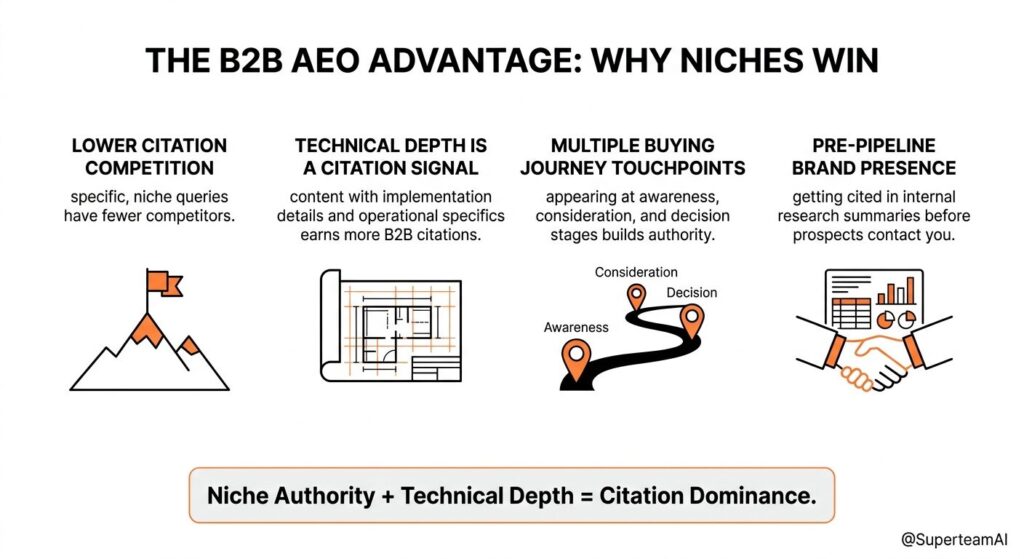
B2B AEO strategy differs from consumer AEO in four ways that change phase prioritization.
Lower query volume creates less citation competition. A B2B buyer searching for “multi-channel inventory management software for Indian e-commerce sellers” faces far less competition for AI citation than a consumer searching for “inventory app.” A B2B company can dominate citation presence in its niche with 30 to 50 well-optimized articles.
Technical depth is a citation advantage. B2B buyers ask specific, technical questions. Generic answers do not satisfy them. Content with implementation detail and operational specifics earns more B2B citations than broadly accessible overviews.
The buying journey creates multiple citation touchpoints. AI search appears at every stage of B2B buying in 2026: awareness queries, consideration queries, and decision queries. Each stage requires different content and different AEO priorities.
Niche authority beats broad presence. Building topical authority in a narrow B2B niche is achievable in 6 to 9 months with consistent execution.
Building the B2B AEO Content Calendar
Map your content calendar to the buyer journey: awareness content targets definitional queries, consideration targets comparison queries, and decision targets validation queries. Awareness content needs answer-first structure and FAQ schema. Comparison content needs structured data tables and entity clarity. Decision content needs case study specificity and strong E-E-A-T signals.
We have seen B2B clients appear in AI-generated research summaries that prospects share internally during vendor evaluation, before the prospect opens a contact form. It is pre-pipeline brand presence that directly influences shortlisting decisions without appearing in any attribution model.
Using Case Studies as AEO Authority Assets
B2B case studies are powerful AEO assets because they answer the two most common B2B AI queries: “who uses X?” and “what results can I expect from X?” A case study that names the client, describes the problem, and quantifies the outcome is exactly what AI systems cite when answering these queries. Structure them for AEO from the start: a results summary table, quantified outcomes, and Article schema with author and publisher fields.
Ready to build your B2B AEO strategy without hiring a content team? Talk to Superteam AI.
In-House vs. AI-Powered AEO Execution
Whether to build your AEO strategy in-house or use an AI-powered system depends on content volume requirements, team capacity, and how quickly you need to build citation authority.
| Dimension | In-House Execution | AI-Powered Execution (AI SEO Workforce) |
| Time to First Citation | 3-6 months | 2-4 months |
| Cost Per Content Asset | $200-$800 (writer + editor + SEO) | $13-$27 (Scale Plan: $399/mo, 30 articles) |
| Monthly Content Capacity | 4-10 articles (small team) | 30 articles (Scale Plan) |
| Consistency | Variable (depends on individuals) | Consistent (AI QA on every asset) |
| AEO Optimization | Applied manually per piece | Built into every brief and draft |
| Iteration Speed | Slow (manual analysis required) | Fast (structured measurement at Phase 5) |
The in-house path works well when you have a content team already producing 8 or more pieces per month and the primary task is restructuring existing content (Phases 1 through 2). The economics shift toward AI-powered execution when you need Phase 3 production volume (20 or more optimized articles per month) or when you are starting from a thin content base.
A company we worked with, EasyOps, started with 4,200 monthly organic visits and no content strategy. Using Superteam AI’s AI SEO Workforce, they published 198 articles over 14 months, grew traffic 626% to 30,500 monthly visits, and built an 89-keyword top-10 presence supporting a $21.6 million acquisition at a 9X ARR multiple. Cost: $399 per month for 30 AEO-optimized articles. The in-house equivalent would have required three content writers, one SEO specialist, and one editor at $25,000 to $40,000 per month.
How Long Does an AEO Strategy Take to Show Results?
AEO results timelines vary significantly by platform. Setting realistic expectations before starting prevents the premature abandonment that kills most programs before traction.
| Platform | First Citations Possible | Regular Citation Frequency | Full Traction |
| Perplexity | 2-4 weeks (fresh, well-cited content) | 1-2 months | 3-5 months |
| Google AI Overviews | 4-12 weeks (requires top-10 ranking first) | 3-6 months | 6-9 months |
| ChatGPT | 4-8 weeks | 3-5 months | 6-12 months |
| Gemini | 4-12 weeks (aligned with Google timeline) | 3-6 months | 6-9 months |
First citations means isolated appearances for long-tail queries. Regular citation frequency means consistent appearances for a meaningful share of target queries. Full traction means broad, stable, growing citation presence where each new asset accelerates the cluster.
AEO is a compounding channel. The brands earning the most AI citations in 2026 started in 2024 or early 2025. Authority signals, entity recognition, and content cluster depth reinforce each other over time. Starting with a clean, sequenced strategy now is significantly better than a rushed one six months from now.
Common AEO Strategy Errors and How to Fix Them
Jumping to Phase 5 tactics without Phase 1 foundations. Deploying platform-specific optimization without answer-first structure and a clean technical base is the most common error. Fix: audit first, optimize foundation second, add platform tuning after traction begins.
Treating AEO as a campaign with a fixed end date. Teams that run a 60-day sprint and move on abandon the strategy exactly when compounding would begin. Fix: build AEO into standard content operations as a permanent channel.
Optimizing for only one platform. Optimizing only for Google AI Overviews means missing 87.4% of AI referral traffic through ChatGPT. Fix: use the Platform vs. Phase Priority table to distribute effort proportionally.
Neglecting entity authority. A brand AI systems do not recognize as a defined entity gets cited inconsistently even when content quality is high. Fix: address entity signals (Knowledge Panel, consistent naming, external mentions) before Phase 1 begins.
Measuring AEO with traditional SEO metrics only. A page can hold the number one organic position and earn zero AI citations. Fix: add AI citation monitoring tools (Profound, OmniSEO) to your measurement stack in Phase 5.
Abandoning before the traction phase. Most AEO programs fail in months two and three: after enough work to feel discouraging but before enough time for compounding. Fix: set expectations using the timeline table above and review progress quarterly, not weekly.
Frequently Asked Questions About Answer Engine Optimization Strategy
Q: Where should I start if my site has no existing AEO optimization?
Start with the three prerequisites: a clean technical foundation, at least one content asset per core topic, and entity clarity. Then run the Phase 1 audit. Your audit output tells you which pages to prioritize in Phase 3 before producing any new content. Restructuring existing high-authority pages delivers faster citation results than publishing new ones because authority signals are already in place.
Q: How is an AEO strategy different from an SEO strategy?
SEO optimizes for ranking position where the goal is a page that earns clicks. AEO optimizes for citation selection by AI systems where the goal is content extracted as a direct answer. They share a technical foundation but diverge in content structure: SEO rewards keyword-dense copy and meta titles, while AEO rewards direct opening answers, question-based headings, and schema-typed content. Both together produce better outcomes than either alone.
Q: How much content do I need to start seeing AEO results?
A single well-optimized pillar article with FAQPage schema and answer-first structure can earn Perplexity citations within weeks. Sustained citation authority across a topic cluster typically requires 10 to 20 optimized pieces. The volume threshold scales with competition: narrow B2B niches require far less content than broad consumer categories where major publishers compete for the same citations.
Q: Can I run an AEO strategy without an in-house SEO team?
Yes. Phases 1 through 3 require content judgment and basic technical knowledge, both manageable by a generalist marketer. The most resource-intensive component is Phase 3 production at scale. AI-powered systems like Superteam AI’s AI SEO Workforce handle the full Phase 3 workflow, from brief generation through drafting and QA, reducing the in-house requirement to strategic approval and publication.
Q: How do I make the business case for AEO investment internally?
Frame AEO as traffic channel diversification. AI referral traffic surged 357% year-over-year and converts at 3 to 4 times the rate of standard organic traffic. A business dependent entirely on traditional SEO is concentrating risk in a channel that saw a 64% CTR drop for top-ranked pages between 2024 and 2025. AEO builds presence in the fastest-growing channel with a comparable timeline (3 to 6 months to traction) and lower cost per content asset.
Q: How often should I update content as part of my AEO strategy?
Quarterly is the standard cadence for brands consistently earning AI citations. Each update should refresh statistics, add new platform guidance, update internal links, and verify cited external sources are still live. A thorough update takes two to three hours per piece and resets freshness signals for Perplexity and other recency-weighted platforms. Annual updates are insufficient: AI-surfaced URLs are 25.7% fresher on average than standard organic results.
Q: What is the right content cluster size for an AEO strategy?
A functional cluster consists of one pillar article (2,500 to 5,000 words) supported by eight to fifteen cluster articles covering specific subtopics and use cases. This gives AI systems enough coverage depth to recognize topical authority without spreading production resources too thin. Build one cluster to citation traction before expanding to the next.
Q: When should I use a tool or agency vs. building AEO in-house?
Use AI-powered execution when you need Phase 3 volume (20 or more articles per month), are starting from a thin content base, or cannot maintain a quarterly update cadence. Build in-house when your team already produces 8 or more pieces per month and the primary task is restructuring existing content in Phases 1 and 2. At Phase 3 scale, cost-per-asset economics almost always favor AI-powered execution.
Start Building Your AEO Strategy
The five phases of a complete answer engine optimization strategy work because they respect the order in which AI systems build trust: technical foundation before schema, schema before content optimization, content before authority signals, authority before platform-specific tuning.
Start the Phase 1 audit this week. It takes two weeks, costs no budget, and produces a precise action list that eliminates guesswork from every subsequent phase. Most teams skip it because it does not feel like progress. It is the work that makes everything else work.
AEO is a compounding channel. Every optimized piece, every schema implementation, every fresh update, and every earned external mention adds to citation authority that accumulates over time. The brands that started building systematically in 2024 and 2025 have a compounding advantage today. The gap grows every quarter.
Superteam AI’s AI SEO Workforce builds and runs complete AEO strategies for B2B companies, from Phase 1 audit and technical schema deployment through AEO-optimized content production, quarterly freshness cycles, and citation tracking. Our 18-agent system executes all five phases simultaneously with human approval at every key checkpoint.Get started today.