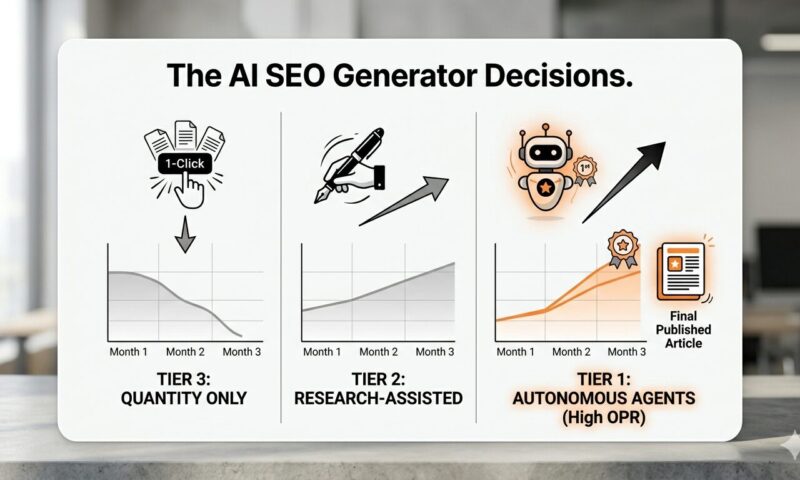
The ai seo content landscape in 2026 has produced more than 50 competing article generation platforms. This guide evaluates seven of the best using a quality-first framework drawn from running each tool category in live client programmes.
Why Most AI SEO Article Generator Reviews Miss the Point
More than 50 new AI content platforms launched in 2025 alone. Every one of them promised SEO-optimised articles in minutes, and every review of those platforms spent its word count comparing the same set of features: SERP integration, word count limits, CMS connectors, and template libraries.
These are reasonable things to know. They are not, however, the question the person evaluating an ai seo article generator actually needs answered.
The question that matters is: will the ai seo articles this tool produces actually rank?
In evaluating ai seo article generators across client ai seo content programmes in B2B sectors, our team has run every major tool category through live production. Not demos. Not 48-hour trials. Live programmes where ranking outcomes are the measure of success.
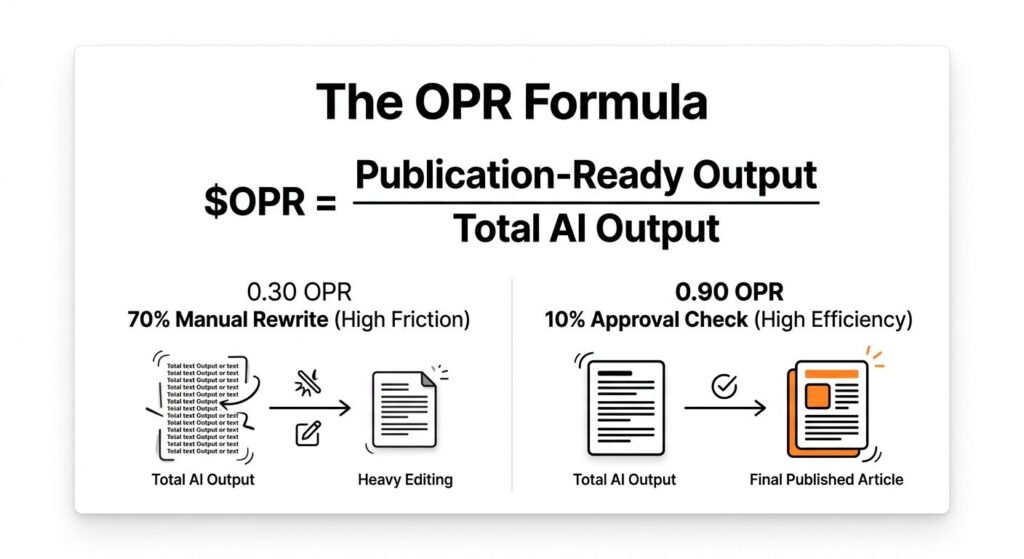
What separates the tools that deliver results from the tools that deliver volume is one metric: Output-to-Publish Ratio.
Output-to-Publish Ratio (OPR): The proportion of AI-generated output that reaches publication without a full editorial rewrite. An OPR of 0.90 means 90% of the article is publication-ready as generated. An OPR of 0.30 means roughly 70% of the content needs rewriting before it is fit to publish.
Every tool in this evaluation is scored on OPR alongside four other quality dimensions. We also address the question sitting beneath most ai seo article writer comparisons: is AI content actually bad for SEO in 2026? The answer is more specific than most reviews acknowledge, and understanding it changes which tool tier you should be using.
How We Evaluated Each AI SEO Article Generator
Every score in this article reflects our team’s observations from running each tool category across live client content programmes. These are operational measurements, not vendor demonstrations or feature checklists. For deeper context on the quality framework underpinning these evaluations, see our guide to ai seo content.
| Dimension | What It Measures | Max Score |
| Content Quality | OPR range, depth, and E-E-A-T signals in generated output | /2 |
| SEO Research | SERP analysis depth, keyword integration, and intent matching accuracy | /2 |
| GEO/AI Visibility | FAQ schema readiness, extractable definitions, and comparison table output | /2 |
| Workflow Automation | Editorial hours required per article and publishing pipeline integration | /2 |
| Value for Money | Cost per quality article at scale | /2 |
| Total | /10 |
Is AI Content Bad for SEO? What the 2026 Data Actually Shows
The short answer is no. The accurate answer is: it depends entirely on OPR.
Google’s official position has not changed since it first addressed AI content in 2023: quality and purpose matter, not authorship method. Content that demonstrates expertise, depth, and genuine usefulness is treated the same regardless of how it was written. Content that is thin, generic, and produced to manipulate rankings is treated the same as human-written content with those characteristics: poorly.
The longitudinal data makes the mechanism clear. SE Ranking tracked a set of ai generated seo articles over three months. In month one, 71% of pages were indexed and appearing in search results.
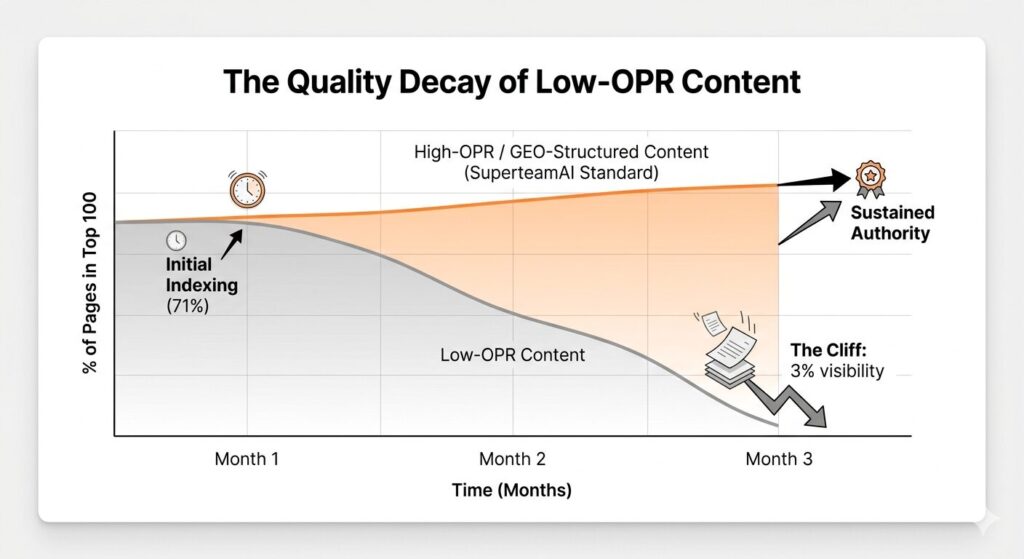
By month three, the share of those pages appearing in the top 100 results had dropped from 28% to 3%. The content had not changed. Google’s quality evaluation had caught up with it.
The articles that dropped shared three characteristics. First, low OPR: the output was not publication-ready, reflected in vague sentences, unsupported claims, and structural gaps. Second, no GEO structure: invisible to AI search systems because it lacked extractable definitions, FAQ schema, and comparison tables. Third, no E-E-A-T signals: the articles read as assembled from secondary sources rather than written from operational experience.
This is the mechanism. Low-quality AI content drops in rankings not because it was written by AI, but because it fails the quality evaluation that applies to all content. The ai content for seo ranking question is not about authorship. It is about whether the output clears the quality bar; the ai seo article generator you choose determines that.
Key principle: Google penalises low-OPR volume content, not AI authorship. Choosing a higher-OPR tool tier is the most direct way to reduce ranking risk in any AI-assisted content programme.
The 3 Tiers of AI SEO Article Generators
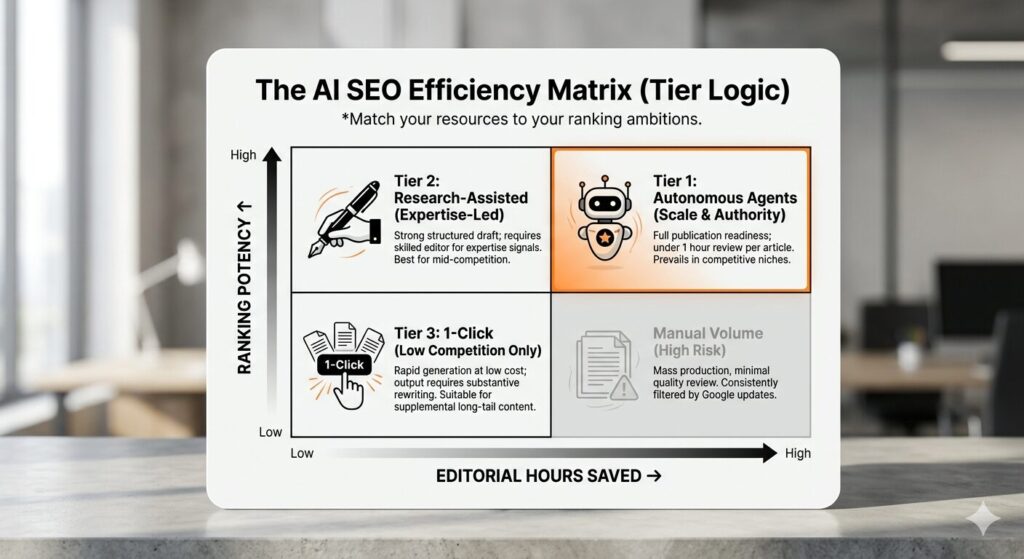
The ai seo article generator market has three distinct tiers, each with a different OPR range, a different editorial requirement, and a different use case. Understanding which tier fits your programme is the decision that most tool reviews skip entirely.
| Tier | OPR Range | Editorial Hours per Article | Best For |
| Autonomous Content Agents | 0.85 to 0.95 | 0.5 to 1 (approval only) | Competitive niches, 15+ articles/month |
| Research-Assisted Platforms | 0.55 to 0.75 | 2 to 4 (skilled editor required) | Mid-competition niches, teams with editorial capacity |
| 1-Click Generators | 0.25 to 0.45 | 4 to 8 (near-full rewrite needed) | Low-competition keywords, high-volume supplemental content |
Autonomous agents take a keyword brief and brand parameters as input and produce a publication-ready article as output. The human role is approver, not editor. These are the only tools that consistently produce content competitive in 2026 SERPs where quality filtering is the baseline.
Research-assisted platforms generate a structured draft informed by SERP research. The output is stronger than a 1-click generator but requires a skilled editor to add expertise signals, verify claims, and sharpen the argument. For teams with that editorial capacity, these ai writing tools for seo deliver genuine time savings at the research and outlining stage.
1-Click generators produce content quickly at low cost. They are appropriate for supplemental content on low-competition long-tail keywords where the ranking bar is set by thin, pre-2025 content. In competitive niches, these automated seo article generation tools consistently produce output that is outranked by content produced at higher OPR tiers.
Tier 1: Autonomous Content Agents (OPR 0.85 to 0.95)
In our client programmes, autonomous content agents are the only tool category where editorial review is an approval step rather than a rewrite session. The content arrives structured, sourced, and E-E-A-T-ready. For programmes operating in competitive niches or at volume above 10 articles per month, Tier 1 is not a premium option. It is the operationally correct choice.
1. Superteam AI AI SEO Workforce: Best Overall AI SEO Article Generator
The Superteam AI AI SEO Workforce is an autonomous content agent that takes a keyword brief as input and delivers a publication-ready ai seo article as output: SERP research, E-E-A-T signal integration, GEO-structured formatting, and brand voice alignment included. Our team runs this system across client content programmes where the editorial workflow is review and approve, not draft and rewrite. OPR consistently ranges from 0.90 to 0.95 across B2B niches.
Key Features:
- Full SERP research and intent classification per keyword, with competitive gap analysis integrated into every content brief
- E-E-A-T signal integration: first-person practitioner framing, expertise markers, and authoritative external citations built into the output structure by default
- GEO-structured output: FAQ sections, definition callouts, and comparison tables formatted for AI search citation in every article
- Brand voice alignment from a one-time brief parameter setup, maintained consistently across all articles at scale
- Dual-surface optimisation: content structured to perform on Google rankings and earn citations in Google AI Overviews, Perplexity, and ChatGPT Search
Scoring:
| Dimension | Score | Notes |
| Content Quality | 2/2 | OPR 0.90 to 0.95; output meets publication bar without a full editorial pass |
| SEO Research | 2/2 | Full SERP analysis, intent classification, and gap analysis per keyword |
| GEO/AI Visibility | 2/2 | FAQ schema, definition callouts, and comparison tables in every output by default |
| Workflow Automation | 2/2 | Keyword brief in, publication-ready article out; editorial time under 1 hour |
| Value for Money | 1.5/2 | Priced above Tier 3 tools; premium justified for competitive niche programmes |
| Total | 9.5/10 |
Best For: B2B companies and agencies scaling ai seo articles in competitive niches at 10 to 30+ articles per month.
Pricing: Pro $79/month (5 articles) / Business $199/month (15 articles) / Scale $399/month (30 articles, 10 users)
Pros:
- Highest OPR on the market; editorial review is an approval step, not a rewriting session
- GEO and dual-surface structuring built into every output without manual configuration
- Consistent E-E-A-T signals across all articles without prompting
- Full programme capability from keyword research through production and quality review
Cons:
- Requires a one-time brand brief onboarding session before the first article is produced
- Not the most cost-efficient choice for very low-competition keywords where Tier 3 OPR is sufficient to rank
Start your AI SEO Workforce trial →
Tier 2: Research-Assisted Platforms (OPR 0.55 to 0.75)
Research-assisted platforms produce a stronger draft than 1-click generators because they begin with SERP research: analysing what is ranking, identifying topics and questions the content needs to address, and structuring the draft accordingly. The output is not publication-ready, but editorial time focuses on expertise signals and argument depth rather than structural correction. These are the right tools for programmes with a skilled editor available and 8 to 15 articles per month. For long form seo article generation in mid-competition niches, Tier 2 offers a strong balance of quality and editorial control.
2. Frase: Best for Teams With Editorial Bandwidth
Frase analyses the top 20 SERP results for a target keyword, extracts common topics and content gaps, and generates a structured brief and draft from that research. We use Frase in programmes where clients maintain a dedicated editor, and the SERP research output consistently saves 30 to 45 minutes per article compared to manual analysis.
Key Features:
- SERP analysis across the top 20 results with topic and question extraction for every keyword
- Auto-generated content brief with heading structure and subtopic recommendations
- AI writing assistant integrated into the brief interface for section-level drafting
- Real-time content scoring against top-ranking pages as you edit
- Google Search Console integration for optimising existing content alongside new production
Scoring:
| Dimension | Score | Notes |
| Content Quality | 1.5/2 | OPR 0.65 to 0.75; strong research base but expertise signals require editorial addition |
| SEO Research | 2/2 | Best-in-class SERP research and brief generation in the Tier 2 category |
| GEO/AI Visibility | 1/2 | FAQ generation available but not applied by default; GEO structuring requires manual setup |
| Workflow Automation | 1/2 | Requires 2 to 3 hours of editorial per article from a skilled writer |
| Value for Money | 2/2 | Strong research capability at approximately $45/month; good ROI for editorial-led teams |
| Total | 7.5/10 |
Best For: Content teams with a skilled writer or editor who want to reduce research time without reducing content quality or editorial control.
Pricing: From approximately $45/month. Article generation volume is tied to AI credit limits at higher plan tiers.
Pros:
- Best SERP research and brief generation in the Tier 2 category
- Real-time content scoring provides quality feedback during editing
- GSC integration supports content refresh programmes alongside new production
Cons:
- GEO/AI Visibility structuring requires manual configuration and is not built in by default
- Editorial bandwidth is a hard requirement; OPR drops significantly without a skilled editor completing each article
3. Surfer SEO: Best for Optimising Alongside New Article Production
Surfer SEO combines on-page optimisation analysis with an AI writing function. The AI Writer generates a structure and draft from NLP analysis of top-ranking content, then scores the output against those benchmarks as you edit. Surfer’s core strength is the optimisation layer; the AI writing function is a solid addition but secondary to it.
Key Features:
- NLP-based content guidelines drawn from analysis of the top-ranking SERP results for each keyword
- AI Writer generating outline and draft from the content score data
- Real-time content editor with keyword density, heading, and readability guidance
- Internal link suggestions surfaced during the editing process
- Topical map function for content cluster planning alongside article production
Scoring:
| Dimension | Score | Notes |
| Content Quality | 1.5/2 | OPR 0.60 to 0.70; NLP-grounded structure but depth requires editorial addition |
| SEO Research | 1.5/2 | Strong NLP analysis; weaker on intent classification and gap analysis |
| GEO/AI Visibility | 1/2 | No default GEO structuring; FAQ section available as a manual template |
| Workflow Automation | 1/2 | Optimisation-focused workflow; 2 to 4 hours editorial per article is standard |
| Value for Money | 1.5/2 | $89/month plus AI writer add-on; justified for established content programmes with active optimisation needs |
| Total | 6.5/10 |
Best For: Teams running active content programmes who want AI writing capability within an established optimisation workflow they already use.
Pricing: From $89/month; AI Writer available as a separate add-on at additional cost.
Pros:
- Best-in-class content optimisation analysis; the industry standard for on-page scoring
- Topical map feature supports content cluster planning alongside article production
- Internal link suggestions reduce a common post-production task
Cons:
- AI writing is a secondary feature, not the platform’s core product
- No default GEO or dual-surface structuring in generated article output
4. Semrush ContentShake AI: Best for All-in-One Platform Users
Semrush ContentShake AI generates SEO-optimised drafts using Semrush’s keyword and SERP data as the research input. For teams already using Semrush for keyword research and competitive analysis, the integration removes the friction of transferring data between platforms. The editing interface includes keyword recommendations and readability guidance throughout.
Key Features:
- Article generation powered directly by Semrush keyword and SERP data
- Competitor content analysis feeding into the generated draft structure
- Tone of voice customisation settings for basic brand alignment
- One-click WordPress publishing integration for streamlined production workflows
- Built-in readability scoring and improvement suggestions throughout editing
Scoring:
| Dimension | Score | Notes |
| Content Quality | 1/2 | OPR 0.55 to 0.65; draft quality depends on Semrush data quality for the specific keyword |
| SEO Research | 1.5/2 | Semrush data integration is strong; intent classification is fairly basic |
| GEO/AI Visibility | 1/2 | No default GEO structuring; FAQ sections added manually |
| Workflow Automation | 1.5/2 | WordPress integration and one-click publishing reduce post-production steps meaningfully |
| Value for Money | 1/2 | Requires an active Semrush subscription from approximately $139/month; value depends on platform utility beyond articles |
| Total | 6.0/10 |
Best For: Teams already subscribed to Semrush who want article generation within their existing toolset without adding another platform.
Pricing: Included in Semrush plans from approximately $139/month.
Pros:
- The Semrush data integration reduces research-to-draft friction
- One-click WordPress publishing saves meaningful production time
- Familiar interface for established Semrush users
Cons:
- Dependent on an active Semrush subscription; not worth the combined cost as a standalone article generation tool
- GEO structuring requires manual addition; no dual-surface optimisation built into the output
Tier 3: 1-Click Generators (OPR 0.25 to 0.45)
1-click generators produce ai seo articles at speed and low cost. Input a keyword; receive a draft in minutes. The OPR range reflects the trade-off honestly: the draft typically requires 4 to 8 hours of editorial work before it is publication-ready, because the output lacks the depth, expertise signals, and structural precision competitive SERPs require in 2026.
These ai writing tools for seo serve a specific purpose. For low-competition long-tail keywords where the ranking bar is thin pre-2025 content, a 1-click generator produces adequate output at a fraction of the cost. For supplemental informational content, the economics work. In competitive niches, this seo article automation tier consistently produces content that is outranked and filtered by Google’s quality evaluation within three months.
5. SEOWriting.AI: Best for High-Volume, Low-Competition Content
SEOWriting.AI generates 1-click SEO articles with WordPress auto-publishing, bulk generation, and affiliate content optimisation templates. Plans support generating dozens of articles simultaneously with direct CMS integration. For content programmes targeting informational keywords in low-competition niches, the cost-per-article economics are strong.
Key Features:
- 1-click article generation from a keyword or topic input
- Bulk generation mode supporting high-volume content programmes
- Auto-publish to WordPress and other CMS platforms without manual transfer
- Affiliate content templates with product comparison formatting built in
- Multilingual support across 48 languages for international programmes
Scoring:
| Dimension | Score | Notes |
| Content Quality | 0.5/2 | OPR 0.30 to 0.45; output requires substantive editing for competitive SERPs |
| SEO Research | 1/2 | Basic keyword integration; limited SERP analysis depth |
| GEO/AI Visibility | 0.5/2 | FAQ section generated by default; minimal GEO structuring beyond that |
| Workflow Automation | 2/2 | Highest automation level in this comparison; bulk generation and auto-publish |
| Value for Money | 1.5/2 | Very low cost per article at volume; justified for low-competition programmes |
| Total | 5.5/10 |
Best For: High-volume content programmes targeting low-competition informational keywords where production speed and cost outweigh output quality requirements.
Pricing: Free tier available with limited monthly volume; paid plans from approximately $14/month.
Pros:
- Lowest cost per article in this comparison; strong volume economics for supplemental content
- Bulk generation and auto-publish reduce the production workflow to near-zero
- Affiliate content templates provide useful structure for product-focused articles
Cons:
- OPR 0.30 to 0.45 means significant rewriting is required before competitive SERP publishing
- GEO structuring is minimal by default; dual-surface optimisation is not a feature
6. Writesonic: Best for Multi-Format Content Teams
Writesonic covers a wide format range: long-form articles, social posts, product descriptions, landing page copy, and ad creative. The Article Writer generates SEO drafts using competitor page analysis and keyword integration. For teams producing content across multiple channels, the format versatility reduces the need for separate tools at each stage of a programme.
Key Features:
- Long-form Article Writer with SERP-informed structure and competitor analysis input
- Multi-format generation covering social, ads, email, and blog in one platform
- Chatsonic AI assistant for content research and campaign ideation
- Integrations with Zapier, Semrush, and WordPress for workflow connection
- Brand voice settings for basic tone consistency across formats
Scoring:
| Dimension | Score | Notes |
| Content Quality | 0.5/2 | OPR 0.30 to 0.40; article output is surface-level without editorial depth addition |
| SEO Research | 1/2 | Competitor analysis is present; keyword integration trends toward over-repetition without careful prompting |
| GEO/AI Visibility | 0.5/2 | No default GEO structuring; FAQ section available as a manual template |
| Workflow Automation | 1.5/2 | Multi-format automation value is strong; article-specific workflow still requires editorial |
| Value for Money | 2/2 | Strong value for multi-format teams; competitive pricing at approximately $20/month |
| Total | 5.5/10 |
Best For: Content teams producing across multiple formats who want a single platform for articles, social, and short-form copy without managing separate tool subscriptions.
Pricing: From approximately $20/month for individual plans.
Pros:
- Best format versatility in Tier 3; reduces the tool stack for multi-channel teams
- Chatsonic research assistant is useful for content ideation alongside generation
- Competitive pricing for the range of formats covered in one platform
Cons:
- Article output quality is the weakest dimension; OPR 0.30 to 0.40 requires near-full editorial passes for competitive content
- Keyword integration can trend toward over-repetition without precise prompt guidance
7. Jasper: Best for Brand Voice Consistency at Scale
Jasper has built the strongest brand voice customisation capability in the ai seo article generator category. Teams can configure brand voice profiles, terminology, and tone parameters that persist across all generated content. Drafts sound like the brand even when they require editorial depth additions, which matters for larger teams producing content across multiple writers.
Key Features:
- Brand voice profiles persisting across all content generation for consistent tone at scale
- SEO mode with keyword integration and SERP-informed content structure
- Templates covering multiple content types including long-form articles and social posts
- Team collaboration features with shared brand guidelines and workflow management
- Jasper Art for AI image generation alongside written content production
Scoring:
| Dimension | Score | Notes |
| Content Quality | 1/2 | OPR 0.35 to 0.50; brand voice consistency is strong; content depth requires editorial |
| SEO Research | 1/2 | SEO mode keyword integration is functional; SERP analysis depth is limited |
| GEO/AI Visibility | 0.5/2 | No default GEO structuring; templates configurable but require manual setup |
| Workflow Automation | 1/2 | Team workflow tools are strong; article production still requires 3 to 5 hours editorial per piece |
| Value for Money | 1.5/2 | Priced at approximately $49/month; value concentrated in brand voice and team features |
| Total | 5.0/10 |
Best For: Larger content teams where brand voice consistency across multiple writers and formats is a priority alongside article generation.
Pricing: From approximately $49/month.
Pros:
- Strongest brand voice consistency of any Tier 3 generator; maintains tone across all outputs
- Shared brand guidelines and collaboration features reduce writer onboarding time
- AI image generation included for teams managing visual assets alongside content
Cons:
- Priced higher than other Tier 3 tools despite similar OPR output
- SEO research depth is surface-level; GEO structuring requires manual configuration with no default support
AI SEO Article Generator Comparison: Full Scoring Table
All seven tools scored across the five evaluation dimensions. For a broader comparison across SEO research, technical features, and programme management capability, see our full AI SEO tools comparison.
| Tool | Tier | Content /2 | SEO Research /2 | GEO/AI /2 | Automation /2 | Value /2 | Total /10 |
| Superteam AI AI SEO Workforce | Autonomous Agent | 2 | 2 | 2 | 2 | 1.5 | 9.5 |
| Frase | Research-Assisted | 1.5 | 2 | 1 | 1 | 2 | 7.5 |
| Surfer SEO | Research-Assisted | 1.5 | 1.5 | 1 | 1 | 1.5 | 6.5 |
| Semrush ContentShake AI | Research-Assisted | 1 | 1.5 | 1 | 1.5 | 1 | 6.0 |
| SEOWriting.AI | 1-Click Generator | 0.5 | 1 | 0.5 | 2 | 1.5 | 5.5 |
| Writesonic | 1-Click Generator | 0.5 | 1 | 0.5 | 1.5 | 2 | 5.5 |
| Jasper | 1-Click Generator | 1 | 1 | 0.5 | 1 | 1.5 | 5.0 |
Scores reflect observed OPR and operational performance from live client content programme use, not vendor marketing claims or feature availability.
Which AI SEO Article Generator Is Right for You?
Finding the best ai seo article generator for your programme depends on two operational realities more than any feature list: how many ai seo articles you produce per month, and how many editorial hours your team has available per article. The scenarios below reflect the questions our team asks every new client before making a tool tier recommendation.
If you have a strong writer and need to reduce research time
Tier 2 is the right starting point. Frase or Surfer SEO will reduce your research and outlining time by 30 to 45 minutes per article while leaving the editorial depth and expertise signals in your writer’s control. This works well for programmes producing 5 to 12 articles per month with a dedicated content person who knows the topic area.
If you’re scaling to 15 or more articles per month with limited editorial capacity
Tier 2 breaks at this volume. Producing 15 articles per month at 3 hours of editorial each requires 45 hours of writing time. At this scale, an autonomous agent delivering publication-ready content with under 1 hour of review per article reduces that overhead to 15 hours monthly. For a ranked comparison of the best ai seo blog writers at this tier, see our dedicated guide.
If you’re targeting competitive SERPs where quality determines rankings
Only Tier 1 consistently produces content at the OPR level required to compete in contested niches. Where the top five results are from established domain authorities with deep, E-E-A-T-rich content, a Tier 3 generator at OPR 0.35 will not hold a ranking. A Tier 2 tool at OPR 0.65 will rank initially but struggle to hold position against content at OPR 0.90 or above.
If AI search citation alongside Google rankings is a programme priority
Tier 1 is the only category that produces GEO-structured output by default. AI search systems cite content structured for extractability: clear definitions, FAQ sections with schema, and comparison tables formatted for AI parsability. This answer engine optimisation content structure requires deliberate architectural decisions that 1-click generators and most research-assisted platforms do not apply without manual configuration. For most B2B audiences in 2026, who use Perplexity, ChatGPT Search, or Google AI Overviews as a discovery channel, dual-surface structuring is not optional.
If you want to remove yourself from content production entirely
The AI SEO Workforce removes the tool evaluation question. You provide a keyword brief; the system handles SERP research, content production, E-E-A-T integration, GEO structuring, and quality review. The human role shifts from content producer to programme director.
Explore the AI SEO Workforce →
Frequently Asked Questions
What is an AI SEO article generator?
An AI SEO article generator is a software tool that uses artificial intelligence to produce search-engine-optimised articles from a keyword or topic input. The category spans three tiers: autonomous content agents delivering publication-ready output, research-assisted platforms generating drafts that require editorial refinement, and 1-click generators producing rapid drafts at lower output quality. The tool sits within the broader ai seo content ecosystem alongside keyword research, SERP analysis, and performance tracking.
Is AI-generated content bad for SEO in 2026?
No, but low-OPR AI-generated content consistently underperforms. Google evaluates content on quality, expertise, and usefulness rather than authorship method. SE Ranking’s longitudinal data shows that AI articles with low OPR decline sharply by the three-month mark, while high-OPR content holds its position.
The variable is not AI authorship; it is whether the content demonstrates the depth and expertise signals that search systems reward. Choosing a higher-OPR tool tier directly reduces this risk.
Which AI SEO article generator produces the best output for ranking?
Based on our evaluation, Superteam AI’s AI SEO Workforce produces the highest OPR (0.90 to 0.95) of any tool in this comparison, making it the best ai seo article generator for competitive SERPs. For teams with editorial capacity, Frase is the strongest Tier 2 option at OPR 0.65 to 0.75. For low-competition, high-volume programmes, SEOWriting.AI offers the best cost-per-article economics. The right choice depends on your competitive niche, monthly volume, and editorial bandwidth.
Can an AI article generator produce content cited in AI search results?
Tier 1 autonomous agents do this consistently; Tier 2 and Tier 3 tools do not by default. AI search systems cite content structured for extractability: FAQ sections with schema, clear definitions, and comparison tables that AI systems can parse. This answer engine optimisation content structure is built into Superteam AI’s AI SEO Workforce output automatically. Research-assisted platforms and 1-click generators require manual addition of these structural elements, which is not consistently applied in practice.
How much does an AI SEO article generator cost?
Costs range from free at limited volume (SEOWriting.AI free tier) to $399/month for high-volume programmes. 1-click generators typically cost $14 to $49/month. Research-assisted platforms range from $45 to $139/month depending on the plan.
Superteam AI’s AI SEO Workforce is priced at Pro $79/month (5 articles), Business $199/month (15 articles), and Scale $399/month (30 articles). The meaningful metric is cost per quality article that reaches publication, not cost per draft generated.
What is the difference between an AI article generator and an autonomous content agent?
An AI article generator produces a draft that requires editorial work before publication. An autonomous content agent produces a publication-ready article. The difference is OPR: generators produce output at OPR 0.25 to 0.75 depending on tier; autonomous agents deliver above OPR 0.85. For automated seo article generation at scale, the operational difference is significant: at 20 articles per month, the gap between OPR 0.40 and OPR 0.90 represents approximately 80 hours of editorial time per month that either exists in your workflow or does not.
The Bottom Line
The ai seo article generator market in 2026 is not short of options; what it is short of is honest evaluation. Most reviews compare features. Features do not rank. Content quality does.
The three-tier framework in this guide makes one thing clear: the tool you choose determines the OPR of what you produce, and OPR determines whether your ai seo articles rank in competitive SERPs, earn citations in AI search systems, and contribute to business goals beyond publication count.
For competitive niches at volume, or where dual-surface search visibility is a priority, Tier 1 is the operationally correct choice. For teams with editorial capacity targeting mid-competition keywords, Tier 2 delivers strong value. For high-volume supplemental content on low-competition keywords, Tier 3 serves its purpose at low cost.
If your analysis leads you to Tier 1, Superteam AI’s AI SEO Workforce is built for exactly that use case.


