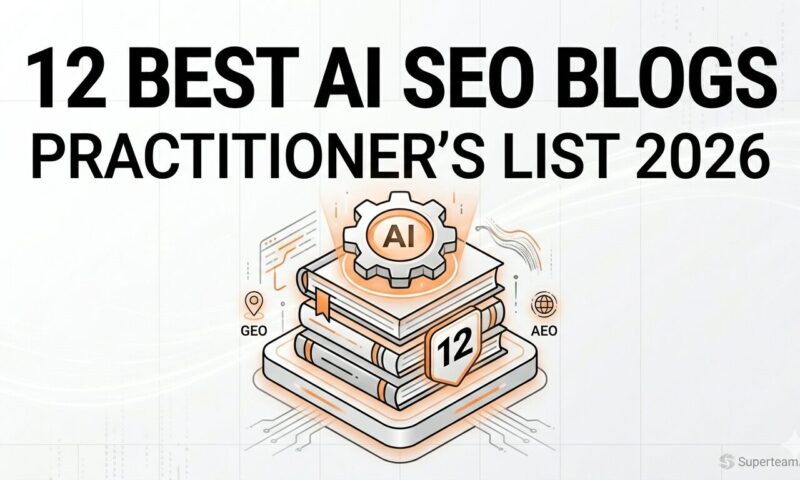
At Superteam AI, we built this list from the ai seo blogs our team reads each week to run client content programmes. The top ai seo blogs 2026 has to offer are not the same list that was circulating in 2023; the landscape has shifted, and so has what makes a publication worth your time.
Why Most SEO Blog Lists Get It Wrong in 2026
The standard “best SEO blogs to follow” list has barely changed in five years. You will find Ahrefs, Moz, Search Engine Journal, and Search Engine Land on almost every one of them, and the descriptions are interchangeable: “comprehensive,” “regularly updated,” “trusted by professionals.” These assessments are not wrong. They are just incomplete.
The problem is that most lists were built for a search landscape that no longer exists. In 2026, organic search optimisation runs alongside a second discipline: AI search optimisation, covering Generative Engine Optimisation (GEO), Answer Engine Optimisation (AEO), and dual-surface strategy for ranking on traditional Google results while simultaneously getting cited by AI Overviews. A blog can be authoritative for traditional SEO while having almost nothing to say about the 2026 AI search landscape.
When choosing which best seo blogs to follow for AI SEO specifically, the missing question is: does this publication actually cover GEO, AEO, Google AI Overviews, and dual-surface strategy with enough depth to be useful? Our list evaluates specifically on that dimension, in addition to the criteria below.
In running AI SEO content programmes for our clients, we read dozens of SEO publications each week. What you are reading now is the reading list we actually use, evaluated not by domain authority or publishing volume, but by whether the content makes our team better at the work.
How We Evaluated These AI SEO Blogs
The criteria below reflect what we have learned evaluating blog content while building AI SEO programmes for clients. Generic SEO quality signals are table stakes; every blog on this list clears those bars. The differentiating question in 2026 is whether a blog covers the ai search optimization territory that now determines whether content gets discovered and cited. These dimensions also inform how we assess ai seo blog writing quality.
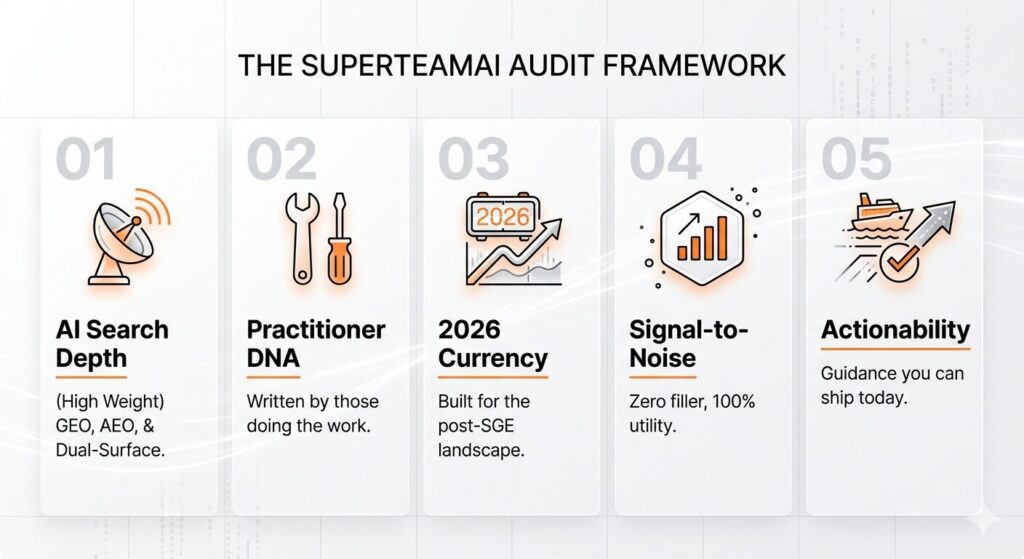
Our 5 Evaluation Dimensions
- AI Search Coverage Depth: Does the blog actively cover GEO, AEO, Google AI Overviews, and dual-surface strategy in 2026? This is weighted most heavily.
- Practitioner vs. Theoretical Perspective: Are articles written by people who execute campaigns, or by observers who report on what others are doing?
- Freshness and Publishing Frequency: Is the blog reflecting the actual 2026 search landscape, not the 2023 one?
- Signal-to-Noise Ratio: What proportion of articles are genuinely useful versus traffic-capture filler?
- Actionability: Can the reader implement guidance without extensive additional research?
The 12 Best AI SEO Blogs in 2026
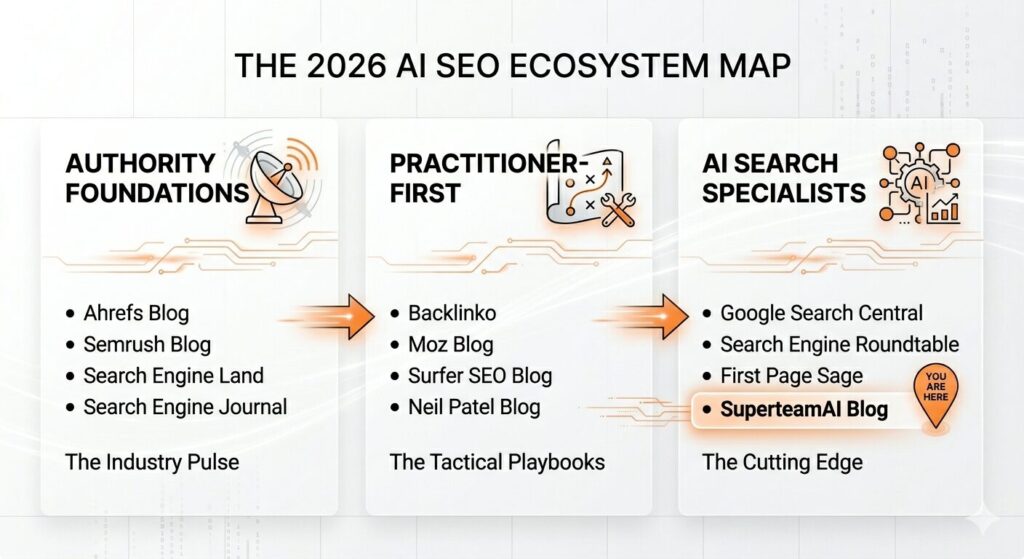
Segment 1: The Authority Foundations
These four publications form the bedrock of SEO knowledge for any practitioner. Their research budgets and editorial breadth mean they respond quickly to significant algorithm changes, including AI search developments. All four rank among the best ai marketing blogs for SEO practitioners and belong on every reading list.
1. Ahrefs Blog
The Ahrefs Blog is one of the most data-rich SEO publications in the industry, and its value for AI SEO practitioners has grown substantially since 2024. Their original research on AI Overview citation rates, click-through impact from Position Zero changes, and keyword-level shifts caused by AI Overviews is consistently the most rigorous available: methodology disclosed, sample sizes credible, conclusions specific. For teams that need data to back client decisions, no publication delivers as consistently on AI search impact research.
AI SEO Coverage: High Best for: Practitioners and strategists who need data to back client decisions. Best article to start with: Their annual AI and organic search research study, which gives the clearest picture of how AI Overviews are redistributing traffic across query categories.
2. Semrush Blog
Semrush Blog publishes at high volume with a practical orientation. Their coverage of AI content strategy, AI-assisted keyword research, and GEO tactics is consistent and directly applicable. They translate new AI search features into actionable guidance faster than most publications, likely because their product team is building tools around the same capabilities simultaneously. Coverage is occasionally product-adjacent, but the editorial content holds up independently of the platform.
AI SEO Coverage: Medium-High Best for: Practitioners and content teams running AI-assisted programmes. Best article to start with: Their GEO optimisation guide, which translates dual-surface strategy into a repeatable workflow content teams can apply immediately.
3. Search Engine Land
Search Engine Land is the news wire of the SEO industry. It is not primarily a how-to blog; it is a publication that covers algorithm updates, Google announcements, and AI search developments as they happen, often within hours of official communication. In 2026, where the pace of change across AI search features has accelerated, this real-time awareness function is essential. Read it to stay current, not to build skills.
AI SEO Coverage: High (news-driven, not instructional) Best for: All SEO professionals who need real-time awareness of what is changing. Best article to start with: Their AI Overviews coverage archive, which tracks the feature’s evolution from the Search Generative Experience pilot through its 2026 form.
4. Search Engine Journal
Search Engine Journal covers a broad range of SEO topics through a contributor model, which means quality varies by author. The editorial standards have improved, and AI SEO coverage has grown substantially. Their how-to content on AI content strategy, structured data for AI search, and GEO basics is solid at the educational level. Best used for building conceptual understanding before moving to more advanced practitioner sources.
AI SEO Coverage: Medium Best for: Intermediate practitioners and teams building foundational AI SEO knowledge. Best article to start with: Their series on AI-driven search behaviour changes, which provides useful context for where the ai and seo blog landscape currently stands.
Segment 2: The Practitioner-First Blogs
These four blogs prioritise depth over volume. Their ai seo blog posts tend to be more complete, more actionable, and more useful for teams that need to implement rather than just stay informed. Think of this segment as seo blogs for practitioners who need to implement, not just stay informed.
5. Backlinko
Brian Dean’s legacy content remains some of the most referenced in SEO. The Skyscraper Technique, the Moving Man Method, and the data-backed link-building research remain foundational even in 2026. Backlinko’s AI SEO coverage is growing but slower than its peers, partly because of a lower publishing cadence and partly because the brand’s historical strength is in link acquisition and content frameworks rather than AI search optimisation. Its content strategy material translates directly to AI SEO fundamentals.
AI SEO Coverage: Medium Best for: Strategists and content leads who want foundational frameworks, not just tactical guides. Best article to start with: Their ranking guide for 2026, which integrates traditional organic signals with AI search considerations.
6. Moz Blog
Moz invented the Domain Authority metric and has long been a community hub for practitioners who value methodological rigour. The Moz Blog has slowed in publishing cadence in recent years but still produces research-grade content on ranking factor analysis, local SEO, and increasingly AI search behaviour. Coverage is less current on breaking developments than Ahrefs or Search Engine Land, but more methodologically rigorous than most.
AI SEO Coverage: Medium Best for: Practitioners who want to understand the why behind ranking changes, not just the tactical response. Best article to start with: Their annual ranking factors study, which in 2026 now includes AI search-specific signal analysis alongside the traditional breakdown.
7. Surfer SEO Blog
Surfer’s blog is product-adjacent by nature but consistently delivers useful guidance on AI content strategy, content scoring, and on-page optimisation. Their coverage of AI-assisted content creation workflows is practical and directly applicable, particularly for teams integrating AI tools into their production process. Content from Surfer tends toward the tactical rather than the strategic, which makes it most useful for writers and content managers rather than programme architects.
AI SEO Coverage: Medium-High (particularly for content and on-page) Best for: Content teams and writers implementing AI-assisted production at scale. Best article to start with: Their guide to AI content and SEO compliance, which addresses whether AI-generated content can rank in 2026 and under what conditions.
8. Neil Patel Blog (NP Digital)
The Neil Patel Blog publishes at high volume across digital marketing broadly. SEO content covers the entry-to-intermediate spectrum, and in 2026 the publication has increased its AI SEO coverage meaningfully, with practical articles on optimising for Google AI Overviews, GEO basics, and AI content strategy for non-technical marketers. For practitioners already past the fundamentals, value is selective; for teams newer to AI SEO, it is an accessible starting point.
AI SEO Coverage: Medium Best for: Those newer to AI SEO, and marketing teams needing accessible coverage across digital channels. Best article to start with: Their guide to optimising for Google AI Overviews, which translates the technical concept into a format accessible to non-specialist marketers.
Segment 3: The AI Search Specialists
These four resources are the most important for teams working specifically at the intersection of ai seo in 2026. They are where GEO, AEO, and dual-surface SEO strategy receive the most thorough, most current, and most actionable treatment. For teams building an AI SEO programme, these are the essential dual-surface seo resources.
9. Google Search Central Blog
Primary source. Google’s own blog is non-negotiable for any AI SEO practitioner. It is where algorithm updates, guidance on AI-generated content, E-E-A-T requirements, AI Overviews policies, and structured data specifications are officially communicated.
When Google publishes here, it supersedes any third-party interpretation regardless of analytical quality. Read every post; prioritise the ones on AI content and search quality.
AI SEO Coverage: High (authoritative, first-party) Best for: Everyone; non-negotiable reading for any SEO professional at any level. Best article to start with: Google’s guidance on AI content and quality standards, which resolves more industry speculation than any third-party article can.
10. Search Engine Roundtable
Barry Schwartz’s Search Engine Roundtable has become essential in 2026 for a reason that did not fully exist two years ago: AI-driven algorithm updates are now occurring more frequently, with less official communication from Google than practitioners have historically expected. SER tracks ranking volatility through community signals, forum analysis, and tool data, often detecting significant algorithm movements before Google acknowledges them. For practitioners monitoring client ranking health, this is the closest thing to an early warning system available.
AI SEO Coverage: High (real-time, event-driven) Best for: Practitioners who monitor client ranking health on a daily or weekly basis. Best article to start with: Their daily algorithm update thread, which calibrates normal versus unusual volatility so practitioners can separate genuine updates from routine fluctuation.
11. First Page Sage
First Page Sage has built a reputation for original research on AI search behaviour that is consistently cited by other SEO publications. Their studies on AI Overview click-through rates, GEO citation factors, and the economics of AI-era content marketing are the closest the industry has to independent academic-quality research. The readership is smaller than the authority publications, but the signal value per article is disproportionately high. This is the generative engine optimisation blog practitioners reference when building the business case for AI SEO investment.
AI SEO Coverage: High (original research focus) Best for: Strategists and agency leads building data-backed cases for AI SEO investment. Best article to start with: Their AI Overview CTR research, which provides the most complete picture of how click behaviour is changing as AI Overviews expand.
12. Superteam AI Blog
We are including our own blog here with full transparency. The Superteam AI Blog is written by the team that builds and operates AI SEO programmes for clients. Every article reflects live experience from running AI content systems rather than observing them.
Coverage spans GEO optimisation, dual-surface content strategy, AI SEO workflows, AEO, and the practical realities of deploying AI content at scale. We publish less frequently than authority publications because every article is drawn from client work.Read our AI SEO content strategy guide to see how we build content that ranks on Google and gets cited by AI.
AI SEO Coverage: High (practitioner-first, programme-derived) Best for: Teams building AI SEO programmes or evaluating AI SEO services. Best article to start with: Our AI SEO content strategy guide, which covers dual-surface optimisation from a team that has run these systems in live client programmes.
How to Build Your AI SEO Reading Stack
When we onboard a new client content team, we recommend starting with four blogs, not twelve. The goal is depth of engagement, not breadth of coverage. Following twelve publications at surface level produces noise; following four consistently produces compounding knowledge.
By Role
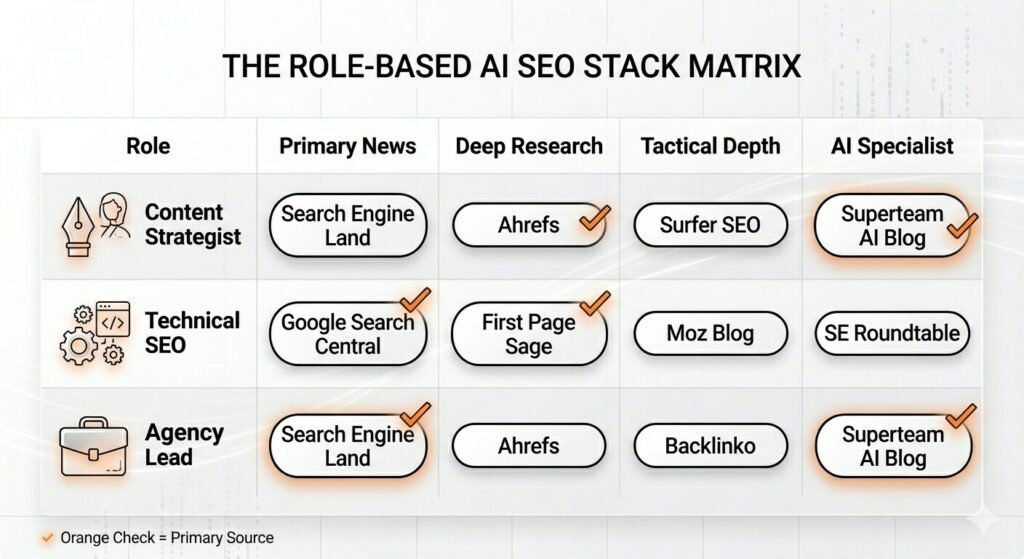
The right reading stack depends on what you are trying to accomplish:
- Content strategists and writers: Ahrefs Blog (AI traffic data), Surfer SEO Blog (content workflow), Superteam AI Blog (programme strategy), Neil Patel Blog (accessible fundamentals)
- Technical SEOs and analysts: Google Search Central Blog (primary source), Search Engine Roundtable (real-time tracking), First Page Sage (AI search research), Moz Blog (ranking factor methodology)
- Agency leads and SEO managers: Search Engine Land (real-time news), Semrush Blog (GEO and AI content strategy), Backlinko (foundational frameworks), Superteam AI Blog (programme architecture)
How Many Blogs Should You Actually Follow?
Four to five is the practical ceiling for consistent, deep engagement alongside a full client workload. The seo blog resources structure we recommend: one real-time news source (Search Engine Land or Search Engine Roundtable), one original research source (Ahrefs or First Page Sage), one tactical depth source (Surfer SEO Blog or Backlinko), and one AI-native source (Superteam AI Blog or Google Search Central). These four form the core ai seo reading list: breaking news, foundational research, and day-to-day implementation. If you want the programme built and run without reading your way into the discipline first, see how our AI SEO Workforce delivers results for client programmes.
AI SEO Blog Comparison at a Glance
| Blog | Segment | AI SEO Coverage | Best For | Publishing Frequency | Unique Value |
| Ahrefs Blog | Authority Foundation | High | Practitioners, Strategists | Weekly | Original AI traffic impact research |
| Semrush Blog | Authority Foundation | Medium-High | Content Teams | Daily | Practical GEO and AI workflow guides |
| Search Engine Land | Authority Foundation | High (news) | All SEO Professionals | Daily | Real-time algorithm and AI search news |
| Search Engine Journal | Authority Foundation | Medium | Intermediate Practitioners | Daily | Educational AI SEO how-to content |
| Backlinko | Practitioner-First | Medium | Strategists, Content Leads | Monthly | Deep foundational strategy frameworks |
| Moz Blog | Practitioner-First | Medium | Methodologically Rigorous Practitioners | Monthly | Ranking factor research and analysis |
| Surfer SEO Blog | Practitioner-First | Medium-High | Content Teams, Writers | Weekly | AI content workflow and scoring |
| Neil Patel Blog | Practitioner-First | Medium | Teams New to AI SEO | Daily | Accessible, marketer-friendly coverage |
| Google Search Central | AI Search Specialist | High (first-party) | Everyone | Variable | Official Google guidance: primary source |
| Search Engine Roundtable | AI Search Specialist | High (real-time) | Daily Monitoring Practitioners | Daily | Algorithm volatility tracking |
| First Page Sage | AI Search Specialist | High (research) | Strategists, Researchers | Monthly | Original GEO and AI search economics research |
| Superteam AI Blog | AI Search Specialist | High (practitioner) | AI SEO Programme Builders | Monthly | Live client programme insights |
Which AI SEO Blogs Should You Prioritise?
The right starting point depends on where you are in your AI SEO journey and how much time you have each week.
If You Have 30 Minutes Per Week
Start with two sources: Search Engine Land for real-time awareness of what is changing, and one deep-research source (Ahrefs Blog or First Page Sage) for the data behind those changes. Thirty minutes of focused reading from two quality sources produces more applicable knowledge than an hour of skimming across ten. Set up email digests for both so significant developments reach you without a manual check each day.
If You Are Building an AI SEO Programme from Scratch
Begin with Google Search Central Blog, then the Superteam AI Blog, then Ahrefs Blog, then Search Engine Roundtable, in that order. Google Search Central defines the official parameters.
The Superteam AI Blog gives you programme-level structure from practitioners who have built these systems in client work. Ahrefs provides the traffic data to set realistic expectations. Search Engine Roundtable keeps you informed when the ground shifts under active programmes.
If You Are Managing a Content Team
Prioritise Surfer SEO Blog for content production workflow, Semrush Blog for GEO and AI content strategy implementation, and Superteam AI Blog for programme architecture. These three cover the practical seo content blog strategy for a team producing AI SEO content at scale. For teams evaluating which tools to use, our guide to the best AI SEO article generators covers what is worth deploying.
Frequently Asked Questions
What is the best AI SEO blog for learning AI SEO in 2026?
For most practitioners, Ahrefs Blog is the strongest starting point. The data quality is exceptional, AI SEO coverage is substantive and growing, and articles are long-form enough to build genuine understanding.
If you are building an AI SEO programme specifically, add the Superteam AI Blog for programme-level thinking drawn from live client work. For real-time awareness, add Search Engine Land. Three sources, read consistently, will give you a more complete picture than twelve read sporadically.
How often should I check AI SEO blogs to stay current?
Match frequency to publication type. For real-time news sources (Search Engine Land, Search Engine Roundtable): set up an email digest so significant developments reach you automatically. For deep-research publications (Ahrefs Blog, First Page Sage, Backlinko): read every new piece when it publishes; these are low volume, high value.
For tactical blogs (Semrush, Surfer): weekly review is sufficient. Treating all ai seo blogs the same way is the most common mistake practitioners make with their reading stack.
Are free SEO blogs as valuable as paid SEO courses?
For staying current with AI SEO in 2026, yes. The best blogs for seo learning are typically more current than courses, because courses have longer production cycles and can be outdated before launch in a field changing as quickly as AI search. The trade-off is structure: courses provide a learning path, blogs require you to build your own.
The combination that works well is a foundational course for structure, supplemented by consistent blog reading for currency. Most practitioners performing well in AI SEO in 2026 credit ongoing reading over formal courses for their current knowledge.
What is the difference between an SEO blog and an AI SEO blog?
A traditional SEO blog covers organic search optimisation: keyword research, link building, on-page optimisation, and content strategy for ranking on Google. An aeo seo blog or GEO-focused publication covers the additional discipline of optimising for AI search systems: how to appear in AI-generated answers, how to get cited by Google AI Overviews, and how to maintain visibility as zero-click search behaviour increases. In 2026, the best ai seo blogs and any dedicated ai search optimization blog cover both dimensions, but the AI search dimension remains the less thoroughly covered territory.
Does reading AI SEO blogs actually improve rankings?
Indirectly, and with a lag. Reading ai seo blogs builds the knowledge base that informs better strategic and tactical decisions; it does not change rankings directly.
Better-informed decisions lead to better-executed content programmes, which lead to improved rankings over a typical 3 to 6 month implementation cycle. Practitioners who get the most value are those who immediately translate what they read into tests and implementations. If the gap between reading and implementation is a resource constraint, that is the problem an AI SEO Workforce addresses.
The 12 ai seo blogs on this list were chosen not because they are the most popular, but because they are the most useful for teams doing the actual work of AI search optimisation in 2026. Popularity reflects reach; usefulness reflects whether content improves the decisions that move rankings.
Three things worth keeping: most “best SEO blogs” lists were built for a pre-AI search landscape; AI search coverage depth is now the critical evaluation dimension for any SEO publication; and four to five consistently-read sources will outperform twelve read at surface level, every time.If reading about AI SEO is the research phase, the next step is putting it into practice. See what our AI SEO Workforce delivers for client content programmes.