Every week, another traditional SEO agency updates its homepage to include “AI-powered.” The term has become so diluted that it now covers everything from agencies that use ChatGPT to write content briefs to those running fully automated publishing pipelines with zero editorial review. When you are trying to find the best ai seo agency for your business, that ambiguity is not just frustrating. It is expensive.
At Superteam AI, we have built and assessed each of the three major delivery models in this market: AI-augmented traditional agencies, AI-native agencies, and AI SEO workforce solutions. What we have consistently found is that most companies evaluating an ai seo agency are asking the wrong questions. They focus on tools listed and case study names when they should be probing for process architecture and measurable deliverables.
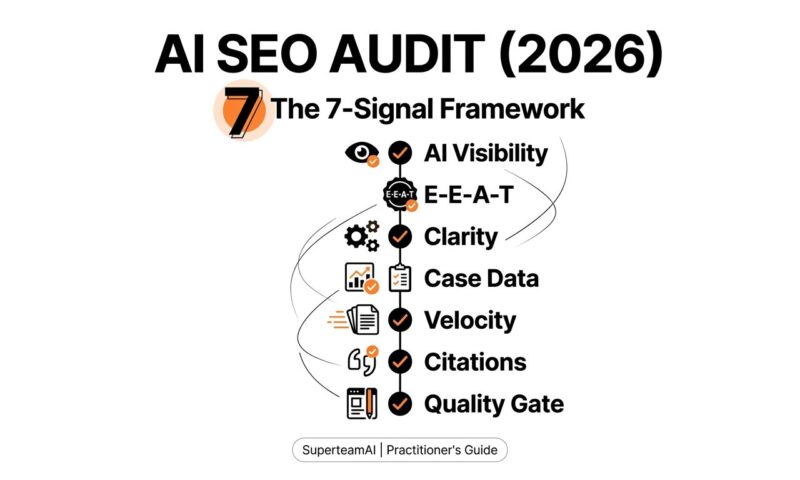
This guide gives you a practical audit framework: seven signals that separate genuine ai seo agency services from rebadged traditional SEO with a language model attached. By the end, you will know exactly how to choose an ai seo agency in 2026, what discovery questions to ask, and which ai seo agency red flags should end the conversation early.
The Problem with Most “AI SEO Agency” Claims in 2026
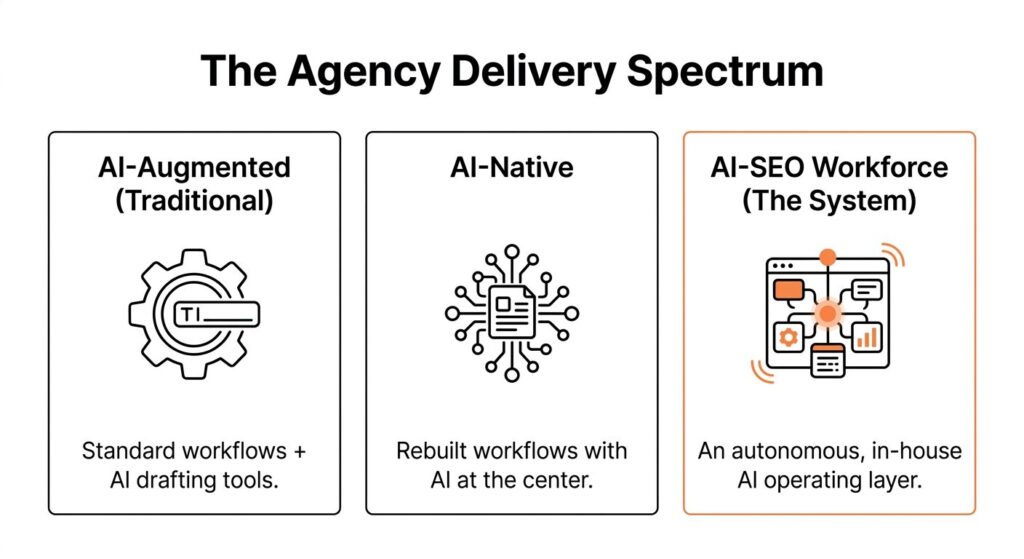
The phrase “ai powered seo agency” has become a marketing label rather than a delivery descriptor. When we analyse what agencies actually deliver under this banner, we find three distinct operational realities underneath the same terminology.
The first category is the AI-augmented traditional agency. This is a conventional SEO firm that has added AI tools to parts of its workflow: using a language model to draft meta descriptions, or a keyword clustering tool for content planning. The underlying delivery model (account managers, monthly reporting, and human writers) remains unchanged.
The second category is the AI-native agency. These firms have rebuilt their content and technical SEO workflows around AI systems. Content is produced at higher velocity, keyword research is more comprehensive, and reporting is often automated. They still employ editorial teams, but AI is central to their operations rather than peripheral.
The third category is the AI SEO workforce solution. Rather than hiring an agency to manage deliverables, the client deploys an AI system that functions as a dedicated in-house SEO team. This is a structurally different engagement model, and we address it in detail in the final section.
Understanding which category an ai seo agency actually belongs to is the first step in any evaluation. An agency that claims to be AI-native but operates like an AI-augmented firm will consistently underdeliver against what it promises. The audit framework below is designed to surface this distinction quickly, before you have committed time to a full proposal process.
The category problem is made worse by the fact that agencies rarely self-identify accurately. Most will describe themselves as AI-native because the term carries more commercial appeal. This is why you need a structured set of signals to evaluate from the outside, based on operational evidence rather than marketing language.
What a Genuine AI SEO Agency Actually Does
The question “what does an ai seo agency do” has a deceptively simple answer: it produces SEO results faster and at greater scale, with visibility across both traditional search and AI-generated results. But that answer is only meaningful when it maps to a specific operational reality.
Here is how genuine ai seo agency services compare to traditional SEO delivered with AI tools added:
| Dimension | Genuine AI SEO Agency | Traditional Agency with AI Tools |
| Content production | AI-orchestrated pipeline with human editorial gate | Human writers using AI assistance |
| Keyword research | Automated NLP analysis at scale | Manual research supplemented by AI tools |
| AI search visibility | GEO/AEO tracked as a primary KPI | Not measured |
| E-E-A-T integration | Structured process for injecting experience signals | Relies on writer judgement |
| Reporting cadence | Automated, real-time dashboards | Monthly PDF reports |
| Content velocity | 20 to 40+ pieces per month | 4 to 8 pieces per month |
| AI citation tracking | Multi-platform (Google AI Overviews, Perplexity, ChatGPT) | Not tracked |
| Pricing model | Performance-aligned or subscription | Time-and-materials or retainer |
One important note on E-E-A-T: AI-generated content without a rigorous editorial quality gate will not produce durable rankings. At Superteam AI, our content production pipeline requires every piece to pass a quality review that checks for experience signals, factual accuracy, and source attribution before publication. This is not an optional step. It is what separates content that ranks from content that merely exists.
The 7-Signal AI SEO Agency Audit Framework
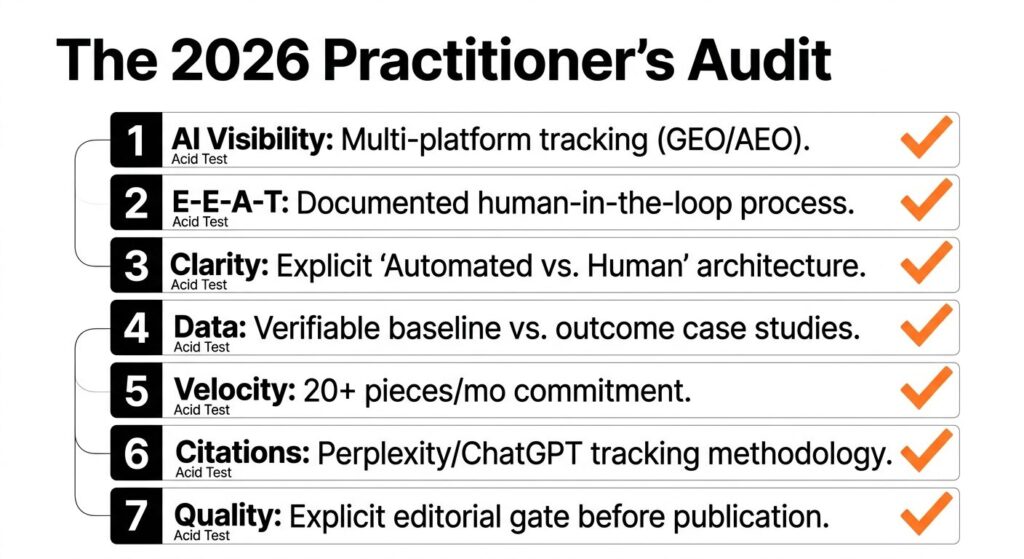
This framework came directly out of our experience building and assessing ai seo agency delivery models across all three categories. Each signal is binary: the agency either demonstrates it clearly, or it does not. An agency that cannot pass all seven is not yet operating as a genuine AI SEO agency, regardless of how it markets itself.
Signal 1: AI Search Visibility as a Measured Deliverable
A genuine ai search agency tracks performance across AI-generated search surfaces alongside traditional rankings. This means Google AI Overviews citation rates, Perplexity citations, and ChatGPT source appearances are in the reporting dashboard as primary KPIs, not afterthoughts.
Ask any agency you evaluate: “How do you measure AI search visibility, and what does that look like in your reporting?” If the answer is vague, or if the agency says AI visibility is “hard to measure right now,” that is a definitive signal it is not operating as a generative seo agency or llm seo agency in any meaningful sense. Measurement methodologies for AI search surfaces are well-established in 2026, and any serious agency uses them. What you are looking for is a specific answer: named platforms, a described methodology, and sample reporting that shows AI citation data alongside traditional rank tracking.
Signal 2: Defined E-E-A-T Integration Process
Google’s quality evaluator guidelines place Experience, Expertise, Authoritativeness, and Trustworthiness at the centre of content quality assessment. For AI-produced content, E-E-A-T signals do not emerge organically. They must be designed in deliberately.
A genuine ai seo agency has a documented process for this: author bios, first-person practitioner framing, citation architecture, and editorial sign-off. Ask the agency to walk you through its E-E-A-T integration process step by step. If it cannot describe a specific workflow, the content it produces carries structural risk under Google’s quality systems.
Signal 3: Category Clarity
Ask the agency to describe its own delivery model in one minute. Can it explain clearly whether it is an AI-augmented firm, an AI-native firm, or something else? Can it tell you which parts of its workflow are automated and which involve human judgement?
Agencies that genuinely operate with AI at their core can describe their architecture clearly, because they built it intentionally and documented it. Agencies that have added AI tools incrementally tend to give vague, defensive answers when pressed on operational specifics. Category clarity is one of the fastest signals to assess on an initial call.
Signal 4: Specific Verifiable Case Study Data
Ai seo agency results should be documentable. The agency should be able to provide specific case studies with verifiable data: client context, baseline metrics, timeline, and measured outcomes. “We grew organic traffic by 200%” is not a case study. “We grew organic traffic for a B2B SaaS client from 12,000 to 36,000 monthly sessions over nine months, with a corresponding increase in demo requests from organic” is a case study.
Ask for two or three case studies relevant to your industry or business model. Testimonials in place of data are a yellow flag. No specific data at all is a red flag. Also ask whether the agency can put you in touch with the client referenced; agencies with genuine results are usually comfortable facilitating a reference conversation.
Signal 5: Content Velocity Specificity and 30-Day Commitment
One of the core value propositions of an ai seo agency for b2b or an ai seo agency for saas is content velocity: the ability to produce high-quality content at a pace that compounds topical authority faster than a traditional agency can. Ask the agency for its specific monthly content output, and ask what it will deliver in the first 30 days.
A genuinely AI-native agency commits to specific numbers. “It depends on your budget” is not a specific answer. “At our standard tier, we publish 20 optimised blog posts per month with a two-day turnaround from brief approval” is a specific answer. Specificity is the signal.
Signal 6: Multi-Platform AI Citation Tracking
Ranking on Google remains critical in 2026, but a growing share of information-seeking queries are answered by AI systems that pull from ranked content. In our programme work with B2B and SaaS clients, we track AI citation appearances across Google AI Overviews, Perplexity, and ChatGPT on a weekly basis, because citation data directly informs which content structures and formats generate the most visibility.
Ask the agency which AI platforms it tracks citations on, what its methodology is, and how it feeds citation data back into content strategy. Top ai seo agencies in 2026 treat AI citation optimisation as a first-class deliverable, not a feature to be added later.
Signal 7: Transparent Quality Review at Production Stage
Ask the agency where human editorial judgement enters its production process. The answer reveals whether AI is being used to scale quality or to replace it.
An agency that says “our editors review every piece before it goes out” is describing an editorial process. An agency that says “our AI system checks for grammar and duplicate content” is describing an automated filter, which is not the same thing. You need to know that a person with editorial authority reviewed the content for accuracy, E-E-A-T compliance, and brand alignment before publication.
Use this checklist during your evaluation calls:
| Signal | Question to Ask | What Pass Looks Like |
| 1. AI Search Visibility | “How do you measure AI search performance?” | Specific platforms named, methodology described |
| 2. E-E-A-T Integration | “What is your E-E-A-T integration process?” | Documented workflow with editorial component |
| 3. Category Clarity | “Describe your delivery model in 60 seconds” | Clear, confident description of automated vs human steps |
| 4. Case Study Data | “Can you share a relevant case study with specific data?” | Client context, baseline, timeline, outcome |
| 5. Content Velocity | “What will you deliver in the first 30 days?” | Specific output numbers and format |
| 6. AI Citation Tracking | “Which AI platforms do you track citations on?” | Multiple platforms named, methodology described |
| 7. Quality Review | “Where does human editorial review happen?” | Specific stage described, role with authority named |
Discovery Questions to Ask Before You Sign
Beyond the seven signals, several additional questions surface operational maturity and strategic fit. These matter most for companies evaluating an ai seo agency for b2b or an ai seo agency for saas, where content accuracy is as important as content volume.
Ask about their onboarding process: what do they need from your team, how long does it take, and what does the first month look like in terms of your involvement? A well-structured onboarding should be time-bounded and light on your team’s calendar after the initial knowledge transfer phase.
Ask about content accuracy: for B2B and SaaS, technical accuracy in content is both a ranking factor and a credibility signal. How does the agency verify factual claims, particularly for industries with regulatory or technical requirements where errors carry real business consequences?
Ask about the reporting structure: who is your primary point of contact, how often will you receive reports, and which decisions will you be expected to make versus which the agency handles autonomously? The level of autonomy the agency proposes tells you a great deal about whether its systems are genuinely capable or still require constant client direction.
Ask how they handle underperforming content: what is their process when a piece does not rank as expected? Do they revise, repurpose, or simply move on? The answer signals whether they view content as a long-term compounding asset or as a volume output metric to be replaced.
Finally, ask about their ai seo strategy for the first 90 days specifically: what is the sequencing logic, why those topics in that order, and how does the initial content plan relate to your ICP’s research behaviour? An agency that can answer this with precision has done the strategic work. One that gives a generic answer about “targeting quick wins first” has not.
If you want to compare ai seo agency services in more detail before making a decision, our guide to what AI SEO services include covers the full service landscape.
Red Flags vs Green Flags When Evaluating an AI SEO Agency
In our experience evaluating agencies in this space, a consistent set of ai seo agency red flags surfaces across all three categories. Some are obvious on the first call; others only emerge when you push into operational specifics.
| Red Flag | Green Flag |
| Uses “AI-powered” without explaining what is automated | Describes specific automated and human components |
| Case studies are testimonials only, with no data | Case studies include baseline, timeline, and specific outcomes |
| Cannot explain their E-E-A-T integration process | Has a documented editorial quality gate |
| No mention of AI search visibility or GEO/AEO | Tracks citations across Google AI Overviews, Perplexity, and ChatGPT |
| Vague about content velocity or monthly output | Commits to specific monthly deliverables |
| Only reports on traditional rankings | Reports on both traditional and AI-generated search performance |
| Promises rapid results without explaining the mechanism | Explains the content architecture behind expected results |
Recognising these red flags early saves both time and budget. The most revealing evaluation calls are the ones where you skip the presentation deck and move directly into operational questions within the first ten minutes.
What to Expect in the First 30, 60, and 90 Days
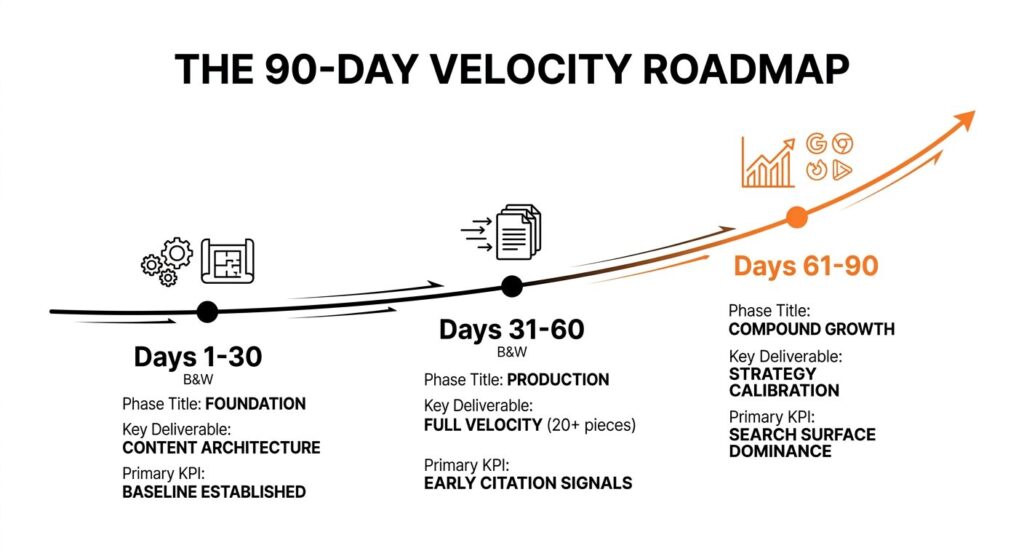
The right agency should give you a clear, specific picture of what happens at each stage of the engagement. Here is what a well-structured first quarter looks like when the agency is operating properly.
Days 1 to 30: Foundation and Onboarding
The first month is primarily about knowledge transfer and setup. The agency audits your existing content, maps your keyword landscape, establishes baseline metrics across both traditional and AI search surfaces, and finalises the initial content calendar.
You should receive a strategy document and first deliverables before the 30-day mark. This might be the first two or three published blog posts, a completed technical audit with prioritised recommendations, or both. If you reach day 30 with only a strategy document and a promise that “delivery starts next month,” treat it as a red flag.
Days 31 to 60: Production and Calibration
By the second month, content production should be at full velocity. The agency is publishing, tracking, and beginning to calibrate based on early performance signals. This is also when the reporting cadence becomes real: you should see dashboards covering traditional ranking movement, content engagement, and early AI citation data. Expect two or three calibration adjustments based on what the data shows.
Days 61 to 90: Optimisation and Expansion
By the third month, you have enough data to evaluate which content types and topics are performing and which need revision. The agency should be presenting a revised forward strategy based on actual performance data, not just the initial assumptions from month one. AI search visibility metrics should be showing meaningful signal by this point, even if traditional rankings are still building. A well-run AI SEO agency will also be able to show you which specific content formats (definitions, structured comparisons, step-by-step guides) are generating the most AI citations, and will have already adjusted the production calendar accordingly.
Why Some B2B and SaaS Companies Skip the Agency Model Entirely
For many B2B and SaaS companies, the agency engagement model (whether traditional or AI-native) introduces friction that the business does not need. Account management overhead, knowledge transfer cycles, and the inherent limitations of an external team understanding your product deeply are real costs that rarely appear in a retainer proposal.
This is why a growing number of companies in 2026 are moving to an AI SEO workforce model instead. Rather than hiring an ai seo agency, they deploy an AI system that operates as a dedicated in-house SEO team: researching, producing content, managing technical optimisation, and tracking performance across both traditional and AI search surfaces, without the coordination overhead of an external relationship.
At Superteam AI, we designed the onboarding architecture for our AI SEO Workforce specifically for companies that need SEO running at scale without constant client input. The initial knowledge transfer is structured and time-bounded. After that, the system produces, publishes, and reports autonomously, with the client’s role shifting to strategic direction rather than operational involvement.
The ai seo agency vs traditional debate, and even the question of which specific agency to hire, often misses this third option entirely. For companies where SEO is a core growth channel, a workforce model that combines AI scale with in-house operational simplicity can outperform any agency relationship over a twelve-month horizon. If you are evaluating both models, it is worth understanding what a workforce solution includes before committing to an agency retainer.
Frequently Asked Questions
What does an AI SEO agency actually do that a traditional agency cannot?
A genuine ai seo agency operates at fundamentally different content velocity and measures performance across AI-generated search surfaces in addition to traditional rankings. Where a traditional agency might produce 4 to 8 content pieces per month, an AI-native agency produces 20 to 40 or more, with quality maintained through a structured editorial gate. The additional dimension is AI search optimisation: structuring content to appear in Google AI Overviews, Perplexity answers, and ChatGPT responses.
Traditional agencies do not measure or optimise for this surface, which means a growing share of their clients’ potential search visibility goes unaddressed in 2026. The volume advantage is also compounding: more content published consistently means faster topical authority growth, which in turn improves both traditional rankings and AI citation rates.
How do I know if an agency is genuinely AI-native or just using AI tools?
Use Signals 3 and 6 from the audit framework above. An AI-native agency can clearly articulate what is automated in its pipeline and can show you AI citation data from existing clients. A traditional agency with AI tools added will typically be vague on both points. The test is not whether the agency mentions AI in its pitch, but whether it can describe, with specific operational detail, how AI is integrated into its daily production and reporting workflow.
Are top AI SEO agencies more expensive than traditional SEO agencies?
Top ai seo agencies in 2026 vary significantly in pricing by delivery model. AI-augmented agencies tend to price similarly to conventional SEO firms. AI-native agencies often charge a premium that reflects higher content velocity and dual-surface reporting.
The more useful metric is cost per qualified organic visit or cost per pipeline opportunity, not the monthly fee in isolation. An agency producing 30 optimised pieces per month will often deliver a lower cost per outcome than a traditional firm producing 6 at a higher per-piece fee.
Is an AI SEO agency a good fit for B2B companies with long sales cycles?
An ai seo agency for b2b needs to understand that the goal is qualified pipeline, not traffic volume alone. The right agency builds content around your ICP’s research journey, prioritising topics with commercial intent and measurable paths to conversion. Ask any B2B-focused agency how it connects content performance to pipeline metrics. If it speaks only to traffic figures, it is not structured for a long-cycle B2B business where a single qualified lead can be worth more than a month of retainer fees.
What is a generative SEO agency or GEO agency, and do I need one?
A generative seo agency or geo agency specialises in optimising content for AI-generated search results, a discipline known as Generative Engine Optimisation (GEO) or Answer Engine Optimisation (AEO). In 2026, with AI Overviews appearing on a significant proportion of informational and commercial queries, GEO optimisation is a core deliverable rather than an optional add-on. Any ai seo agency you hire should have GEO capability built into its standard workflow, not offered as a premium tier or a future roadmap item.
Choosing the Right AI SEO Agency: The Bottom Line
The 7-Signal Audit Framework will eliminate most agencies that are not ready to deliver what they claim. What distinguishes the best ai seo agency options from the rest, once you have passed all seven signals, is architectural transparency. The best agencies can show you their system in operational detail: the brief template they use, the quality gate checklist, the citation tracking dashboard, and what their process is when a piece underperforms. That level of transparency is only possible when the agency has genuinely built and documented its processes, rather than assembling an answer for you in real time.
When you are evaluating an ai seo agency in 2026, the goal is not to find the agency with the most compelling pitch deck. The goal is to find the one whose systems you would trust to run without you watching closely every week. Use the seven signals, ask the discovery questions, and pay close attention to how any agency responds when you push past social proof and into operational specifics. The quality of that response will tell you everything you need to know.


