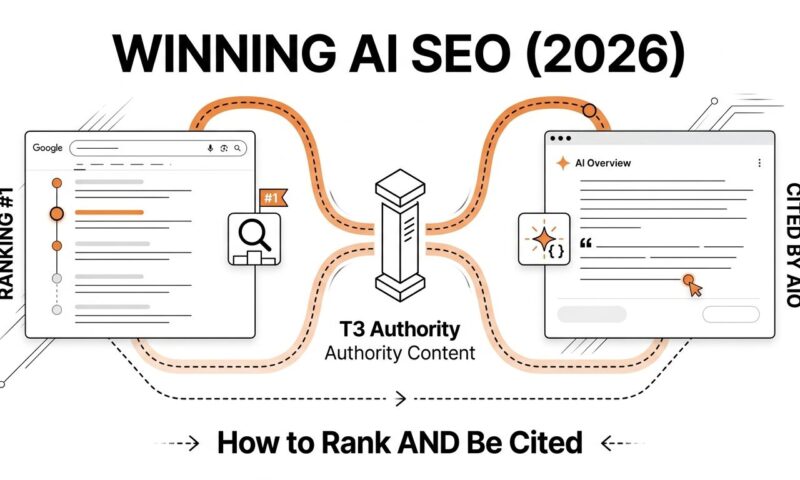
At Superteam AI, we have deployed AI content systems for client programmes across multiple sectors and measured what happens to rankings. The question of whether ai seo is compatible with AI-generated content has a clear answer in 2026, and it is more specific than most articles will tell you. If you are asking is ai content bad for seo, the answer depends on which production tier your AI content falls into.
The Short Answer (and Why Most Explanations Stop Too Soon)
No. AI content is not inherently bad for SEO. Google does not penalise content because it was written with AI assistance. What Google penalises is low-quality content; and in 2026, the relationship between ai written content seo performance and quality depends almost entirely on what production tier that content falls into.
That is the answer most articles give, and it is where they stop. The problem is that “make it high quality” is not actionable guidance for a practitioner running an AI content programme. You cannot audit your content against an instruction to be helpful. You need a concrete framework: what specific signals separate AI content that ranks from AI content that gets suppressed in the 2026 search environment?
In deploying AI content systems for clients at Superteam AI, we have found that the question is never whether AI was involved in creating the content. It is whether the output meets the quality signals Google rewards. Those signals are measurable, auditable, and learnable. This article gives you the framework.
The short answer is worth restating clearly: is ai content bad for seo? No, not if it meets the quality threshold. The rest of this article defines that threshold precisely.
What Google Actually Says About AI Content in 2026
Google’s official position has been consistent since 2022, though the nuance has deepened significantly over three years of public guidance.
The 2022 Starting Point: Helpful Content as the Standard
When Google published its original guidance on AI-generated content in 2022, the message was clear. Content produced primarily for search engines, regardless of how it was created, violated their spam policies. Content created to help people, regardless of how it was created, did not. The helpful content update ai guidance introduced the “created for people” standard that remains the governing principle in 2026.
The critical phrase from Google’s 2022 guidance was “appropriate use of AI or automation is not against our guidelines.” This established from the outset that AI origin is not the issue. Quality and intent are. A piece of content produced entirely by a human author but written to game search engines is more problematic under this framework than a piece of AI-assisted content that genuinely addresses what the reader needs.
How the Position Has Evolved Through 2025 and 2026
The position has been refined considerably since 2022. The March 2023 spam policy update explicitly addressed “scaled content abuse”: mass-produced content, whether AI-generated or not, that adds no original value. The 2024 and 2025 core updates tightened E-E-A-T requirements, raising the bar for what “demonstrating experience” means in practice. The expanded rollout of Google AI Overviews has added a second quality dimension: content that ranks in traditional search must now also be structured to be cited in AI-generated answers, which requires a different kind of specificity and authority.
By 2026, the practical implication is clear. The google ai content penalty people worry about does not exist for well-executed AI content. What does exist is a quality threshold that is higher than it was in 2023, more specifically defined in terms of E-E-A-T signals, and now applies to two search surfaces simultaneously. The google helpful content ai standard rewards people-first content and suppresses thin, generic output, a distinction that cuts across the human-versus-AI debate entirely.
The Real Question: What Quality Threshold Does AI Content Need?
The human vs ai content seo debate has always asked the wrong question. When practitioners ask is ai content bad for seo, the question is about quality, not origin. The right question is: what does quality AI content look like at the production level, and how do you know when your content meets the standard that determines ai content google ranking?
When we built the Superteam AI content production system, we categorised every client content workflow into one of three tiers based on what we observed performing consistently across programmes. The tier determines expected performance more reliably than any other single variable.
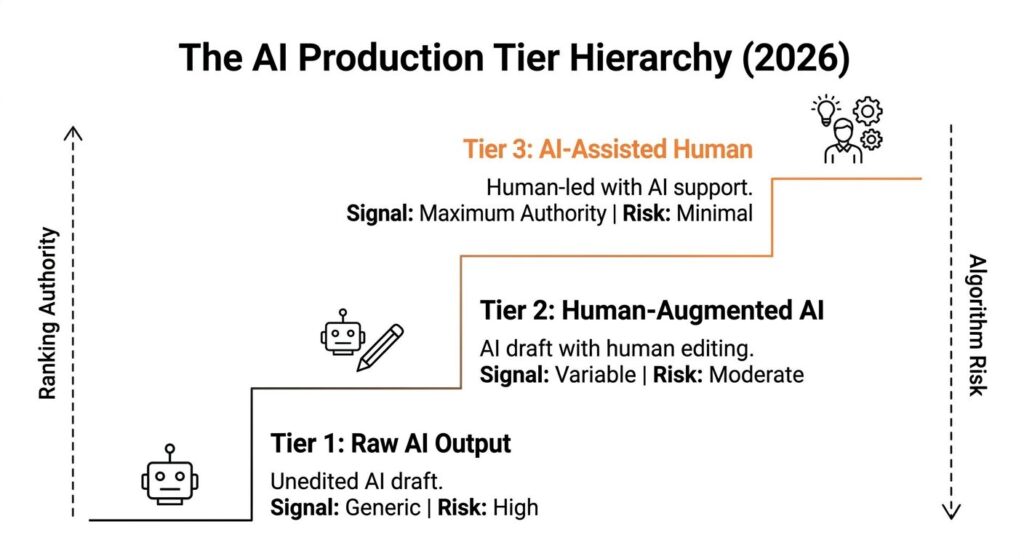
Tier 1: Raw AI Output
Unedited AI output is the draft that comes directly from the model with minimal or no human intervention. This is the tier most responsible for the perception that ai generated content seo performance is unreliable. Raw AI output consistently exhibits the same weaknesses: generic assertions without supporting specifics, no first-person experience signals, predictable sentence structures, and a tendency to cover the obvious sub-topics while missing the nuanced ones.
Tier 1 content is not always penalised immediately, and in low-competition niches it can rank. But it is at the highest risk of suppression during core algorithm updates, and it performs poorly for AI Overview citations because it lacks the specific, authoritative statements AI systems prefer to extract. Teams relying on unedited AI output are building a content programme on an unstable foundation.
Tier 2: Human-Augmented AI Content
The majority of AI content in production falls into Tier 2. This is AI-drafted content that has been reviewed and edited by a human before publication. Performance varies widely within this tier, determined largely by the depth of human intervention.
Light editing (grammar corrections, minor restructuring) produces content that performs similarly to Tier 1. Substantive editing (adding specific claims, original data, first-person observations, and editorial voice) produces content that performs much closer to Tier 3.
The critical question for Tier 2 is whether the editor adds something the AI cannot: perspective, experience, or a unique point of view. Chatgpt content seo performance data consistently shows that Tier 2 content with genuine editorial augmentation ranks competitively; Tier 2 content with surface-level editing does not. The editing is the differentiator, not the AI draft.
Tier 3: AI-Assisted Human Writing
A human author uses AI for research, structuring, or first-draft support but drives the content direction, experience signals, and editorial voice. This is the highest-performing tier across our client programmes. The AI reduces production time; the human provides the quality signals that determine rankings performance. Tier 3 content is, in practice, indistinguishable from high-quality human writing in the ways that Google measures.
| Tier | Description | Key Signals | SEO Risk | Expected Performance |
| Tier 1: Raw AI Output | Unedited AI draft | Generic assertions, no experience signals, predictable structure | High | Variable; most vulnerable to algorithm suppression |
| Tier 2: Human-Augmented | AI draft with human editing | Depth of editing determines signal strength | Medium | Correlates directly with editing depth |
| Tier 3: AI-Assisted Human | Human-led with AI support | Strong experience signals, specific claims, editorial voice | Low | Consistently competitive; approaches Tier 3 human writing quality |
The 5 Quality Signals That Separate Ranking AI Content from Penalised Content
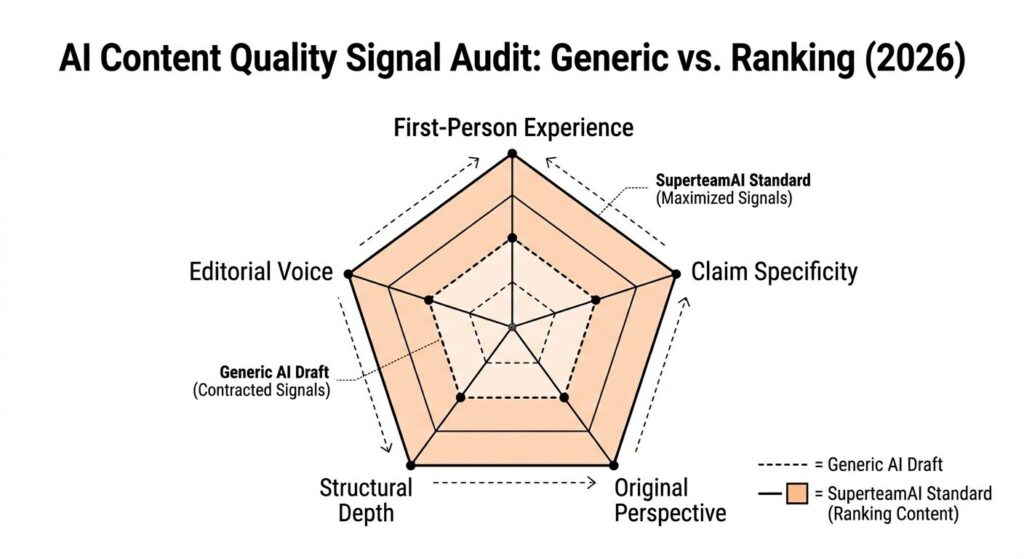
These are the five signals we review in every piece of content produced under the AI SEO Workforce before it goes to publication. They are also the signals that distinguish Tier 2 content that performs from Tier 2 content that does not. Understanding ai content quality seo at this level separates teams that rank consistently from those running an unpredictable programme.
1. First-Person Experience Signals
Experience is the most underweighted quality signal in AI content. AI models cannot have experiences; they can only describe experiences in the abstract. Content that includes genuine first-person observations (specific things the author has noticed, tested, encountered, or built) reads differently to both human readers and search quality assessors than content that describes experience generically.
In our programme work, we consistently find that content without experience signals underperforms even when all other quality dimensions are strong. Adding them is not complicated: it requires either an author who has direct experience with the topic, or a process for incorporating experience signals from a subject matter expert before publication. A single specific observation from someone who has done the work outweighs three paragraphs describing what practitioners generally do.
2. Specificity of Claims
Generic AI content makes generic assertions. “Content is important for SEO” is an assertion. “Pages with direct answers to target queries in the first 100 words achieve substantially higher featured snippet capture rates than pages that bury the answer” is a specific claim. The difference matters not just for reader trust but for ai content e-e-a-t signals that search algorithms use to assess content quality and citation worthiness.
Audit your content by identifying any sentence that could have been written without specific knowledge of the topic. Every such sentence is a quality signal gap. The goal is not to fabricate specificity but to replace vague claims with accurate, evidence-backed statements that demonstrate genuine understanding.
3. Original Data or Unique Perspective
The ai content originality seo dimension is frequently misunderstood. Originality does not require conducting original research. It requires adding something to the conversation that was not already there before this content existed. This can be an original analysis of published data, a framework developed from direct experience, a comparison that no one has made explicitly, or a well-supported contrarian position.
AI models synthesise existing information; they do not generate new perspectives. Every piece of content that relies entirely on information the model already knew is, by definition, non-original. The antidote is always a human contribution: a data point from your own work, an observation from your specific context, or an analytical framework drawn from your experience that no model could have produced on its own.
4. Structural Depth and Topical Coverage
AI content reliably covers the obvious sub-topics of any subject and reliably misses the nuanced ones that experienced practitioners actually search for. For ai content best practices specifically, this means the model will always address keyword placement and readability; it will often miss the failure modes, the edge cases, and the implementation challenges that practitioners encounter when they actually try to do the work.
Audit your content against the questions you would still have after reading it. If substantive questions remain unanswered, your topical coverage has gaps that a competitor with deeper practitioner knowledge will fill. Cross-referencing the “People Also Ask” results for your target keyword is a practical starting point for identifying coverage gaps.
5. Editorial Voice and Consistency
Generic AI content has no authorial perspective. It does not take positions, it hedges, and it uses patterns that average across many writing styles without committing to any. High-quality AI-assisted content has a recognisable voice: it takes positions, it uses consistent phrasing, and it reads as though a single person with a specific point of view wrote it.
Building editorial voice into AI-assisted content requires a style guide enforced at the editing stage. It also requires that editors are empowered to take positions rather than soften all claims toward the neutral centre that AI models naturally produce. An article that disagrees with conventional wisdom and supports that disagreement with specific evidence demonstrates editorial voice far more effectively than one that presents all perspectives as equally valid.
| Signal | Strong | Weak | How to Fix |
| Experience signals | Specific first-hand observations across multiple sections | Generic descriptions of what practitioners do | Add subject matter expert input before publication |
| Specificity of claims | Verifiable, evidence-backed statements | Assertions without supporting specifics | Replace generic assertions with cited, specific claims |
| Original perspective | Unique analysis, framework, or data point | Synthesis of publicly available information only | Add original analysis, contrarian position, or first-hand data |
| Topical depth | Covers edge cases and nuanced sub-topics | Covers only obvious primary sub-topics | Cross-reference against PAA and practitioner questions |
| Editorial voice | Consistent voice with clear positions | Hedged, neutral, interchangeable writing | Apply style guide; editors take positions and defend them |
AI Content and AI Search in 2026: The Dimension Everyone Misses
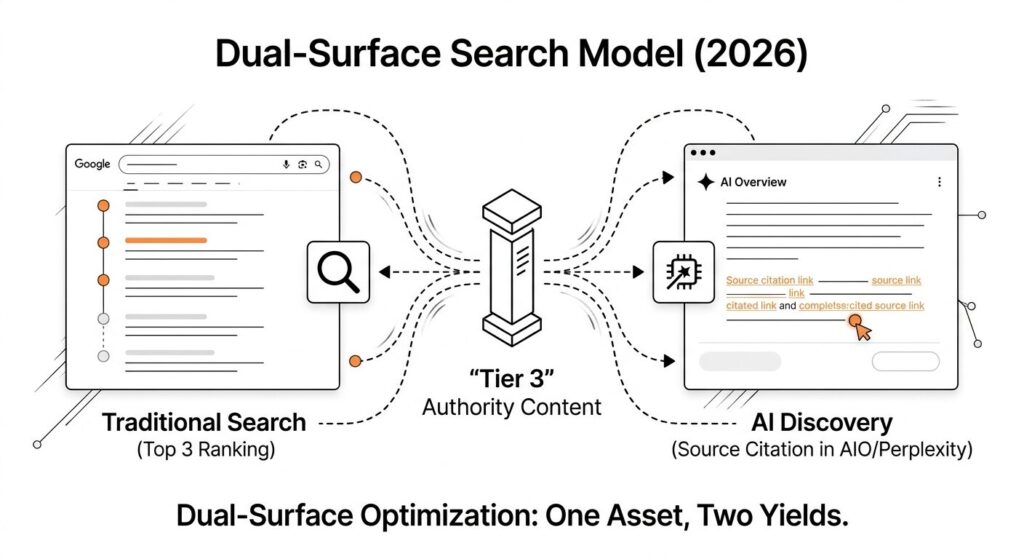
The question “is ai content bad for seo” has traditionally been answered in terms of traditional Google rankings. In 2026, that frame is incomplete. AI search (Google AI Overviews, Perplexity, ChatGPT search, and equivalent systems) now represents a significant and growing share of how searchers discover content. Content that ranks well in traditional search but never gets cited in AI-generated answers is reaching a declining share of total search demand for information queries.
How does ai generated content seo performance interact with AI Overview citations specifically? The pattern we observe is consistent. Content that scores highly on the five quality signals above gets cited by AI systems at substantially higher rates than content that does not.
AI systems prefer specific, authoritative, experience-backed statements: exactly the signals that distinguish Tier 3 from Tier 1 content. This means the quality framework described in this article is not just a traditional SEO consideration; it is a dual-surface requirement.
The practical implication for your ai seo content strategy: the quality threshold that earns AI Overview citations is higher than the threshold that earns traditional rankings position alone. Content that ranks at position 3 on Google without being cited by AI Overviews is losing an increasing share of the search demand for that query to the AI-generated answer above it. Building for dual-surface performance means building for all five quality signals from the production stage.
For how we build content to perform on both search surfaces, see our AI SEO content strategy guide.
What We Have Learned Running AI Content Systems at Scale
The minimum human editing threshold that moves content meaningfully from Tier 2 to Tier 3 performance is not measured in time or word count. This reframes is ai content bad for seo as a production process question, not a philosophical one.
It is measured in whether the editor adds a perspective, observation, or specific claim that the AI could not have generated. An editor who corrects grammar and tightens sentences is providing value, but not the quality signal Google needs. An editor who reads the draft, identifies what is missing from their direct experience, and adds three specific observations from their own work is providing the signal that changes rankings performance.
The content category where AI performs most consistently without heavy augmentation is educational content on established topics: definitions, process explanations, and comparative overviews where the primary reader need is accurate information rather than practitioner insight. Where AI content falls shortest without significant human augmentation is in content that should demonstrate the author has actually done the thing being described. Case studies, implementation guides, and opinion pieces require a human to have an opinion grounded in real experience.
In our programme work, we consistently find that the content teams most effectively using AI are those that have separated the roles clearly. The AI handles research aggregation, structural drafting, and first-pass writing. The human handles experience signals, specific claims, editorial voice, and quality review. Teams that treat AI as a replacement for those human contributions rather than a complement to them consistently produce Tier 1 or low Tier 2 content, regardless of the quality of the model they are using.
The production reality behind our AI SEO Workforce is built around this distinction. Every article produced for clients goes through a quality signal review that checks explicitly for all five signals above before publication. The AI accelerates production; the quality review ensures the content meets the threshold that determines performance on both traditional and AI search surfaces.
Can Google Detect AI Content? (And Does It Matter?)
The ai content detection seo concern is understandable but ultimately misplaced as a primary worry. Teams that frame is ai content bad for seo as a detection question are solving the wrong problem.
Google’s official position is that they do not use AI detection as a ranking signal; they use quality signals. The question of whether Google can technically detect AI content is separate from whether they target AI detection as a penalty mechanism. They do not.
Third-party AI detection tools are unreliable in both directions. They flag human-written content as AI-generated, and they pass AI-generated content as human. No algorithm update in 2025 or 2026 has been confirmed to target AI origin specifically. Every confirmed update has targeted quality signals: thin content, lack of original value, absence of experience signals, and failure to meet the helpful content standard.
The practical implication is clear. Resources spent on AI detection avoidance would be better spent on quality signal improvement.
A piece of content that passes every detection tool but lacks experience signals, specific claims, and original perspective will underperform. A piece of content that any detection tool would flag as AI-generated but that includes all five quality signals will rank. The detection concern is a distraction; the quality signals are the variable that matters.
How to Audit Your Existing AI Content for SEO
If you have published AI content and are concerned about its performance, the following five-step process will identify the gaps that explain underperformance and tell you exactly what to fix. The same framework applies whether you are asking is ai content bad for seo in general or auditing a specific underperforming page.
Step 1: Classify by Tier
Review each piece against the three-tier definitions above. If the content was published as raw AI output or with light editing only, it is Tier 1 or low Tier 2. If it was substantively augmented with human expertise before publication, it is high Tier 2 or Tier 3. Tier classification predicts performance risk before you even check ranking positions.
Step 2: Check for Experience Signals
Read the content and identify every sentence that includes a specific first-person observation or experience reference. A 2,000-word article should have at least four experience signals. Fewer than two is a significant quality gap that no amount of keyword optimisation will compensate for.
Step 3: Audit Specificity
Identify every generic assertion: any claim that could appear in any article on this topic without specific knowledge. A useful test: if the sentence could appear unchanged in a Wikipedia article, it is not specific enough. Replace each generic assertion with a specific, accurate, evidence-backed claim.
Step 4: Assess Topical Coverage
List the questions a reader would still have after finishing the article. If two or more substantive questions remain unanswered, the topical coverage has gaps. Check the “People Also Ask” results for your target keyword; any PAA question not addressed in the content represents both a coverage gap and a missed featured snippet opportunity.
Step 5: Review Editorial Voice
Read the article aloud. Does it sound like a specific person with a specific perspective? Or does it sound like averaged, hedging writing that presents all perspectives as equally valid?
If it avoids taking positions, the editorial voice is weak. Strengthen it by identifying at least two claims the article should take a position on and adding that position with supporting reasoning.
If you want an AI content system that builds these quality signals into the production process rather than requiring a post-publication audit, our AI SEO Workforce handles this end to end.
Frequently Asked Questions
Is AI-generated content penalised by Google in 2026?
No. Google does not penalise AI-generated content because of its origin. The does google penalize ai content question gets a misleading answer when it frames origin as the variable; quality is the variable.
Google’s spam policies target content produced at scale without adding original value, and their quality systems target thin, experience-free content; both standards apply to human and AI content equally. High-quality AI-assisted content that demonstrates E-E-A-T signals faces no penalty. Low-quality content of any origin faces suppression.
What is the difference between AI content that ranks and AI content that doesn’t?
The difference maps directly to the five quality signals in this article: first-person experience, specificity of claims, original perspective, structural depth, and editorial voice. AI content that ranks consistently demonstrates at least four of these five signals strongly. Content that underperforms typically demonstrates fewer than two. The three-tier framework predicts which category your content falls into: Tier 1 raw output almost always underperforms; Tier 3 AI-assisted human writing almost always performs competitively.
Can Google tell if content was written by AI?
Third-party AI detection tools misclassify both human and AI content regularly, which reflects the fundamental difficulty of the problem. More importantly, Google has not confirmed using AI origin detection as a ranking or penalty signal. Their systems target quality signals, not production method.
The practical implication: the ai content detection seo concern is secondary. The question worth prioritising is whether the content demonstrates the five quality signals, not whether it passes a detection tool.
Does human editing of AI content make it better for SEO?
Yes, but only if the editing adds something the AI cannot provide. Editing that corrects grammar and tightens prose does not meaningfully change the quality signal profile. Editing that adds first-person observations, specific claims from direct experience, and an original analytical perspective moves content from low Tier 2 to high Tier 2 or Tier 3, substantially changing its performance profile. The depth of human contribution (specifically whether the editor contributes perspective and experience) is what determines the SEO outcome.
How does AI content affect E-E-A-T signals?
AI content does not inherently weaken E-E-A-T signals, but raw AI output systematically produces content with weak Experience and Expertise signals because models cannot have experiences and their knowledge is general rather than specific. Ai content e-e-a-t performance improves substantially when human editorial contribution adds genuine experience markers (specific observations, project references, named methodologies) and demonstrates domain expertise through accurate, specific claims that go beyond what general training data produces. The E in E-E-A-T is the one AI cannot generate; it must come from a human contributor.
Is AI content effective for building topical authority?
Used correctly, yes. AI content can accelerate the production of supporting cluster content that builds topical authority around pillar pages; this works particularly well for educational, definitional, and comparative content where practitioner experience is less critical. The risk is producing high volumes of thin, undifferentiated content that registers as a low-quality cluster rather than a coherent authority-building programme. The framework that works in our client programmes: use AI for established-topic educational content, and use AI-assisted human writing for content that requires practitioner perspective, implementation guidance, or opinion.
AI content is not bad for SEO. The question was never whether is ai content bad for seo; it was always whether the content is good enough to rank. In 2026, “good enough” is defined by five measurable quality signals, a three-tier production framework that predicts performance, and a dual-surface standard that now includes AI search citations alongside traditional rankings.
Three things worth keeping from this article: the tier your AI content falls into predicts its performance more reliably than any other single variable; the five quality signals are auditable and fixable with the right production process; and the standard is higher in 2026 than it was in 2023, particularly for content that needs to perform on AI search surfaces alongside traditional rankings.The fastest way to close the gap between AI content output and the quality threshold that ranks is a production system built around those quality signals from the start. That is what our AI SEO Workforce delivers for client programmes.


