Every content audit we run surfaces the same missed opportunity. Pages ranking on page one for their target keyword have related questions stacked in the search results that they never answer. Those questions are the People Also Ask box, and the pages failing to capture them are leaving both clicks and answer engine optimization gains on the table.
People Also Ask SEO is not a minor tactical upgrade. In 2026, it is one of the clearest signals of topical authority available in Google’s SERP, and it is directly connected to how AI systems evaluate whether your content deserves citation. PAA boxes now appear on approximately 49% of desktop searches and 52% of mobile searches. More importantly, they appear alongside Google AI Overviews 90.03% of the time, which tells you something critical about how Google organizes knowledge and why PAA and answer engine optimization are inseparable in practice.
This guide covers exactly what the People Also Ask box is, how to find your best PAA opportunities, the five steps to rank in PAA boxes, and why PAA optimization is the most practical entry point into AEO strategy your content team has access to right now.
Why People Also Ask Matters More in 2026 Than It Did in 2022
PAA is not a static SERP feature. Between February 2024 and January 2025, PAA presence grew 34.7% on mobile and 37.5% on desktop, simultaneous with Google AI Overviews expanding to 58% of queries. The two trends are not coincidental.
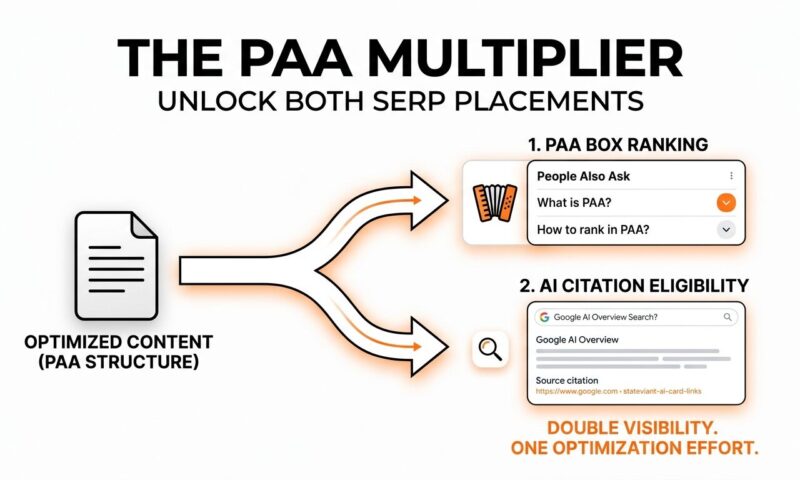
When Google generates an AI Overview, it relies on the same question-topic mapping logic that drives PAA box population. PAA questions represent Google’s structured understanding of what related knowledge belongs to a topic. AI Overviews draw from that same map when selecting which pages to cite and which angles to cover. The data reflects this directly: PAA boxes appear alongside AI Overviews 90.03% of the time.
What this means in practice: a content program that systematically answers the PAA question tree for its target topics is not just winning SERP boxes. It is building the question-answer architecture that AI systems parse when deciding which pages understand a topic comprehensively enough to cite. Teams that treat PAA as optional in 2026 are leaving AI citation eligibility on the table, not just traffic.
What Is the People Also Ask Box?
Definition: The People Also Ask (PAA) box is a Google SERP feature that displays a set of related questions tied to the user’s search query, presented as expandable accordion dropdowns. Each question contains a short answer extracted from a web page, along with a link to the source. PAA boxes appear most frequently on informational, how-to, and definition queries, and they expand dynamically: clicking any question generates additional related questions, creating an effectively infinite chain of related topics.
That dynamic expansion behavior is one of the most underappreciated aspects of the feature. Each time a user clicks to expand a question, new related questions appear. This means a single topic can generate dozens of PAA questions in a chain, each of which represents a content targeting opportunity.
How Google Selects Content for PAA Boxes
Google extracts PAA answers using the same signals that drive featured snippet selection: a direct, extractable answer under a question-format heading, topical relevance, and FAQPage schema markup. The page must rank on page one for a related query, or be assessed as topically authoritative for the specific PAA question.
Unlike position one rankings, PAA inclusion is not strictly tied to high organic positions. A page at position 7 can appear in the PAA box if it provides the clearest direct answer available.
Where PAA Boxes Appear on the SERP
Table 1: PAA Box Positioning Data
| SERP Position | PAA Box Frequency (Desktop) | PAA Box Frequency (Mobile) | Notes |
| Position 2 | ~50% | ~48% | Most common PAA placement |
| Position 3 | ~16% | ~17% | Second most common |
| Positions 4-6 | ~24% | ~25% | Mid-SERP presence |
| Positions 7-10 | ~9% | ~10% | Less common but achievable |
| Multiple appearances | Common | Common | PAA can appear more than once per SERP |
PAA boxes most commonly appear at position 2 in the SERP, making it one of the most prominent placements available, appearing before most organic results.
The Two Ways to Use PAA (Most Teams Only Know One)
Most PAA guides cover one use case: get your content into the box. That is a valid goal. But it is the less strategically valuable of the two ways PAA can work for your content program.
PAA as a Ranking Target
The tactical use case: find PAA questions on SERPs for your target keywords, optimize your content to answer them with direct extractable answer blocks, add FAQPage schema, and get into the box.
The box carries approximately 3% click-through rate, which understates its actual value. Every PAA appearance generates impressions on related queries, builds brand recognition across the topic, and sends topical relevance signals that compound into broader authority. The value extends well beyond any individual click.
PAA as a Content Intelligence Tool
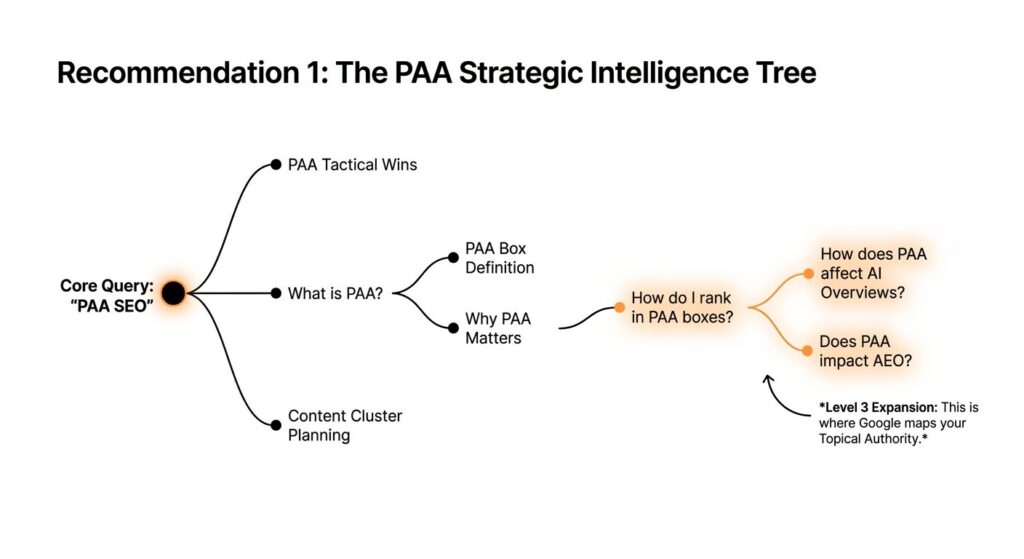
This is the use case most teams miss entirely. PAA questions are not randomly generated. They represent Google’s own structured map of what related questions belong to a topic. When you extract the full PAA question tree for a target topic, which involves clicking through the expanding questions to reveal Level 2 and Level 3 related questions, you are looking directly at the question architecture Google uses to evaluate whether a page or domain understands a topic comprehensively.
In our client content programs, PAA trees are the primary input for content cluster planning. Expanding the PAA chain for a pillar topic tells you which subtopics need standalone pages, which questions need H2 coverage within existing pages, and which clusters represent content gaps waiting to be filled.
A content cluster built around the full PAA question tree systematically covers every question Google associates with that topic, matching precisely what AI systems require to assess topical authority. In 2026, this is how you build content programs that win in both traditional and AI-driven search.
How to Find Your Best PAA Opportunities
The fastest wins come from topics your site already covers. The goal is identifying existing pages close to PAA inclusion that are not yet structured correctly to qualify.
How to build your PAA opportunity list: Export your Google Search Console data filtered for queries with “what,” “how,” “why,” “which,” “when,” or “steps to” that are generating impressions from positions 1-10. These are your pre-qualified candidates. Cross-reference with a live SERP check: search each query and record whether a PAA box is present. If it is, you have a box to displace or enter. If it is not, assess whether the query type is likely to generate one.
Table 2: PAA Opportunity Scoring Framework
| Criteria | Signal to Look For | Score | Notes |
| Current ranking position | Positions 1-5 = 3, positions 6-8 = 2, positions 9-10 = 1 | 1-3 | Stronger-ranking pages convert faster |
| Query type | Question-based or how-to = 3, informational = 2, mixed intent = 1 | 1-3 | Question queries have the highest PAA trigger rate |
| PAA box status | No box present = 3, competitor holds box = 2, you already hold = 1 | 1-3 | Empty boxes are the fastest wins |
| Content format match | Format matches expected answer type = 1, partial = 2, mismatch = 3 | 1-3 | High scores indicate quick-reformat opportunities |
| Topical cluster size | 10+ interlinked pages = 1, 5-9 = 2, fewer than 5 = 3 | 1-3 | Larger clusters reinforce PAA eligibility across the cluster |
Scoring: Pages scoring 12-15 are immediate targets. Pages scoring 8-11 are secondary priorities. Pages below 8 need ranking or authority improvement before PAA optimization will produce results.
Tools that accelerate this research: AlsoAsked.com maps the full PAA question tree visually. Semrush’s PAA filter shows which PAA questions your domain is already appearing in. Ahrefs’ SERP features filter surfaces question-type keywords where PAA boxes exist for your tracked keywords.
How to Optimize Content to Rank in PAA Boxes
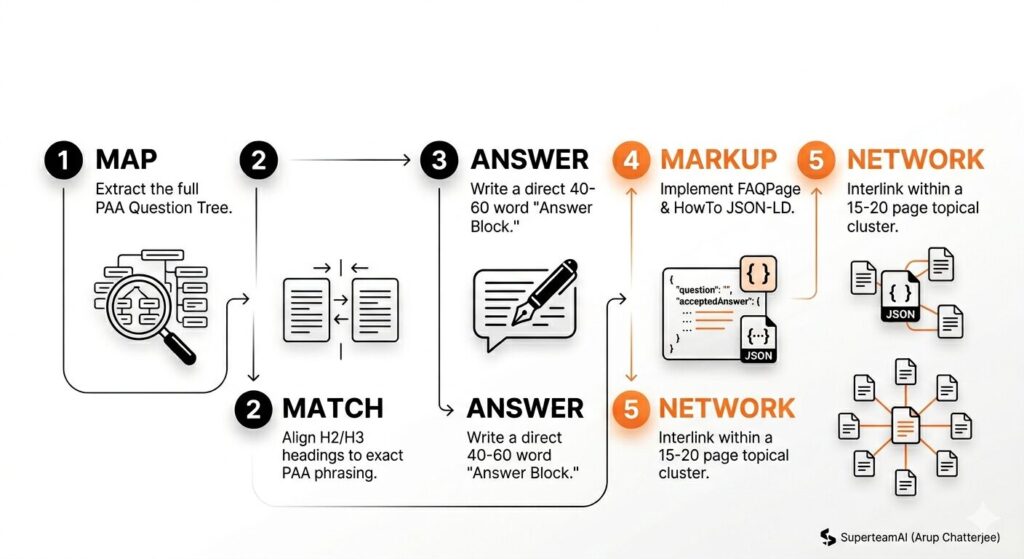
These five steps apply to any page that has been prioritized using the scoring framework above.
Step 1: Map the Full PAA Question Tree for Your Topic
Before touching any content, extract the complete question tree for your target topic. Search your primary keyword, record the visible PAA questions, click each to expand, and record the additional questions that appear one level deeper. The result is a hierarchical map of every question Google associates with your topic.
Identify which questions your existing content answers and which it ignores. Ignored questions are either optimization gaps on the current page (add an H2 and answer block) or opportunities for new cluster pages.
Step 2: Add Question-Format Headings That Match the PAA Phrasing
The heading above your answer must match the PAA question as closely as possible. Google matches the text of PAA questions to heading structures in indexed content. If the PAA question is “How does People Also Ask work?” your H2 or H3 should be exactly or very close to that phrasing.
This is the most common reason pages fail to capture PAA boxes they otherwise qualify for. The answer may be there, the schema may be there, but if the heading says “Understanding the PAA Mechanism” instead of “How Does People Also Ask Work?”, Google cannot make the match reliably.
Step 3: Write a Direct 40-60 Word Answer Block Under Each Question Heading
The answer must appear in the first paragraph under the question heading. No introductory context, no “that is a great question,” no restatement of the heading. Lead with the direct answer. Write it as a standalone paragraph that makes complete sense without the rest of the article around it.
Match the answer format to the expected PAA answer type: numbered list for how-to questions, direct paragraph for definitions, structured table for comparisons. The same format logic applies as featured snippet optimization.
Step 4: Implement FAQPage Schema on Every Q&A Section
FAQPage schema explicitly marks up each question-answer pair for Google’s crawlers. It removes ambiguity about which text is the question and which text is the answer. For PAA optimization in 2026, this is not an optional enhancement. It is a baseline implementation step.
Map every question heading and answer block to FAQPage schema in JSON-LD. Validate with Google’s Rich Results Test before publishing. Apply HowTo schema to step-by-step sections and Speakable schema to key answer paragraphs for voice and AI query delivery.
Step 5: Build Topical Breadth Across a Content Cluster
A single well-optimized page can rank in PAA for a handful of related questions. A content cluster of 10-20 interlinked pages, each covering a distinct branch of the PAA question tree, earns PAA placements at scale and reinforces topical authority across the entire cluster, not just the individual page.
When we track PAA coverage breadth for clients, the relationship between question tree coverage and topical authority scores is consistent: pages within clusters that answer three or more PAA questions for their topic earn PAA placements at significantly higher rates than isolated pages targeting one question. The cluster compounds what individual page optimization starts.
EasyOps built 198 articles over 14 months using the Superteam AI AI SEO Workforce, covering the full question tree across three topical clusters. The result: 89 top-10 keywords, 626% organic traffic growth, and a $21.6M acquisition at a 9x ARR multiple. Topical authority from comprehensive PAA coverage was a primary driver.
Building a 15-20 page topical cluster manually takes four to six months. The Superteam AI AI SEO Workforce produces PAA-structured, schema-optimized content at 10-30 pieces per month, compressing that to six to ten weeks.
How PAA Optimization Feeds AI Overview Citation
PAA boxes and AI Overviews are not competing SERP features. They are two outputs of the same underlying question-topic organization logic Google uses to evaluate content authority.
When Google generates an AI Overview, it retrieves pages demonstrating structured, authoritative answers to the full question set for that topic. The signals it evaluates match PAA eligibility signals exactly: question-format headings, direct answer blocks, FAQPage schema, topical breadth, and E-E-A-T indicators. The 90.03% co-occurrence rate reflects this shared logic directly.
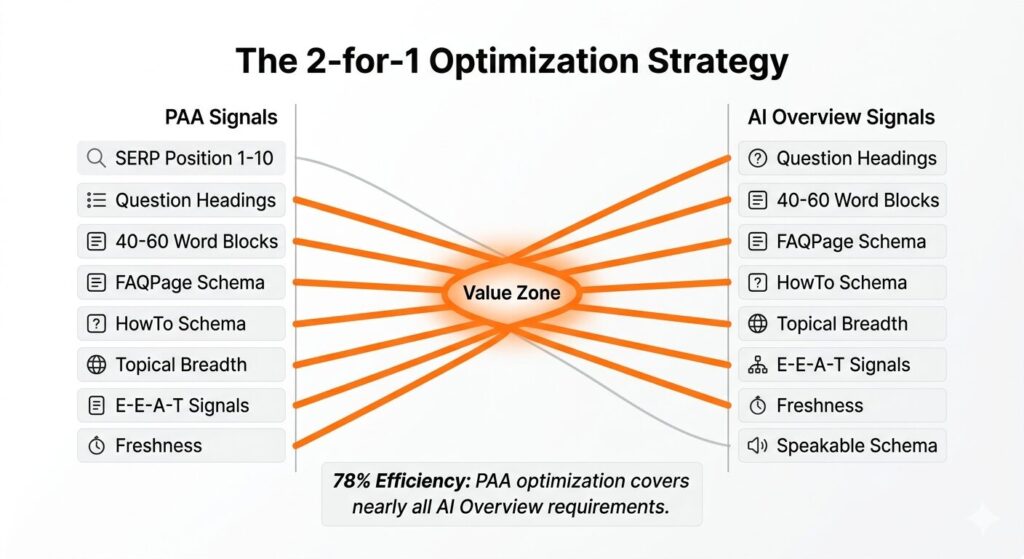
Table 3: PAA vs. AI Overview Optimization: Signal Overlap
| Optimization Signal | Required for PAA | Required for AI Overview Citation | Overlap |
| Question-format headings | Yes | Yes | Full overlap |
| Direct 40-60 word answer block | Yes | Yes | Full overlap |
| FAQPage schema | Yes | Yes | Full overlap |
| HowTo schema | For step content | For step content | Full overlap |
| Topical breadth (content cluster) | Strongly helps | Critical | Full overlap |
| E-E-A-T signals | Important | Critical | Full overlap |
| Page-one ranking for related query | Helpful | Not strictly required | Partial overlap |
| Content freshness | Important | Important | Full overlap |
| Speakable schema | Partial | Yes | Partial overlap |
Seven of the nine optimization signals overlap completely. Implementing PAA optimization for a topic comprehensively covers the content requirements for AI Overview citation for that same topic. They are the same investment.
PAA Questions as AI Content Architecture Signals
The PAA question tree maps what Google’s knowledge graph associates with a topic, and AI systems learn topic structure from the same patterns. A content cluster covering the full PAA question tree signals to both Google and AI systems that the domain understands the full scope of the topic, not just the primary keyword. This is why answer engine optimization that starts with PAA produces compounding results: the question-answer architecture built for PAA is the same architecture that earns AI citation eligibility.
Frequently Asked Questions About People Also Ask
What is the People Also Ask box on Google?
The People Also Ask box is a Google SERP feature displaying related questions tied to a user’s search query, presented as expandable accordions. Each question contains a short extracted answer and a source link. PAA boxes appear on approximately 49% of desktop and 52% of mobile searches and dynamically generate new related questions as users click through the accordion, creating an expanding question chain tied to the original topic.
How often does People Also Ask appear in search results?
Research shows PAA boxes appear on approximately 49.5% of desktop searches and 52.3% of mobile searches in 2025-2026. That presence has grown roughly 35-37% across devices between early 2024 and early 2025. When Google AI Overviews appear on a query, PAA boxes accompany them 90.03% of the time, making PAA one of the most consistently present features in the AI-enhanced SERP.
How do I get my content to appear in People Also Ask boxes?
To appear in People Also Ask boxes, add question-format headings to your content that match the exact PAA questions shown on your target SERP. Write a direct 40-60 word answer in the first paragraph under each question heading. Implement FAQPage schema in JSON-LD format mapping each question-answer pair. Your page must rank on page one for a related query, or be assessed as topically authoritative for the PAA question itself. Content freshness signals from regular updates also improve PAA inclusion rates.
Does ranking in People Also Ask increase click-through rates?
PAA boxes carry approximately 3% click-through rate, which is lower than the 42.9% CTR for featured snippets. The value extends beyond direct clicks. PAA appearances generate impressions on related queries beyond your page’s primary keyword, build brand recognition across the topic area, and send topical relevance signals that compound into broader authority. For answer engine optimization, the AI citation signal from PAA inclusion has a value that pure CTR measurement does not capture.
What is the relationship between People Also Ask and featured snippets?
Both PAA boxes and featured snippets are pulled from the same pool of content using overlapping selection signals: direct answer blocks under question headings, appropriate format matching, schema markup, and topical authority. A page optimized to rank in People Also Ask using the steps in this guide is also optimized to win featured snippets for related queries. The optimization investment covers both placements, and both feed into Google AI Overview citation eligibility.
How does People Also Ask connect to answer engine optimization?
People Also Ask optimization is the most practical entry point to answer engine optimization. The PAA question tree reveals exactly which questions Google associates with your topic, which is the same question architecture AI systems use to evaluate topical completeness when deciding what to cite. A content program built around the full PAA question tree for its target topics is building the question-answer architecture that earns citations across ChatGPT, Perplexity, Gemini, and Google AI Overviews simultaneously.
What tools can I use to research People Also Ask questions?
AlsoAsked.com visualizes the full PAA question tree for any query, including Level 2 and Level 3 questions that only appear after manual expansion in the SERP. Semrush’s SERP features report shows PAA appearances for your tracked keywords. Ahrefs’ keyword research tool filters for question-type queries with PAA boxes. Google Search Console shows which question-format queries are generating impressions for your pages, even without a PAA box click, surfacing optimization gaps in your existing content.
People Also Ask Is the Entry Point to AEO
The case for systematic PAA optimization in 2026 is not about chasing a box. It is about building content architecture that signals topical authority to both traditional and AI-driven search simultaneously.
The PAA question tree is Google’s own map of what comprehensive knowledge about a topic looks like. Content programs that cover the full question tree for their target topics are demonstrating the same topical completeness that AI systems evaluate when selecting sources to cite. PAA optimization, AEO, and AI Overview citation eligibility are not three separate strategies. They are three outcomes of the same content investment.
The key takeaways: PAA appears on half of all searches and alongside AI Overviews 90% of the time. Seven of nine optimization signals overlap between PAA and AI Overview citation. The fastest wins come from reformatting existing page-one content with question-format headings, direct answer blocks, and FAQPage schema. The compounding approach is building a cluster that covers the full PAA question tree across 15-20 interlinked pages.
Teams building content programs that systematically answer the People Also Ask question tree for their target topics are building the most durable visibility asset available in search right now: one that wins in traditional rankings, in PAA boxes, and in AI Overview citations from a single content investment.