Most companies searching for ai seo services make the same mistake before they even speak to a provider. They evaluate options based on agency brand recognition, monthly pricing tiers, and capability claims that are nearly impossible to verify from a sales call. What they miss is that “AI SEO services” is not a single, uniform category. It covers three fundamentally different service models, and the model determines your outcomes far more than the brand name on the proposal.
The result of buying the wrong category is predictable: mismatched expectations, underperforming engagements, and the conclusion that AI SEO does not work. In most cases, the AI worked fine. The buyer simply purchased a different product than their growth stage required.
At Superteam AI, we have built and operated AI SEO systems for client programmes across multiple sectors, and we have seen this pattern consistently. This guide gives you the framework to avoid it. By the end, you will understand what ai seo services actually include, how to identify which of the three service categories a provider belongs to, how to evaluate them with five specific questions, and what to expect in the first 90 days of a well-run engagement.
What Are AI SEO Services? (A Working Definition)
AI SEO services are done-for-you search optimisation programmes where artificial intelligence is used to research, produce, optimise, and measure content and technical SEO performance. The depth at which AI is involved varies significantly across providers: from agencies using AI tools to accelerate human-led workflows, to fully productised AI systems that operate as a client’s entire SEO function.
The category is distinct from two things people commonly conflate it with: traditional SEO services and AI SEO tools.
How AI SEO Services Differ From Traditional SEO
Traditional SEO services are human-led: a consultancy team plans your content strategy, writes to briefs, and optimises your technical setup on a monthly retainer. AI seo services introduce artificial intelligence at varying depths into that delivery model, enabling different things at each depth level.
The most significant 2026 difference is not speed: it is the addition of AI search visibility as a performance dimension. In the ai seo vs traditional seo comparison, the defining line is that traditional agencies track rankings and organic traffic. The best ai seo services in 2026 also track how often your content is cited in Google AI Overviews, Perplexity, ChatGPT search, and other AI answer platforms, a performance surface that now accounts for a material and growing share of search demand for information and commercial investigation queries.
How AI SEO Services Differ From AI SEO Tools
AI SEO tools (Surfer SEO, Clearscope, Semrush AI features, Ahrefs) are self-serve platforms that your internal team uses to improve its SEO output. They require your people to operate them, interpret the outputs, and execute the work. AI seo services are done-for-you: a team or deployed system does the research, production, and optimisation on your behalf. The distinction is accountability: with a tool, your team is responsible for outcomes; with a service, the provider is.
| Dimension | AI SEO Services | Traditional SEO Services | AI SEO Tools |
| Who does the work | External team or AI system | External human team | Your internal team |
| Speed of execution | High to very high | Moderate | Depends on your team |
| AI search visibility | Included in quality providers | Rarely included | Manual; additional tools needed |
| Accountability for outcomes | Provider | Provider | Internal team |
| Cost model | Retainer or productised | Monthly retainer | SaaS subscription |
| Best for | Full-service execution | Complex bespoke needs | In-house SEO capacity |
The Three Categories of AI SEO Services in 2026
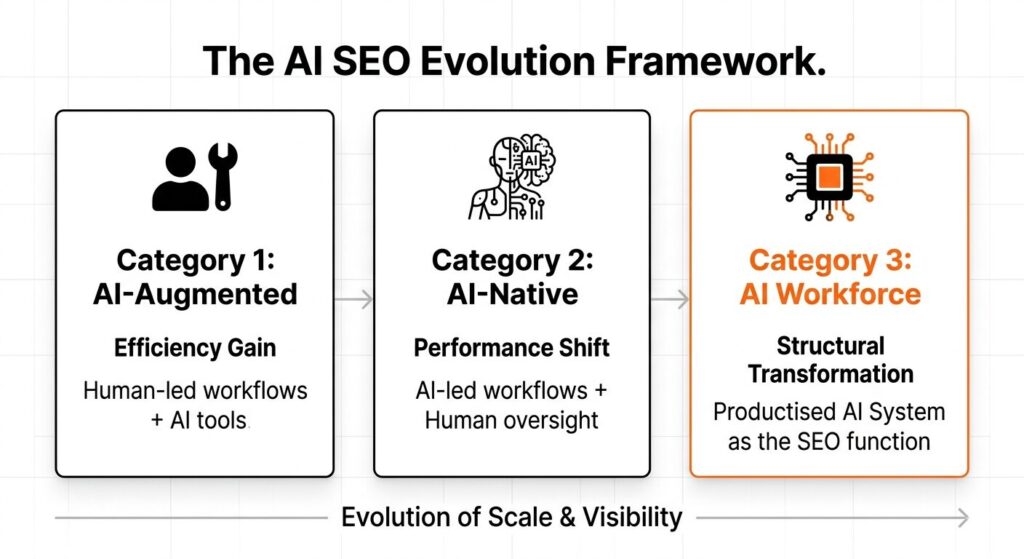
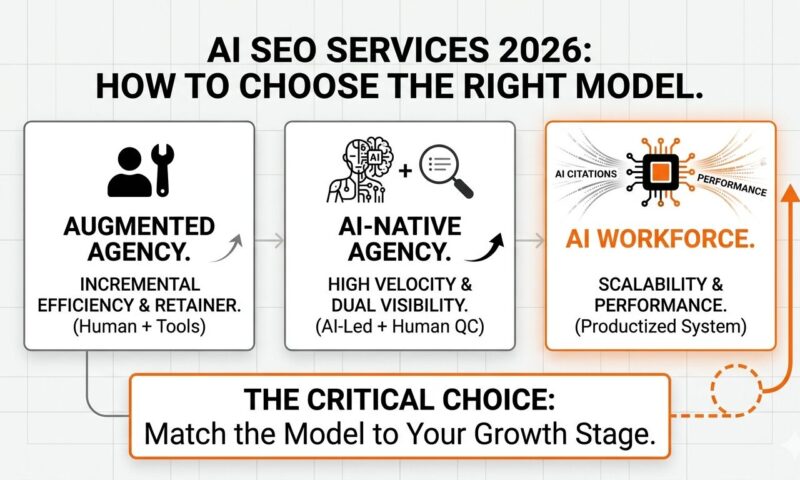
The most important thing to understand before evaluating any ai seo company is which of the three delivery categories they belong to. Category determines content velocity, AI search visibility capability, the depth of human oversight, and the structural model under which you will be billed and held accountable.
Category 1: AI-Augmented Traditional Agencies
These are established SEO agencies that have integrated AI tools into existing human-led delivery workflows. They use platforms like Surfer SEO for content scoring, Semrush AI for keyword research, and AI writing assistants to accelerate first-draft production. Strategic decisions, editorial quality control, and client communication remain human-led throughout.
This is the most common type of ai seo agency in 2026. The efficiency gains over traditional SEO are real but incremental: faster research, higher content velocity, more consistent on-page optimisation.
The retainer model and reporting structure are essentially unchanged from pre-AI agencies. AI search visibility work is inconsistent or absent. Pricing tends to reflect the retained human team overhead.
Who it suits: companies with established SEO programmes that want efficiency improvements without changing their agency relationship model. AI seo consulting at this level is appropriate when you need experienced strategists managing a programme rather than a system executing one at scale.
Category 2: AI-Native SEO Agencies
These agencies were built around AI workflows from inception. AI handles research aggregation, content structuring, competitor gap analysis, and first-pass drafting. Human strategists and editors provide direction, quality review, and the experience signals that AI systems cannot generate on their own. The result is significantly higher content velocity and broader keyword coverage than Category 1, at a comparable or lower cost.
Category 2 ai seo companies typically offer more sophisticated ai search optimization as a deliverable, because their systems were designed to track and optimise for AI Overview citations alongside traditional rankings. They tend to be more transparent about their AI-assisted production process and more specific about what GEO and AEO optimisation involves in practice.
Who it suits: growth-stage companies needing higher content velocity, broader topical authority coverage, and AI search visibility as a measurable deliverable rather than a marketing claim.
One useful test when evaluating Category 2 providers: ask for a sample report from an active client account. Category 2 providers with genuine AI-native infrastructure will show you reporting dashboards that include both traditional rankings and AI citation metrics side by side. Those without it will show you a standard organic traffic report with an AI SEO section added to the cover page.
Category 3: AI SEO Workforce Solutions
This is the most evolved category of ai powered seo services, and one that most agency roundups have not yet captured. Rather than a human team using AI tools, Category 3 deploys a productised AI system that operates as the client’s SEO function. Continuous content production, technical monitoring, performance reporting, and AI visibility optimisation run as a system rather than a staffed retainer.
When we designed the AI SEO Workforce at Superteam AI, the core principle was that the AI system should handle every repeatable SEO task (keyword research, brief creation, content production, internal linking, schema implementation, performance tracking) while a quality and strategy layer ensures outputs meet the signal thresholds that determine both traditional rankings and AI search citations.
The distinction from Category 2 is structural, not just operational. Category 3 is a deployed system rather than a staffed agency. The cost structure, production cadence, and scalability profile are fundamentally different from any retainer model.See how the AI SEO Workforce operates for client programmes →
Who it suits: companies that want the full output of an SEO team without the agency retainer overhead, and that need both traditional search performance and AI search visibility operating as consistent, measurable deliverables.
| Dimension | Category 1: AI-Augmented Agency | Category 2: AI-Native Agency | Category 3: AI Workforce |
| Who delivers the work | Human team using AI tools | AI system with human oversight | Productised AI system |
| Content velocity | Moderate | High | Very high |
| AI search visibility | Inconsistent | Standard deliverable | Core deliverable |
| Strategy layer | Strong | Moderate to strong | Built into system |
| Best for | Established programmes | Growth-stage companies | Scale-focused operations |
| Pricing model | Monthly retainer | Monthly retainer | Productised / fixed |
What AI SEO Services Actually Include: A Deliverables Breakdown
Regardless of category, the best ai seo services in 2026 cover five core deliverable areas. Here is what each includes in practice, and what to assess when evaluating whether a provider is genuinely delivering on each.
Keyword Research and Opportunity Mapping
AI-native keyword research differs materially from traditional spreadsheet-based research. It covers semantic clustering across intent variants, identification of AI Overview citation opportunities (which require different content structures than traditional ranking targets), and gap analysis against competitor topical coverage. The output should not be a keyword list; it should be a mapped content architecture connecting target queries to your buyer journey and to both traditional and AI search surfaces.
The practical test: ask your provider how they separate keywords that are best served by traditional ranking from those where the primary search demand is now captured by AI-generated answers. A provider with genuine keyword research capability will give you a specific answer. One without it will describe the same keyword research process they were running in 2023.
Content Strategy and Production
AI seo services delivered at Category 2 and 3 quality include full content production, not just briefs. Keyword research informs the content architecture; briefs specify structure, E-E-A-T requirements, and keyword targets; production delivers fully written content; and a quality signal review checks for experience markers, specificity, and editorial voice before publication. What separates quality ai seo optimization from volume-first content production is whether that quality review is enforced before publication, not as an afterthought during a quarterly audit.
Technical SEO Monitoring and Implementation
Technical SEO under an ai driven seo service covers automated crawl analysis, Core Web Vitals tracking, schema markup implementation, internal linking optimisation, and structured data recommendations. For AI search visibility specifically, schema implementation becomes more critical. Article, FAQ, and Speakable schema all increase the probability of content being cited in AI-generated answers, a technical deliverable most Category 1 agencies do not include in their standard scope.
AI Search Visibility Optimisation (GEO and AEO)
This is the deliverable area that most clearly distinguishes genuine ai seo services from traditional agencies that have added “AI” to their positioning. Generative Engine Optimisation and Answer Engine Optimisation involve structuring content to earn citations in AI-generated search answers, not just rankings in the traditional blue-link results.
In our programme work, we consistently find that content structured for AI citation performs on both traditional and AI search surfaces simultaneously. The quality threshold for AI Overview citation is higher than for a position-five traditional ranking, which makes GEO and AEO work an effective forcing function for overall content quality improvement.
Reporting and Performance Measurement
Good reporting from an ai seo company in 2026 covers traditional performance metrics (rankings, organic traffic, conversions from organic) alongside AI visibility metrics: citation frequency in Google AI Overviews, brand mentions in AI-generated answers, and share-of-voice in AI search for target topics. Any provider reporting only on traditional rankings is not delivering full-spectrum AI SEO performance visibility.
The AI Search Visibility Dimension: What Most AI SEO Services Still Miss
The majority of providers calling themselves AI SEO services in 2026 still measure and optimise primarily for traditional search rankings. They have added AI tools to their workflow but have not extended their performance measurement or their content structuring practices to the AI search surfaces where a significant and growing share of information and commercial investigation queries are now resolved without a click.
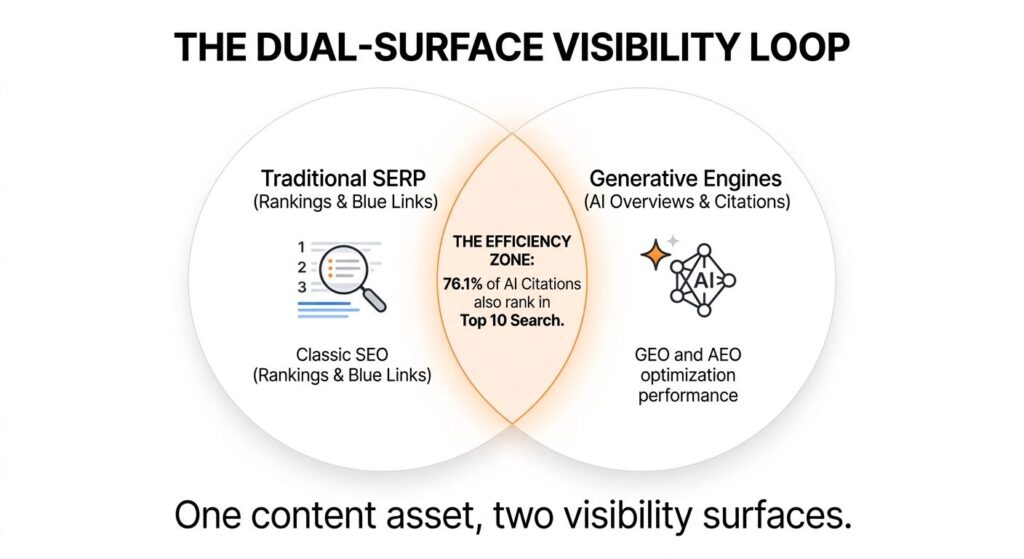
Definition: Generative Engine Optimisation (GEO): The practice of structuring content to earn citations in AI-generated search answers across Google AI Overviews, Perplexity, ChatGPT Search, and equivalent platforms. GEO works alongside traditional SEO rather than replacing it: 76.1% of URLs cited in AI Overviews also rank in the top 10 of traditional Google search results.
The practical implication for buyers: an ai seo service that does not include GEO and AEO as measured deliverables is selling a 2023 product in a 2026 search environment. As AI-generated answers account for an increasing share of search demand, content that ranks well traditionally but is never cited in AI answers is reaching a declining proportion of total search intent for that query.
The question to ask any provider is not just “how do you optimise for Google?” but “how do you measure and improve our AI search visibility, and which AI platforms do you track?” The answer to that question separates generative ai seo providers with genuine capability from those that have rebranded traditional SEO with AI in the title.
Providers with real GEO capability will name specific platforms they track (Google AI Overviews, Perplexity, ChatGPT Search, Gemini), describe how they structure content for citation eligibility, and show you what AI visibility reporting looks like in practice. Providers without it will tell you AI search optimisation is part of their “content quality process” without being able to show you a single citation metric from a client account.
How to Evaluate AI SEO Services: 5 Questions Every Buyer Should Ask
These are the five questions we work through before recommending any ai seo solutions engagement to a prospective client. They are designed to reveal the actual capability level behind the positioning: identifying which service category a provider genuinely belongs to, not just which one they claim.
1. What Is Your Process for AI Search Visibility, and How Do You Measure It?
A Category 1 provider will give a vague answer referencing featured snippets or voice search optimisation. A Category 2 or 3 provider will be specific: they will name the AI search platforms they track, describe how they structure content for citation eligibility, and show you the visibility metrics in their standard reporting.
2. How Do You Handle E-E-A-T Signals in AI-Produced Content?
Any provider using AI for content production should have a defined process for adding experience, expertise, and authority signals before publication. If the answer is “our AI produces high-quality content natively,” that is a claim, not a process. The answer should describe how first-person experience markers are incorporated, how specific claims are verified, and what editorial review looks like before a piece is published under the client’s brand.
3. What Does a Typical 90-Day Engagement Look Like, and What Will Be Live by Day 30?
The best ai seo services are specific about delivery timelines. Vague answers (“we will develop a strategy and begin production”) indicate an agency still building its process around each new client. A capable provider should describe what is live, what is in production, and what is being measured at the end of each of the first three months.
4. Which Category of Service Delivery Are You, and Why Is That Right for Our Stage?
Ask the provider to describe their delivery model: human-led with AI tools, AI-native with human oversight, or AI workforce. Then ask why that model suits your content velocity requirements, budget, and growth stage. A provider who cannot answer this question clearly has not thought carefully about what they are actually selling, or what you actually need.
5. What Client Results From AI SEO Programmes Can You Share, and How Were They Measured?
Generalised testimonials and case study headlines do not count. Look for specific performance data: organic traffic growth measured over a defined timeframe, keyword ranking improvements for named target queries, and (for quality providers) AI search visibility data showing citation frequency before and after the engagement. The best ai seo company relationships are evidenced by numbers, not descriptions.
| Red Flags | Green Flags |
| “We use AI to create content at scale” (no quality process described) | Specific E-E-A-T integration process described before publication |
| No AI search visibility metrics in reporting | GEO and AEO visibility tracked alongside traditional rankings |
| Vague 90-day delivery timelines | Named deliverables for days 30, 60, and 90 |
| Cannot categorise their own delivery model | Clearly articulates which service category they belong to and why |
| Case studies without specific performance data | Specific, measurable outcomes attributed to the engagement |
| “Fully automated content production” as the primary selling point | Defined human quality review step in every production workflow |
What to Expect in the First 90 Days of an AI SEO Service Engagement
One of the clearest signals of an experienced ai seo agency is a specific, realistic 90-day delivery framework. Here is what a well-run engagement should produce.
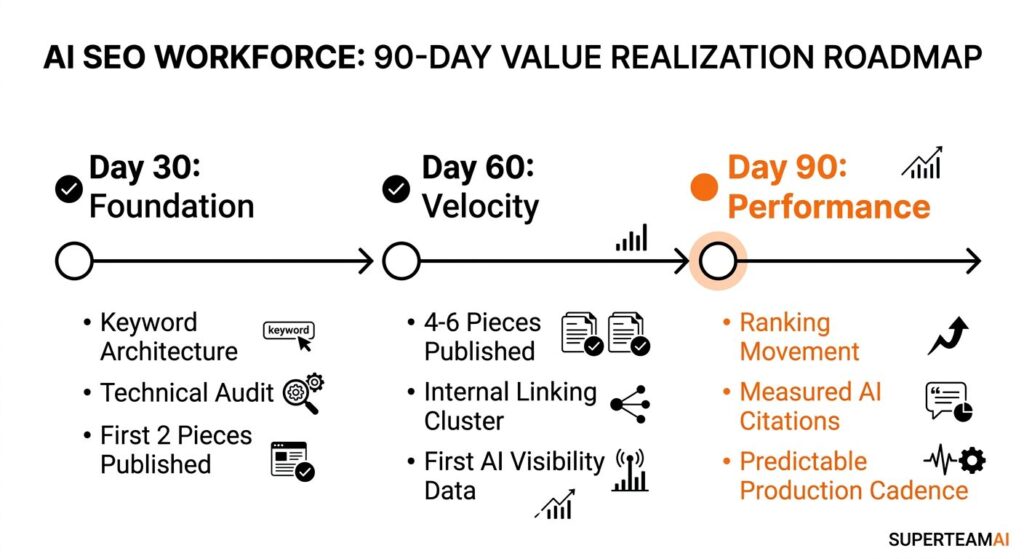
Days 1 to 30: Foundation and Architecture
The first month covers research, architecture, and technical foundations; publication at scale comes in months two and three. In our client onboarding process, the first 30 days follow a consistent architecture: keyword research and content architecture are complete, technical SEO audit findings are documented and prioritised, the first content briefs are drafted and approved, and at least two pieces are published with baseline performance measurements established. Any provider that has published nothing and produced only a strategy document by day 30 is running behind a responsible timeline.
Days 31 to 60: Production and Initial Performance Signals
Month two is production at pace. A minimum of four to six pieces should be published, internal linking across the content cluster should be in place, and schema implementation on early-published content should be complete. The first AI search visibility data should be appearing in reports, not necessarily showing strong citation numbers yet, but tracking which pieces are being indexed and surfacing in AI-generated answers.
This is also the stage where quality signal gaps become visible. If early-published content is not earning any AI Overview appearances, the issue is almost always in the content structure: insufficient definition blocks, weak FAQ schema, or a lack of the specific authoritative statements that AI systems extract when building generated answers. A capable ai seo agency identifies and corrects these gaps before month three rather than waiting for a quarterly review.
Days 61 to 90: Optimisation and AI Visibility Tracking
By the end of month three, the engagement should show early ranking movement on target keywords, first measurable AI Overview citations on the best-performing published pieces, and a content production cadence that is visible and predictable. LLM seo services at this stage should be producing a monthly report that explicitly separates traditional rankings performance from AI visibility performance, with each measured independently.
AI SEO Services vs Hiring In-House: How to Make the Decision
The alternative to engaging ai seo services is building in-house SEO capability: hiring an SEO manager, a content team, or a combination of both. The right answer depends on three variables: required content velocity, budget, and how quickly AI search visibility capability needs to be operational.
| Dimension | AI SEO Services | In-House SEO Team |
| Time to first published content | 2–4 weeks | 2–4 months (hiring and onboarding) |
| Cost at equivalent output volume | Lower | Higher (salaries, tools, management overhead) |
| AI search visibility capability | Immediate (Category 2 or 3) | Requires specialist hire or significant training |
| Content velocity | High to very high | Limited by team size |
| Scalability | High | Low (constrained by headcount) |
| Direct control over brand voice | Lower | Higher |
Automated seo services or a deployed AI workforce solution make more sense than in-house when speed to output, AI search visibility capability, and cost efficiency at scale are the priorities. In-house makes more sense when direct control over brand voice, content strategy decisions, and institutional knowledge retention outweighs those factors.
For most growth-stage companies, the three-to-four-month hiring and onboarding cycle for an equivalent in-house capability makes external ai seo solutions the faster and more capital-efficient path to organic growth. The exception is companies for whom content strategy is a core competency and where the long-term value of retained institutional knowledge outweighs the speed and scalability advantages of an external service. Both models can work; the decision should be made on programme requirements, not on which option sounds more modern.
Frequently Asked Questions
What is the difference between AI SEO services and traditional SEO services?
AI SEO services use artificial intelligence to research, produce, optimise, and measure SEO performance at a speed and scale that human-only teams cannot match at the same cost. The core difference in 2026 is twofold: AI-powered production enables higher content velocity at lower per-piece cost, and the best ai seo services include AI search visibility (GEO and AEO) as a measured performance dimension alongside traditional rankings and traffic. Traditional SEO services typically optimise only for Google rankings and do not track performance in AI-generated search answers.
How much do AI SEO services cost?
Pricing varies significantly by service category and programme scope. AI-augmented traditional agencies (Category 1) typically charge between £2,000 and £6,000 per month on retainer. AI-native agencies (Category 2) range from £1,500 to £5,000 per month depending on content volume and scope.
Productised AI workforce solutions (Category 3) are priced per programme scope rather than hourly retainer. Any provider quoting less than £1,000 per month for a comprehensive ai seo service is almost certainly delivering tool-augmented content production with minimal strategic or quality oversight.
Can AI SEO services help with Google AI Overviews?
Yes, but only if the provider includes GEO and AEO optimisation in their service scope, and not all do. Providers that genuinely optimise for AI Overview citations structure content with clean definition blocks, FAQ schema, extractable lists, and specific authoritative statements. They also measure citation frequency as part of their regular reporting. Ask any prospective provider whether they track your brand’s visibility in AI-generated answers before committing to an engagement.
How long does it take for AI SEO services to show results?
Initial ranking movements typically appear within 60 to 90 days for lower-competition target keywords. For competitive terms, three to six months is a realistic expectation for measurable organic traffic improvement. AI search visibility citations can appear faster; well-structured content on established topics can earn AI Overview citations within 30 to 60 days of publication. Any ai seo solutions provider promising significant results within the first month is overstating realistic timelines for any honest engagement.
What should I look for when comparing AI SEO service providers?
Focus on three things: category clarity (can they clearly describe their delivery model?), AI search visibility capability (do they measure and optimise for GEO and AEO?), and process transparency (can they describe their E-E-A-T signal integration and quality review steps?). Avoid providers that lead with volume claims without explaining how quality signals are maintained at that velocity. The five evaluation questions in this guide provide a reliable framework for comparing generative ai seo providers across all three categories.
Is an AI SEO service better than hiring an in-house SEO team?
It depends on your priorities. AI seo services deliver faster time-to-output, broader capability including AI search visibility, and more cost efficiency at scale than an equivalent in-house hire. In-house gives you more direct control over brand voice and content strategy. For companies that need content velocity and AI search visibility operational quickly (without the three-to-four-month hiring cycle), ai powered seo services are typically the faster and more capital-efficient path.
AI SEO services are not a uniform category. They range from traditional agencies with AI tools added to fully productised AI systems that operate as a client’s entire SEO function. The distance between those two ends of the spectrum is larger than any agency comparison roundup will tell you. Understanding which category of ai seo services matches your growth stage is the decision that determines whether the investment performs.
Three things worth keeping from this guide: the service category determines your outcomes more than the provider’s brand name; AI search visibility is a core deliverable dimension in 2026, not an optional add-on to negotiate at renewal; and a realistic 90-day expectation framework will protect you from the overpromising that is still endemic in this space.If you are ready to move beyond the traditional agency retainer and deploy a full AI SEO team built to perform on both traditional search and AI search surfaces from the first piece of published content, our AI SEO Workforce is built for exactly that.