56% of marketers are already using generative AI in their SEO workflows. Most of them are disappointed with the results.
Not because AI SEO does not work. Because they are using AI tools the way they used software tools a decade ago: one function at a time, disconnected from each other, with a human manually stitching everything together.
That is not AI SEO. That is manual SEO with an AI spell-checker.
In building our SEO Workforce and deploying it across 50+ businesses, we have seen every version of this mistake. Teams adding six different tools to an already broken workflow and calling it a strategy. Growth leads running AI-generated drafts through three rounds of manual editing and wondering why they are not saving any time.
This guide covers what AI SEO actually means in 2026, the three stages of its evolution, the real difference between tools and agents and workforces, and the framework for building a system that compounds instead of just running faster on the same treadmill.
The answer is not more tools. It is a better system.
What Is AI SEO? (The Definition That Actually Matters in 2026)
AI SEO Definition: AI SEO is the practice of using artificial intelligence systems to execute, optimise, and scale search engine optimisation workflows, while simultaneously structuring content so that AI-powered search engines and large language models can retrieve, understand, and cite it.
That definition contains two distinct problems that most businesses treat as one.
Problem 1: Using AI to execute SEO work. This means deploying AI systems to handle keyword research, SERP analysis, content briefing, writing, editing, technical audits, meta optimisation, and internal linking. The goal is speed, scale, and cost reduction.
Problem 2: Optimising content for AI-powered search. This means structuring your content so that Google’s AI Overviews, ChatGPT, Perplexity, and other AI-powered discovery systems find, trust, and cite your content in their generated answers. The goal is AI visibility and citation.
In 2026, these two problems have converged. The same structural principles that help AI agents execute better SEO also make content more citable by AI search systems. Clear definitions, logical structure, evidence-backed claims, and question-answer formatting serve both audiences simultaneously.
Most AI for SEO content online focuses on one or the other. The businesses getting the best results are treating both as a single integrated strategy.
The Two Meanings of AI SEO: And Why Both Matter
When a founder searches “seo ai,” they are usually asking one of two questions. Either “how can I use AI to improve my SEO performance?” or “how do I rank in AI-generated search results?”
The honest answer is that these are the same question. If your content is executed well enough to rank in traditional search, it is also structured well enough to get cited in AI Overviews. The underlying requirements, original expertise, clear structure, factual accuracy, and genuine depth, are identical.
How It Differs From Traditional SEO
Traditional SEO relies on humans executing every workflow step: pulling keyword data, writing from scratch, editing for optimisation, checking technical elements one by one. AI enters as a tool to do some of those tasks faster.
The shift that defines how ai and seo work together at scale is not speed. It is operating model. The question changes from “how do we do this faster” to “how do we build a system that executes continuously, at quality, without the human being the bottleneck at every step.” That shift leads to a completely different answer.
How AI Changed SEO: The Three Stages Every Business Needs to Understand
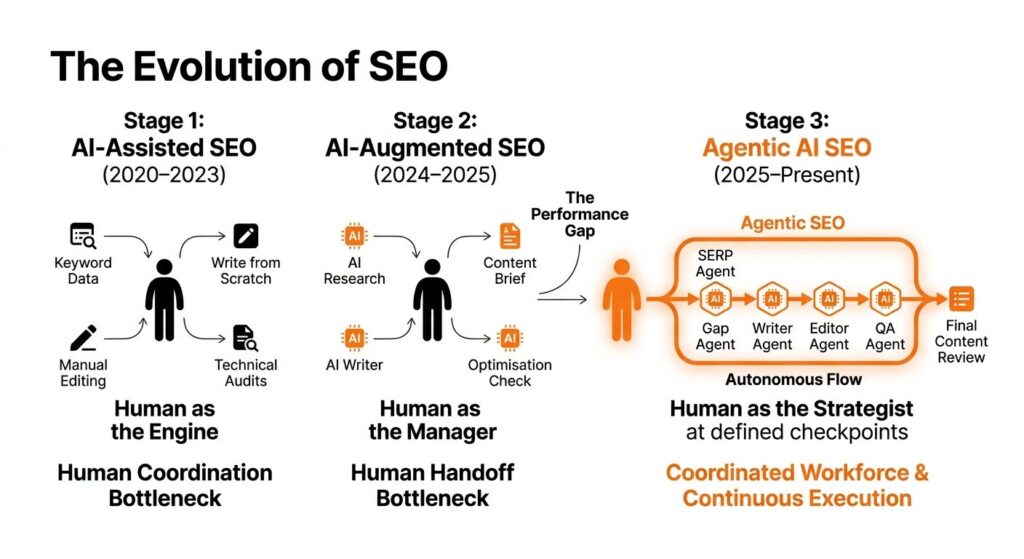
Understanding where AI SEO came from is the fastest way to understand where most businesses are stuck and where the performance gap is opening up.
Stage 1: AI-Assisted SEO (2020–2023): Tools That Help Humans Work Faster
This is where the mainstream story begins. ChatGPT writes a draft. Surfer SEO scores it for keyword density. Jasper fills in the gaps. Ahrefs pulls the data. A human coordinates the whole thing.
AI in this stage is a junior assistant. It handles individual tasks faster. The human still sets the strategy, manages the workflow, and reviews every output. The constraint is still human capacity, and the quality ceiling is still determined by human judgment, because every AI output goes through a human review that introduces as much inconsistency as it removes.
Stage 2: AI-Augmented SEO (2024–2025): Workflows That Blend Human and Machine
Integrated pipelines emerge. A single prompt triggers research, which feeds a brief, which feeds a writing tool, which feeds a basic optimisation check. The human is still managing the workflow, but the number of manual handoffs has dropped.
This is where the majority of businesses sit in 2026. The output volume is higher. The cost savings are real but modest. The fundamental constraint, human oversight at every step, has not changed.
Stage 3: Agentic AI SEO (2025–Present): Systems That Execute the Entire Workflow
This is the stage where the performance gap becomes decisive, and where the agentic orchestration model changes everything.
A coordinated system of specialised AI agents executes the complete SEO lifecycle. One agent handles SERP research. Another runs gap analysis. A brief agent synthesises findings. Writer agents produce the content. An editor agent refines it. A QA agent validates against brand standards and technical requirements. A meta agent creates the final on-page elements.
The human does not manage each step. The human approves at two or three strategic checkpoints: the brief and the final content. Everything between those checkpoints runs autonomously.
The analogy that best captures this stage: the difference between hiring a freelance writer and managing them yourself versus deploying an in-house content department with a managing editor, writer team, QA process, and publishing workflow. One requires your constant attention. The other requires your strategic input at defined moments.
This is what agentic SEO looks like when it is built properly. It is also what almost none of the AI for SEO tools on the market today have actually built.
What an AI SEO System Actually Covers (The Full Workflow)
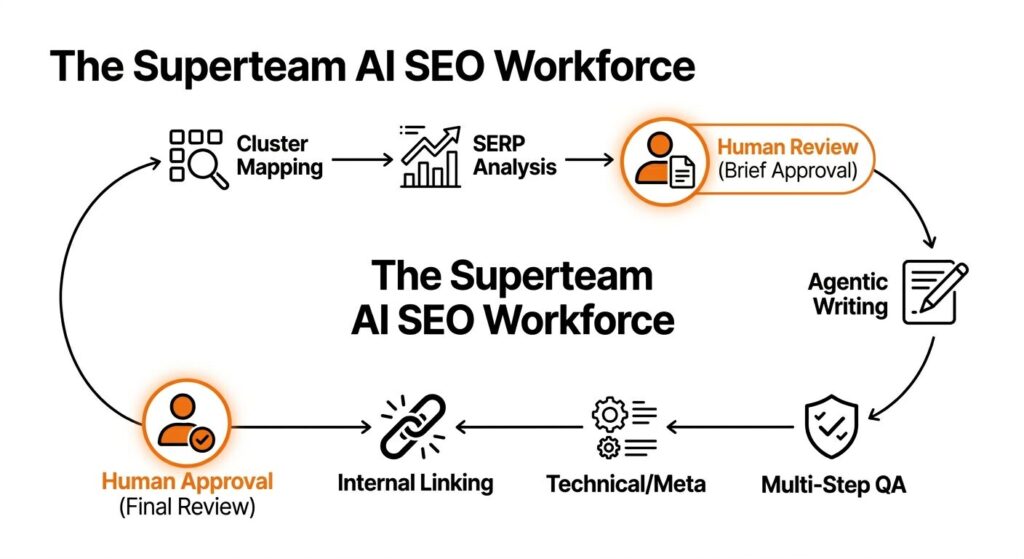
Most content on AI for SEO lists individual tasks. That framing misses the point. What separates a coordinated SEO system from a tool stack is that the tasks are connected. Output from one agent feeds the next. Quality gates exist between stages. The workflow completes without a human in the middle of every handoff.
Here is what the complete workflow looks like at the agent level.
Keyword Research and Cluster Mapping
The research agent identifies target keywords, maps semantic clusters, and prioritises by search intent and competitive opportunity. This is not a keyword suggestion tool. It is a full cluster architecture that determines what content to create, in what order, and for what purpose, all before a single word is written.
SERP Analysis and Competitive Intelligence
A dedicated SERP research agent collects the top 10 ranking pages for each target keyword and runs a 14-point gap analysis. What subtopics do they cover? What do they miss? What data do they cite? What questions do they leave unanswered? This analysis becomes the foundation for every content brief.
Content Brief Generation
A brief-generation agent synthesises the keyword data, SERP analysis, citation research, and brand guidelines into a comprehensive, human-reviewable brief. This brief goes to the human for approval before any content is written. That is the first human-in-the-loop checkpoint, and it is non-negotiable in a responsible AI SEO workflow.
Content Creation and Optimisation
Specialised writer agents produce the full draft from the approved brief. An editor agent reviews for clarity, brand voice consistency, and flow. A QA agent validates keyword integration, readability, and technical SEO elements. The content does not move forward until it passes the quality threshold.
Technical SEO and On-Page Elements
A meta details agent produces the optimised title tag, meta description, URL slug, and schema markup recommendations. An interlinking agent identifies internal linking opportunities across the existing content library, without a human having to manually cross-reference every published article.
Human Checkpoints: Where the Human Still Belongs
A properly built AI SEO system has two non-negotiable human checkpoints: brief approval and final content review. These are not bottlenecks. They are quality gates that ensure the AI is executing the right strategy, not just executing efficiently.
We learned early at Superteam AI that fully automated SEO without these checkpoints produced content that was technically optimised but strategically misaligned. The brief checkpoint is where strategy gets validated. The final review is where brand nuance gets applied. Everything between those two points runs autonomously without sacrificing the judgment that makes the content worth publishing.
AI SEO Tools vs. AI SEO Agents vs. AI SEO Workforces: What Is the Actual Difference?
This is the question nobody in the AI for SEO space is answering clearly, because most content is written by tool companies with a financial interest in blurring these categories. Here is the honest breakdown.
| AI SEO Tools | AI SEO Agent | AI SEO Workforce | |
| What it is | Single-function software (keyword tool, writing assistant, technical audit) | One AI model executing a defined task end-to-end | 15+ coordinated agents executing the complete SEO lifecycle |
| Human involvement | High: human directs every step | Medium: agent acts, human reviews output | Low: human approves at 2 strategic checkpoints |
| Personalisation | Basic prompt or template customisation | Task-level customisation | Deep business memory, brand guidelines, ICP knowledge |
| Output quality | Variable, dependent on prompt quality and human editing | Consistent within its defined scope | Consistent and improving over time as the system learns |
| Cost model | Per seat or per feature | Per task or per output | Monthly subscription covering full workflow |
| Best for | Augmenting individual manual tasks | Automating one specific workflow | Replacing a full SEO team’s execution layer |
| Example | Surfer SEO, seo.ai, Clearscope | Single-pipeline content tools | Superteam AI SEO Workforce |
Why Most “AI SEO Agent” Tools Are Not Actually Agents
The term “ai seo agent” is being used loosely in 2026. Many tools marketing themselves as agents are, in practice, single-step automations. You input a keyword, the tool runs one model call, you get an output. That is not an agent. That is a prompt wrapper with a user interface.
Genuine ai-powered seo agents execute multi-step workflows autonomously, making decisions between steps without human input. Research, analysis, production, validation, and handoff all happen without the user clicking “next” at each stage. The distinguishing feature of real ai-powered seo agents is autonomous decision-making between workflow steps, not just automation of a single step.
What Makes a Multi-Agent SEO Workforce Different
In Superteam AI’s SEO Workforce, 18+ specialised agents operate as a coordinated team. A manager model orchestrates the workflow, assigns tasks to the right agents, and manages quality gates between stages. Each agent is fine-tuned for one function: SERP research, gap analysis, brief generation, writing, editing, QA, meta optimisation, internal linking.
Each function performs at a higher quality than any generalist model could achieve, because each agent was trained specifically for that task on real data from 100+ company implementations. Brand knowledge, target audience, competitive positioning, and content strategy flow through the entire workflow without a human having to re-enter context at every stage.
That is the difference between a tool, an agent, and a workforce. Each is a different operating model, not just a different price point.
The Business Case for AI SEO: Cost, Speed, and Output Compared
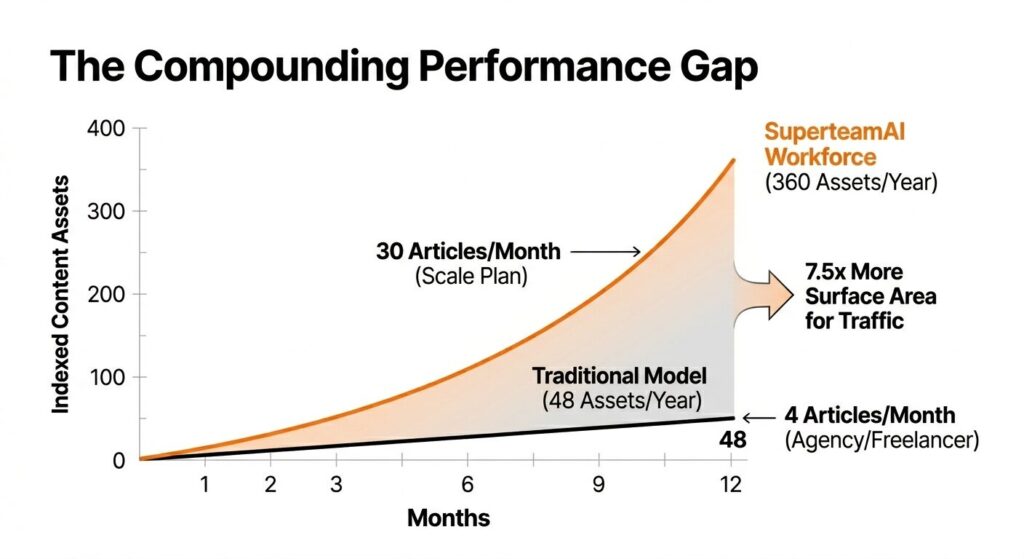
The businesses that have moved from AI tools to coordinated systems are seeing a fundamentally different outcome. Across 50+ companies we have deployed agentic SEO for, the pattern is consistent: 3x the content output, 77% reduction in per-article cost, and production cycles running 300% faster than equivalent human teams.
The financial comparison is direct.
| Comparison | Traditional Cost | AI SEO Workforce (Scale Plan) | Annual Saving |
| vs. In-house SEO + content writer | $36,000–$60,000/year | $4,788/year | $31,000–$55,000 |
| vs. Agency retainer ($3K–$8K/month) | $36,000–$96,000/year | $4,788/year | Up to $91,000 |
| vs. Freelance writer at $2/word (1,500-word article) | $3,000 per article | Included in subscription | Effectively $0 per article at scale |
| Articles produced per month | 3 – 10 (agency/freelance standard) | 30 (Scale Plan) | 6x–10x output increase |
If your current SEO spend sits above $500 per month for fewer than 10 published articles, the numbers above are worth a serious look.
Why AI SEO Produces Compounding Returns
SEO is the only growth channel where the assets you build today keep generating returns for years without additional spend. A well-optimised article published today will drive organic traffic in month 9, month 18, and month 36 without another dollar spent on it.
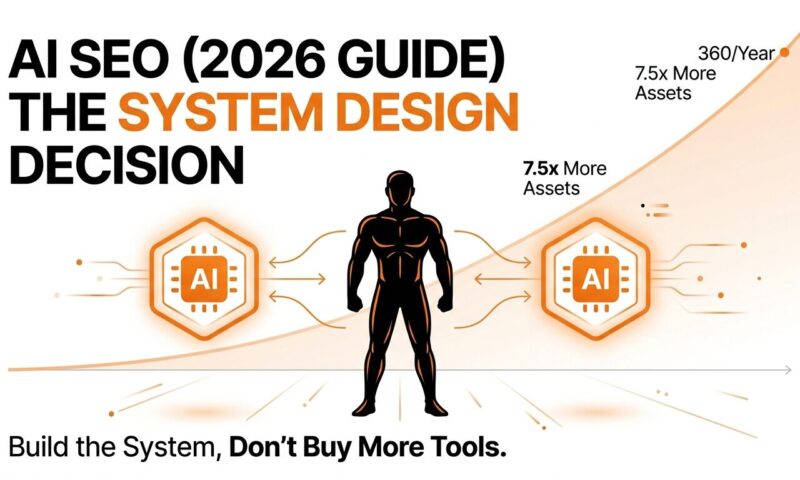
At 30 articles per month, the compound effect is significant. By month 12, a business running at that velocity has over 360 pieces of indexed, optimised content building topical authority, attracting backlinks, and pulling in search traffic. A business producing 4 articles per month has 48. The performance gap at month 24 is not linear. It is exponential.
The 60-2-3 Framework: The Standard Every AI SEO System Should Meet
At Superteam AI, every agent in our system must simultaneously meet three benchmarks: at least 60% reduction in workflow time, at least 2x return on investment through cost savings or revenue impact, and at least 3x the speed of equivalent human execution.
We did not develop these numbers as marketing language. We derived them from 100+ business implementations and found that any system missing any one of the three is delivering automation theatre: speed without quality, or cost savings without output. An agent that meets two out of three gets rebuilt or scrapped.
We recommend applying the same standard to any SEO investment you evaluate. If a tool or service cannot tell you its time savings percentage, its ROI impact, and its speed multiplier versus human baseline, it is a feature, not a system.
How to Build Your AI SEO Strategy in 2026: A Practical Framework
The difference between businesses that build effective systems and those that accumulate tool subscriptions without results comes down to one decision: starting with system design instead of tool selection.
Here is the five-step framework we use when helping businesses build their search operation from scratch.
Step 1: Audit Your Current SEO Operation
Before buying or changing anything, document the baseline. How many articles are you producing per month? What is the average time from brief to published? What is your cost per published piece? What is your current organic traffic trend?
These numbers define the benchmark against which any search automation investment gets measured. Without them, you cannot determine whether the system is working.
Step 2: Find the Highest-Impact Automation Points
Not all SEO tasks deliver equal automation value. In our experience, keyword research and brief generation offer the fastest ROI because they are time-intensive, highly structured tasks that AI executes well. Content production comes second. Technical SEO automation comes third.
Start with the step costing you the most human time per output. Automate that first, measure the result, then build outward.
Step 3: Choose the Right System for Your Stage
- Founders and early-stage teams producing 1–3 pieces per month: start with AI SEO tools for specific tasks. Get familiar with the workflow before introducing agents.
- Growing teams needing 5–15 pieces per month without hiring: an AI SEO agent covering research through content generation, replacing a junior writer and SEO coordinator.
- Scaling operations needing 20+ pieces per month, or agencies managing multiple clients: a full AI SEO workforce. This is where coordinated multi-agent execution with human checkpoints at the strategic level becomes the correct operating model.
Step 4: Build Human-in-the-Loop Checkpoints
Define two non-negotiable approval points before running any agentic workflow at scale. One at the brief stage (is the system researching and structuring the right content?) and one at the final review (does the output meet brand and quality standards?).
Everything between these two checkpoints runs autonomously. The brief checkpoint protects strategy. The final checkpoint protects brand. Both together give you AI speed without sacrificing the judgment that separates publishable content from filler.
Step 5: Measure What Actually Matters
The metrics that tell you your system is working are: month-over-month organic traffic growth, cost per ranking article (total search automation spend divided by articles in top 10 positions), content output volume, and downstream lead attribution from organic search.
Rankings are an outcome. These four inputs are what drive them. Review them monthly for the first six months. If organic traffic is growing, cost per piece is decreasing, and output is holding steady or increasing, the system is compounding correctly.
AI SEO and Optimising for AI Search: Two Problems, One Strategy
The second component of search optimisation, getting your content surfaced and cited by AI-powered search systems, has moved from an emerging priority to a core business requirement in 2026.
Google’s AI Overviews now appear at the top of results pages for a significant portion of informational queries. ChatGPT, Perplexity, and Gemini are where a growing share of B2B buyers begin their research. If your content is not being cited by these systems, you are invisible to a segment of your audience that grows every quarter.
Optimising for AI citation does not require a separate strategy. It requires the same fundamentals that strong search optimisation has always demanded, applied with more structural precision.
What Changes When AI Is Your Audience
AI systems extract information differently from human readers. They prioritise:
- Clear definitional statements that can be pulled as standalone answers
- Numbered lists and structured steps representing complete processes
- Comparison tables contrasting options on specific dimensions
- Question-and-answer formats that map directly to the search query
- Content positioned in the first 30% of the page (research shows 44.2% of LLM citations come from this section)
Articles over 2,900 words average 5.1 AI citations, compared to 3.2 for articles under 800 words. Content updated within the past 90 days averages 6 citations versus 3.6 for pages that have not been refreshed. Length and freshness are direct, measurable predictors of AI citation rate.
Structuring Your Content for AI Citation
Five structural techniques that improve AI citation rates directly:
- Open with a clear definition block. A 2–3 sentence definition of the core topic, formatted as a standalone paragraph, is the most commonly extracted element in Google AI Overviews. Put it in the first 300 words.
- Use FAQ sections with clean Q&A pairs. FAQPage schema marks your Q&A as structured data that AI systems can parse and extract directly. Every FAQ section should be schema-marked.
- Format processes as numbered steps. Sequential information in numbered lists is significantly more likely to be extracted than the same information in prose paragraphs.
- Include comparison tables with specific data. AI systems pull from tables when a query involves comparing options. Your table becomes the source for the AI’s generated comparison, bypassing competing pages.
- Write extractable section summaries. At the end of each major section, include a 1–2 sentence summary that stands alone as a complete answer. These become the citation candidates for queries matching that subsection’s topic.
AI Overview Optimisation Checklist:
- Definition block in the first 300 words
- FAQ section with FAQPage schema markup
- Numbered steps for every process described
- Comparison tables for every options discussion
- One-paragraph section summaries at the end of each H2
- Content freshness: updated or published within the last 90 days
Frequently Asked Questions About AI SEO
What is AI SEO?
AI SEO is the practice of using artificial intelligence to execute and optimise search engine optimisation workflows, while structuring content so that AI-powered search engines and large language models can retrieve and cite it. In 2026, these two goals, using AI to do SEO and optimising for AI search results, have merged into one priority. Businesses addressing both simultaneously produce content that ranks in traditional search and gets cited in AI-generated answers from systems like Google AI Overviews and Perplexity.
How is AI SEO different from regular SEO?
Traditional SEO relies on human execution at every step: pulling keyword data, writing content, editing for optimisation, checking technical elements. AI SEO automates the execution layer through coordinated agents, so the human focuses on strategy and approval rather than production. The fundamentals, including E-E-A-T, keyword targeting, content depth, and technical hygiene, do not change. What changes is the speed, scale, and cost structure of meeting those fundamentals consistently.
What is an AI SEO agent?
An ai seo agent is an AI system that executes a defined SEO workflow autonomously, making decisions between steps without human input. It differs from a tool in that it performs multi-step processes: researching, analysing, producing, validating, and handing off to the next stage without human triggering. Most tools marketed as “AI SEO agents” in 2026 are single-step automations. The distinguishing feature of a genuine agent is autonomous decision-making between each stage of the workflow.
How much does AI SEO cost?
Managed AI SEO services in 2026 range from $2,000 to $30,000 per month depending on scope and provider. AI SEO tool subscriptions run from $50 to $500 per month per seat. AI SEO workforce platforms, which automate the complete lifecycle, start at $79 per month (Superteam AI Pro Plan, 5 articles per month) and scale to $399 per month for 30 articles with full agent coordination. The comparison that matters most is not the subscription cost but the cost per published, ranking article, where AI-powered systems are typically 10x to 20x more cost-efficient than agency or freelance models at equivalent output volume.
Can AI SEO replace a human SEO team?
It replaces the execution layer: content research, brief creation, writing, editing, on-page optimisation, technical checks, and meta data. It does not replace strategic judgment, brand positioning decisions, or the creative direction that makes content genuinely original. The practical outcome is that an agentic system replaces 2–4 execution roles, including junior SEO, content writer, and editor, while freeing one strategic lead to focus on direction and measurement rather than production management.
How long does it take for AI SEO to show results?
Content ranking follows the same timeline regardless of AI or human production: 6–12 months for meaningful organic traffic from competitive keywords. What changes with agentic SEO is the volume of content entering that pipeline. At 30 articles per month versus 4–5, a business builds topical authority 6–10x faster. The ranking timeline per article does not shorten, but the aggregate traffic at month 12 is far larger because there are far more ranking assets compounding simultaneously.
What is the best AI SEO tool or platform in 2026?
The right choice depends on what you need the system to do. For optimising individual pieces when a human is still writing, tools like Surfer SEO and Clearscope are strong. For businesses needing a complete search operation at scale, covering coordinated research, brief generation, content production, QA, and technical optimisation, a workforce model replaces the full tool stack in a single subscription. Superteam AI’s AI SEO Workforce starts at $79 per month for 5 articles and scales to $399 per month for 30 articles across 10 users.
Build the System. Don’t Buy More Tools.
AI SEO in 2026 is not a tool purchase. It is a system design decision.
The businesses pulling ahead in organic search have built a coordinated workflow where AI executes the full lifecycle, humans approve at the right moments, and the output compounds month over month into a permanent traffic asset.
Three things this guide has established: businesses winning in search in 2026 solve both meanings of AI SEO simultaneously. There is a decisive difference between a tool, an agent, and a workforce. And at 30 articles per month versus 4, the compounding performance gap by month six is not marginal.
The system exists. The question is whether you build it yourself or deploy one already proven.
Start the Superteam AI Pro Plan at $79 per month to run your first 5 articles through the 18-agent workflow. Or book a demo to watch all 18 agents execute on a live keyword from your business. No agency rates. No long-term contract. Just the system.