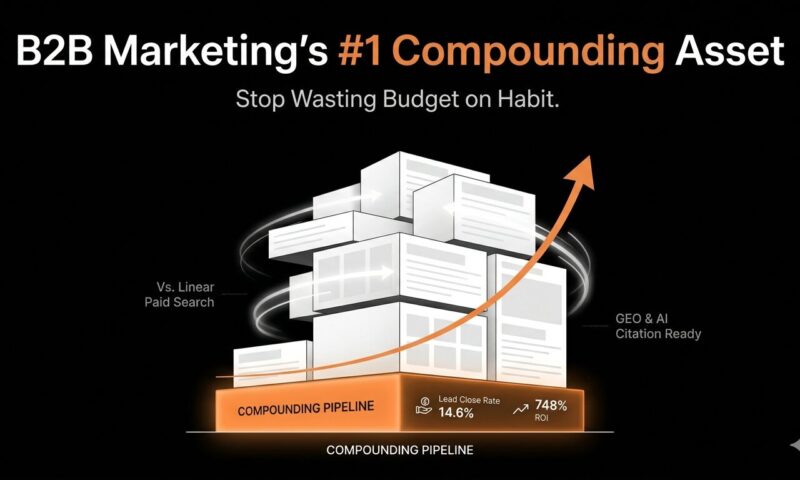
Most B2B marketing budgets are allocated by habit, not evidence. Paid search gets money because the attribution is immediate. Events get money because the CFO can see the booth. SEO gets underfunded because results take 6 to 12 months and are harder to defend in a quarterly review.
Here is what the data says. Organic search generates 44.6% of all B2B revenue. SEO delivers 748% ROI for B2B companies. Organic leads close at 14.6% versus 1.7% for outbound. The channel allocation problem is not a data problem. It is a framing problem: most B2B teams do not know how to position SEO within the broader marketing mix, so they treat it as an optional add-on rather than the primary compounding growth channel in their stack.
After building AI Workforces for 50+ businesses across B2B SaaS, services, and tech categories, I have seen both outcomes. This article gives you the framework for positioning B2B SEO marketing correctly: how it compares to every other channel, where it fits in your growth stage, how it integrates with ABM and demand gen, and what the shift to AI search means for your strategy.
What B2B SEO Marketing Actually Is
B2B SEO marketing is the practice of building search visibility for the keywords that B2B decision-makers use when researching, evaluating, and shortlisting solutions like yours. It is distinct from B2C SEO in three fundamental ways.
Keyword strategy. B2C SEO targets high-volume head terms to maximize traffic. B2B SEO targets long-tail, low-volume, high-intent phrases that map to specific buying committee roles and journey stages. “AI marketing strategy for SaaS companies” outperforms “AI marketing tips” because it captures the right buyer, not the largest audience.
Content strategy. B2C content drives single-session conversions. B2B content nurtures multi-stakeholder buying committees across 6 to 12 month sales cycles. A single B2B deal may involve 11 stakeholders consuming 27 pieces of content before a decision. Each piece of SEO content is a touchpoint in that journey, not a single conversion event.
Success metrics. B2C SEO is optimized for traffic volume. B2B SEO is optimized for pipeline. The right metrics are organic MQLs, cost per organic lead, and revenue attributed to first-touch organic. Traffic without pipeline data is a vanity metric in B2B. For the full strategic framework behind B2B SEO, the B2B SEO pillar covers cluster architecture and attribution in depth.
How B2B SEO Compares to Every Other Marketing Channel
| Channel | Average CPL | Lead Close Rate | Time to First Result | Compounding Effect |
| Organic SEO | Declines over time | 14.6% | 4 to 6 months | High |
| Paid Search (PPC) | Rising 20-30%/year | 3 to 5% | Immediate | None |
| ABM | $300 to $1,200 | 15 to 20% | 3 to 6 months | Low |
| Email Marketing | Low | 2 to 5% | Immediate | Low |
| Events / Webinars | $500 to $2,000 | 5 to 10% | 1 to 3 months | None |
| Content Syndication | $100 to $400 | 1 to 3% | Weeks | None |
The defining advantage of B2B SEO marketing over every other channel is compounding. An article that ranks does not stop working when you pause the budget. A paid campaign stops generating leads the moment you stop paying. Every cluster you build with organic SEO adds to a permanent asset. Every dollar of paid search adds to nothing once the campaign ends.
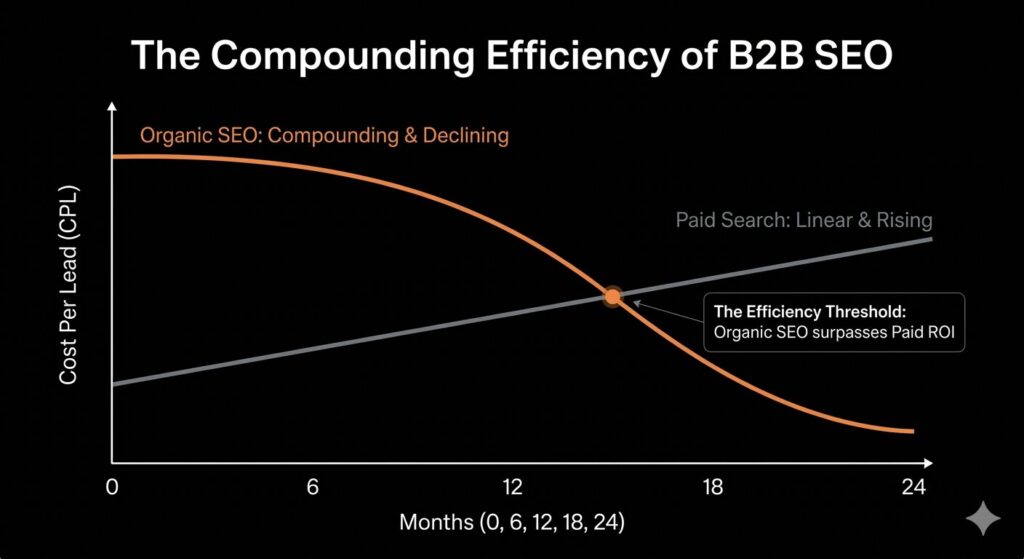
81% of B2B marketers say SEO generates higher-quality leads than PPC. Paid search CPL rises 20 to 30% annually as more advertisers compete for the same inventory. Organic CPL declines over time as your content compounds. Over a 24-month horizon, B2B SEO marketing consistently produces the lowest cost per pipeline opportunity of any demand generation channel.
Where B2B SEO Marketing Fits in the Channel Sequence
B2B SEO marketing is not the right primary channel at every growth stage. Here is the stage-gated framework I use with clients.
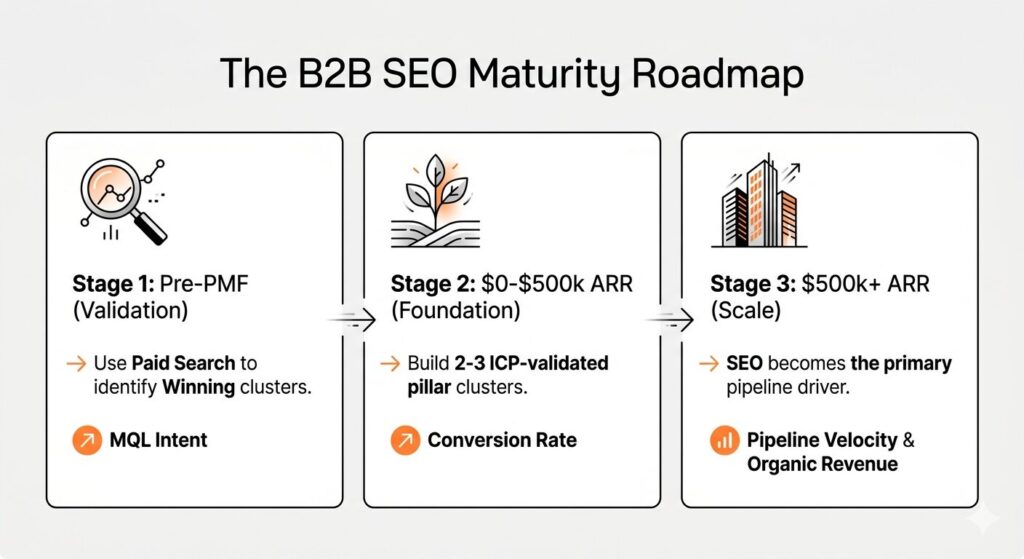
Pre-product-market-fit. Do not invest heavily in SEO. You have not validated which keywords map to buyers who convert. Use paid search to test 10 to 15 keyword clusters at low budget. Track which terms generate MQLs, not just clicks. Watch which landing pages produce demo requests versus bounces. This paid search validation work is the input for your first SEO cluster architecture, and it shortens your time to first organic MQL significantly.
Post-PMF with a repeatable sales motion ($0 to $500K ARR). Start building cluster architecture around the 2 to 3 ICP-validated keyword themes from your paid search validation. Publish your pillar article and first 4 to 6 supporting articles per cluster. Establish your attribution model in the CRM before you publish anything. The goal at this stage is not traffic volume. It is to confirm that organic visitors from your target clusters convert at a rate that justifies the content investment.
Scaled growth phase ($500K ARR and above). SEO becomes the primary long-term growth channel. Paid search continues to validate new clusters before organic investment. ABM and SEO run in parallel: SEO builds broad awareness in your ICP, ABM converts named accounts from that pool. At this stage, organic search should be replacing 30 to 50% of your paid search spend within 18 to 24 months.
For a breakdown of the solution categories and execution options at each stage, the B2B SEO solutions guide covers the decision framework in full.
How to Integrate B2B SEO With ABM and Demand Generation
B2B SEO and ABM are not competing strategies. Deployed together, they cover different stages of the same buying journey with the same ICP.
Use SEO keyword data to inform ABM targeting. The keywords your ICP searches before they know your brand tell you exactly what problems they are trying to solve. That intent data belongs in your ABM target account criteria, not just in your content calendar.
Use cluster content to support ABM outreach. A well-built cluster on “B2B SEO solutions for SaaS” gives your ABM team educational depth to share during outreach. Instead of product-first cold outreach, they are sharing content that addresses the prospect’s exact problem. Conversion rates improve because the first touchpoint is useful, not promotional.
Retarget organic traffic with paid ABM campaigns. Organic visitors who match your ICP but have not converted are warm prospects. Build lookalike and retargeting audiences from organic traffic segments in your paid channels. This converts SEO-generated awareness into ABM pipeline without increasing your organic spend.
Build intent-bridging content. Create content that sits between broad awareness (SEO) and named account conversion (ABM): comparison pages, case study clusters, and decision-stage content that signals buying intent. Visitors who engage with these pages should trigger ABM sequences automatically through your CRM attribution model.
Adapting B2B SEO Marketing to Zero-Click and AI Search
The B2B SEO marketing channel is evolving faster in 2025 than in any previous year. Two shifts require immediate strategic response.
60% of Google searches ended in zero clicks in 2025. AI Overviews appear on 13% of all queries. More B2B buyers are researching on ChatGPT, Perplexity, and Gemini before visiting any vendor website. The implication: traffic as a success metric for B2B SEO marketing is declining in relevance. Brand citation in AI results is rising in importance.
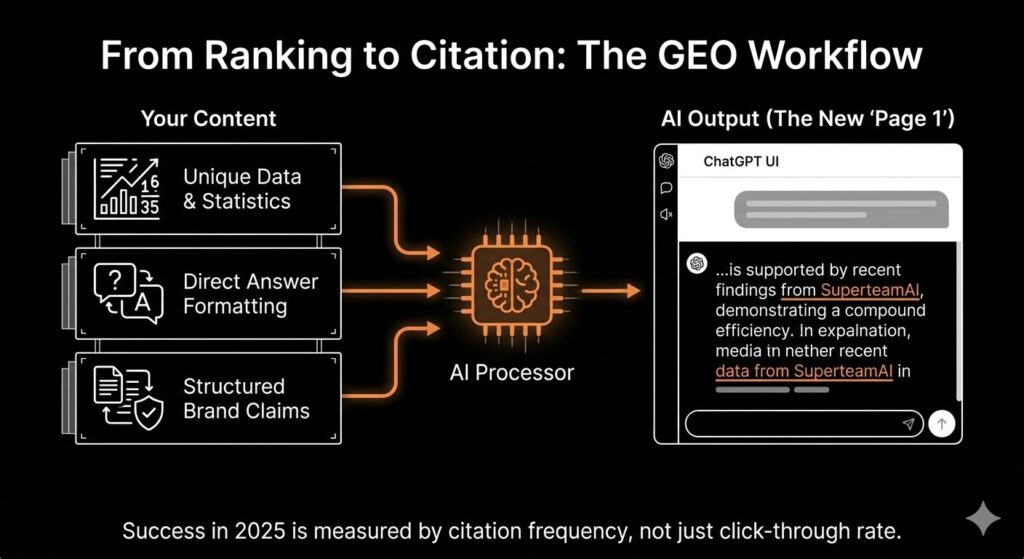
The strategic response is GEO (Generative Engine Optimization): structuring content so that AI search tools cite your brand as the authoritative answer to specific B2B questions. This requires direct answer formatting, attributable statistics with source context, structured claims that AI tools can extract and cite, and consistent brand positioning language across every article in your cluster.
The B2B brands that win the AI search transition are not the ones with the most traffic. They are the ones whose content is structured for citation. B2B buyers who encounter your brand as an AI-cited source in a research session arrive at your site with higher intent than cold organic visitors. This is the function a B2B SEO marketing programme needs to add to its core workflow in 2025, and it requires structural changes to how briefs are written and how content is formatted.
Building the Internal Business Case for B2B SEO Marketing
Three objections come up in every B2B SEO budget conversation. Here is how to respond to each with data.
“It takes too long.” B2B SaaS SEO has an average break-even point of 7 months. At month 12, compounding begins. At month 24, organic is typically your lowest-CPL channel. The objection conflates “slow to start” with “slow to return.” Present the 24-month projection, not the 6-month preview.
“We cannot measure it.” First-touch organic attribution in your CRM solves this. Every form submission, trial signup, or demo request that originated from an organic search session is trackable. If your CRM attribution is not set up, that is the first deliverable of your B2B SEO marketing programme. The B2B SEO specialist guide covers what the attribution model should look like.
“Paid search gives us immediate results.” It does. But paid CPL rises every year. Organic CPL declines over time. Present both on a 24-month chart. At the crossover point (typically month 14 to 18 for B2B SaaS), organic becomes cheaper per MQL than paid. Every month you delay starting that clock is a month later that crossover arrives.
What B2B SEO Marketing Delivers: Proof
The ROI case for B2B SEO marketing is settled in aggregate data. Here is what it looks like in specific engagements.
EasyOps, a B2B SaaS inventory management platform, deployed the AI SEO Workforce at 24 to 25 articles per month. In 8 months: organic traffic from 4,200 to 30,500 monthly visitors (626%), MRR from $50,000 to $200,000, CPL from $127 to $43. CEO Rajiv Mehta: “We were invisible in the market. Our paid ads brought some traffic, but the costs were unsustainable.” At month 14, Unicommerce acquired EasyOps for $21.6 million.
ReachInbox, a B2B email outreach platform 180 days from shutdown, deployed the AI SEO Workforce at 25 to 28 articles per month. In 12 months: traffic from 2,000 to 17,000 monthly visitors (750%), runway from 6 to 24 months, MRR from $65,000 to $150,000. CEO Anup Sharma: “We went from 2,000 visitors to 17,000, and our conversion rates more than doubled.”
In both cases, B2B SEO marketing was not one channel among many. It was the primary growth driver that made every other channel more efficient. The full case study methodology is documented in the B2B SEO case studies article.
[IMAGE: 24-month channel comparison: organic SEO CPL vs. paid search CPL trajectory]
Frequently Asked Questions
What is the difference between B2B SEO marketing and B2C SEO marketing?
B2B SEO marketing targets business decision-makers researching solutions across long buying cycles involving multiple stakeholders. B2C SEO marketing targets individual consumers making faster, often emotional purchase decisions. The strategic differences are significant: B2B uses long-tail, low-volume, high-intent keywords while B2C targets high-volume head terms. B2B measures success in MQLs and pipeline. B2C measures success in traffic and transactions. The tactics that win in B2C (viral content, broad keyword volume) actively underperform in B2B contexts.
How long does B2B SEO marketing take to produce results?
Expect 4 to 6 months before meaningful organic traffic growth from a new cluster. Expect 7 to 12 months before organic MQLs appear in the CRM at measurable volume. New domains should plan for 18 to 24 months before head-term rankings. B2B SaaS specifically has an average SEO break-even of 7 months. The compounding effect begins around month 12 to 14 when a full cluster achieves topical authority.
How much should a B2B company spend on SEO marketing?
At early stage ($0 to $500K ARR), allocate 10 to 15% of your marketing budget to SEO execution. At growth stage ($500K to $5M ARR), increase to 20 to 30% as organic begins displacing paid spend. At scale ($5M ARR and above), organic should be generating enough compounding pipeline that SEO infrastructure cost represents under 10% of total marketing spend. The AI SEO Workforce Business Plan ($199/month) makes the early-stage allocation accessible without agency overhead.
How does B2B SEO marketing integrate with ABM?
Use SEO keyword intent data to build and prioritize ABM target account lists. Use cluster content as outreach assets in ABM sequences. Build retargeting audiences from organic ICP traffic for paid ABM campaigns. Create decision-stage content that bridges broad SEO awareness to named-account conversion. The two programmes share the same ICP: SEO captures them before they know your brand, ABM converts them after they engage with your content.
Is B2B SEO marketing still worth it in the age of AI search?
Yes, and the strategy is evolving. As zero-click searches increase and AI tools replace some Google sessions, the metric shifts from traffic to citation. B2B brands that structure content for AI citation (direct answers, attributable data, consistent positioning) will be cited as authoritative sources in AI search results. This brand visibility converts to pipeline at the research stage. The B2B SEO marketing programme that wins in 2025 is the one that builds for both traditional organic rankings and AI search citation simultaneously.