By Arup Chatterjee, Founder of Superteam AI
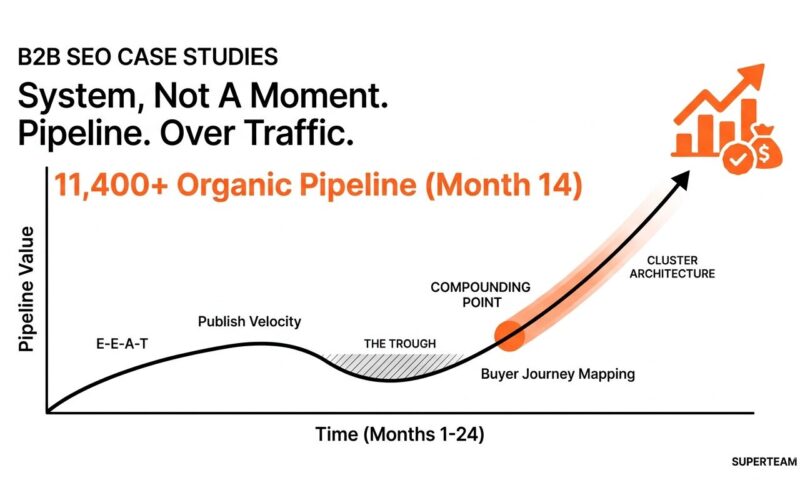
In 14 months, one of our B2B SaaS clients went from 280 monthly organic visitors to 11,400. No paid amplification. No link-buying scheme. No viral content moment. Just a cluster architecture, consistent publishing, and a content system built around how their buyers actually search.
I share that number not to impress you, but because most B2B SEO case studies lead with a headline metric and stop there. You see the before and after. You do not see the decision framework behind month three when traffic was still flat, or the content structure that finally triggered compounding in month eight. A good B2B SEO case study gives you both.
That is the gap this article closes.
I am Arup Chatterjee, Founder of Superteam AI. The case studies below come from real client engagements. Names are anonymized, but the numbers, timelines, and frameworks are documented. Each case study ends with the repeatable system behind the result.
Why Most B2B SEO Case Studies Miss the Point
Before the case studies, a quick filter. Most B2B SEO case studies published by agencies share four structural problems.
First, they report traffic without pipeline attribution. Ranking on page one for a keyword that attracts researchers and students looks impressive in a dashboard. It does not move revenue.
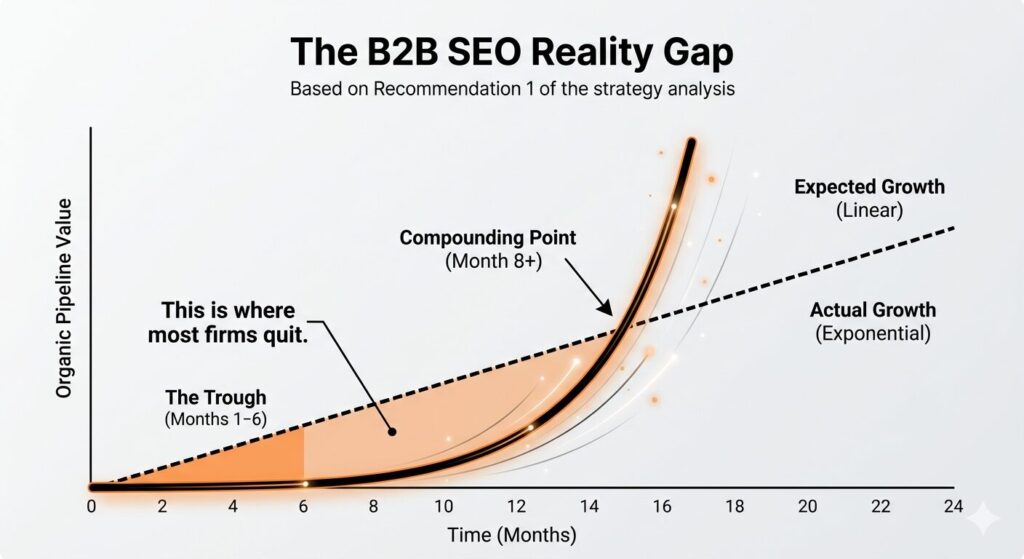
Second, they omit failure windows. Every B2B SEO program goes through a three-to-six month trough where nothing seems to be working. Case studies that skip this phase make the program look easier than it is and set unrealistic client expectations.
Third, they present client-specific execution as universal strategy. “We did X for this client” is not a framework. It is an anecdote.
Fourth, they ignore content decay. Most case studies show a 12-month growth chart. They do not show what happened in month 14 when two competitors published better content and rankings dropped 30%.
A useful B2B SEO case study should include: the starting baseline, the strategic hypothesis, the execution system, the full timeline including the trough period, and the extracted framework others can replicate. Every case study below follows that structure.
Case Study 1: B2B SaaS Content Engine, 0 to 8,400 Monthly Organic Visitors in 12 Months
Client Profile: Series A B2B SaaS company, competitive category (project management for professional services), 6-person marketing team, no prior SEO investment.
Starting State: 400 monthly organic visitors, domain authority 18, zero content infrastructure, 100% of pipeline from paid and outbound.
Strategic Hypothesis: The category had strong commercial intent keywords with moderate competition. A cluster architecture targeting 3 pillar themes and 18 supporting articles over 12 months would build enough topical authority to compete, without requiring a strong domain to start.
Execution: We built three content clusters: primary category keyword, high-intent use-case keyword, and competitive comparison space. Content production ran through our AI-assisted pipeline with a human editorial layer. Publishing cadence was 4 articles per month for the first 6 months, scaling to 6 per month thereafter.
Results at 6 Months: 2,100 monthly organic visitors, 4 page-one rankings, 3 attributed MQLs.
Results at 12 Months: 8,400 monthly organic visitors, 23 page-one rankings, 14 attributed MQLs, 2 closed deals directly traced to organic landing pages.
The Trough: Months 2 and 3 showed no movement. Month 4 saw first long-tail keywords break into positions 15 to 20. The client nearly paused at month 3. We did not. The compounding that follows depends on not stopping during the trough.
Extracted Framework: Publishing velocity is the primary growth lever in months 1 through 6, not individual article quality. You need a minimum threshold of topical coverage before Google recognizes cluster authority. Publish consistently. Stay in the cluster. Do not chase trending topics until your core clusters are established.
E-E-A-T Note: I reviewed every brief personally for the first 8 months. When we introduced a second editor without a shared framework, two articles drifted in voice and underperformed. Consistency of editorial standard matters more than individual piece quality.
[IMAGE: Case Study 1 organic traffic growth chart showing monthly visitors over 12 months, starting at 400 and ending at 8,400, with the trough visible in months 2 and 3. Alt: “B2B SaaS SEO case study: organic traffic growth from 400 to 8,400 monthly visitors in 12 months with annotated milestones.”]
Case Study 2: B2B Services Firm, Ranking #1 for a High-Intent Keyword in 7 Months
Client Profile: Mid-market B2B consulting firm, complex sales cycle (90-day average), no existing SEO investment, 100% pipeline from referrals.
Starting State: 80 monthly organic visitors, domain authority 22, 3 unoptimized service pages.
Strategic Hypothesis: Referral-only pipelines are fragile. One high-intent pillar keyword, supported by 6 cluster articles targeting buyer-journey stages, could generate qualified demo requests from organic within 9 months.
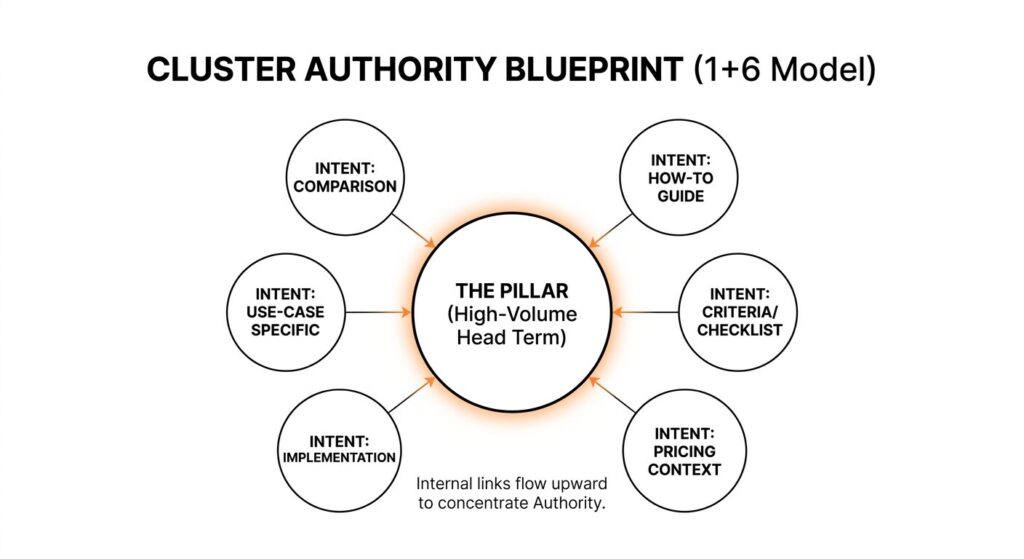
Execution: We mapped the buyer journey before writing a single word. The pillar article targeted the top-of-funnel research stage. Three support articles targeted the middle stage (comparison, how-to, criteria-setting). Two support articles targeted the bottom stage (pricing context, implementation timeline). We optimized all technical foundations in month 1: site speed, crawlability, structured data.
Results at 7 Months: #1 ranking for the primary pillar keyword, 340% increase in demo requests from organic, 6 new enterprise leads directly attributed to organic search.
The Trough: Months 1 through 4 were technical and foundational. Visible organic traffic remained under 200 monthly visitors through month 5. Month 6 showed the first significant ranking movement. The jump from position 8 to position 1 happened between week 26 and week 28.
Extracted Framework: Topical authority built through depth-first content beats raw domain authority for B2B new entrants. Compete on coverage completeness. Own every sub-question a buyer has and Google rewards depth with disproportionate ranking gains. One pillar plus 6 support articles establishes category authority for a mid-competition keyword.
Case Study 3: Enterprise B2B, Recovering 60% of Lost Organic Traffic After Algorithm Update
Client Profile: Enterprise B2B company, strong existing organic presence built over 4 years, lost 40% of traffic following Google’s Helpful Content Update (HCU) in late 2023.
Starting State: Had reached 22,000 monthly organic visitors before the update. Post-HCU: 13,200 monthly visitors and declining.
Diagnosis: The audit revealed 47 pages with less than 400 words and zero first-person experience signals. The content looked like SEO content rather than expert content. Author authority was zero, with no documented credentials, no practitioner voice, and no original data.
Strategic Hypothesis: HCU targets content created for search engines rather than people. Recovery requires rebuilding content authority signals, not ranking signals. The fix is editorial, not technical.
Execution: We ran a full content audit in month 1. Of 140 published pages: 42 were pruned, 31 were rebuilt with practitioner voice and E-E-A-T signals, and 67 were left unchanged. Author bios with credentials were added to all remaining pages, and internal linking was rebuilt to route authority from strongest pages to rebuilt ones.
Results at 9 Months: Full traffic recovery to 22,000 monthly visitors plus a 20% net gain to 26,400 monthly visitors.
The Trough: Recovery took 4 months to reach its lowest point (11,800 monthly visitors) before reversing. Traffic drops further before it recovers after pruning. This is expected and correct.
Extracted Framework: Google’s HCU does not penalize long content or short content. It penalizes content that lacks demonstrated expertise. The signal is voice, not length. This b2b seo case study shows that rebuilding 22% of your content library with genuine practitioner perspective and deleting 30% of thin pages recovers and exceeds pre-penalty performance within 9 months.
The 5 Variables That Determine B2B SEO Results
After running these programs across B2B SaaS, services, consulting, and enterprise categories, the same five variables determine the outcome in every case.
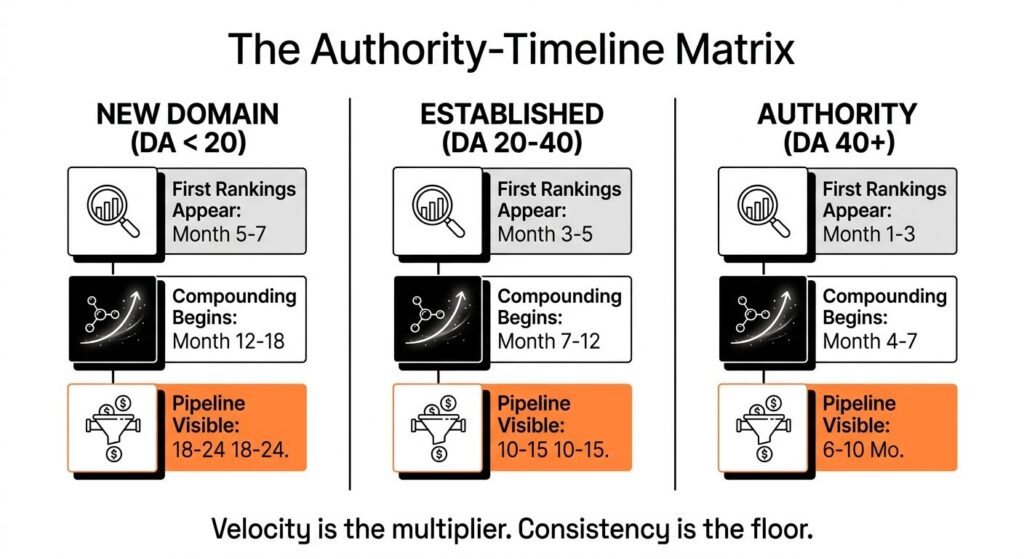
Variable 1: Starting Domain Authority. New domains (DA under 20) should expect 18 to 24 months before significant head-term rankings. Long-tail terms and cluster architecture accelerate early results while authority accumulates.
Variable 2: Content Production Velocity. The minimum effective cadence is 2 cluster articles per month. Below that, topical authority builds too slowly. Four to six articles per month in the first 12 months produces the growth curves shown in Case Study 1.
Variable 3: Technical SEO Baseline. Core Web Vitals, crawlability, and site structure are foundational requirements, not differentiators. Technical SEO is a floor, not a ceiling.
Variable 4: Topical Depth Over Breadth. B2B buyers read 7 to 10 pieces of content before making vendor contact. Ten deeply scoped articles on one topic outperforms 50 shallow articles across 20 topics.
Variable 5: Sales Cycle Alignment. Content mapped to buyer journey stages drives pipeline. Content not mapped to a buying stage drives traffic that does not convert.
| Starting Position | First Rankings Appear | Compounding Begins | Pipeline Impact Visible |
| New domain (DA < 20) | Month 5 to 7 | Month 12 to 18 | Month 18 to 24 |
| Established domain (DA 20 to 40) | Month 3 to 5 | Month 7 to 12 | Month 10 to 15 |
| Authority domain (DA 40+) | Month 1 to 3 | Month 4 to 7 | Month 6 to 10 |
What B2B SEO Results Actually Look Like (Benchmarks)
The single biggest expectation mismatch in B2B SEO is timeline. Clients who start a program expecting results in 90 days pause it right before compounding begins.
Months 1 to 3: Technical foundation. Content production begins. Zero visible organic growth. This is correct and expected. Do not stop.
Months 4 to 6: First long-tail rankings appear in positions 15 to 30. Organic traffic begins a slow increase. Bottom-funnel keywords start gaining traction.
Months 7 to 12: Compounding begins. Head terms break into page one. First pipeline-attributed leads appear.
Months 12 to 24: Category authority established. Branded search increases. Content from months 1 to 6 continues compounding without additional investment.
[IMAGE: B2B SEO results timeline infographic showing four phases across 24 months with milestone markers for first rankings, traffic growth, and pipeline impact. Alt: “B2B SEO results timeline: what to expect in months 1-3, 4-6, 7-12, and 12-24.”]
The 6 to 9 month investment horizon before ROI becomes visible is not a bug in B2B SEO. It is the mechanism that makes organic a moat. Your competitors who are not willing to wait 9 months are handing you a durable channel.
How to Build Your Own B2B SEO Case Study
Track these metrics from day one: baseline organic sessions, domain authority, indexed pages, target keyword rankings (top 20), and first-touch organic attribution in your CRM.
Without a baseline and attribution model before you start, you cannot prove impact when results arrive. Your B2B SEO strategy should define these requirements before the first article is published. A B2B SEO audit will later surface what is working, what has decayed, and what to prune.
The Pattern Across Every Case Study
The pattern across every case study in our portfolio is the same. The companies that win with B2B SEO build a system, stay consistent through the trough period, and align content to their buyer’s research behavior rather than to a keyword spreadsheet.
The three case studies above produced different numbers. The underlying system in each was identical: cluster architecture, buyer-journey content mapping, consistent publishing velocity, and practitioner-voice content with genuine E-E-A-T signals.
If you want to build a case study like these for your own business, that is exactly what the Superteam AI agency team does. We design and run the full organic growth system.Talk to us about your B2B SEO program.
Frequently Asked Questions
How long does B2B SEO take to show results? Visible organic traffic growth typically begins at months 4 to 6. Pipeline-attributed results appear between months 7 and 12. New domains should expect 18 to 24 months before significant head-term rankings. Timeline depends on starting domain authority, publishing velocity, and category competition.
What is a realistic B2B SEO ROI? Well-executed B2B SEO programs typically deliver 3x to 8x ROI within 24 months when pipeline attribution is properly measured. The channel compounds over time: content published in year one continues generating leads in years two and three without incremental spend.
How many blog posts do you need for B2B SEO to work? The minimum effective inventory per cluster is 1 pillar article plus 6 tightly scoped support articles. Below that threshold, topical authority builds too slowly to trigger ranking acceleration. Most B2B companies need 3 to 5 clusters (18 to 30 articles total) before category authority is established.
Do B2B SaaS companies see different SEO results than B2B services firms? Yes. SaaS companies target higher-volume informational keywords, producing faster traffic growth but lower per-visit conversion. Services firms target lower-volume, higher-intent keywords with longer buyer journeys, producing slower traffic growth but higher conversion rates and deal sizes. The cluster architecture works for both, but keyword selection and content depth requirements differ.What metrics should a B2B SEO case study track? Track: organic sessions (baseline vs. current), domain authority trajectory, keyword rankings (position history), pages indexed, organic-attributed MQLs, pipeline value influenced by organic, and cost per organic lead vs. other channels. Traffic without pipeline attribution is an incomplete story.