Here is something most B2B marketers discover too late: 70% of B2B buyers complete their research before speaking to a vendor. They are reading, comparing, and forming preferences on Google, and the companies ranking at the top of those searches are winning before the sales conversation even starts.
The problem is that most guides on B2B SEO were written for a search landscape that no longer exists. The rise of Google AI Overviews, Perplexity, voice search, and AI-powered content execution has fundamentally changed how B2B companies need to approach organic search in 2026.
This guide gives you a complete, practitioner-built framework for B2B SEO that works in the current landscape. You will learn what B2B SEO is, how it differs from B2C, how to build a strategy that generates real pipeline, and how the most forward-thinking B2B companies are using AI-powered execution to scale their organic growth faster and more efficiently than traditional approaches allow.
Having built and deployed AI-powered SEO systems for B2B companies at Superteam AI, I have seen firsthand what separates programs that generate compounding organic pipeline from those that stall after a few months. What I am sharing here is not theory. It is the framework we use every day.
What Is B2B SEO? (Definition and Core Principles)
Definition: B2B SEO is the practice of optimizing a company’s digital presence to rank for the search queries that business buyers use during their research, evaluation, and purchasing process.
B2B SEO is not simply “SEO for businesses.” It is a discipline shaped by how business buyers search: with specific technical intent, across long research timelines, through multiple decision-maker touchpoints, and increasingly across AI-powered platforms alongside traditional Google.
The goal of seo for b2b companies is to build organic visibility that aligns with your buyers’ journey. When a CFO searches “best accounts payable automation software,” or a Head of Marketing searches “b2b seo strategy for saas companies,” they are conducting B2B searches. If your company ranks for those queries, you are present when buyers form their shortlist.
Effective B2B SEO addresses three layers simultaneously. First, it builds visibility for the search queries your buyers are using at every stage of their journey. Second, it creates content that demonstrates expertise and builds trust across a longer evaluation window. Third, it structures that content in a way that AI search systems , including Google AI Overviews, Perplexity, and ChatGPT. These systems can extract, cite, and surface to buyers who may never click through to your site at all.
B2B SEO vs. B2C SEO: The 5 Critical Differences
If you have a B2C SEO background and are applying it to B2B, the fundamentals overlap but the strategic approach is fundamentally different. Treating them the same is one of the most costly mistakes B2B marketing teams make.
B2B SEO differs from B2C SEO in three fundamental ways: a smaller, more specialized audience of professional buyers; a longer sales cycle that spans months rather than days; and significantly lower keyword search volumes that require a different approach to traffic measurement and conversion attribution.
Here is how the two disciplines compare across five key dimensions:
| Dimension | B2B SEO | B2C SEO |
| Audience | Small, specialized (CFOs, marketing directors, procurement teams) | Large, broad (general consumers) |
| Sales Cycle | 6 to 12 months, multiple decision-makers | Days to weeks, individual buyer |
| Keyword Volume | Lower monthly searches; high conversion value per visitor | High monthly searches; lower individual conversion value |
| Content Type | In-depth guides, case studies, comparison content, technical documentation | Product pages, reviews, short-form content |
| Conversion Goal | Pipeline generation, MQL capture, demo requests | Direct purchase, add-to-cart, sign-up |
The most important practical difference: in B2B SEO, you are optimizing for a small audience of high-value buyers. A B2B article generating 500 monthly visits that converts 3% to MQLs is more valuable than a B2C article with 50,000 visitors converting at 0.1% to a $20 purchase. Every B2B SEO decision (keyword prioritization, content type, and ROI measurement) flows from understanding this difference.
Why B2B SEO Matters in 2026: The Business Case for Organic Growth
The case for B2B SEO has always been strong. In 2026, it is stronger than ever. Search is now the dominant channel in the early-to-mid stages of the B2B purchase process, and that includes AI-powered platforms like Perplexity and ChatGPT that buyers use alongside traditional Google. The companies that own the organic results for their buyers’ queries build pipeline advantages that paid media cannot replicate.
The Compounding Value of Organic Search vs. Paid Media
Every dollar you spend on paid search stops working the moment your budget runs out. Every piece of organic content you publish compounds over time, attracting traffic and generating leads months and years after you created it.
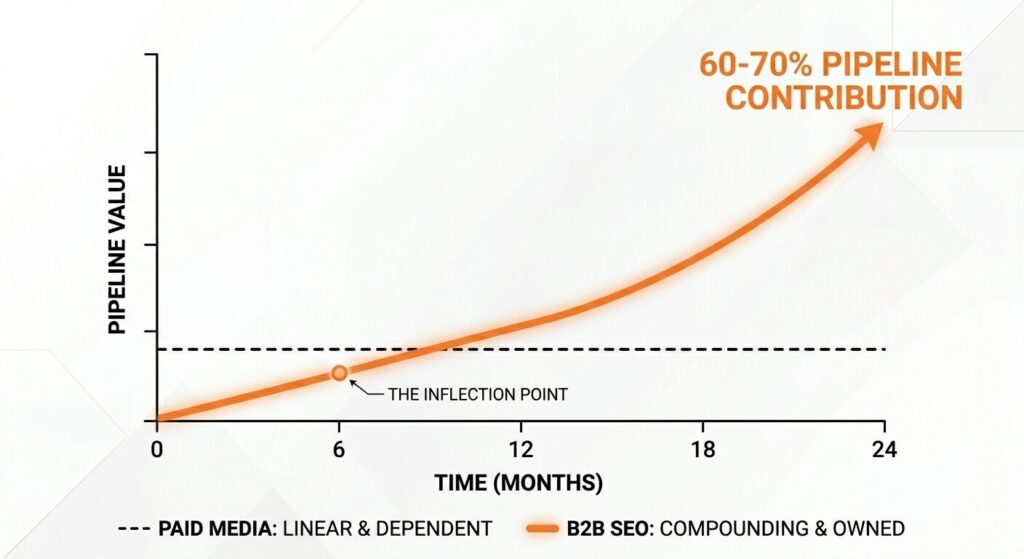
A well-executed B2B SEO program takes 6 to 12 months to show significant results. Once it is running, cost per organic lead drops consistently while lead volume grows. After 24 months, companies with strong programs routinely generate 60% to 70% of marketing-attributed pipeline from organic channels at a fraction of the paid search cost per acquisition. Paid media is a faucet. Organic search is a well.
How B2B Buyers Use Search in 2026
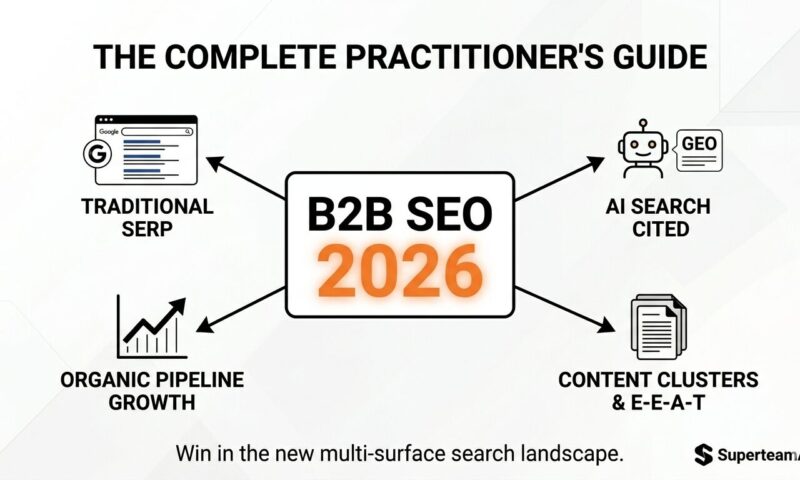
The B2B buyer journey now spans multiple search surfaces. A procurement manager researching enterprise software might start with a Google search, find an article cited in a Google AI Overview, switch to Perplexity for a quick AI-generated comparison, and then ask their voice assistant for a definition before returning to Google to find vendor-specific case studies.
If your content is not structured to appear across these touchpoints: traditional search results, AI citations, and voice search answers. Without this, you are invisible to a meaningful portion of your audience. The b2b seo statistics consistently show that companies investing in organic content across multiple search surfaces outperform those optimizing for Google alone.
What does B2B buyer search behavior look like in 2026? Buyers use multiple platforms, expect expert-level answers, and have very low tolerance for generic or outdated content. If your site does not answer their specific question with genuine depth, they move on to the result that does.
B2B SEO ROI: What to Expect and When
Is SEO worth it for B2B companies? Yes, but not immediately, and not if you approach it casually.
The typical b2b seo roi timeline looks like this. Months 1 to 3: foundation-building, technical improvements, and initial content publishing. Months 4 to 6: first ranking movements and early traffic signals. Months 7 to 12: compounding rankings and measurable organic lead generation. Month 12 and beyond: significant organic pipeline contribution with an improving cost per MQL.
Companies that start B2B SEO with realistic expectations and consistent execution consistently see strong returns. Those that expect overnight results and abandon the program at month four see nothing.
See our [b2b seo case studies] for real organic growth results from B2B companies.]
The B2B Buyer Journey and Search Intent Mapping
Most B2B SEO guides treat keyword research as a search volume exercise. The best B2B SEO practitioners treat it as a buyer intent mapping exercise.
Your B2B buyers are not all at the same stage of the purchase process when they search. Some are trying to understand a problem they have just identified. Some are comparing solutions. Some are one approval away from signing a contract. Each of these stages produces different search queries, requires different content, and converts differently.
Understanding this is the foundation of effective seo for b2b strategy.
Awareness Stage: “I Have a Problem”
At the awareness stage, buyers are researching a problem they have identified. They are not yet looking for your product. They want context, education, and validation.
Search examples: “how to reduce customer acquisition cost,” “why is our organic traffic declining,” “b2b demand generation best practices.”
Content that works here: educational guides, explainer articles, “what is” definitions, and top-of-funnel thought leadership. These are the articles that introduce your brand months before buyers are ready to buy.
Consideration Stage: “I Am Evaluating Solutions”
At the consideration stage, buyers know what category of solution they need. They are now comparing options: tools vs. services, in-house vs. outsourced, vendor A vs. vendor B.
Search examples: “best b2b seo agency vs in-house team,” “b2b seo tools comparison,” “how to choose a b2b seo partner.”
Content that works here: comparison articles, buyer’s guides, case studies, feature breakdowns, and ROI calculators. These pieces accelerate evaluation and position your offering at the center of the comparison.
Decision Stage: “I Am Ready to Choose”
At the decision stage, buyers are moving toward a purchase decision and searching for validation and specificity.
Search examples: “superteam ai b2b seo review,” “b2b seo agency pricing models,” “b2b seo specialist near me.”
Content that works here: case studies with specific results, pricing transparency content, and customer testimonials. This content closes the gap between consideration and conversion.
| Buyer Journey Stage | Search Behavior | Primary Content Type | Keyword Examples |
| Awareness | Problem-aware queries | Educational guides, blog posts | “b2b seo fundamentals,” “importance of seo for b2b” |
| Consideration | Solution-aware queries | Comparisons, buyer’s guides | “b2b seo agency vs in-house,” “best b2b seo tools” |
| Decision | Vendor-specific queries | Case studies, pricing content | “b2b seo specialist,” “b2b seo firm pricing” |
How to Build a B2B SEO Strategy: The 6-Step Framework
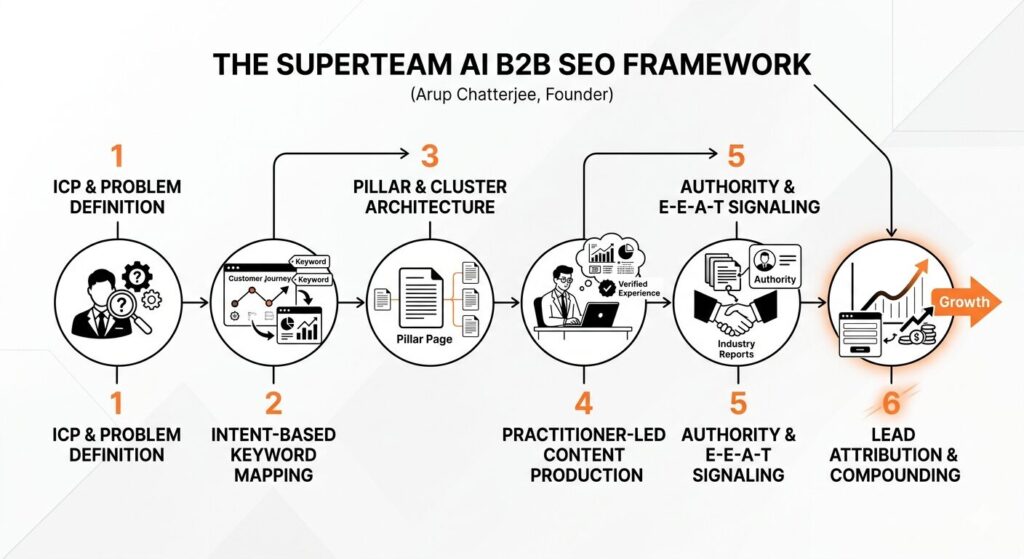
The most effective B2B SEO strategy targets keywords at every stage of the B2B buyer journey using a hub-and-spoke content cluster architecture built around the core topics your buyers research. Topical authority (owning a comprehensive cluster of interconnected content on your core subject) is the foundational principle of effective B2B SEO in the AI search era.
This is the framework we use at Superteam AI when building organic growth programs for B2B clients. It is not theoretical. It is built from repeated deployment across companies at different stages and in different industries.
Step 1: Define Your B2B Audience and ICP
When we start working with a new B2B client at Superteam AI, the first thing I always do before touching a keyword tool is define the Ideal Customer Profile (ICP) with precision. Not a vague persona, but a specific profile: the industry, the company size, the job title of the decision-maker, the specific problems they face, and the language they use when describing those problems.
This matters because B2B SEO keywords are defined by professional jargon that varies significantly by industry and role. A CFO and a Head of Marketing might both be buyers for the same product but search for entirely different things. Your keyword strategy must account for both.
Pro tip: Interview 3 to 5 of your best existing customers about how they searched for the solution you provide. The phrases they used are worth more than any keyword research tool.
Common mistake: Defining your ICP by company demographics alone without understanding the specific job-level problems your buyers actively search for.
Step 2: Conduct B2B Keyword Research the Right Way
B2B keyword research differs from B2C in one critical way: search volume is a secondary metric, not the primary one. A keyword with 150 monthly searches that your ICP uses at the decision stage of a six-figure purchase is more valuable than a keyword with 15,000 searches from casual browsers who will never buy from you. In b2b seo marketing, you are mapping buyer intent keywords across all three journey stages: awareness, consideration, and decision. Long-tail variations such as “b2b seo for saas companies” often outperform broad head terms in actual conversion quality.
Step 3: Build a Topic Cluster Architecture
At Superteam AI, we build the topic cluster architecture before writing a single piece of content. This means identifying one pillar topic and mapping all supporting subtopics that branch from it.
A topic cluster creates what Google’s NLP systems interpret as topical authority. When your pillar article on “b2b seo” links to support articles on b2b seo strategy, b2b saas seo, b2b seo tools, and fifteen other related subtopics, Google recognizes your site as a comprehensive, authoritative resource on the subject. Without this structure, individual articles fight uphill battles against competitors who own entire topic ecosystems.
Step 4: Create Content That Matches Buyer Intent
Every piece of content in your cluster should be built around a specific buyer intent. That means understanding what the searcher needs at the exact moment they run that query and building content that satisfies that need completely. What I have found working with B2B companies across multiple sectors is that the content performing best is specific, experience-backed, and structured for scannability. Deep, practitioner-level content consistently outranks generic guides over a 12-to-18-month horizon. This is where your seo for b2b marketing strategy earns real differentiation.
Step 5: Build Authority Through Links and Digital PR
Link building for B2B SEO in 2026 is about demonstrating expertise to credible sources in your industry. The highest-value links come from original research that others cite naturally, thought leadership placements in industry publications, and expert contributions to relevant media. Cold outreach tactics that dominated pre-2025 B2B SEO produce diminishing returns. Authority is built by creating content worth citing.
Step 6: Measure, Optimize, and Compound
What I have found consistently across client programs is that organic MQLs tell a more honest story than traffic numbers alone. A B2B SEO program should be measured by the quality and volume of leads entering the pipeline from organic search.
Set a monthly optimization cadence: review which content is ranking but not converting, update content that has slipped, and publish new content to capture emerging search demand. Consistent optimization is what separates programs that plateau from those that keep growing.
B2B SEO in 2026: AI Search, Voice Search, and the New Organic Landscape
Here is what most B2B SEO guides published before 2025 missed entirely: the search landscape has shifted in ways that make the old playbook incomplete.
B2B seo in 2026 operates across multiple search surfaces simultaneously. Google AI Overviews now summarize answers directly in the SERP, reducing click-through rates for certain queries while creating a new form of brand visibility through citation. Perplexity has become a legitimate research tool for B2B buyers conducting vendor comparisons. Voice search queries from B2B professionals are growing. If your b2b seo strategy only optimizes for the traditional blue-link Google result, you are leaving significant visibility on the table.
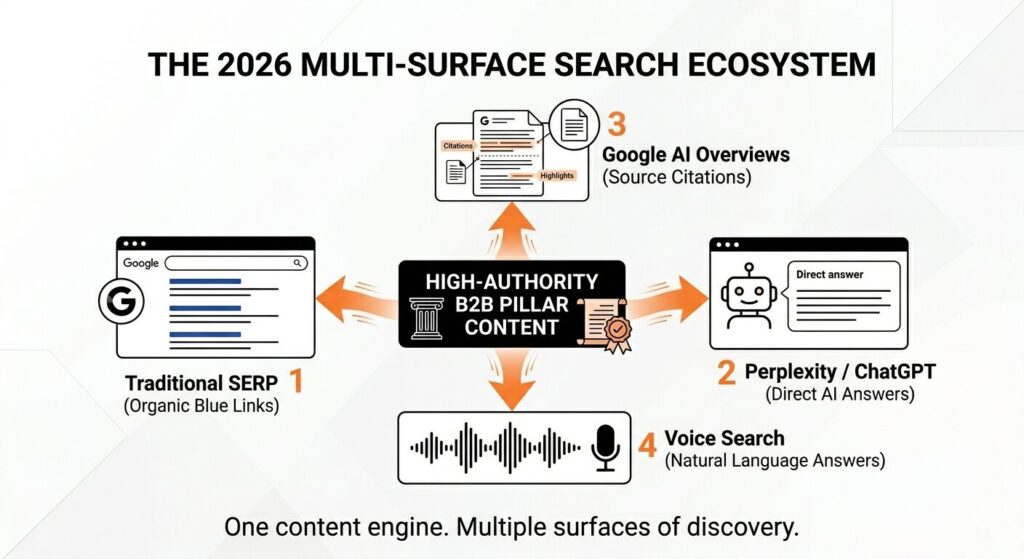
Generative Engine Optimization (GEO) for B2B Companies
Generative engine optimization (GEO) is the practice of structuring content to be cited by AI-powered search systems rather than just ranked in traditional results. When Google AI Overviews, Perplexity, or ChatGPT answer a B2B search query, they draw from the most authoritative, clearly structured content available.
In 2026, B2B SEO programs must be optimized not just for traditional search engines, but for AI search platforms including Google AI Overviews, Perplexity, and ChatGPT, which are now standard tools in the B2B research process.
To earn citations from AI search systems, your content needs clear definitional statements that can be extracted as standalone answers, structured comparison tables that AI can parse, numbered lists and step-by-step processes, and strong topical authority signals that establish your site as the primary expert source on your subject. Content that earns AI citation gets brand exposure to B2B buyers even when they never click through to your site.
Voice Search Strategy for the B2B Buyer Journey
Voice search for B2B is different from consumer voice search. A B2B professional asking a voice assistant “What’s the best way to do SEO for a B2B company?” wants a substantive, expert answer, not a product recommendation or a list of generic tips.
Voice search queries are longer, more conversational, and often phrased as complete questions. Writing content that mirrors these natural language patterns, especially in FAQ sections and dedicated “what is” or “how to” sections. This approach captures these queries and positions your content as the preferred voice search answer. Conversational paragraphs that directly answer the spoken version of a query perform significantly better in voice results than dense, technical prose.
How AI-Powered Search Changes B2B Keyword Strategy
Traditional B2B keyword strategy targeted individual keywords. The 2026 approach targets intent clusters. When an AI system generates an answer about “b2b seo strategy,” it draws from the most topically comprehensive and authoritative source available. A company with a pillar article on b2b seo plus fifteen deeply developed support articles covering every related subtopic will consistently outperform a company with a single well-optimized article. The hub-and-spoke cluster architecture is not just an SEO tactic in 2026. It is the structural requirement for visibility across both traditional and AI-influenced search.
See our guide on [b2b SEO trends in 2026] for a deeper analysis of how AI search is reshaping B2B organic strategy.]
Technical SEO for B2B Websites: The Foundations
Technical SEO is the foundation that your content strategy is built on. Even the best content will underperform if the site hosting it has crawlability issues, poor page experience, or structural problems preventing Google from properly indexing your pages.
Site Architecture for B2B SEO
B2B websites often have complex architectures: multiple product lines, regional pages, resource libraries, and gated content sections. Clear URL structures, logical internal linking, and a crawlable site hierarchy ensure Google can index your content efficiently.
The cluster architecture described in Step 3 also functions as your site architecture guide. Pillar pages sit at a higher level in the hierarchy; support articles sit beneath them. This structure communicates topical relationships to search engines and improves the internal authority flow between related pages across your entire domain.
Core Web Vitals and Page Experience
Google’s Core Web Vitals remain a ranking factor in 2026, and B2B websites, which often run on older CMS platforms with heavy resource loads, are frequent underperformers on page speed and layout stability. A site that loads in under 2.5 seconds, with stable layout shifts and responsive mobile performance, has a measurable ranking advantage over slower competitors targeting the same B2B keywords.
Schema Markup for B2B Sites
Schema markup helps search engines understand what your content is about and generates rich results that improve click-through rates from the SERP. For b2b technical seo, the most valuable schema types are: Article (for all blog and guide content), FAQ (for pages with question-and-answer sections), HowTo (for step-by-step process content), and Person schema for verified author profiles.
Implementing Person schema for your content authors. Linking to a verified author profile is a direct E-E-A-T signal that Google incorporates into quality assessments. For Superteam AI content authored by Arup Chatterjee, this schema should be implemented on every published article.
AI-Powered B2B SEO Execution: The New Competitive Advantage
The strategic framework covered so far tells you what to do. The execution challenge is doing it consistently, at scale, and faster than your competitors. This is where AI-powered SEO execution changes the competitive dynamic entirely for B2B companies.
The Problem With Traditional B2B SEO Execution
Traditional B2B SEO execution has a structural problem: it is slow, expensive, and difficult to scale consistently.
An SEO agency retainer costs $3,000 to $15,000 per month and produces content at a pace determined by human bandwidth. An in-house team requires hiring, management, and sustained budget allocation. A stack of individual tools: keyword research, content optimization, technical auditing, tracking , requires someone with expertise to connect the dots manually and execute consistently. The result for most B2B companies is irregular publishing cadences, inconsistent optimization, and SEO programs that generate activity without generating compounding results.
What an AI-Powered B2B SEO Workforce Looks Like
When I built the AI SEO Team at Superteam AI, the core challenge was designing a system that handles the full execution loop autonomously: keyword research and prioritization, content brief creation, content production, on-page optimization, technical SEO monitoring, and performance tracking. The goal was to give B2B companies the consistent execution capacity of a full SEO team, without the cost or management overhead that comes with one.
An AI-powered B2B SEO workforce handles these functions at a speed and consistency that human teams struggle to match. Content that would take a traditional b2b seo marketing agency 3 to 4 weeks to research, produce, optimize, and publish can be completed in days. The consistency of brand voice, keyword integration, and structural optimization is maintained across every piece of content without editorial drift.
See a breakdown of what b2b SEO solutions look like when delivered by an AI-powered execution model.
When to Use an AI SEO Tool vs. a Done-For-You SEO Service
The right choice depends on your team’s capacity and strategic needs.
If you have basic marketing execution capacity and need a scalable system to handle the SEO workload: keyword research, content production, on-page optimization, and tracking , an AI SEO Team like Superteam AI’s platform is the most efficient path. You deploy it, define your priorities, and it executes. No lengthy onboarding, no ongoing management overhead, and standard transparent pricing.
If you want an expert team to handle everything from strategy development through execution, with deep customization, hands-on strategic oversight, and full inbound channel buildout. Superteam AI’s Inbound Growth Channel Development service may be the right fit. The only requirement on your end is knowledge transfer about your business. We handle the rest.
Should I hire a b2b seo agency, use AI SEO tools, or deploy an AI SEO team? The answer depends on whether you need a technology deployment or a strategic partnership. Both paths lead to the same destination. The AI SEO Team is faster and more cost-efficient for companies ready to deploy immediately. Done-for-you services are better for companies that want full strategic partnership and are not ready to self-manage execution.
B2B SEO for Different Industries: What Changes
B2B SEO fundamentals apply across industries, but implementation details change based on your buyers and their search behavior.
B2B SaaS SEO
B2B SaaS SEO is arguably the most competitive B2B SEO category. SaaS companies face well-funded competitors, high keyword competition, and buyers who are highly search-literate. The winning approach for b2b saas seo centers on deep topic cluster development, strong bottom-of-funnel content targeting comparison and “alternatives to” keywords, and content that demonstrates genuine product expertise rather than generic category knowledge.
B2B Manufacturing SEO
Manufacturing B2B SEO operates in a fundamentally different competitive environment: lower keyword competition, more technical buyer language, and longer sales cycles driven by procurement processes rather than individual decisions. Seo for b2b manufacturing often rewards deep technical content that demonstrates product knowledge, specification-matching ability, and industry credibility with procurement teams who are evaluating long-term supplier relationships.
B2B Professional Services SEO
For B2B professional services companies (consulting, legal, accounting, staffing): SEO is primarily about establishing individual and organizational credibility with high-stakes buyers. Thought leadership content, case studies with specific client outcomes, and author-driven E-E-A-T signals matter more in this category than in product-led or SaaS categories. Decision-makers are not just evaluating a service; they are evaluating the people behind it.
B2B Technology Companies SEO
B2B technology companies face the challenge of explaining complex technical products to buyers who range from highly technical (engineers and IT leaders) to non-technical (executives and procurement). A content strategy that serves both audiences is essential. B2b enterprise seo for technology companies often requires parallel content tracks for technical and business buyer personas, unified under the same topical cluster architecture so both audiences reach the same product and solution pages.
B2B SEO Tools: What You Actually Need
Here is an honest breakdown of the B2B SEO tool categories you need, with representative options in each.
| Function | Representative Tools | What to Look For |
| Keyword Research | Ahrefs, SEMrush, Moz, Google Search Console | Buyer intent filters, keyword clustering, SERP feature data |
| Content Optimization | Surfer SEO, Clearscope, MarketMuse | NLP-based content scoring, competitor gap analysis, keyword density guidance |
| Technical SEO Auditing | Screaming Frog, Ahrefs Site Audit, SEMrush Site Audit | Crawl depth, Core Web Vitals, schema validation |
| Analytics and Tracking | Google Analytics 4, Google Search Console, Looker Studio | Organic MQL attribution, landing page performance, search visibility trends |
| AI-Powered End-to-End Execution | Superteam AI’s AI SEO Team | Full-stack: research, content creation, optimization, and tracking in one platform |
You do not need all of these simultaneously. Most growing B2B companies are well-served by a keyword research tool, a content optimization tool, Google Search Console, and either a technical auditing tool or an AI SEO platform. The best b2b seo tools stack is the one your team will actually use consistently.
Measuring B2B SEO Success: The Right Metrics
The most common B2B SEO measurement mistake is treating organic traffic as the primary success metric. A B2B company generating 1,000 monthly organic visits from its ICP is in a far stronger position than one generating 10,000 visits from audiences that will never buy. Traffic without conversion context is meaningless, especially when justifying ongoing investment to leadership.
Organic Traffic vs. Organic Pipeline: The Measurement Distinction
The right way to measure B2B SEO success is to connect organic search performance to pipeline outcomes. How many leads entered your CRM from organic sources this month? What was the average deal size of organic-source leads? What percentage of closed-won deals had organic touchpoints somewhere in their journey?
These are business metrics, not SEO metrics. They are the numbers that justify continued investment and reflect the actual commercial value of your organic growth program. Organic traffic trends are useful as directional signals; organic pipeline contribution is the definitive measure.
Key B2B SEO KPIs to Track Monthly
| KPI | What It Measures | Target Benchmark | Tracking Tool |
| Organic Sessions from ICP Pages | Traffic quality from target-audience content | Month-over-month growth | GA4 |
| Keyword Rankings (Target Cluster) | Visibility for primary and support keywords | Top 10 for primary pillar; top 20 for support articles | Ahrefs, SEMrush |
| Organic MQLs | Leads from organic search meeting qualification criteria | Growing % of total MQL mix over time | CRM plus GA4 |
| Organic Assisted Pipeline | Pipeline from deals with organic touchpoints | Growing share of total pipeline | CRM attribution |
| Content Coverage Ratio | Percentage of target keywords with published, ranking content | 60% to 80% cluster coverage | Keyword tracking tool |
| Core Web Vitals Score | Technical page experience quality | All pages in the “Good” range | Google Search Console |
B2B SEO Mistakes That Stall Results
One pattern we see almost universally when auditing a B2B site at Superteam AI is that the same seven mistakes appear across companies of all sizes. These are the ones that stall results most consistently.
- Prioritizing search volume over buyer intent. Targeting high-volume keywords that your ICP does not actually use wastes budget and produces traffic that never converts. Always start with intent, then check volume.
- Publishing content without a cluster strategy. Isolated articles do not build topical authority. Without a connected cluster of content, individual articles struggle to rank against competitors who own the full topic ecosystem.
- Ignoring the bottom of the funnel. Most B2B teams focus on awareness content and skip the high-intent queries at the decision stage. Comparison pages, pricing content, and “alternatives to” articles consistently generate the highest conversion rates in B2B SEO programs.
- Treating technical SEO as a one-time project. Technical issues compound over time. Sites that are not audited regularly accumulate crawl errors, broken links, and page experience problems that drag down rankings across the entire domain.
- Measuring success by rankings instead of pipeline. Rankings are a leading indicator, not the outcome. B2B companies that optimize for rankings rather than for MQL generation often build impressive dashboards with disappointing business results attached to them.
- Underinvesting in content depth. One of the most reliable findings from our client work: shallow content does not rank in competitive B2B niches. The content that wins has genuine depth, specific examples, and practitioner-level insight that generic articles cannot provide.
- Abandoning the program before the compounding phase. I have seen B2B companies generate their first strong month of organic leads at month 11, right after deciding to pause SEO at month 10. B2B SEO requires a 12-plus-month commitment to see the compounding effect take hold.
Frequently Asked Questions About B2B SEO
What is B2B SEO?
B2B SEO (business-to-business search engine optimization) is the practice of optimizing a company’s website and content to rank in search engines for the specific queries that business buyers use during their research, evaluation, and purchasing process. Unlike B2C SEO, which targets broad consumer audiences, B2B SEO focuses on a smaller, highly specialized audience of professional decision-makers. The goal is to build organic search visibility that aligns with the B2B buyer journey and generates marketing-qualified leads from organic search channels.
How is B2B SEO different from B2C SEO?
B2B SEO differs from B2C SEO primarily in audience, sales cycle, and content requirements. B2B buyers are professional decision-makers with specific technical needs, longer evaluation timelines, often 6 to 12 months, and multiple stakeholders involved in the purchase. This means B2B keywords have lower search volumes but higher commercial value, content must address multiple buyer personas and journey stages, and success is measured by pipeline generation rather than transaction volume.
Why is SEO important for B2B companies?
SEO is important for B2B companies because business buyers conduct the majority of their research online before contacting a vendor. If you are not visible for the queries your buyers are running, you are absent from their evaluation. B2B SEO builds a compounding organic channel that generates pipeline at a lower cost per acquisition than paid media over time, while establishing authority and trust before your sales team makes first contact.
How long does B2B SEO take to show results?
B2B SEO typically takes 6 to 12 months to show significant results. The first 3 months focus on technical foundations and content publishing. Months 4 through 6 show early ranking movements. By months 7 through 12, well-executed programs generate measurable organic leads. The compounding phase begins after the 12-month mark. Anyone promising significant results in under 3 months should be approached with skepticism.
Is SEO worth it for B2B companies in 2026?
Yes. B2B SEO is one of the highest-ROI marketing channels available for companies with a 12-plus-month growth horizon. In 2026, with AI search platforms making organic visibility more valuable than ever: your content gets cited across multiple AI surfaces, not just traditional search results. the case for B2B SEO investment is stronger than it has ever been. Companies with strong B2B SEO programs consistently generate a significant share of their pipeline from organic sources at a lower cost per lead than paid alternatives.
What are the most important B2B SEO ranking factors in 2026?
The most important B2B SEO ranking factors in 2026 are: topical authority (comprehensive cluster content on your core subjects), content quality and depth, E-E-A-T signals (demonstrated expertise, authoritativeness, and trustworthiness), Core Web Vitals (page speed and user experience), and AI search optimization. Backlinks remain important but are increasingly earned through authority-building content rather than outreach.
How do I build a B2B SEO strategy from scratch?
To build a b2b seo strategy step by step: first, define your ICP and the specific search queries they use at each stage of the buyer journey. Second, conduct buyer intent keyword research, prioritizing conversion quality over search volume. Third, build a topic cluster architecture with a pillar page and connected support articles. Fourth, create content that matches the specific intent of each keyword. Fifth, address technical SEO foundations including site speed, crawlability, and schema markup. Sixth, build authority through original research and thought leadership that earns organic links naturally. Track organic MQLs from the first month.
Should I hire a B2B SEO agency, use tools, or deploy an AI SEO team?
It depends on your execution capacity and strategic goals. If you have a lean team and need a full-stack execution system, an AI SEO platform like Superteam AI’s AI SEO Team handles keyword research, content creation, on-page optimization, and tracking in one integrated deployment. If you want deep strategic partnership with custom program design and hands-on oversight, a done-for-you service like Superteam AI’s Inbound Growth Channel Development may be the right choice. You provide knowledge transfer, and we handle everything else. If your team has strong execution capacity and just needs research tools for guidance, a tool stack can work but requires significant internal bandwidth to operate effectively.
What is the ROI of B2B SEO?
B2B SEO ROI varies by competitive landscape, execution quality, and timeline. A well-executed program begins generating measurable returns after 6 to 12 months and significant pipeline contribution after 18 to 24 months. Companies with mature organic programs often report organic cost per MQL that is 60% to 80% lower than paid search, with traffic that compounds without proportional spending increases. Unlike paid media, organic ROI improves over time and does not stop when budget stops.
How does AI search (Google AI Overviews, Perplexity) affect B2B SEO?
AI search is changing B2B SEO in two significant ways. First, Google AI Overviews and Perplexity cite specific content sources when generating answers, creating visibility beyond traditional rankings. Content with clear definitions, structured lists, and extractable answer statements earns these citations. Second, AI search is shifting query volume toward AI-generated answer consumption, making generative engine optimization essential alongside traditional ranking work.
Your Next Steps in B2B SEO
B2B SEO in 2026 is both more complex and more rewarding than it was two or three years ago. The complexity comes from the multi-surface search landscape, the demand for genuine expertise in content, and the longer timeline required to build real topical authority. The reward comes from the compounding organic pipeline that well-built programs generate consistently, at a cost per lead that paid media cannot match over an 18-to-24-month horizon.
Here is what matters most from this guide. First, approach B2B SEO as a buyer journey mapping exercise, not a keyword volume exercise. Second, build your content around a hub-and-spoke cluster architecture before publishing a single article. Third, treat technical SEO as ongoing maintenance, not a one-time project. Fourth, measure your program by organic MQLs and pipeline contribution, not by traffic alone. Fifth, account for AI search and generative engine optimization in your content structure. Topical authority and extractable, clearly structured content are the currency of the 2026 search landscape.
If you want help deploying this framework without building it from scratch, Superteam AI’s AI SEO Team handles end-to-end B2B SEO execution with standard, transparent pricing and immediate deployment. Or if you want a full-service team to build and manage your entire inbound growth channel, from strategy through execution. Let us have that conversation.