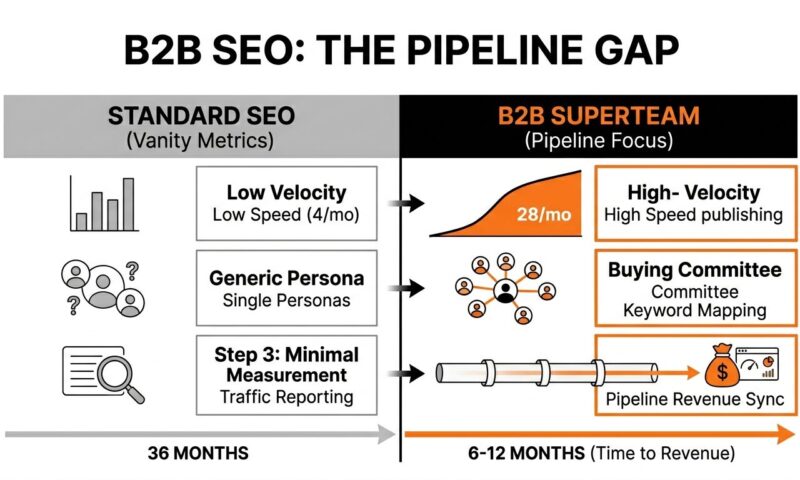
Most b2b seo services packages look identical on paper: keyword research, on-page optimisation, technical SEO, content, link building, monthly reporting. The problem is not what they list but what they leave out. I have run and built b2b seo services programs for 50+ companies through SuperteamAI, and I find the same three gaps every time: no pipeline attribution layer, no buying committee keyword mapping, and no GEO structure for AI Overview citation eligibility.
These gaps mean the program generates traffic that never converts into pipeline the CFO can see. This guide covers what b2b seo services should include, what most providers skip, and the questions to ask before you sign. For the full program architecture, see the B2B SEO strategy guide.
What B2B SEO Services Are and Why They Differ From Standard SEO
B2B SEO services are the combination of technical optimisation, content production, and pipeline measurement activities that help a business-to-business company attract and convert buyers through organic search. They differ from standard SEO in three ways that matter.
First, the buying cycle. A B2B deal involves an average of 11 stakeholders running independent research over 6 to 18 months (Gartner 2024). A B2C buyer searches and converts in one session. The program must cover the full evaluation cycle, not just the awareness stage.
Second, the measurement model. Success in B2B organic search is not sessions or rankings. It is organic-attributed pipeline value and cost per organic lead, tracked through a CRM integrated with GA4 and attributed over a 12-month window. Third, content depth. B2B buyers read 7 to 10 pieces of content before making vendor contact (Forrester 2025). The content layer must cover every stakeholder role and every stage of the evaluation. In my experience, providers who focus on a single persona at the awareness stage account for the majority of underperforming B2B SEO programs I have been called in to fix.
Keyword Research as a B2B SEO Service
Keyword research in any credible B2B SEO engagement is not a one-time deliverable. It is a continuous architecture exercise that maps search terms to buying committee roles and funnel stages before any content is produced. A keyword list sorted by search volume is not a B2B keyword strategy. It is a starting point at best and a distraction at worst.
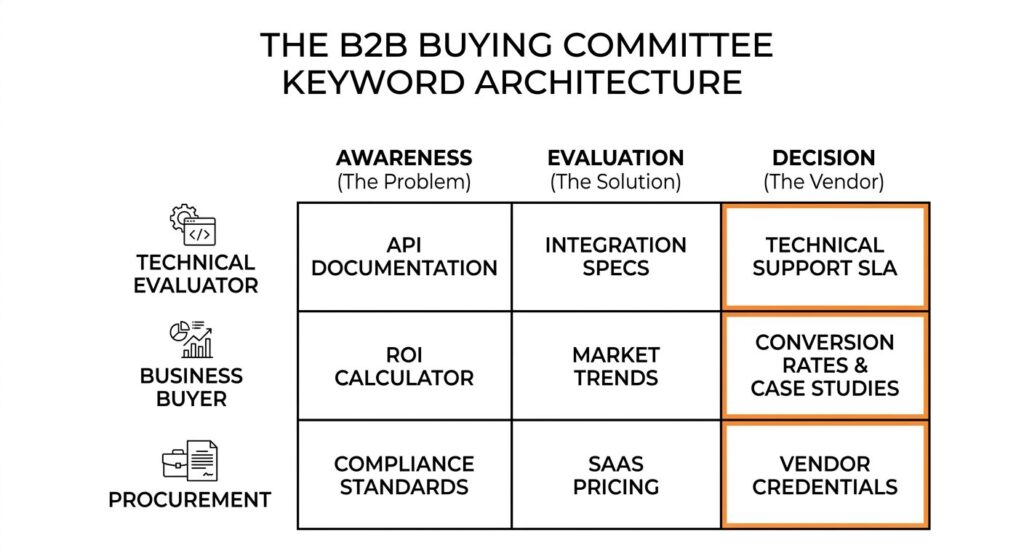
The keyword research framework I run in every SuperteamAI engagement starts with an ICP document, not a keyword tool. I define target job titles, industries, company sizes, and pain points first. I then map keywords to three buyer roles: the technical evaluator searching for features and integration requirements, the business buyer searching for ROI and pricing, and the procurement contact searching for compliance and vendor credentials. Each role needs its own keyword cluster, and each cluster needs articles at awareness, evaluation, and decision stages. Without this mapping, the content strategy produces articles that rank but do not reach the right committee members at the right moment.
Content Strategy and Production
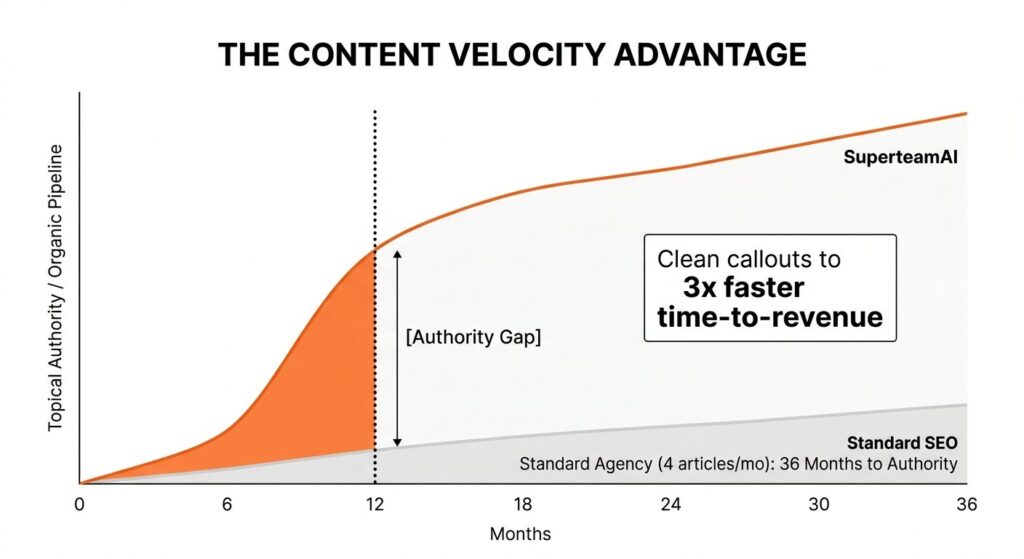
Content production is where the velocity and quality of a provider’s work become measurable. A provider running 4 articles per month builds topical authority in 24 to 36 months. One running 24 to 28 articles per month builds the same authority in 6 to 12 months. Publishing rate is a service specification and it should appear in the contract alongside content quality standards.
The content layer I deliver through the AI SEO Workforce at SuperteamAI runs at 24 to 28 articles per month, structured for topic cluster authority, buying committee coverage, and GEO citation eligibility from day one. Every article maps to a specific cluster keyword, a specific buyer role, and a specific funnel stage. ReachInbox came to SuperteamAI running at 4 articles per month. After deploying the AI SEO Workforce at 25 to 28 articles per month, traffic grew 750% from 2,000 to 17,000 monthly visitors in 12 months. CEO Anup Sharma: “We went from 2,000 visitors to 17,000, and our conversion rates more than doubled.” Content velocity is the primary driver of how quickly a B2B SEO engagement reaches break-even.
Technical SEO as a Service Deliverable
Technical SEO is the foundation that determines whether every other part of the program compounds or stalls. If Google cannot crawl and index the pages that matter, content and links deliver no return. A provider who starts with a technical audit in week one and ships fixes before article one publishes is operating correctly. One who waits until month three is leaving early pipeline contribution on the table.
The technical audit I run in week one of every SuperteamAI engagement covers five areas in sequence: the GSC indexation report, Core Web Vitals performance, a full site crawl for broken internal links and redirect chains, schema markup coverage for Service, Organization, and FAQPage types, and crawl budget review for sites over 500 pages. B2B sites most commonly fail on Core Web Vitals because of third-party scripts from CRM tools and live chat widgets that delay page load. Sites that meet all three Core Web Vitals thresholds see 24 percent lower bounce rates on average (Google 2025). Technical fixes are not optional within a B2B organic program. They are the prerequisite for everything else.
Pipeline Attribution: The Component Most Providers Skip
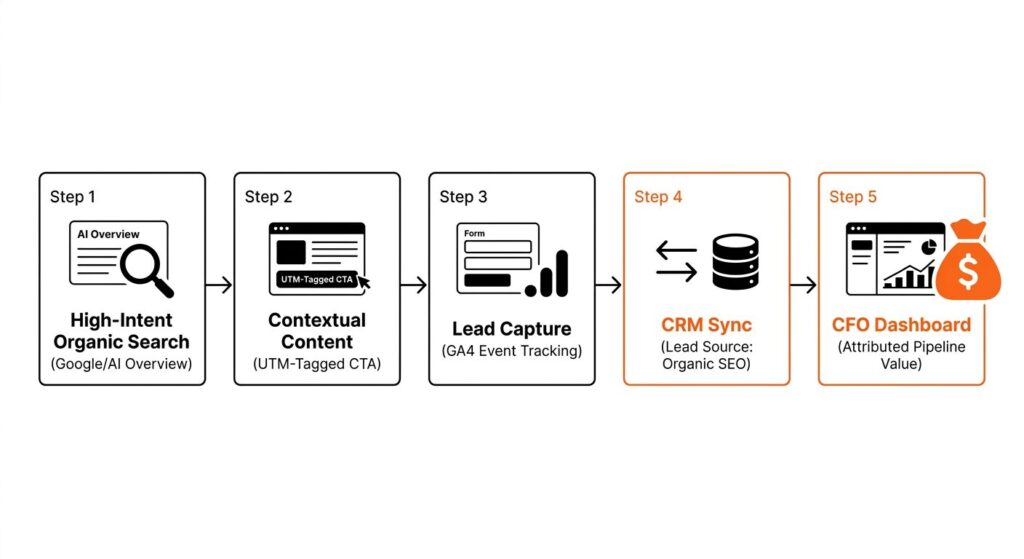
Pipeline attribution is the configuration layer that makes organic SEO revenue visible to the CFO. It is also what most providers do not include. A service that delivers monthly traffic reports without connecting organic sessions to closed CRM deals is measuring the wrong thing. The SEO budget will be cut at the next planning cycle because the dashboard shows sessions, not pipeline.
The attribution stack I configure in week one of every SuperteamAI engagement has four components: UTM parameters on every organic CTA, GA4 goal tracking for every conversion event, CRM lead source fields mapped to capture first-touch and assisted organic separately, and the attribution window extended to 12 months to capture the full B2B buying cycle. Companies measuring on a 30-day window understate organic pipeline contribution by 40 to 60 percent relative to a correctly configured multi-touch model (HubSpot 2025). EasyOps had no attribution model when we began. After I configured the full pipeline attribution stack, organic traffic grew 626% from 4,200 to 30,500 monthly visitors and CPL dropped from $127 to $43. CEO Rajiv Mehta: “We were invisible in the market.” The company was acquired at $21.6 million at month 14, and the attribution model is what made that pipeline story legible to an acquirer. The B2B SEO checklist covers the full 27-item attribution setup and the B2B SEO ROI guide covers the CFO dashboard.
Link Building for B2B Pipeline
Link building within a B2B organic program is not a domain authority exercise. It is an authority signal to the specific pages that generate pipeline: solution pages, pricing pages, and high-intent cluster articles that capture buyers in evaluation mode. A link profile built entirely around blog posts and awareness content does not move ranking performance on the commercial pages that matter most.
The link building I run in SuperteamAI engagements targets three page types: pillar articles establishing topical authority across the cluster, solution pages ranking for commercial-intent keywords, and case study pages capturing decision-stage buyers. Each campaign maps to an attribution event so I can track MQL movement, not just domain rating changes. Link building without attribution mapping is a vanity exercise. With it, each campaign has a measurable pipeline output. Organic SEO delivers 756 percent ROI versus 362 percent for paid search over comparable periods (FirstPageSage 2025). Link quality is a primary driver of that gap.
GEO and AI Visibility as a Standard Deliverable
GEO, or Generative Engine Optimisation, is the layer that most providers have not yet built into their standard service. It should be standard. AI Overviews now appear for 13 percent of Google queries and that share is growing at 116 percent year over year (Semrush 2025). Eighty-nine percent of B2B buyers use generative AI during their purchase journey (Forrester 2025). When an AI system answers a buyer’s query and cites a source, the cited company generates branded search as a second step. If a competitor’s content is structured for AI citation eligibility and yours is not, they are capturing pipeline from AI-mediated research that your attribution model cannot see.
The GEO signals I build into every SuperteamAI article at production stage are direct-answer H2 openings, FAQPage schema markup in JSON-LD, LCP under 2.5 seconds, and question-format keyword targeting drawn from People Also Ask data. These are production standards applied to every article from article one, not retrofits applied after rankings plateau. Providers without a GEO production process are building for a 2023 search landscape while B2B buyers increasingly get answers from AI before they ever click an organic result. The best B2B SEO tools guide covers the GEO audit stack.
How to Evaluate B2B SEO Services Before You Buy
The single most revealing question to ask any provider is: show me a case study where you increased pipeline, not just traffic. Traffic growth without pipeline attribution proves nothing in B2B. A provider who cannot show organic-attributed MQL or revenue movement has not built the measurement layer that makes the service defensible.
Four other questions separate credible B2B SEO providers from generic ones. First, what does week one look like? A credible provider ships a technical audit, fixes critical indexation issues, and configures the attribution stack before any content publishes. Second, how do you map content to the buying committee? Providers who write for one persona are not running a B2B-specific program.
Third, what is your publishing velocity and what is included at that rate? Velocity drives compounding and the specification should be in the contract. Fourth, how do you handle GEO and AI Overview citation eligibility? Providers without a GEO production process are building for a 2023 search landscape. Run the AI SEO Workforce free for 14 days and I configure the full technical, attribution, and GEO layer in week one so the program is measurable from month one.
Frequently Asked Questions
What are B2B SEO services?
B2B SEO services are the technical, content, and measurement activities that help a business-to-business company generate pipeline through organic search. Core components include keyword research mapped to ICP and buying committee roles, content production covering the full evaluation cycle, technical SEO addressing crawlability and Core Web Vitals, pipeline attribution configuration connecting organic sessions to CRM deal records, and link building targeting commercial-intent pages. Effective B2B SEO services measure success by organic-attributed pipeline value and cost per organic lead, not sessions or keyword rankings.
How much do B2B SEO services cost?
B2B SEO services range from $1,250 per month for entry-level packages to $15,000 to $60,000 per month for specialist firms serving enterprise B2B tech. The pricing reflects content velocity, attribution sophistication, and whether GEO and AI visibility are included. The SuperteamAI AI SEO Workforce runs at $400 to $2,000 per month depending on tier, covering full cluster execution at 24 to 28 articles per month with technical audit and attribution setup included in week one.
How long do B2B SEO services take to show results?
B2B SEO services typically show ranking improvements for intent-driven keywords within 30 to 60 days. Measurable pipeline influence follows in 60 to 90 days. Full revenue attribution develops over 3 to 6 months as buying cycles complete and CRM data accumulates. Programs running at 24 to 28 articles per month reach topical authority in 6 to 12 months. Programs running at 4 articles per month take 24 to 36 months to reach the same point.
What should B2B SEO services include that most providers skip?
Three components are consistently missing from standard packages. First, pipeline attribution configuration: UTM parameters on all organic CTAs, GA4 integrated with the CRM, and attribution window set to 12 months minimum. Without this, organic pipeline is invisible in reporting. Second, buying committee keyword mapping: separate keyword clusters for each stakeholder role, not one content plan for a generic buyer. Third, GEO structure for AI Overview citation eligibility: direct-answer content, FAQPage schema markup, and page speed that keeps content eligible for AI responses where 89 percent of B2B buyers now research (Forrester 2025).
How do I measure the ROI of B2B SEO services?
Measure B2B SEO ROI using organic-attributed pipeline value divided by total service cost, calculated on a rolling 12-month basis. Organic-attributed pipeline should include first-touch organic, last-touch organic, and assisted organic deal value captured from CRM lead source fields. Run the calculation on 12 months minimum to account for the full buying cycle. Cost per organic lead compared to paid CPL is the CFO-facing metric that determines whether the program budget is protected or cut at the next planning cycle.


