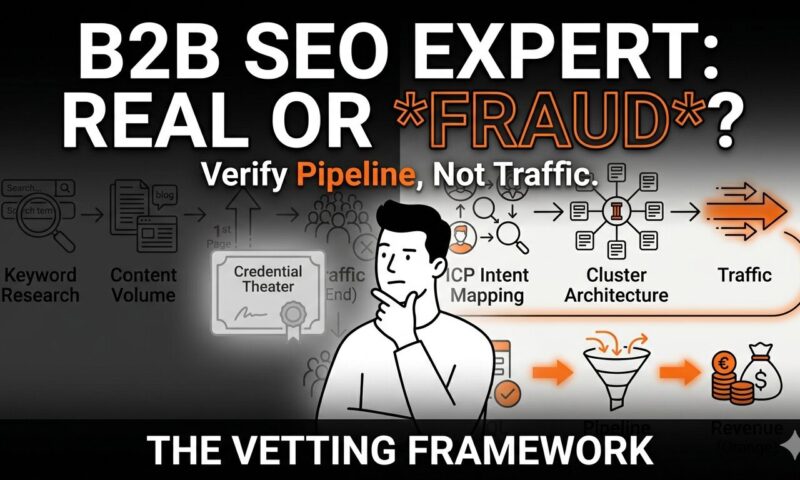
The title “B2B SEO expert” has no barrier to entry. Any freelancer can add it to their LinkedIn profile. Any agency can build a case study page. I have audited B2B companies that paid $7,000 to $10,000 per month for someone carrying the expert title and received monthly traffic reports with no pipeline movement. When I dig in, the pattern is consistent: the expert’s portfolio is B2C-heavy, their cluster architecture is a keyword spreadsheet, and their attribution model stops at Google Analytics sessions.
After building AI Workforces for 50+ businesses across B2B SaaS, services, and tech categories, I have been on both sides of the expert evaluation process. This article gives you the verification framework I use before recommending any external B2B SEO expert engagement: 7 criteria that separate genuine expertise from credential theater, 5 red flags that appear before the contract is signed, and the point at which an AI SEO Workforce removes the vetting problem entirely.
What Separates a Genuine B2B SEO Expert From Someone Who Claims the Title
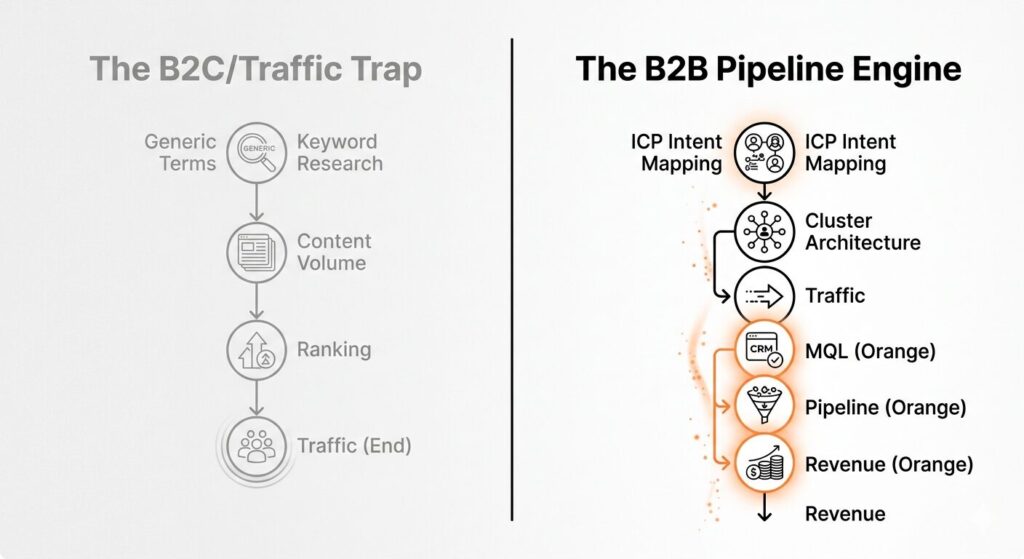
Most SEO experts are optimized for rankings and traffic. A genuine B2B SEO expert is optimized for pipeline. That distinction changes everything downstream: keyword selection, content structure, reporting, and how they define success.
Three characteristics mark the real difference.
B2B-specific commercial outcomes in their portfolio. Traffic growth without pipeline data is a B2C metric applied to a B2B engagement. A genuine B2B SEO expert can tell you the traffic growth, the keyword positions gained, the organic MQL volume, and the CPL movement. If their strongest case study shows “400% traffic growth” with no revenue or pipeline data attached, they are measuring the wrong thing for your context.
Cluster architecture they built and can describe. Publishing individual articles around disconnected keywords is not B2B SEO. It is blogging. A genuine expert has built pillar-and-cluster structures: one hub article on a primary keyword supported by 8 to 12 spoke articles covering related intent. Ask them to name the pillar keyword, the number of supporting articles, and the internal link structure. If they cannot answer without checking notes, they have not built one.
Pipeline attribution in a CRM, not just a dashboard. B2B SEO experts track the full journey from organic search to closed deal. First-touch organic attribution flowing into the CRM. MQLs sourced from organic. Cost per organic lead tracked against paid CPL. Any expert who reports only on sessions and positions is not measuring B2B outcomes.
The 7 Verification Criteria
Use these criteria in sequence during the evaluation process. Each includes a verification question and what a real answer looks like.
1. B2B-specific case studies with verifiable clients. Ask for the domain name of at least one case study client. Run it through Ahrefs or Semrush to verify the traffic trajectory they claim. A genuine expert will give you the domain without hesitation. Traffic data is publicly available to any SEO tool user. Refusal to name the client while citing confidentiality means they are protecting information that is not actually private.
2. Cluster architecture they built. Ask them to describe the pillar-and-cluster structure they built for a B2B client. You want: the primary pillar keyword, the number of supporting articles published, the internal link structure, and the traffic outcome per cluster. Vague answers about “content strategy” or “topical authority initiatives” without specifics indicate a strategist who directed others but did not build anything themselves.
3. Pipeline attribution methodology. Ask how they track organic pipeline in a CRM. The answer should include: first-touch attribution setup in HubSpot, Salesforce, or equivalent, the MQL definition they use, and how they report CPL from organic versus paid. If the answer is “we track rankings and traffic in Search Console and Analytics,” they have never built a B2B attribution model.
4. GEO and AI search experience. Ask what they are doing for clients to optimize for Google AI Overviews and LLM-driven search tools such as ChatGPT and Perplexity. B2B buyers increasingly research vendors through AI tools before visiting any website. An expert who has no answer for AI search optimization has a skill set that is 18 months behind the current distribution landscape.
5. Technical SEO scope and depth. Ask for a specific technical issue they identified and resolved in a B2B client engagement. Site architecture, crawl budget, hreflang, Core Web Vitals, structured data. A genuine expert can name a specific problem, what they found, what they fixed, and what the ranking impact was. Generic answers about “technical SEO audits” without specifics indicate surface-level technical knowledge.
6. ICP content mapping methodology. Ask how they map keywords to buyer journey stages for a B2B client. You want to hear: ICP definition, buying committee role identification, intent mapping across awareness, consideration, and decision stages, and how they sequence cluster publishing to build authority from bottom-funnel terms up. This is the methodology that connects SEO to pipeline, not just traffic.
7. Reporting framework and KPI cadence. Ask what is in their standard monthly report and what KPIs they hold themselves accountable to. Organic sessions and keyword positions are insufficient for B2B. A genuine expert reports on: organic MQL volume, CPL from organic versus paid, cluster coverage percentage, and keyword position movement on commercial-intent terms. If their reporting framework does not include pipeline metrics, their engagement will not move your pipeline.
5 Red Flags to Screen Before You Sign
Case studies cite traffic without pipeline or revenue outcomes. A 300% traffic increase is a vanity metric in B2B if it is not connected to MQLs, pipeline, or revenue. This is the most common signal that an expert is optimizing for the wrong goal.
Portfolio is predominantly B2C or ecommerce. B2C SEO and B2B SEO require fundamentally different approaches. B2C targets high-volume head terms. B2B targets long-tail commercial intent across multi-stakeholder buying journeys. B2C experience does not transfer to B2B pipeline generation without explicit B2B work to demonstrate it.
Guaranteed results in a specific timeframe. No legitimate B2B SEO expert guarantees first-page rankings within 30, 60, or 90 days. Anyone making this promise is either misrepresenting the timeline or planning to use tactics that will eventually trigger a Google penalty.
Reporting framework is GA sessions and keyword positions only. Organic sessions tell you about traffic volume. Keyword positions tell you about visibility. Neither tells you about pipeline. An expert who reports only on these metrics is either not building an attribution model or does not know how.
No CRM integration in their workflow. B2B SEO without CRM attribution is marketing activity disconnected from revenue outcomes. Any expert who does not ask about your CRM setup in the first discovery call is not planning to connect their work to your business results.
What a B2B SEO Expert Should Cost at Each Engagement Model
Cost does not correlate with expertise in B2B SEO. A $10,000/month agency retainer and a $199/month AI SEO Workforce can cover identical functional scope. Use these benchmarks to calibrate expectations, not to judge quality.
| Engagement Model | Typical Cost Range | What It Covers |
| Freelance hourly | $75 to $200/hour | Project work, audits, consulting |
| Freelance retainer | $1,500 to $7,000/month | Strategy plus limited execution |
| Agency retainer | $3,000 to $25,000/month | Strategy plus full execution team |
| In-house hire (fully loaded) | $130,000 to $715,000/year | Dedicated strategic ownership |
| AI SEO Workforce | $199 to $399/month | Full content operations execution |
The freelance and agency models require the credential verification process above before signing. The AI SEO Workforce replaces the credential question with a documented, auditable output trail that can be reviewed before you commit.
For a full breakdown of cost structures across all four solution categories, the B2B SEO solutions guide covers the decision framework in detail.
How to Audit an Expert’s Case Studies Before Hiring
Most case studies presented during a sales process are designed to impress, not to inform. Here is how to evaluate them objectively in three steps.
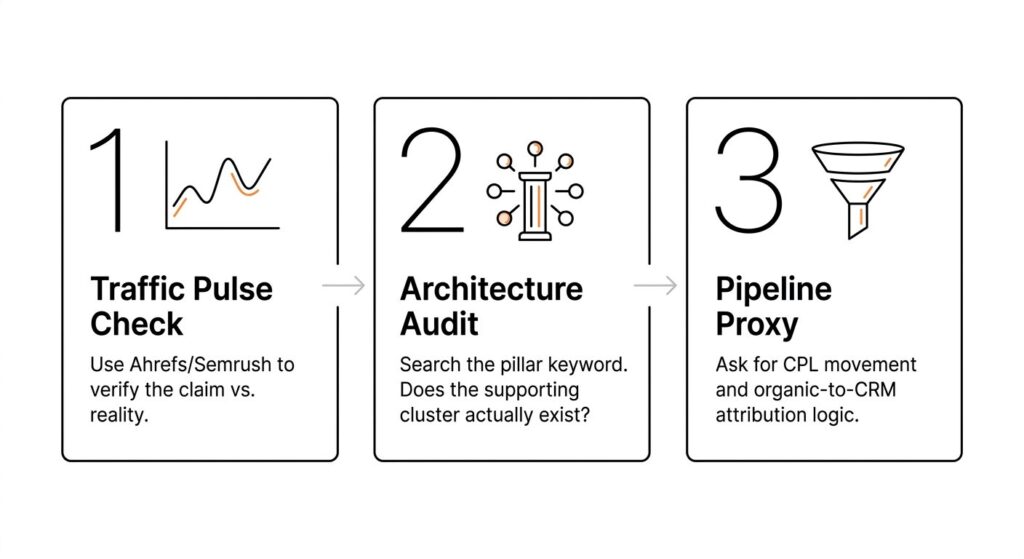
Step 1: Verify the traffic data independently. Ask for the client domain. Pull it in Ahrefs or Semrush. Does the traffic trend match what they are claiming? Does the growth period align with when they say the engagement was active? Discrepancies here are disqualifying.
Step 2: Verify the cluster they built. Take the pillar keyword they mention and search for it. Does the pillar article rank? Does a cluster of supporting articles exist on the same domain targeting related intent keywords? The cluster structure is visible in public search results. If it does not exist, neither does the expertise they are claiming.
Step 3: Ask for pipeline data in approximate ranges. Not exact MQL numbers, not revenue figures. Just a range: did organic pipeline increase or decrease during the engagement? Did CPL from organic move? Most genuine B2B SEO experts track this data and can share it directionally even if exact figures are under NDA. An expert who has no pipeline data from a 12-month engagement was not measuring B2B outcomes.
When an AI SEO Workforce Removes the Expert-Vetting Problem
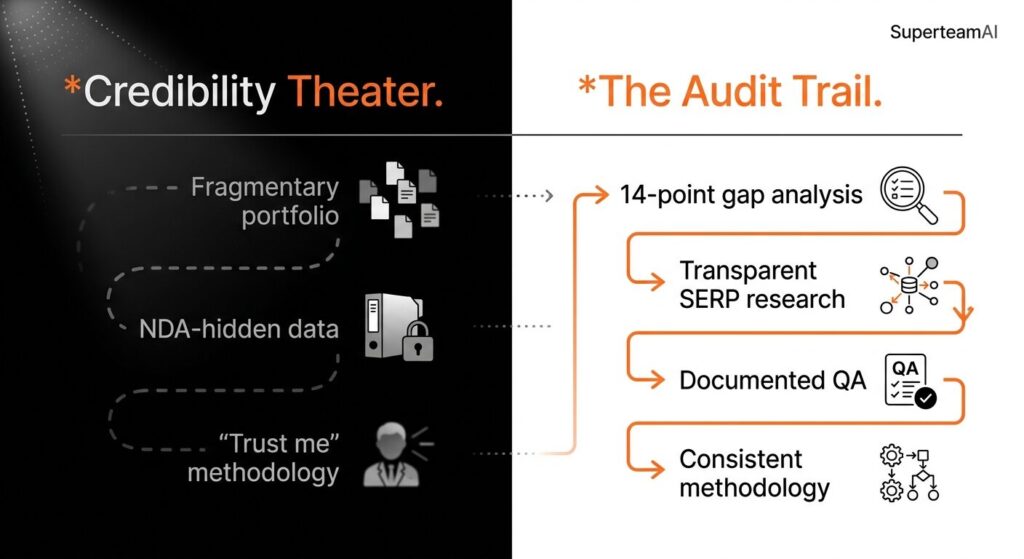
The credential verification problem exists because you are evaluating a human whose expertise cannot be fully audited in advance. The output trail of past work is fragmentary. The attribution data is under NDA. The cluster they claim to have built may not be verifiable.
The AI SEO Workforce produces a different kind of transparency. Every article passes through documented SERP research, a 14-point competitive gap analysis, a structured brief, a full draft, and a QA audit. The system’s output is reviewable before you scale. The methodology is consistent across every article, every cluster, every engagement.
EasyOps deployed the AI SEO Workforce at 24 to 25 articles per month. CEO Rajiv Mehta: “We were invisible in the market. Our paid ads brought some traffic, but the costs were unsustainable.” In 8 months: organic traffic from 4,200 to 30,500 monthly visitors (626%), MRR from $50,000 to $200,000, CPL from $127 to $43. Unicommerce acquired EasyOps for $21.6 million at month 14.
ReachInbox deployed the AI SEO Workforce at 25 to 28 articles per month with 180 days of runway remaining. CEO Anup Sharma: “We went from 2,000 visitors to 17,000, and our conversion rates more than doubled.” In 12 months: traffic from 2,000 to 17,000 monthly visitors (750%), runway extended from 6 to 24 months, MRR from $65,000 to $150,000.
The full methodology behind both engagements is in the B2B SEO case studies article. For the strategic framework that sits behind both, the B2B SEO pillar covers cluster architecture, ICP mapping, and attribution setup from the ground up.
Frequently Asked Questions
What is the difference between a B2B SEO expert and a B2B SEO specialist?
In practice, the titles are used interchangeably. The distinction that matters is seniority and scope. A specialist typically executes within a defined system: briefs, articles, on-page optimisation. An expert typically owns the full strategic programme: cluster architecture, ICP mapping, attribution model, and reporting to the C-suite. When hiring, ignore the title. Evaluate the scope of work they can evidence from past engagements. The B2B SEO specialist guide covers the functional scope and hiring criteria for each level.
How much does a B2B SEO expert charge per month?
Freelance retainers run $1,500 to $7,000 per month for strategy-level work. Agency retainers covering equivalent expert-level output run $3,000 to $25,000 per month. Hourly consulting rates for genuine B2B SEO experts range from $75 to $200 per hour. Cost does not reliably indicate quality. Use the 7 verification criteria above rather than using price as a proxy for expertise.
How long should it take a B2B SEO expert to show results?
Expect 4 to 6 months before meaningful organic traffic growth from a new cluster. Expect 7 to 12 months before pipeline-attributed results show up in the CRM at meaningful volume. New domains should plan for 18 to 24 months before head-term rankings. Any expert promising results faster than this timeline without explaining the mechanism is either misleading you or planning tactics that create short-term gains and long-term risk.
Can I verify a B2B SEO expert’s past results independently?
Yes. Ask for the client domain from any case study and verify the traffic trajectory in Ahrefs or Semrush. Search for the pillar keyword they claim to have ranked and check whether a cluster of supporting articles exists on that domain. These verification steps require only a free SEO tool trial and take under 20 minutes. Any expert who refuses to share client domains citing confidentiality is protecting information that is already publicly visible.
What questions should I ask a B2B SEO expert in the first discovery call?
Five questions that separate genuine B2B SEO experts from credential theater: (1) Walk me through a cluster architecture you built for a B2B client. (2) How do you track organic pipeline in a CRM? (3) What is in your standard monthly report and what KPIs do you hold yourself accountable to? (4) What are you doing for clients to optimize for Google AI Overviews and LLM-driven search? (5) Can you share the domain name from your strongest B2B case study so I can verify the traffic data independently?


