By Arup Chatterjee, Founder of Superteam AI
I have watched B2B companies spend $15,000 a month on an agency to publish four articles. I have watched others buy a $99 SEO tool and produce zero articles for six months. Both are failures of matching the solution to the stage.
B2B organic leads convert at 14.6% against 1.7% for outbound. The ROI case for B2B SEO is settled. What is not settled is which B2B SEO solution is actually right for where your company is right now.
After building AI Workforces for 50+ businesses across B2B SaaS, services, and tech categories, I have run every category of B2B SEO solution. This article gives you the decision framework I use when a new client asks where to start.
Why the Right B2B SEO Solution Depends on Your Stage, Not Your Ambition
The three most common B2B SEO solution mistakes I see are not about choosing a bad product. They are about choosing the right product for the wrong stage.
Mistake one: buying an SEO tool without the team to execute it. The tool surfaces 400 keyword opportunities. No one writes the articles. Six months later the subscription is cancelled and SEO is written off as “not working for us.”
Mistake two: hiring an agency before having a defined ICP and clear positioning. The agency produces content. It does not convert because it targets the wrong buyer. The retainer ends after 12 months with traffic but no pipeline.
Mistake three: building an in-house SEO team before validating the channel works. A content manager ($80,000/year), SEO strategist ($90,000/year), and writer ($60,000/year) consume $230,000 annually before a single compounding result appears.
When I audit companies that “use SEO tools,” I find six months of subscription data and three articles published. The tool is not the problem. The mismatch between solution category and execution capacity is.
There are four B2B SEO solution categories. Each has a different cost floor, output ceiling, and stage fit.
The 4 B2B SEO Solution Categories
Category 1: SEO Tools
Tools such as Ahrefs, Semrush, Surfer SEO, and Clearscope surface data, competitive intelligence, and content recommendations. They do not execute. You do.
Cost: $99 to $500 per month for tooling. True cost with internal execution time: $3,000 to $4,500 per month for 3 to 4 articles when you account for a content manager’s fully-loaded hours.
Best fit: bootstrapped founders with a dedicated content writer already in place, or teams that need better data to inform an existing execution function.
Hard ceiling: output velocity is entirely dependent on your internal team’s bandwidth. When that bandwidth runs out, so does publishing.
Category 2: SEO Freelancers and Consultants
A single specialist handles either content production or technical SEO, rarely both at quality simultaneously.
Cost: $1,500 to $5,000 per month depending on scope and seniority. Output velocity: 2 to 6 articles per month at consistent quality.
Best fit: early-stage companies with a single, focused problem. A technical SEO audit from a senior consultant. A content writer producing 4 pieces per month while you build the strategy in-house.
Hard ceiling: single point of failure. If they leave, the system leaves with them. No institutional knowledge, no compounding infrastructure, no QA process that outlasts the engagement.
Category 3: B2B SEO Agencies
A full-service agency provides strategy, content production, technical SEO, and link-building under one retainer.
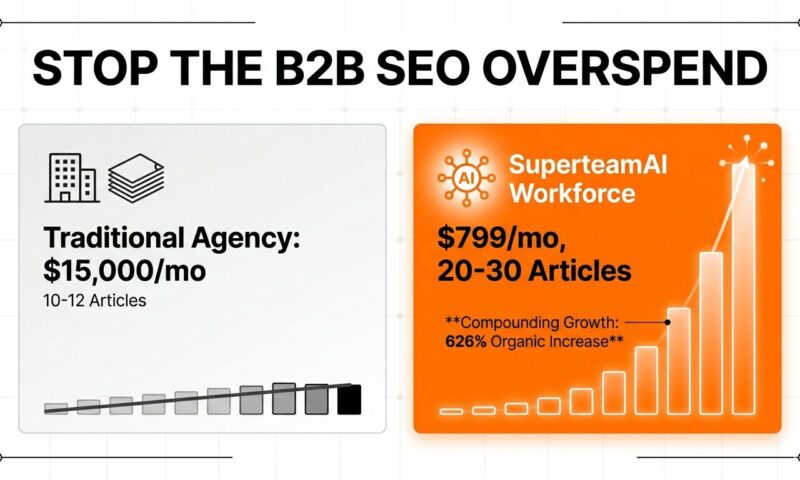
Cost: $7,500 to $20,000 per month for growth-stage B2B companies. At $10,000 per month producing 10 articles, that is $1,000 per article. At $15,000 per month producing 12 articles, that is $1,250 per article.
Best fit: companies with $10,000 or more per month in dedicated SEO budget, a clear ICP, and no desire to build execution in-house.
Hard ceiling: high cost per unit of output and content frequently produced to fill a retainer scope rather than compound a cluster architecture. For more on evaluating this option, see our full breakdown of B2B SEO agency selection criteria.
Category 4: AI-Powered SEO Workforces
An AI SEO Workforce replaces the content operations function using coordinated multi-agent systems. Superteam AI’s AI SEO Workforce runs 18+ specialized agents covering the full content lifecycle: SERP research, 14-point competitive gap analysis, keyword clustering, brief generation, drafting, editorial QA, and SEO optimisation. Every article passes through a human approval checkpoint before publication.
Cost: from $399 per month for the Scale Plan (30 articles per month). That is $13 per article at scale, versus $1,000 to $1,250 per article at a traditional agency.
Best fit: B2B SaaS and tech companies at $500K to $15M ARR that need agency-level publishing velocity without agency pricing. Companies where the content manager should be directing strategy, not writing every draft.
Hard ceiling: requires a human editor who reviews and approves briefs and final articles. The AI Workforce handles volume and research depth. A human owns editorial direction. If no one on the team can commit two to four hours per week to reviews, output quality drifts.
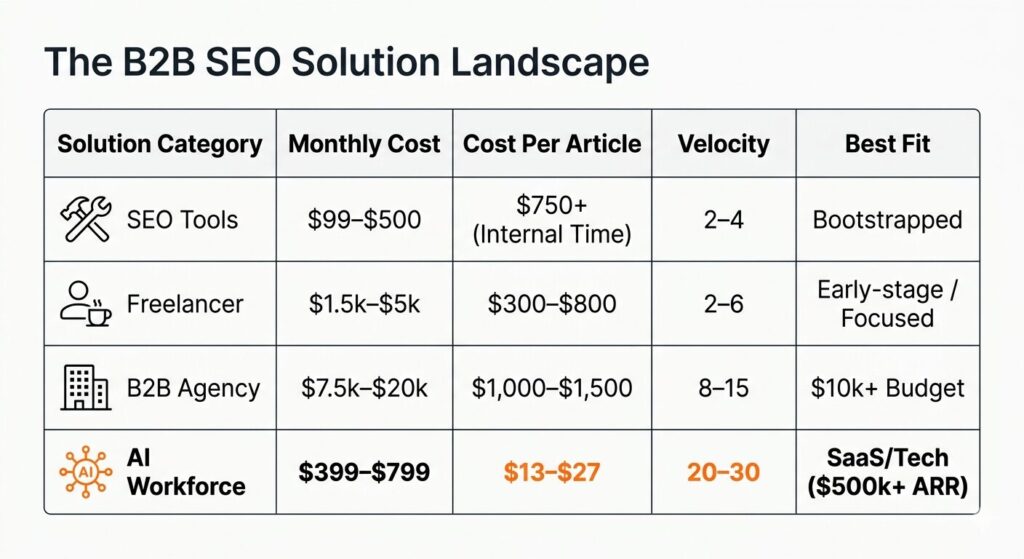
[IMAGE: B2B SEO solution comparison chart showing 4 categories across 5 columns: monthly cost, cost per article, output velocity, best stage fit, and hard ceiling. Alt: “B2B SEO solution comparison: tools vs freelancers vs agencies vs AI SEO workforce by cost, velocity, and stage fit.”]
| Solution Category | Monthly Cost | Cost Per Article | Output Velocity | Best Stage Fit |
| SEO Tools | $99-$500 | $750-$1,500 (true cost with team time) | 2-4 articles | Bootstrapped, existing writer |
| Freelancer / Consultant | $1,500-$5,000 | $300-$800 | 2-6 articles | Early-stage, single focus |
| B2B SEO Agency | $7,500-$20,000 | $1,000-$1,500 | 8-15 articles | $10K+ budget, no in-house |
| AI SEO Workforce | $399-$799 | $13-$27 | 20-30 articles | B2B SaaS $500K-$15M ARR |
The B2B SEO Solution Decision Framework
Four questions determine the right solution for your stage. Answer them in order.
Question 1: What is your monthly budget for SEO? Under $2,000 per month: tools plus a freelancer is the realistic range. $2,000 to $8,000 per month: a focused agency engagement or an AI SEO Workforce is viable. Over $8,000 per month: full-service agency or AI Workforce plus DFY strategic overlay.
Question 2: Do you have in-house editorial capacity? If you have a content manager or writer who can dedicate two to four hours per week to reviewing briefs and final articles, an AI SEO Workforce runs at full capacity. If your team cannot commit that time, a full-service agency that handles end-to-end delivery is the correct fit despite the cost premium.
Question 3: What monthly publishing velocity do you need? Under 4 articles: a freelancer or tools-plus-team is enough. 4 to 15 articles: agency or AI Workforce. Over 15 articles per month: only the AI Workforce delivers that volume at a sustainable unit cost. An agency producing 15 articles per month at $1,000 per article is a $15,000 per month retainer.
Question 4: Are you building a long-term compound asset or solving a short-term problem? Short-term: a technical SEO audit from a consultant plus basic on-page fixes. Long-term compound: cluster architecture is required, which means either an agency with a content strategy practice or an AI Workforce built around topical clusters.
[IMAGE: B2B SEO solution decision flowchart showing four questions leading to recommended solution type for each budget and stage scenario. Alt: “B2B SEO solution decision framework: which approach is right for your budget, team size, and publishing velocity.”]
| Budget | In-house Capacity | Velocity Needed | Recommended Solution |
| Under $2K/month | Weak | Under 4 articles | Tools + Freelancer |
| $2K-$8K/month | Moderate | 4-12 articles | AI SEO Workforce |
| $8K-$20K/month | Weak | 8-15 articles | Full-service Agency |
| $8K+/month | Strong | 15-30 articles | AI SEO Workforce + DFY |
What Every B2B SEO Solution Must Include in 2026
Regardless of which category you choose, any solution missing the following five components is building a depreciating asset.
Cluster architecture. Publishing disconnected articles does not build topical authority. A pillar-and-cluster structure (one hub article supported by 6 to 10 spokes) triggers compounding. Any solution that does not operate this way is running an older playbook.
Buyer journey content mapping. Every article must map to a buyer journey stage before the brief is written. Content not mapped to a buying stage drives traffic that does not convert.
Technical SEO baseline. Core Web Vitals, crawlability, site structure, and schema markup are non-negotiable table stakes in 2026. They are not a differentiator. They are a floor.
GEO (Generative Engine Optimization). Google AI Overviews appear on 13% of all search queries. B2B buyers use ChatGPT, Perplexity, and Gemini to research vendors before visiting a website. A solution that does not structure content for AI citation (clear answers, attributable data, structured claims) is building visibility that does not transfer to where buyers now research.
Pipeline attribution. Traffic without pipeline tracking is marketing theater. Every solution must include a first-touch organic attribution model in the CRM from day one. The B2B SEO case studies article covers the baseline metrics every engagement should track.
What the AI SEO Workforce Solution Delivers: Proof
We built the AI SEO Workforce because I kept seeing the same pattern: B2B companies either overspending on agencies or under-executing on tools. There was no middle option combining agency-quality research depth with sustainable unit economics.
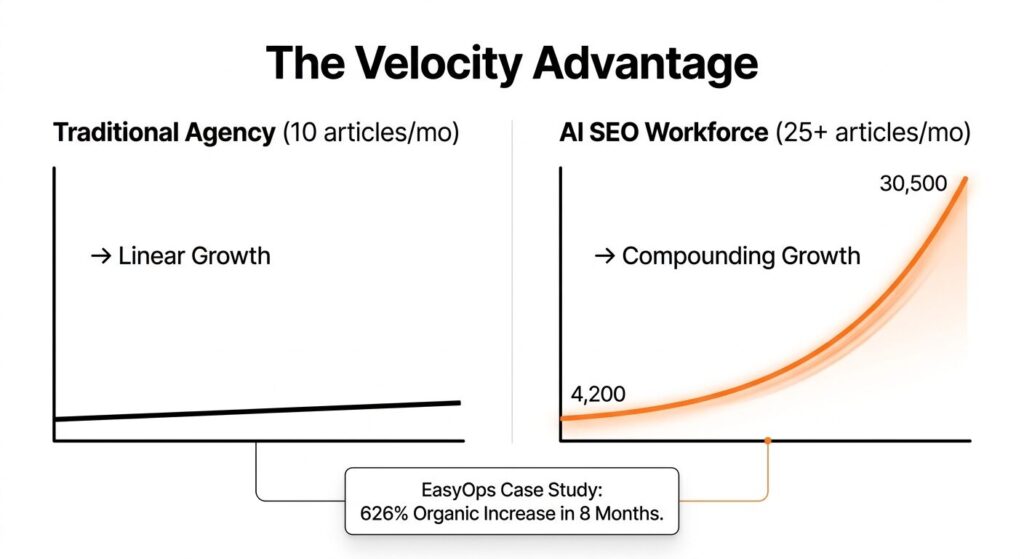
EasyOps, a B2B SaaS inventory management platform, deployed Superteam AI’s AI SEO Workforce at 24 to 25 articles per month. In 8 months: organic traffic from 4,200 to 30,500 monthly visitors (626%), MRR from $50,000 to $200,000, CPL from $127 to $43. At month 14, Unicommerce acquired EasyOps for $21.6 million. CEO Rajiv Mehta described the starting position: “We were invisible in the market. Our paid ads brought some traffic, but the costs were unsustainable.” A traditional agency at that volume would have cost $24,000 to $37,000 per month.
ReachInbox, a B2B email outreach platform 180 days from shutdown, deployed the AI SEO Workforce at 25 to 28 articles per month. In 12 months: traffic from 2,000 to 17,000 monthly visitors (750%), runway from 6 to 24 months, MRR from $65,000 to $150,000. CEO Anup Sharma: “We went from 2,000 visitors to 17,000, and our conversion rates more than doubled.” Team grew from 8 to 12 employees funded from revenue, not additional fundraising.
Neither result was achievable at those budgets with a traditional agency. Velocity drove the compounding. The AI SEO Workforce is the only solution category that delivers that velocity at that cost.
Choosing the Right B2B SEO Solution for Your Business
The framework above narrows the decision to two variables: budget and editorial capacity. If your budget is under $8,000 per month and someone can review content for two to four hours per week, the AI SEO Workforce is the highest-ROI option at that range.
If you need full strategic oversight and end-to-end execution without internal involvement, the Superteam AI DFY service manages the complete organic growth system on your behalf.
For the full strategic framework behind whichever solution you choose, the B2B SEO strategy guide covers keyword architecture, cluster design, and measurement from the ground up.
Frequently Asked Questions
What is the most cost-effective B2B SEO solution for a startup? For early-stage B2B startups, an AI SEO Workforce at $199 to $399 per month delivers the highest output per dollar. The Business Plan ($199/month) replaces a junior content hire ($4,500/month fully loaded) for companies publishing 8 to 10 articles per month. Tools alone are cheaper on paper but require execution capacity most startups do not have.
How much should a B2B company spend on SEO per month? Growth-stage B2B companies typically spend $7,500 to $20,000 per month on full-service agency SEO. Companies using an AI SEO Workforce run the same output volume for $399 to $799 per month. The right number depends on your publishing velocity and whether you have internal editorial capacity.
Can an AI-powered SEO solution replace a traditional B2B SEO agency? For content production and SEO execution, yes. The AI SEO Workforce handles SERP research, gap analysis, keyword clustering, brief generation, drafting, QA, and optimisation at significantly lower cost and higher velocity than an agency team. What it does not replace is senior strategic consulting or technical SEO for complex site architecture issues.
What is the difference between a B2B SEO tool and a B2B SEO solution? A B2B SEO tool (Ahrefs, Semrush, Surfer) surfaces data and recommendations. You execute. A B2B SEO solution executes the workflow: research, brief, content, optimisation, publication. Most companies that “invest in SEO” buy tools but skip the execution layer. Tools give you a map. Solutions drive the car.How long before a B2B SEO solution produces measurable results? Regardless of solution category, expect 4 to 6 months before meaningful organic traffic growth and 7 to 12 months before pipeline-attributed results. New domains should plan 18 to 24 months before head-term rankings. The solution category affects content velocity, not Google’s authority signal timeline. EasyOps saw compounding at month 8 at 24 to 25 articles per month. ReachInbox saw first organic pipeline at month 6 at 25 to 28 per month.